


7,19 €
Mehr erfahren.
- Herausgeber: Eye Press
- Kategorie: Gesellschafts- und Liebesromane
- Sprache: Englisch
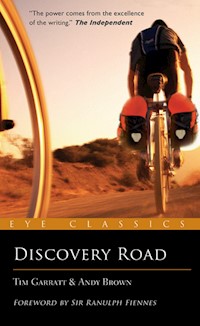
The inspiring story of the first people to ride mountain bikes across the vast deserts of Australia, the dangerous bushlands of Africa, and the mountains of South America Fed up and disillusioned with corporate life, Andy persuaded Tim to leave his job and cycle around the world, convinced there could be more to life. Their goal was to become the first people to ride mountain bikes unsupported across the three southern continents and, in doing so, to raise money for the charity Intermediate Technology. This is a fast-moving tale of self-discovery, full of adventure, conflict, humor, danger, and a multitude of colorful characters. Much more than a travelogue, it proves ordinary people can chase great dreams.
Das E-Book können Sie in Legimi-Apps oder einer beliebigen App lesen, die das folgende Format unterstützen:
Veröffentlichungsjahr: 1998
Ähnliche




















Praise for Discovery Road
‘The power comes from the excellence of the writing.’The Independent
‘Truly inspirational reading 10/10.’Cycling Plus
‘Readers will find themselves reassessing their lives and being inspired.’Sir Ranulph Fiennes
‘This book doesn’t set out to change your life, but don’t be surprised if it does.’Roger Greenaway
‘Once in a while you come across a book that’s a sheer delight to read. I’d recommend Discovery Road to anyone in possession of, or in search of the spirit of adventure.’Alastair Humphreys
Published by Eye Books Ltd29 Barrow StreetMuch WenlockShropshireTF13 6EN
www.eye-books.com
First published 1997Second edition 1998Reprinted 1999, 2001Third edition 2003Fourth edition 2005First Eye Classics edition 2014
Copyright © Tim Garratt and Andy Brown
The events and opinions in this book originate from the authors. The publisher accepts no responsibility for their accuracy.
The moral right of Andy Brown and Tim Garratt to be identified as authors of this work has been asserted by them in accordance with the Copyright, Designs and Patents Act 1988.
All rights reserved. No part of this publication may be reproduced, stored in a retrieval system or otherwise, except brief extracts for the purpose of review, without the prior permission of the publisher and copyright owner.
British Library Cataloguing in Publication Data A catalogue record for this book is available from the British Library
Printed by CPI Group (UK) Ltd, Croydon CR0 4YY
ISBN: 978-1-903070-83-3
Discovery Road
Tim Garratt&Andy Brown
www.facebook.com/DiscoveryRoad
Contents
Acknowledgments
Foreword
Something Happened
Australia
A Flying Wombat Called Ethel
Cruising the Great Ocean Road
Beyond the Back O’Bourke
Roo-Shooters and Road Trains
Africa
Beside the Jade Sea
Rikki-Tikki-Tonga and the Bongo Bongo Man
Crossing the Masai Steppe
Ladies Who Are Not Gentlemen
Half-Way Around the World
Too Much Close Encounters
Much Further by Bicycle
The Heart of the Matter
Sauerkraut and Cream Cakes
South America
Hottest Spot North of Havana
Two Scabby Dogs on the Road to IguaÇu
The Lost Jungle
A Little Argie Bargie
Over the Pampas
Appointment at the End of the World
Postscript
Tribute to Tim
Equipment List
About Eye Books
Acknowledgments
The following people have contributed either their magic, faith, energy, vision, passion, support, money, skill, friendship or beer in an important way and we greatly appreciate all of them:
His Royal Highness Prince Charles.
Sir Ranulph Fiennes, adventurer and author.
Sir Bob Horton, former chairman of BP.
Dick Crane, adventurer and writer.
Mary and Peter Withall for the cottage, encouragement, kindness and wine (read Mary’s novels published by Hodder and Stoughton).
John Brown, sorry you didn’t get to read it, Dad.
Ruth and Roy Garratt for a lifetime of love and support.
Simon Garratt for invaluable advice on equipment and those endless faxes.
Phyl for waiting and always being there when it mattered most.
Gordon, Trish, Colin, Lisa, Claire and all the kids for advice, space and a real home.
Suzanne and the Taplin family.
Cassie.
The people of Easdale Island for your welcome.
Bianca Pik Yiu Lam for your love, wisdom, kindness and gerunds.
Miriam Hurley for being there.
Steve ‘Silver Back’ Hodnett for your letters which followed us all around the world.
Jenny Hayward of Macmillans, Hong Kong, for artwork and advice.
The people at BP Polygon for helping the people of Turkana.
Debbie Smith at I.T.
The people of Poulshot and Telford for contributing to fund raising events.
The staff and students of Bridgnorth Endowed School for support and inspiration.
Ken Heywood for the use of your workshop to tinker about with the bikes.
Anne Marie De Godoy and family and the friendly people of Féderal.
The staff and students of the Outward Bound Schools in Scotland and Hong Kong.
Huw Parsons for advice.
Saracen for bikes.
Kodak for film.
Karrimor for panniers.
Phoenix for tents.
Cotswold for camping gear.
On Your Bike, London Bridge for bike bits.
John Munyes and the staff of IT, Nairobi, Kenya.
Sue Ryrie for love and endless support.
Simon Beames and Al Inglis for friendship, encouragement, advice and laughing in the right places.
Captain Greg Tonnison for smart ideas.
Paola, Kate, Piggy and Monty for the old days.
Phil Andrews and Carina for artwork and support.
Anne Maloney, Macy DeCarrie and Alistair ‘Offshore’ Westell for your friendship.
Thank you all.
Foreword
I know little about bicycles but to attempt to cycle fifteen thousand kilometres, without back-up, through some of the most demanding terrain on earth is clearly no mean undertaking.
There are all too few young people like Tim Garratt and Andy Brown who, in this money aware age, are driven by a spirit of adventure and are willing to give up comfortable, safe lives for the hardship and danger of arduous venture.
This fascinating account is a kaleidoscope of sharp observation, humour and revealing introspection. We are taken on a voyage of self-discovery and are confronted with some of the crucial issues facing everyone living in the world today.
Readers will surely find themselves reassessing their lives and be inspired to reach out and follow their own dreams.
Sir Ranulph Fiennes
Explorer
FOR THE PROUD PEOPLEOF TURKANA.AGAINST ALL THE ODDSMAY YOU PROSPER.
Something Happened
Andy
A delicate essence of human excrement, finely blended with rotting fruit, followed me down the station platform. An ageing brown cow with a hunched back nuzzled through a waste bin and contentedly chewed on a portion of crumpled newspaper. Beyond the cow, in half-light, lay a human corpse. A man in his thirties, lying to attention, feet slightly splayed and eyes staring up at the vaulted wooden roof. It was midnight in Agra, northern India. The air was still; the stench and the heat oppressive.
Ahead, in the dim fluorescent light of the platform, a scabby dog staggered around going nowhere, shaking violently and frothing at the mouth. He used to be a greyhound. Now, his rear leg was broken and gleaming white bone jutted through skin and black gunk. Odd tufts of ginger hair hung to purulent, pink flesh. I skirted him and climbed aboard the train.
The engineer was stoking up the boiler, ready for the off. Squeezing my way along the narrow corridors in the dark, I stumbled over sleeping bodies, a mother cuddling a child, a wrinkly man two hundred years old, several families on the move with their pots and pans, chickens and bulging white bundles. Using my lighter, I located the numbers painted on the ends of bunks and found my way, eventually, to my reserved bed.
Sitting smoking clay pipes on the opposite bunk were two white guys. ‘Wild place, eh?’ I said as I lit a candle and introduced myself. Their names were Wink and Tim. ‘Did you see the dog?’ I asked. ‘He’s hoping to find someone who will be kind enough to shoot him in the head,’ said Tim. They were English like myself.
Wink wore a flying helmet, but his resemblance to Biggles ended there. They both wore lightweight cotton, bought for a penny or two in some local market. In dim, flickering light we chatted amicably for a while about diarrhoea. A small boy came down the gangway selling chai. He waited patiently while we drank the sweet brew from fragile clay cups.
An open hand appeared at the window, resting on the ledge. We ignored it for a minute. Tim eventually looked out. ‘Christ, look at this,’ he said. ‘We’ll have to give this guy something.’
I moved over and looked down on the beggar and was shocked at the sight. His face was horribly contorted; skin seemed to drip off his skull like melted chocolate. Dark, empty eyes stared back from beneath folds of skin. He just stood there, not speaking, hand out. We each gave a few rupees to ease our consciences.
At last the train lurched into action and we lay back and tried to rest. Sleep was impossible with the banging of the carriage couplings and the rolling of the old beast, instead we recounted adventures long into the night.
‘How about a little poetry, Watson?’ said Tim, looking to his friend.
In the dark, swaying train, Winker Watson recited Coleridge’s Kubla Khan, from beginning to end. It sounded fantastic, although he probably made half of it up. I responded by reciting If, by Rudyard Kipling and certainly made half of it up!
Wink, the poet, worked in a scrap metal yard, melting down beer barrels; Tim was a teacher of English and Physical Education and they both lived and played rugby in Telford in Shropshire.
The three of us hit it off and went, eventually, up to Nepal, where we trekked, laughed and philosophised for a few weeks in the Himalayas. At about sixteen thousand feet, on the well worn trail to Everest Base Camp, I got sick and headed down, while they got sick and headed up.
I had met Cassie a short time before I went to India and when I got back to London we moved in together. I was really ill, amoebic dysentery, giardia, campylobacter and fish flukes were all drawing lots for my food before I could get to it. When Cassie eventually got tired of the smell, she pushed me into The Hospital for Tropical Diseases in St. Pancras, where I was fed nothing but cream crackers and after dinner mints; not because they were any good for me, it was just that these were the only foods the nurses could slide under the door!
For most of the next four years I behaved like an ambitious, suburban career boy, while Cassie and I toddled along quite happily. I devoted myself to the petroleum industry and made respectable, safe progress through the corporate ranks. The pension fund was building up nicely, I had a few shares, the cottage was stylish – stripped pine, Monet prints, mandolin on the mantelpiece and magnetic messages on the fridge.
Every morning a pile of paper an inch thick dropped on my desk and needed attention. I pushed and tweaked the business relentlessly; for this my staff used to call me the electric ferret. I travelled the country spending two or three nights a week in hotels trying to avoid ball-bearing salesmen at the bar. I persuaded people to believe in company policies in which I did not believe myself. The company squeezed every possible hour out of me; they owned my soul and my passing youth. Every month I paid a thousand quid to the mortgage company and every month the value of the cottage went down by the same amount and I worked harder and harder. I seldom slept peacefully, or found time to walk in the hills, watch the sunset, play with my nieces or see my friends. The more successful I became, the harder it became for Cassie to put up with my unpredictable mood swings and my miserable face.
Meanwhile Tim, Wink and I only met up a handful of times. I dragged them down to London for one or two wild parties and they, being good old rugby-playing Midlanders, thought me rather yuppyish; though compared to real yuppies I was a yokel! When everything started to change for me I had not seen them for nearly two years. Tim had even lived in London for six months but I had always been too busy to see him.
On a dazzling, blue January day I was invited to a business lunch in the private dining room of a country pub. It was a jovial, mutual back-slapping affair for the key management.
When the meal was finished the Director held the floor, ‘... and most of all,’ he said, ‘ I have to thank the Sector Managers, Andrew and Bernie, who have each made around a million pounds net profit over and above their targets this year. Without their innovation and persistence we would not have turned this company around or achieved these tremendous results.’ He paused dramatically. ‘Outstanding performance guys.’ There was real emotion, his voice even cracked on the word ‘outstanding’. Now it could have been the Châteauneuf du Pape talking or perhaps his jubilation at his imminent promotion and return to Aussieland on the back of our success, but he seemed to mean it.
‘Christ,’ I thought, nodding my head in thanks, ‘this job’s done then.’ The job and the figures were not important to me: being successful and collecting the recognition was all that mattered. I had now achieved what I had wanted. Another thing struck me; ‘Outstanding achievement’ he had said, but where exactly was it? I could not see it or touch it; it was just a set of figures on paper. There would always be more petrol and more figures stretching on forever. My pioneering spirit would not allow me to plod on into middle age with more of the same, so what could I do now?
Perhaps reading my mind, the Director pulled me aside a few days after the lunch and said he was trying to sort me out a secondment in Europe or the States to ‘keep me interested’ and ‘moving forward’. ‘No promises though.’
‘Yeeee haaa!!’ I thought, ‘Now that’ll be a challenge.’
I soon attended a five-day assessment programme, where twenty assessors analyze every move of the twelve candidates. The prize at the end of countless tests and presentations was a place on the fast track to oil stardom. When the fifty-page report arrived a month later the summary read, ‘While Andy is certainly able to operate at Grade Eleven (the grade of the posts mentioned in the US and Sweden) it is the view of the panel that Andy is too entrepreneurial and too innovative to become a senior manager in this organisation.’ This was worth rereading a few times. It wasn’t that I wasn’t entrepreneurial enough or innovative enough, but too much so. For five years I had been under the impression that I was working for a business. I had clearly got it wrong; it must have been a government I was working for, perhaps in the Eastern bloc. It also struck me that no senior managers apart from my immediate boss had made any mention of the fact that I had produced an extra million pounds profit from the seventy businesses under my control. No ‘Well done.’ No ‘How did you manage that?’ No ‘I bet you sacrificed a lot to do that!’ In fact they didn’t seem to care whether I made ten million or lost ten million. They seemed to be playing chess while I was playing World Cup football.
Alone one night, flicking around for a late-night movie, I was assaulted by images. The usual thing, you know: starving babies, injustice, apathy and greed.
‘... 250,000 children die each week from easily preventable diseases...’ the presenter informed me.
Not wanting to witness such misery I reached for the ON/OFF button, but was stopped, ‘... $2.5 billion per year, the amount spent on cigarette advertising in America, would prevent most child deaths in the developing world …’, the presenter went on, ‘... the quarter of the planet’s population which lives in the north consumes three-quarters of the planet’s resources...’ On and on she went. I could not switch off.
The head of Oxfam came on, ‘… What is living? What is life?’ he asked, speaking slowly. ‘Living is discovering your intellect and using it ...’ He was forceful and angry. ‘… for hundreds of millions of children there is no possibility of living in the true sense ...’ More pictures of deformed, miserable, homeless children.
My cheeks were wet with tears. I felt embarrassed to be a European; ashamed that I was healthy, that I was capable of anything and doing nothing. I cried for the children starved of opportunity and I cried for my life, full of opportunity yet unfulfilling.
Another Friday evening, dark and drizzly. Windscreen wipers slid in time to Roy Orbison singing Mystery Girl. I joined Roy in the good bits, ‘…Darkness falls and I, I take her by the hand, take her to my twilight land …’ We were not bad together Roy and I. We could have been great, except that when I went up he went down. The powerful car felt like a cheetah zipping up the motorway.
My phone rang. This would be my own mystery girl, Cassie. It was her first day back. Roy Orbison was cut off in mid-flow. Pushing a button, I spoke to the microphone above my head. In case it was not her I said a formal, ‘Andrew Brown’.
‘Drasvadure!!’ said the voice. It was her, bursting with enthusiasm. That word, some sort of Russian greeting, sounded like, ‘Does your arse fit you?’
‘Yes, thank you,’ I said and we both chuckled as always. ‘Hello, it’s lovely to hear your voice. Are you OK?’
‘Yes. Come home, I want to see you.’ She had been filming in the Soviet Union for five weeks. Too long, much too long!
After the call I turned the music up and sang on happily. Ahead, brake lights banged on across three carriageways. We all stopped, sat and waited. No movement. Must be an accident, I thought. Why do people have to have accidents on Friday evenings? Why can’t they wait until Monday morning? It’s so damned selfish. Eventually we started moving again, a metre at a time. Flickering jets floated down across the night sky. Where had they been?
I was so looking forward to seeing her tonight. Cassie had been twenty-one when we met. I was twenty-six then. She had lifted me up when my marriage had ended and taught me to enjoy living. Cassie was a beautiful girl, marvellous in lots of ways; bright, artistic, mischievous and passionate. I felt I would never find anyone better. Through her I had discovered the theatre, great art, foreign movies, toe-sucking and taramasalata. I confess that, before Cassie, I had even eaten white bread.
The traffic crawled forward. We had moved half a mile in thirty minutes. I switched the tape off and listened to the radio. After a while the announcer said, ‘… and London’s traffic this Friday night … There are long delays on the M25, anti-clockwise, approaching Heathrow Airport.’ I could have told him that.
Things, though, had changed between Cassie and me over the last few months. It just happens. Work had got in the way, my electric ferret trips all over the country and her filming trips to the Soviet Union were starting to tell. We had started to form our own separate lives.
A large dark shape loomed up gradually on the left hand side of the motorway. As I edged forward, I could make out a crane, forty feet high. Ten minutes later I was level with the mighty praying mantis of a machine as it stood deserted on the hard shoulder. I inched past and was confused to see the cars in front zooming off into clear road. There had been no pile-up after all.
I exploded, ‘You mean I’ve sat in a queue for half an hour, while you lot have taken your turn to stop and look at a crane? A crane!! You stupid bastards!!’ This was the last straw.
Had they no awareness of how their actions affected anyone else? Or was it that they were aware, but did not care?
Who were they, these motorway loonies, these crane spotters? People driving expensive company cars; they had power and position. They were off to warm, comfortable homes in the suburbs. All this talent, education, ingenuity, drive and skill being wasted on trivia; making and selling things that we do not need, while the world is crumbling about our ears. Their lives so dull that a crane was interesting. People LIKE ME!!
I realised I had always wanted to be in their gang and bit by bit, over the last years, I had joined. I was one of them, self-absorbed, inward-looking, unproductive and I despised myself for it. I was, after all, making my living by selling the earth’s resources, polluting, using and consuming. My life was almost void of giving.
I pulled the car over onto the hard shoulder beyond the crane and turned the whole thing over in my mind. It just hit me, sitting there in the car: I did not want to be one of these people any more, or more accurately I did not want to be me any more.
It is a shocking experience finding that all you have worked for is worthless. I just sat, oblivious. There had been something else I had wanted to do, once. That might be a way out. What was that? I had a vague memory of studying maps and jotting notes on weather. I could give up the job, satisfy my stupid ego and my lust for adventure, drop the millstone of the mortgage, leave this poisoned air far behind, and maybe do someone a little good at the same time. There had been an idea; I had left it tucked away in a dark place at the back of my mind, safely out of view for two or three years.
Had I been in a movie, I would have jumped out of the car right there. Leaving door open and engine running, I would have kicked off my sensible, shiny shoes, discarded the white shirt and Paisley tie and crossed those muddy fields to the roar and bright lights of the airport and caught the first flight out. But no. Too straight. Too stiff.
I kept my own counsel for a week while I mulled over my life. Work suffered, my head was full of distraction. I took long walks along the Thames towpath in the evenings, while a battle of conscience raged in my head. Wait for the job in Europe. No, break out and find new ground. Think of the dangers. You are thirty years old, grow up will you? You’re still young, in your prime, you should be out hunting, it’s a natural instinct. Knuckle down. No, make your life extraordinary. You’ve got it made, don’t chuck it all away now. Stay with Cassie, get married, have kids. No, no, you fool, live your life as if your life depends on it. There was no easy solution, the price was going to be high whatever I decided.
‘I have something to tell you,’ I said to Cassie at last. We were in the sitting room, reading and drinking a cheap Safeway Rioja.
There was a worried silence, then, ‘What is it?’ She was more than beautiful, she was elegant and offbeat. She leant forward, supporting her chin gracefully with the back of her hand. I did not want to lose her. Her cheek bones statuesque. The dark silky hair was high on the forehead and severely short at the back, an image of cool efficiency.
‘I’m going to cycle round the world.’ For something so major for us both the words came out surprisingly easily.
More silence. ‘Oh yes?’ she said at last, flatly, not believing, ‘Er ...Why?’ Even a hint of mockery. Her mahogany eyes were piercing and unyielding, missing nothing. She was weighing me up.
‘Come with me, Cassie, this life is no good for us. These jobs and the expense of living are destroying us.’
‘Why, AB?’ she said calmly, putting down her book.
‘Time’s ticking away, I have to do something before my spirit is sucked out of me entirely. We can do it together.’
She held my gaze. ‘AB, this life happens to be good for me, and anyway the furthest I’ve ever cycled is to the shops to buy sherbet dips when I was twelve. It’s just not my thing.’ Her face showed concern and strain but she was too strong and too proud to cry in front of me, even if her emotions pushed her. She would not give herself away.
‘Cassie, I love you. I don’t want to leave you, but I have to do something real. It’s too painful and too wasteful playing by the rules all the time. I’m tired of being a suburban money grabber. There has to be a better way to live, that’s all.’
‘And what about the house?’ she said.
‘We’d need to sell it if you come – if you don’t come, I don’t know. I’ll need my share to finance the journey. We don’t really own it anyway, the mortgage company owns it. It’s just an illusion.’
‘Well, listen, AB, I can’t come with you. I don’t share your need to escape from life.’
‘No, no, you’ve missed the point,’ I enthused. ‘I’m not escaping from life, I’m escaping to life. Life is calling and asking more from me.’
‘Well, maybe.’
We sat silently for a few minutes. Cassie refilled the wine glasses and said, ‘I can see that you must go or you’ll just drift with your dreams and be a misery for ever.’ I was to be released. She paused for a moment, ‘Don’t expect me to wait for you though,’ she said coolly. ‘I have my own things to do.’
So there it was, the ultimate price. Love. To find happiness I had to give up what I loved best.
After some months, I kissed Cassie goodbye, handed her my key and walked down the crazy paving path which I had laid myself a year earlier. I had proudly left my initials in the wet cement on the step by the front door. I reached the gate, turned to look at Cassie and the cottage, my life. This was the point of no return. I had managed to rescue half of the last dribble of equity in the house before the plummeting economy swallowed it, barely enough though for the trip, and nothing compared to the effort I had put in over the years to pay the goddammed mortgage. Though laden with a box of books, I waved, turned and walked out into the world. At that precise moment my life changed irrevocably, but it was not the joyous release I had expected. Never have I felt more sad, more lonely or more frightened.
I reckoned I still needed a year to plan the project. I rented a room in a house nearby and left Cassie to carry on with her life in peace.
There would be nothing to stop me now but my own lack of will. No means of transport but cycling had even crossed my mind; nothing else offered such self-reliance, speed, cleanliness and simplicity. There is something pure and natural about revolving, repeating and rolling forwards under your own power.
There was much to figure out: Where to go? Which route? Who would come with me? For which charity could we raise money, and how? How much would it cost? What equipment would be needed? How do you fix a puncture? Would some bastard stick a knife in my back in some unknown backstreet? What about the wild animals and diseases? Was I just having a nervous breakdown? This last question kept popping up with alarming regularity.
I had not adjusted a set of brakes since I was eleven and I would not have known a bottom bracket if it had fallen out of my bottom, so I took the first positive step in all this planning by deciding to take two weeks off work to cycle from John O’Groats to Land’s End. The top of Britain to the foot. After all the upheaval I had caused so far, it was also about time I discovered whether or not I was actually up to cycling long distances.
As the train glided north across the green and pleasant Scottish lowlands, I could not help thinking, ‘This is a bloomin’ long way from Land’s End. What have I done?’ Somehow it did not matter that it all seemed too difficult. A microchip in my head had taken over my life. Once it was switched on it could not be switched off; like sex, once you have started you cannot stop, you are not really in control. Somehow I would do this thing.
At Thurso Station I met a girl. I lifted her bike off the train and fate did the rest. She too was doing the End to End ride, with a relay of friends to keep her company.
Suzanne Taplin was a bubbly character, short and strong with a pretty, rounded face, bright eyes, straight brown hair and was a dedicated, verbal communicator, if you know what I mean.
She was a primary school teacher, frustrated with the new compulsory testing. ‘People are leaving the profession in droves,’ she said. ‘It’s not the same any more, this Government’s trying to control everything we do. Too many rules and forms.’
As we sat in the pub at John O’Groats, it was hard to get a word in once she had started. We made each other laugh though, and connected. Suzanne had done some travelling and was very active with swimming, cycling, rowing and horse riding. I could see that behind the chatter she had a special strength.
‘Do you think you’ll do any more travelling?’ I asked.
‘Maybe. I suppose now is the right time whilst I’m still single. If I meet someone special I probably won’t have the chance again.’
My faithful, yellow mountain bike was accustomed to the Thames towpath. It liked the flatness, the ducks and the pub by Hampton Court Bridge. Leaving John O’Groats, I was alarmed at the effort needed to persuade the bike to move at all. It was in a sulk over the panniers I had asked it to carry, stuffed with a tent, stove, too many clothes, food, spares. I had to talk very gently to let it know that I was, indeed, its friend.
I cycled with Suzanne and her friend, Bridget, for a few days along the Scottish coast and through the mountains.
While scooting past fields of freshly rolled wheat, I divulged my vague plan.
Suzanne visualised me struggling along mud roads in Asia, in unbearable heat and dismissed it, ‘You are NUTS! It’s not possible ... Is it?’
‘Haven’t you heard, Suzanne,’ I said, quoting one of my beloved motivation tapes, ‘the choicest fruit is always to be found on the highest and most precarious branches. You just have to reach out further and take a risk to win it.’
‘Nuts.’
On the way south towards Land’s End, having left Suzanne and Bridget in Edinburgh, I asked the bike how it felt about a teensy-weensy detour to Telford to see the boys. You should have heard the language!
I turned up on Tim’s doorstep unannounced, hungry, dirty and particularly smelly. He took me in without a word, fed me and later whisked me off to the Red Lion in Wrockwardine Wood.
Tim is an uncompromising rugby centre, with hard features and solid build. He has sparkling blue eyes and short curly hair. Ladies find him good looking.
‘How’s Wink these days?’ I asked as we sat down to our first pint.
‘He’s great. He found he didn’t have enough time to read poetry at the scrappy, so he left and joined the Fire Brigade instead. He got married recently. You remember Maggie, don’t you?’
‘Yes, of course, that’s great. Marriage is further away than ever for me.’
‘How’s Cassie?’
‘Ahh, don’t ask. She’s picked up with a new man, and she seems really happy. It’s hard to handle. Anyway, what’s happening with you?’
Tim recalls: I remember Andy sitting there looking lean and mean. The cycling was obviously doing him good. His blond hair and round glasses made him look like a cross between John Lennon and a Surfer’s Paradise beach bum. It was surprising to have him pop up out of the blue after two years.
‘Hm, I’m in a bit of a rut really,’ said Tim. ‘I’m not attached at the moment, so I’ve been thinking I might do some more travelling; go off to South-East Asia for a while. Life’s a bit too easy here, you know. Don’t you think we hear so much bad news all the time from everywhere else. I have an idea to go travelling again to see if the world is as shitty as it’s made out. How about you, what are you up to?’
‘Ah ha,’ I thought.
I asked Tim, ‘How do you feel about risking everything, to find out if you can cycle round the world?’
This very nearly put him off his pint, and that is no mean feat.
‘WHAT, TONIGHT?’ he chuckled.
‘No, next year, a twelve-month journey,’ I said. ‘I haven’t worked out the details yet, but it’s got to be different and difficult; none of this catching buses and pushing bikes up hills rubbish; a proper expedition.’
I gave him ample time to think it over. After five seconds I said, ‘What do you reckon then?’
Tim protested, ‘I haven’t ridden a bike since I was a kid! And anyway, what would be the point?’
‘That’s just it, I’ve been missing the point. I got caught up in the trap of suburban life, collecting things and chasing comfort. I’m tired of it all, it’s meaningless. Now I want discomfort, to reconnect with myself and with real things like hills, forests, wind and rain. I need more purpose to my life. We take food, water and shelter for granted but for over half the world’s population, the attainment of those most basic needs is an impossible dream, while we all live like kings at their expense. I’d like to think that there’s a way of balancing things out so that we have less and they have what they need to live real lives.’
‘Oh yeah?’ scoffed Tim. ‘How?’
‘I have absolutely no idea, but I want to try to find out. You have to start somewhere. We have to go and take a look. We only have one chance of life in this world and this world has only one chance of us. We should try to contribute more. Anyway, whatever happens it’ll be a great adventure, eh?’
Tim recalls: The idea seemed totally absurd to me. How could anyone possibly cycle around the world in twelve months? And as for Andy’s ideas on balancing the supplies to human needs, well it seemed a bit far fetched. Over the following weeks, however, I began to see what he meant and became more aware of my need for some kind of fulfilment. The prospect of continuing year after year, treading the same waters, was suffocating and the thought of going off to South-East Asia just for the hell of it seemed empty. Andy’s idea was a lifeline that could save me from drowning in a sea of security. If I had the guts to join him.
I left Tim to think and pushed on to eventually reach Land’s End overflowing with hope and dreams.
The company was very understanding. ‘Poor chap’, they thought and humoured me, probably not believing I would pull it off. They allowed me to set up an in-house charity fund-raising scheme and even left a door open for me to return to work for them (on the off chance that I come back alive). Through the winter and spring I assembled the team, gained commitment to the plans, and ploughed through a mass of logistical issues and the dream slowly became a solid entity.
A year after the Land’s End journey, on a sweltering August morning, stuck in the typical traffic jam on the M25 were three people not on their way to work, but on a journey of discovery.”
At Heathrow Airport, a television reporter asked Tim, ‘What do you expect to be the hardest part of the journey?’
‘Well,’ he said, ‘the deserts, mountains and jungles.’
‘So, all of it really.’
‘Yes. All of it.’
Australia
We must all hang out together,
or, most assuredly,
we shall all hang separately.
Benjamin Franklin, 4th July 1776
A Flying Wombat Called Ethel
Tim
Will Mr. Ray Johnson please report to the information booth immediately,’ a woman’s shrill voice boomed over the tannoy. ‘Mrs. Johnson has been waiting for him for over two hours.’
A loud cheer went up from the crowd into the clear morning sunshine.
‘He’s in the bloody pub missus,’ someone shouted.
‘Piss off and leave him in peace!’ called another.
The crowd roared its laughter, high on the camaraderie of people having fun.
Suzanne, Andy and I had chosen Bondi Beach as the starting point of our journey. Unfortunately, so had the City to Surf half marathon and we found ourselves competing for space with several thousand runners, back-up teams, spectators and hot dog vans. The race had started at Sydney Opera House two hours before and was finishing here on the grassy esplanade overlooking the beach.
A clown, complete with red plastic nose, baggy yellow trousers and red braces, jogged past juggling multi-coloured balls. Minutes later a large, black gorilla loped towards me. I clapped him on his way.
Lesen Sie weiter in der vollständigen Ausgabe!
Lesen Sie weiter in der vollständigen Ausgabe!
Lesen Sie weiter in der vollständigen Ausgabe!
Lesen Sie weiter in der vollständigen Ausgabe!
Lesen Sie weiter in der vollständigen Ausgabe!
Lesen Sie weiter in der vollständigen Ausgabe!
Lesen Sie weiter in der vollständigen Ausgabe!
Lesen Sie weiter in der vollständigen Ausgabe!
Lesen Sie weiter in der vollständigen Ausgabe!
Lesen Sie weiter in der vollständigen Ausgabe!
Lesen Sie weiter in der vollständigen Ausgabe!
Lesen Sie weiter in der vollständigen Ausgabe!
Lesen Sie weiter in der vollständigen Ausgabe!
Lesen Sie weiter in der vollständigen Ausgabe!
Lesen Sie weiter in der vollständigen Ausgabe!
Lesen Sie weiter in der vollständigen Ausgabe!
Lesen Sie weiter in der vollständigen Ausgabe!
Lesen Sie weiter in der vollständigen Ausgabe!
Lesen Sie weiter in der vollständigen Ausgabe!
Lesen Sie weiter in der vollständigen Ausgabe!
Lesen Sie weiter in der vollständigen Ausgabe!
Lesen Sie weiter in der vollständigen Ausgabe!
Lesen Sie weiter in der vollständigen Ausgabe!
Lesen Sie weiter in der vollständigen Ausgabe!
Lesen Sie weiter in der vollständigen Ausgabe!




