


66,99 €
Mehr erfahren.
- Herausgeber: John Wiley & Sons
- Kategorie: Wissenschaft und neue Technologien
- Sprache: Englisch
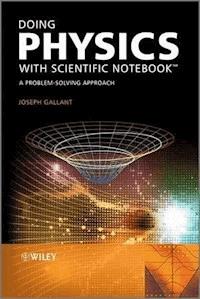
The goal of this book is to teach undergraduate students how to use Scientific Notebook (SNB) to solve physics problems. SNB software combines word processing and mathematics in standard notation with the power of symbolic computation. As its name implies, SNB can be used as a notebook in which students set up a math or science problem, write and solve equations, and analyze and discuss their results.
Written by a physics teacher with over 20 years experience, this text includes topics that have educational value, fit within the typical physics curriculum, and show the benefits of using SNB.
This easy-to-read text:
- Provides step-by-step instructions for using Scientific Notebook (SNB) to solve physics problems
- Features examples in almost every section to enhance the reader's understanding of the relevant physics and to provide detailed instructions on using SNB
- Follows the traditional physics curriculum, so it can be used to supplement teaching at all levels of undergraduate physics
- Includes many problems taken from the author’s class notes and research
Aimed at undergraduate physics and engineering students, this text teaches readers how to use SNB to solve some everyday physics problems.
Sie lesen das E-Book in den Legimi-Apps auf:
Seitenzahl: 770
Veröffentlichungsjahr: 2012
Ähnliche



















Contents
Cover
Half Title page
Title page
Copyright page
Preface
So we’re all on the same page…
What is science?
To the Student
To the Teacher
Contact Information
Acknowledgments
Chapter 1: Introduction to SNB
Why SNB?
The Basics
Solving Equations
The Compute Menu
Other Good Stuff
Units
Plotting
Fitting a Curve to Data
Differential Equations
Problems
Chapter 2: One-Dimensional Kinematics
Constant Acceleration
Free Fall
Varying Acceleration
Gravity and Air Resistance
Problems
Chapter 3: Vectors
Components of a Vector
Magnitude and Direction
Adding Vectors
Unit Vectors
Multiplying Vectors
Problems
Chapter 4: Projectile Motion
No Air Resistance
Linear Air Resistance
Quadratic Air Resistance
Height-Dependent Air Resistance
Problems
Chapter 5: Newton’s Laws of Motion
Newton’s First Law
Newton’s Second Law for Constant Forces
Newton’s Second Law for Varying Forces
Newton’s Third Law
Problems
Chapter 6: Conservation Laws
Definitions
Conservation of Energy
Conservation of Momentum
Rockets
Problems
Chapter 7: Circular Motion
Uniform Circular Motion
Rotational Kinematics
Newton’s Second Law and Circular Motion
Problems
Chapter 8: Harmonic Motion
Simple Harmonic Motion, Simply
Not-Quite-as-Simple Harmonic Motion
Damped Harmonic Motion
Driven Harmonic Motion
Constant Driving Force with Damping
Small Oscillations
Not-so-Simple Harmonic Motion
Problems
Chapter 9: Central Forces
Equations of Motion
Newtonian Gravitation
The Effective Potential
Two Special Forces
Numerical Stuff
Problems
Chapter 10: Fluids
Density and Pressure
Static Fluids
Buoyancy
Fluids in Motion
A More Realistic Approach
Problems
Chapter 11: Temperature and Heat
Temperature Scales
Heat and Work
Heat Flow
Calorimetry
Varying Specific Heat
Problems
Chapter 12: Special Relativity
The Two Postulates
The Consequences
The Lorentz Transformation
Space-Time
Relativistic Momentum and Energy
Relativistic Dynamics
Four-Vectors
Problems
Appendix A: Topics in Classical Physics
Newton’s Nose-Cone Problem
The Shape of the Eiffel Tower
An Interesting Classical Orbit
Fisher’s Crystal
Problems
Appendix B: Topics in Modern Physics
The Tale of the Traveling Triplets
Orbits in General Relativity
Classical Lifetime of a Hydrogen Atom
Quantum Mechanical Bound States
Problems
References and Suggested Reading
Index
Doing Physics with Scientific Notebook
This edition first published 2012© 2012 John Wiley & Sons, Ltd
Registered officeJohn Wiley & Sons Ltd, The Atrium, Southern Gate, Chichester, West Sussex, PO19 8SQ, UK
For details of our global editorial offices, for customer services and for information about how to apply for permission to reuse the copyright material in this book please see our website at www.wiley.com.
The right of the author to be identified as the author of this work has been asserted in accordance with the Copyright, Designs and Patents Act 1988.
All rights reserved. No part of this publication may be reproduced, stored in a retrieval system, or transmitted, in any form or by any means, electronic, mechanical, photocopying, recording or otherwise, except as permitted by the UK Copyright, Designs and Patents Act 1988, without the prior permission of the publisher.
Wiley also publishes its books in a variety of electronic formats. Some content that appears in print may not be available in electronic books.
Designations used by companies to distinguish their products are often claimed as trademarks. All brand names and product names used in this book are trade names, service marks, trademarks or registered trademarks of their respective owners. The publisher is not associated with any product or vendor mentioned in this book. This publication is designed to provide accurate and authoritative information in regard to the subject matter covered. It is sold on the understanding that the publisher is not engaged in rendering professional services. If professional advice or other expert assistance is required, the services of a competent professional should be sought.
The publisher and the author make no representations or warranties with respect to the accuracy or completeness of the contents of this work and specifically disclaim all warranties, including without limitation any implied warranties of fitness for a particular purpose. This work is sold with the understanding that the publisher is not engaged in rendering professional services. The advice and strategies contained herein may not be suitable for every situation. In view of ongoing research, equipment modifications, changes in governmental regulations, and the constant flow of information relating to the use of experimental reagents, equipment, and devices, the reader is urged to review and evaluate the information provided in the package insert or instructions for each chemical, piece of equipment, reagent, or device for, among other things, any changes in the instructions or indication of usage and for added warnings and precautions. The fact that an organization or Website is referred to in this work as a citation and/or a potential source of further information does not mean that the author or the publisher endorses the information the organization or Website may provide or recommendations it may make. Further, readers should be aware that Internet Websites listed in this work may have changed or disappeared between when this work was written and when it is read. No warranty may be created or extended by any promotional statements for this work. Neither the publisher nor the author shall be liable for any damages arising herefrom.
Library of Congress Cataloging-in-Publication Data
A catalogue record for this book is available from the Library of Congress.
A catalogue record for this book is available from the British Library.
Print ISBN: 978-0470-665978 (Cloth) 978-0470-665985 (Paper)
“It’s all physics!”
Donny MacNamara
Preface
Welcome to the wonderful world of physics! The study of physics is useful and important because physics is the most fundamental science. It is the framework upon which other sciences are built. As my old friend the high school physics teacher used to say “It’s all physics!” Once you understand the basic principles of physics, you’ll find it easier to understand other sciences. The thinking and problem-solving skills you develop here will help you in any endeavor.
This goal of this book is to teach undergraduate physics students how to use Scientific Notebook to solve physics problems. I’ve tried to choose topics that have educational value, fit within a typical physics curriculum, and show the benefits of SNB. Many problems come from my class notes, some from my research, while others I included because they’re interesting. Some are problems I wanted to do in class but couldn’t because the math was too difficult or time consuming.
Solving real-world problems usually requires more complicated mathematics than the idealized problems presented in introductory textbooks. Those “easy” problems are a good place to start. Once you can solve and understand them, we’ll add some complications and let SNB do the math. This lets us solve interesting, more realistic problems, and this book will be a useful reference for your entire undergraduate career.
Many of you are training for careers in fields which require technical or scientific calculations and written reports. SNB, which you can think of as a combination math gizmo and word processor, is ideally suited for these tasks. You’ll find this inexpensive software helpful and easy to use, in the classroom and beyond. However SNB can only assist you in solving physics problems, it cannot solve them for you.
Physics is not math. In mathematics you learn to solve equations. In physics you learn to apply equations to describe and explain the physical universe. Physicists construct equations involving physical quantities that are based on fundamental principals to describe and explain nature and we use mathematics to solve them. The bad news is that SNB will not solve any physics problems for anyone. The good news is that is will help you do physics by helping you with the math stuff. You do the physics, SNB does the math. You create the equation, SNB solves it. SNB will make the graph, but you will have to interpret it.
Undergraduate physics is taught with varying degrees of mathematical rigor, from freshmen no-calculus science-major courses to upper-level lots-of-calculus courses for physics majors. Not all physics classes use calculus so many students learn physics without it. But omitting calculus from a book about Doing Physics with SNB is like warping with one nacelle tied behind your impulse drive. The calculus and no-calculus problems are usually in separate sections, with the more complicated sections at the ends of chapters.
In Chapter 1, I introduce you to many SNB features I have used to solve physics problems. There are many more features of SNB, and the best way to learn them is to explore and play with SNB. Excellent written documentation accompanies SNB and it has an extensive built-in help system, all of which was written with SNB. If you see it in the help, you can do it with SNB. You can even cut-and-paste from the help into your document. The Help + Search feature is a great place to start when you need help or information.
In the subsequent chapters, I follow the basic introductory physics curriculum, extending it to include interesting problems (some with calculus but all at the undergraduate level) that show the power and usefulness of SNB and let your skills grow. Each section has a brief introduction to the relevant physical concepts. Since this is not a comprehensive physics textbook, I emphasize problem solving over conceptual knowledge, although both are important.
At least one example appears in almost every section. Their purpose is to enhance your understanding of the relevant physics and to provide detailed instructions on using SNB. You can (and should) explore the topics further with the wide selection of problems at the end of each chapter.
The two Appendices at the end of the book contain special topics in classical and modern physics that are not typically part of the traditional undergraduate physics curriculum. These are topics I find interesting, important or curiosity-inducing. They also show just how powerful SNB is as a problem-solving tool.
This book uses the following notation and conventions:
The abbreviation
SNB
refers to
Scientific Notebook.
Really.
Words written like Evaluate and Plot 2D Rectangular refer to
SNB
menu commands, buttons, and options.
Notation like Compute + Evaluate means click on the Compute menu item and select Evaluate.
Notation like Help + Search, Tags means click on the Help menu item and select Search. When the input box appears, type Tags.
Words written like TAB and CTRL refer to a key on your keyboard.
Notation like CTRL + F means hold down the CTRL key, press the F key and release the two keys simultaneously.
Important physics words like
force
appear in bold face the first time you meet them.
Shaded gray boxes contain
SNB
output.
This is a box of output!
I made every calculation and graph in this book with Scientific Notebook 5.50 (Build 2960). To write this book, I used Scientific WorkPlace 5.50 (Build 2960), which has all of SNB’s computational capabilities plus the typesetting system. To create the final PDF file, I used Pdf 995 (version 10.2).
So we’re all on the same page…
For the most part, I’ve left SNB’s default settings unchanged. There is one important exception. Under the Tools menu item, on the General page of Engine Setup, you will find the Solve Options. The default setting for Principal Value only and Ignore Special Cases is unchecked, which when solving equations can lead to output from SNB that looks like this:
This answer is correct ( is the set all complex numbers, is the empty set, the symbol means “and”) and you could cut-and-paste the parts you want. But as is, it’s cumbersome and contains too much information to be helpful to most students. To simplify the output, let’s check both Principal Value only and Ignore Special Cases and solve the equation again.
As you can see, SNB returns only the first answer and considers none of the special cases. Checking Ignore Special Cases while leaving Principal Value only unchecked produces this output.
Unless otherwise stated, the Solve Options I use in this book are Ignore Special Cases checked and Principal Value only unchecked.
There are a few not-so-important exceptions as well, which are more a matter of style and preference than substance. I made the following minor adjustments to the default settings.
Under Tools + User Setup, choose the Math page, click the Radical button, and choose the Square Root button on the left.
Under Tools + Computation Setup, choose the 2D Plots page. Click Rectangular and set the Default Plot Interval from zero to five.
On the same page, click Polar and set the Default Plot Interval from zero to 6.2832 (about 2
π
).
On the Plot Layout page, set the Screen Display and Plot Attributes to Plot Only and choose Displayed for the Placement option.
I keep SNB’s default setting of five digits in its output. Beyond this, I make no attempt to do significant figures, which I leave to the instructors. To make a global change for the number of digits in your answers, go to Tools + Computation Setup, choose the General page and change the Digits Shown in Results setting.
What is science?
Science is a systematic process to obtain and explain the facts to answer questions about the physical universe. Science is something you do. The fundamental precept of science is “look first, then decide”. To be scientific, you can’t make up your mind and then look for corroborating facts. You must carefully and rigorously gather the facts first, and then you analyze and interpret them. This prevents you from taking a few anecdotes and interpreting them as evidence. In science, “anecdotal evidence” is an oxymoron.
Experience suggests the universe operates under cause-and-effect laws. Contrary to the views espoused by many TV detectives, coincidences are real and they do happen. Take care not to mistake the occasional coincidence for a cause-and-effect relationship. You also must be careful not to assume something is inexplicable because you can’t explain it. The difference between “I don’t know” and “it’s not knowable” is huge. The former is a wonderful beginning; the latter is a dead end. Science minimizes these mistakes.
The three parts of science are experiment, theory, and the facts.
Experiments play two roles. They obtain the facts and they test the predictions of a theory. Experimenters make careful, controlled measurements to collect data. In science not all information rises to the level of data, much like not all information rises to the level of evidence in a courtroom. An experiment must be repeatable and verifiable. There is no “take my word for it” in science.
There is no truth in science either. Truth is subjective but the facts are objective. When you seek the truth, the response you get depends on who or how you ask. The facts do not depend on who or how you ask. Suppose two people decide to settle an argument with a race. When they return person A says “I won and he lost” while person B says “I finished just behind the person that won and she finished just ahead of the person that came in last”. Who is telling the truth? They both are telling a version of the truth. The facts are person A ran the race in 10 seconds and person B ran the race in 11 seconds.
A scientific theory must do two things. It must explain the known facts and predict new facts that can be measured experimentally. This ensures that the theory is not simply “aimed” at only known facts. A theory is rigorous, detailed, and mathematical. A theoretical result is much more than a hypothetical idea. Don’t say “I have a theory” when you only have an idea or a guess and don’t say “theoretically” when you mean “hypothetically”.
To the Student
Many of you are just beginning to learn physics. Perhaps you have heard that physics is a difficult course. Many students, even those who have had success in other subjects, are frightened by the prospect of taking physics for a grade. Physics is simple to understand but sometimes it’s difficult to learn. Difficult, but not impossible. Ultimately you hold the key to your success and there are several ways you can help yourself.
Read your Textbook
Physics books are not novels and you might not understand everything you read the first time through. Use your text book (and this book) as a resource to look stuff up and to review. Some students prefer to read the text before the lecture, others after the lecture, some even do both. You must find the way that works best for you. Either way, you will find many answers and insights in your text.
Ask Questions
If there is something in the class or the text that is not clear,
please
ask! Do not be embarrassed. You’re in a physics class and the room is full of people who don’t understand. Yet.
Work Together
Students who study with other students often are more successful. One of the best ways to improve your own understanding of a concept is to explain it to someone else. But remember, the purpose of a study group is to exchange ideas not answers!
Seek Help
Some problems take more than 15 minutes to solve. Don’t give up! Here’s a rule of thumb: if you spend a good hour working on a problem, put it aside and visit your professor. Bring your work, as often an expert can see a small error that was preventing your success. Visit your professor, teacher, or graduate assistant with questions, comments, or just to talk physics.
Time Is Not Always On Your Side
Physics is best learned in small doses. You don’t know in advance which problems will be the most time consuming, so budget your time wisely. Waiting until the last minute and trying to cram is not a good strategy. Avoid falling into the “due Monday means do Sunday” trap.
Pay More Than Attention
Physics is more a skill rather than a collection of facts. Solving physics problems is a skill, and like all skills it must be learned by doing. You cannot learn a skill by reading about it or by listening to your professor talk about it in a lecture. This is as true for riding a bicycle as it is for learning physics. How much and how well you learn physics depends mostly on the time and effort you put forth. Educators guide you, encourage you, offer you our insights. It’s up to you to actually learn the physics.
In other words, as in most things in life worth doing, success in learning physics requires hard work and effort.
In most physics courses, you are required to solve word problems. There is no guaranteed recipe for successful problem solving. It is a skill that you must acquire through practice. But I can offer a few words of advice about problem solving.
Read the problem carefully! The biggest problem with word problems is the words.
Ask yourself two important questions: “what do I know?” and “what am I trying to find?”.
Draw a picture! Visualizing the problem will help you solve it.
Do the math correctly.
SNB
will help you with this step.
Check your units. Are the units right?
Is the answer reasonable?
There is much more to do than just the math.
The problems at the end of the chapters are rarely “SNB problems” any more than problems in other physics books are calculator problems. After Chapter 1, there are very few SNB problems in this book. Most of the problems are physics problems. Remember that SNB is a tool and we want to do something with it.
To the Teacher
SNB has many features that teachers will find useful. You can use SNB to write homework assignments, exams, and solutions. You can use it to write your class notes and post them on the web so your students can access them with the Open Location command. SNB uses text files that are easily emailed so you and your students can exchange questions and answers.
You can create your own document types (ideal for lab reports or in-class worksheets) with the Export Document command. SNB exports the document as a shell file and treats it as a template. When your students click the New button, your preferred formats appears as one of their options.
We all try to be available and encourage our students to contact us. When they do, I usually use SNB to answer their questions. This is not the traditional approach, and the soulless minions of orthodoxy may not approve, but it seems to work.
When given a math or physics problem to solve with SNB, students often treat it as an SNB problem. Remind them SNB is a tool and the goal is to use that tool to do something.
Contact Information
If you have any questions, comments or suggestions about this book, please feel free to contact me directly at DPwSNB@gmail.com and I’ll respond as quickly as I can.
To find the book’s website, go to http://booksupport.wiley.com/ and search for this book by my name or the title. Once you’re there, you’ll find the DPwSNB e-book, the solutions manual, PowerPoint files containing all the figures in this book, and any other goodies we conjure up.
Acknowledgments
There are many people I’d like to thank for their help that made this book possible.
Barry MacKichan, President of MacKichan Software, Inc., graciously responded to my initial overtures about publishing this book and turned the matter over to this staff. Patti Kearney put me in contact with the good people at Wiley. John MacKendrick and George Pearson of MacKichan Support thoroughly answered my many questions.
Many people at Wiley contributed much time and effort to this project. Christoph von Friedeburg, then Commissioning Editor for Physics, was an early and enthusiastic supporter. Jenny Cossham was the Publisher who successfully presented my proposal to the publications committee. Sarah Tilley was my Project Editor and primary contact for the last year of this project when most of the work happened. She skillfully managed every aspect of this project and did so with charm and wit. Zoë Mills, Assistant Editor and mother of the cutest pumpkin ever, oversaw the design of the book’s attractive cover. Judith Egan-Shuttler, my copy editor with an extraordinary eye for detail, found many mistakes but was always gracious and gentle when pointing them out.
John Brehm was my former modern physics professor and a great teacher and author. He was also my undergraduate advisor and his simple “so where are you going to grad school?” question started this journey. His insights and suggestions improved this book immeasurably. John Dubach was my professor and the best dissertation advisor anyone could want. Barry Holstein, another former professor and quantum gator, generously gave me his time and expertise on relativity.
I’d like to thank Mike Crescimanno and John Fisher for many stimulating conversations on all thing physics, more than a few of which ended up in this book. I’m grateful to Sal Caronite for his friendship and sharing his unique perspective and keen observations on the human condition, including mine.
Over the years, many of my students were able helpers and guinea pigs. This includes my daughter Lisa, who was my student when this book was nothing more than a small handout. Our many interesting conversations and wonderful, delightful adventures are but small parts of her contribution to my life and this book.
Finally, I’d like to thank the rest of my family for encouraging and supporting me when I needed it, and for giving me the time and space to write. Words alone cannot express the gratitude and thanks I owe my mother. My wife Patti’s love and support for me and this project have been unwavering. Such debts can never be paid.
Joseph Gallant …………………………………… February 2012
Chapter 1
Introduction to SNB
The main activity of most physics classes is to teach students how to solve physics problems. Mathematics is a tool we use to solve those problems. Many of the difficulties students have in physics classes are rooted in the mathematics. They can’t see the forest of physics for all the mathematical trees. Scientific Notebook (SNB) is a powerful yet easy-to-use computer algebra system that can help alleviate this problem. SNB is inexpensive and easy enough to be accessible to most undergraduates yet powerful enough to be useful in solving interesting physics problems.
The goal of this book is to teach students how to use SNB to solve physics problems. Once you have learned how (and it won’t take all that long), you will use SNB as its name implies – as a notebook in which you set up a science or math problem, write and solve an equation, analyze and discuss the results. Of course a regular notebook will never help you do the math, but SNB will. Soon you will be able to think and write at the computer, in much the same way you use a paper and pencil now, with the power of a computer algebra system at your disposal.
Why SNB?
Scientific Notebook is powerful software that combines word processing and mathematics in standard notation with the power of symbolic computation. You enter the mathematical expressions in a form that is familiar to you and SNB evaluates it. This is the key to SNB. All the mathematics are in standard notation in a form that is familiar to you. There is no arcane syntax to learn.
With one click, SNB will find the first zero of the function.
You can see the other zeros with a plot of the function. It would be simple to graph this function by hand, but tedious and time consuming. To see a 2-dimensional plot of this function with SNB, we can again click a single button.
Figure 1.1 A plot of x2e-3x sin 4x
Later in this chapter you’ll learn how to find the other zeros.
Once we created the expressions, which was very easy to do, all it took was a few mouse clicks to answer our three questions. The entire process took about a minute. With SNB’s help, you will be able to spend more time thinking about physics and less time worrying about mathematics. However, keep in mind that SNB can only help you solve physics problems, it can not solve them for you.
This chapter presents a brief introduction to SNB, emphasizing features you will use in your physics class. It explains how to perform basic tasks such as entering and editing mathematics and text, solving equations and how to compute and plot mathematics. You can even use SNB to open and save documents available on the Internet. Keep in mind the main advantage of SNB over other systems. It is easy to learn and easy to use yet powerful enough to do physics. Before you start Doing Physics with SNB, you need to know how to use SNB.
The Basics
When you start SNB, you see a typical Windows interface containing menus, icons, and other graphics. This interface allows you to interact with the “brains” of SNB, the engine. The engine is the program which performs all the mathematical calculations. In version 5.5 of SNB, the engine is MuPAD (version 3.1). SNB translates your input into a form the engine can understand, sends it to the engine, translates the engine’s output into a form you can understand, and shows it to you.
Since SNB uses a standard interface, all the editing techniques you use in other programs will work in SNB. If you are new to computing, all the editing techniques you learn here will be useful in other applications. The blinking vertical line on your screen is called the insertion point, and it marks the position where characters or symbols are entered when you type or click a symbol. You can change the position of the insertion point with the arrow keys, or by clicking a different screen position with your mouse. The position of the mouse is indicated by the mouse pointer, which takes the shape of an I-beam over text and an arrow over mathematics.
Some actions in SNB require you to select, or highlight, text or mathematics. When you make a selection with the mouse or the keyboard, the next action you take affects the selection. To select an individual word or mathematical object with the mouse, doubleclick the word or object. To make a large selection with the mouse you can either click-and-drag the pointer with the left mouse button down, or click the mouse at the start of the selection, press and hold , move the pointer to where you want the selection to end, click the mouse and release . For more information on selecting, look under .
Lesen Sie weiter in der vollständigen Ausgabe!
Lesen Sie weiter in der vollständigen Ausgabe!
Lesen Sie weiter in der vollständigen Ausgabe!
Lesen Sie weiter in der vollständigen Ausgabe!
Lesen Sie weiter in der vollständigen Ausgabe!
Lesen Sie weiter in der vollständigen Ausgabe!
Lesen Sie weiter in der vollständigen Ausgabe!
Lesen Sie weiter in der vollständigen Ausgabe!
Lesen Sie weiter in der vollständigen Ausgabe!
Lesen Sie weiter in der vollständigen Ausgabe!
Lesen Sie weiter in der vollständigen Ausgabe!
Lesen Sie weiter in der vollständigen Ausgabe!
Lesen Sie weiter in der vollständigen Ausgabe!
Lesen Sie weiter in der vollständigen Ausgabe!
Lesen Sie weiter in der vollständigen Ausgabe!




