



Erhalten Sie Zugang zu diesem und mehr als 300000 Büchern ab EUR 5,99 monatlich.
- Herausgeber: CLXBX
- Kategorie: Gesellschafts- und Liebesromane
- Sprache: Englisch
Dom Casmurro is a timeless masterpiece of Brazilian literature that explores love, jealousy, memory, and the fragile nature of truth. Written by Machado de Assis, one of the greatest literary figures of the 19th century, this psychological novel invites readers into the introspective and unreliable mind of its narrator, Bento Santiago. The story unfolds as Bento, now an aging and solitary man, decides to recount his life in an attempt to "tie together the two ends" of his existence. Through his memories, we follow his childhood friendship and blossoming romance with the captivating and enigmatic Capitu. Their young love, filled with tenderness and promise, gradually evolves into marriage—but beneath the surface, doubt begins to grow. Bento becomes consumed by suspicion, questioning Capitu's fidelity and interpreting every glance, gesture, and coincidence as potential betrayal. What makes Dom Casmurro extraordinary is not simply its plot, but its masterful narrative voice. Machado de Assis crafts a narrator who is intelligent, ironic, and deeply human—yet profoundly biased. Readers are left to navigate the blurred line between reality and imagination, constantly questioning whether Bento's accusations are grounded in fact or shaped by his own insecurities and jealousy. This ambiguity transforms the novel into a compelling psychological puzzle that continues to spark debate more than a century after its publication. With subtle humor, sharp social commentary, and emotional depth, Dom Casmurro explores themes of obsession, pride, betrayal, and the power of memory. It is a story not only about love lost, but about how perception can distort truth and how suspicion can quietly dismantle even the strongest bonds. A cornerstone of Brazilian literature, Dom Casmurro remains a haunting and thought-provoking exploration of the human heart—one that challenges readers to decide for themselves what is real, what is imagined, and whether certainty is ever truly possible.
Sie lesen das E-Book in den Legimi-Apps auf:
Seitenzahl: 366
Veröffentlichungsjahr: 2026
Das E-Book (TTS) können Sie hören im Abo „Legimi Premium” in Legimi-Apps auf:
Ähnliche













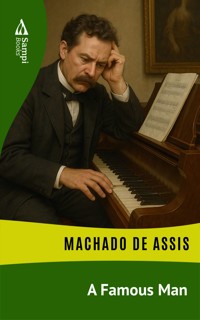

Dom Casmurro
Machado de Assis
Copyright © 2026 by Machado de Assis
All rights reserved.
No part of this book may be reproduced in any form or by any electronic or mechanical means, including information storage and retrieval systems, without written permission from the author, except for the use of brief quotations in a book review.
Contents
Chapter 1
Chapter 2
Chapter 3
Chapter 4
Chapter 5
Chapter 6
Chapter 7
Chapter 8
Chapter 9
Chapter 10
Chapter 11
Chapter 12
Chapter 13
Chapter 14
Chapter 15
Chapter 16
Chapter 17
Chapter 18
Chapter 19
Chapter 20
Chapter 21
Chapter 22
Chapter 23
Chapter 24
Chapter 25
Chapter 26
Chapter 27
Chapter 28
Chapter 29
Chapter 30
Chapter 31
Chapter 32
Chapter 33
Chapter 34
Chapter 35
Chapter 36
Chapter 37
Chapter 38
Chapter 39
Chapter 40
Chapter 41
Chapter 42
Chapter 43
Chapter 44
Chapter 45
Chapter 46
Chapter 47
Chapter 48
Chapter 49
Chapter 50
Chapter 51
Chapter 52
Chapter 53
Chapter 54
Chapter 55
Chapter 56
Chapter 57
Chapter 58
Chapter 59
Chapter 60
Chapter 61
Chapter 62
Chapter 63
Chapter 64
Chapter 65
Chapter 66
Chapter 67
Chapter 68
Chapter 69
Chapter 70
Chapter 71
Chapter 72
Chapter 73
Chapter 74
Chapter 75
Chapter 76
Chapter 77
Chapter 78
Chapter 79
Chapter 80
Chapter 81
Chapter 82
Chapter 83
Chapter 84
Chapter 85
Chapter 86
Chapter 87
Chapter 88
Chapter 89
Chapter 90
Chapter 91
Chapter 92
Chapter 93
Chapter 94
Chapter 95
Chapter 96
Chapter 97
Chapter 98
Chapter 99
Chapter 100
Chapter 101
Chapter 102
Chapter 103
Chapter 104
Chapter 105
Chapter 106
Chapter 107
Chapter 108
Chapter 109
Chapter 110
Chapter 111
Chapter 112
Chapter 113
Chapter 114
Chapter 115
Chapter 116
Chapter 117
Chapter 118
Chapter 119
Chapter 120
Chapter 121
Chapter 122
Chapter 123
Chapter 124
Chapter 125
Chapter 126
Chapter 127
Chapter 128
Chapter 129
Chapter 130
Chapter 131
Chapter 132
Chapter 133
Chapter 134
Chapter 135
Chapter 136
Chapter 137
Chapter 138
Chapter 139
Chapter 140
Chapter 141
Chapter 142
Chapter 143
Chapter 144
Chapter 145
Chapter 146
Chapter 147
Chapter1
One night, coming from the city to Engenho Novo, I met a young man from the neighborhood on the Central train, whom I know by sight and by his hat. He greeted me, sat down beside me, talked about the moon and the ministers, and ended up reciting verses to me. The trip was short, and the verses may not have been entirely bad. However, as I was tired, I closed my eyes three or four times; that was enough for him to interrupt the reading and put the verses in his pocket.
"Continue," I said, waking up.
"I'm finished," he murmured.
They are very beautiful.
I saw him make a gesture to take them out of his pocket again, but it was just a gesture; he was sulking. The next day he came in calling me nasty names, andThey ended up nicknaming me Dom Casmurro . The neighbors, who don't like my reclusive and quiet habits, spread the nickname, which eventually stuck. I wasn't angry about it. I told the anecdote to my friends in the city, and they, jokingly, call me that, some even in notes: "Dom Casmurro, I'm having dinner with you on Sunday." — "I'm going to Petrópolis, Dom Casmurro; the house is the same as in Rhenania; see if you can leave that cave in Engenho Novo and come spend a fortnight with me." — "My dear Dom Casmurro, don't think I'm letting you off the hook for the theater tomorrow; come and sleep here in the city; I'll give you a box, I'll give you tea, I'll give you a bed; I just won't give you a girl."
Don't consult dictionaries. Casmurro isn't used here in the sense they give it, but in the sense the common people use it, meaning a silent and withdrawn man. Dom was added ironically, to attribute to me airs of nobility. All because I was dozing off! I also couldn't find a better title for my narration; if I don't find another one by the end of the book, this one will do. My poet from the train will know that I hold no grudge against him. And with a little effort, since the title is his, he can claim the work as his own. There are books that will only have that much from their authors; some not even that.
Chapter2
Now that I've explained the title, I'll move on to writing the book. Before that, however, let's state the reasons that put pen to paper.
I live alone, with a servant. The house I live in is my own; I had it built on purpose, driven by a very particular desire that I am ashamed to express, but there you go. One day, many years ago, I remembered reproducing in Engenho Novo the house where I grew up on the old Rua de Matacavallos, giving it the same appearance and layout as that other one, which disappeared. The builder and painter understood well the instructions I gave them: it is the same two-story building, three windows at the front, a balcony at the back, the same alcoves and rooms. In the main one, the painting of the ceiling and walls is more or less the same, garlands of small flowers and large birds that take them in their beaks, spaced apart.The space. In the four corners of the room are figures of the seasons, and in the center of the walls are medallions of Caesar, Augustus, Nero, and Massinissa, with their names underneath... I don't understand the reason for such figures. When we went to the house in Matacavallos, it was already decorated like this; it dated from the previous decade. Naturally, it was fashionable at the time to incorporate classical flavor and antique figures into American paintings. The rest is also analogous and similar. I have a small garden, flowers, vegetables, a casuarina tree, a well, and a laundry area. I use old dishes and old furniture. In short, now, as before, there is the same contrast here between the quiet interior life and the noisy exterior life.
My evident aim was to tie together the two ends of life, and restore adolescence in old age. But, sir, I haven't managed to reconstruct what was, nor what I was. In everything, if the face is the same, the physiognomy is different. If only I lacked others, fine; a man consoles himself more or less for the people he loses; but I lack myself, and this gap is everything. What remains here is, to make a poor comparison, similar to the paint that is put on the beard and hair, which only preserves the external appearance, as they say in autopsies; the internal doesn't hold the paint. A certificate that gave me twenty years of age could deceive strangers, like all false documents, but not me. The friends I have left are of recent date; all the old ones have gone to study the geology of cemeteries. As for my female friends, some date back fifteen years, others less.And almost all believe in youth. Two or three could convince others of it, but the language they speak often requires consulting dictionaries, and such frequency is tiresome.
However, a different life doesn't mean a worse life; it's something else entirely. In certain respects, that old life seems to me stripped of many of the charms I found in it; but it's also true that it has lost many of the thorns that made it troublesome, and, in my memory, I retain some sweet and enchanting recollections. In truth, I rarely appear and speak even less. Distractions are rare. Most of my time is spent gardening, reading, and tending the garden; I eat well and sleep well.
Now, as everything tires, this monotony ended up exhausting me as well. I wanted a change, and it occurred to me to write a book. Jurisprudence, philosophy, and politics came to mind, but I lacked the necessary strength. Then, I thought of writing a History of the Suburbs , less dry than the memoirs of Father Luiz Gonçalves dos Santos concerning the city; it was a modest work, but it required documents and dates as preliminaries, all arid and lengthy. It was then that the busts painted on the walls began to speak to me and tell me that, since they could not reconstruct the past for me, I should take up my pen and recount some of it. Perhaps the narration would give me the illusion, and the shadows would come to pass lightly, as to the poet, not the one from the train, but the one from Faust : "Here you come again, restless shadows..." ?
I was so happy with this idea that I stillNow my pen trembles in my hand. Yes, Nero, Augustus, Massinissa, and you, great Caesar, who incite me to write my commentaries, I thank you for the advice, and I will put down on paper the reminiscences that come to me. In this way, I will relive what I lived, and I will set my hand to some work of greater scope. Come, let us begin the evocation with a famous November afternoon, which I have never forgotten. I have had many others, better and worse, but that one has never faded from my mind. You will understand this as you read.
Chapter3
I was about to enter the drawing room when I heard my name called and I hid behind the door. The house was on Matacavallos Street, the month was November, the year is rather distant, but I'm not going to change the dates of my life just to please people who don't like old stories; the year was 1857.
— Mrs. Gloria, do you still insist on sending our Bentinho to the seminary? It's about time, and there might be difficulties now.
What difficulty?
— A major difficulty.
My mother wanted to know what it was. José Dias, after a few moments of concentration, came to see if anyone was in the hallway; he didn't notice me, turned back and, muffling his voice, said that the problem was in the house next door, the people from Padua.
— People from Padua?
"I've been meaning to tell you this for some time, but I didn't dare. I don't think it's right that our Bentinho is hanging around with Tartaruga 's daughter , and that's the problem, because if they start dating, you'll have a lot of trouble separating them."
I don't think so. Huddled in the corners?
— It's just a way of speaking. In whispers, always together. Bentinho is almost never out of there. The little one is a scatterbrain; her father pretends not to see; he wishes things would go in a way that... I understand your gesture; you don't believe in such calculations, it seems to you that everyone has a pure soul...
— But, Mr. José Dias, I've seen the children playing, and I've never seen anything to make me suspicious. Their age is enough; Bentinho is barely fifteen. Capitú turned fourteen last week; they're two little children. Don't forget they were raised together since that great flood ten years ago, when the Padua family lost so much; that's how our relationship began. So, am I supposed to believe...? Brother Cosme, what do you think?
Uncle Cosme replied with an "Oh!" which, translated into colloquial language, meant: "It's José Dias's imagination; the kids are having fun, I'm having fun; where's the backgammon?"
Yes, I believe you are mistaken.
— It could be, madam. I hope they haveThat's a reason; but believe me, I only spoke after much consideration...
"In any case, it's about time," my mother interrupted; "I'll try to get him into the seminary as soon as possible."
— Well, since he hasn't given up on the idea of making him a priest, the main thing has been achieved. Bentinho will fulfill his mother's wishes. And besides, the Brazilian church has a great destiny. Let's not forget that a bishop presided over the Constituent Assembly, and that Father Feijó governed the empire...
"He governed just like him!" interrupted Uncle Cosme, giving in to old political grudges.
— Excuse me, doctor, I'm not defending anyone, I'm just quoting. What I want to say is that the clergy still plays a significant role in Brazil.
"What you want is a coat; go on, go get the backgammon. As for the little one, if he has to be a priest, it's really better that he doesn't start saying mass behind closed doors. But, look here, Sister Gloria, is there really any need to make him a priest?"
It's a promise, it must be kept.
— I know you made a promise... but a promise like that... I don't know... I think, if you think about it... What do you think, cousin Justina?
- I?
"The truth is, everyone knows themselves best," Uncle Cosme continued; "God knows everyone. However, a promise made so many years ago... But what's this, Sister Gloria? Are you crying? Really! Is this something to cry about?"
My mother blew her nose without answering. I believe Cousin Justina got up and went to her. A long silence followed, during which I was on the verge of entering the room, but another force, another emotion... I couldn't hear the words Uncle Cosme began to say. Cousin Justina exclaimed: "Cousin Gloria! Cousin Gloria!" José Dias apologized: "If I had known, I wouldn't have spoken, but I spoke out of veneration, esteem, affection, to fulfill a bitter duty, a most bitter duty..."
Chapter4
José Dias loved superlatives. It was a way of giving ideas a monumental character; if there were none, it served to lengthen sentences. He got up to fetch the backgammon set, which was inside the house. I pressed myself tightly against the wall and saw him pass by in his starched white trousers, belt loops, frock coat, and bow tie. He was one of the last to wear belt loops in Rio de Janeiro, and perhaps in the world. He wore his trousers short so that they would fit him perfectly. The black satin tie, with a steel ring inside, immobilized his neck; it was the fashion then. The chintz frock coat, a light, casual garment, looked like a ceremonial frock coat on him. He was thin, gaunt, with a receding hairline; he must have been about fifty-five years old. He got up with his usual slow step, not that languid, unassuming pace.Not the state of the lazy, but a calculated and deduced leisure, a complete syllogism, the premise before the consequence, the consequence before the conclusion. A most bitter duty!
Chapter5
He didn't always walk at that slow, stiff pace. He would also break into quick movements, often swift and nimble, as natural in this manner as in that one. Furthermore, he would laugh heartily, if necessary, a great, unwilling but communicative laugh, to such an extent that his cheeks, teeth, eyes, his whole face, his whole being, the whole world seemed to laugh in him. In serious situations, he was extremely serious.
He had been our dependent for many years; my father was still at the old Itaguahy farm, and I had just been born. One day he appeared there presenting himself as a homeopathic doctor; he carried a manual and a medicine cabinet. There was then an outbreak of fevers; José Dias cured the overseer and a slave, and refused any payment. Then my father proposed that he stay there living, with a small order.swimming. José Dias refused, saying that it was only right to bring health to the poor man's thatched house.
— Who's stopping you from going to other places? Go wherever you want, but stay and live with us.
I'll be back in three months.
He returned from there two weeks later, accepting room and board without any other stipend, except for what they wanted to give for celebrations. When my father was elected deputy and came to Rio de Janeiro with his family, he came too, and had his room at the back of the farm. One day, when fevers were raging again in Itaguahy, my father told him to go and see our slaves. José Dias remained silent, sighed, and ended up confessing that he was not a doctor. He had taken this title to help promote the new school, and he did not do so without studying very hard; but his conscience did not allow him to accept any more patients.
But you healed the other times.
— I believe so; however, the most accurate thing to say is that they were the remedies indicated in the books. Yes, those, below God. I was a charlatan... Don't deny it; the motives for my actions could have been and were worthy; homeopathy is the truth, and, to serve the truth, I lied; but it's time to set everything right.
He wasn't dismissed, as he had requested; my father could no longer do without him. He had a gift for making himself accepted and necessary; his absence was felt as if he were a member of the family. When my father died, the grief that overwhelmed him was enormous, they told me, I don't remember.Remember. My mother was very grateful to him, and did not allow him to leave the room at the farm; on the seventh day, after mass, he went to say goodbye to her.
— Stay, José Dias.
— I obey, my lady.
He received a small legacy in the will: a policy and four words of praise. He copied the words, framed them, and hung them in his room, above the bed. "This is the best policy," he often said. Over time, he acquired a certain authority in the family, a certain audience, at least; he didn't abuse it, and he knew how to give his opinion while obeying. In the end, he was a friend, I won't say the best, but not everything is best in this world. And don't assume he had a subservient soul; the courtesies he offered stemmed more from calculation than from nature. His clothes lasted a long time; unlike people who quickly ruin their new clothes, he kept his old ones brushed and smooth, mended, buttoned, with a simple and modest elegance. He read, albeit hastily, enough to entertain during evenings and after dessert, or to explain some Phoenician notion, to talk about the effects of heat and cold, the poles and Robespierre. He often recounted a trip he had made to Europe, and confessed that if it weren't for us, he would have already returned there; he had friends in Lisbon, but our family, he said, after God, was everything.
"Below or above?" Uncle Cosme asked him one day.
"Down," José Dias repeated, full of veneration.And my mother, who was religious, liked seeing that he put God in his proper place, and smiled approvingly. José Dias nodded his thanks. My mother would give him some money from time to time. Uncle Cosme, who was a lawyer, entrusted him with copying court documents.
Chapter6
Uncle Cosme had been living with my mother since she was widowed. He was already a widower then, as was my cousin Justina; it was the house of the three widowers.
Fortune often betrays nature. Trained for the serene functions of capitalism, Uncle Cosme didn't get rich in the courtroom: he just ate. He had his office on the old Rua das Violas, near the jury room, which was in the now-defunct Aljube prison. He worked in criminal law. José Dias never missed Uncle Cosme's oral defenses. He was the one who dressed and undressed him in his robes, with many bows at the end. At home, he would recount the debates. Uncle Cosme, however modest he wanted to be, smiled with persuasion.
He was fat and heavy, short of breath, and had sleepy eyes. One of my earliest memories was seeing him mount the horse my mother gave him every morning, the one that took him to...The black man who had gone to fetch her from the stable held the bridle while he lifted his foot and placed it in the stirrup; this was followed by a minute of rest or reflection. Then, he gave a push, the first one, the body threatened to rise, but did not; a second push, the same effect. Finally, after some long moments, Uncle Cosme gathered all his physical and moral strength, gave the last surge of earth, and this time fell onto the saddle. Rarely did the beast fail to show by a gesture that it had just received the world. Uncle Cosme adjusted his body, and the beast trotted away.
I also haven't forgotten what he did to me one afternoon. Although I was born in the countryside (where I came from when I was two years old) and despite the customs of the time, I didn't know how to ride, and I was afraid of horses. Uncle Cosme picked me up and straddled me on the horse. When I found myself high up (I was nine years old), alone and helpless, with the ground far below, I started screaming desperately: "Mommy! Mommy!" She rushed over, pale and trembling, thinking they were killing me, she helped me down, stroked me, while her brother asked:
— Mana Gloria, how can someone this big be afraid of a tame beast?
He's not used to it.
— You'll get used to it. Whether you're a priest or a vicar in the countryside, you have to ride a horse; and even here, even if you're not a priest yet, if you want to show off like the other boys and don't know how, you'll have to complain about it, Sister Gloria.
— Let him complain; I'm afraid.
Fear! Oh, fear!
The truth is, I only learned to ride later, less out of enjoyment than out of shame for admitting I didn't know how to ride. "Now he'll really start dating," they said when I began my lessons. The same couldn't be said of Uncle Cosme. For him, it was old custom and necessity. He was no longer up for dating. They say that, as a young man, he was accepted by many ladies, besides being an ardent supporter; but the years took away most of his political and sexual fervor, and his weight put an end to the rest of his public and specific ideas. Now he only fulfilled the obligations of his office, without love. In his leisure time, he spent his time watching or gambling. Once in a while he would tell jokes.
Chapter7
My mother was a good person. When her husband, Pedro de Albuquerque Santiago, died, she was thirty-one years old and could have returned to Itaguahy. She didn't want to; she preferred to stay near the church where my father was buried. She sold the farm and the slaves, bought some whom she put to work or rented out, a dozen buildings, a certain number of bonds, and settled in the house in Matacavallos, where she had lived the last two years of her marriage. She was the daughter of a lady from Minas Gerais, a descendant of another from São Paulo, the Fernandes family.
Now, then, in that year of grace 1857, Dona Maria da Gloria Fernandes Santiago was forty-two years old. She was still beautiful and young, but she stubbornly hid the vestiges of youth, however much nature wished to preserve her from the effects of time. She lived immersed in aShe wore an eternal dark dress, without adornment, with a black shawl folded into a triangle and fastened at the chest with a cameo. Her hair, in buns, was gathered at the nape of her neck with an old tortoiseshell comb; sometimes she wore a white frilly cap. Thus she went about her business, in her flat, stiletto shoes, going from one place to another, overseeing and guiding all the tasks of the entire house, from morning till night.
I have her portrait on the wall, next to her husband's, just like in the other house. The painting has darkened considerably, but it still gives an idea of them both. I remember nothing of him, except vaguely that he was tall and wore a large wig; the portrait shows round eyes that follow me everywhere, an effect of the painting that haunted me as a child. His neck emerges from a black tie with many turns, his face is completely shaved, except for a small patch near his ears. My mother's portrait shows that she was beautiful. She was then twenty years old, and she had a flower between her fingers. In the panel, she seems to be offering the flower to her husband. What one reads in their faces is that, if marital happiness can be compared to winning the lottery, they hit the jackpot.
I conclude that lotteries should not be abolished. No winner has yet accused them of being immoral, just as no one has called Pandora's box evil for having hope at the bottom; it must remain somewhere. Here I have them, the two happily married couple of yesteryear, the beloved ones, theBlessed are those who have departed this life for the next, continuing a dream, probably. When the lottery and Pandora bore me, I raise my eyes to them, and forget the blank tickets and the fateful box. They are portraits that are worth their weight in gold. The one of my mother, extending the flower to her husband, seems to say: "I am all yours, my handsome gentleman!" The one of my father, looking at us, makes this comment: "See how this girl loves me..." If they suffered illnesses, I don't know, just as I don't know if they had sorrows: I was a child and began by not being born. After his death, I remember that she cried a lot; but here are the portraits of both, without the grime of time taking away their first expression. They are like instantaneous photographs of happiness.
Chapter8
But it's time to turn that November afternoon into a clear, fresh afternoon, as peaceful as our house and the stretch of street where we lived. Truly, it was the beginning of my life; everything that had happened before was like painting and dressing the people who had to go on stage, lighting the lights, preparing the violins, the symphony... Now I was going to begin my opera. "Life is an opera," an old Italian tenor who lived and died here used to tell me... And he explained the definition to me one day in such a way that he made me believe it. Perhaps it's worth giving it; it's only one chapter.
Chapter9
He no longer had a voice, but he insisted he did. "Disuse is what's hurting me," he added. Whenever a new company arrived from Europe, he would go to the manager and expose all the injustices of heaven and earth; the manager would commit yet another, and he would go out shouting against the iniquity. He still had the mustaches from his papers. When he walked, despite his old age, he seemed to be courting a princess of Babylon. Sometimes, without opening his mouth, he would hum some tune even more eccentric than himself, or just as much; such muffled voices are always possible. He would come here to dine with me a few times. One night, after much Chianti, he repeated his usual definition, and when I told him that life could be an opera, a sea voyage, or a battle, he shook his head and replied:
Life is an opera, and a grand opera at that. The tenor and the baritone fight for the soprano, in the presence of the bass and supporting cast, or sometimes it's the soprano and the contralto fighting for the tenor, in the presence of the same bass and supporting cast. There are numerous choruses, many ballets, and the orchestration is excellent...
— But, my dear Marcolini...
— What...?
And after taking a sip of liqueur, he put down the chalice and told me the story of its creation, in words that I will summarize.
God is the poet. The music is by Satan, a young maestro with a bright future, who learned at the conservatory of heaven. A rival of Michael, Raphael, and Gabriel, he could not tolerate the precedence they had in the distribution of prizes. It may also be that the excessively sweet and mystical music of those other fellow students was abhorrent to his essentially tragic genius. He plotted a rebellion that was discovered in time, and he was expelled from the conservatory. Everything would have passed without further incident if God had not written an opera libretto, which he had relinquished, understanding that such a kind of recreation was inappropriate for his eternity. Satan took the manuscript with him to hell. In order to show that he was worth more than the others—and perhaps to reconcile himself with heaven—he composed the score, and as soon as he finished it, he took it to the Eternal Father.
Sir, I have not forgotten the lessons I received.He said to her, "Here is the score; listen to it, amend it, perform it, and if you find it worthy of the heights, admit me with it to your feet..."
"No," the Lord retorted, "I don't want to hear anything."
But, Lord...
Nothing! Nothing!
Satan pleaded further, without better luck, until God, weary and full of mercy, consented that the opera be performed, but outside of heaven. He created a special theater, this planet, and invented an entire company, with all the parts, primary and secondary, choruses and dancers.
I just heard some rehearsals!
No, I don't want to hear about rehearsals. It's enough that I've composed the libretto; I'm ready to share the copyright with you.
Perhaps this refusal was a mistake; it resulted in some confusions that prior consultation and friendly collaboration would have avoided. Indeed, there are places where the verse goes to the right and the music to the left. There are those who say that therein lies the beauty of the composition, avoiding monotony, and thus they explain the Eden tercet, Abel's aria, the choruses of the guillotine and slavery. It is not uncommon for the same passages to be repeated without sufficient reason. Certain motifs become tiresome through repetition. There are also obscurities; the conductor abuses the choral masses, often obscuring the meaning in a confusing way. The partsOrchestras, moreover, are handled with great skill. Such is the opinion of impartial people.
The maestro's friends believe that it would be difficult to find a work as well-finished. One or two admit to certain roughness and such or such gaps, but as the opera progresses, it is likely that these will be filled in or explained, and those will disappear entirely, the maestro not refusing to amend the work where he feels it does not fully respond to the sublime thought of the poet. The poet's friends say the same. They swear that the libretto was sacrificed, that the score corrupted the meaning of the lyrics, and, although beautiful in some places and artfully crafted in others, is absolutely different from and even contrary to the drama. The grotesque, for example, is not in the poet's text; it is an excrescence to imitate the Wives of Windsor . This point is contested by Satanists with some semblance of reason. They say that, at the time when young Satan composed the great opera, neither that farce nor Shakespeare had been born. They even claim that the English poet had no other genius than to transcribe the opera's lyrics with such skill and fidelity that he himself seems to be the author of the composition; but, evidently, he is a plagiarist.
"This piece," concluded the old tenor, "will last as long as the theater lasts, and it's impossible to calculate when it will be demolished for astronomical reasons. Its success is growing. Poet and musician receive their royalties punctually, which do not..."They are the same, because the rule of division is that of Scripture: "Many are called, but few are chosen." God receives in gold, Satan in paper.
That's funny...
"Grace?" he cried furiously; but he quickly quieted down and replied: "Dear Santiago, I have no grace, I have a horror of grace. What I say is the pure and ultimate truth. One day, when all books are burned as useless, there will be someone, perhaps a tenor, and maybe an Italian, who will teach this truth to men. Everything is music, my friend. In the beginning was C , and C became D , etc. This calyx (and he filled it again) this calyx is a short refrain. Can't you hear it? You can't hear the stick or the stone either, but everything fits into the same opera..."
Chapter10
That it's too much metaphysics for just one tenor, there's no doubt; but the loss of voice explains everything, and there are philosophers who are, in short, unemployed tenors.
I, dear reader, accept the theory of my old friend Marcolini, not only because of its plausibility, which is often the whole truth, but because my life fits the definition well. I sang a most tender duet , then a trio , then a quartet ... But let's not get ahead of ourselves; let's go to the first afternoon when I learned that I was already singing, because the accusation by José Dias, my dear reader, was mainly directed at me. It was me he denounced.
Chapter11
As soon as I saw the crowd disappear down the corridor, I left my hiding place and ran to the back balcony. I didn't want to know about the tears or the reason my mother was shedding them. The reason was probably her ecclesiastical plans, and the occasion of these is what I'm going to tell you, since it's already old news; it dated back sixteen years.
The plans dated back to the time I was conceived. Having lost her first child to death, my mother prayed to God that the second would survive, promising that if it were a boy, she would dedicate him to the church. Perhaps she was hoping for a girl. She didn't tell my father anything, neither before nor after giving birth to me; she planned to do so when I started school, but she was widowed before then. As a widow, she felt the terror of parting from me; but she was so devout, so God-fearing, that she sought witnesses to the truth.out of obligation, entrusting the promise to relatives and family. Solely so that we would separate as late as possible, he made me learn my first letters, Latin, and doctrine at home, from that Father Cabral, an old friend of Uncle Cosme, who would come over to play games at night.
Long deadlines are easy to agree to; imagination makes them infinite. My mother waited for the years to pass. Meanwhile, I was growing fond of the idea of the church; childhood games, devotional books, images of saints, conversations at home, everything converged on the altar. When we went to Mass, she always told me it was to learn to be a priest, and that I should pay attention to the priest, not take my eyes off the priest. At home, I played Mass—somewhat secretly, because my mother said that Mass was not a game. Capitú and I would set up an altar. She would act as sacristan, and we would alter the ritual, dividing the host between us; the host was always a sweet. In the time when we played like that, it was very common to hear my neighbor: "Is there Mass today?" "I already knew what this meant, I answered affirmatively, and went to ask for the host by another name. I would return with it, we would arrange the altar, mumble our Latin, and rush through the ceremonies. Dominus, non sum dignus ... This, which I should have said three times, I think I only said once, such was the greed of the priest and the sacristan. We drank neither wine nor water; we didn't have the former, and the latter would take away the taste of sacrifice."
Lately, they hadn't spoken to me about the seminary anymore, to the point that I thought it was a closed matter. Fifteen years old, lacking a vocation, they would ask for the world's seminary rather than St. Joseph's. My mother would often look at me as if I were a lost soul, or take my hand, for no apparent reason, and squeeze it tightly.
Chapter12
I stopped on the veranda; I was dizzy, bewildered, my legs trembling, my heart feeling like it wanted to leap out of my chest. I didn't dare go down to the garden and cross into the neighboring yard. I started pacing back and forth, stopping to brace myself, then walking again and stopping. Confused voices echoed José Dias's speech:
"Always together..."
"In little secrets..."
"If they start dating..."
Bricks I stepped on and restepped on that afternoon, yellowed columns you passed me by on the right or left, as I went or came, in you remained the best part of the crisis, the sensation of a new joy that enveloped me within myself, and then dispersed me, and gave me shivers, and poured out some kind of inner balm. Sometimes I found myself,Smiling, with a satisfied laugh that belied the abomination of my sin. And the voices repelled each other in confusion:
"In little secrets..."
"Always together..."
"If they start dating..."
A coconut tree, seeing me uneasy and guessing the cause, murmured from atop it that it wasn't wrong for fifteen-year-old boys to hang out in the corners with fourteen-year-old girls; on the contrary, teenagers of that age had no other occupation, nor did the corners have any other use. It was an old coconut tree, and I believed in old coconut trees, even more than in old books. Birds, butterflies, a cicada that was trying out the summer, all the living beings in the air were of the same opinion.
So, I loved Capitú, and Capitú loved me? Truly, I was always glued to her skirts, but nothing truly secret ever happened between us. Before she went to school, it was all childish mischief; after she left school, it's true we didn't immediately re-establish our former intimacy, but it returned little by little, and in the last year it was complete. Meanwhile, the subject of our conversations was the same as always. Capitú sometimes called me handsome, a young man, a flower; other times she would take my hands to count my fingers. And I began to remember these and other gestures and words, the pleasure I felt when she ran her hand through my hair, saying she found it beautiful. I, without doing the same to hers, would say that...They were much more beautiful than mine. Then Capitú would shake her head with a great expression of disappointment and melancholy, all the more surprising since she had truly admirable hair; but I would retort by calling her crazy. When she asked me if I had dreamed of her the night before, and I said no, I would hear her tell me that she had dreamed of me, and they were extraordinary adventures, that we climbed Corcovado through the air, that we danced on the moon, or that angels came to ask us our names, in order to give them to other angels who had just been born. In all these dreams we were very close. The ones I had with her were not like that, they only reproduced our familiarity, and often they were nothing more than a simple repetition of the day, some phrase, some gesture. I also told them. One day Capitú noticed the difference, saying that hers were more beautiful than mine; After some hesitation, I told her they were like the person who dreamed... Her face turned the color of a pitanga cherry.
Well, frankly, only now did I understand the emotion these and other confidences gave me. The emotion was sweet and new, but its cause eluded me, without my seeking it or suspecting it. The silences of the last few days, which had revealed nothing to me, I now felt as signs of something, and so did the half-spoken words, the curious questions, the vague answers, the worries, the pleasure of remembering childhood. I also realized that it was a recent phenomenon to wake up thinking about Capitú, andI listened to her by heart, and trembled when I heard her footsteps. If she was mentioned in my house, I paid more attention than before, and, depending on whether it was praise or criticism, it brought me more intense pleasure or displeasure than before, when we were merely playmates. I even thought of her during the masses that month, with intervals, it's true, but also exclusively.
All this was now presented to me through the mouth of José Dias, who had denounced me to myself, and whom I forgave everything: the evil I had said, the evil I had done, and whatever might come from either of them. At that moment, eternal Truth would not be worth more than him, nor eternal Goodness, nor the other eternal Virtues. I loved Capitú! Capitú loved me! And my legs walked, unwalked, stopped, trembling and believing they could encompass the world. That first throbbing of sap, that revelation of consciousness to itself, I never forgot, nor did I find any other sensation of the same kind comparable to it. Naturally, because it was mine. Naturally also, because it was the first.
Chapter13
Suddenly, I heard a voice shouting from inside the house nearby:
— Capitú!
And in the backyard:
- Mommy!
And back home again:
Come here!
I couldn't contain myself. My legs descended the three steps leading to the garden and walked towards the neighboring yard. It was their custom, in the afternoons, and in the mornings too. For legs are also people, only inferior to arms, and they are self-sufficient when the head doesn't govern them through ideas. Mine reached the foot of the wall. There was a connecting door there, ordered to be opened by my mother when Capitú and I were little. The door had no key or latch.It opened by pushing from one side or pulling from the other, and closed by the weight of a stone hanging from a rope. It was almost exclusively ours. When they were children, we would visit them by knocking on one side, and be received on the other with many courtesies. When Capitú's dolls fell ill, I was the doctor. I would enter her yard with a stick under my arm, to imitate Doctor João da Costa's walking stick; I would take the patient's pulse and ask her to show me her tongue. "She's deaf, poor thing!" Capitú would exclaim. Then I would scratch my chin, like the doctor, and end up ordering some leeches to be applied or an emetic to be given: it was the doctor's usual therapy.
— Capitú!
- Mommy!
Stop digging holes in the wall; come here.




