


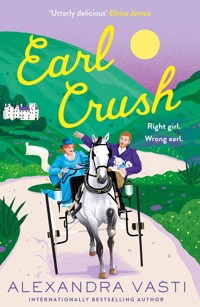
Erhalten Sie Zugang zu diesem und mehr als 300000 Büchern ab EUR 5,99 monatlich.
- Herausgeber: Corvus
- Kategorie: Gesellschafts- und Liebesromane
- Sprache: Englisch
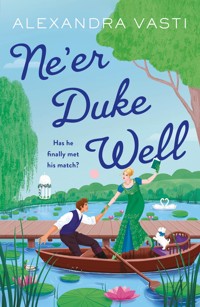
'Both a rollicking romp and the most tender of love stories... Sexy, kind, and full of adventure!' Naina Kumar, USA Today bestselling author of Say You'll Be My Jaan Right girl. Wrong Earl. Lydia Hope-Wallace's secret life as the anonymous author of rebellious political pamphlets has led her into a correspondence with the charming Earl of Strathrannoch. When she learns he's in dire financial straits, Lydia sets out for Scotland to offer him a marriage of convenience - to, erm, herself. Arthur Baird, Earl of Strathrannoch is stunned when a bewitching stranger offers him her hand in marriage. But when he realizes that his traitorous brother has been writing to her under his name, he's bloody furious. Desperate to track down his estranged sibling, Arthur needs Lydia's help. What he doesn't need? The attraction that burns hotter each moment they spend together. As Lydia slips past his defences, Arthur will have to risk everything to keep her safe - even his heart... Hot, hilarious and heartfelt, this racy Regency romp from bestselling author Alexandra Vasti is perfect for fans of Bridgerton and Lex Croucher 'Bridgerton at its sexiest... Crush? Ha. I'm in love with the earl!' Eloisa James, New York Times bestselling author of Viscount In Love 'Wildly delightful! ... Marvelously funny and sexy' Joanna Shupe, USA Today bestselling author of The Scandal of Rose 'Witty banter, endearing characters, and smoking hot chemistry' Liana De la Rosa, author of Ana Maria and The Fox
Sie lesen das E-Book in den Legimi-Apps auf:
Seitenzahl: 444
Veröffentlichungsjahr: 2025
Das E-Book (TTS) können Sie hören im Abo „Legimi Premium” in Legimi-Apps auf:
Ähnliche
















Praise for Earl Crush
“Wildly delightful! With Earl Crush, Alexandra Vasti has crafted a marvelously funny and sexy read featuring a brawny Scottish earl, zebras, and a feminist heroine ahead of her time. This belongs on every romance reader’s keeper shelf!”
—Joanna Shupe, USA Today bestsellingauthor of The Duke Gets Even
“I dare anyone to read this book and walk away without a crush on this earl! Arthur Baird is the new definition of a pining, besotted hero, and his deep love and appreciation for Lydia Hope-Wallace’s mind and courage had me swooning. Both a rollicking romp and the most tender of love stories, Earl Crush is sexy, kind, and full of adventure! Alexandra Vasti is an immense talent, and I look forward to reading everything she writes until the end of time!”
—Naina Kumar, USA Today bestsellingauthor of Say You’ll Be My Jaan
“With witty banter, endearing characters, and smoking-hot chemistry, Alexandra Vasti’s Earl Crush will enchant readers and establish her as a breakout star of historical romance!”
—Liana De la Rosa, USA Today bestsellingauthor of Isabel and The Rogue
Praise for Ne’er Duke Well
“As hot as it is heartfelt, this will have historical romance fans hooked.”
—Publishers Weekly (starred review)
“The kind of romance you want to wrap around yourself like a blanket.”
—NPR
“Ne’er Duke Well is a delightful, quicksilver romp with unforgettable characters that readers will be rooting for from start to finish.”
—Deanna Raybourn, New York Times bestsellingauthor of the Veronica Speedwell series
“An irresistible delight from a remarkable new talent . . . Vasti has quickly earned her place on my list of favorite writers.”
—India Holton, USA Today bestselling authorof The Ornithologist’s Field Guide to Love
“A witty page-turner with two adorable leads whose funny banter and chemistry is off the charts! I didn’t want their antics to end.”
—Virginia Heath, author of Never Fall for Your Fiancée
“Utterly delicious and undeniably clever, Alexandra Vasti’s Ne’er Duke Well was unputdownable. . . . Regency romance fans everywhere will love this warm, wonderfully witty, and oh-so-sexy novel just as much as I did. What a spectacular debut!”
—Amy Rose Bennett, author of Up All Night with a Good Duke
Praise for the Halifax Hellions Series
“These stories are hot, smart, funny, and charming as hell—much like the Hellions themselves. I’ve read them each twice.”
—Alix E. Harrow, New York Times bestsellingauthor of Starling House
“Emotional and sexy and full of thrilling hijinks with jaw-dropping prose that transports you in every possible way. Each sibling and their partner has a unique journey, but there’s an undeniable thread of finding radical acceptance in love that ties the three together beautifully. Alexandra Vasti has easily secured her place as a superstar in the genre.”
—Jessica Joyce, USA Today bestsellingauthor of You, with a View
“Alexandra’s plots are so zany and so fun but also earnestly explored and impeccably executed! Perfect for anyone who loves Tessa Dare but with a fresh voice wholly her own. I will pick up anything Alexandra writes.”
—Rosie Danan, USA Today bestsellingauthor of Do Your Worst
“Delightful, truly scrumptious—like if Lisa Kleypas and Tessa Dare had a sexy baby. Alexandra Vasti is my favorite writer, full stop.”
—Mazey Eddings, USA Today bestselling author of Late Bloomer
“Filled to the brim with heart and heat, these absolutely delicious stories are not only ideal comfort reads but master classes in novella writing. I’m forever in awe of Alexandra Vasti’s talent.”
—Sarah Adler, USA Today bestsellingauthor of Happy Medium
ALSO BY ALEXANDRA VASTI
Ne’er Duke Well
HALIFAX HELLIONS NOVELLAS
In Which Margo Halifax Earns Her Shocking Reputation
In Which Matilda Halifax Learns the Value of Restraint
In Which Winnie Halifax Is Utterly Ruined
First published in paperback in the United States in 2025 by St Martin’s Griffin, an imprint of Pan Macmillan
First published in paperback in Great Britain in 2025 by Corvus, an imprint of Atlantic Books Ltd.
Copyright © Alexandra Vasti, 2025
The moral right of Alexandra Vasti to be identified as the author of this work has been asserted by her in accordance with the Copyright, Designs and Patents Act of 1988.
All rights reserved. No part of this publication may be reproduced, stored in a retrieval system, or transmitted in any form or by any means, electronic, mechanical, photocopying, recording, or otherwise, without the prior permission of both the copyright owner and the above publisher of this book.
No part of this book may be used in any manner in the learning, training or development of generative artificial intelligence technologies (including but not limited to machine learning models and large language models (LLMs)), whether by data scraping, data mining or use in any way to create or form a part of data sets or in any other way.
This novel is entirely a work of fiction. The names, characters and incidents portrayed in it are the work of the author’s imagination. Any resemblance to actual persons, living or dead, events or localities, is entirely coincidental.
10 9 8 7 6 5 4 3 2 1
A CIP catalogue record for this book is available from the British Library.
Paperback ISBN: 978 1 80546 400 6
E-book ISBN: 978 1 80546 401 3
Printed in Great Britain.
Corvus
An imprint of Atlantic Books Ltd Ormond House
26–27 Boswell Street
London
WC1N 3JZ
www.atlantic-books.co.uk
For the romance-reading Vasti women before me, who taught me that the genre is meaningful, joyful, and empowering. (And especially in memory of Grammy Vasti, who would have loved this book, even though I could not get a sexy shirtless man on the cover per her request.)
And for Matt, with love in abundance.
Content note: This novel contains non-graphic threatened violence and historical firearm usage, as well as brief references to homophobia and past parental death.
Chapter 1
I am, undoubtedly, an idiot. Also an arse.
—from the 1818 papers of Arthur Baird,Fifth Earl of Strathrannoch, unsent draft
“Based upon our respective financial situations, our mutually agreeable political interests, and the general compatibility of our persons,” Lydia Hope-Wallace said, “it seems to both our advantages that we unite in holy matrimony.”
Her voice shook only a trifle, which was a notable improvement.
Her friend Georgiana Cleeve gazed at her from across the post-chaise, expression impassive. Bacon, Georgiana’s dog, gave Lydia a sympathetic moan from his position on Georgiana’s lap.
Lydia winced. “Too wordy?” She fiddled with her sheaf of papers, trying not to look at her notes. Again. “I was afraid of that. Perhaps there is some way I can compress the language of the third clause—”
“I am not certain the language is the problem.”
“Perhaps not.” Lydia chewed on her lower lip and stared blearily down at the papers in her lap, draft after penciled draft of marriage proposals in her own hand.
Marriage proposals. To a man she had never met.
It turned out it was rather difficult to get such a thing right.
She pulled out the pencil she’d stuffed into her coiffure and scratched out a hasty revision. “How about this: Based upon the mutual benefits conferred by a legal union—”
“Mutual benefits? Lydia, you are the third-richest unmarried heiress in London. The benefits are all Strathrannoch’s.”
“Second-richest, I think.” Lydia frowned and drew a line through compatibility of our persons, which suddenly struck her as a bit indecent. “Hannah Harvey got engaged last week to that fellow in tin from Birmingham.”
She drew a line through mutual benefits as well, for the sake of caution.
Georgiana cleared her throat, and Lydia redirected her gaze to her friend’s finely drawn, deceptively innocent face.
“Perhaps,” Georgiana said—as though she had not said it half a dozen times in the last week—“we might consider a social call on Lord Strathrannoch first. You might discuss your ‘mutual interests.’”
Lydia clenched her teeth. Her heart beat harder in her chest, as it did every time Georgiana proposed an alteration in their plan. “No.”
“I can ask for a tour of his castle. You can take tea in his parlor. And then we can return to Dunkeld for the evening.”
They had left the posting inn in Dunkeld that morning to set off for Strathrannoch Castle. It had taken quite a bit of coin to persuade the postilion to take them away from Perth and Dundee, rather than toward those centers of civilization—a fact that had given Lydia a moment of pause—but the farther afield they traveled, the more the view out the hazed glass soothed something inside her. Softened the spiked edges of panic in her chest.
They’d spent nearly an hour winding along the river before they’d passed into a forest of thick-branched oaks and clustered fir trees. When they’d emerged, it had been to a wide soft vista of green—all hills and sun-spangled water and no other humans as far as the eye could see.
Lydia had loved every moment she’d spent peering out the coach window. It was only when she looked down into her lap, at the rumpled papers and scratched-out notations in her own neat hand, that panic resettled itself somewhere above her breastbone.
“You needn’t propose to the man immediately upon meeting him,” Georgiana went on. Also not for the first time. “Perhaps you might consider making him earn the privilege of your hand. Men perform better when they are required to rise to the occasion.”
“No,” Lydia said again.
Her blood had begun pounding in her ears. Her stomach churned.
She could not recall a time—even in the furthest reaches of her memory—when she had been comfortable with basic social congress.
In her own home, within the comfortable knot of her friends and family, she was perfectly capable of human interaction. Outside that circle, however, she tended to fade silently into the background—or, alternatively, become so flustered and dizzy that she fainted in the middle of a drawing room and had to be carried out by a footman.
She knew herself. There was no possible way that she could sit down with the Earl of Strathrannoch and make polite conversation for several days before revealing the truth of why she had come to his castle. She had to get it over with as quickly as possible before she made an utter cake of herself.
“We’ve come this far,” Lydia said. She looked down at the papers in her lap—some in her own hand and some in Strathrannoch’s, dozens of his clever, charming letters—and tried to force the tremble out of her voice. “I’m not going to give up now.”
She could not. She had hidden her whereabouts from her mother and brothers, revealed the truth of her plot only to her closest friends, and set out for Scotland armed with nothing but a trunk and a fresh pencil.
This is your chance, she had thought to herself. This is your chance to change your life.
Three years ago, Lydia had begun writing radical political tracts, distributed anonymously by the scandalous circulating library Belvoir’s. Lydia’s first pamphlet had called for universal suffrage for both men and women. Her second had argued for the complete abolition of the aristocracy in England.
It had been that second pamphlet that had prompted the Earl of Strathrannoch’s response, delivered care of the library.
Dear H, he had written. I admire your fighting spirit and wonder when you mean to write on the question of Scotland.
(Lydia had, of necessity, employed a simple pseudonym for her pamphlets. H for Hope-Wallace. H for heart and hardihood. H for Holy hell, what have I done? and Hope I don’t end up in prison!)
Dear Strathrannoch, she had written back. What Scotland question do you have in mind? I assure you, I have numerous opinions, most of which you probably will not appreciate. Your lordship.
Two weeks later, she’d had his reply: Dear H, I suppose you mean because the Strathrannochs have for five generations allied themselves with your monarchy instead of our own people? Aye, I can see why you’d think I’d oppose your incendiary ideas. You’d be wrong, however. Tell me what you think about the Scots fighting for your English king against Napoleon and don’t hold back. I’d like for my eyebrows to burn off when I read your next letter.
She’d written back. And in the months and years that had followed, she and the Earl of Strathrannoch had developed a peculiar friendship.
He did not know her true identity. He did not know she was an absurdly rich spinster. He had no idea that she was so terrified of interacting with other humans that, despite her fortune, she’d been a disaster during her seven unbearable Seasons.
But he knew her, in a way. He knew the heart of her—at least, the political part—and the shape of her ideas. And he agreed with them all, even the most outrageous.
When Strathrannoch had confessed in his last letter that his ancestral home in the Scottish Lowlands could scarcely support itself financially, that he was struggling to keep the place running, an idea had crystallized in her mind.
She could marry him.
Strathrannoch needed money, and Lydia had coin in abundance.
And Lydia needed—
Her chest felt tight. She rubbed her fingers at the ache there and stared down at the papers in her lap.
In the years since her ignominious debut, she had folded in on herself. She’d hidden behind the protective wall of her older brothers and let herself become smaller and smaller. More and more invisible.
Her anonymous pamphlets had felt almost miraculous at first. Suddenly, she had a voice—a way to make herself heard even when she could not manage to speak aloud.
But the rich, honeyed taste of independence that her writing had given her only made her crave more of the same. Her pamphlets were secret, hidden; she had no real autonomy. Almost no one in her life knew of her work—to everyone else, she was only silent, mousy, helpless Lydia Hope-Wallace.
Except to Strathrannoch. He did not know her for an awkward wallflower. He saw only her radical spirit, the bright ferocity of her writing.
And if she had her way, he would never know the way the beau monde perceived her. If she marched into his house and proposed a marriage of convenience—if he said yes—
She could be the woman from the pamphlets, strong and independent. She could be proud of who she was.
“This is my chance,” she murmured to the letters. “I will not waste it.”
“I beg your pardon?”
She blinked and met Georgiana’s gaze. “I am not going home in disgrace. I can do this. It’s going to work out.”
“Your abilities are not my primary concern,” Georgiana said. Her lovely face had gone slightly peevish. “I don’t doubt that you can persuade this stranger to marry you. I wonder whether you are certain that you want to.”
Lydia set her teeth. “I’m certain.”
The coach shuddered and slowed down. Bacon made an excited circle in Georgiana’s lap, leaving a trail of white hairs.
Georgiana pressed her lips together firmly, and Lydia knew her friend would not speak of her hesitations again. She might doubt Lydia’s plan, but if anyone could understand a desperate desire for independence, it was Georgiana.
“Time to pluck up, then,” Georgiana said, “because we seem to have arrived.”
• • •
Lydia had known what to expect from the castle itself. She’d found a picture of it in advance, in an illustrated guide to the great estates of Scotland. She’d blinked at the page in shock, wondering if it was romanticized, so closely did it match the drawings of a fantasy castle one might find in a children’s storybook.
But no. The impression of a fairy-tale castle was, if anything, stronger in person. Though she could see from the outside the signs of disrepair that Strathrannoch had told her about in his letters, she was still boggled by the place, white and turreted, crenellations notched against the sharp blue of the early-autumn sky.
She had expected the fairy-tale castle. She had anticipated the missing glass on the upper-floor windows and the tumbledown ruin of the gate lodge, overgrown with mosses.
She had not anticipated the zebra.
The black-and-white equine moved placidly past them as they approached the castle’s front door, wending its way down the drive and toward the postilion.
The postboy swore in a Scots so thick and broad that Lydia could not quite make it out. “What in hell—”
“Not to worry!” Georgiana called out. “’Tis only a zebra!” She turned to Lydia and the expression of blithe unconcern fell off her face. “Why is there a zebra?” she hissed.
“I—I don’t—”
“Your earl did not mention a penchant for acquiring African mammals?”
Lydia felt a familiar panic swell in her chest, the kind that always rose when she was forced into unpredictable social situations. “I—no, he didn’t mention any—any animals—”
Georgiana appeared to notice the blood draining slowly from Lydia’s face and heaved a sigh. She gave Lydia a gentle shove toward the front door. “Never mind. I’m sure there’s a perfectly reasonable explanation.” Under her breath, she muttered, “For a zebra.”
The front door to the castle was tall and arched, positioned between two dainty towers. Lydia lifted her eyes higher, straining to see the crest of the ramparts above her.
Her heart fluttered. Her throat tightened.
Strathrannoch, she reminded herself. This is Strathrannoch’s home.
She knew him. He knew her. He was not a stranger. She did not need to be afraid.
She tried to make her unruly body believe it. She bit down hard on her lower lip and knocked on the door.
It was flung open almost instantaneously, and Lydia promptly dropped her reticule in shock. Papers exploded outward at her feet, but she did not look down.
She stared instead at the man who had opened the door.
He was an enormous fellow, tall—considerably taller even than Jasper, the tallest of her brothers—and probably twice as broad about the shoulder as Jasper as well. His hair was a goldish sort of brown, curly and rumpled, and his face was obscured by a haphazard growth of whiskers. He wore some kind of boiled-leather smock over his clothing, and Lydia wondered, half hysterically, where they had found a pot big enough to boil the leather for a man of these titanic proportions.
He was scowling.
Lydia swallowed. Was this the . . . butler? She racked her brain and found to her horror that she could not recall Strathrannoch mentioning, in any of his letters, the name of his butler.
Georgiana gave her another, slightly more discreet shove. Bacon whimpered.
“Good afternoon,” Lydia said. Oh hell and damnation, her voice was trembling so hard, he mightn’t be able to make out her words. She felt her face flame but forced herself to keep talking despite her embarrassment. “I am here to see the—the Earl of Strathrannoch.”
This is your chance, she repeated in her head. This is your only chance.
The words felt suddenly less inspiring and rather more ominous.
“Aye,” the man said, “you’re looking at him.”
It was a measure of her rapidly increasing terror that she looked from side to side in desperate hope of some other hidden fellow before returning her gaze to the bearded giant.
“Oh,” she whispered. “You are—you are—”
“Aye,” he said again, “I’m Strathrannoch.”
She stared up at the man’s stern face, the hazel eyes boring into her from beneath the fierce line of his dark-gold brows.
This was Strathrannoch. This was Strathrannoch? This glower belonged to the man who had teased her about her politics and confessed his most private vulnerabilities over the last three years?
“Oh,” she said again. “I see your eyebrows are none the worse for wear.”
The aforementioned brows shot toward his hairline, and beside her, Georgiana made a stifled sound of despair.
Oh hell, oh damn, she was mucking this up. She tried again. “That is, I—I—I should like to make your acquaintance. Um. In the flesh.”
She instantly regretted the word flesh, which seemed distressingly . . . fleshly.
This is Strathrannoch, she told herself. He knows you. You know him. He just doesn’t know it yet.
“I am H,” she managed to say.
That wasn’t quite how she’d imagined it coming out. Truly, when she’d imagined this part of the scenario, they had simply recognized each other and then fallen into the habit of conversation built by three years’ correspondence.
Her imagination, Lydia was coming to realize, was thoroughly fuddled.
“H,” Strathrannoch repeated.
Did his eyes sharpen upon her—in recognition, perhaps? She could not tell.
“H,” she said again. “From the letters.”
His gaze flickered down to the papers strewn about her feet, and then up, up her body and back to her face. “And what are you doing here?”
She sucked in a lungful of air and tried with all her not inconsiderable brainpower to recollect what she had written in her notes for this precise moment.
Mutually . . . persons . . . union . . .
The words swam. In fact, the whole world seemed to be swimming slightly before her eyes, with Strathrannoch framed in the doorway and her head tilted up to look at his face.
“I am here,” she said, “to marry you.”
No, that wasn’t how she’d written it out. Strathrannoch made a faint choking sound, and, at her side, Georgiana did as well.
“I have money,” Lydia said desperately.
Your only chance, shouted her brain. Your only chance!
She tried again, attempting to tamp down her panic. “I know that you—that you need money—from what you said in your letters. And I have plenty—and I know that we—that we get on—”
“Lass,” Strathrannoch said. Lydia’s words died in her throat. “Should I have some idea who you are?”
“I am H,” she said again. Surely the man could not have multiple correspondents by that pseudonym. “From the letters. From all the letters we exchanged these last three years.”
He met her eyes straight on. His were brown and green and blue, all the colors of the landscape they’d passed through on the ride from Dunkeld. She had loved the sight. She had been so hopeful.
“Lass,” he said, “I’ve not written you any letters.”
There was a buzzing sound in her ears. “Not to—to me as me. But you wrote to me as H, in reply to my political tracts. Dozens of letters about Scotland and revolution and Napoleon and—”
He gave his head a short, sharp shake. “No,” he said. “I didn’t. I don’t care a fig for politics and I’ve no time for correspondence.”
Lydia couldn’t feel her fingers. Her heart bolted forward like a rabbit, crashing against her ribs, and it hurt, and she couldn’t catch her breath.
He did not know her? Her head seemed to whirl, and she blinked dizzily at the letters at her feet. “You did not write those?”
Strathrannoch’s gaze was steady on her face. “No. Not a one.”
“Oh,” she said.
And then, to her very great relief, everything around her went cold and black and senseless. She toppled forward through the doorway, out of conscious awareness and into Strathrannoch Castle.
Chapter 2
I have made many mistakes in my life born of fear or desperation or the desire for safety, but the greatest error I have ever made was letting you go. I should never have let you go.
—from the papers of Arthur Baird, written upon the back of an envelope, never posted
Arthur Baird, Fifth Earl of Strathrannoch, caught the madwoman in his arms when she fell.
Great bloody bollocking hell.
He did not have time for a mad English ginger on his doorstep. He had to go catch a bloody zebra.
This, evidently, was to be his fate: no fortune, no prospects, but rich in exotic equines and insensible ladies.
The unconscious woman’s companion—blond, frowning, and half a head taller than her short, unhinged friend—leapt forward across the threshold. “She’s perfectly well, I assure you. Give her some air.”
“Oh aye,” he said drily. “I’ll just lay her down on the stone floor and leave her there. Very hospitable.”
Instead he turned on his heel, leaving the stern blonde and her small white dog in his wake, and made for the drawing room. He was at least fifty percent certain there was a chaise longue in the drawing room.
He hoped.
He hitched the madwoman higher in his arms as he strode forward. Christ, she was an armful, all softness and curves everywhere, the sunset-colored sweep of her hair spilling over his shoulder, and—
He coughed and nearly tripped over his own feet.
Surely to God he had not just entertained a brief stab of attraction toward an unconscious mad Englishwoman.
He shook himself, causing the woman’s head to jostle about alarmingly. Her eyelids fluttered. Her eyelashes were long and thick and—he had no name for the color of them. The darkest, warmest, rosiest copper.
He kicked a child’s puzzle-box out of his way, swept three leather-bound books off the faded chintz chaise, and plopped the woman on it in some relief.
Orange. The color of her eyelashes was orange.
The other woman had gathered up the loose letters and trailed him into the room. When he deposited her companion onto the chaise, she knelt immediately before the still faintly fluttering redhead. The dog leapt up onto the chaise, and the woman picked up her friend’s wrists and chafed them briskly.
“Lydia,” she said, her tone crisp. “Wake up. This is no time for hysterics.”
The ginger on the chaise cracked open one blue eye. She flicked her gaze around the room, landed on Arthur, hesitated briefly, and then closed the eye once more.
“No,” she rasped. “I have chosen the abyss.”
Despite himself, Arthur laughed.
Her eyes flew open, both of them this time, and she pushed herself upright, disarranging the dog. A bit of color came back into her milk-pale cheeks. “No,” she said. “Never mind. I don’t want the abyss. I—I want an explanation. For all of this.”
The blond woman blinked at her companion, looking surprised and ever so slightly impressed.
“Aye,” said Arthur. “As do I. Who are you? And why did you—” He paused, quite unable to find the proper turn of phrase for this situation.
Why did you just offer me your person and your fortune? seemed a bit unseemly.
And oh by the by, do you truly have a fortune, because I might be persuaded to accept you after all? seemed even worse.
He settled for, “Why did you seem to think we are acquainted?”
The redhead took a deep, fortifying breath. She opened her mouth, then closed it again, and attempted several more breaths.
Arthur waited. He did not look at the woman’s bosom as she breathed, which was astonishingly difficult, given how she’d felt in his arms. He did not know whether to congratulate himself on his restraint or be alarmed that it was required.
“My name is Lydia Hope-Wallace,” she said finally, “and this is my friend Lady Georgiana Cleeve.” She looked down and gestured at the dog. “And this is Sir Francis Bacon.”
Arthur did not know what to do with that information. He elected to nod.
“My eldest brother, Theodore Hope-Wallace, is an MP in London,” Miss Hope-Wallace went on, “and our father was the third son of the Marquess of Vye.”
She appeared to be waiting for some acknowledgment of the name, but Arthur did not recognize it. His brother, Davis, had all the political ardor in the family—he would have recognized the names of Vye and Hope-Wallace and known straightaway who this woman was.
But thinking about Davis was like pressing his finger against the fine edge of a blade, and so he forced the thought back down.
“Right,” Miss Hope-Wallace said, taking another deep breath. “I am a writer. I write, um—” She looked up at him, then down at the letters her companion had gathered up. She seemed to set her teeth before going on. “I write political pamphlets under the pseudonym H, distributed by Belvoir’s Library in London. They are”—she licked her lips—“radical pamphlets. Hence the pseudonym.”
She looked up at him again, her cheeks going pale once more, but he only nodded at her to go on.
“Nearly three years ago, I received a letter from the Earl of Strathrannoch, inviting me to discuss the role of Scottish soldiers in the fight against Napoleon. We have corresponded regularly since. Our letters passed only through Belvoir’s—I never wrote to Strathrannoch directly, and he never wrote to me. You—” She tightened her hands around the bundle of letters and locked her gaze with Arthur’s. Her eyes were dark blue, a velvety midnight blue, and just now close to spilling over with tears. “Did you truly mean what you said? You are Lord Strathrannoch? And yet you did not write these letters?”
He had the sudden and insane desire to tell her that he had written them, simply so she would stop looking so wounded, but he shook his head. “I’m Strathrannoch. And I’ve never written to a political pamphleteer in my life, I can promise you that.”
She looked down at the letters, her thick rosy lashes—orange, damn it—veiling her eyes. Arthur felt a discomfiting tension rise between his shoulder blades at the sight. She was going to cry, and then he was going to do what he always did when someone dissolved in front of him—act a complete nodcock.
But she didn’t cry. She lifted her lashes and those great dark-blue eyes were hard with outrage.
“Then who,” she said precisely, “has written these letters? Before you answer”—she appeared to notice his mouth opening in refutation—“keep in mind that this individual has been impersonating you, your lordship, for nigh on three years. It may be in your best interest to figure out who would do such a thing.”
Arthur ran a hand through his hair in exasperation before answering her. “I’ve no bloody idea. Probably someone pulled my name out of Debrett’s—Strathrannoch Castle is far away enough from London that you’d never know the difference.”
Miss Hope-Wallace shook her head. “That’s impossible. We spoke of Scotland often—the letters were certainly written by a Scot. And more than that, it’s someone who knew this place intimately. I could tell you the number of windows that need replacing on each floor of the castle.”
Arthur felt heat start in the tops of his ears. He knew well enough how many windows in the damned castle needed replacing, and where each was located, and he didn’t very well require a reminder from—
His thoughts ground suddenly to a halt. “Knew this place?” he repeated. “Knew Strathrannoch Castle?”
“Yes,” she said. “From the gate lodge to the stables to the tops of the ramparts.”
The tension between his shoulder blades redoubled, and he had to force his muscles to unlock so he could stride over to the chaise and pluck the topmost letter from Miss Hope-Wallace’s lap.
She let out an outraged squawk, but Arthur barely heard her. He sank down atop the desk in the corner of the room and stared at the letter.
At the handwriting he knew almost as well as he knew his own.
“Oh Christ,” he said quietly. “Oh fuck.”
There was a squeaking sound from the chaise, and Arthur was abruptly recalled to the present moment.
The friend, Lady Georgiana, seemed to have been the one who’d made the sound. He could not quite discern if her fingers pressed to her mouth were holding back horror or laughter.
Miss Hope-Wallace, on the other hand, was staring at him, her full lips pressed tightly together. “You know,” she said. “You know who authored the letters.”
His voice came out low and furious. “Aye. I know who wrote this.”
It should not have been a surprise. He’d had a lifetime of such surprises, a thousand cuts that were always just a bit too fresh to heal.
What was this new betrayal after the last one, the greatest one?
And yet—stupidly—he was still surprised. It still hurt.
“Who?” Miss Hope-Wallace demanded. Her cheeks were pink again, flushed and rosy, and her chin was set. “Who wrote them?”
“Davis Baird,” Arthur said. “My brother.”
The words were still ringing in the silence when two of his employees burst into the drawing room.
“Strathrannoch!” Huw Trefor, the Welshman in charge of the Strathrannoch stables, was out of breath, his cheeks ruddy over his white beard. “Get the bloody hell out of your books, man, and help me with the damn zebras! They’re all over the estate—I think one’s made it down to the forest, and I—”
At the sight of the two women on the chaise, Huw stopped speaking abruptly.
Bertie Palmer—Arthur’s estate manager and secretary, as well as the love of Huw’s life—peered curiously around his much-taller partner.
An expression of utter delight stole across Bertie’s face, and he adjusted his spectacles with one finger. “Well,” he said, in his gentle voice, “what have we here?”
Bloody hell.
“These are—” Arthur began, and then paused. “This is—”
He had no idea how to finish his sentence. What had Davis told the woman? What had he promised?
Davis could charm the wool off a goddamned sheep. He could convince anyone of anything—no one knew that better than Arthur himself. If Davis wanted something from this woman, he’d have promised her the bloody world. He must have promised her something, because somehow she had turned up here believing herself the next Countess of Strathrannoch.
Davis had always been the same. Handsome, clever, charming, perfect—a winning smile that deflected punishment, always the right words to persuade people to bend to his will. A natural leader, a charmer of women, the second son who ought to have been the first.
Who wished he had been the first. Who never saw an obstacle he couldn’t manipulate his way around. Who let nothing—neither wisdom nor morals nor compassion—stop him from getting what he wanted. It was no surprise that his charming, traitorous, contemptible arse of a brother had persuaded this woman to fall in love with him. Arthur had seen it plenty of times before.
He cursed Davis to the depths of hell—again—for leaving him alone with this catastrophe. How the devil was he meant to introduce her? This is my brother’s affianced bride?
Or, worse—mine?
No. There would be no mention of weddings or troths in front of his staff.
Huw was the more practical and forthright of the pair. Bertie, on the other hand, was crafty. Cunning. Almost Machiavellian.
On the faintest suggestion of a potential Lady Strathrannoch, Bertie would have Arthur’s mother’s silver ring polished and presented on a platter. Bertie would have a special license procured and Arthur and Lydia’s first five children named—not that Arthur was thinking about procreating with Miss Hope-Wallace.
The tops of his ears burned again. “Nothing,” he declared. “No one.”
He paused. That hadn’t come out right.
But Miss Hope-Wallace was nodding her agreement. “Nothing,” she said. Her voice was shaking again, her pupils bigger than Arthur felt they ought to be, her eyes glassy. “No one. We were never here.”
And then she leaned forward, her flame-colored hair tumbling over one shoulder, and vomited on her own shoes.
Chapter 3
. . . We arrive at Strathrannoch tomorrow. Doyou recollect the bit in the Vindication in which Wollstonecraft claims that the only way for women to achieve spiritual vigor is for them to first run wild? Well—let us hope she was not wrong.
—from Lydia Hope-Wallace to Selina Kent,Duchess of Stanhope and patroness of Belvoir’s Library, posted from Dunkeld
Lydia was not certain she had ever, in her entire life, so longed for oblivion.
It was not the first time she had vomited in public. It was also not the second, nor even, lamentably, the third. (The third had been a rather unfortunate incident involving her next-oldest brother Ned and a not-very-grief-stricken widow whom Ned had been attempting to charm. At her own husband’s funeral.)
It was, however, the first time Lydia had vomited in front of a man to whom she had recently offered her hand in marriage.
She had liked these slippers. They were pale green and pointed, with huge floppy bows on top. She’d thought, when she put them on that morning, that they would give her a burst of courage when she looked down and glimpsed their optimistic adornments.
They were now a horrifying, ruined, utterly unmentionable metaphor for the outcome of her fondest hopes and dreams.
Independence. A life of her own devising. A partner who did not see her as an object of pity.
Everything she’d imagined—all of it as insubstantial as smoke.
Her total humiliation had been made worse by the fact that rather than permitting her to lapse into another swoon, they had instead all very decorously introduced themselves. Strathrannoch’s estate manager, Mr. Palmer—a bespectacled older man with deep brown skin—had been the very picture of soothing comfort. In between words of consolation, he’d fetched her a warm blue-and-green plaid and a wet cloth. Lydia was not sure whether to use it on her face or her slippers.
Mr. Trefor, the stable master, had been tasked with securing chairs for the room, which was mostly empty, aside from scattered books and a few incongruous children’s toys. The state of the castle’s interior did not surprise her, from what she knew of the Strathrannoch earldom’s finances. She supposed that the furniture and candlesticks and anything else that might fetch some coin had been carted off and sold.
Eventually, Lord Strathrannoch himself returned from a long absence, bearing a pot of tea and a hefty bottle of whisky. He added a hearty splash of the whisky to her teacup and then rather grimly filled his own cup nearly to the brim. She could not discern if he looked worried or furious, and when she caught herself staring at his face, she lifted her teacup to her mouth, abandoned decorum, and gulped.
The alcohol-laced concoction brought some feeling back into her fingers, and after a moment, she lifted her gaze to the men arrayed across from her. Mr. Palmer was the first to speak. “Are you feeling better, my dear?”
She was not feeling especially better. But she nodded anyway.
“She’s here because Davis tricked her,” said Lord Strathrannoch bluntly. “Meant to take her fortune, no doubt. If I was not already of a mind to kill the bastard when we find him, I’d be plotting murder now, damn it.”
“When you find him?” Lydia asked in surprise.
At the same time, Mr. Palmer’s brows rose over his wire-rimmed spectacles. “Take her fortune? However did he mean to do that?”
A roomful of eyes swung in her direction. She made a small, involuntary whimper. There was nothing—nothing—more calculated to discompose her than a vista of interested strangers peering into her face.
She directed a pathos-filled glance at Georgiana, who gave a delicate shrug.
Lord Strathrannoch reached over and poured some more whisky into her teacup. Mr. Palmer coughed meaningfully, and Strathrannoch added a splash of tea as well.
Lydia drank again, grateful for brothers, secret liquor stashes, and Ned in particular, whose commitment to the proper behavior of society ladies was negligible. She did not even cough at the whisky’s endless burn.
And when she felt herself capable of it, she stared down into the teacup and, as quickly as possible, explained her marital intentions toward the Earl of Strathrannoch.
Her former marital intentions, back when she’d thought she’d known the man. This whisky-pouring giant was a stranger who had seen her faint and vomit in close succession. A wedding did not seem imminent.
“I’d meant to propose a mutually beneficial arrangement,” she informed the teacup. “I am an heiress—”
“Very rich,” put in Georgiana helpfully.
Lydia shot her friend a brief glare. Georgiana did not look repentant.
“I would not have come empty-handed into the agreement,” Lydia went on. “It was not purely self-interested. I had something to offer.”
She felt absurd saying the words. She had money. That was what she meant. That had been her enticement: The Strathrannoch estate needed money, and she could provide it.
She knew she had other good qualities. She was clever and well-read. She had a head for figures. She’d had a hand in the elections of at least half of the decade’s most progressive Whigs and had personally organized the downfall of a corrupt MP who’d championed the death penalty for political protestors.
She was an excellent sister, recent deceptions notwithstanding. She tried to be a good friend.
It was just that, in her plan to propose marriage, her inheritance had seemed by far the most appealing part of her person, and she’d intended to capitalize upon that.
It felt surprisingly painful to say so aloud.
“I don’t understand,” said Mr. Trefor. “Why would Davis pretend to be Strathrannoch? What could he have hoped to gain?”
“For God’s sake,” said Strathrannoch, “he wanted her blasted fortune. Thought to play her like a fiddle, get her money for himself somehow.” His ears had gone rather red again; he looked furious.
Lydia shook her head, compelled to set him straight despite her instincts urging her to hide underneath the plaid. “I don’t think so. I don’t see how he could have known of my fortune. My identity is closely guarded by Belvoir’s—I would trust the patroness with my life. In fact, I do trust her with my life. I could be charged with sedition and imprisoned for those pamphlets.”
Mr. Palmer nudged his spectacles up his nose. “If not for money, then perhaps for information. You said you spoke of politics?”
“Yes,” Lydia said slowly. “It’s possible. I assume he was a radical, looking for more information about radical causes?”
The three men all made various noises of scorn and disbelief, and she blinked.
“There was a time when he was,” Lord Strathrannoch explained, “but that time is long since passed. A few years ago, he became a great pet of some of the Scottish peers—always entertaining, always the merry charming flirt.”
Lydia felt ill. “It’s impossible. He disparaged them in his letters. He was never more scathing than when he spoke of the Duchess of Sutherland—”
“One of his fastest friends,” Strathrannoch said.
Her mind reeled, and she licked her lips. “I had expected that a Scottish earl would be horrified by my more radical beliefs—the abolition of the aristocracy, for one. But he was never horrified. In every possible way we seemed to be in agreement. Even my most outrageous ideas, he . . . he . . .”
She looked up at Strathrannoch. The real Strathrannoch, plainspoken and disheveled and casually exploding everything she’d thought she’d known.
“Your brother lied,” she said. “Didn’t he? He lied about that too. He agreed with whatever it was that I said, not because he felt the same but because—because he wanted something from me. If not my money, then the information I provided him in all those letters.”
It had been a fantasy, all of it, from start to finish. Her friendship with Strathrannoch. Her carefully embroidered dreams.
She could never be the woman from the pamphlets. Her family—her loving, absurd, wildly protective family—had been right to shield and cosset her.
She had been wrong to believe that she could stand on her own.
Strathrannoch looked furious, his big hands opening and closing on his teacup. “I’m sorry, lass.”
Tears pricked at the backs of her eyes, and she absolutely refused to let them fall. “Don’t be.”
“Not just because of Davis’s actions,” he said. “But because I must ask something of you, and I fear that doing so makes me not so very different from my brother.”
She looked up at him, his tight jaw, his grim mouth. “What do you mean?”
“I need you to help me find him.”
At this pronouncement, there was a small but decided clamor.
Mr. Trefor looked outraged. “You cannot mean to ask this poor girl, after all she’s been through—”
Mr. Palmer, meanwhile, appeared delighted. “What an excellent idea! Strathrannoch, I do not give you enough credit for cleverness.”
“I—” Lydia said. “I—I’m not certain—”
Strathrannoch quieted them all with a slight lift of his deep voice. “I would not ask if it were not urgent.” He hesitated, then seemed to steel himself to go on. “A month ago, Davis came to stay with us at Strathrannoch Castle. He had not spent so much time here in years. I thought perhaps things had changed between us. He seemed so interested in the estate, in the tenants and my work.” He laughed, and it was a brief, bitter sound that clutched at Lydia’s insides. “He was, in a way. He stole something from me. A prototype I had built—an object of my own design.”
“Your design?” She did not know what he meant. Was the man not an earl? What sort of designing did he do? She glanced again at the boiled-leather smock he wore. Was he a painter?
“A rifle scope,” Strathrannoch said.
“I don’t know what that is.”
“Imagine a telescope,” Mr. Palmer put in, “mounted to the top of a rifle. Imagine how far and how clearly you could see through it—and how precisely you could aim your weapon in that case.”
“I don’t understand. You design weaponry? Are you an especially avid hunter?”
Strathrannoch made a sort of growling noise. “For God’s sake, no. I’m a farmer. I make plows. Reaping machines. Sometimes I mess about with engines. I’d thought”—he rubbed at the back of his neck—“I’d thought to make the rifle shot more accurate, if I could. Sometimes shots go wild and the tenants are injured, you see.”
She stared at him in astonishment. “You are an inventor?”
He looked as uncomfortable as Lydia herself. His throat had gone pink, and his hands—she could see now that they were flecked with small burn scars—rotated his teacup rather madly. “I make things, that’s all. For the tenants and the villagers. Little things to ease their way.”
“And you invented this—this rifle telescope? And your brother stole it?”
“Aye. He asked plenty of questions. How the device worked. How far away you could be from your target and aim true.” She could see the muscles of his jaw work. “A hundred leagues. Do you know the kind of damage that could be done with a weapon like that? When the Duchess of Sutherland cleared her lands of the farmers who’d been there for generations, she had them driven out, their homes burned. But not all of them wanted to leave. Had her men a weapon of this kind, there could have been a massacre.”
“You think he means to use this weapon of yours—and the information I gave him—to do violence?”
“Aye. I can think of no other reason that he would have stolen the rifle scope.”
She could feel her heart beat hard, doubling, tripling in pace. Her brain tried to keep up, to take in the facts. The man she’d corresponded with these last three years had deceived her, had lied to her for information and meant to use what she’d told him to work against everything she believed in.
“I think you can help us,” Strathrannoch went on. “Write to this Belvoir’s. Find out what they know. And while we wait for their response—let me look at your letters and see what information Davis might have let slip.” He looked at her, his multihued eyes hard and direct on her face. “Please, lass. I need your help.”
Her heart clenched. Her throat constricted. Speech seemed suddenly beyond her, as absurd and impossible as flight.
She leapt to her feet. “No,” she got out. Her voice sounded strangled. “I’m sorry. No.”
Georgiana stood as well. “Lydia?”
She felt humiliation crawling across her skin as she looked at the three men who’d been so kind to her. Mr. Palmer, Mr. Trefor. Lord Strathrannoch.
She was going to let all of them down.
She could not change her life. This was what she was—a foolish spinster. A woman who wrote pamphlets instead of living. Who blushed and cried and fainted too easily, whose emotions swam through her body like physical things.
“I can’t,” she said. She felt almost frantic to get away. She wrestled with the blue-and-green plaid Mr. Palmer had given her, trying to pull it off her body while Bacon turned bemused circles at her feet. “I’m sorry. You don’t want me here. I’ll write to Belvoir’s. I promise I’ll write to them. I’ll tell them to send you whatever they know. But I cannot—I cannot—”
She couldn’t stay here.
She had imagined Strathrannoch Castle so many times—had pictured herself here, living here—a marriage of practicality and convenience, to be sure, but nonetheless a marriage. Her own off-kilter happily ever after.
Had she really thought she could change her life? Upon what basis would such a mad fancy have seemed possible?
She knew herself. She could scarcely manage the trials of a routine dinner party. Why had she thought she could succeed at something as outrageous as this?
She finally managed to get the plaid off her body, letting it fall onto the chaise behind her. “I’m sorry,” she said again.
There was no sense in trying to control the shaking of her hands or her voice, but she picked her way carefully across the floor, her letters clutched in her hands. At least this time she would not swoon.
“Miss Hope-Wallace,” Mr. Palmer said gently.
And at the same time, Strathrannoch’s voice rasped out from behind her: “Wait. Wait a moment.”
But she couldn’t wait. She couldn’t even turn back to look at him, or the burn at the backs of her eyes would turn into hot flooding tears of embarrassment.
That, Lydia felt, would be too far. The full cornucopia of indignity.
She could faint. She could vomit. She could make a perfect ninny of herself by proposing to a complete stranger.
But she would not cry in front of all of them, in front of their gentle sympathy and fresh-brewed tea.
Instead, she hiked up her skirts in one hand and ran.
Chapter 4
. . . The censures which may ensue from striking into a path of literature rarely trodden by my sex will not cause me to keep silent in the cause of liberty.
—from Lydia’s private copy of Catharine Macaulay’s the history of england from the accession of james i, underlined thrice
Lydia could recall clearly the first time she’d seen one of her pamphlets in the hands of readers.
It had been 1816—a late July afternoon, hot and blue. Her lace petticoats had clung to her legs, and her heart had nearly stopped in her chest when she’d recognized the crisp printing. Two matrons, seated beside each other on a bench, had bent their heads together over Lydia’s words.
One of the women had looked around as if uncertain of her audience, and had cupped her hand protectively over the pamphlet. The other had hesitated, then folded the tract and tucked it away in her reticule, her expression caught somewhere between reticence and desperate, brilliant-edged hope.
That piece had argued for the expansion of the rights of women to sue for divorce. In Lydia’s lifetime, only two women had been successful in their divorce suits in England—a breathtaking double standard that Lydia had become determined to change. She’d worked the language over with Selina Kent, the duchess who ran Belvoir’s Library, again and again, and then Selina had commissioned a satirical print mocking the opponents of reform and their many paramours.
It had sold like wildfire. Her words, Selina’s incisive cartoon—the piece had been daring and honest and right. Lydia had been so proud of that pamphlet. When she’d seen the two matrons in the park—had sensed the hope her words had engendered—she’d felt strong and certain and bright with resolve. She’d felt as though she could do anything.
She tried very hard to recall that confidence as she looked between Strathrannoch’s groom and the two bay horses that had drawn their carriage all the way up to the castle from Dunkeld.
“Where did you say Angus went?” Angus, she had learned that morning, was the postboy.
The groom ran his hand through his thinning sandy hair and looked apologetically at her. “The sheep walk, lass.”
“Perhaps you might point me in the direction of—” The groom coughed. “With his wife, you ken.” Lydia did not precisely ken.




