



Erhalten Sie Zugang zu diesem und mehr als 300000 Büchern ab EUR 5,99 monatlich.
- Herausgeber: Corvus
- Kategorie: Gesellschafts- und Liebesromane
- Serie: The Halifax Hellions
- Sprache: Englisch
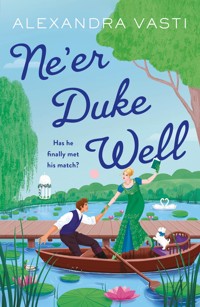
"Hot, smart, funny, and charming as hell" - Alix E. Harrow on THE HALIFAX HELLIONS series. The final novella in Alexandra Vasti's Halifax Hellions series. In 1811, Winifred Wallace told one lie. To secure her future as an independent sheep farmer, she invented an estranged husband named Mr. Spencer Halifax and forged their marriage record. Ten years later, her deception catches up with her: in the form of the disturbingly real, distressingly attractive earl on her doorstep. Spencer Halifax wants to set a good example for his beloved hellion sisters. Ever since their father's death, he's tried to play the role of sensible earl - and involving himself with a felonious sheep farmer is decidedly not sensible. But Winnie's passion and fierce self-reliance draws him in, even as her closely guarded secrets keep him out. When Spencer asks Winnie to travel with him to London to disentangle their semi-legal union, she's horrified. London is where her mother stole several lavish necklaces from noblemen. But she cannot pass up the chance to return the stolen jewelry. Though returning the gems is more difficult than Winnie imagined, and she soon realizes that the only way forward is to trust Spencer with the truth of her past. Even if doing so threatens their pretend marriage and the all-too-real feelings between them.
Sie lesen das E-Book in den Legimi-Apps auf:
Seitenzahl: 245
Veröffentlichungsjahr: 2025
Das E-Book (TTS) können Sie hören im Abo „Legimi Premium” in Legimi-Apps auf:
Ähnliche















Praise for Earl Crush
“Wildly delightful! With Earl Crush, Alexandra Vasti has crafted a marvellously funny and sexy read featuring a brawny Scottish earl, zebras, and a feminist heroine ahead of her time. This belongs on every romance reader’s keeper shelf!” — USA Today bestselling author Joanna Shupe
“I dare anyone to read this book and walk away without a crush on this earl! Arthur Baird is the new definition of a pining, besotted hero, and his deep love and appreciation for Lydia Hope-Wallace’s mind and courage had me swooning. Both a rollicking romp and the most tender of love stories, Earl Crush is sexy, kind, and full of adventure! Alexandra Vasti is an immense talent, and I look forward to reading everything she writes until the end of time!” — Naina Kumar, USA Today bestselling author of Say You’ll Be My Jaan
“With her deft hand for writing witty banter, endearing characters, and smoking-hot chemistry, Alexandra Vasti’s Earl Crush will enchant readers and establish her as a breakout star of historical romance!” — Liana De la Rosa, author of Ana María and The Fox
Praise for Ne’er Duke Well
“As hot as it is heartfelt, this will have historical romance fans hooked.” — Publishers Weekly, starred review
“The kind of romance you want to wrap around yourself like a blanket.” — NPR
“Ne’er Duke Well is a delightful, quicksilver romp with unforgettable characters that readers will be rooting for from start to finish.” — Deanna Raybourn, New York Times bestselling author of the Veronica Speedwell series
“An irresistible delight from a remarkable new talent . . . Vasti has quickly earned her place on my list of favourite writers.” — India Holton, author of The Wisteria Society of Lady Scoundrels
“A witty page-turner with two adorable leads whose funny banter and chemistry is off the charts! I didn’t want their antics to end.” — Virginia Heath, author of Never Fall for Your Fiancée
“Utterly delicious and undeniably clever, Alexandra Vasti’s Ne’er Duke Well was unputdownable . . . Regency romance fans everywhere will love this warm, wonderfully witty, and oh-so-sexy novel just as much as I did. What a spectacular debut!” — Amy Rose Bennett, author of Up All Night with a Good Duke
Praise for the Halifax Hellions series
“These stories are hot, smart, funny, and charming as hell—much like the Hellions themselves. I’ve read them each twice.” — Alix E. Harrow, New York Times bestselling author of Starling House
“Emotional and sexy and full of thrilling hijinks with jaw-dropping prose that transports you in every possible way. Each sibling and their partner has a unique journey, but there’s an undeniable thread of finding radical acceptance in love that ties the three together beautifully. Alexandra Vasti has easily secured her place as a superstar in the genre.” — Jessica Joyce, USA Today bestselling author of You, with a View
“Alexandra’s plots are so zany and so fun but also earnestly explored and impeccably executed! Perfect for anyone who loves Tessa Dare but with a fresh voice wholly her own. I will pick up anything Alexandra writes.” — Rosie Danan, USA Today bestselling author of Do Your Worst
“Delightful, truly scrumptious — like if Lisa Kleypas and Tessa Dare had a sexy baby. Alexandra Vasti is my favourite writer, full stop.” — Mazey Eddings, USA Today bestselling author of Late Bloomer
“Filled to the brim with heart and heat, these absolutely delicious stories are not only ideal comfort reads but master classes in novella writing. I’m forever in awe of Alexandra Vasti’s talent.” — Sarah Adler, USA Today bestselling author of Happy Medium
ALSO BY ALEXANDRA VASTI
Ne'er Duke Well
Earl Crush
THE HALIFAX HELLIONS SERIES
In Which Matilda Halifax Learns The Value of Restraint
In Which Margo Halifax Earns Her Shocking Reputation
First published in eBook in the United States in 2024 by St Martin’s Publishing Group, an imprint of Pan Macmillan.
First published in eBook in Great Britain in 2025 by Corvus, an imprint of Atlantic Books Ltd.
Copyright © Alexandra Vasti, 2024
The moral right of Alexandra Vasti to be identified as the author of this work has been asserted by her in accordance with the Copyright, Designs and Patents Act of 1988.
All rights reserved. No part of this publication may be reproduced, stored in a retrieval system, or transmitted in any form or by any means, electronic, mechanical, photocopying, recording, or otherwise, without the prior permission of both the copyright owner and the above publisher of this book.
No part of this book may be used in any manner in the learning, training or development of generative artificial intelligence technologies (including but not limited to machine learning models and large language models (LLMs)), whether by data scraping, data mining or use in any way to create or form a part of data sets or in any other way.
This novel is entirely a work of fiction. The names, characters and incidents portrayed in it are the work of the author’s imagination. Any resemblance to actual persons, living or dead, events or localities, is entirely coincidental.
A CIP catalogue record for this book is available from the British Library.
E-book ISBN: 978 1 80546 592 8
Corvus An imprint of Atlantic Books Ltd Ormond House 26–27 Boswell Street London WC1N 3JZwww.atlantic-books.co.uk
Product safety EU representative: Authorised Rep Compliance Ltd., Ground Floor, 71 Lower Baggot Street, Dublin, D02 P593, Ireland. www.arccompliance.com
Table of Contents
Praise for Alexandra Vasti
Title Page
Also by Alexandra Vasti
Copyright
Dedication
Prologue
Chapter 1
Chapter 2
Chapter 3
Chapter 4
Chapter 5
Chapter 6
Chapter 7
Chapter 8
Chapter 9
Chapter 10
Chapter 11
Chapter 12
Chapter 13
Chapter 14
Chapter 15
Acknowledgments
Ad:
Ne'er Duke Well
Landmarks
Cover
Title Page
Dedication
Prologue
Chapter 1
Acknowledgments
Contents
Copyright
Start of content
To the Heroines of Chaos, with love
Prologue
1811
At twenty years of age, Winifred Wallace had to her name one dress, seventy-two pounds sterling, and three necklaces dripping with diamonds.
When one was utterly alone in the world, Winnie reflected, it was rather a good thing to be rich.
Unfortunately, as she could not bring herself to sell, pawn, or otherwise divest herself of the necklaces, her funds were somewhat circumscribed. She was not, however, too poor to rent a small cottage and a plot of land on the farthest tip of western Wales.
No, money was not the problem. She had the funds. And yet, as she stared at the Viscount Loxley’s elderly steward across the desk, she felt suddenly, alarmingly unsure of herself.
She had the money—and yet she did not know if she could bring it about.
The steward stared at her over his half-moon spectacles. Winnie put her hand inside her large netted reticule and squeezed the coins that clinked inside. The coins felt cool and hard and real beneath her hands. They would not vanish. She could do this.
“You’ve come to rent the cottage?” the grizzled man repeated. “You mean to … raise sheep?”
“Yes,” Winnie said. She flipped the coins nervously between her fingers, hidden by the fabric of the bag. Four coins for the Southdown ram. Another two for the ewes. One for the materials to build the hay-rack, and another four for the winter’s fodder.
And twenty for the first year’s rent—if she could just persuade this man to let her have the cottage.
“You,” the steward repeated. He nudged his spectacles with the tip of one gaunt finger. “Alone.”
“Yes,” Winnie said again, more definitely.
She loved sheep. She was an expert on sheep. She had borrowed every book on animal husbandry available at Heavisides’ Select Library; she knew the precise time to wean a lamb from its mother and the earliest indications of hoof-ail. She could discern a Southdown from a Merino at twenty paces.
At least, theoretically. She had never actually seen a sheep at closer than twenty paces. In fact, Winnie had never been on a farm of any kind, had never even left London prior to her flight a week ago.
But she’d known, somehow. She had known it was coming, from the brittle brilliance of her mother’s smile and the violent rapping on the door at night. When her mother had spilled handfuls of guineas and jewels on the chaise longue and flashed her signature feline smile, Winnie had not even been surprised.
“Take your pick, beauty,” her mother had said. “I’m for Paris. Do you want the Champs-Élysées, or the money?”
Winnie had chosen the money.
She thought her mother had been expecting it. Their final parting.
Eliza Wallace might not have understood her daughter, who hated glitter and flash, whose greatest desires centered around a library and a flock of sheep, but she knew Winnie. She’d known what Winnie would choose.
Perhaps, those last months, when Eliza had worn her bodice ever-lower, had charmed just one more aristocrat and stolen just one last pair of diamond ear-bobs, she had been thinking of her daughter. Perhaps she had been setting aside this money for when they would eventually part: Eliza for France, and Winnie for her precious sheep farm.
Or perhaps not. Perhaps Winnie only wanted very much to believe that her mother had cared.
Winnie raised her chin and looked at the steward across his desk. “I can afford the rent. There is no reason for you to balk. I am well prepared to establish my flock on these lands. I will make no trouble for you or for Viscount Loxley.”
“But a woman alone”—the steward’s voice was reedy and uncertain—“it’s just not done. The men in the village will be at you night and day! The viscount likes for things to be proper, you know.”
And for the first time since her mother had left, a trickle of anger slid in between Winnie’s fear and uncertainty and frantic desire for independence. The men would be at her night and day? And yet she was the one to be punished—simply because she was not married?
It was asinine. It was unjust.
For once, Winnie could understand why her mother had taken such pleasure in having her way with wealthy men, in deceiving them and stealing from them, and leaving them so utterly besotted that they almost did not mind what they’d lost.
Winnie gritted her teeth. No. No. She would not lose her cottage over this. There had to be another way. There had to be a solution to this problem.
She could think of only one.
Slowly, she made herself relax the tense muscles of her jaw. Slowly, ever so slowly, she forced her lips up into a smile. Her mother’s smile, wide and feline and entrancing.
It had the intended effect. The steward looked suddenly uncertain.
“Sir,” Winnie said, “you’ve misunderstood entirely. There will be no men after me because I am already married.”
“You … are?” The steward gazed at her doubtfully. Winnie amplified the smile. “Are you a widow then?”
“Certainly not.” That would not do. A young widow? She’d be inundated by gentleman callers on the morrow. Winnie searched her imagination.
“My husband and I are estranged,” she decided. “He has chosen to remain in London, while I have elected to live independently here in Llanreithan.”
“And he does not mind, your husband?”
Winnie waved a hand airily. “He is a modern man.” Inspiration struck, and she made her face stiffen a bit, as though she were hiding a wound. “He has … found other companionship. It is of no consequence to me, of course.”
She allowed her voice to crack on the final word. Dear God, she was her mother’s daughter, for all that she did not want to be.
The elderly steward leaned forward. He had softened toward her. She could feel it.
“And you so young!” he said. “A sin, that’s what I say. Is that why you introduced yourself as Miss Jellicoe when you entered?”
Oh blast, she had. Hell. She had chosen her pseudonym on the mail coach as she’d ridden from London to Llanreithan. She’d plucked the name from the address on an envelope that she’d watched slip from a satchel of letters and fall onto the street. The wind had caught it; the envelope had fluttered into the air and then wheeled merrily up, up, into the sky and away.
“Ah,” she said. She pinched her own thigh through her skirts until her eyes started to fill with tears. “Yes. You’ve found me out. I should not have tried to deceive you, only it has been so difficult to come to terms with my separation from my husband.”
She made her voice grow rather tragic. The steward leaned forward, utterly enthralled. “In fact, I am Mrs. Spencer—”
Oh hell, why had she said Spencer? It had just popped out, familiar on the tongue—the very pseudonym her mother had used in London, and thus utterly unsuitable.
“Er,” she tried again, “Mrs. Spencer…”
Think, Win, think! A town, a name—the place you were born—say something!
“Halifax,” she said. “I am Mrs. Spencer Halifax.”
Chapter 1
Ten years later
Spencer Halifax, Earl of Warren, looked at the jailer. The man was built like a bull—a short bull—and appeared to be missing at least three fairly important teeth.
“You are certain?” Spencer asked. He tried to peer again into the dimness of the tiny ring of cells, but it was no use. It was too dark, and the building was too windowless, and the cells were entirely too fetid. “You’re certain she’s in there?”
“Oh, aye, she’s in there.” The jailer spat directly on the floor. “A hellish vixen, she is. She’s been here eighteen hours, and the only moment of peace I’ve had is when I went to piss. Screeching and caterwauling to wake the dead and—”
The jailer paused and looked up at Spencer. It was several inches up, and his loutish form seemed to quail a bit, deflating under Spencer’s gaze. He did not, perhaps, often encounter men who could outmatch him in a fight without breaking a sweat.
“Who did you say she was to you?” the jailer asked.
“I didn’t.”
Spencer thought again of the letter he’d received from his solicitor. Of the hours he’d spent on the coach staring in consternation at the fair copy of the ten-year-old marriage record.
Winifred Halifax.
Mrs. Spencer Halifax.
“I believe,” he said, “that the woman you have incarcerated in this hellhole is my wife.”
The jailer choked. “Ah—begging your pardon, sir, but surely—surely—”
The man looked up into Spencer’s face and appeared to think the better of what he was about to say.
“Take me to her,” Spencer instructed, and the jailer backed nervously away.
As he followed the jailer deeper into the dank interior, Spencer tried to gather his wits.
Two months ago, his best friend and solicitor, Henry Mortimer, had brought to him a newspaper clipping. A woman calling herself Mrs. Spencer Halifax had come to Henry’s attention after the startling commercial success of her naturally dyed woolen embroidery floss.
Mrs. Halifax’s Handmade Thread, the advertisement read. Rich lustrous embroidery for les femmes à la pointe du raffinement—for the first time available on English shores.
The implication that Mrs. Halifax had just sailed in from Paris with boxes of high-grade woolen yarn struck Spencer as rather amusing. He doubted there was a Mrs. Halifax at all—certainly not the seductive golden-haired Aphrodite in heavily embroidered evening wear who graced the advertisements.
Henry had found it all somewhat less funny. “Does it not trouble you that the woman is parlaying your name for attention?”
“She’s not calling herself the Countess of Warren, is she?”
Henry had looked put out. “Of course not—she could be jailed for that. But I suspect she looked you up in Debrett’s and used your name for her own notoriety.”
“We have plenty to go around.” Between their wealth, their connection to one of the royal dukes, and his twin sisters’ flamboyant talent for getting themselves into scrapes, the Halifax name was not precisely what it had been when Spencer’s father—the fourth earl—had been alive.
But that fact gave Spencer a hot, uncomfortable feeling in his chest, so he tried not to think about it.
Henry had compressed his lips. “Be that as it may, I question her motives.”
Spencer had rubbed his temples, wondered briefly if at twenty-eight he could be old enough to need spectacles, and told Henry to look into Mrs. Spencer Halifax and her woolen thread if it pleased him to do so.
Henry, who was both diligent and clever, had tracked down Mrs. Halifax’s advertisement printer, and from there her man of business. Spencer had been startled to discover that she was real and living in a place called Llanreithan, which was decidedly not in France but rather in Wales.
According to Henry’s formidable investigative skills, Mrs. Halifax lived alone in Wales while her husband—Spencer Halifax—made his home in London.
Henry had shuffled his papers with an air of agitation. “Does this not concern you?”
“Why would it concern me? Surely I cannot be the only man with the name in a city of a million inhabitants.”
“All of you exhaust me,” Henry had mumbled.
“Who?”
“Halifaxes. All of you. Damn it.”
Spencer had waited patiently for Henry to elaborate, but no revelations appeared forthcoming.
That had been the end of the matter—though in truth, Spencer found himself thinking of embroidery rather more than was his usual—until Henry had stormed into Spencer’s office one evening before dinner, looking fantastically disheveled.
Spencer blinked. He had seen Henry discomposed a time or two in their decade of friendship—thrice, probably, though one of those times Spencer had been so deep in his cups he could not precisely recall Henry’s appearance—but it was not a usual occurrence.
“I found the banns,” Henry declared. His hair was standing on end above his left ear.
“Whose banns?”
Henry withdrew a battered leather portfolio from his brief-bag. “Yours.”
“What the devil could you possibly—”
Henry flipped open the portfolio across the polished surface of the huge mahogany desk. “It’s that woman. Mrs. Halifax, in Wales. I wanted to confirm that she was not using your name for her own nefarious purposes—”
“Nefarious purposes? For God’s sake, Henry, she makes thread.”
“So I looked for record of her marriage. It took a few weeks—the post seems rather slow between here and that particular part of Wales—but her parish church assured me that the marriage was all aboveboard. They had a copy of the banns themselves, you see.”
Spencer stared at his friend. “I don’t understand what any of this has to do with me.”
“They had a copy of the banns,” Henry explained patiently. “Not the real thing. Because the real banns were filed here in London ten years ago. They sent me their copy when I raised the specter of legal action—”
“You did what?”
“Look, Spencer! Look at the damned banns!”
Dear God, Henry must be agitated. Spencer looked.
And then he blinked, rubbed his eyes, and looked again.
I certify that the banns of marriage between Spencer George Halifax of [illegible smudge] Mayfair and Winifred Wallace of 79 Hackney Road were duly published in the Church of Saint Mary le Bow for the first time on January 12th of 1811, for the second time on January 19th of …
He looked back up at Henry. “What on Earth…”
Henry scrubbed his hand through his hair, disordering it further. “I told you. I told you the woman had some ulterior motive. That is you, Spencer. She’s used your name. She’s used your address!”
Spencer George Halifax. “I’m certain there are plenty of men with George as their second name,” he protested. “For God’s sake, it’s the king’s name.”
“Are there any other Spencer George Halifaxes living at Number Twelve Mayfair?”
Spencer stared down at the handwritten page. “Are you certain that says twelve? I rather think it might read twenty. Or eight, if I tilt the page a bit…”
“It is undeniable,” Henry said flatly, “that for whatever reason, this woman has chosen to pass herself off as your wife.”
“I was eighteen in 1811, for Christ’s sake. I wasn’t getting married—I was getting drunk with you at Cambridge.”
His parents had not yet died. He had not yet become the earl. He had still been just plain Spencer, wild and careless and young.
“I went to Bow Church,” Henry said, “but their records for that year were lost in a fire.”
“Good God.” If this Mrs. Halifax was some kind of confidence woman—not that he believed that she was—she was proving to be shockingly good at covering her tracks.
“I suggest you go down to Llanreithan and determine from where they’ve procured this copy of the banns. If this Mrs. Halifax claims to have the original, perhaps you can examine it more closely.”
“To what end?” Spencer asked. “I’m not going to bring the woman up on charges, for God’s sake. She has done nothing to harm me or mine.”
“You don’t understand.” Henry ran a hand through his hair again and looked down at the desk. “If the original records cannot be obtained to prove that this Spencer George Halifax was not you Spencer George Halifax, then this semi-legible fair copy might be all that we have to go on.”
“Meaning…?”
“Meaning that if this Mrs. Halifax claims she is married to you—with these banns as evidence—you might not be able to contradict her.”
“I—what?”
“Spencer.” Henry’s dark eyes fixed on him with an expression he could not quite interpret. “In the eyes of the courts, you might actually be married to this woman.”
That information had been highly motivating. Spencer had packed, given the very thinnest of excuses to his sisters, Margo and Matilda, and set off for Wales the very next day.
Llanreithan was about as far from London as it was possible to be and still be on dry land—a full week’s travel by coach. He was not fond of long carriage journeys. Despite nearly a decade of forcing himself into the proper mold of the Earl of Warren, he still preferred to be out-of-doors as much as possible, his face to the sky and his feet in the dirt.
Henry had taken a first at Cambridge. Spencer had mostly clung to Henry’s coattails, and tried to do what he’d thought his father would have wanted him to do.
That memory was enough to force him into the carriage where he belonged, though he would rather have been on horseback, riding alongside. He would have preferred the frigid drizzle of autumn rain and the exhaustion of a long day’s ride, rather than the stiff-limbed discomfort of a day in repose. But he was the earl now, so he did what he was supposed to do.
By the time he’d arrived in Llanreithan, a minuscule village consisting of a single main thoroughfare, he’d mostly convinced himself that the entire thing was some kind of bizarre misunderstanding.
Spencer George Halifax. There had to be plenty of those.
Didn’t there?
After he’d seen the horses settled at the village’s sole inn, he’d gone inside and asked after Mrs. Halifax. He’d introduced himself as the Earl of Warren—traveling in the family coach made that somewhat inevitable—and refrained from giving his personal name.
The inn’s landlady—a pale wizened woman with a permanent purse to her lips—had, if anything, grown even more pinched. “Mrs. Halifax? You’ll have to ride on to Treffynnon, then, m’lord. That’s where they put her last night, the great steaming goats.”
“What’s in Treffynnon?”
The landlady made a little huff of outrage. “The jail.”
He had not been able to glean much more than that. The landlady had muttered rather evilly about “sheep” and “goats” and “jackasses” and Spencer honestly was not sure at what point she’d switched from livestock to curses.
He’d retrieved one of his horses from the stable where it had been posted for all of a quarter-hour and ridden on to Treffynnon, unable to contain his curiosity.
Was his wife—
Dear God, he quashed that insane thought promptly.
Was this totally-unknown-to-him Mrs. Halifax infamous for her crimes then? Perhaps she had already attempted to use his title and been caught out?
Perhaps he could interrogate her while she was incarcerated and be back at the inn by suppertime, secure in the knowledge that her real husband—whoever the poor sod was—could be easily distinguished from himself.
Treffynnon was a marginally larger village—he would still hesitate to call it a town—and a bluff man leading a scraggly flock of sheep boomingly directed him to the jail.
But as he entered it, he found himself growing uneasy. The place was foul; the jailer more so. He wondered, a bit bizarrely, if in the eighteen hours she’d been jailed, Mrs. Halifax had been given enough to eat and drink. If she could even bring herself to eat and drink, given the stench that seemed to permeate the building.
“Here she is.” The jailer stopped in front of a cell and made a flourishing gesture with his arm. “Your lady wife. In the flesh, as whole and hearty as when she came here. Sir.”
By God, the man had changed his tune. It made Spencer feel a little sick. How had the woman been treated before he’d arrived? And how would they go on to treat her if he—her supposed husband—abandoned her again?
He peered through the small barred square in the door. Inside the dim cell, what had appeared to be a pile of rags thrust itself upright and turned into a woman.
At least, it seemed to be a woman. He could scarcely make her out. She was begrimed from head to toe, her hair so dirty he could not discern the color. She had mud smeared across her cheek and she smelled of—
Ah. Hmm. Perhaps that wasn’t mud on her face. Perhaps it was sheep shit.
“Pritchard,” she said, “what the bloody hell is going on?”
Her voice was a shock. Spencer had expected the lilting tones of Wales, but her accent was precisely modulated, somehow aristocratic despite the oaths tripping off her tongue.
“I’ve brought you a visitor,” Pritchard said loudly, and then muttered something under his breath that Spencer did not like the sound of.
Spencer stepped away from the door to face the jailer. “What are the charges against her?” he heard himself ask.
“Thievery,” said Pritchard and spat again on the floor. “Trespassing.”
Dear God, this place was bleak. Spencer wouldn’t leave a dog here. Hell, he wouldn’t leave a sheep here, despite the place smelling distinctly of their excrement.
“This is absurd,” the woman said. “Turner Green has had it out for me ever since my ram beat out his at the county fair in 1816.”
“Mr. Green tells it differently—”
The woman let out a tiny shriek, like the short blast of a whistle. “Of course he does, the muckworm! I was rescuing my lamb on his property. I’d bet my best ewe that Turner Green knocked the damned fence down himself so he could accuse me of theft—I am going to kill him when I get out of here—”
“Threats,” said Pritchard. “Attempted assault.”
“I have not assaulted anyone, you blasted nodcock!”
“Nearly scratched my eyes out, she did,” Pritchard informed Spencer.
The woman in the cell was growing agitated, flinging her arms about and fluffing up within her rags like an outraged chicken. “Maybe if your eyes hadn’t been pointed in the direction of my bosom, you would have dodged in time!”
The smaller man looked uneasily at Spencer. “No harm in looking.” He attempted a sickly chuckle, which died in his throat when Spencer did not echo him.
Christ. Jesus bloody bollocking Christ. This was not his responsibility. He did not know this woman. He didn’t owe her anything.
“No one’s come for her?” he asked.
“Not until you.”
There was no one else. He looked around at the dank walls, oozing moisture from the frigid rain outside. He glanced again through the bars at the woman’s rags, at the mud and shit and whatever other horrors coated her face and hair.
Whatever she had done, she did not deserve this. He could get her out, take her back to her home, and question her there.
The woman had started at the unfamiliar sound of his voice; he suspected she could not see him well from inside the dark cell.
“Pritchard,” she said, “who is that?”
This was probably a terrible idea. Henry suspected she was a confidence woman, and Henry was the most sensible person Spencer knew. The rational thing would be to leave her here: let her solve her own problems and rescue her own damned sheep.
But as much as he tried, Spencer couldn’t always make himself do the rational thing.
“How much?” he asked Pritchard.
The jailer, who’d just opened his mouth to answer Mrs. Halifax’s query, hesitated, looking back and forth between them. His gaze landed upon Spencer, and the fact that he ignored Mrs. Halifax utterly only strengthened Spencer’s sudden, demented resolve.
“How much for what?”
“To have her out of here. To make the charges against her go away.”
“What the devil—” began Mrs. Halifax.
Avarice did not improve the jailer’s face. He named an eye-popping sum, and Spencer did not hesitate to count out the coins.




