


63,99 €
Mehr erfahren.
- Herausgeber: John Wiley & Sons
- Kategorie: Wissenschaft und neue Technologien
- Sprache: Englisch
Short, compelling, but mostly thought-provoking essys that encompass many of the central issues shaping ecology and conservation in the changing world
- Collected essays from one of the best known ecologists and conservationists in the world
- Includes all issues at the cutting edge of the interface between ecology and conservation
- Attractive to a broad audience of ecologists, conservationists, natural resource managers, policy makers, and naturalists
Sie lesen das E-Book in den Legimi-Apps auf:
Seitenzahl: 634
Veröffentlichungsjahr: 2016
Ähnliche


















Table of Contents
Cover
Title Page
Copyright
Dedication
Preamble: Why this book?
Acknowledgments
Essay 1: How did I get here?
Essay 2: Found! The survivor in the swamps (2005)
Essay 3: In defense of footnotes (2014)
Part I: Change, the challenge
Chapter 1: Conservation and change
Chapter 2: A digression on paradigms
Essay 4: The power of paradigms (2014)
Essay 5: Patterns, paradigms, and preconceptions (2013)
Essay 6: Fat times, lean times, and competition among predators (1993)
References
Chapter 3: Equilibrium, stability, and change
Essay 7: From our southern correspondent(s) (2011)
Essay 8: Boom and bust: lessons from the outback (2014)
Chapter 4: A digression on disturbance
Essay 9: Oil, oil, everywhere…(2010)
Part II: The forces of change
Chapter 5: Climate change and sea-level rise
Essay 10: Polar bears, golden toads, and conservation futures (2008)
Chapter 6: Land-use change
Essay 11: Will land-use change erode our conservation gains? (2007)
Essay 12: Landscape ecology: the science and the action (1999)
Chapter 7: Distributional changes: invasive species
Chapter 8: Societal, cultural, and political change
Essay 13: Wildlife, people, and water: who wins? (2012)
Chapter 9: Population growth
Chapter 10: Linkages among changes
Part III: Conservation conundrums
Chapter 11: Variation and history
Essay 14: The eclipse of history? (2008)
Essay 15: From our southern correspondent(s): which history?
Chapter 12: A digression on baselines and targets
Essay 16: Shooting at a moving target (2011)
Chapter 13: Ecological thresholds
Essay 17: Tipping points in the balance of nature (2010)
Chapter 14: Ecological resilience
Chapter 15: Dealing with novelty
Essay 18: Black swans and outliers (2012)
Essay 19: Moving outside the box (2009)
Chapter 16: Uncertainty: a boon or a bane?
Essay 20: Taking risks with the environment (2012)
Essay 21: Uncertainty and the relevance of ecology (2008)
Chapter 17: Prioritization and triage
Essay 22: Talking about triage in conservation (2015)
Chapter 18: Protected areas: where the wild things are
Essay 23: Build it and they will come (2013)
Essay 24: The dangers of black-and-white conservation (2007)
Chapter 19: Ecosystem services and the value of nature
Essay 25: What's so new about ecosystem services? (2007)
Part IV: Doing conservation
Chapter 20: What is it we are trying to conserve?
Essay 26: Be careful what you wish for (2014)
Essay 27: Concluding comments: Are bird communities real? (1980)
Essay 28: A metaphor meets an abstraction: the issue of “Healthy Ecosystems” (2015)
Chapter 21: Numbers, numbers, numbers
Essay 29: Is “monitoring” a dirty word? (2009)
Essay 30: The place of long-term studies in ornithology (1984)
Essay 31: What use is small data in a big data world? (2013)
Chapter 22: A digression on words
Essay 32: Word processing versus writing (1983, 2011)
Chapter 23: Debates in ecology and conservation
Essay 33: On skepticism and criticism in ornithology (1981)
Essay 34: The demise of wildness? (2007)
Chapter 24: What lies behind the debates? Philosophy, values, and ethics
Chapter 25: A digression on advocacy in conservation
Essay 35: Scientific responsibility and responsible ecology (1997)
Part V: Concluding comments
Chapter 26: Whither ecology and conservation in a changing world?
Essay 36: “It was the best of times, it was the worst of times…” (2009)
Essay 37: Being green isn't easy (2010)
Essay 38: Stewart Udall and the future of conservation (2010)
References
Scientific names of species mentioned in the text
Index
End User License Agreement
Pages
xi
xii
xiii
xiv
11
13
14
15
16
17
18
19
20
21
22
39
40
41
42
43
57
58
59
69
71
72
73
74
75
79
80
81
82
83
84
91
92
93
94
95
96
97
98
99
105
106
107
108
109
110
111
112
113
114
115
117
118
119
120
121
129
130
131
132
138
139
140
141
142
143
149
150
151
152
153
154
155
156
157
158
159
167
168
169
170
171
180
181
182
183
184
185
186
187
191
192
193
194
195
196
206
207
208
209
210
215
217
218
219
220
221
237
238
239
240
251
252
253
257
258
259
260
261
262
263
270
271
272
273
274
275
276
277
278
279
285
287
288
289
290
291
301
302
303
304
305
306
307
308
309
310
311
312
313
314
315
316
317
318
319
320
321
323
324
Guide
Cover
Table of Contents
Part I: Change, the challenge
Begin Reading
List of Illustrations
Chapter 2: A digression on paradigms
Figure 2.1 The “Kuhn cycle.” Initially, observations, speculations, theories, tools and methods, and other features of a developing area of activity within a science coalesce into a cohesive worldview—a paradigm—which guides research to explore the problems and puzzles posed by the paradigm—normal science. As anomalous observations and results that do not mesh comfortably with the paradigm accumulate, a crisis and scientific revolution may follow, producing a shift to a replacement paradigm that does a better job of explaining things, and the cycle continues.
Chapter 3: Equilibrium, stability, and change
Figure 3.1 A conceptualization of the changes that may occur in ecological systems. The graph is not intended to illustrate a particular time sequence, but a spectrum of dynamics from steady-state equilibrium to thresholds and alternative system states. The horizontal bars illustrating equilibrium and nonequilibrium dynamics show the sorts of variations that have been considered by ecologists who have espoused one or the other view of ecological systems. Although the diagram illustrates different sorts of temporal dynamics, it may also apply to variations in space. “Equilibrium” and “nonequilibrium” are equivalent to “homogeneous” and “heterogeneous,” respectively. “Trends” may indicate gradients or ecotones, while “thresholds” may be the counterpart of sharp boundaries or discontinuities between places, habitats, or cover types in a landscape.
Chapter 5: Climate change and sea-level rise
Figure 5.1 Yearly average temperature for California since records began in 1895. Note the high annual variation, the long-term trend, and the extreme value for 2014, which surpassed previous records by 1.8 °F. This graph provides an empirical example of some of the forms of change depicted conceptually in Figure 3.1.
Figure 5.2 Annual average global ocean heat content, 1955–2014.
Figure 5.3 Monthly mean atmospheric levels of CO
2
at Mauna Loa Observatory, Hawai'i. The trend line represents the seasonally corrected data. Data are reported as a dry mole fraction defined as the number of molecules of carbon dioxide divided by the number of molecules of dry air multiplied by 1 million (ppm).
Chapter 6: Land-use change
Figure 6.1 Changes in forest cover in Cadiz Township, Wisconsin, from the time of European settlement in the 1830s until 1950.
Figure 6.2 A forested landscape perforated by housing in Massachusetts.
Chapter 7: Distributional changes: invasive species
Figure 7.1 An area in Queensland, Australia, formerly covered with prickly pear cactus (
Opuntia stricta
). The cactus was introduced to the region in 1926, and 3 years later the moth borer (
Cactoblastis cactorum
) was introduced as a biological control agent to reduce populations of the cactus.
Chapter 9: Population growth
Figure 9.1 World human population (ascending curve) and annual growth rate (variable curve), 1900–2050 (projected), based on United Nations data.
Chapter 10: Linkages among changes
Figure 10.1 Water flowing through the California Delta is the main source of supply for two major California water delivery projects, the State Water Project and the federal Central Valley Project. Millions of Californians rely on water from the Delta for their drinking water, and one-third of the state's cropland uses water flowing through the Delta.
Figure 10.2 Fall mid-winter trawl Delta smelt annual abundance indices, 1967–2014. Note that the 2014 survey recorded only nine smelt, the smallest number ever recorded. This occurred despite court-ordered measures to protect the smelt by ensuring adequate water flows at critical times of year.
Figure 10.3 The South Fork of the Feather River feeding Lake Oroville, California, on September 5, 2014, during the third year of unprecedented drought. Lake Oroville is the second largest reservoir in California. When full, the lake elevation is 736 ft (224 m); when this photograph was taken the lake elevation was 678 ft (207 m).
Chapter 11: Variation and history
Figure 11.1 The conceptualization of kinds of environmental change shown in Figure 3.1, indicating (roughly) the windows through which ecologists and conservationists traditionally viewed system dynamics under a presumption of equilibrium (a) and of nonequilibrium, variation, trends, and thresholds (b).
Chapter 13: Ecological thresholds
Figure 13.1 The conceptualization of the kinds of changes that may occur in ecological systems shown in Figure 3.1. Relevant here is the transition from a variable state to a threshold and alternative system state.
Figure 13.2 The disappearance of the Aral Sea, Central Asia, 1989–2014.
Chapter 16: Uncertainty: a boon or a bane?
Figure 16.1 In a variable environment, uncertainty increases as one looks farther back into the past or attempts to look into the future. Uncertainty about the past condition of a system may be reduced by historical or paleoecological data, although this becomes more difficult with increasing variation and greater distance into the past. Future conditions may follow one of multiple trajectories, which can be explored using models. The models themselves, however, introduce additional sources of uncertainty.
Chapter 17: Prioritization and triage
Figure 17.1 An endangered California condor flies over the Bitter Creek National Wildlife Refuge, California. This individual was hatched and raised in captivity and then released, fully outfitted with plastic wing tags and GPS electronics.
Chapter 26: Whither ecology and conservation in a changing world?
Figure 26.1 Walt Kelly's poster for the first Earth Day, April 22, 1970.
Ecological Challenges and Conservation Conundrums
Essays and Reflections For A Changing World
John A. Wiens
Winthrop Research ProfessorUniversity of Western AustraliaandEmeritus Distinguished ProfessorColorado State University
This edition first published 2016, © 2016 John Wiley & Sons Ltd
Registered office: John Wiley & Sons, Ltd, The Atrium, Southern Gate, Chichester, West Sussex, PO19 8SQ, UK
Editorial offices: 9600 Garsington Road, Oxford, OX4 2DQ, UK
The Atrium, Southern Gate, Chichester, West Sussex, PO19 8SQ, UK
111 River Street, Hoboken, NJ 07030-5774, USA
For details of our global editorial offices, for customer services and for information about how to apply for permission to reuse the copyright material in this book please see our website at www.wiley.com/wiley-blackwell.
The right of the author to be identified as the author of this work has been asserted in accordance with the UK Copyright, Designs and Patents Act 1988.
All rights reserved. No part of this publication may be reproduced, stored in a retrieval system, or transmitted, in any form or by any means, electronic, mechanical, photocopying, recording or otherwise, except as permitted by the UK Copyright, Designs and Patents Act 1988, without the prior permission of the publisher.
Designations used by companies to distinguish their products are often claimed as trademarks. All brand names and product names used in this book are trade names, service marks, trademarks or registered trademarks of their respective owners. The publisher is not associated with any product or vendor mentioned in this book.
Limit of Liability/Disclaimer of Warranty: While the publisher and author(s) have used their best efforts in preparing this book, they make no representations or warranties with respect to the accuracy or completeness of the contents of this book and specifically disclaim any implied warranties of merchantability or fitness for a particular purpose. It is sold on the understanding that the publisher is not engaged in rendering professional services and neither the publisher nor the author shall be liable for damages arising herefrom. If professional advice or other expert assistance is required, the services of a competent professional should be sought.
Library of Congress Cataloging-in-Publication Data
Names: Wiens, John A., author.
Title: Ecological challenges and conservation conundrums : essays and reflections for a changing world / John A. Wiens.
Description: Chichester, UK ; Hoboken, NJ : John Wiley & Sons, 2016. |
Includes bibliographical references and index.
Identifiers: LCCN 2015044916 | ISBN 9781118895108 (cloth)
Subjects: LCSH: Ecological assessment (Biology) | Conservation of natural resources.
Classification: LCC QH541.15.E22 W54 2016 | DDC 333.72–dc23 LC record available at http://lccn.loc.gov/2015044916
A catalogue record for this book is available from the British Library.
Wiley also publishes its books in a variety of electronic formats. Some content that appears in print may not be available in electronic books.
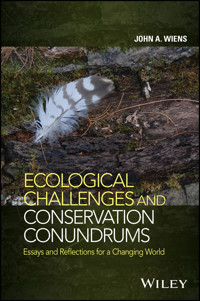
Cover image: Ruffed Grouse (Bonasa umbellus) feather on the forest floor, Vilas County, Wisconsin. Photo: John Wiens
To my grandchildren, Madeleine, Henry, and Annika. May you always enjoy Nature's beauty.
Preamble: Why this book?
Many books have been written about ecology and conservation in the changing world that is fast upon us. This book is an idiosyncratic one. It's not a traditional science book, dealing with facts, figures, explanations, and theories, although it is a book about science. Neither is it a traditional conservation book about protecting biodiversity in the face of the looming environmental crisis or the perils of climate change, although environmental change is the underlying theme. Rather, it's a personal accounting of some of the challenges and conundrums I see confronting ecology and conservation as we move into an uncertain world. Fresh thinking is needed; my hope is to prompt some of that thinking.
The book is built around an eclectic collection of essays that I wrote over the past decade for the Bulletin of the British Ecological Society, plus a few older ones. The Bulletin is distributed to all members of the Society—an appreciative but somewhat circumscribed group of professional ecologists and students, mostly based in the United Kingdom. The essays are presented here as they were published, along with some new prefacing material to explain why I wrote the essay or to update the topic.
Essays, however, are usually written as stand-alone pieces. To tie them together, or at least to keep them from floating off as untethered balloons, I've included some accompanying text to provide context for the essays and offer my thoughts on some topics and issues in ecology and conservation. These writings are really reflections rather than reviews or syntheses. Those who want a textbook, richly annotated with literature citations, will need to look elsewhere, but those who want some fodder for thinking about the challenges facing ecology and conservation will, I hope, find this book rewarding.
I said that this book is not a science book, and that's immediately evident in the writing style. By striving for objectivity, scientific writing tends to avoid opinions and personality. Essays, however, aren't like that. Essays express opinions. They are intended to be stimulating, sometimes controversial, somewhat personal, and even (shudder) entertaining. They are meant to be read and enjoyed. I've kept the accompanying chapters short, so each can be read in a single, relaxed sitting. I've always been interested in why ecologists and conservationists ask the questions or address the issues they do, so I explore the history of ideas—a historiography of sorts—more than is customary. I use examples that I'm familiar with, so there's a lot about California, the American West, and Australia. I've retained the illustrations that originally accompanied the essays, but I've otherwise used pictures and graphs sparingly, hoping that the words will speak for themselves. I haven't gone into technical details and have tried to avoid mystery by limiting the use of jargon. I use footnotes to offer asides and direct readers to some relevant literature, but I relegate the full citations to the end of the book.
This is a book I've wanted to write for some time. I want others—ecologists, conservationists, environmentalists, students, my professional colleagues, resource managers, policy makers, even philosophers; indeed, anyone with an interest in conservation and the natural world—to feel my excitement and share my concerns by thinking about the issues I consider in the essays and chapters. My hope is that, after reading an essay and the writings, you'll nod in agreement—or perhaps you'll nod more vigorously in disagreement (but hopefully not nod off)—and will pause to think, and enjoy the thinking.
The book is organized into five parts. I first set the stage by describing some of the challenges facing ecology and conservation. Some of these challenges stem from the changing world, others from how science and scientific thinking progress. “Change,” however, can take many forms, so I also consider the multiple ways ecological systems can change. In Part II, I discuss several forces behind the changes that make ecology and conservation so challenging, so interesting, and so important. These changes create a variety of conundrums for conservation, which I address in Part III. These “wicked problems” must be tackled if conservation is to achieve its goals; continuing with “business as usual” will not meet the challenges. In Part IV, I comment on some aspects of how ecology and conservation are done: methods, communication, dealing with differences of opinion, and debates. I also comment on some philosophical and ethical undercurrents that run through these debates and the historiographies. I conclude in Part V by attempting to salvage some hope out of what may seem to have been a cataloging of daunting and dismal challenges.
To accustom you to the interspersion of essays with the chapters and to provide background for what follows, I begin with three essays. The first (Essay 1, How did I get here? (page 1)) gives some perspective on where I've come from—what might have led me to think and write the way I do? The second (Essay 2, Found! The survivor in the swamps (2005) (page 4)) provides a parable of sorts for conservation, embodying many of the themes that drive conservation, but especially hope. The third (Essay 3, In defense of footnotes (2014) (page 7)) explains why I use footnotes throughout the book.
Acknowledgments
A simple listing of people would not do justice to the many sources, in many places, at many times, that have nurtured my thinking and shaped my perspectives. These are what make this book a personal tour through some topics that have interested me rather than a comprehensive review of the state of the sciences. Teachers, students, colleagues, adversaries—all have contributed to what's in this book, even though they may not realize it. However, several people have had a special role in helping me mold a confusing mélange of thoughts, experiences, paragraphs, and sentence fragments into something coherent, and they deserve credit.
First, Alan Crowden. Alan is a long-time friend who, in his role as Editor of the Bulletin of the British Ecological Society, first encouraged me to try my hand at writing an essay now and then. “Now and then” became more regular, leading to most of the essays included in this book. Alan carelessly suggested that I write on whatever struck my fancy, so the responsibility for the eclectic nature of the collection rests on his shoulders—I simply took the bait.
Whatever grace and style the essays have is due to my daughter, Kyra, who served as my in-house editor for most of the essays. After laboring to get just the right phrasing, I'd send Kyra what I imagined to be a final version, just needing a tweak here and there. Kyra always—always—found a better way to say things, a more logical flow, a way to shorten my sentences to crystallize the meaning. She left little for Alan to do except pass an essay on to the printer.
Two colleagues have been sounding boards for my thoughts over the years. Mike Scott and I have critiqued each other's ideas and collaborated for nearly 50 years, and Richard Hobbs became a kindred spirit when my attention shifted to landscape ecology, and then to conservation and restoration ecology. Richard also orchestrated an appointment for me as a Winthrop Research Professor at the University of Western Australia, which has provided contemplative as well as physical space, recharged my Aussiephile batteries, and enabled me to access their library holdings from my desk in Oregon.
Others have read bits and pieces of the writings to validate (or, more often, correct) my thinking. I especially thank Jerry Franklin, Dale Goble, Richard Hobbs, Bob Lackey, Ariel Lugo, Michael Nelson, Dick Norgaard, Mike Scott, and Tom Spies. Pete Warzybok and Jamie Jahncke of Point Blue Conservation Science provided graphics and updates on the saga of Cassin's auklets on the Farallon Islands, a great example of all sorts of things (not least the value of long-term monitoring). Cliff Dahm, Peter Goodwin, the staff of the Delta Science Program, and my colleagues on the Delta Independent Science Board helped me begin to understand the Sacramento–San Joaquin Delta in California, where all the challenges and conundrums explored in this book seem to converge in a single place.
That this book emphasizes conservation so much is a consequence of my move from the sheltered halls of academia to the world of conservation NGOs. Steve McCormick took the risk of hiring an ivory-tower professor to be a Lead Scientist at The Nature Conservancy, for which I am forever grateful. Together with Peter Kareiva and M. Sanjayan, the other Lead Scientists, I experienced the challenges of incorporating science into the real-world practice of conservation, and the delight when it happened. Ellie Cohen and the enthusiastic scientists at PRBO Conservation Science (now Point Blue Conservation Science) provided the opportunity to learn about conservation issues in that peculiar state called California.
I've sometimes wondered why authors always acknowledge the support of their family. Is this just something that's politically correct, or is it really that important? Now I know: it's absolutely essential! There's putting up with the aberrant behavior of someone experiencing writer's block,1 or abruptly leaving the dinner table to write furiously when the blockage suddenly breaks. But there's also the deeper understanding and belief in the value of what you're doing. Everyone in my family—Bea, Kyra, Taryn, Ann, Mike, Dave, Susan—is a scientist, artist, or writer, so their understanding extended well beyond what I was trying to do to what I was actually saying. A very special kind of support, for which I'm forever grateful.
1
A condition, according to Wikipedia, in which “an author loses the ability to produce new work or experiences a creative slowdown.” I know it well.
Essay 1
How did I get here?
Essays and writings are by their nature personal, reflecting the personality and perspective of their writers. Writers carry the baggage of their past—their childhood, their family, their teachers, their friends and colleagues, their jobs, their experiences—which affects how they view the world and how they write about it. It's therefore important, I think, that you know something about what's in my bags—how I came to write about the things I do in the ways I do. There are several threads to weave together.
One thread is natural history. I grew up in central Oklahoma. It was a time when kids could roam freely, and I did, riding my bike out of town to spend the days exploring nature. For reasons I can't quite fathom, I almost always headed west, to the prairies, rather than to the woodlands east of town. This was when I developed a fascination for birds. I became a boy birdwatcher, saved my allowance to buy binoculars and a field guide, and joined the Cleveland County Bird Club. As I grew older, my interest in birds was nurtured by several mentors—George Miksch Sutton, Charles Carpenter, Margaret Morse Nice—who took me into the field with them and slowly but surely revealed how birdwatching could be a science as well as a passion. When I decided to major in Zoology as an undergraduate, Sutton hired me as a research assistant to collect birds for the university museum. Such collecting has now fallen out of favor as taxonomy and systematics have become increasingly molecular, but then, in the early 1960s, it was still the foundation of museum work. So I spent my free time (and some time I should have been in classes) roaming the state with David Ligon, observing and collecting. I learned more about ecology, behavior, and natural history in those days in the field than I did in the classroom.
When I went to Wisconsin for graduate work, I joined John Emlen's large group of students. Everyone else was studying behavior and ecology, so I joined in and left museum collecting and systematics behind. I was on the pathway to becoming a behavioral ecologist.
However, I didn't start out to be a scientist. My parents were university professors in the humanities, and my boyhood friends were the sons and daughters of academics, none of them scientists. Little wonder, then, that I enjoyed things academic—reading, writing, and debating. I was much more attracted to the currency of ideas than the cataloging of facts, to asking “why” (or “why not”) questions more than “what” or “how.” In high school, my favorite classes were in English literature, where Francis Dunham alerted me to the nuances of writing and the joys of critical reading. When I started college, my majors (several, at various times) were in the humanities rather than science. Courses in philosophy encouraged challenging of conventional modes of thought, and critical dissections of writing styles and composition structure were the bulwark of my classes in English literature, which I continued to take even after changing to major in Zoology. How many Zoology undergraduates would have time now to take a graduate-level course in Shakespeare from a renowned Milton scholar, as I was able to do?
This background in the humanities fostered my interests in writing, but also my gravitation toward concepts and ideas, along with an inherent skepticism. These traits were slow to surface, however. When I began my graduate studies (that is, when I began to do real research rather than just read about it), ecology was dominated by concepts of equilibrium and order in nature. Perhaps because it appealed to my love of ideas (or simply because it was the prevailing paradigm of the time), I embraced this thinking. My PhD dissertation examined how habitat was partitioned in an assemblage of grassland birds, and I had no reservations in concluding that the community was exquisitely (but subtlety) structured so as to circumvent competition among the species. Only later, after I had expanded my studies into a broader range of grasslands and shrubsteppe over western North America, did I begin to realize that my difficulties in getting my observations to match theory might have less to do with the observations than with the theory itself. Competition theory did not explain everything, everywhere. I became an iconoclast (and, perhaps as I've grown older, a curmudgeon).
What led me to expand the scope of my studies beyond the 100-acre grassland in Wisconsin? Perhaps it was simply an extension of the roaming I had done to the prairies west of town in my childhood, or traversing the state during my museum days in Oklahoma, or perhaps because I had moved to the forested landscapes of western Oregon and yearned for the open spaces of grasslands and shrubsteppe. Whatever the impetus, the broadened perspective alerted me to the importance of scale, which became another thread in the fabric of my thinking. I soon saw that the patterns I had so carefully documented at a single site in my PhD studies began to erode as I expanded the scale of analysis. The habitat associations of species, for example, could change completely with a shift from a local to a regional scale. As my students and I conducted repeated surveys over several years, the patterns we documented changed depending on whether we analyzed one or several years. Scales in space and time affected what we saw and how we interpreted our results. This is now almost a trivial observation, but at that time it was a new insight, at least for me.
All of these studies fell under the rubric of basic science: gathering observations to test theories, accumulating knowledge for knowledge's sake, and pursuing questions because they were interesting. At some point, however, I began to move toward addressing more practical problems. It wasn't because I was suddenly motivated to do something relevant, however. Instead, two of my graduate students who were interested in seabirds saw an opportunity to fund their studies in a program to assess oil development off Alaska. We applied, got the funding, and spent several years doing field studies and modeling. Years later, this work led to a quarter-century involvement in assessing the effects of the Exxon Valdez oil spill on marine birds, deepening my involvement in real-world issues.
As an ecologist, I had long had an interest in conservation. This latent interest was activated when I was asked to lead a review of science in The Nature Conservancy (TNC). As we conducted the review and I learned more about conservation in practice, I became increasingly intrigued. One thing led to another, and I ended up leaving the sheltered halls of academia to join TNC as a Lead Scientist. After several years, I moved to smaller, west-coast organization, PRBO Conservation Science, to see how the lessons I had learned could be applied at a different scale. This brought me back, probably not coincidentally, to birds. And then I decided to retire so I could write this book.
So, that's my story. Careers in science often do not develop following the lines of some carefully scripted plan; at least mine hasn't. The threads of thinking that I bring to these essays and writings—a perspective grounded in natural history, the humanities, and an appreciation for writing; a fondness for concepts combined with a skepticism about their veracity; a joy in the complexities of spatial and temporal variation and scale; and a meshing of science driven by what interests me at the moment with science that is pragmatic and applied—have developed as a sinuously branching braided river, directed by the currents of what came before and wandering this way and that, only then to merge again into something new and different.
Essay 2
Found! The survivor in the swamps (2005)*
*Wiens, J. A. 2005. Found! The survivor in the swamps. Watershed Journal (Brown University). 1(3):11. Reproduced with permission of the Watershed Journal.
This essay provides somewhat of a parable, illustrating several of the themes that characterize conservation. The story begins in the Big Woods of eastern Arkansas in early 2004, when a lone kayaker caught a glimpse of an extraordinarily large woodpecker. Its field marks matched those of an ivory-billed woodpecker, thought for a half-century to be extinct. A fuzzy video recorded two months later appeared to support the identification. Subsequent searches yielded tantalizing hints that the species really was there, and in April 2005 the findings were released to the public.1Excitement spread. That's when I wrote this essay. For several years, teams scoured the Big Woods and other likely areas seeking definitive proof that the bird still existed. There were sightings in other areas, but no irrefutable proof. Hope has given way to disappointment.
What does this say about conservation? Like many species that attract conservation attention, the ivory-bill had iconic status: it was large, visually striking, hung out in nearly impenetrable swamps, and seemed to be remarkably persistent (it had been thought extinct and then rediscovered twice before). I doubt that a less charismatic species would have garnered the same attention. The shreds of evidence that emerged from time to time gave rise to hope—the conservationist's mainstay—that the species might still exist in the depths of the few remaining southern swamps. Like the vast majority of imperiled species, ivory-bills suffered from human actions, primarily logging and the fragmentation and disappearance of its forest habitat.
The responses to the announcement of the sightings in 2005 are also symptomatic of conservation. Non-governmental conservation organizations (NGOs) such as The Nature Conservancy set about quietly buying land to supplement the habitat already protected in wildlife refuges. Government agencies allocated funds to conservation efforts, and the U.S. Fish and Wildlife Service prepared a recovery plan under the auspices of the Endangered Species Act, just to be ready in case tangible evidence of more than a single individual emerged. These actions were driven by the excitement of the discovery rather than a thoughtful and deliberate prioritization process, and they inevitably entailed tradeoffs; the funds allocated to ivory-bill conservation were taken from programs to support other endangered species.2
These themes—the importance of charisma, the effects of habitat loss and fragmentation, the role of NGOs and government actions, the lack of prioritization, and especially the driving force of unrelenting hope—will emerge time and again in the writings and essays that follow.
Once upon a time, virgin forests of mixed hardwoods and softwoods blanketed much of the South. The Civil War and industrialization changed all that. Mature timber was cleared from the uplands and the old forests were increasingly confined to the swampy bottomland. Eventually, most of the bottomland forests also disappeared, drained for agriculture or harvested for their huge trees. Such is the all-too-familiar nature of progress.
These disappearing forests were the province of the ivory-billed woodpecker, the largest and most spectacular woodpecker in North America. Nearly two feet long, with a wingspan of two and a half feet and a flaming red crest, the woodpecker inspired awe from early naturalists and backwoods settlers alike. Individual birds covered immense territories in search of the huge beetle larvae on which they fed, larvae that occurred only in the largest dead and dying trees. With the disappearance of large expanses of forest and the fragmentation of much of what remained into small patches, the woodpecker ran out of habitat and their numbers dwindled. By the 1930s only a few remained, and by the 1940s the species was widely presumed to be extinct. Even so, occasional sightings in the few remaining, remote bottomland swamp forests in scattered places kept the hopes of diehard believers alive.
But now, with the recent sightings and recordings of the Ivory-bill in the Big Woods of eastern Arkansas, we no longer need use the past tense. There are Ivory-bills, lingering still in the depths of backwater swamps and forests.
I remember as a boy birder in the early 1950s buying a tattered copy of James Tanner's monograph on Ivory-bills, being enthralled with the magnificence and mystique of the bird, and dreaming that someday someone would find it again. There was something about the allure of this bird and the eerie places it haunted to give one hope.
All of us who care about nature and conservation are heartened by the very idea that this noble bird could persist for so long, beyond our notice, and it gives us renewed confidence that our efforts to protect endangered species and places such as the Big Woods are, indeed, worthwhile.
However, once the euphoria of the moment has faded, what then? Already some scientists are questioning the reliability of the sightings and sound recordings, and while the government rushed to pledge $10 million to protect the woodpecker's habitat, critics note that this cash infusion has come while budgets for the recovery of other endangered species have been slashed. More to the point, even the best evidence confirms the existence of only one, or perhaps two, woodpeckers. What if this is the last lone bird, its cries for companions echoing silently through the bayous? Will that bring our optimism and hope crashing down? Does that mean that our efforts in protecting the Big Woods or other places have been for naught?
Surely not! The message of this bird is in its startling affirmation of the core philosophy of conservation, of the value of building over many years a place where Ivory-bills can live long and, if all goes well, prosper. Without places of sufficient variety and size, the loss of species like the Ivory-bill will be an inevitable consequence of the inexorable march of progress. But “progress” is not incompatible with conservation. People have been hunting and fishing in the Big Woods for more than a century, and the woodpeckers don't seem to have minded much.
Perhaps these will turn out to be the last sightings of the last of a species. We hope not. But even if it is, this bird has shown us that not all lost causes are really lost, that by protecting such places we keep alive the hope. Somewhere, perhaps, another budding birder may be dreaming of the day when someone, somewhere, hears the “tin-horn” call of an Ivory-bill and is as startled by the vision of a majestic black bird with expansive white wing patches fleeing into the depths of a swampy forest.
1
Fitzpatrick et al. (2005).
2
Additional information about ivory-billed woodpeckers and their conservation may be found in Tanner (1942) and Hoose (2004).
Essay 3
In defense of footnotes (2014)*
*Wiens J.A. 2014. In defense of footnotes. Bulletin of the British Ecological Society 45(3): 41–42. Reproduced with permission of the British Ecological Society.
I believe that this essay speaks for itself. It is my justification for using footnotes throughout this book.
I should note, however, that footnotes, by definition, are placed at the bottom of the page containing the reference. When this and other essays were published in the Bulletin, however, the footnotes were gathered together at the end. Instead of footnotes, this made them endnotes, which I disparaged. Here I've put them back at the bottom of the page.1
I like1 footnotes. I think it goes back to my childhood. Both of my parents were professors in the humanities. Most of the books that surrounded me were about art, literature, philosophy, history, and language. They were full of footnotes. Aside from the science fiction that I bought, I don't recall there being a single science book in the house.
When I went to college, I focused on English literature, continuing to read heavily footnoted texts. It was only in my third year of studies that my earlier interest in birds re-emerged. I switched to major in Zoology and started down the road to becoming a scientist, only to discover that those discursive footnotes I had learned to love for their interesting digressions, commentaries, and speculations were nowhere to be seen.
Such footnotes are generally frowned upon in scientific journals and books. They disrupt the text, rather like speed bumps or detours in the flow of scientific prose. Curious readers will wonder what's behind those little numbers and pause to look, while others will ignore them and miss any nuggets they might contain. If they are lengthy,2 they clutter the page with small type.3 They may also express opinions, which, as we all know, are dangerous and by definition unsubstantiated. They have no place in scientific writing.
I would argue instead that by banishing footnotes and leaving no room for personal viewpoints, scientific writing is itself diminished. Although footnotes in literature, history, and the arts were initially used to demonstrate the thoroughness of scholarship,4,5 they soon took on the additional role of providing commentary, digressions, or opinions, rather like the sotto voce asides that figure so prominently in many of Shakespeare's plays.6 This is what gives footnotes their particular value and makes them more than just another way of citing sources. The really interesting stuff is often in the footnotes. One cannot fully understand the progression of Sir Karl Popper's thinking in The Logic of Scientific Discovery,7 for example, without reading his footnotes. Legal arguments, which rely on precedents to a greater extent than most other areas of scholarship, often contain copious footnote references to previous case law. But here, also, the asides and digressions in footnotes can be extraordinarily important, leading some to suggest that “the most eagerly studied parts of Supreme Court opinions are the footnotes.”8
Such “wandering footnotes”9 are largely absent from scientific writing. Here, however, the prose of Stephen Jay Gould provides a refreshing exception. In his massive synthesis of evolutionary theory,10 Gould used standard scientific notation (author, year) for reference citations and parenthetical clauses (or sentences, or entire paragraphs) to embellish a point. His infrequent footnotes, however, provide delightful and astute asides. In a footnote dealing with controversies over the unit of selection in Darwinian theory11 (p. 598), he observes, “I don't think that mere personal stupidity underlies my puzzlement—or rather, if so, the mental limitations must be largely collective, because other participants share the same struggle and express the same frustrations.” He then goes on to wonder if this reflects an underlying wiring of the human brain to deal in dichotomies. Other footnotes refer to his grandparents (p. 684) or to his graduate (p. 1231) or undergraduate (p. 1290) experiences.
In fact, whether and how footnotes are used is one of the clearest demarcations between writing in the sciences and in the humanities—scientists avoid footnotes, humanists embrace them. At one level, this distinction may simply reflect differences in the cultures of science and the humanities, reinforced by the conventions of publication in scholarly outlets.12 We become habituated to the mode of referencing in our respective disciplines—scientists, for example, are more likely to be jolted by the intrusions of footnotes into a text than are those in the humanities, who scarcely notice the skipping back and forth. More deeply, however, there may be fundamental differences in the way scientists and humanists think (or are trained to think). Scientists tend to think linearly, from cause to effect, theory to hypothesis to test. Footnotes, especially digressive ones, represent a shift in thought. They seem symptomatic of disorderly thinking, something to be avoided in scientific writing. Perhaps humanists think differently, pursuing a thought and then thinking of other related things, in a process more closely resembling a fisherman's net than a taut line. This is the stuff of footnotes. By shunning footnotes, scientists are deprived of an outlet for their interesting thoughts, opinions, and asides.
I realize now that, by my (over)use of footnotes, I may have had an effect opposite to what I intended, distracting you from my main point. Footnotes, by providing a way to separate opinions, speculations, and digressions from the mainstream of a scientific text, allow those opinions, speculations, and digressions to come forth. These “tangentia” come from thinking about the science, adding a twist or a novel interpretation, or pointing out a relationship that may be the seed of innovation. They should not be lost or suppressed.
There is, of course, some risk in allowing such tangentia to intrude into scientific writing. When we read a paper in a scientific journal or a chapter in a science book, we expect that what we read has an empirical or theoretical foundation and the work has followed appropriate scientific methods. This is what peer review is supposed to assure. But now, if opinions and speculations are allowed to creep into footnotes, can their inclusion in the main text be far behind? Would such footnotes call into question the credibility of the science in the main text? Would the role of science as an objective arbiter of policy disputes be jeopardized?13 Would the use of footnotes further blur the line between science and advocacy?
These are not easy questions. They are not confined to footnotes. The avenues for communicating science are rapidly diversifying through online journals, blogs, podcasts, TED talks, Twitter, and the like.
But I still like footnotes.
1
Where they belong; that's why they're called
foot
notes.
2
As some tend to be. The prize for the longest footnote on record apparently belongs to the 165-page entry that John Hodgson, a 19th century British vicar and antiquarian, wrote in the
History of Northumberland
; if you're really interested, see Creighton (1891), or look it up on Wikipedia. [Bowing to convention, I've assembled full citations at the end of this book rather than including them in the footnotes.] One has to wonder, even with a footnote much less lengthy, whether it is possible to go back to pick up whatever flow of thought was interrupted—as you're probably wondering right now.
3
Worse yet are endnotes, which force the reader to flip to the end of the paper, chapter, or entire book to find the information, which (to make things worse) may list citations in the order in which they appear in the text rather than alphabetically, creating even more of a challenge. See
Science
or
Nature
for examples.
4
Grafton (1997).
5
Scientists do this too, by citing obscure or foreign references or, more often, the works of their close colleagues (or potential reviewers).
6
See Hirsh (2003).
7
Popper (1959).
8
Balkin (1989). Balkin devoted most of a 45-page paper originally published in the
Northwestern University Law Review
to the lasting impact of a single footnote (known in legal circles as “The Footnote”) written by Justice Harlan Fiske Stone in 1938 to an opinion in United States v. Carolene Products, which had to do with interstate shipment of a product containing skimmed milk.
9
Horowitz (2011).
10
Gould (2002). At 1,433 pages and 5.0 lbs, it is scarcely light reading, despite its readability (Gould wrote in the first person throughout).
11
Interestingly, Darwin did not use footnotes in
On the Origin of Species
(published in 1859), although he did in other works, such as
Journal of Researches into the Geology and Natural History of the Various Countries Visited by H.M.S. Beagle, under the Command of Captain Fitzroy, R.N., from 1832 to 1836
(published in 1839) or
The Descent of Man and Selection in Relation to Sex
(published in 1871).
12
A clear signpost of Snow's
Two Cultures
(1963).
13
Leaving aside the question of whether science really does play this role.
Part IChange, the challenge
The title of this book gives equal billing to ecology and conservation. My emphasis, however, is on the conservation side of things. Yet ecology and conservation are closely intertwined, so it is hard to separate the two. Ecology provides much of the scientific foundation for conservation, but conservation is setting a good share of the 21st century agenda for ecology. And both must deal with change. Changes in the environment—climate change and sea-level rise, land-use change, and natural and human-induced shifts in species' distributions chief among them—are altering the setting for conservation and ecology and creating new challenges. However, there are also changes taking place in how ecology and conservation are done. Both also seem to have a built-in inertia that may limit how nimble they can be in responding to rapid environmental changes.
In this part, I develop a context for thinking about change. I'll begin by describing the multiple perceptions of what “conservation” means and offer a summary of thoughts about how the practice of conservation may need to adjust to a changing world. I'll then consider how a particular aspect of science—the development and dominance of paradigms—may contribute to inertia and resistance to change. Following that, I'll elaborate a bit on how “change” has been viewed in ecology and conservation. I'll end the part with a brief discourse about “disturbance” and its consequences.
Lesen Sie weiter in der vollständigen Ausgabe!
Lesen Sie weiter in der vollständigen Ausgabe!
Lesen Sie weiter in der vollständigen Ausgabe!
Lesen Sie weiter in der vollständigen Ausgabe!
Lesen Sie weiter in der vollständigen Ausgabe!
Lesen Sie weiter in der vollständigen Ausgabe!
Lesen Sie weiter in der vollständigen Ausgabe!
Lesen Sie weiter in der vollständigen Ausgabe!
Lesen Sie weiter in der vollständigen Ausgabe!
Lesen Sie weiter in der vollständigen Ausgabe!
Lesen Sie weiter in der vollständigen Ausgabe!
Lesen Sie weiter in der vollständigen Ausgabe!
Lesen Sie weiter in der vollständigen Ausgabe!
Lesen Sie weiter in der vollständigen Ausgabe!
Lesen Sie weiter in der vollständigen Ausgabe!
Lesen Sie weiter in der vollständigen Ausgabe!
Lesen Sie weiter in der vollständigen Ausgabe!
Lesen Sie weiter in der vollständigen Ausgabe!
Lesen Sie weiter in der vollständigen Ausgabe!
Lesen Sie weiter in der vollständigen Ausgabe!
Lesen Sie weiter in der vollständigen Ausgabe!
Lesen Sie weiter in der vollständigen Ausgabe!
Lesen Sie weiter in der vollständigen Ausgabe!
Lesen Sie weiter in der vollständigen Ausgabe!
Lesen Sie weiter in der vollständigen Ausgabe!
Lesen Sie weiter in der vollständigen Ausgabe!
Lesen Sie weiter in der vollständigen Ausgabe!
Lesen Sie weiter in der vollständigen Ausgabe!
Lesen Sie weiter in der vollständigen Ausgabe!
Lesen Sie weiter in der vollständigen Ausgabe!
Lesen Sie weiter in der vollständigen Ausgabe!
Lesen Sie weiter in der vollständigen Ausgabe!
Lesen Sie weiter in der vollständigen Ausgabe!
Lesen Sie weiter in der vollständigen Ausgabe!
Lesen Sie weiter in der vollständigen Ausgabe!
Lesen Sie weiter in der vollständigen Ausgabe!
Lesen Sie weiter in der vollständigen Ausgabe!
Lesen Sie weiter in der vollständigen Ausgabe!
Lesen Sie weiter in der vollständigen Ausgabe!
Lesen Sie weiter in der vollständigen Ausgabe!
Lesen Sie weiter in der vollständigen Ausgabe!
Lesen Sie weiter in der vollständigen Ausgabe!
Lesen Sie weiter in der vollständigen Ausgabe!
Lesen Sie weiter in der vollständigen Ausgabe!
Lesen Sie weiter in der vollständigen Ausgabe!
Lesen Sie weiter in der vollständigen Ausgabe!
Lesen Sie weiter in der vollständigen Ausgabe!
Lesen Sie weiter in der vollständigen Ausgabe!
Lesen Sie weiter in der vollständigen Ausgabe!
Lesen Sie weiter in der vollständigen Ausgabe!
Lesen Sie weiter in der vollständigen Ausgabe!
Lesen Sie weiter in der vollständigen Ausgabe!
Lesen Sie weiter in der vollständigen Ausgabe!
Lesen Sie weiter in der vollständigen Ausgabe!
Lesen Sie weiter in der vollständigen Ausgabe!
Lesen Sie weiter in der vollständigen Ausgabe!
Lesen Sie weiter in der vollständigen Ausgabe!
Lesen Sie weiter in der vollständigen Ausgabe!
Lesen Sie weiter in der vollständigen Ausgabe!
Lesen Sie weiter in der vollständigen Ausgabe!
Lesen Sie weiter in der vollständigen Ausgabe!
Lesen Sie weiter in der vollständigen Ausgabe!
Lesen Sie weiter in der vollständigen Ausgabe!
Lesen Sie weiter in der vollständigen Ausgabe!
Lesen Sie weiter in der vollständigen Ausgabe!
Lesen Sie weiter in der vollständigen Ausgabe!
Lesen Sie weiter in der vollständigen Ausgabe!
Lesen Sie weiter in der vollständigen Ausgabe!
Lesen Sie weiter in der vollständigen Ausgabe!




