


96,99 €
Mehr erfahren.
- Herausgeber: John Wiley & Sons
- Kategorie: Wissenschaft und neue Technologien
- Sprache: Englisch
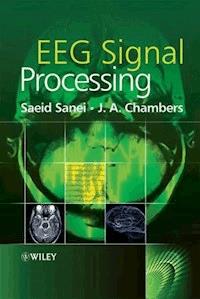
Electroencephalograms (EEGs) are becoming increasingly important measurements of brain activity and they have great potential for the diagnosis and treatment of mental and brain diseases and abnormalities. With appropriate interpretation methods they are emerging as a key methodology to satisfy the increasing global demand for more affordable and effective clinical and healthcare services.
Developing and understanding advanced signal processing techniques for the analysis of EEG signals is crucial in the area of biomedical research. This book focuses on these techniques, providing expansive coverage of algorithms and tools from the field of digital signal processing. It discusses their applications to medical data, using graphs and topographic images to show simulation results that assess the efficacy of the methods.
Additionally, expect to find:
- explanations of the significance of EEG signal analysis and processing (with examples) and a useful theoretical and mathematical background for the analysis and processing of EEG signals;
- an exploration of normal and abnormal EEGs, neurological symptoms and diagnostic information, and representations of the EEGs;
- reviews of theoretical approaches in EEG modelling, such as restoration, enhancement, segmentation, and the removal of different internal and external artefacts from the EEG and ERP (event-related potential) signals;
- coverage of major abnormalities such as seizure, and mental illnesses such as dementia, schizophrenia, and Alzheimer’s disease, together with their mathematical interpretations from the EEG and ERP signals and sleep phenomenon;
- descriptions of nonlinear and adaptive digital signal processing techniques for abnormality detection, source localization and brain-computer interfacing using multi-channel EEG data with emphasis on non-invasive techniques, together with future topics for research in the area of EEG signal processing.
Sie lesen das E-Book in den Legimi-Apps auf:
Seitenzahl: 529
Veröffentlichungsjahr: 2013
Ähnliche
















Contents
Preface
List of Abbreviations
List of Symbols
1 Introduction to EEG
1.1 History
1.2 Neural Activities
1.3 Action Potentials
1.4 EEG Generation
1.5 Brain Rhythms
1.6 EEG Recording and Measurement
1.7 Abnormal EEG Patterns
1.8 Ageing
1.9 Mental Disorders
1.10 Summary and Conclusions
References
2 Fundamentals of EEG Signal Processing
2.1 EEG Signal Modelling
2.2 Nonlinearity of the Medium
2.3 Nonstationarity
2.4 Signal Segmentation
2.5 Signal Transforms and Joint Time–Frequency Analysis
2.6 Coherency, Multivariate Autoregressive (MVAR) Modelling, and Directed Transfer Function (DTF)
2.7 Chaos and Dynamical Analysis
2.8 Filtering and Denoising
2.9 Principal Component Analysis
2.10 Independent Component Analysis
2.11 Application of Constrained BSS: Example
2.12 Signal Parameter Estimation
2.13 Classification Algorithms
2.14 Matching Pursuits
2.15 Summary and Conclusions
References
3 Event-Related Potentials
3.1 Detection, Separation, Localization, and Classification of P300 Signals
3.2 Brain Activity Assessment Using ERP
3.3 Application of P300 to BCI
3.4 Summary and Conclusions
References
4 Seizure Signal Analysis
4.1 Seizure Detection
4.2 Chaotic Behaviour of EEG Sources
4.3 Predictability of Seizure from the EEGs
4.4 Fusion of EEG–fMRI Data for Seizure Prediction
4.5 Summary and Conclusions
References
5 EEG Source Localization
5.1 Introduction
5.2 Overview of the Traditional Approaches
5.3 Determination of the Number of Sources
5.4 Summary and Conclusions
References
6 Sleep EEG
6.1 Stages of Sleep
6.2 The Influence of Circadian Rhythms
6.3 Sleep Deprivation
6.4 Psychological Effects
6.5 Detection and Monitoring of Brain Abnormalities During Sleep by EEG Analysis
6.6 Concluding Remarks
References
7 Brain–Computer Interfacing
7.1 State of the Art in BCI
7.2 Major Problems in BCI
7.3 Multidimensional EEG Decomposition
7.4 Detection and Separation of ERP Signals
7.5 Source Localization and Tracking of the Moving Sources within the Brain
7.6 Multivariant Autoregressive (MVAR) Modelling and Coherency Maps
7.7 Estimation of Cortical Connectivity
7.8 Summary and Conclusions
References
Index
Copyright © 2007 John Wiley & Sons Ltd, The Atrium, Southern Gate, Chichester, West Sussex PO19 8SQ, England
Telephone (+44) 1243 779777
Email (for orders and customer service enquiries): [email protected] our Home Page on www.wileyeurope.com or www.wiley.com
All Rights Reserved. No part of this publication may be reproduced, stored in a retrieval system or transmitted in any form or by any means, electronic, mechanical, photocopying, recording, scanning or otherwise, except under the terms of the Copyright, Designs and Patents Act 1988 or under the terms of a licence issued by the Copyright Licensing Agency Ltd, 90 Tottenham Court Road, London W1T 4LP, UK, without the permission in writing of the Publisher. Requests to the Publisher should be addressed to the Permissions Department, John Wiley & Sons Ltd, The Atrium, Southern Gate, Chichester, West Sussex PO19 8SQ, England, or emailed to [email protected], or faxed to (+44) 1243 770620.
Designations used by companies to distinguish their products are often claimed as trademarks. All brand names and product names used in this book are trade names, service marks, trademarks or registered trademarks of their respective owners. The Publisher is not associated with any product or vendor mentioned in this book.
This publication is designed to provide accurate and authoritative information in regard to the subject matter covered. It is sold on the understanding that the Publisher is not engaged in rendering professional services. If professional advice or other expert assistance is required, the services of a competent professional should be sought.
Other Wiley Editorial Offices
John Wiley & Sons Inc., 111 River Street, Hoboken, NJ 07030, USA
Jossey-Bass, 989 Market Street, San Francisco, CA 94103-1741, USA
Wiley-VCH Verlag GmbH, Boschstr. 12, D-69469 Weinheim, Germany
John Wiley & Sons Australia Ltd, 42 McDougall Street, Milton, Queensland 4064, Australia
John Wiley & Sons (Asia) Pte Ltd, 2 Clementi Loop #02-01, Jin Xing Distripark, Singapore 129809
John Wiley & Sons Canada Ltd, 6045 Freemont Blvd, Mississauga, Ontario, L5R 4J3, Canada
Wiley also publishes its books in a variety of electronic formats. Some content that appears in print may not be available in electronic books.
Anniversary Logo Design: Richard J. Pacifico
Library of Congress Cataloging-in-Publication Data
Sanei, Saeid.
EEG signal processing / Saeid Sanei and Jonathon Chambers.
p. ; cm.
Includes bibliographical references.ISBN 978-0-470-02581-9 (alk. paper)1. Electroencephalography. 2. Signal processing. I. Chambers, Jonathon. II.Title.[DNLM: 1. Electroencephalography – methods. 2. Evoked Potentials. 3. SignalProcessing, Computer-Assisted. WL 150 S223e 2007]RC386.6.E43S252 2007616.8′047547 – dc22
2007019900
British Library Cataloguing in Publication Data
A catalogue record for this book is available from the British Library
ISBN-13 978-0-470-02581-9
Preface
There is ever-increasing global demand for more affordable and effective clinical and healthcare services. New techniques and equipment must therefore be developed to aid in the diagnosis, monitoring, and treatment of abnormalities and diseases of the human body. Biomedical signals (biosignals) in their manifold forms are rich information sources, which when appropriately processed have the potential to facilitate such advancements. In today’s technology, such processing is very likely to be digital, as confirmed by the inclusion of digital signal processing concepts as core training in biomedical engineering degrees. Recent advancements in digital signal processing are expected to underpin key aspects of the future progress in biomedical research and technology, and it is the purpose of this research monograph to highlight this trend for the processing of measurements of brain activity, primarily electroencephalograms (EEGs).
Most of the concepts in multichannel EEG digital signal processing have their origin in distinct application areas such as communications engineering, seismics, speech and music signal processing, together with the processing of other physiological signals, such as electrocardiograms (ECGs). The particular topics in digital signal processing first explained in this research monograph include definitions; illustrations; time-domain, frequency-domain, and time-frequency domain processing; signal conditioning; signal transforms; linear and nonlinear filtering; chaos definition, evaluation, and measurement; certain classification algorithms; adaptive systems; independent component analysis; and multivariate autoregressive modelling. In addition, motivated by research in the field over the last two decades, techniques specifically related to EEG processing such as brain source localization, detection and classification of event related potentials, sleep signal analysis, seizure detection and prediction, together with brain–computer interfacing are comprehensively explained and, with the help of suitable graphs and (topographic) images, simulation results are provided to assess the efficacy of the methods.
Chapter 1 of this research monograph is a comprehensive biography of the history and generation of EEG signals, together with a discussion of their significance and diagnostic capability. Chapter 2 provides an in-depth introduction to the mathematical algorithms and tools commonly used in the processing of EEG signals. Most of these algorithms have only been recently developed by experts in the signal processing community and then applied to the analysis of EEG signals for various purposes. In Chapter 3, eventrelated potentials are explained and the schemes for their detection and classification are explored. Many neurological and psychiatric brain disorders are diagnosed and monitored using these techniques. Chapter 4 complements the previous chapter by specifically looking at the behaviour of EEG signals in patients suffering from epilepsy. Some very recent methods in seizure prediction are demonstrated. This chapter concludes by opening up a new methodology in joint, or bimodal, EEG–fMRI analysis of epileptic seizure signals. Localization of brain source signals is next covered in Chapter 5. Traditional dipole methods are described and some very recent processing techniques such as blind source separation are briefly reviewed. In Chapter 6, the concepts developed for the analysis and description of EEG sleep recordings are summarized and the important parameters and terminologies are explained. Finally, in Chapter 7, one of the most important applications of the developed mathematical tools for processing of EEG signals, namely brain–computer interfacing, is explored and recent advancements are briefly explained. Results of the application of these algorithms are described.
In the treatment of various topics covered within this research monograph it is assumed that the reader has a background in the fundamentals of digital signal processing and wishes to focus on processing of EEGs. It is hoped that the concepts covered in each chapter provide a foundation for future research and development in the field.
In conclusion, we do wish to stress that in this book there is no attempt to challenge previous clinical or diagnostic knowledge. Instead, the tools and algorithms described in this book can, we believe, potentially enhance the significant clinically related information within EEG signals and thereby aid physicians and ultimately provide more cost-effective and efficient diagnostic tools.
Both authors wish to thank most sincerely our previous and current PhD students who have contributed so much to the material in this work and our understanding of the field. Special thanks to Min Jing, Tracey Lee, Kianoush Nazarpour, Leor Shoker, Loukianous Spyrou, and Wenwu Wang, who contributed to providing some of the illustrations. Finally, this book became truly possible due to spiritual support and encouragement of Maryam Zahabsaniei, Erfan Sanei, and Ideen Sanei.
Saeid SaneiJonathon ChambersJanuary 2007
List of Abbreviations
3D
Three-dimensional
ACT
Adaptive chirplet transform
AD
Alzheimer’s disease
ADC
Analogue-to-digital converter
ADD
Attention deficit disorder
ADHD
Attention deficit hyperactivity disorder
AE
Approximate entropy
AEP
Audio evoked potential
Ag–AgCl
Silver–silver chloride
AIC
Akaike information criterion
ALF
Adaptive standardized LORETA/FOCUSS
ALS
Alternating least squares
AMDF
Average magnitude difference function
AMI
Average mutual information
ANN
Artificial neural network
AP
Action potential
APGARCH
Asymmetric power GARCH
AR
Autoregressive modelling
ARMA
Autoregressive moving average
ASDA
American Sleep Disorders Association
BCI
Brain–computer interfacing/interaction
BDS
Brock, Dechert, and Scheinkman
BEM
Boundary element method
BMI
Brain–machine interfacing
BOLD
Blood oxygenation level dependence
BSS
Blind source separation
Ca
Calcium
CANDECOMP
Canonical decomposition
CDR
Current distributed-source reconstruction
CF
Characteristic function
CJD
Creutzfeldt–Jakob disease
Cl
Chloride
CNS
Central nervous system
CSD
Current source density
CT
Computerized tomography
DC
Direct current
DCT
Discrete cosine transform
DLE
Digitally linked ears
DSM
Diagnostic and Statistical Manual
DTF
Directed transfer function
DWT
Discrete wavelet transform
ECD
Electric current dipole
ECG
Electrocardiogram/electrocardiography
ECoG
Electrocorticogram
ED
Error distance
EEG
Electroencephalogram/electroencephalography
EGARCH
Exponential GARCH
EGG
Electrogastrography
EKG
Electrocardiogram/electrocardiography
EM
Expectation maximization
EMG
Electromyogram/electromyography
EOG
Electrooculogram
EP
Evoked potential
EPSP
Excitatory postsynaptic potential
ERD
Event-related desynchronization
ERP
Event-related potential
ERS
Event-related synchronization
FA
Factor analysis
FEM
Finite element model
FFNN
Feedforward neural network
FHWA
First half-wave amplitude
FHWD
First half-wave duration
FHWS
First half-wave slope
fICA
Fast independent component analysis
FIR
Finite impulse response
fMRI
Functional magnetic resonance imaging
FOCUSS
Focal underdetermined system solver
FSP
Falsely detected source number percentage
GA
Genetic algorithm
GARCH
Generalized autoregressive conditional heteroskedasticity
GARCH-M
GARCH-in-mean
GFNN
Global false nearest neighbours
GJR-GARCH
Glosten, Jagannathan, and Runkle GARCH
HCI
Human–computer interfacing/interaction
HMM
Hidden Markov model
HOS
Higher-order statistics
IBE
International Bureau for Epilepsy
ICA
Independent component analysis
IIR
Infinite impulse response
ILAE
International League Against Epilepsy
IPSP
Inhibitory postsynaptic potential
IR
Impulse response
ISODATA
Iterative self-organizing data analysis technique algorithm
JADE
Joint approximate diagonalization of eigenmatrices
K
Potassium
KL
Kullback–Laibler
KLT
Karhunen–Loéve transform
KT
Kuhn–Tucker
LD
Linear discriminants
LDA
Linear discriminant analysis
LDA
Long-delta activity
LE
Lyapunov exponent
LEM
Local EEG model
LLE
Largest Lyapunov exponent
LMS
Least mean square
LORETA
Low-resolution electromagnetic tomography algorithm
LP
Lowpass
LRT
Low-resolution tomography
LS
Least squares
LWR
Levinson–Wiggins–Robinson
MA
Moving average
MAF
Multivariate ambiguity function
MAP
Maximum
a posteriori
MDP
Moving dipole
MEG
Magnetoencephalogram
MI
Mutual information
MIL
Matrix inversion lemma
ML
Maximum likelihood
MLE
Maximum likelihood estimation
MLE
Maximum Lyapunov exponent
MLP
Multilayered perceptron
MMN
Mismatch negativity
MP
Matching pursuits
MRI
Magnetic resonance imaging
MS
Mean square
MS
Multiple sclerosis
MSE
Mean-squared error
MTLE
Mesial temporal lobe epilepsy
MUSIC
Multichannel signal classification
MVAR
Multivariate autoregressive
Na
Sodium
NLMS
Normalized least mean square
NMF
Nonnegative matrix factorization
NN
Neural network
NREM
Nonrapid eye movement
OA
Ocular artefact
OBS
Organic brain syndrome
OP
Oddball paradigm
PARAFAC
Parallel factor
PCA
Principal component analysis
PD
Parkinson’s disease
Probability density function
PET
Positron emission tomography
PLED
Periodic literalized epileptiform discharges
PMBS
Postmovement beta synchronization
PNRD
Persistent nonrhythmic delta activity
POST
Positive occipital sharp transients
PPM
Piecewise Prony method
PSDM
Phase-space dissimilarity measures
PSG
Polysomnography
PWVD
Pseudo Wigner–Ville distribution
QEEG
Quantitative EEG
QGARCH
Quadratic GARCH
QNN
Quantum neural network
QP
Quadratic programming
R&K
Rechtschtschaffen and Kales
RAP
Recursively applied and projected
RBD
REM sleep behaviour disorder
RBF
Radial basis function
REM
Rapid eye movement
RKHS
Reproducing kernel Hilbert space
RLS
Recursive least squares
RV
Residual variance
SAS
Sleep apnea syndrome
SCA
Sparse component analysis
SCP
Slow cortical potential
SCPS
Slow cortical potential shift
SDTF
Short-time DTF
SEM
Structural equation modelling
SHWA
Second half-wave amplitude
SHWD
Second half-wave duration
SHWS
Second half-wave slope
sLORETA
Standardized LORETA
SNNAP
Simulator for neural networks and action potentials
SNR
Signal-to-noise ratio
SOBI
Second-order blind identification
SPET
Single photon emission tomography
SREDA
Subclinical rhythmic EEG discharges of adults
SRNN
Sleep EEG recognition neural network
SSLOFO
Source shrinking LORETA–FOCUSS
SSPE
Subacute sclerosing panencepalities
SSVEP
Steady-state visual-evoked potential
SSVER
Steady-state visual-evoked response
STF
Space–time–frequency
STFD
Spatial time–frequency distribution
STFT
Short-time frequency transform
STL
Short-term largest Lyapunov exponent
SV
Support vector
SVD
Singular-value decomposition
SVM
Support vector machine
SWA
Slow-wave activity
SWDA
Step-wise discriminant analysis
SWS
Slow-wave sleep
TDNN
Time delay neural network
TF
Time–frequency
TGARCH
Threshold GARCH model
TLE
Temporal lobe epilepsy
TNM
Traditional nonlinear method
TTD
Thought translation device
USP
Undetected source number percentage
VEP
Visual evoked potential
WA
Wald tests on amplitudes
WL
Wald test on locations
WMN
Weighted minimum norm
WN
Wavelet network
WT
Wavelet transform
WV
Wigner–Ville
List of Symbols
1
Introduction to EEG
The neural activity of the human brain starts between the 17th and 23rd week of prenatal development. It is believed that from this early stage and throughout life electrical signals generated by the brain represent not only the brain function but also the status of the whole body. This assumption provides the motivation to apply advanced digital signal processing methods to the electroencephalogram (EEG) signals measured from the brain of a human subject, and thereby underpins the later chapters of the book.
Although nowhere in this book do the authors attempt to comment on the physiological aspects of brain activities there are several issues related to the nature of the original sources, their actual patterns, and the characteristics of the medium, that have to be addressed. The medium defines the path from the neurons, as so-called signal sources, to the electrodes, which are the sensors where some form of mixtures of the sources are measured.
Understanding of neuronal functions and neurophysiological properties of the brain together with the mechanisms underlying the generation of signals and their recordings is, however, vital for those who deal with these signals for detection, diagnosis, and treatment of brain disorders and the related diseases. A brief history of EEG measurements is first provided.
1.1 History
Carlo Matteucci (1811–1868) and Emil Du Bois-Reymond (1818–1896) were the first people to register the electrical signals emitted from muscle nerves using a galvanometer and established the concept of neurophysiology [1,2]. However, the concept of action current introduced by Hermann Von Helmholz [3] clarified and confirmed the negative variations that occur during muscle contraction.
Richard Caton (1842–1926), a scientist from Liverpool, England, used a galvanometer and placed two electrodes over the scalp of a human subject and thereby first recorded brain activity in the form of electrical signals in 1875. Since then, the concepts of electro-(referring to registration of brain electrical activities) encephalo- (referring to emitting the signals from the head), and gram (or graphy), which means drawing or writing, were combined so that the term EEG was henceforth used to denote electrical neural activity of the brain.
Fritsch (1838–1927) and Hitzig (1838–1907) discovered that the human cerebral can be electrically stimulated. Vasili Yakovlevich Danilevsky (1852–1939) followed Caton’s work and finished his PhD thesis in the investigation of the physiology of the brain in 1877 [4]. In this work, he investigated the activity of the brain following electrical stimulation as well as spontaneous electrical activity in the brain of animals.
Lesen Sie weiter in der vollständigen Ausgabe!
Lesen Sie weiter in der vollständigen Ausgabe!
Lesen Sie weiter in der vollständigen Ausgabe!
Lesen Sie weiter in der vollständigen Ausgabe!
Lesen Sie weiter in der vollständigen Ausgabe!
Lesen Sie weiter in der vollständigen Ausgabe!
Lesen Sie weiter in der vollständigen Ausgabe!




