


1,20 €
Mehr erfahren.
- Herausgeber: Dean Street Press
- Kategorie: Gesellschafts- und Liebesromane
- Sprache: Englisch
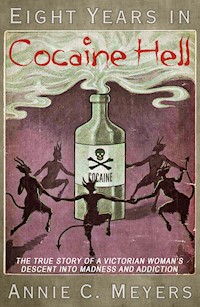
"To the sensitive (cocaine) is soothing, to the stupid it is enlivening, to the exhausted it gives strength and mental vigor. To the sufferers from pain it gives peace…" Dr. T.D. Crothers, 1899 "I never used any other drug but the clear cocaine and I believe that I am the only living person in the world to-day who ever took two hundred grains in twenty-four hours and survived." Annie C. Meyers The autobiographical Eight Years in Cocaine Hell (1902) recounts in shockingly straightforward style the transformation of Annie C. Meyers, affluent and well-connected Chicago widow, to junkie, thief, forger, inventor of the 'Cocaine Dance', and ultimately authoress of the first drug confessional written by a woman. It was 1894. Annie Meyers had a bad cold, and her lawyer advised her to try Birney's Catarrh Powder, in which then-legal cocaine was a principal active ingredient. She rapidly became addicted to the drug, ran through her money and travelled the USA shoplifting, house-breaking and writing forged checks to support her habit. Arrested repeatedly, miraculously escaping a custodial sentence, Annie finally tried safe-blowing and was collared for the final time: 'homeless and friendless, degraded and frenzied, insane, a broken-down and pitiful wreck of what I had once been.' She had lost most of her teeth (one gold tooth she had extracted herself and sold), her upper jaw was eaten away and ulcers covered much of her body. She was down to about five and a half stones in weight. Remarkably, and happily, she recovered, with the help of her long-suffering sister and the St. Luke Society, who encouraged and originally published this concise, ground-breaking memoir. "Her book established a literary genre, and her case helped to outlaw cocaine." Stuart Walton, Intoxicology
Das E-Book können Sie in Legimi-Apps oder einer beliebigen App lesen, die das folgende Format unterstützen:
Veröffentlichungsjahr: 2016
Ähnliche




















Annie C. MeyersEight Years inCOCAINE HELL
“To the sensitive (cocaine) is soothing, to the stupid it is enlivening, to the exhausted it gives strength and mental vigor. To the sufferers from pain it gives peace…” Dr. T.D. Crothers, 1899
“I never used any other drug but the clear cocaine and I believe that I am the only living person in the world to-day who ever took two hundred grains in twenty-four hours and survived.” Annie C. Meyers
The autobiographical Eight Years in Cocaine Hell (1902) recounts in shockingly straightforward style the transformation of Annie C. Meyers, affluent and well-connected Chicago widow, to junkie, thief, forger, inventor of the ‘Cocaine Dance’, and ultimately authoress of the first drug confessional written by a woman.
It was 1894. Annie Meyers had a bad cold, and her lawyer advised her to try Birney’s Catarrh Powder, in which then-legal cocaine was a principal active ingredient. She rapidly became addicted to the drug, ran through her money and travelled the USA shoplifting, house-breaking and writing forged checks to support her habit.
Arrested repeatedly, miraculously escaping a custodial sentence, Annie finally tried safe-blowing and was collared for the final time: ‘homeless and friendless, degraded and frenzied, insane, a broken-down and pitiful wreck of what I had once been.’ She had lost most of her teeth (one gold tooth she had extracted herself and sold), her upper jaw was eaten away and ulcers covered much of her body. She was down to about five and a half stones in weight. Remarkably, and happily, she recovered, with the help of her long-suffering sister and the St. Luke Society, who encouraged and originally published this concise, ground-breaking memoir.
“Her book established a literary genre, and her case helped to outlaw cocaine.” Stuart Walton, Intoxicology
Contents
Annie C. Meyers in 1890, member of the board of Lady Managers of the World’s Columbian Exposition
To my beloved sister, Mrs. McCabe, this book is affectionately inscribed.
THE AUTHOR.
Preface
It has been thought by my friends that I could be of service to humanity by putting into book form the story of the terrible experiences and degradation brought into my life by the use of cocaine, and the redemption through the mercy of the Lord that has again placed me among the living and into paths of usefulness.
As the reader may well suppose, there is no pleasure to me in reciting in these pages the awful chapters of crime that this hell-sent drug has forced me to commit; on the contrary it is a matter of deep contrition and mortification that I under any circumstances ever got so far away from my early Christian training and my mother’s God. But that others, who may not know to what depths this accursed drug will drag them, may be warned, and still others who are in the fearful grasp of the monster may learn that there is hope of deliverance, I have concluded to banish the feelings of shame and lay open some of the pages of a life in which I seemed to lose all responsibility for a period of years.
There is also coupled with these ideas the hope that there may come some financial reward from this publication, and if so it is my intention to use it in rescuing victims of these drug habits and try to do for others what the Lord has led friends to do for me. In this connection I want to tender my sincerest thanks to Madame Jeanne Conley and the Post Graduate College for very kind assistance that materially aided in my final recovery of health.
A.C.M.




