


95,99 €
Mehr erfahren.
- Herausgeber: John Wiley & Sons
- Kategorie: Wissenschaft und neue Technologien
- Sprache: Englisch
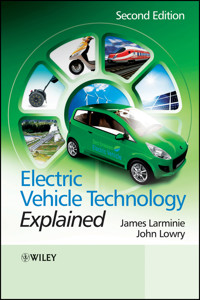
Fully updated throughout, Electric Vehicle Technology, Second Edition, is a complete guide to the principles, design and applications of electric vehicle technology. Including all the latest advances, it presents clear and comprehensive coverage of the major aspects of electric vehicle development and offers an engineering-based evaluation of electric motor scooters, cars, buses and trains.
This new edition includes:
- important new chapters on types of electric vehicles, including pickup and linear motors, overall efficiencies and energy consumption, and power generation, particularly for zero carbon emissions
- expanded chapters updating the latest types of EV, types of batteries, battery technology and other rechargeable devices, fuel cells, hydrogen supply, controllers, EV modeling, ancillary system design, and EV and the environment
- brand new practical examples and case studies illustrating how electric vehicles can be used to substantially reduce carbon emissions and cut down reliance on fossil fuels
- futuristic concept models, electric and high-speed trains and developments in magnetic levitation and linear motors
- an examination of EV efficiencies, energy consumption and sustainable power generation.
MATLAB® examples can be found on the companion website www.wiley.com/go/electricvehicle2e
Explaining the underpinning science and technology, this book is essential for practicing electrical, automotive, power, control and instrumentation engineers working in EV research and development. It is also a valuable reference for academics and students in automotive, mechanical, power and electrical engineering.
Sie lesen das E-Book in den Legimi-Apps auf:
Seitenzahl: 538
Veröffentlichungsjahr: 2012
Ähnliche



















Table of Contents
Title Page
Copyright
About the Author
Preface
Acknowledgments
Abbreviations
Symbols
Chapter 1: Introduction
1.1 A Brief History
1.2 Electric Vehicles and the Environment
1.3 Usage Patterns for Electric Road Vehicles
Chapter 2: Types of Electric Vehicles—EV Architecture
2.1 Battery Electric Vehicles
2.2 The IC Engine/Electric Hybrid Vehicle
2.3 Fuelled EVs
2.4 EVs using Supply Lines
2.5 EVs which use Flywheels or Supercapacitors
2.6 Solar-Powered Vehicles
2.7 Vehicles using Linear Motors
2.8 EVs for the Future
Chapter 3: Batteries, Flywheels and Supercapacitors
3.1 Introduction
3.2 Battery Parameters
3.3 Lead Acid Batteries
3.4 Nickel-Based Batteries
3.5 Sodium-Based Batteries
3.6 Lithium Batteries
3.7 Metal–Air Batteries
3.8 Supercapacitors and Flywheels
3.9 Battery Charging
3.10 The Designer's Choice of Battery
3.11 Use of Batteries in Hybrid Vehicles
3.12 Battery Modelling
3.13 In Conclusion
Chapter 4: Electricity Supply
4.1 Normal Existing Domestic and Industrial Electricity Supply
4.2 Infrastructure Needed for Charging Electric Vehicles
4.3 Electricity Supply Rails
4.4 Inductive Power Transfer for Moving Vehicles
4.5 Battery Swapping
Chapter 5: Fuel Cells
5.1 Fuel Cells—A Real Option?
5.2 Hydrogen Fuel Cells—Basic Principles
5.3 Fuel Cell Thermodynamics—An Introduction
5.4 Connecting Cells in Series—The Bipolar Plate
5.5 Water Management in the PEMFC
5.6 Thermal Management of the PEMFC
5.7 A Complete Fuel Cell System
5.8 Practical Efficiency of Fuel Cells
Chapter 6: Hydrogen as a Fuel—Its Production and Storage
6.1 Introduction
6.2 Hydrogen as a Fuel
6.3 Fuel Reforming
6.4 Energy Efficiency of Reforming
6.5 Hydrogen Storage I—Storage as Hydrogen
6.6 Hydrogen Storage II—Chemical Methods
Chapter 7: Electric Machines and their Controllers
7.1 The ‘Brushed’ DC Electric Motor
7.2 DC Regulation and Voltage Conversion
7.3 Brushless Electric Motors
7.4 Motor Cooling, Efficiency, Size and Mass
7.5 Electric Machines for Hybrid Vehicles
7.6 Linear Motors
Chapter 8: Electric Vehicle Modelling
8.1 Introduction
8.2 Tractive Effort
8.3 Modelling Vehicle Acceleration
8.4 Modelling Electric Vehicle Range
8.5 Simulations—A Summary
Chapter 9: Design Considerations
9.1 Introduction
9.2 Aerodynamic Considerations
9.3 Consideration of Rolling Resistance
9.4 Transmission Efficiency
9.5 Consideration of Vehicle Mass
9.6 Electric Vehicle Chassis and Body Design
9.7 General Issues in Design
Chapter 10: Design of Ancillary Systems
10.1 Introduction
10.2 Heating and Cooling Systems
10.3 Design of the Controls
10.4 Power Steering
10.5 Choice of Tyres
10.6 Wing Mirrors, Aerials and Luggage Racks
10.7 Electric Vehicle Recharging and Refuelling Systems
Chapter 11: Efficiencies and Carbon Release Comparison
11.1 Introduction
11.2 Definition of Efficiency
11.3 Carbon Dioxide Emission and Chemical Energy in Fuel
Chapter 12: Electric Vehicles and the Environment
12.1 Introduction
12.2 Vehicle Pollution—The Effects
12.3 Vehicle Pollution in Context
12.4 The Role of Regulations and Lawmakers
Chapter 13: Power Generation for Transport—Particularly for Zero Emissions
13.1 Introduction
13.2 Power Generation using Fossil Fuels
13.3 Alternative and Sustainable Energy
13.4 Nuclear Energy
13.5 In Conclusion
Chapter 14: Recent Electric Vehicles
14.1 Introduction
14.2 Low-Speed Rechargeable Battery Vehicles
14.3 Battery-Powered Cars and Vans
14.4 Hybrid Vehicles
14.5 Fuel-Cell-Powered Bus
14.6 Conventional High-Speed Trains
14.7 Conclusion
Chapter 15: The Future of Electric Vehicles
15.1 Introduction
15.2 The Tesla S
15.3 The Honda FCX Clarity
15.4 Maglev Trains
15.5 Electric Road–Rail Systems
15.6 Conclusion
Appendices
Appendix 1: Performance Simulation of the GM EV1
Appendix 2: Importing and Creating Driving Cycles
Appendix 3: Simulating One Cycle
Appendix 4: Range Simulation of the GM EV1 Electric Car
Appendix 5: Electric Scooter Range Modelling
Appendix 6: Fuel Cell Range Simulation
Appendix 7: Motor Efficiency Plots
Index
This edition first published 2012
© 2012 John Wiley & Sons Ltd
Registered office
John Wiley & Sons Ltd, The Atrium, Southern Gate, Chichester, West Sussex, PO19 8SQ, United Kingdom
For details of our global editorial offices, for customer services and for information about how to apply for permission to reuse the copyright material in this book please see our website at www.wiley.com.
The right of the author to be identified as the author of this work has been asserted in accordance with the Copyright, Designs and Patents Act 1988.
All rights reserved. No part of this publication may be reproduced, stored in a retrieval system, or transmitted, in any form or by any means, electronic, mechanical, photocopying, recording or otherwise, except as permitted by the UK Copyright, Designs and Patents Act 1988, without the prior permission of the publisher.
Wiley also publishes its books in a variety of electronic formats. Some content that appears in print may not be available in electronic books.
Designations used by companies to distinguish their products are often claimed as trademarks. All brand names and product names used in this book are trade names, service marks, trademarks or registered trademarks of their respective owners. The publisher is not associated with any product or vendor mentioned in this book. This publication is designed to provide accurate and authoritative information in regard to the subject matter covered. It is sold on the understanding that the publisher is not engaged in rendering professional services. If professional advice or other expert assistance is required, the services of a competent professional should be sought.
MATLAB® is a trademark of The MathWorks, Inc. and is used with permission. The MathWorks does not warrant the accuracy of the text or exercises in this book. This book's use or discussion of MATLAB® software or related products does not constitute endorsement or sponsorship by The MathWorks of a particular pedagogical approach or particular use of the MATLAB® software.
Library of Congress Cataloging-in-Publication Data
Larminie, James
Electric vehicle technology explained / James Larminie, John Lowry.—
Second Edition.
pages cm
Includes bibliographical references and index.
ISBN 978-1-119-94273-3 (cloth)
1. Electric vehicles–Technological innovations. 2. Electric vehicles–
Design and construction. I. Lowry, John. II. Title.
TL220.L37 2012
629.22′93— dc23
2012006649
A catalogue record for this book is available from the British Library.
Print ISBN: 9781119942733
About the Author
John Lowry is a professional engineer who graduated in Mechanical Engineering from Imperial College, London University. He holds a PhD from Queen Mary College, London University. He was formerly a university lecturer and is currently a consultant engineer. He is a Fellow of the Institution of Mechanical Engineers, the Institute of Energy and the Institute of Engineering and Technology.
Preface
Electric vehicle technology is now in its third century of development and is likely to advance rapidly in the coming years.
Electric trains are widely used and modern high-speed trains are competitive with air travel in terms of journey speed over shorter land routes. In energy terms they use less than 10% of the fuel per passenger kilometre than air transport.
Electric road vehicles have not achieved the commercial success that internal combustion engine vehicles have; however, battery technology has now developed to the point where electric vehicles are being commercially produced. Future battery developments are likely to accelerate the use of electric road vehicles in the next few years.
Small electric vehicles such as golf buggies and personnel carriers in airports have become well established. Electric bicycles are becoming increasingly popular and are considered one of the fastest ways to move about crowded cities.
Potential environmental benefits which can result from the use of electric vehicles are substantial when the vehicles use electricity that is generated from sources which use highly efficient modern generating stations or which use nuclear or sustainable energy. Environmental benefits include zero exhaust emissions in the vicinity of the vehicles, reduced dependence on fossil fuels and reduced overall carbon emissions.
This book explains both the technology of electric vehicles and how they affect the environment. The book is designed for engineers and scientists who require a thorough understanding of electric vehicle technology and its effects on the environment.
John Lowry
Acknowledgments
The authors would like to put on record their thanks to the following companies and organisations that have made this book possible:
In addition we would like to thank friends and colleagues who have provided valuable comments and advice. We are also indebted to our families who have helped and put up with us while we devoted time and energy to this project. Special thanks are also due to Dr Peter Moss, formerly of The Defence Academy, Cranfield University, for reading and commenting on the draft manuscript.
Abbreviations
ABS
Anti-lock brake system
AC
Alternating current
AFC
Alkaline fuel cell
BLDC
Brushless DC (motor)
BOP
Balance of plant
CAD
Computer-aided design
CAM
Computer-aided manufacturing
CARB
California Air Resources Board
CCGT
Combined cycle gas turbine
CFD
Computational fluid dynamics
CHP
Combined heat and power
CJR
Central Japan Railway
CNG
Compressed natural gas
CPO
Catalytic partial oxidation
DC
Direct current
DMFC
Direct methanol fuel cell
DOH
Degree of hybridisation
DOHC
Double overhead cam
ECCVT
Electronically controlled continuous variable transmission
ECM
Electronically commutated motor
EFTC
Electric Fuel Transportation Company
EMF
Electromotive force
EPA
Environmental Protection Agency
EPS
Electric power steering
ETSU
Energy Technology Support Unit (a UK government organisation)
EUDC
Extra-Urban Driving Cycle
EV
Electric vehicle
FC
Fuel cell
FCV
Fuel cell vehicle
FHDS
Federal Highway Driving Schedule
FUDS
Federal Urban Driving Schedule
GM
General Motors
GM EV1
General Motors Electric Vehicle 1
GNF
Graphitic nanofibre
GRP
Glass reinforced plastic
GTO
Gate turn-off
HEV
Hybrid electric vehicle
HHV
Higher heating value
HSR
High-speed rail
HSST
High-speed surface train
IC
Internal combustion
ICE
Internal combustion engine
IEC
International Electrotechnical Commission
IGBT
Insulated gate bipolar transistor
IMA
Integrated Motor Assist
IPT
Inductive power transfer
JET
Joint Euorpean Torus
kph
Kilometres per hour
LH
2
Liquid (cryogenic) hydrogen
LHV
Lower heating value
LIB
Lithium ion battery
LPG
Liquid petroleum gas
LSV
Low-speed vehicle
MCFC
Molten carbonate fuel cell
MeOH
Methanol
MEA
Membrane electrode assembly
MOSFET
Metal oxide semiconductor field effect transistor
mph
Miles per hour
NASA
National Aeronautics and Space Administration
NEDC
New European Driving Cycle
NiCad
Nickel cadmium (battery)
NiMH
Nickel metal hydride (battery)
NL
Normal litre, 1 litre at NTP
NOx
Nitrous oxides
NTP
Normal temperature and pressure (20 °C and 1 atm or 1.013 25 bar)
OCV
Open-circuit voltage
PAFC
Phosphoric acid fuel cell
PEM
Proton exchange membrane OR polymer electrolyte membrane (different names for the same thing which fortunately have the same abbreviation)
PEMFC
Proton exchange membrane fuel cell OR polymer electrolyte membrane fuel cell
PM
Permanent magnet OR particulate matter
POX
Partial oxidation
ppb
Parts per billion
ppm
Parts per million
PROX
Preferential oxidation
PSA
Pressure swing absorption
PTFE
Polytetrafluoroethylene
PZEV
Partial zero-emission vehicle
RRIM
Reinforced reaction injection moulding
SAE
Society of Automotive Engineers
SFUDS
Simplified Federal Urban Driving Schedule
SL
Standard litre, 1 litre at STP
SLI
Starting, lighting and ignition
SMC
Sheet moulding compound
SOC
State of charge
SOFC
Solid oxide fuel cell
SRM
Switched reluctance motor
STP
Standard temperature and pressure
SULEV
Super ultra-low-emission vehicle
SUV
Sports utility vehicle
TDI
Toyota Direct Ignition
TGV
Train à grande vitesse
VOC
Volatile organic compound
VRLA
Valve-regulated (sealed) lead acid (battery)
WOT
Wide open throttle
ZEBRA
Zero Emissions Battery Research Association
ZEV
Zero-emission vehicle
Symbols
Letters are used to stand for variables, such as mass, and also as chemical symbols in chemical equations. The distinction is usually clear from the context, but for even greater clarity italics are used for variables and ordinary text for chemical symbols, so H stands for enthalpy, whereas H stands for hydrogen.
In cases where a letter can stand for two or more variables, the context always makes it clear which is intended.
Chapter 1
Introduction
Electric vehicles are becoming increasingly important as not only do they reduce noise and pollution, but also they can be used to reduce the dependence of transport on oil—providing that the power is generated from fuels other than oil. Electric vehicles can also be used to reduce carbon emissions. Production of zero release of carbon dioxide requires that the energy for electric vehicles is produced from non-fossil-fuel sources such as nuclear and alternative energy.
The worst scenario is that we have only 40 years supply of oil left at current usage rates. In practice, of course, increasing scarcity will result in huge price rises and eventually the use of oil and other fossil fuels will not be economically viable, hence oil will be conserved as usage will decrease. Oil can also be produced from other fossil fuels such as coal. Traditionally oil produced in this way was considered to be around 10% more expensive, but with current oil prices production from coal is starting to become economic. Coal is more abundant than oil and there is in excess of 100 years of coal left, though it is still a finite resource.
Increasing worries about global warming continue. Global warming is blamed on the release of carbon dioxide when fossil fuels are burnt and it is believed to give rise to a myriad of problems including climate change and rising sea levels which could destroy many of the world's coastal cities.
Lesen Sie weiter in der vollständigen Ausgabe!
Lesen Sie weiter in der vollständigen Ausgabe!
Lesen Sie weiter in der vollständigen Ausgabe!
Lesen Sie weiter in der vollständigen Ausgabe!
Lesen Sie weiter in der vollständigen Ausgabe!
Lesen Sie weiter in der vollständigen Ausgabe!
Lesen Sie weiter in der vollständigen Ausgabe!
Lesen Sie weiter in der vollständigen Ausgabe!
Lesen Sie weiter in der vollständigen Ausgabe!
Lesen Sie weiter in der vollständigen Ausgabe!
Lesen Sie weiter in der vollständigen Ausgabe!
Lesen Sie weiter in der vollständigen Ausgabe!
Lesen Sie weiter in der vollständigen Ausgabe!
Lesen Sie weiter in der vollständigen Ausgabe!
Lesen Sie weiter in der vollständigen Ausgabe!
Lesen Sie weiter in der vollständigen Ausgabe!




