


141,99 €
Mehr erfahren.
- Herausgeber: John Wiley & Sons
- Kategorie: Wissenschaft und neue Technologien
- Serie: IEEE Press Series on Power Engineering
- Sprache: Englisch
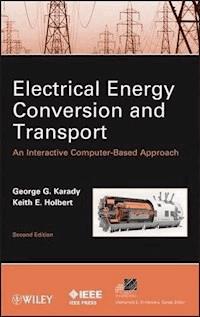
Designed to support interactive teaching and computer assisted self-learning, this second edition of Electrical Energy Conversion and Transport is thoroughly updated to address the recent environmental effects of electric power generation and transmission, which have become more important together with the deregulation of the industry. New content explores different power generation methods, including renewable energy generation (solar, wind, fuel cell) and includes new sections that discuss the upcoming Smart Grid and the distributed power generation using renewable energy generation, making the text essential reading material for students and practicing engineers.
Sie lesen das E-Book in den Legimi-Apps auf:
Seitenzahl: 890
Veröffentlichungsjahr: 2013
Ähnliche



















Table of Contents
IEEE Press
Title page
Copyright page
Preface and Acknowledgments
How to Use This Book Effectively
Acknowledgments
1: Electric Power Systems
1.1. Electric Networks
1.2. Traditional Transmission Systems
1.3. Traditional Distribution Systems
1.4. Intelligent Electrical Grids
2: Electric Generating Stations
2.1. Fossil Power Plants
2.2. Nuclear Power Plants
2.3. Hydroelectric Power Plants
2.4. Wind Farms
2.5. Solar Power Plants
2.6. Geothermal Power Plants
2.7. Ocean Power
2.8. Other Generation Schemes
2.9. Electricity Generation Economics
2.10. Load Characteristics and Forecasting
2.11. Environmental Impact
3: Single-Phase Circuits
3.1. Circuit Analysis Fundamentals
3.2. AC Circuits
3.3. Impedance
3.4. Loads
3.5. Basic Laws and Circuit Analysis Techniques
3.6. Applications of Single-Phase Circuit Analysis
3.7. Summary
4: Three-Phase Circuits
4.1. Three-Phase Quantities
4.2. Wye-Connected Generator
4.3. Wye-Connected Loads
4.4. Delta-Connected System
4.5. Summary
4.6. Three-Phase Power Measurement
4.7. Per-Unit System
4.8. Symmetrical Components
4.9. Application Examples
5: Transmission Lines and Cables
5.1. Construction
5.2. Components of the Transmission Lines
5.3. Cables
5.4. Transmission Line Electrical Parameters
5.5. Magnetic Field Generated by Transmission Lines
5.6. Transmission Line Inductance
5.7. Transmission Line Capacitance
5.8. Transmission Line Networks
5.9. Concept of Transmission Line Protection
5.10. Application Examples
6: Electromechanical Energy Conversion
6.1. Magnetic Circuits
6.2. Magnetic and Electric Field Generated Forces
6.3. Electromechanical System
6.4. Calculation of Electromagnetic Forces
6.5. Applications
6.6. Summary
7: Transformers
7.1. Construction
7.2. Single-Phase Transformers
7.3. Three-Phase Transformers
8: Synchronous Machines
8.1. Construction
8.2. Operating Concept
8.3. Generator Application
8.4. Induced Voltage and Armature Reactance Calculation
8.5. Concept of Generator Protection
8.6. Application Examples
9: Induction Machines
9.1. Introduction
9.2. Construction
9.3. Three-Phase Induction Motor
9.4. Single-Phase Induction Motor
9.5. Induction Generators
9.6. Concept of Motor Protection
10: DC Machines
10.1. Construction
10.2. Operating Principle
10.3. Operation Analyses
10.4. Application Examples
11: Introduction to Power Electronics and Motor Control
11.1. Concept of DC Motor Control
11.2. Concept of AC Induction Motor Control
11.3. Semiconductor Switches
11.4. Rectifiers
11.5. Inverters
11.6. Flexible AC Transmission
11.7. DC-to-DC Converters
11.8. Application Examples
APPENDIX A: Introduction to Mathcad
A.1. Worksheet and Toolbars
A.2. Functions
A.3. Equation Solvers
A.4. Vectors and Matrices
APPENDIX B: Introduction to MATLAB
B.1. Desktop Tools
B.2. Operators, Variables, and Functions
B.3. Vectors and Matrices
B.4. Colon Operator
B.5. Repeated Evaluation of an Equation
B.6. Plotting
B.7. Basic Programming
APPENDIX C: Fundamental Units and Constants
C.1. Fundamental Units
C.2. Fundamental Physical Constants
APPENDIX D: Introduction to PSpice
D.1. Obtaining and Installing PSpice
D.2. Using PSpice
Problem Solution Key
Bibliography
Index
IEEE Press
445 Hoes Lane
Piscataway, NJ 08854
IEEE Press Editorial Board 2013
John Anderson, Editor in Chief
Kenneth Moore, Director of IEEE Book and Information Services (BIS)
Cover Design: John Wiley & Sons, Inc.
Cover Illustration: Courtesy of Siemens AG; Power Lines © Corbis Super Royalty Free/Alamy
Copyright © 2013 by the Institute of Electrical and Electronics Engineers, Inc. All rights reserved.
Published by John Wiley & Sons, Inc., Hoboken, New Jersey.
Published simultaneously in Canada.
No part of this publication may be reproduced, stored in a retrieval system, or transmitted in any form or by any means, electronic, mechanical, photocopying, recording, scanning, or otherwise, except as permitted under Section 107 or 108 of the 1976 United States Copyright Act, without either the prior written permission of the Publisher, or authorization through payment of the appropriate per-copy fee to the Copyright Clearance Center, Inc., 222 Rosewood Drive, Danvers, MA 01923, (978) 750-8400, fax (978) 750-4470, or on the web at www.copyright.com. Requests to the Publisher for permission should be addressed to the Permissions Department, John Wiley & Sons, Inc., 111 River Street, Hoboken, NJ 07030, (201) 748-6011, fax (201) 748-6008, or online at http://www.wiley.com/go/permissions.
Limit of Liability/Disclaimer of Warranty: While the publisher and author have used their best efforts in preparing this book, they make no representations or warranties with respect to the accuracy or completeness of the contents of this book and specifically disclaim any implied warranties of merchantability or fitness for a particular purpose. No warranty may be created or extended by sales representatives or written sales materials. The advice and strategies contained herein may not be suitable for your situation. You should consult with a professional where appropriate. Neither the publisher nor author shall be liable for any loss of profit or any other commercial damages, including but not limited to special, incidental, consequential, or other damages.
For general information on our other products and services or for technical support, please contact our Customer Care Department within the United States at (800) 762-2974, outside the United States at (317) 572-3993 or fax (317) 572-4002.
Wiley also publishes its books in a variety of electronic formats. Some content that appears in print may not be available in electronic formats. For more information about Wiley products, visit our web site at www.wiley.com.
Library of Congress Cataloging-in-Publication Data:
Karady, George G.
Electrical energy conversion and transport : an interactive computer-based approach / George G. Karady, Keith E. Holbert. – Second edition.
pages cm
Includes bibliographical references and index.
ISBN 978-0-470-93699-3 (cloth)
1. Electric power distribution. 2. Electric current converters. 3. Electric power production–Data processing. I. Holbert, Keith E. II. Title.
TK1001.K36 2012
621.31–dc23
2012029241
Preface and Acknowledgments
This book provides material essential for an undergraduate course covering the fundamental concepts of electric energy conversion and transport—a key branch of electrical engineering. Every electrical engineer should know why a motor rotates and how electric energy is generated and transported. Moreover, the electric power grid is a critical part of any national infrastructure. The maintenance and development of this vital industry requires well-trained engineers who are able to use modern computation techniques to analyze electric systems and understand the theory of electrical energy conversion.
Engineering education has improved significantly during the last decade due to advancements in technology and the widespread use of personal computers. Engineering educators have also recognized the need to transform students from passive listeners in the classroom to active learners. The paradigm shift is from a teacher-centered delivery approach to that of a learner-centered environment.
Computer-equipped classrooms and the computer aptitude of students open up new possibilities to improve engineering education by changing the delivery method. We advocate an interactive presentation of the subject matter, in which the students are intimately engaged in the lectures. This book is designed to support active learning, especially in a computer-based classroom environment. The computer-assisted teaching method increases student mastery of the course material as a result of their participation in its development. The primary goal of this approach is to increase student learning through their dynamic involvement; secondarily, students’ interest in power engineering is enhanced through their own attraction to computer technologies. This interactive approach provides students with a better understanding of the theory and the development of solid problem-solving skills.
As many universities and instructors firmly favor the use of one software package versus another, we leave the instructor to freely choose the software employed. This book applies Mathcad®, MATLAB®, and PSpice® throughout, and as such appendices introduce the basic use of these three programs. Less emphasis is paid on dedicated power engineering simulation tools due to the extended time and effort needed to learn such specialized software. In contrast, general-purpose programs permit students to focus more on the connection between the theory and computational analysis.
The extensive computer use permits analyzing complex problems that are not easily solvable by hand computations with calculators. In fact, the experienced instructor will find that their students are able to work complicated problems that were previously too difficult at this level. This is a significant modernization of the classical topic of electric energy conversion. Students familiar with the application of modern computational techniques to electrical power applications are better prepared to meet the needs of industry.
This textbook facilitates interactive teaching of the subject material. Through the students’ active participation, learning is enhanced. The advantages of this method include:
The authors recommend the textbook to faculty who want to modernize their electric power curriculum. The book is also intended for engineers interested in increasing their knowledge of electrical power and computer-based problem-solving skills. Such knowledge may open up or expand career opportunities in the electric power industry.
This second edition has inserted an additional chapter by moving and substantially expanding the treatment of electric power generation. Furthermore, the technical coverage of all the chapters has been expanded with the addition of material in areas such as the intelligent (smart) grid, symmetrical components, long transmission lines, induction generators, flexible alternating current (ac) transmission systems, buck and boost converters, and the protection of transformers, generators, motors, and transmission lines.
How to Use This Book Effectively
This textbook differs noticeably from others in that classical derivations are combined with numerical examples. In doing so, the reader is not only provided with the general analytical expressions as the theoretical development proceeds, but additionally, the concurrent numerical results assist the student in developing a sense for the correct magnitude of various parameters and variables. The authors have found Mathcad particularly well suited to this approach. Regardless of which software the reader chooses to use, we recommend that the reader first familiarize himself or herself with the information in Appendix A (“Introduction to Mathcad”), since Mathcad expressions are utilized throughout the text. This will allow the reader to reap the full benefits of this delivery method. Although this book employs Mathcad, MATLAB, and PSpice, other computational software can also be utilized effectively—this includes HSpice, Maple, Mathematica, and even spreadsheet packages such as Excel.
The authors suggest a course syllabus ordering that parallels the textbook. The textbook may be used for either a single semester or a two-semester course. For instance, Chapter 2 (“Electric Generating Stations”) can be skipped without significant loss of continuity for those instructors and readers who wish to do so. Similarly, Chapter 3 (“Single-Phase Circuits”) represents a review of basic circuit analysis, albeit in the context of computer-based analysis, which is generally a prerequisite to a course such as this. Suggested timelines for one and two three-semester-hour courses are outlined in the tables below.
Here, we present a brief overview of the suggested instructional technique for a representative class period. The basis of the approach is that after introducing the hardware and theory, the basic formulae and their practical application are developed jointly with the students using computers. Having divided the particular topic into sections, the instructor outlines each step of the analysis, and students then proceed to develop the equation(s) using his or her computer. While students are working together, the instructor is free to move about the classroom, answer student questions, and assess their understanding. After allowing students sufficient time to complete the process and reach conclusions, the instructor confirms the results and the students make corrections as needed. This procedure leads to student theory development and analysis of performance—learner-centered education.
Through computer utilization, a seamless integration of theory and application is achieved, thereby increasing student interest in the subject. The textbook derivation of the system equations and the operational analyses are presented using numerical examples. The numerical examples reinforce the theory and provide deeper understanding of the physical phenomena. In addition, computer utilization provides immediate feedback to the student.
Again, paralleling the classroom activities, each chapter first describes the hardware associated with that topic; for example, the construction and components are presented using drawings and photographs. This is followed by the theory and physics of the chapter material together with the development of an equivalent circuit. The major emphasis of the chapters is operational analysis. The questions at the end of each chapter are open ended to promote deeper investigation by the reader.
The interactive method is also applicable in a self-learning environment. In this case, the text outlines each step. The reader is encouraged to initially ignore the solution given in the text, but instead derive the equations and calculate the value using his or her computer. The reader then compares his or her results with the correct answers. This process is continued until the completion of the instructional unit.
Acknowledgments
The second edition of this textbook has benefited from the constructive criticism of others. The authors would like to express their sincere gratitude to the late Professor Richard Farmer, who was a member of the National Academy of Engineering, for his thorough review of both the first and second editions of the book manuscript. We also humbly thank the Institute of Electrical and Electronics Engineers (IEEE) Education Society for its recognition of the merits of computer-based active learning through the IEEE Transactions on Education Best Paper1 award to us.
George G. Karady
Keith E. Holbert
Tempe, AZ
April 2013
Note
1Holbert, K.E. and Karady, G.G., “Strategies, challenges and prospects for active learning in the computer-based classroom,” IEEE Transactions on Education, 52(1), 31–38, 2009.
1
Electric Power Systems
The purpose of the electric power system is to generate, transmit, and distribute electrical energy. Usually, a three-phase alternating current (ac) system is used for generation and transmission of the electric power. The frequency of the voltage and current is 60 Hz in the United States and some Asian countries, and is 50 Hz in Europe, Australia, and parts of Asia. Sometimes, exceptions are the rule, as in the case of Japan for which the western portion of the country is served by 60 Hz, whereas the eastern side operates at 50 Hz.
In the 1880s, during the development of electricity distribution, the pioneers' choice as to whether to use direct current (dc) or ac was contested. In particular, Thomas Edison favored dc, whereas both George Westinghouse and Nikola Tesla supported ac. AC transmission won this so-called War of the Currents due to the ability to convert ac voltages from higher to lower voltages using transformers and vice versa. This increased ac voltage permitted electric energy transport over longer distances with less power line losses than with dc.
The ac electrical system development started in the end of the 19th century, when the system frequency varied between 16.66 and 133 Hz. A large German company introduced 50 Hz frequency around 1891, after flickering was observed in systems operating at 40 Hz. In 1890, the leading U.S. electric company, Westinghouse Electric, introduced the 60 Hz frequency to avoid arc light flickering at lower frequencies.
The major components of the power system are:
power plants, which produce electric energy,transmission and distribution lines, which transport the electric energy,substations with switchgear, which transform voltages, provide protection, and form node points, andloads, which consume the energy.Figure 1.1 shows the major components of the electric power system.
Figure 1.1. Overview of the electric power system.
This chapter describes the construction of the electric transmission and distribution system; discusses the substation equipment, including circuit breakers (CBs), disconnect switches, and protection; and describes the low voltage distribution system, including residential electric connections.
1.1. Electric Networks
Power plants convert the chemical energy in coal, oil, or natural gas, or the potential energy of water, or nuclear energy into electric energy. In fossil nuclear power plants, the thermal energy is converted to high-pressure, high-temperature steam that drives a turbine which is mechanically connected to an electric generator. In a hydroelectric plant, the water falling to a lower elevation drives the turbine-generator set. The generator produces electric energy in the form of voltage and current. The generator voltage is around 15–25 kV, which is insufficient for long-distance transmission of the energy. To permit long-distance energy transportation, the voltage is increased and, simultaneously, the current is reduced by a transformer at the generation station. In Figure 1.1, the voltage is raised to 500 kV, and an extra-high-voltage (EHV) line carries the energy to a faraway substation, which is usually located in the outskirts of a large town or in the center of several large loads. For example, in Arizona, a 500 kV transmission line connects the Palo Verde Nuclear Generating Station to the Kyrene and Westwing substations, which supply a large part of Phoenix (see Fig. 1.2).
Figure 1.2. High- and extra-high-voltage transmission system in Arizona (power generation sites are shown in bold letters). (Data are from Western Systems Coordinating Council, 1999).
The electric power network is divided into separate transmission and distribution systems based on the voltage level. The system voltage is described by the root-mean-square (rms) value of the line-to-line voltage, which is the voltage between phase conductors. Table 1.1 lists the standard transmission line and the subtransmission voltages. The line voltage of the transmission systems in the United States is between 115 and 765 kV. The ultra-high-voltage lines are generally not in commercial use; although in 2011 China started the operation of a 392 miles (630 km) long 1000 kV ultra-high-voltage ac line with a maximum capacity of 3000 MVA. The 345–765 kV transmission lines are the EHV lines, with a maximum length of 400–500 miles. The 115–230 kV lines are the high-voltage lines with a maximum length of 100–200 miles. The high-voltage lines are terminated at substations, which form the node points on the network. The substations supply the loads through transformers and switchgear. The transformer changes the voltage and current. The switchgear protects the system. The most important part of the switchgear is the circuit breaker, which automatically switches off (opens) the line in the event of a fault. Distribution line lengths are around 5–30 miles (8–48 km) with voltages at or below 46 kV.
TABLE 1.1. Standard System Voltages (ANSI C84.1-1995a and C92.2-1987b)
Name or CategoryNominal Voltage (kV)Subtransmission34.54669High voltage115138161230EHV345400 (Europe)500765Ultra-high voltage1000 (China)aANSI C84.1-1995, Voltage ratings for electric power systems and equipment (60 Hz).
bANSI C92.2-1987, Alternating-current electrical systems and equipment operating at voltages above 230 kV nominal—preferred voltage ratings.
Lesen Sie weiter in der vollständigen Ausgabe!
Lesen Sie weiter in der vollständigen Ausgabe!
Lesen Sie weiter in der vollständigen Ausgabe!
Lesen Sie weiter in der vollständigen Ausgabe!
Lesen Sie weiter in der vollständigen Ausgabe!
Lesen Sie weiter in der vollständigen Ausgabe!
Lesen Sie weiter in der vollständigen Ausgabe!
Lesen Sie weiter in der vollständigen Ausgabe!
Lesen Sie weiter in der vollständigen Ausgabe!
Lesen Sie weiter in der vollständigen Ausgabe!
Lesen Sie weiter in der vollständigen Ausgabe!
Lesen Sie weiter in der vollständigen Ausgabe!
Lesen Sie weiter in der vollständigen Ausgabe!
Lesen Sie weiter in der vollständigen Ausgabe!
Lesen Sie weiter in der vollständigen Ausgabe!
Lesen Sie weiter in der vollständigen Ausgabe!
Lesen Sie weiter in der vollständigen Ausgabe!




