


116,99 €
Mehr erfahren.
- Herausgeber: John Wiley & Sons
- Kategorie: Wissenschaft und neue Technologien
- Sprache: Englisch
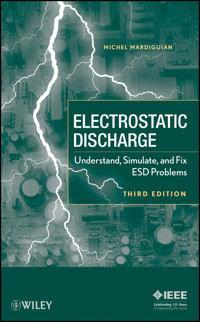
A thorough and concise treatment of ESD
Recognizing its methodic, step-by-step attack of the electrostatic discharge (ESD) problem, the initial release of this book was quoted by specialists as "the most thorough and concise treatment of the broad ESD continuum that is available." Now in its Third Edition, this book delivers the same trusted coverage of the topic while also incorporating recent technological advances that have taken place in the engineering community. The book begins with the basics of ESD for humans and objects, and goes on to cover:
-
Effects of ESD coupled to electronics
-
Principal ESD specifications
-
ESD diagnostics and testing
-
Design for ESD immunity
To help with troubleshooting, many ESD case histories are given along with their successful fixes. Electrostatic Discharge is essential reading for all designers who want to avoid component failures, no trouble found incidents, and random errors.
Sie lesen das E-Book in den Legimi-Apps auf:
Seitenzahl: 388
Veröffentlichungsjahr: 2011
Ähnliche


















Contents
Preface to the First Edition
Preface to the Third Edition
Acknowledgements
Chapter 1 The Electrostatic Discharge Phenomenon
1.1. PHYSICS INVOLVED
1.2. INFLUENCING PARAMETERS
1.3. VARIOUS TYPES OF ELECTROSTATIC CHARGING WITH HUMANS AND OBJECTS
1.4. STATISTICS OF VOLTAGES AND CURRENTS REACHED DURING ESD
1.5. WAVEFORMS OF ELECTROSTATIC DISCHARGES
REFERENCES
Chapter 2 Effects of ESD on Electronics
2.1. DIRECT DISCHARGE TO AN ELECTRONIC COMPONENT
2.2. DIRECT DISCHARGE TO ELECTRONIC EQUIPMENT ENCLOSURE
2.3. INDIRECT DISCHARGE
2.4. COUPLING MECHANISMS OF ESD PULSE INTO THE VICTIM’S CIRCUITRY
2.5. RESPONSE OF VICTIM CIRCUITS AND TYPE OF ERRORS
2.6. PREDICTION OF ACTUAL ESD-INDUCED ERROR, FAST APPROXIMATION METHOD
2.7. REMARKS ON THE ACTUAL CURRENT PATHS AND ASSOCIATED RADIATION
2.8. PERSONNEL OR FURNITURE ESD: WHICH ONE IS WORSE?
REFERENCES
Chapter 3 Principal ESD Specifications
3.1. ESD TEST SPECIFICATIONS FOR DEVICE SENSITIVITY
3.2. ESD SPECIFICATIONS FOR EQUIPMENT IMMUNITY
3.3. ANTISTATIC CONTROL PROCEDURES
REFERENCES
Chapter 4 ESD Diagnostics and Testing
4.1. ESD SIMULATORS: HOW THEY WORK
4.2. FURNITURE VERSUS PERSONNEL ESD SIMULATION
4.3. OTHER TYPES OF ESD SIMULATORS FOR COMPONENT TESTING
4.4. ESD TEST SETUP—DIRECT AND INDIRECT ESD
4.5. ESD TEST ROUTINE AND DISCHARGE PROCEDURES
4.6. NO ERROR/NO DAMAGE CONCEPT: THE SEVERAL LAYERS OF SEVERITY
4.7. THE ERROR PER DISCHARGE CONCEPT OR MULTIPLE-TRIALS APPROACH
4.8. ESD TEST DURING DESIGN AND DEVELOPMENT
4.9. ESD FOR FIELD DIAGNOSTICS AND FORCED CRASH METHOD
4.10. HOME-MADE INVESTIGATION TOOLS AND DIAGNOSTIC HINTS
REFERENCES
Chapter 5 Design for ESD Immunity
5.1. ESD PROTECTION AT COMPONENT LEVEL
5.2. ESD PROTECTION AT THE PCB LEVEL (Internal Circuitry)
5.3. ESD PROTECTION BY INTERNAL WIRING AND MECHANICAL PACKAGING
5.4. ESD PROTECTION BY BOX SHIELDING AND ENVELOPE DESIGN
5.5. ESD PROTECTION OF EXTERNAL CABLES AND I/O PORTS
5.6. ESD IMMUNITY BY SOFTWARE AND NOISE INHIBITION TECHNIQUES
5.7. ESD IMMUNITY WITH MINIATURE, PORTABLE DEVICES
5.8. SYSTEM ESD IMMUNITY
5.9. ESD CONTROL AT INSTALLATION LEVEL
REFERENCES
Chapter 6 ESD Cases Studies
6.1. CASE 1: THE RERADIATING GROUND STRAP
6.2. CASE 2: ESD HARDENING OF A PRINTER
6.3. CASE 3: THE DATA TERMINAL WITH FLOATING TRAY
6.4. CASE 4: THE SAFETY WIRE “ANTENNA”
6.5. CASE 5: THE TOUCHY WATCHDOG
6.6. CASE 6: THE TRIGGER-HAPPY AIR BAG INITIATOR
6.7. CONCLUSION: TROUBLESHOOTING HINTS
Appendix A ESD Protection by Design of Chips and Microcircuits
A.1. FUNCTIONS PROVIDED BY ON-CHIP ESD PROTECTION STRATEGY
A.2. PRINCIPAL COMPONENTS USED FOR ON-CHIP ESD PROTECTION
A.3. TYPICAL ESD PROTECTION NETWORKS
A.4. SOME DESIGN PRECAUTIONS TO IMPROVE ESD IMMUNITY OF ICS
A.5. THE LATCH-UP PROBLEM
A.6. COMPARING STRESSES OF HUMAN BODY, MACHINE, AND CHARGED DEVICE MODELS, AND IEC 61,000-4-2 DISCHARGE
REFERENCES
Appendix B Prediction of ESD Damage Level for a Semiconductor Junction
Appendix C Spark-Over Voltages
REFERENCES
Appendix D Fatigue Phenomena During Repeated ESD Testing
Appendix E Prediction of ESD-Induced Noise by Fast Frequency-Domain Calculations
ESD Coupling after Reduction by Shield Aperture
REFERENCE
Appendix F More Experiments on ESD Coupling to Boxes
DATA ON THE INSTRUMENTATION USED
PURPOSE OF THE VALIDATION TESTS
Summary of the experiments and results
Appendix G Examples of Simple SPICE Modeling of ESD Coupling Effects
G.1. SIMULATED ESD GENERATOR
G.2. DIRECT ESD ON ACCESSIBLE CONNECTOR PIN
G.3. MAGNETIC FIELD, INDUCTION COUPLING INTO A PCB LOOP
G.4. INDIRECT ESD (VERTICAL COUPLING PLATE) EFFECTS ON A PCB TRACE
G.5. FEW REMARKS ON SIMPLIFYING ASSUMPTIONS USED IN THESE SPICE SIMULATIONS
G.6. FEW GENERAL CONCLUSIONS FROM SPICE MODELING WITH 8-KV ESD
Appendix H Time-to-Frequency Conversion for a Single Transient
Index
IEEE Press445 Hoes LanePiscataway, NJ 08854
IEEE Press Editorial Board
Lajos Hanzo, Editor in Chief
R. AbariT. ChenO. MalikJ. AndersonT. G. CrodaS. NahavandiS. BasuS. FarshchiM. S. NewmanA. ChatterjeeB. M. HammerliW. ReeveKenneth Moore, Director of IEEE Book and Information Services (BIS)Jeanne Audino, Project Editor
Copyright © 2009 by the Institute of Electrical and Electronics Engineers, Inc.
Published by John Wiley & Sons, Inc., Hoboken, New Jersey. All rights reserved.Published simultaneously in Canada.
No part of this publication may be reproduced, stored in a retrieval system, or transmitted in any form or by any means, electronic, mechanical, photocopying, recording, scanning, or otherwise, except as permitted under Section 107 or 108 of the 1976 United States Copyright Act, without either the prior written permission of the Publisher, or authorization through payment of the appropriate per-copy fee to the Copyright Clearance Center, Inc., 222 Rosewood Drive, Danvers, MA 01923, (978) 750-8400, fax (978) 750-4470, or on the web at www.copyright.com. Requests to the Publisher for permission should be addressed to the Permissions Department, John Wiley & Sons, Inc., 111 River Street, Hoboken, NJ 07030, (201) 748-6011, fax (201) 748-6008, or online at www.wiley.com/go/permission.
Limit of Liability/Disclaimer of Warranty: While the publisher and author have used their best efforts in preparing this book, they make no representations or warranties with respect to the accuracy or completeness of the contents of this book and specifically disclaim any implied warranties of merchantability or fitness for a particular purpose. No warranty may be created or extended by sales representatives or written sales materials. The advice and strategies contained herein may not be suitable for your situation. You should consult with a professional where appropriate. Neither the publisher nor author shall be liable for any loss of profit or any other commercial damages, including but not limited to special, incidental, consequential, or other damages.
For general information on our other products and services or for technical support, please contact our Customer Care Department within the United States at (800) 762-2974, outside the United States at (317) 572-3993 or fax (317) 572-4002.
Wiley also publishes its books in a variety of electronic formats. Some content that appears in print may not be available in electronic formats. For more information about Wiley products, visit our web site at www.wiley.com.
Library of Congress Cataloging-in-Publication Data is available.
ISBN: 978-0470-39704-6
Preface to the First Edition
Static electricity is the most ancient form of electricity known to humans. More than 2000 years ago, the Greeks recognized the attraction between certain materials when they were rubbed together; indeed, the word electricity comes from the Greek elektron, which means amber. During the seventeenth and eighteenth centuries, several key experiments were conducted to understand and measure static electricity. But the discovery of electromagnetism and its formidable breakthrough has rapidly outgrown interest in static electricity. Even today, where the industrial applications of static electricity are not insignificant, they cannot compare with those of electromagnetism and electrodynamics.
Ironically, as much as static electricity was relegated to the attic of scientific evolution, she continuously occupied (I say “she” because electricity, in French, is feminine-don’t ask me why) the headlines with her undesirable effects. If we consider the thousands of lightning strikes hitting the terrestrial atmosphere every minute, we have to realize that our planet with its surrounding clouds is nothing more than a huge electrostatic machine constantly charging and discharging on itself. For decades, people have been learning the hard way that statics can cause explosions of fuels and ammunitions. In 1937, the German flying boat Hindenburg arriving in Lakehurst, New Jersey, caught fire while anchoring at its landing mast. What could have been a severe incident became a tragedy: Due to international tension, the United States had put an embargo on helium sales to Germany and the vessel was inflated with hydrogen instead. The resulting fire caused the death of 37 of its hundred or so passengers. Although the causes have not been completely understood, electrostatic discharge (ESD) is at the top of the list.
More recently, during the 1970s in the United States, a spacecraft lauching rocket exploded during the fueling operation, killing three engineers. The cause was, beyond any doubt, identified as ESD. Satellites have paid a heavy toll because of ESD, from minor anomalies to severe malfunctions, as in the European Space Agency (ESA) MARECS satellite. In January 1985, during the assembly of a Pershing missile near Heilbronn, Germany, the motor case, made of Kevlar, was repeatedly rubbed against the cushioning in its container. The ensuing ESD caused the 4 tons of highly flammable propellant to catch fire and the motor exploded, blowing parts 125 meters away, killing three people and injuring nine.
Although such catastrophes are terrible and spectacular, they are quite rare; but a more insidious aspect of ESD bloomed in the early 1970s, with the massive arrival of integrated microelectronics. The plants producing integrated circuits (ICs) started to experience disappointing percentage yields. Once thoroughly investigated, the problem was found to be largely due to ESD during all fabrication steps and handling. Although the problem has been fully explained and drastic solutions adopted, ESD is still costing millions of dollars a year of pure losses. Considering the astronomical quantities of ICs manufactured each year, the mere fact that 3 to 30% of them die in infancy because of ESD represents an impressive amount of money. To quote G. C. Quinn, technical editor of Electronics Test Magazine (April 1984): “The volume range of ESD sensitive components is rising faster than the development and usage of ESD protections... Estimating costs of ESD failures not caught at manufacturing inspection is far more difficult. Many of the degraded, walking-wounded devices may not show up until after termination of the manufacturer’s guarantee.” Around 1980, Lockheed Corporation reported a one-year cost savings of $1.8 million through static protection measures, which reduced ESD-related failures by a 16 to 1 ratio. Arithmethic, then, tells us that Lockheed had endured losses of $1.92 million the previous year. Even with severe protection measures, some manufacturers still confess that ESD is causing 39 to 48% of their IC rejects. The only hope that the plague will ever be dominated is a progressive awareness of people and the growing use of robots on manufacturing lines.
But the worst was yet to come: With the proliferation of microelectronics in all possible applications, an even bigger number of complaints flourished about ESD-related erratic bugs, transient malfunctions, erased memories, and the like. Although the economic losses resulting from erroneous transactions and corrupted data of all kinds are difficult to evaluate, it is probably an even larger figure than the one for chip damage during fabrication. It seems ironic that a physical fact, known for 2500 years as doing nothing but nasty things to us, has continued to defy electronics engineers. Solving the problem of transient errors induced by ESD has not been given the same concerted effort as the manufacturing aspect. Most early research was performed by isolated pioneers fighting with their own weapons. Initiating the research themselves, seldom supported by vast budgets, these men used their sagacity and all the resources they could find to investigate a problem for which no measuring techniques existed. They had to invent the tools they needed, and they had to be statisticians, chemists, and radio-frequency (RF) designers all at once. The names of Ted Madzy, W. Byrne, Michael King, Ralph Calcavecchio, Richard Simonic, and many others that I don’t know of are the people to whom all of us who followed are indebted. By mentioning their work, this book will try to render a piece of the recognition they deserve: They paved the road for bringing the understanding of ESD from black magic up to an analytic method. We hope this book will demystify ESD and give a step-by-step strategy for predicting, testing, and reducing its effects on electronic equipment.
Michel MardiguianGainesville, VirginiaJune 1985
Preface to the Third Edition
The two previous editions of this book had a very favorable reception from the EMC community. However, the first and second editions, published by the EMC consulting firm Interference Control Technologies, had a rather limited distribution and have been out of print since the year 2000. A new edition was sorely needed, incorporating current technological advances with the needs of the engineering community.
Since the first edition of this book 22 years ago, the electrostatic discharge (ESD) phenomenon has continued to plague the electronic industry. In spite of undisputable progress in ESD awareness and protection measures, which are inforced by regular audits and accreditations, the “sleeping sentinel” syndrome takes its toll. Inspections often reveal that in an assumed static-free manufacturing chain, all but one of the workstations or handling/packing posts are adequately protected. This single defective link is enough to compromise the entire ESD line of defense. Sometimes it was the very apparatus intended to eliminate human influence, for example, automatic handling by robots, that created a new ESD problem, sometimes worse than the one it was supposed to cure.
Once these pernicious problems are fixed, the return on investment of a flawless ESD control program is often spectacular, not forgetting that this is a constant battle because today’s problem is frequently the consequence of some unanticipated effect of yesterday’s solution.
Nonetheless, once marketed and sold, some modern equipment, although it has undergone a compete EMC test program that includes ESD, is still experiencing malfunctions, a tangible share of which is traceable to ESD. Consider a recent example: This author, among other consultants, was asked to solve a problem on a certain model of car. Five percent of owners were experiencing a very unpleasant dashboard failure: During operation some displays would freeze up, eventually becoming totally dark without a possibility of reset, even after a stop-and-start action. The problem was a peculiar ESD configuration that had escaped the standard test program.
In order to cope with such omnipresent threats, intensive research has continued worldwide, using instrumentation that is much more elaborate than that available in the 1970s and 1980s to the pionneers of ESD studies. Recent studies have covered arc formation, initial spike with the hand/metal scenario, fields radiated in the vicinity of the discharge, and the like. Among the engineers who investigated these facets of ESD, one of the most prolific has certainly been D. Pommerenke of Missouri University. In the first few chapters of this new edition, we give an overview of these recent studies.
The problem of poor repeatability has always also plagued ESD testing, as with many EMC tests in general. But, while other tests have gained significant improvements in accuracy and credibility, ESD remains the black sheep of the herd, raising sarcastic jokes among EMC practicioners and lab technicians, who are struggling constantly with these “ESD guns that don’t shoot right” or “ESD tests that make failing products pass and good products fail.” Therefore, a substantial share of the R&D effort has been aimed at reducing the uncertainty attached to ESD generators and test procedures.
However, we have some reservations: While a tremendous amount of activity has been deployed toward ESD generator modeling, calibration, and error analysis that is basically “simulating the simulators,” it seems that the EMC community has lost sight of the actual fact we are trying to counteract: the real, everyday electrostatic discharge. To our knowledge, no organized, wide ranging statistical survey of ESD events has been conducted since the last outstanding work done by R. Simonic around 1973–1974. Things have changed: People’s habits are different: interior decoration, furniture, and clothing are different. Instrumentation that could capture and record ESD is now more accurate, with much greater bandwidth than in the early 1970s. As a result there is a danger that we may very well be trying to reproduce perfectly, with today’s advanced simulators, events as they were recorded 35 years ago.
Michel MardiguianSt. Remy les Chevreuse, FranceMay 2009
Acknowledgments
After writing the word end, my gratitude goes to to those who provided their timely assistance and information: Etienne Sicard and Alain Charoy who gave me valuable details on IC protection, David Pommerenke who shed some light on his very specific series of measurements and modeling, Diethard Mohr and William Rhoades for bringing me up to date on some current ESD documents status. My thanks go also to Joel Raimbourg and Sebastien Bazzoli who provided invaluable support for some practical experiments. Last, but not the least, I am grateful to Mark Montrose and Michael King-the latter being a living memory of the pionneering era of ESD-who expressed their encouragement for the making of this third edition.
Many thanks also to Jeanne Audino and Steve Welch of the IEEE Press team, for their very professionnal assistance that gave life to my crude manuscript, and again to Mark Montrose who did the technical review, adding some precious remarks. Very special thanks go to the editorial team at Wiley: Lisa Van Horn, Ernestine Franco, and Dean Gonzalez, respectively, senior production editor, copy editor, and illustration manager, who performed a meticulous editing and turned my crude sketches into fine drawings. I also thank my wife Corinne for her patience, not to mention that she has been the one who typed some of the chapters, as it is often the case with we engineers, who pretend to become writers.
M. M.




