


139,99 €
Mehr erfahren.
- Herausgeber: John Wiley & Sons
- Kategorie: Wissenschaft und neue Technologien
- Sprache: Englisch
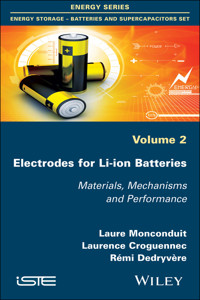
The electrochemical energy storage is a means to conserve electrical energy in chemical form. This form of storage benefits from the fact that these two energies share the same vector, the electron. This advantage allows us to limit the losses related to the conversion of energy from one form to another. The RS2E focuses its research on rechargeable electrochemical devices (or electrochemical storage) batteries and supercapacitors.
The materials used in the electrodes are key components of lithium-ion batteries. Their nature depend battery performance in terms of mass and volume capacity, energy density, power, durability, safety, etc. This book deals with current and future positive and negative electrode materials covering aspects related to research new and better materials for future applications (related to renewable energy storage and transportation in particular), bringing light on the mechanisms of operation, aging and failure.
Sie lesen das E-Book in den Legimi-Apps auf:
Seitenzahl: 146
Veröffentlichungsjahr: 2015
Ähnliche


















Table of Contents
Cover
Title
Copyright
Acknowledgments
Preface
Introduction
1: Negative Electrodes
1.1. Preamble
1.2. Classic materials: insertion mechanism
1.3. Toward other materials and other mechanisms
1.4. Summary on negative electrodes
2: Positive Electrodes
2.1. Preamble
2.2. Layered transition metal oxides as positive electrode materials for Li-ion batteries: from LiCoO
2
to Li
1+x
M
1−x
O
2
2.3. Alternatives to layered oxides
Conclusion
Bibliography
Index
End User License Agreement
List of Tables
Introduction
Table I.1. The conditions that constitutive active materials (AM) of positive and negative electrodes should meet in order to create a Li-ion battery
Guide
Cover
Table of Contents
Begin Reading
Pages
Cover
Contents
iii
iv
ix
vii
xi
xii
xiii
xiv
xv
1
2
3
4
5
6
7
8
9
10
11
12
13
14
15
16
17
18
19
20
21
22
23
24
25
26
27
28
29
30
31
32
33
34
35
36
37
38
39
40
41
42
43
44
45
46
47
48
49
50
51
52
53
54
55
56
57
58
59
60
61
62
63
64
65
66
67
68
69
70
71
72
73
74
75
76
77
78
79
80
81
82
83
84
Energy Storage – Batteries and Supercapacitors Set
coordinated byPatrice Simon and Jean-Marie Tarascon
Volume 2
Electrodes for Li-ion Batteries
Materials, Mechanisms and Performance
Laure Monconduit
Laurence Croguennec
Rémi Dedryvère
First published 2015 in Great Britain and the United States by ISTE Ltd and John Wiley & Sons, Inc.
Apart from any fair dealing for the purposes of research or private study, or criticism or review, as permitted under the Copyright, Designs and Patents Act 1988, this publication may only be reproduced, stored or transmitted, in any form or by any means, with the prior permission in writing of the publishers, or in the case of reprographic reproduction in accordance with the terms and licenses issued by the CLA. Enquiries concerning reproduction outside these terms should be sent to the publishers at the undermentioned address:
ISTE Ltd27-37 St George’s RoadLondon SW19 4EUUK
www.iste.co.uk
John Wiley & Sons, Inc.111 River StreetHoboken, NJ 07030USA
www.wiley.com
© ISTE Ltd 2015
The rights of Laure Monconduit, Laurence Croguennec and Rémi Dedryvère to be identified as the authors of this work have been asserted by them in accordance with the Copyright, Designs and Patents Act 1988.
Library of Congress Control Number: 2015937457
British Library Cataloguing-in-Publication Data
A CIP record for this book is available from the British Library
ISBN 978-1-84821-721-8
Acknowledgments
The authors would like to thank their colleagues from RS2E and Alistore-ERI, respectively, the French and European research networks on the electrochemical storage of energy, for their numerous discussions. They would also like to thank CNRS and Région Aquitaine for their financial support. Laurence Croguennec is grateful to C. Delmas, M. Ménétrier, D. Carlier, F. Weill and C. Masquelier for their collaboration and numerous discussions shared on different oxide and polyanionic electrode materials for Li-ion batteries. Rémi Dedryvère is grateful to D. Gonbeau, D. Foix, J.B. Ledeuil and H. Martinez, as well as the firm SAFT for its financial help and scientific exchanges. Laure Monconduit is grateful to L. Stievano, M.T. Sougrati, B. Fraisse, J. Fullenwarth and M.L. Doublet for their fruitful collaboration.




