


20,99 €
Mehr erfahren.
- Herausgeber: John Wiley & Sons
- Kategorie: Wissenschaft und neue Technologien
- Serie: Antipode Book Series
- Sprache: Englisch
Winner of the 2018 James M. Blaut Award in recognition of innovative scholarship in cultural and political ecology!
Enterprising Nature explores the rise of economic rationality in global biodiversity law, policy and science. To view Jessica's animation based on the book's themes please visit http://www.bioeconomies.org/enterprising-nature/
- Examines disciplinary apparatuses, ecological-economic methodologies, computer models, business alliances, and regulatory conditions creating the conditions in which nature can be produced as enterprising
- Relates lively, firsthand accounts of global processes at work drawn from multi-site research in Nairobi, Kenya; London, England; and Nagoya, Japan
- Assesses the scientific, technical, geopolitical, economic, and ethical challenges found in attempts to ‘enterprise nature’
- Investigates the implications of this ‘will to enterprise’ for environmental politics and policy
Sie lesen das E-Book in den Legimi-Apps auf:
Seitenzahl: 587
Veröffentlichungsjahr: 2016
Ähnliche



















Table of Contents
Cover
Title Page
Acronyms
Preface
1 Enterprising Nature
In the beginning, There Was failure
Are you Being Served? Two Images of Enterprising Nature
Enterprising Nature: A Dual Definition
The Friction-Filled Terrain of the Neoliberal, the Universal, the Global, and the Enterprising
Four Tensions within Enterprising Nature
2 The Problem and Promise of Biodiversity Loss
Rivets Are Popping All Over the Place: Extinction as Global Biopolitical Concern
Rise of the Crisis and Promise of Global Biodiversity
Liberal Natures? The Rise of the Convention on Biological Diversity
Shiva interruptus
3 An Ecological-Economic Tribunal for (Nonhuman) Life
An Ecological-Economic Tribunal
Ecologists and Economists Unite!
The Beijer Institute Project on Biodiversity
Ecology in the Ecological-Economic Tribunal
Getting On with the Adjudicating: What Is Necessary and What Is Surplus
An Economic Tribunal for Cranes (Group
Gruiformes
)
Rationalizing Biological Diversity Loss
Waiting for the tribunal
4 Ecosystem Services as Political-Scientific Strategy
The Rise of Ecosystem Services
Ecosystem Services in Global Conservation: Failure Is Everywhere
Ecosystem Services as Political-Scientific Strategy
Calculating Trade-offs: InVEST as a Calculative Device
Ecosystem Services: Hegemonic and Peripheral?
5 Protecting Profit
Defining Biodiversity-Related Risk
Biodiversity: Risk and the Corporate Interest
The Challenge: Biodiversity Loss Is Not a Material Risk, “Naturally”
Strong Movements and Legislation = Biodiversity Loss as Reputational and Regulatory Risk
Calculative “Risk” Devices: new Tools for Risk Production
Conclusion
6 Biodiversity Finance and the Search for Patient Capital
The State of the “Markets”
A Taxonomy of Actors and Projects
Making Markets: Challenges
Biodiversity Markets: The Jalopy of the Financial World?
7 Multilateralism vs. Biodiversity Market-Making
Battleground 1: WGRI 3 in Nairobi, Kenya
Promissory Mechanisms: The Green Development Mechanism
Battleground 2: COP 10 in Nagoya, Japan
Conclusions
8 The Tragedy of Liberal Environmentalism
“So There Is Lots of Stuff Going On … But When You Think About It, Very Little Is Going On”
The Radical Project of Enterprising Nature?
Finding a New Pragmatic Politics
References
Index
End User License Agreement
List of Tables
Chapter 02
Table 2.1 Countries with highest number of species for selected organisms, © World Resources Institute. (by permission). From McNeely et al. (1990, 89).
Chapter 03
Table 3.1 Crane Extinction Probability. © Oxford University Press (by permission). From Weitzman (1993, 161).
Table 3.2 Genetic differences between cranes. © Oxford University Press (by permission). From Weitzman (1993, 165).
Table 3.3 Conservation diagnostics. © Oxford University Press (by permission). From Weitzman (1993, 172).
Chapter 04
Table 4.1 Growth in ecosystem services discourse at the CBD.
Table 4.2 Some of InVEST’s calculations comparing two scenarios in the Heart of Borneo. Derived from Van Paddenburg et al. (2012, 90).
Chapter 05
Table 5.1 Reports addressing the risks of biodiversity loss
Chapter 06
Table 6.1 “Species” of actors at the Green Power conferences.
Chapter 07
Table 7.1 Meetings at which the GDM initiative is present and active.
List of Illustrations
Chapter 01
Figure 1.1 Illustration from
The Economist
, © Ian Whadcock (by permission). First appeared in
The Economist
, 2005.
Chapter 02
Figure 2.1 Priority regions for the establishment of protected areas, identified in the 1980 IUCN World Conservation Strategy, © IUCN, WWF, UNEP 1980 (by permission).
Figure 2.2 Biodiversity “hotspots” map from the 1990 IUCN report
Conserving the World’s Biodiversity
. © Springer (by permission).
Chapter 03
Figure 3.1 Supply and demand curve for optimal biodiversity policy. © Cambridge University Press 1995 (by permission). From
Figure 3.2 The four ecosystem functions and the flow of events between them. © Cambridge University Press 1995 (by permission). From
Chapter 04
Figure 4.1 Model of ecosystem service framework employed by the Millennium Ecosystem Assessment. © World Resources Institute 2005 (by Creative Commons license).
Figure 4.2 Eight categories of ecosystem service trade-offs. © Millennium Ecosystem Assessment (by permission of Island Press, Washington, DC).
Figure 4.3 (a) Forest cover in Borneo in Business as Usual scenario; (b) Forest cover in Borneo in Green Economy scenario. © WWF HoB Global Initiative (by permission).
Figure 4.4 Projected Gross Domestic Product under Green Economy and Business as Usual scenarios.
Chapter 05
Figure 5.1 Biodiversity in the global risk landscape.
Figure 5.2 Biodiversity in the global risk landscape (2015).
Chapter 06
Figure 6.1 McKinsey greenhouse gas abatement curve, showing abatement cost beyond Business As Usual to 2030.
Chapter 07
Figure 7.1 UNEP compound.
Figure 7.2 Delegates entering the UNEP compound.
Figure 7.3 Plenary Hall in Nairobi.
Figure 7.4 Draft recommendations for innovative financial mechanisms as first proposed in Nairobi at WGRI 3 (CBD 2010c).
Figure 7.5 Contact group negotiations in Nairobi.
Figure 7.6 Nagoya conference center.
Figure 7.7 Inside the ministerial plenary at COP 10.
Figure 7.8 Photo of action at COP 10 (1).
Figure 7.9 Photo of action at COP 10 (2).
Guide
Cover
Table of Contents
Begin Reading
Pages
ii
iii
iv
ii
vi
vii
viii
x
xi
xii
xiii
xiv
xv
1
2
3
4
5
6
7
8
9
10
11
12
13
14
15
16
17
18
19
20
21
22
23
24
25
26
27
28
29
30
31
32
33
34
35
36
37
38
39
40
41
42
43
44
45
46
47
48
49
50
51
52
53
54
55
56
57
58
59
60
61
62
63
64
65
66
67
68
69
70
71
72
73
74
75
76
77
78
79
80
81
82
83
84
85
86
87
88
89
90
91
92
93
94
95
96
97
98
99
100
101
102
103
104
105
106
107
108
109
110
111
112
113
114
115
116
117
118
119
120
121
122
123
124
125
126
127
128
129
130
131
132
133
134
135
136
137
138
139
140
141
142
143
144
145
146
147
148
149
150
151
152
153
154
155
156
157
158
159
160
161
162
163
164
165
166
167
168
169
170
171
172
173
174
175
176
177
178
179
180
181
182
183
184
185
186
187
188
189
190
191
192
193
194
195
196
197
198
199
200
201
202
203
204
205
206
207
208
209
210
211
212
213
214
215
216
217
218
219
220
221
222
223
224
225
226
227
228
229
230
231
232
233
234
235
236
237
238
239
240
241
242
243
244
245
246
247
248
249
250
251
252
253
254
255
256
257
258
259
260
261
262
263
264
265
266
267
268
269
270
271
272
273
274
275
276
277
278
279
280
281
282
283
284
285
286
287
288
289
290
291
292
293
294
295
296
Antipode Book Series
Series Editors: Vinay Gidwani, University of Minnesota, USA and Sharad Chari, CISA at the University of the Witwatersrand, South Africa
Like its parent journal, the Antipode Book Series reflects distinctive new developments in radical geography. It publishes books in a variety of formats – from reference books to works of broad explication to titles that develop and extend the scholarly research base – but the commitment is always the same: to contribute to the praxis of a new and more just society.
Published
Enterprising Nature: Economics, Markets, and Finance in Global Biodiversity PoliticsJessica Dempsey
Global Displacements: The Making of Uneven Development in the CaribbeanMarion Werner
Banking Across Boundaries: Placing Finance in CapitalismBrett Christophers
The Down-deep Delight of DemocracyMark Purcell
Gramsci: Space, Nature, PoliticsEdited by Michael Ekers, Gillian Hart, Stefan Kipfer and Alex Loftus
Places of Possibility: Property, Nature and Community Land OwnershipA. Fiona D. Mackenzie
The New Carbon Economy: Constitution, Governance and ContestationEdited by Peter Newell, Max Boykoff and Emily Boyd
Capitalism and ConservationEdited by Dan Brockington and Rosaleen Duffy
Spaces of Environmental JusticeEdited by Ryan Holifield, Michael Porter and Gordon Walker
The Point is to Change it: Geographies of Hope and Survival in an Age of CrisisEdited by Noel Castree, Paul Chatterton, Nik Heynen, Wendy Larner and Melissa W. Wright
Privatization: Property and the Remaking of Nature-SocietyEdited by Becky Mansfield
Practising Public Scholarship: Experiences and Possibilities Beyond the AcademyEdited by Katharyne Mitchell
Grounding Globalization: Labour in the Age of InsecurityEdward Webster, Rob Lambert and Andries Bezuidenhout
Privatization: Property and the Remaking of Nature-Society RelationsEdited by Becky Mansfield
Decolonizing Development: Colonial Power and the MayaJoel Wainwright
Cities of WhitenessWendy S. Shaw
Neoliberalization: States, Networks, PeoplesEdited by Kim England and Kevin Ward
The Dirty Work of Neoliberalism: Cleaners in the Global EconomyEdited by Luis L. M. Aguiar and Andrew Herod
David Harvey: A Critical ReaderEdited by Noel Castree and Derek Gregory
Working the Spaces of Neoliberalism: Activism, Professionalisation and IncorporationEdited by Nina Laurie and Liz Bondi
Threads of Labour: Garment Industry Supply Chains from the Workers' PerspectiveEdited by Angela Hale and Jane Wills
Life’s Work: Geographies of Social ReproductionEdited by Katharyne Mitchell, Sallie A. Marston and Cindi Katz
Redundant Masculinities? Employment Change and White Working Class YouthLinda McDowell
Spaces of NeoliberalismEdited by Neil Brenner and Nik Theodore
Space, Place and the New Labour InternationalismEdited by Peter Waterman and Jane Wills
Enterprising Nature
Economics, Markets, and Finance in Global Biodiversity Politics
Jessica Dempsey
This edition first published 2016© 2016 John Wiley & Sons, Ltd.
Registered OfficeJohn Wiley & Sons, Ltd, The Atrium, Southern Gate, Chichester, West Sussex, PO19 8SQ, UK
Editorial Offices350 Main Street, Malden, MA 02148-5020, USA9600 Garsington Road, Oxford, OX4 2DQ, UKThe Atrium, Southern Gate, Chichester, West Sussex, PO19 8SQ, UK
For details of our global editorial offices, for customer services, and for information about how to apply for permission to reuse the copyright material in this book please see our website at www.wiley.com/wiley-blackwell.
The right of Jessica Dempsey to be identified as the author of this work has been asserted in accordance with the UK Copyright, Designs and Patents Act 1988.
Part of chapter 5 appeared in Jessica Dempsey, “Biodiversity loss as material risk: Tracking the changing meanings and materialities of biodiversity conservation,” Geoforum 25 (2013): 41–51. Reprinted by permission of Elsevier.
Part of chapters 2 and 3 appeared in Jessica Dempsey, “Fixing biodiversity loss,” Environment and Planning A 47 (2015): 2555–2572. Reprinted by permission of Sage.
All rights reserved. No part of this publication may be reproduced, stored in a retrieval system, or transmitted, in any form or by any means, electronic, mechanical, photocopying, recording or otherwise, except as permitted by the UK Copyright, Designs and Patents Act 1988, without the prior permission of the publisher.
Wiley also publishes its books in a variety of electronic formats. Some content that appears in print may not be available in electronic books.
Designations used by companies to distinguish their products are often claimed as trademarks. All brand names and product names used in this book are trade names, service marks, trademarks or registered trademarks of their respective owners. The publisher is not associated with any product or vendor mentioned in this book.
Limit of Liability/Disclaimer of Warranty: While the publisher and author have used their best efforts in preparing this book, they make no representations or warranties with respect to the accuracy or completeness of the contents of this book and specifically disclaim any implied warranties of merchantability or fitness for a particular purpose. It is sold on the understanding that the publisher is not engaged in rendering professional services and neither the publisher nor the author shall be liable for damages arising herefrom. If professional advice or other expert assistance is required, the services of a competent professional should be sought.
Library of Congress Cataloging-in-Publication Data
Names: Dempsey, Jessica, 1977– author.Title: Enterprising nature : economics, markets, and finance in global biodiversity politics / Jessica Dempsey.Description: Chichester, UK ; Hoboken, NJ : John Wiley & Sons, 2016. | Includes bibliographical references and index.Identifiers: LCCN 2016010099 | ISBN 9781118640609 (cloth) | ISBN 9781118640555 (pbk.) | ISBN 9781118640531 (ePub) | ISBN 9781118640548 (Adobe PDF)Subjects: LCSH: Environmental economics. | Environmental policy–Economic aspects.Classification: LCC HC79.E5 D45155 2016 | DDC 333.7–dc23 LC record available at https://lccn.loc.gov/2016010099
A catalogue record for this book is available from the British Library.
Cover image: Illustration by Ian Whadcock / ianwhadcock.com.Cover design by Wiley and Cathy Matusicky, State Creative Group
Acronyms
AHTEG
Ad Hoc Technical Expert Group
ALBA
Bolivarian Alliance for the Peoples of Our America
BAU
Business as Usual
BBRs
Biodiversity Business Risks
BP
British Petroleum
BSR Network
Business Social Responsibility Network
CBD
Convention on Biological Diversity
CDM
Clean Development Mechanism
CEQ
Council on Environmental Quality
CER
Certified Emission Reductions
CESR
Corporate Ecosystem Service Review
CEV
Corporate Ecosystem Valuation
CI
Conservation International
COP
Conference of the Parties
COP 9
9th Conference of the Parties to the Convention on Biological Diversity
COP 10
10th Conference of the Parties to the Convention on Biological Diversity
CRP
Conference Room Paper
CSD
Commission on Sustainable Development
CSR
corporate social responsibility
EIRIS
Experts in Responsible Investment Solutions
ES
Ecosystem Services
ETS
European Trading Scheme
FAO
Food and Agriculture Organization
FI
Financial Institution
FFI
Flora & Fauna International
G77
Group of 77
GBA
Global Biodiversity Assessment
GDM
Green Development Mechanism
GDP
gross domestic product
GE
Green Economy
GEF
Global Environment Facility
GMO
genetically modified organism
HoB
Heart of Borneo
IBAT
Integrated Biodiversity Assessment Tool
ICSF
International Collective in Support of Fishworkers
IFC
International Finance Corporation
IFM
Innovative Financial Mechanisms
IIFB
International Indigenous Forum on Biodiversity
INBio
Costa Rica’s National Biodiversity Institute
InVEST
Integrated Valuation of Ecosystem Services and Trade-offs
IPCC
Intergovernmental Panel on Climate Change
IRR
internal rate of return
IUCN
International Union for the Conservation of Nature
MA
Millennium Ecosystem Assessment
MSY
Maximum Sustained Yield
NAS
National Academy of Sciences
NatCap
Natural Capital Project
NBASP
National Biodiversity Action and Strategies Plan
NCD
Natural Capital Declaration
NGO
Non-governmental organization
PES
Payments for Ecosystem Services
PwC
PricewaterhouseCoopers
PWS
payments for watershed services
REDD
Reducing Emissions from Deforestation and forest Degradation
SAR
species–area relationship
SBSTTA
Subsidiary Body on Scientific, Technical and Technological Advice
SCOPE
Scientific Committee on the Problems of the Environment
TEEB
The Economics of Ecosystems and Biodiversity project
TNC
The Nature Conservancy
TWN
Third World Network
UBC
University of British Columbia
UN
United Nations
UNDP
United Nations Development Programme
UNEP
United Nations Environment Programme
UNEP FI
United Nations Environment Programme Finance Initiative
UNEP-WCMC
United Nations Environment Programme World Conservation Monitoring Centre
UNESCO
United Nations Educational, Scientific and Cultural Organization
UNFCCC
United Nations Framework Convention on Climate Change
USAID
US Agency for International Development
WB
World Bank
WBCSD
World Business Council on Sustainable Development
WCED
World Commission on Environment and Development
WEF
World Economic Forum
WGRI
Working Group on the Review of Implementation of the Convention on Biological Diversity
WRI
World Resources Institute
WTO
World Trade Organization
WWF
World Wildlife Fund
Series Editors’ Preface
The Antipode Book Series explores radical geography “antipodally,” in opposition, from various margins, limits, or borderlands.
Antipode books provide insight “from elsewhere,” across boundaries rarely transgressed, with internationalist ambition and located insight; they diagnose grounded critique emerging from particular contradictory social relations in order to sharpen the stakes and broaden public awareness. An Antipode book might revise scholarly debates by pushing at disciplinary boundaries, or by showing what happens to a problem as it moves or changes. It might investigate entanglements of power and struggle in particular sites, but with lessons that travel with surprising echoes elsewhere.
Antipode books will be theoretically bold and empirically rich, written in lively, accessible prose that does not sacrifice clarity at the altar of sophistication. We seek books from within and beyond the discipline of geography that deploy geographical critique in order to understand and transform our fractured world.
Vinay GidwaniUniversity of Minnesota, USA
Sharad ChariCISA at the University of the Witwatersrand, South Africa
Antipode Book Series Editors
Preface
The first spark of this book began in May 2006, in the outskirts of Curitiba, Brazil. I was attending a negotiation of the United Nations Convention on Biological Diversity (CBD). Most attention centered whether or not the Parties, government signatories to the agreement, would reaffirm or overturn a moratorium on the field-testing of what is known colloquially as terminator technology (seeds engineered to produce sterile seeds). Hundreds of small farmers and landless people gathered outside the conference center every day reminding the suited delegates that they had responsibilities beyond the patent holders of the technology.
Outside this crucial debate, other agendas galloped ahead. The first of many events on concepts like “biodiversity offsets” took place, and bureaucrats were just beginning to speak in the language of ecosystem services. Compared to other CBD negotiations, where debates oriented around the definition of “primary forests,” it seemed as though the floor underneath international conservation was shifting. Global biodiversity policy was going (more) economic, and perhaps market based! This research was conceived following that negotiation, oriented around a simple question: how did this happen? How did economic and market-based approaches become so dominant, even commonsense, in global biodiversity conservation?
My role in these biodiversity circuits has never been one of passive observer, but of active participant, largely organized by the ongoing work of the Convention on Biological Diversity Alliance (CBD Alliance), a network of civil society groups that follows and intervenes in global biodiversity policies. For over a decade, working with all kinds of people, from all kinds of organizations and social movements – from WWF to Via Campesina – I researched and prepared briefing papers, coordinated joint policy statements, and fundraised endlessly to bring Southern NGOs, Indigenous communities, and social movement representatives to negotiations. Attending over a dozen negotiations, we worked to influence the shape of international biodiversity law and policy. This might sound as if I inhabited a glamorous world of international diplomats and the jet-set crowd, but I can say that it mostly involved sitting with headsets on for long periods of time, carefully following boring legalese as it shifted and shaped, crafting alternative text to circulate to friendly government delegates, and working all hours for one or two weeks.
These experiences, but especially the people I worked closely with, contributed to the particular lens through which I see “enterprising nature,” a phrase that I use to describe efforts to transform diverse natures into economically competitive entities. More than anything, I learned how to inhabit the uncomfortable, impure spaces of liberal environmentalism.
Let me explain. I went to my first CBD negotiation in Den Haag in 2002 armed with a straightforward narrative about the limits of the global, and especially the limits of the multilateral, a lens honed over the course of my undergraduate education and local political activities: the bad experts and elites of the globe continue to wreak havoc on the local, the Indigenous, the peasant, even when they are saving nature. Yet upon arrival I met a group of international activists, such as Ricardo Carrere, Pat Mooney, Ashish Kothari, Chee Yoke Ling, Patrick Mulvany, and Simone Lovera, who were at once deeply skeptical of the premises of the CBD and the “sustainable development compromise,” but who also used the negotiations as a site to draw attention to the persistent blind spots in international environmental law and policy: to how new financial mechanisms fail to address deep power imbalances and socioecological injustices, to the way that very small steps forward at the CBD are undermined by neoliberal trade rules, to the enormous gulfs between haves and have-nots, to the epistemological conceits of Western conservation and science.
They were (and still are) constantly reminding government delegates and international experts that global biodiversity loss is an effect of a kind of “imperial ruination” (to take a term from Anne Stoler), and that addressing this problem requires not just cooperation and consensus between nations, but also disassembling deeply etched power asymmetries and clusters of concentrated power and knowledge that mark some ways of knowing, valuing, and living with nature above others – over and over again, with violent effects for both humans and nonhumans. This tireless group of people showed me what global environmental justice politics looked like: the problems of trenchant poverty in the Global South and the sixth extinction were not oppositional problems, but rather problems with the same root.
But perhaps most crucially, I learned that there was no privileged or perfect place to conduct this struggle; on one day I was holding a banner outside the negotiation stating “no green economy,” then a bit later I was circulating concrete language to improve the Convention text, asking for further study and research on the impact of market-based approaches. We were engaged in advocacy that sometimes shamed governments, sometimes destabilized the worst policy initiatives, and occasionally saw victories (as with the ban on terminator technology that was reaffirmed by governments in Curitiba).
The research questions and approach of this book are overdetermined by this set of personal and political experiences: I see the global as neither homogenous nor smooth, but replete with contestation and even possibility. The shifting ground toward “enterprising nature” is deeply inflected by the hegemonic, elite processes of contemporary neoliberal capitalism, but it is also composed of people I know, often found easy to talk to, and with whom I could at times imagine becoming allies, depending on the issue or the political moment. And over the course of my research I was often surprised at what the most ardent advocates of “enterprising” said in the course of interviews, at the difficulties and hesitations articulated.
…
In this book I tell the story of how biodiversity is being tethered to economic and market logics and practices: when and where this is happening, who and what is involved, and how it is unfolding. This is the story of the making of enterprising nature. But the book is also a story of its non-making: attempts “to enterprise” are often halting and even marginal (while remaining strangely hegemonic).
Within this book I do not dismiss the people involved in enterprising nature, or their ideas, their knowledges and tools. My aim is to open a historically and geographically situated debate on this way of addressing the monoculturing of the planet. The approach I bring to enterprising nature is influenced by feminist scholarship, particularly that of Donna Haraway. Her work reminds us that science and technology are accumulation strategies, deeply implicated in producing classed, gendered, and racialized hierarchies. Yet she also asks that we sit awhile with the excess, with historical and geographical overabundance, that we engage with the “always messy projects of description, narration, intervention, inhabiting, conversing, exchanging, and building” (1994, 62). The point is not simply to “make a tangled mess,” but rather to “learn something about how worlds get made and unmade, and for whom” (1994, 70).
My hope is that this book will be of interest to scholars engaged with debates over the character of environmentalism and conservation in an era of neoliberalism. I hope, too, that it will be read by actors in the circuits I describe: scientists, economists, bureaucrats, employees of non-profit and international organizations, who are keen to reflect on broader implications of the processes in which they are enmeshed. While enterprising nature is so pervasive as to seem axiomatic, if we look closely at the specific operations of these circuits and calculative devices, their effects and non-effects, we can avoid the weary resignation, narrowing vision, and sense of inevitability that so many involved in resisting the sixth extinction nowadays experience. For this reason, I am particularly hopeful that activists and advocates in biodiversity politics will see the book as an invitation to engage and challenge the turn to enterprising nature in new ways.
…
I remember when I was a graduate student I would read other people’s book acknowledgments and think: why did it take them so long? Now I get it. This book took a stupidly long time to finish and so there are many people to thank.
For the most part this project emerged out of an almost decade-long participation in two worlds – the University of British Columbia’s Department of Geography where I was a student and around the world of global biodiversity politics. Around the negotiations of the Convention on Biological Diversity, I can’t believe my luck in meeting the inspiring, insightful and fierce policy wonks and activists already mentioned above, and many more, such as Faris Ahmed, Tasneem Balasinorwala, Joji Carino, S. Faizi, Ana Filipini, Barbara Gemmill, Antje Lorch, Malia Nobrega, Helena Paul, Hope Shand, Chandrika Sharma, Ricarda Steinbrecher, Jim Thomas, and Christine von Weizsacker. All of these people infuse this research project, although they may take issue with some of my interpretations.
Many other people generously gave of their time to be interviewed in the course of my research. It was rare that anyone said no, strangely, even if it meant sneaking me into a 15-minute time slot (which often carried on much longer). The Trudeau Foundation and the Social Sciences and Humanities Research Council supported this travel-intensive research.
At UBC, Trevor Barnes provided the most supportive but also demanding supervision on my dissertation that led to this book. I don’t want to make anyone jealous, but he’s the kind of supervisor who turns your work around to you overnight (it’s true, it happened many times!) but also makes your heart skip a beat because you know that feedback is going to feel like ripping a band-aid off raw skin. Also at UBC, Gerry Pratt and Juanita Sundberg led me through rigorous scholarly but also political debates in courses, over beer and in the hallways at 1984 West Mall. They model a kind of feminist, political scholarship that I aspire to: keenly critical and questioning but also open and generous. I’m so happy to be back there as their colleague.
If there is anything good in this book it is in good part due to the diligent advising I received at UBC but also the ever-critical and supportive students and postdocs I met there: Chris, Matt S., Bonnie, Ted, Alex, Pablo, Fiona, Tyler, Sarah, Michael, Joel, Dawn, and many more. Kevin Gould, Matt Dyce, Shiri Pasternak, Jono Peyton, Jo Reid, Geoff Mann, Emilie Cameron, and Rosemary Collard are probably some of the funniest and most fun people to be a student and now faculty with, as well as hefting serious scholarly weight. I am so grateful for their ongoing friendship and collaborations. Emilie, Rosemary, Geoff, and Jo in particular are big influences on this book: Emilie with her straight-shooting advice and wise insight over the phone, Geoff with his political-economic might delivered from his perch at JJ Bean (and often behind a can of 1516), Rosemary with her lightning-fast email responses clarifying and improving anything I put to paper. Jo edited and re-edited the manuscript, raising big and little questions about what lies within. They are the jackpot I somehow managed to hit in this whole academic thing.
Others who improved this book with their astute readings or conversations include Scott Prudham, Karen Bakker, Matthew Sparke, Nik Heynen, Laura Janara, Rebecca Lave, Raj Patel, Juliane Collard, Erika Bland, Ryan Lucy, Morgan Robertson, Larry Lohmann, Daniel Suarez, and Sian Sullivan. Then there is the stellar editing of Vinay Gidwani, all the way from book prospectus to final edits. I’m so happy I was on the receiving end of his hard questions, thoughtful comments, and ongoing support. At Wiley-Blackwell, Jacqueline Scott and Sakthivel Kandaswamy were ever so patient and prompt; copy-editor Katherine Carr whipped the text into further shape. Cathy Matusicky designed the lovely cover; Ian Whaddel allowed us to use his illustration and Eric Leinberger at UBC helped with maps.
Much of this book was rewritten (and re-rewritten) while I was at the University of Victoria’s School of Environmental Studies, an oasis in the dry, ever neoliberalizing university. Conversations with Kara Shaw, James Rowe, Michael M’Gonigle, and Brian Starzomski are highlights of my time there, and they read parts of this book with their keen analytical but also political minds. Michael also sent me to my first Convention on Biological Diversity meeting in 2002, setting off the more than a decade of learning and collaboration that underpins this book. James and Kara deserve special fist bumps for having my back in those sometimes challenging years.
All the way through are friends and family, many of whom are the pointy-heads mentioned above, but also Suzie, Shawn, Narda, Deb, Brad, Michelle, Kira, Donovan, Madeline, Robbie, Nate, Trish and all of the little people that surround us, crack us up, and irritate us. My mom and dad – Joy and Steve – regularly dropped everything to drive from Edmonton to Victoria/Vancouver to help out, providing bucketloads of support and love to my family when I was travelling. There is also our extended family of caregivers for my kids for over a decade: Lynn Busby, Laurel Beerbower, Narda Nelson, Eaglets, the YMCA-False Creek and even further back. My now not-so-little family is sustained by a big circle.
In 2006 when I went to Curitiba for the CBD negotiation, my family came along for the ride – then composed of Ryan and Sean. Sean was not quite 2. Now he is 11. I sent off the first book prospectus for this project in 2012 when I was nearly exploding with who are now Cecelia and Eloise, the irrepressible CC and Elly. And so the biggest high five and the most explosive fist bump must go to the ever-generous, wise, and (mostly) unflappable Ryan, the key condition of possibility for all this life and liveliness. Thank you, my love!
Vancouver, CanadaFebruary 2016
1Enterprising Nature
In the beginning, There Was failure
In book- and paper-stuffed academic offices, walking down cold and dark streets in Norway alongside government bureaucrats, on Skype interviews with bankers – everywhere I went in the course of my research people talked about the failures of biodiversity conservation. “We tried to make people care about nature for its own sake,” said global experts, “without the results.” I read about failure within the pages of Science and Nature; I decoded profound disappointment in the stilted text of multilateral policy documents. Over beer in a noisy Palo Alto bar, the chief scientist of The Nature Conservancy, Peter Kareiva, explained the problem in his straight-shooting manner, “No one cares about biodiversity outside of the Birkenstock crowd.” Biodiversity, he went on to say, “is something that suburban white kids care about and nobody else.”
While I remain unconvinced that no one cares about biodiversity outside of white, suburban hippies, such tired resignation makes sense. The decimation of nonhuman life on earth continues. Despite conservation-oriented laws and policies at every level of governance from local to international, and the establishment of thousands of protected areas, “there is no indication of a significant reduction in the rate of biodiversity loss, nor of a significant reduction in pressures upon it” (CBD 2010a, 17). A study published in Science found that most indicators of the state of biodiversity are in decline, and the pressures underlying this shift are also increasing. One in five species of vertebrates are classified as threatened, with that figure increasing every year; 322 vertebrate species have gone extinct since 1500. Declining diversity is apparent in agriculture, where 75% of genetic diversity has been lost since the 1900s. Marine ecosystems, too, face mounting pressures; one quarter of oceanic pelagic sharks and rays are classified as threatened or near threatened. What threatened status indicates is a loss of overall abundance of most animals almost everywhere on the earth, a process biologist Rodolfo Dirzo and his colleagues term defaunation: they estimate there are 28% fewer vertebrate animals across species today than there were only four short decades ago; a startling 35% fewer butterflies and moths over the same time period.1 In a conference hall in Trondheim, Norway, Robert Watson, former chief scientist at the World Bank, declared that 2010 – the UN-declared Year of Biological Diversity – should be a time not to celebrate, but rather to mourn biodiversity’s loss.
What does this loss spell for the future of the planet? The impacts of biodiversity loss on global ecosystem function are difficult to study, and even more difficult to pin down with any certainty. In spite of focused research programs around the world, scientific understanding of the functional role of biodiversity remains in many ways elusive. Certainly there are risks to living on a planet that’s less diverse, but those risks remain hard to quantify in general terms. What these alarming statistics tell us is that we are living in a world that is becoming distinctively less lively, less colorful, and less diverse in the realm of nonhuman life. A key assumption I make in this book is that this earth simply is a better place with more color, more kinds of lives, and more ways of living and living with nonhumans. The radical difference of which biodiversity is a part – what many now call biocultural diversity – matters.
What can be done to stem this tide of loss? How can beleaguered environmental activists, bureaucrats, and ecologists generate the political will to spur governments, business, and the general population to take the urgent action that’s needed? For many ecologists and their allies, the answer lies in a turn toward economics. “The majority of the global population now lives in cities and is disconnected from nature,” said Pavan Sukhdev, the head of a major international initiative to economically value biodiversity. This is “not just a physical distance but also an emotional distance.” This disconnection, Sukhdev went on, is “so real” that “we have got to speak the language of economics to show there is a connection.” For many actors concerned with the conservation of biodiversity, a turn to economics feels like the last hope. Biodiversity, a jaded Canadian bureaucrat-scientist explained to me, must be made relevant to the Ministry of Finance for it to survive. For world-renowned biologist Hal Mooney, there is an urgent need to turn biodiversity into something that both policy-makers and citizens can care about. “When you say that biodiversity delivers services which are a benefit to society,” Mooney told me, you begin to speak in language policy-makers understand, and they can “go to their constituents and say, biodiversity is really important for you, personally, because of the services it provides.”
In this book, I explore this turn to economics, the efforts to speak a new language in global biodiversity conservation. Enterprising Nature is a critical exploration of the ascent of what is becoming a new maxim in this field: “In order to make live, one must make economic.”2 In other words, for diverse nonhumans to persist, biodiversity conservation must become an economically rational policy trajectory, sometimes even profitable. The proliferation of this mantra is the analytical target of this book, which investigates the roots of this refrain and the international alliances and relations that cohere in producing it.
Drawing on four years of intensive, multi-site field research in places such as Nairobi, London, and Nagoya, and on my decade-long involvement in global biodiversity policy-making, this book traces disciplinary apparatuses, ecological-economic methodologies, computer models, business alliances, and regulatory conditions that, together, I argue, aim to create the conditions wherein nature, or parts of nature, can prove itself as “enterprising.” This is a nature that no longer needs the bonds of human care or ethical concern, a nature that is certainly not a public investment burden. Rather, the hope is this will be a nature that is entrepreneurial, a nature that can compete not only in the marketplace but also in modern state governance. An enterprising nature.
Enterprising nature seems, theoretically and practically, an approach to biodiversity conservation that is entirely compatible with current, predominantly capitalist, global political-economic relations. Producing enterprising nature, however, as this book chronicles, is not straightforward or easy. Challenges arise at every step: there are scientific debates over how biodiversity supports ecological functions and services, and methodological debates on how to tether ecological data to economic value. Also prominent are geopolitical struggles and global political economic forces that have hampered international conservation for decades. The result is that this increasingly dominant discourse remains, by and large, on the margins of policy-making and capital flows.
The story of enterprising nature, then, holds an alarming paradox. Conservation is trying to make itself more relevant to market and state governance through economization, but all these efforts fail to become operational in a way that can let diverse ecologies live. Enterprising nature, I argue, is best conceptualized as promissory, a socioecological-economic utopia whose realization is always just around the corner. The story of enterprising nature is one of waiting, of waiting for the conditions that can make the work of nonhumans legible to processes of liberal governance and perhaps facilitate their entry into mainstream processes of accumulation.
Are you Being Served? Two Images of Enterprising Nature
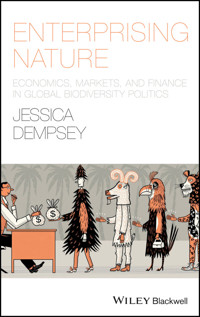
An image from a 2005 edition of the Economist reveals the persistent tensions in the enterprising nature ideal. That image, which appears as this book’s cover, shows a sharp-looking, somewhat jolly, white, middle-aged accountant behind a desk, doling out money to an orderly line of half-human, half-plant/animal creatures, which appear as happy-ish and perhaps bored laborers. It’s payday in a tropical location of some sort and the creature’s hand movements suggest impatience. All recipients of the bags of money defy the human–nonhuman species boundary in some ways; a half-conifer–half-man is followed by a mountain goat–sheep-with-boots, a hand-bag-toting, high heels–wearing bald eagle, followed by an odd-looking leopard or maybe jaguar. The image reveals the dream of enterprising nature: orderly, efficient socioecological relations mediated through a monetary transaction.
In the Economist, the cartoon accompanied an article titled “Are You Being Served?” that followed the release of the Millennium Ecosystem Assessment (MA). The MA was the first global survey of ecosystem services, a study warning that changing ecologies are increasingly impacting human well-being. Despite the dire findings of this assessment, however, the tone of the Economist article is enormously optimistic. The article heralds a new age of ecological-economic accounting. While ecosystem valuation, the Economist staff writer notes, was at one time “a fraught process,” it is now “improved,” mostly due to the knowledge of ecologists, who “know a great deal more than they used to about how ecosystems work” (Economist 2005, 77): they know how different ecosystems deliver services (such as water purification, fiber production, carbon sequestration, etc.) and in what quantities. We know, in other words, how we are “being served.”
The tone of the article suggests not simply improvement in knowledge and accounting, but the arrival at a milestone in human progress: diverse creatures and systems can now be fully brought into the balance sheets of firms and governments, informing the most efficient state or firm investments or payments. “There is no longer any excuse for considering them [ecosystems] unquantifiable,” the article reports (77). The optimism of the Economist article – in spite of the fact that it is describing a devastating report of a planet being rendered less and less hospitable to humans – lay within the certainty that an ecological-economic synthesis (as found in the MA) will tell us, once and for all, how to live on this planet, how to create a permanent order of socioecological relations. In its depiction of an orderly line-up of creatures awaiting payment, the cartoon shows a triumph of a rational system of value allocation, of enterprising nature. The image, though, sidelines critical questions at the heart of this project: what is the right way for humans to live in relation to nonhuman nature? Who decides this and from what location? What socioecologies are investable, worthy of payment, and on whose terms and authority?3
The desire for enterprising nature is a powerful, end-of-history call that reveals troubling signals in environmental politics. What this “will to enterprise” shows, I argue, is a desire for a neutral, objective, efficient, and automatic relationship with nonhuman bodies and populations. Nonhuman nature, this increasingly influential approach pronounces, is best inhabited via an accounting relationship, one that can tell us, neutrally and objectively, through an ecological-economic calculus, how to optimize allocations of the services nonhumans provide. This way of thinking about the human place in nature reasserts, perhaps more than ever, a will for human omniscience regarding relations among humans and nonhumans, a “god trick” here dangerously articulated with neoclassical economics.4 Though an economic logic may show the need for greater investments in nonhuman lives, that investment must be efficient and selective; it is not for all.
That not everything can be saved poses yet another paradox for this kind of conservation. Enterprising nature instrumentalizes, subjugates, and attempts to make passive its subjects – diverse living things – in order to save them.5 It makes new hierarchies of life, rankings meant to guide governance processes. But by rationalizing and, in many ways, rationing nonhuman life through accounting and the logic of efficiency, those advocating for an enterprised nature seem to be trying to lessen human domination over nonhuman living beings, at least in one register: they desire to reduce ecological impoverishment, to make more space for other species to live on this planet. As Stanford biologist Hal Mooney explained to me, ecosystem service and economic valuation are for many conservationists a means to an end: conserving biodiversity. Enterprising nature then, is fraught with a broader tension: it has an end goal of lessening human impact or even domination of nature, yet aims to achieve it through increasingly instrumentalized knowledge-power frameworks and practices that seem to increase human domination over the nonhuman.6 Further, enterprising nature appears, from the cover image, as a reassertion of a particular human mastery, reproducing familiar geopolitical and racial orders: the white man doling out payments for socioecological relations or beings that serve his interests.
A second image: Buying the axe
In the same Economist article about nature’s services, a second image shows a suited, happy man towering over an alarmed campesino while taking away his axe (see Figure 1.1). In his other hand, the businessman is holding a big bag of money over the campesino’s head; coercion and cash payments appear intimately linked. The image portrays an imbalance of power and continuity with colonial relations but, like colonial relations, is also ambiguous. Who is the man holding the bag of cash, and what does he seek to achieve? Does he represent a firm producing forest carbon credits for profit, continuing colonial circuits of extractive wealth production that grab land to benefit Northern fat-cat capitalists? The man’s smile and grandfatherly sweater vest suggest a polite transaction from the point of view of the man, perhaps with honorable, not-entirely-capitalist-intentions. Maybe the man represents an environmental organization like Conservation International and he is buying the land or the forest concession to preserve a “biodiversity hotspot”? Or perhaps the man represents a Norwegian bureaucrat, offering environment-development aid to say, Brazil, in exchange for keeping forests standing and thus doing the critical work of carbon sequestration.
Figure 1.1 Illustration from The Economist, © Ian Whadcock (by permission). First appeared in The Economist, 2005.
Conservationists, bureaucrats, scientists, and diplomats in favor of enterprising nature are not necessarily animated by material interests; their intentions can be deeply benevolent, animated by liberal rationales of improvement. They are often more akin to what Tania Li (2007) calls “trustees,” experts seeking the proper, “right,” and perhaps optimal management of “men and things” (Foucault 1991, 93). Development, for Li, remains a deeply colonial project animated by a liberal “will to improve” the lives of subjects. Perhaps then, we might view the man with the bag of cash as a renovated form of the white, Western “savior,” à la Rudyard Kipling’s “White man’s burden.” Renovated because the altered conduct – the wresting of the axe – is achieved through a monetized economic transactions that is ostensibly “fair.” Fair for the sweater-vested man who achieves conservation or maybe carbon sequestration in return for his bag of cash. And also fair, so the image ambiguously hints, for the campesino who receives a bag of money equal in circumference to the tree stump at his feet. In short, the fairness of exchange value: a tree for its market price. What is on offer, then, is a promise of mutually beneficial improvement through a purportedly neutral ecological-economic calculation.
The image reminds us, however, that even benevolent actors seeking “neutral improvement” or “rational” land management are still deeply embedded in colonial circuitry and power relations. Recognition of benevolence by no means vindicates colonialism; rather, as scholars like Li, Domenico Losurdo, and Lisa Lowe remind, the growth of liberal ideals in governance, economics, and culture “have been commensurate with, and deeply implicated in colonialism, slavery, capitalism, and empire” (Lowe 2015, 2).7 And, depending on the specific time and place, liberal ideals are often tied up in material interests.8 Biodiversity has always been deeply liberal in this sense, entangled in universal impulses for the good of all humanity as well as economistic and imperialist drivers (see chapter 2).
Indeed, the image reflects a well-worn trope in international environmentalism – poor people like this campesino cause biodiversity loss through demand for firewood or income, problems to be solved in this case by paying him. Critical scholarship by the likes of Vandana Shiva (1991) and Arturo Escobar (1998) point, again and again, to how representations of individuals and communities in the Global South dehistoricize and depoliticize the colonial and imperial institutions and impositions that so often lead to dispossession, displacement, and biodiversity loss. This is a key point made by decades of political ecological research: global environmental policies and politics too often direct our attention away from World Bank loans that fuel monocultures and green revolutions, preferring to focus our attention on the poor person with the axe. A trustee tends to ask how one might improve the situation by enhancing the ability of the individual to “do good” (here the peasant with the axe), perhaps via an economic incentive: a tactic that obscures the messy politics and social relations that produce deforestation and the campesino’s involvement in it.
Along these lines, the image in the Economist accompanies discussion of a proposed forest bond scheme. In the article, John Forgach, a principal of ForestRe, a forestry insurance company based in London, describes his idea to create 25-year “forest-backed bonds” that would fund a massive reforestation alongside the Panama Canal in hope of reducing siltation and maintaining water flow needed for the smooth sailing of large container ships central to global trade. Rather than simply appropriating the land for reforestation activities, as colonial businesses or conservation initiatives might have done, ForestRe (the man in the suit) would pay for locals (the campesino with the axe) to stop logging and do the work of tree planting. To fund reforestation activities, bonds would be purchased by those firms most at financial risk from canal closures, such as Walmart. The project is presented as a win-win-win scenario, as reforestation could yield benefits for not only Walmart but also for the environment and the local community, as the proposed reforestation will be a diverse mixture of species that local people also “find useful.” The Economist image shows a clear-cut forest, an entire landscape reduced to stumps. According to proponents of the ForestRe initiative, what distinguishes it from other types of development, like oil palm or sugar cane monocultures, is that it is based on a broader range of services that nature provides beyond timber and other obvious commodities and, as such, will generate value while also protecting forests. The article suggests, too, that the scheme pays attention to the concerns of local people.
Taken together, the foregoing images tell a strong story of an enterprising nature: the cover image reflects the promise of orderly, efficient relations, directed by ecologies and economics; the second image of the man with the axe, meanwhile, calls attention to the processes of uneven development that run along geographical – but also classed, racialized, and gendered – hierarchies. If the two-image story were accurate and complete, enterprising nature would be a tidy set of processes that swiftly allocate resources in order to protect diverse ecosystems according to the values of northern elites. But attempts to govern are always bumpy affairs. ForestRe’s 25-year bonds never materialized; the political and the economic failed to line up. Furthermore, even the ecological fact that underpinned the bond idea in the first place – the fact that reforestation activities would solve water flow issues in the canal – is now disputed.9
This is where the book cover image becomes inadequate, or even misrepresentative. A more apt image for this book’s cover might have had the entire scene entangled by complex mangrove forest roots or fragmented into ill-fitting puzzle pieces set in a UN negotiation hall. At the very least, the man at the desk should have a sweaty brow, bags under his eyes from jetlag, and a wrinkled suit, as the creatures negotiate hard about the amount of money that goes in the bag. Enterprising nature is, I show in this book, reflective of dominant neoliberalizing processes, but nonetheless precarious, dynamic, not at all solid.
Enterprising Nature: A Dual Definition
What does it mean to call nature “enterprising”? The idea is not that nonhumans adopt business plans, take self-help courses, or hire marketing agents. The word “enterprising,” as I mobilize it in this book, has two linked definitions, one as an adjective (“to be enterprising”) and one as a verb, a neologism (“to enterprise”).
Used as an adjective, “enterprising” describes an entity as “imaginative” and “energetic.” To call someone “enterprising” is to draw attention to their creative and productive capacities, to their ability to transform something – a company, an idea, their situation – into something else, usually profitably. The adjective “enterprising” is a term typically reserved to an individual who does not depend on handouts or charity, instead relying upon their own internal smarts, ingenuity, and hard work.10 Thus, the term “enterprising nature” refers to the way that many in the global biodiversity community represent biodiversity and nonhuman ecological bodies and processes: nonhumans are creative, productive, energetic contributors to life on earth.
For many proponents of this vision, the idea is not that we need to transform something uneconomic into something economic. Rather, as the head of the CBD declared, biological diversity is already the world’s largest corporation; it is just not recognized as such. The task is to create the conditions wherein biological diversity can be seen for what it really is: “enterprising,” with diligent work habits that can finally be recognized. This perspective runs strangely parallel, in many ways, to the views expressed by poverty experts Hernando de Soto and C.K. Prashad, and even Nobel Peace Prize–winning microcredit financier Muhammad Yunus: the world’s “bottom billion” or poorest people are naturally enterprising. They are, as Foucault (2008) would say, “entrepreneurial selves.” In this view, what people in poverty need are the conditions in which this true nature can be realized, conditions generated perhaps by extending microcredit (as Yunus has done), or by establishing the right private property relations (as de Soto proposes). In creating these conditions, the goal is to end relations of aid and charity, the “handouts” that supposedly stymie this true nature of human ingenuity, creativity, and productivity. The idea of recognizing inherent entrepreneurship is so pervasive that now, as my research shows, it is being extended toward nonhuman nature. In the era of “enterprising nature,” biodiversity conservation is about creating the right conditions, the conditions under which nonhuman communities can generate the political, financial, and social capital to fend for themselves.
The multiplication of “enterprising units” is a central attribute of what Foucault, in his 1978–79 lectures at the Collège de France, terms “neoliberal governmentality” (Foucault 2003). For Foucault, neoliberal rationality and governance center on cultivating competition. This competition is not necessarily focused on profit-making, but on establishing quantitative differences, measuring economic magnitudes between those differences, and then using such differences to regulate and manage governing choices. Broader than a market logic, which is more tightly focused on creating the conditions for commodity production, pricing, and circulation, neoliberal rationality is focused more on rationing and optimizing “scarce resources”; it is focused on producing something like a “permanent economic tribunal for life” (2008, 247), where the most enterprising can stand up, be seen, and reap their rewards.
Enterprising nature, then, involves the creation of “enterprising units” of nonhuman life in order to set the conditions wherein differential value of species, nonhuman communities, and spaces can be calculated – the creation of what I describe as an ecological-economic tribunal for life (see chapter 3). This project involves rendering the qualities of ecosystems, and rich socioecological relations, into representative forms that can be compared, ranked, and ordered quantitatively. In making the world more enterprising, or competitive, the tribunal marks the “differential endowments” of diverse ecological relations in order to make biodiversity tractable for modern governance, no matter the specific breed of policy – market-oriented, command and control, or community-based.
Enterprising nature, then, is not all about the “tions” – privatization, commodification, financialization, and accumulation – at least not directly.11 It comprises projects and initiatives that are at times about new kinds of commodities, but also about directing efficient government investments in “green infrastructure.” For example, I argue that ecosystem services are better understood as a political-scientific strategy to create new interests in nature, to prevent “stupid decisions,” as one advocate stated, than as an epochal transformation creating new commodities (see chapter 4). This does not mean the processes at play are benign. Nature is of course an “accumulation strategy,” to paraphrase Neil Smith (2007), and has been for a long time (see Peluso 2012); it is the case that capital must find places to constantly expand. But the project of enterprising nature is better described as an attempt to manage the excesses of capitalism that are degrading life on this planet, a project driven by actors who are sometimes but very often not motivated by profit or potential of profit.12
Enterprising nature is more often like Tania Li’s “will to improve.” But unlike Li’s study of development in Indonesia, where projects of improvement bracket out political-economic processes (preferring to focus on cultivating individual and community capacities to manage and adapt to their circumstances), the people and institutions at the center of this project actually take on political-economic processes, attempting to improve the functioning of market society as a whole. “We’re just actually trying to make capitalism work the way it’s meant to,” one ecosystem service scientist and model-creator explained to me, by bringing the full ecological costs of production into state and market decision-making.13 This is a distinctive dream for proponents of market society, one where the invisible hand efficiently directs land use and wealth distributions, a hand now operating within the (also neutral and objective) constraints of scientific calculation (see chapter 3).
Enterprising nature, then, is an attempt to bring biodiversity into governance calculations, into a kind of “permanent visibility” (Foucault 1995) for decision-making on, say, resource developments or land use decisions.14 The circuits I study are creating the conditions that can allow biodiversity to become permanently visible not only to environmentalists but also to market relations, governance calculations, and power brokers. An enterprising nature, the trustees I study seem to be saying, will be considered automatically in decisions; an enterprising nature will be assessed, evaluated, and invested in neutrally and objectively, depending on its work habits and productivity. The friendly accountant pictured on the book’s cover will dole out the necessary payments. Not equal payments, of course: an ecological-economic tribunal will adjudicate the enterprising nature of nature in order to guide efficient investments of scarce resources, a process that necessarily involves making new rankings and hierarchies.
“To enterprise”
Creating and multiplying these enterprising units requires incredibly dense inputs and work, including governmental interventions. This is because, as Foucault explains, competition is not a natural characteristic waiting to be unleashed, if only, for example, the state would get out of the way. Bodies are not in fact born enterprising. As such, a key aspect of the art of neoliberal government is to create the conditions upon which competition can be fostered. Neoliberal governmentality, then, requires not laissez-faire, but actually “permanent vigilance, activity and intervention” (Foucault 2008, 132) on the part of the state but also many other actors. This is why the accountant behind the desk on the cover should have sweat on his brow: cultivating the conditions for competitiveness to flourish, for enterprising nature, takes work; it takes interventions that are “no less dense, frequent, active and continuous than any other system” (145). It is not easy, and it involves enormous amounts of coordination. The man behind the desk on the cover of the book should be not only sweating; he should also be surrounded by experts, his position at the desk supported by institutions – academic, NGO, international. The amount of money in the bag should be underpinned by fractious governments and firms but also computer models, devised on the basis of abstract ecological-economic models.
In the second meaning of the book’s title, enterprising can be understood as a verb: “to enterprise.” It was long after I began using this term that I realized it was grammatically non-existent. My improper use nonetheless matches so well the processes I observed. Enterprising nature is productive; it is a set of ongoing undertakings, actions requiring ever-proliferating effort. In using “enterprising” in this way, I am also drawing from the work of theorists who call attention to the ways in which certain rationalizing knowledge systems or new representations do not somehow reveal a pre-existing world but, rather, help to bring new relations into being (Haraway 1988, 1997; Mitchell 2002, 2007). Scientists, economists, and other experts create the conditions – the subjects and objects, the regulations, laws, policies, and models – needed so that “competitive mechanisms can play a regulatory role at every moment and every point in society” (Foucault 2008, 145). “Enterprising” as a verb, then, calls attention to the productive work of creating a visible and economically legible biodiversity that can be seen and invested in by liberal institutions and within capitalist social relations. Global expertise actively produces “new forms of value, new kinds of equivalences, new practices of calculation,” and importantly, “new relations between human agency and the nonhuman” (Mitchell 2002, 5). Enterprising nature is an attempt




