


32,99 €
Mehr erfahren.
- Herausgeber: John Wiley & Sons
- Kategorie: Wissenschaft und neue Technologien
- Serie: Critical Introductions to Geography
- Sprache: Englisch
Substantially updated for the second edition, this engaging and innovative introduction to the environment and society uses key theoretical approaches to explore familiar objects.
- Features substantial revisions and updates for the second edition, including new chapters on E waste, mosquitoes and uranium, improved maps and graphics, new exercises, shorter theory chapters, and refocused sections on environmental solutions
- Discusses topics such as population and scarcity, commodities, environmental ethics, risks and hazards, and political economy and applies them to objects like bottled water, tuna, and trees
- Accessible for students, and accompanied by in-book and online resources including exercises and boxed discussions, an online test bank, notes, suggested reading, and website links for enhanced understanding
- Offers additional online support for instructors, including suggested teaching models, PowerPoint slides for each chapter with full-color graphics, and supplementary images and teaching material
Sie lesen das E-Book in den Legimi-Apps auf:
Seitenzahl: 743
Veröffentlichungsjahr: 2013
Ähnliche


















Table of Contents
Critical Introductions to Geography
Title page
Copyright page
List of Figures
List of Tables
List of Boxes
Acknowledgments
1: Introduction: The View from a Human-Made Wilderness
What Is This Book?
The Authors' Points of View
Part 1: Approaches and Perspectives
2: Population and Scarcity
A Crowded Desert City
The Problem of “Geometric” Growth
Population, Development, and Environment Impact
The Other Side of the Coin: Population and Innovation
Limits to Population: An Effect Rather than a Cause?
Thinking with Population
3: Markets and Commodities
The Bet
Managing Environmental Bads: The Coase Theorem
Market Failure
Market-Based Solutions to Environmental Problems
Beyond Market Failure: Gaps between Nature and Economy
Thinking with Markets
4: Institutions and “The Commons”
Controlling Carbon?
The Prisoner's Dilemma
The Tragedy of the Commons
The Evidence and Logic of Collective Action
Crafting Sustainable Environmental Institutions
Are All Commoners Equal? Does Scale Matter?
Thinking with Institutions
5: Environmental Ethics
The Price of Cheap Meat
Improving Nature: From Biblical Tradition to John Locke
Gifford Pinchot vs. John Muir in Yosemite, California
Aldo Leopold and “The Land Ethic”
Liberation for Animals!
Holism, Scientism, and Other Pitfalls
Thinking with Ethics
6: Risks and Hazards
Great Floods
Environments as Hazard
The Problem of Risk Perception
Risk as Culture
Beyond Risk: The Political Economy of Hazards
Thinking with Hazards and Risk
7: Political Economy
The Strange Logic of “Under-pollution”
Labor, Accumulation, and Crisis
Production of Nature
Global Capitalism and the Ecology of Uneven Development
Social Reproduction and Nature
Environments and Economism
Thinking with Political Economy
8: Social Construction of Nature
Welcome to the Jungle
So You Say It's “Natural”?
Environmental Discourse
The Limits of Constructivism: Science, Relativism, and the Very Material World
Thinking with Construction
Part 2: Objects of Concern
9: Carbon Dioxide
Stuck in Pittsburgh Traffic
A Short History of CO2
Institutions: Climate Free-Riders and Carbon Cooperation
Markets: Trading More Gases, Buying Less Carbon
Political Economy: Who Killed the Atmosphere?
The Carbon Puzzle
10: Trees
Chained to a Tree in Berkeley, California
A Short History of Trees
Population and Markets: The Forest Transition Theory
Political Economy: Accumulation and Deforestation
Ethics, Justice, and Equity: Should Trees Have Standing?
The Tree Puzzle
11: Wolves
The Death of 832F
A Short History of Wolves
Ethics: Rewilding and Wolves
Institutions: Stakeholder Management
Social Construction: Of Wolves and Men Masculinity
The Wolf Puzzle
12: Uranium
Renaissance Derailed?
A Short History of Uranium
Risk and Hazards: Debating the Fate of High-Level Radioactive Waste
Political Economy: Environmental Justice and the Navajo Nation
The Social Construction of Nature: Discourses of Development and Wilderness in Australia
The Uranium Puzzle
13: Tuna
Blood Tuna
A Short History of Tuna
Markets and Commodities: Eco-Labels to the Rescue?
Political Economy: Re-regulating Fishery Economies
Ethics: Saving Animals, Conserving Species
The Tuna Puzzle
14: Lawns
How Much Do People Love Lawns?
A Short History of Lawns
Risk and Chemical Decision-Making
Social Construction: Good Lawns Mean Good People
Political Economy: The Chemical Tail Wags the Turfgrass Dog
The Lawn Puzzle
15: Bottled Water
A Tale of Two Bottles
A Short History of Bottled Water
Population: Bottling for Scarcity?
Risk: Health and Safety in a Bottle?
Political Economy: Manufacturing Demand on an Enclosed Commons
The Bottled Water Puzzle
16: French Fries
Getting Your French Fry Fix
A Short History of the Fry
Risk Analysis: Eating What We Choose and Choosing What We Eat
Political Economy: Eat Fries or Else!
Ethics: Protecting or Engineering Potato Heritage?
The French Fry Puzzle
17: E-Waste
Digital Divides
A Short History of E-Waste (2000)
Risk Management and the Hazard of E-Waste
E-Waste and Markets: From Externality to Commodity
E-Waste and Environmental Justice: The Political Economy of E-Waste
The E-Waste Puzzle
Glossary
Index
Critical Introductions to Geography
Critical Introductions to Geography is a series of textbooks for undergraduate courses covering the key geographical subdisciplines and providing broad and introductory treatment with a critical edge. They are designed for the North American and international market and take a lively and engaging approach with a distinct geographical voice that distinguishes them from more traditional and out-dated texts.
Prospective authors interested in the series should contact the series editor:
John Paul Jones III
Department of Geography and Regional Development
University of Arizona
Published
Cultural Geography
Don Mitchell
Geographies of Globalization
Andrew Herod
Geographies of Media and Communication
Paul C. Adams
Social Geography
Vincent J. Del Casino Jr
Mapping
Jeremy W. Crampton
Research Methods in Geography
Basil Gomez and John Paul Jones III
Political Ecology, Second Edition
Paul Robbins
Geographic Thought
Tim Cresswell
Environment and Society, Second Edition
Paul Robbins, Sarah Moore and John Hintz
Forthcoming
Cultural Landscape
Donald Mitchell and Carolyn Breitbach
This second edition first published 2014
© 2014 John Wiley & Sons, Ltd
Edition history: Blackwell Publishing Ltd (1e, 2010)
Registered Office
John Wiley & Sons Ltd, The Atrium, Southern Gate, Chichester, West Sussex, PO19 8SQ, UK
Editorial Offices
350 Main Street, Malden, MA 02148-5020, USA
9600 Garsington Road, Oxford, OX4 2DQ, UK
The Atrium, Southern Gate, Chichester, West Sussex, PO19 8SQ, UK
For details of our global editorial offices, for customer services, and for information about how to apply for permission to reuse the copyright material in this book please see our website at www.wiley.com/wiley-blackwell.
The right of Paul Robbins, John Hintz and Sarah A. Moore to be identified as the authors of this work has been asserted in accordance with the UK Copyright, Designs and Patents Act 1988.
All rights reserved. No part of this publication may be reproduced, stored in a retrieval system, or transmitted, in any form or by any means, electronic, mechanical, photocopying, recording or otherwise, except as permitted by the UK Copyright, Designs and Patents Act 1988, without the prior permission of the publisher.
Wiley also publishes its books in a variety of electronic formats. Some content that appears in print may not be available in electronic books.
Designations used by companies to distinguish their products are often claimed as trademarks. All brand names and product names used in this book are trade names, service marks, trademarks or registered trademarks of their respective owners. The publisher is not associated with any product or vendor mentioned in this book.
Limit of Liability/Disclaimer of Warranty: While the publisher and authors have used their best efforts in preparing this book, they make no representations or warranties with respect to the accuracy or completeness of the contents of this book and specifically disclaim any implied warranties of merchantability or fitness for a particular purpose. It is sold on the understanding that the publisher is not engaged in rendering professional services and neither the publisher nor the author shall be liable for damages arising herefrom. If professional advice or other expert assistance is required, the services of a competent professional should be sought.
Library of Congress Cataloging-in-Publication Data
Robbins, Paul, 1967–
Environment and society : a critical introduction / Paul Robbins, John Hintz, and Sarah A. Moore. – Second edition.
pages cm
Includes bibliographical references and index.
ISBN 978-1-118-45156-4 (pbk.)
1. Environmental sciences–Social aspects. 2. Environmental protection–Social aspects. 3. Human ecology–Social aspects. I. Hintz, John. II. Moore, Sarah A. III. Title.
GE105.R63 2014
333.72–dc23
2013032142
A catalogue record for this book is available from the British Library.
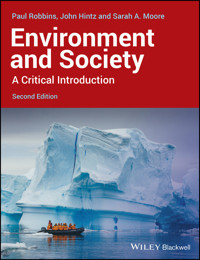
Cover image: Tourists in boat watching penguins on an iceberg, Antarctica. © DreamPictures / Getty Images
Cover designer: Design Deluxe
List of Figures
List of Tables
List of Boxes
Acknowledgments
The book would have been impossible without the impeccably polite prodding of Justin Vaughan at Wiley Blackwell, an editor whose creative interventions extend beyond editing and were key sparks in imagining the book and setting us writing. He also sprang for dinner that time in Boston. Many thanks too to Ben Thatcher at Wiley Blackwell for his patience and hard work.
Paul Robbins and Sarah Moore would like to thank the School of Geography and Development at the University of Arizona for the stimulating environment in which to think and write, and especially John Paul Jones III, Sallie Marston, and Marv Waterstone. They would like to thank the students of their Environment and Society classes for slogging through early performances of some of the material presented here. They owe a debt of gratitude to their current and former graduate students who embody and convey much of the plural thinking in the book. The University of Wisconsin-Madison has become an equally invigorating home, including both the Department of Geography and the Nelson Institute for Environmental Studies. Paul and Sarah would also like to thank Marty Robbins, Vicki Robbins, and Mari Jo Joiner. Special thanks to Khaki and Onyx the Great Danes, who are profound society–environment problems in their own right.
John Hintz would like to thank his colleagues in the Department of Environmental, Geographical and Geological Sciences (EGGS) at Bloomsburg University for helping keep the stresses of academic life to a minimum. Innumerable thanks also need to go to his incredibly supportive family (Michelle, Lyell, Claire, Theo, Carolyn, Mom, and Dad).
1
Introduction
The View from a Human-Made Wilderness
Source: Oostvaardersplassen, a nature reserve in the Netherlands.
Keywords
AnthropocenePolitical ecologyReconciliation ecologyRewildingNews headlines from forests, fields, rivers, and oceans suggest we are in a world of trouble. Storms ravage the coasts of Asia and the Americas, with more looming as sea levels slowly rise. Fresh water is increasingly scarce around the globe, owing not only to heavy water use but also widespread pollution; there is not a single drop of water in the Colorado River in the United States or the Rhone River in France that is not managed through complex dams and distribution systems, or affected by city and industrial waste along their paths to the sea. Agricultural soils are depleted from years of intensive cropping and from the ongoing application of fertilizers and pesticides in the search for ever-sustained increases of food and fiber; in North India, after decades of increasing production, yields of wheat and rice have hit a plateau. Global temperatures are on the rise and, with this increase, whole ecosystems are at risk. Species of plants and animals are vanishing from the Earth, never to return. Perhaps most profoundly, the world's oceans – upon which these global systems rest – show signs of impending collapse. The accumulation of these acute problems has led observers to conclude that the environment may be irreversibly lost or that we may have reached “the end of nature” (McKibben 1990).
And yet in Flevoland, a province in the Netherlands, wild species are thriving as never before. Red deer roam the landscape, feral horses travel in herds, and an ecosystem of foxes and wild birds has arisen, including egrets and wild geese. Aurochs – the massive wild cattle of Europe – have been extinct for centuries, but their human-bred cousins, Heck Cattle, graze the landscape, their long horns and hairy forms rumbling across the marshland (Figure 1.1). This 15,000-acre wilderness, called Oostvaardersplassen, is filled with wild life. Remarkably, all this wildlife is thriving in one of the places on Earth most densely populated by people. For safari visitors, who pay 45 dollars for a visit to the park, there is no question that the place creates a great sense of wonder, as visits to wild places do for most all of us in a world that is increasingly encroached by human activity, pollution, and influence.
Figure 1.1 Heck Cattle. Source: Roel Hoeve/Foto Natura/Corbis.
But if this place is a wilderness, it is by no means a natural one. Envisioned and created by biologists in the 1980s, this park had previously been little more than muddy lowlands devoid of wildlife. Over time, and with the careful introduction of various animals and plants, the landscape has been crafted to produce these animals. Most notably, the very ground upon which the park sits was reclaimed from the sea, as much of Dutch land was long ago. In the time of the Aurochs, Oostvaardersplassen would have been under meters of water! Though intended to mimic a late Pleistocene (10,000-year-old) ecology, therefore, the place is artificial. It is the product of rewilding, where long-lost ecosystems are crafted by people from whole cloth, in order to reclaim – or create – landscapes as they might have been before human influence (Kolbert 2012).
The wonderful landscapes of Oostvaardersplassen therefore raise as many questions as they answer. Which animals are introduced and which are not? Who says this state, devoid of people, is the natural one? Where some animals like the Aurochs are extinct, is a human-bred substitute ecologically acceptable? Given that the Heck Cattle were in fact bred by the Nazis in their effort to restore “pure” European nature, are such introductions socially acceptable? In a world desperate for the protection of existing wilderness (to say nothing of clean water and air), are expensive efforts at creating new wildernesses practical, or elitist?
This view from the Netherlands makes our global situation easier to understand, though perhaps no simpler to solve. The contradictory proposition – dramatically transforming the environment in ways that may preserve the environment – is a metaphor for the condition of our longstanding relationship to the non-human world. From this view, Oostvaardersplassen is in no way unique. Yellowstone National Park in the United States, though heralded as a wilderness, was created through the violent extirpation of the dozens of native tribes who lived in the region, transformed its landscapes, and relied on the resources of what would become a park devoid of people. Coffee plantations throughout Asia and Latin America, though regarded purely as economic and artificial landscapes, often teem with wild birds, mammals, and insects, all beyond the intent and control of farmers, conservationists, or anyone else for that matter. Everywhere we seek some place beyond people, the marks of human creation and destruction confront us, and wherever the works of humans are in evidence, there are non-human systems and creatures, all operating in their own way.
Decisions made in places like Oostvaardersplassen, therefore, cannot be made solely on the basis that the region is a “natural” one, nor a “social” one. The area is simultaneously neither and both, with animals, plants, and waterways springing from human interventions, creating altogether new habitats and environments. Wildlife parks and coffee plantations are both landscapes of the Anthropocene, therefore, one term for our current era, when people exert enormous influence on the Earth, but where control of these environments and their enormously complex ecologies is inevitably elusive.
If decisions about what to do (and what not to do) are to be made, and the larger complex puzzle of living within nature is to be solved, we need tools with which to view the world in fresh ways and assess possible routes forward. For example, viewed as a problem of ethics, the creation of a Dutch wilderness becomes one of sorting through competing claims and arguments about what is ethically best, on whose behalf one might make such an argument (that of people with competing claims on the scarce resources required in this undertaking or that of the animals themselves?), and over which criteria we might use to adjudicate “good” policy. From the point of view of political economy, by contrast, one would be urged to examine what value is created and destroyed in the transformation of these muddy lands, which specific species are selected and why, whose pockets are filled in the process, and how decisions are controlled and directed through circuits of expert power and conservation authority. Indeed, there is no shortage of ways to view this problem, with population-centered considerations competing with those that stress market logics, and arguments about public risk perception competing with those about the romantic social construction of the park.
What Is This Book?
This book is designed to explain these varied interpretive tools and perspectives and show them in operation. Our strategy is first to present the dominant modes of thinking about environment–society relations and then to apply them to a few familiar objects of the world around us. By environment, we mean the whole of the aquatic, terrestrial, and atmospheric non-human world, including specific objects in their varying forms, like trees, carbon dioxide, or water, as well as the organic and inorganic systems and processes that link and transform them, like photosynthesis, predator–prey relationships, or soil erosion. Society, conversely, includes the humans of the Earth and the larger systems of culture, politics, and economic exchange that govern their interrelationships.
From the outset we must insist that these two categories are interlaced and impossible to separate. Humans are obviously environmental beings subject to organic processes. Equally problematically, environmental processes are also fundamentally social, in the sense that they link people and influence human relationships. Photosynthesis is the basis of agriculture, for example, and so is perhaps the most critical environmental process in the history of civilization. More complex: human transformation of carbon levels in the atmosphere may further alter global photosynthesis in a dramatic way, with implications for human food and social organization. Obviously, it is difficult to tell where the environment leaves off and society begins. On the other hand, there is not universal agreement on these relationships and linkages. The perspectives summarized in this text present very different views about which parts of society and environment are connected to which, under what conditions these change or can be altered, and what the best courses of action tend to be, with enormous implications for both thinking about our place in the ecosystem and solving very immediate problems like global warming, deforestation, or the decline in the world's fisheries.
In Part I, we lay out some of the dominant ways of interpreting the environment–society relationship. We begin in Chapter 2 with a perspective that is foundational to the history of both the natural and social sciences: population. Here we describe how human population has been viewed as a growing threat to the non-human world, contrasting this with views of population growth as a process that not only consumes, but also potentially produces, resources in the world. In Chapter 3 we consider economic ways of thinking about the environment. These views stress the power of markets – a category in which we include systems of economic exchange – to respond to scarcity and drive inventive human responses. This is followed in Chapter 4 by approaches that stress institutions, which we define as the rules and norms governing our interactions with nature and resources. Institutional approaches address environmental problems largely as the product of “common property” problems that are amenable to creative rule-making, incentives, and self-regulation. Chapter 5 examines ethics-based approaches to the environment, with their often radical ways of rethinking the place of humans in a world filled with other living and non-living things. The view of the environment as a problem of risk and hazard is explored in Chapter 6. That approach proposes a series of formal procedures for making the best choices possible, given that environments and environmental problems are inherently uncertain and highly variable. This is followed by a description of political economy approaches in Chapter 7, which are those that view the human relationship with nature as one rooted in the economy, but which insist that the economy is based in, and has fundamental implications for, power relationships: who gets what, who works for whom, and who pays. Contrary to market-based approaches, these point to the environmentally corrosive impacts of market economics. Chapter 8 closes this part of the book by describing approaches to environment and society issues that stress social construction, which we define as the tendency for people to understand and interpret environmental issues and processes through language, stories, and images that are often inherited or imposed through systems of media, government, education, or industry. These stories are not harmless, since they can encourage or overlook very real actions, impacts, and behaviors with serious environmental and social consequences.
Within these several ways of seeing are many others, of course. Within political economy, for example, issues of environmental justice are critical to understanding why some people are more heavily exposed to hazards than others. We have nested many of these perspectives within larger categories of thought, though without pretending we can do more than introduce many important concepts. Of particular significance are issues related to gender. These are so important, indeed, that we chose not to set them aside in a separate chapter, but to thread them throughout the book, amidst themes as varied as population and political economy.
Part II presents a set of nine critical objects, and examines each of them in turn using a sample of these approaches. Each chapter begins with a “short history” of the object followed by a discussion of ways in which the characteristics of the object present a puzzle or conundrum, and then presents divergent ways of thinking about the object from competing points of view. In Chapter 9, we introduce carbon dioxide, a curious gas with a complicated history on Earth that shows it to vary widely over time, with enormous implications for the forms of life dwelling here. As one of the most important greenhouse gases, moreover, CO2 has become an increasingly contested object, with competing views about its control, regulation, and circulation. In Chapter 10, we discuss trees. These plants have been companions of human civilization since the beginning, though the long relationship has been marked by dramatic ebbs and flows. In this chapter we take the opportunity to introduce varying theories to account for deforestation and reforestation, as well as a startling ethical proposal for trees to legally represent themselves. Chapter 11 is dedicated to wolves, a species with which humans have a current love–hate relationship and whose return throughout North America and parts of Europe and Asia represents a dramatic change in the way humans and animals relate. This chapter stresses diverse cultural understandings of the same animals, and the implications of our ethics and institutions for the many animals that share the landscape with humanity. Chapter 12 addresses uranium, a natural element that has been harnessed for extraordinary power and benefit, but which has a history rich in danger, injustice, and environmental harm. The tuna takes center stage in Chapter 13, and with it the profound problems faced by the world's oceans. Here, human economics and ethics collide in a consideration of how fish production and consumption are regulated and managed in a complex world. Chapter 14 discusses lawns and the risks posed by the artificial chemical inputs required to maintain them. Chapter 15 addresses one of the world's fastest-growing commodities, bottled water. This object has the rare dual role as a solution to problems of water supply in some parts of the world, while being a clear luxury item – with attendant environmental problems – in others. We next examine French fries (also called “chips”!) in Chapter 16, a culinary invention that connects the complex centuries-old history of the transatlantic “Columbian Exchange” with the health controversies and industrial food economies of the twenty-first century. We close by addressing e-waste in Chapter 17, all the hazardous trash from cell phones, computers, and other electronics that continues to build up in landfills around the world, but which has also become a source of “treasure” for people and companies who mine it for recyclable materials.
Quite intentionally we have selected objects for exploration, rather than problems. We do this for two reasons. First, while many objects are obviously linked to problems (trees to deforestation, as we shall see in Chapter 10, for example), not all human relations with non-humans are problems. Second, we intend by this structure to invite people to think seriously about how different things in the world (giraffes, cell phones, tapeworms, diamonds, chainsaws . . .) have their own unique relationship to people and present specific sorts of puzzles owing to their specific characteristics (they swim, they melt, they migrate, they are poisonous when eaten . . .). This is intended as an opportunity to break away from the environment as an undifferentiated generic problem, one universally characterized by a state of immediate and unique crisis. While global climate change is a critical (and sprawling) suite of problems, for example, the long and complex relationship of people to carbon dioxide itself provides a focused entry point, filled with specific challenges and opportunities. We do indeed face enormous environmental problems, but we believe them to be best solved by exploring the specificities and differences, as well as commonalties, of both people and things.
We do not pretend to have provided an exhaustive list of socio-environmental situations, interactions, and problems. Instead we provide a few key examples to show how objects are tools to think with, and to demonstrate the implications of divergent ways of seeing environmental issues.
We have also provided boxed discussions throughout the text entitled: “Environmental Solution?” Our use of the question mark is both intentional and provocative. All the examples we describe have been considered, by someone, to be a solution to environmental problems. We invite readers to consider whether these solutions make sense but also to interrogate the theoretical assumptions that underpin each such solution, using the tools we have provided in the text to think critically about what constitutes a sensible way to address environmental challenges.
It is also important to note that this is not an environmental science textbook, though it is a book that takes environmental science seriously. Several key concepts and processes from a range of environmental sciences are described and defined, especially in the latter half of the book, including carbon sequestration, ecological succession, and predator–prey relationships, among many others. These are described in terms detailed enough to explain and understand the way human and social processes impinge upon or relate to non-human ones. Throughout we have drawn on current knowledge from environmental science sources (the report on global climate change from the Intergovernmental Panel on Climate Change, for example), but we intend a book that requires no previous knowledge of such sciences or sources. We believe this book might reasonably accompany more strictly environmental science approaches, or be used in courses that seek to bridge environmental ethics, economics, or policy with issues in ecology, hydrology, and conservation biology, or vice versa.
The Authors' Points of View
Finally, we provide many points of view in this volume that directly contradict one another. It is difficult, for example, to simultaneously believe that the source of all environmental problems is the total population of humans on Earth, and to hold the position that population growth leads to greater efficiencies and potentially lower environmental impacts. Even where ideas do not contradict one another (for example, risk perception in Chapter 6 might be seen as a sort of social construction in Chapter 8), they definitely stress different factors or problems and imply different solutions.
With that in mind, it is reasonable to ask what the points of view of the text's authors might be. Which side are we on? This is difficult to answer, not only because there are three of us, each with our own view of the world, but also because, as researchers, we often try to bring different perspectives and theories to bear on the objects of our study, and to foster a kind of pluralism in our thinking.
Nonetheless, we do collectively have a point of view. First, we are each urgently concerned about the state of natural environments around the world. Our own research has focused on diverse environmental topics, including Professor Hintz's work on the status of bears in the western part of the United States, Professor Moore's research on the management of solid and hazardous waste in Mexico, and Professor Robbins' investigation of the conservation of forests in India. From these experiences, we have come to share an approach best described as political ecology: an understanding that nature and society are produced together in a political economy that includes humans and non-humans. What does this mean? To keep it as straightforward as possible, we understand that relationships among people and between people and the environment are governed by persistent and dominant, albeit diverse and historically changing, interactions of power (Robbins 2012). This means that we have some special sympathy for themes from political economy and social construction.
When Hintz examines the conservation of bears in Yellowstone, for example, he thinks it is critical to examine how bears are imagined by people and to know what media, assumptions, and stories influence that imagination, since these prefigure how people do or do not act through policy, regulation, or support for environmental laws. When examining solid waste in Mexico, in another example, Moore thinks the crucial question is who controls access to and use of dumps, since this determines, to a large degree, how waste is managed, whether problems are addressed or ignored, and where the flow of hazards and benefits is directed. When examining forests in India, Robbins wants to know how local people and forest officers coerce one another, in a system of corruption that determines the rate and flow of forest-cutting and environmental transformation. People's power over one another, over the environment, and over how other people think about the environment, in short, is our preferred starting point.
We also share an assumption that persistent systems of power, though they often lead to perverse outcomes, sometimes provide opportunities for progressive environmental action and avenues toward better human–environment relationships. We are stuck in a tangled web, in other words, but this allows us many strands to pull upon and many resources to weave new outcomes.
As a result, we also stress throughout the volume a preference for some form of reconciliation ecology. As described by ecologist Michael Rosenzweig (2003), this describes a science of imagining, creating, and sustaining habitats, productive environments, and biodiversity in places used, traveled, and inhabited by human beings. This point of view holds that while many of the persistent human actions of the past have stubbornly caused and perpetuated environmental problems, the solution to these problems can never be a world somehow bereft of human activity, work, inventiveness, and craft. Such a point of view does not deny the importance of making special places (conservation areas, for example) for wild animals, sensitive species, or rare ecosystems. But it does stress that the critical work of making a “greener” world will happen in cities, towns, laboratories, factories, and farms, amidst human activity, and not in an imaginary natural world, somewhere “out there.” As Emma Marris describes the possibilities of such a world, she invokes the metaphor of the Earth and its ecosystems as a “Rambunctious Garden,” a hybrid of wild nature and human activity (Marris 2011).
For all the weight of our own views, however, we strongly believe in the analytical challenges presented by all of the approaches described here. It is our intention, therefore, to present the most convincing and compelling arguments of the many and diverse ways of viewing society and environment. We insist that, while it is impossible for us to present a fully unbiased view of the many ways of thinking about nature, it is possible to present fair characterizations of many points of view, characterizations without caricatures. Only the reader can judge our success in this regard.
References
Kolbert, E. (2012). “Recall of the Wild.” The New Yorker, December 24.
Marris, E. (2011). Rambunctious Garden: Saving Nature in a Post-Wild World. New York: Bloomsbury.
McKibben, B. (1990). The End of Nature. New York: Random House.
Robbins, P. (2012). Political Ecology: A Critical Introduction. Oxford: Wiley Blackwell.
Rosenzweig, M. L. (2003). Win–Win Ecology: How the Earth's Species Can Survive in the Midst of Human Enterprise. Oxford: Oxford University Press.
Part 1
Approaches and Perspectives
2
Population and Scarcity
Source: Vladimir Wrangel/Shutterstock.
Keywords
Birth rateCarrying capacityDeath rateDemographic transition modelEcological footprintExponential growthFertility rateForest transition theoryGreen RevolutionInduced intensificationKuznets curve (environmental)Neo-MalthusiansZero population growthA Crowded Desert City
A trip into Phoenix, Arizona on almost any day of the week is a journey into a dense haze of exhaust fumes, ozone, and blowing dust. This desert metropolis of four million people is the tangled conurbation of 10 separate cities, together planted squarely in a low desert depression: “The Valley of the Sun.”
The city effectively did not exist at the turn of the twentieth century. In a place that receives seven inches of rain a year and where summer temperatures can exceed 120°F for many days in a row, it was a largely overlooked site for settlement during the period of American Westward expansion, though a range of native peoples had adapted and thrived in the area in small numbers in the centuries prior.
Starting in the 1950s, new people began to arrive in the area, bringing with them new demands for land and water. Going from a half million people before 1960 to its present size, the rate of growth in the valley has been on the order of 40 percent per decade. In the 1990s, the population grew by roughly 300 people per day, as a sun belt economy mushroomed in the region, driven by high tech production, service industries, and retirement communities. As of 2012, Phoenix is home to 1.5 million people, making it the fifth largest city in the United States.
With each new person comes more demand for limited available water, the production of mounds of garbage, and the disturbance of large areas for new home construction. Given weeks on end with temperatures above 100°F (more than 38°C), summer demands for air conditioning are constant. The hundreds of thousands of cars in the region (two automobiles per household) each emit roughly their own weight in greenhouse gases per year, contributing seriously to both local air pollution and global climate change. The dramatic rate of population growth poses obvious questions about the limits of the land, water, and air to support the city.
Lesen Sie weiter in der vollständigen Ausgabe!
Lesen Sie weiter in der vollständigen Ausgabe!
Lesen Sie weiter in der vollständigen Ausgabe!
Lesen Sie weiter in der vollständigen Ausgabe!
Lesen Sie weiter in der vollständigen Ausgabe!
Lesen Sie weiter in der vollständigen Ausgabe!
Lesen Sie weiter in der vollständigen Ausgabe!
Lesen Sie weiter in der vollständigen Ausgabe!
Lesen Sie weiter in der vollständigen Ausgabe!
Lesen Sie weiter in der vollständigen Ausgabe!
Lesen Sie weiter in der vollständigen Ausgabe!
Lesen Sie weiter in der vollständigen Ausgabe!
Lesen Sie weiter in der vollständigen Ausgabe!
Lesen Sie weiter in der vollständigen Ausgabe!
Lesen Sie weiter in der vollständigen Ausgabe!
Lesen Sie weiter in der vollständigen Ausgabe!
Lesen Sie weiter in der vollständigen Ausgabe!
Lesen Sie weiter in der vollständigen Ausgabe!




