


Erhalten Sie Zugang zu diesem und mehr als 300000 Büchern ab EUR 5,99 monatlich.
- Herausgeber: Eland Publishing
- Kategorie: Gesellschafts- und Liebesromane
- Sprache: Englisch
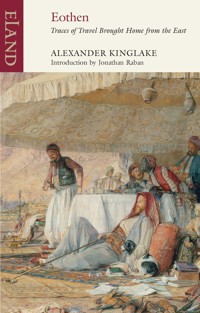
One of the most witty and idiosyncratic travel books, Eothen started out as a few notes scribbled on the back of a map for a friend, but took Kinglake seven years of painstaking work to finesse. The physical details of the journey, undertaken in 1834 through Turkey, Cyprus, the Holy Land, Cairo and Damascus, are barely mentioned. The infectious charm lies in the conversations, the whimsical chance encounters and the attitudes of the author. Over the years, Kinglake has been recognised as a stylist without equal.
Sie lesen das E-Book in den Legimi-Apps auf:
Seitenzahl: 500
Veröffentlichungsjahr: 2024
Das E-Book (TTS) können Sie hören im Abo „Legimi Premium” in Legimi-Apps auf:
Ähnliche



















Praise and criticism for Kinglake’s Eothen
‘one of the most original, graceful and creative of all travel books … sparkling, ironic and terrific fun’
JAN MORRIS
‘Two things above all have made this high-spirited travel narrative a classic, first Kinglake’s superbly honed style, and secondly, his sense of comic fantasy.’
ROBERT IRWIN
‘With perceptions as sharp as an Ottoman scimitar and humour as dry as desert air, elegant, absorbing Eothen is one of my favourite narratives of travel in the Middle East.’
ANTONY SATTIN
‘…continuously alive with daily incident. It marvellously catches the rippling surface of life … his laughter and irony cover strong feeling and a love of life … He returned to the West, unscathed by the plague, richer in a compassionate knowledge of human nature.’
V S PRITCHETT
‘Liberal, self-confident, sensuous … Kinglake is always generous and direct. That is the seat of his likeability, his graciousness, his mental ease. He enjoyed the people with whom he came in contact.’
ROBIN FEDDEN
‘A terse style, keen powers of observation and wry sense of humour make Eothen a masterpiece.’
TED GORTON2
‘Arguably the very first modern travel book with its blend of satire and profundity’
BRUCE PALLING
‘Eothen has the freshness of the immediate and the new … it is far less about the countries and the cities he passes through than it is about himself. This is what makes Eothen a modern travel book, possibly the first and certainly one of the greatest of its kind.’
BARBARA KREIGHER
‘… grotesque, baseless, and confoundedly improper … It must be evidence of a deplorable character that I find it so enjoyable.’
ALLAN MASSIE
‘wicked spirit of jesting at everything’
JOHN MURRAY, who rejected it for publication
‘In travelling through Asia Minor and permitting the East to inspire him with a perverse distrust of western progress, Kinglake could scarcely have “fortified himself for the business of life” to worse effect. Not thus are Lord Chancellors made.’
ROBERT B. INCE
‘… a pathetic catalogue of pompous ethnocentrisms and tangled nondescript accounts of the Englishman’s East …’
EDWARD SAID
Eothen
Traces of Travel Brought Home from the East
ALEXANDER KINGLAKE
Contents
Introduction
Eothen is such an easygoing book, so funny, so crisp and vivid in its handling of people and places, that the reader may well not notice that it is also a very slippery book indeed. It seems so lightly and spontaneously done, this quizzical self-portrait of an Old Etonian swanning idly around the Middle East in the 1830s. Its determinedly inconsequential surface masks a degree of artistic guile for which Kinglake has never received full credit.
‘My excuse for the book is its truth,’ he announces in his Preface. One may let one’s eyebrow lift a fraction at that statement, since the preface itself is an elaborate, and highly purposeful, lie. Kinglake passes off Eothen as a hastily written letter (a ‘scrawl’) to a travelling friend. It was no such thing. The book took Kinglake a decade to write. It was revised and re-revised; its style of bright talk was the product of a long process of literary refinement. In the Preface, Kinglake rejoices in the book’s ‘studiously unpromising’ title and makes the assurance that it is ‘quite superficial in its character’. For an ironist, the worst of all fates is to be taken literally – and Kinglake, adored though he was by generations of Victorian and Edwardian readers, has usually been taken, or mistaken, at his word.
He liked to pose as a gentleman-amateur of life and letters. ‘I, a lay-man not forced to write at all …’ As an artist of considerable cunning and professional seriousness, he was drawn to the travel-memoir precisely because it had the reputation of being an innocent and artless form – a rag-bag of haphazard trifles, random observations, domestic details, notes and sketches. For Kinglake it was the perfect vehicle for his peculiarly devious kind of literary talent. In the travel book he could dissemble, improvise, mock 7his readers. Disguised as a humble reporter, he could tell tall and improbable tales. Recreating himself in the character of the Victorian Englishman Abroad, he could bring off one of the finest pieces of satiric portraiture in 19th-century writing. Eothen needs to be read with more subtlety than most readers have brought to it in the past. If one remains alert to its tone and responsive to its architecture, it reveals itself as a brilliant acid comedy, a sly masterpiece, as full of tricks as an Egyptian magician.
The ribs and spine of the book are provided by a real journey, from the Danube through Greece, Turkey, Cyprus, the Lebanon, Palestine, Egypt, Jordan and Syria. Its flesh is a controlled riot of embroidery and invention. Actual events (or what one presumes to be actual events) are treated as excuses and springboards for a marvellous succession of flights of fancy and imagination. Kinglake shows his hand very early on. Half of Chapter One is taken up by a hilarious, and wholly mythical, conversation between an English Traveller, a dragoman and a Pasha (‘Whirr! whirr! all by wheels! – whiz! whiz! all by steam!’). What might happen interests Kinglake just as much as what actually did happen, and that inspired piece of fiction sets a tone from which the book never falters.
For travelling, in Eothen, is as much a mental state as a physical condition. Liberated by the East from ‘the stale civilization of Europe’, Kinglake – or, rather, his first-person hero – is free to let his mind wander. With his foot in the stirrup he is in much the same reverie of free-association as a patient on an analyst’s couch. For this rich young Englishman, the East itself exists primarily as an exotic stage on which his own character can be more vividly illuminated than it ever was at home. So he soliloquizes, he recollects, he speculates. Sometimes his surroundings bear in on him with more force than his imaginings, but for the most part he is the chief actor in a sublimely egotistic drama.
Here Kinglake and his readers have usually parted company. The readers, eager only for more snapshots of oriental life, have cheerfully ignored the fact that the young man at the centre of the book is a distinctly callow and nasty piece of work. His 8chief memories are of school life at Eton. His only measure of landscape is a sentimental fondness for the Thames at Windsor, to which he refers on every possible occasion. He has an automatic condescension to all ‘orientals’, and is utterly unmoved when they suffer (as they do in almost every chapter) pain and death.
Yet the young man is a triumph. With wit and skill Kinglake paints in his character as a representative Englishman, complete with all the representative vices Anglaises – the lolling hauteur, the moral indifference, the cold charm, the lazy skepticism. Eothen is not a ‘straight’ autobiographical account of Kinglake’s travels; it is a dramatic monologue. It creates the ‘Orient’ as seen through the sensibility of someone who is a close blood-relative of Flashman.
What Kinglake prizes in him is his detachment. As a narrator, he is ideally ruthless. The great comic set-piece of the book, the visit to Lady Hester Stanhope in her fastness in the Lebanon, is a cad’s tale, in which the malicious arrogance of the young man matches, point for point, the outrageous posturing of Milèdi. Eothen’s climax (carefully built-up-to, arranged to happen exactly three-quarters of the way through the book) is the description of the Plague in Cairo. It is an extraordinary stretch of writing: frightening, exact and funny in equal parts. Yet the exactitude, the terror, spring from the absurd distance that the narrator is able to put between himself and his appalling subject. There’s no natural piety in his account: it is snobbish, pitiless, monstrously comic.
I became quite accustomed to the peculiar manner which [Dthmemetri, his servant] assumed when he prepared to announce a new death to me. The poor fellow naturally supposed that I should feel some uneasiness at hearing of the ‘accidents’ which happened to persons employed by me, and he therefore communicated their deaths, as though they were the deaths of friends; he would cast down his eyes, and look like a man abashed, and then gently, and with a mournful gesture allow the words ‘Morto, Signor,’ to come through his lips. I don’t know how many of such instances occurred, but 9they were several, and besides these (as I told you before,) my banker, my doctor, my landlord and my magician, all died of the Plague.
If Kinglake’s tone sounds oddly familiar and up to date, it is because he, more than anyone, established the voice of the modern English literary traveller. Robert Byron’s The Road to Oxiana draws so directly from Kinglake that there are moments when Byron comes close to plagiarism (as in his borrowing of the playlet involving the whirr! whirr! whizz! whizz! Pasha). Evelyn Waugh’s Labels smacks of Kinglake. So does Graham Greene’s Journey Without Maps. So, more recently, does Paul Theroux’s The Great Railway Bazaar. Since its publication 140 years ago, Eothen has been teaching writers how to travel, how to be clever, funny and true. It is one of the most deliciously nasty books in English literature.
Jonathan Raban198210
Preface to the First Edition
Addressed by the author to one of his friends
When you first entertained the idea of travelling in the East, you asked me to send you an outline of the tour which I had made, in order that you might the better be able to choose a route for yourself. In answer to this request, I gave you a large French map, on which the course of my journey had been carefully marked; but I did not conceal from myself that this was rather a dry mode for a man to adopt when he wished to impart the results of his experience to a dear and intimate friend. Now, long before the period of your planning an Oriental tour, I had intended to write some account of my Eastern Travels. I had, indeed, begun the task, and had failed; I had begun it a second time, and failing again, had abandoned my attempt with a sensation of utter distaste. I was unable to speak out, and chiefly, I think, for this reason – that I knew not to whom I was speaking. It might be you or, perhaps, our Lady of Bitterness who would read my story; or it might be some member of the Royal Statistical Society, and how on earth was I to write in a way that would do for all three?
Well – your request for a sketch of my tour suggested to me the idea of complying with your wish by a revival of my twice-abandoned attempt. I tried; and the pleasure and confidence which I felt in speaking to you soon made my task so easy, and even amusing, that after a while (though not in time for your tour), I completed the scrawl from which this book was originally printed. 12
The very feeling, however, which enabled me to write thus freely, prevented me from robing my thoughts in that grave and decorous style which I should have maintained if I had professed to lecture the public. Whilst I feigned to myself that you, and you only, were listening, I could not by possibility speak very solemnly. Heaven forbid that I should talk to my own genial friend as though he were a great and enlightened Community, or any other respectable Aggregate!
Yet I well understood that the mere fact of my professing to speak to you rather than to the public generally could not perfectly excuse me for printing a narrative too roughly worded, and accordingly, in revising the proof-sheets, I have struck out those phrases which seemed to be less fit for a published volume than for intimate conversation. It is hardly to be expected, however, that correction of this kind should be perfectly complete, or that the almost boisterous tone in which many parts of the book were originally written should be thoroughly subdued. I venture, therefore, to ask that the familiarity of language still possibly apparent in the work may be laid to the account of our delightful intimacy, rather than to any presumptuous motive; I feel, as you know, much too timidly, too distantly and too respectfully towards the public to be capable of seeking to put myself on terms of easy fellowship with strange and casual readers.
It is right to forewarn people (and I have tried to do this as well as I can by my studiously unpromising title-page)* that the book is quite superficial in its character. I have endeavoured to discard from it all valuable matter derived from the works of others, and it appears to me that my efforts in this direction have been attended with great success; I believe I may truly acknowledge that from all details of geographical discovery or antiquarian research – from all display of ‘sound learning and religious knowledge’ – from all historical and scientific illustrations – from all useful statistics – 13from all political disquisitions – and from all good moral reflections, the volume is thoroughly free.
My excuse for the book is its truth: you and I know a man, fond of hazarding elaborate jokes, who, whenever a story of his happens not to go down as wit, will evade the awkwardness of the failure by bravely maintaining that all he has said is pure fact. I can honestly take this decent though humble mode of escape. My narrative is not merely righteous in matters of fact (where fact is in question), but it is true in this larger sense – it conveys, not those impressions which ought to have been produced upon any ‘well constituted mind’, but those which were really and truly received at the time of his rambles by a headstrong and not very amiable traveller, whose prejudices in favour of other people’s notions were then exceedingly slight. As I have felt so I have written; and the result is that there will often be found in my narrative a jarring discord between the associations properly belonging to interesting sites and the tone in which I speak of them. This seemingly perverse mode of treating the subject is forced upon me by my plan of adhering to sentimental truth, and really does not result from any impertinent wish to tease or trifle with readers. I ought, for instance, to have felt as strongly in Judaea as in Galilee, but it was not so in fact: the religious sentiment (born in solitude) which had heated my brain in the Sanctuary of Nazareth was rudely chilled at the foot of Zion by disenchanting scenes, and this change is accordingly disclosed by the perfectly worldly tone in which I speak of Jerusalem and Bethlehem.
My notion of dwelling precisely upon those matters which happened to interest me, and upon none other, would of course be intolerable in a regular book of travels. If I had been passing through countries not previously explored, it would have been sadly perverse to withhold careful descriptions of admirable objects merely because my own feelings of interest in them may have happened to flag; but where the countries which one visits have been thoroughly and ably described, and even artistically illustrated by others, one is fully at liberty to say as little (though not quite so much) as one chooses. Now a traveller is a creature not always looking at sights – he remembers 14(how often!) the happy land of his birth – he has, too, his moments of humble enthusiasm about fire and food – about shade and drink; and if he gives to these feelings anything like the prominence which really belonged to them at the time of his travelling he will not seem a very good teacher; once having determined to write the sheer truth concerning the things which chiefly have interested him, he must, and he will, sing a sadly long strain about Self; he will talk for whole pages together about his bivouac fire, and ruin the Ruins of Baalbec with eight or ten cold lines.
But it seems to me that this egotism of a traveller, however incessant, however shameless and obtrusive, must still convey some true ideas of the country through which he has passed. His very selfishness, his habit of referring the whole external world to his own sensations, compels him, as it were, in his writings, to observe the laws of perspective; he tells you of objects, not as he knows them to be, but as they seemed to him. The people and the things that most concern him personally, however mean and insignificant, take large proportions in his picture, because they stand so near to him. He shows you his dragoman, and the gaunt features of his Arabs – his tent – his kneeling camels – his baggage strewn upon the sand; but the proper wonders of the land – the cities – the mighty ruins and monuments of bygone ages, he throws back faintly in the distance. It is thus that he felt, and thus he strives to repeat, the scenes of the Elder World. You may listen to him for ever without learning much in the way of statistics; but, perhaps, if you bear with him long enough, you may find yourself slowly and faintly impressed with the realities of Eastern Travel.
My scheme of refusing to dwell upon matters which failed to interest my own feelings has been departed from in one instance – namely, in my detail of the late Lady Hester Stanhope’s conversation on supernatural topics; the truth is that I have been much questioned on this subject, and I thought that my best plan would be to write down at once all that I could ever have to say concerning the personage whose career has excited so much curiosity amongst Englishwomen. The result is that my account of the lady goes to a 15length which is not justified either by the importance of the subject or by the extent to which it interested the narrator.
You will see that I constantly speak of ‘my People’, ‘my Party’, ‘my Arabs’, and so on, using terms which might possibly seem to imply that I moved about with a pompous retinue. This, of course, was not the case. I travelled with the simplicity proper to my station, as one of the industrious class, who was not flying from his country because of ennui, but was strengthening his will and tempering the mettle of his nature for that life of toil and conflict in which he is now engaged. But an Englishman, journeying in the East, must necessarily have with him dragomen capable of interpreting the Oriental languages; the absence of wheeled-carriages obliges him to use several beasts of burthen for his baggage, as well as for himself and his attendants; the owners of the horses or camels, with their slaves or servants, fall in as part of his train, and altogether the cavalcade becomes rather numerous, without, however, occasioning any proportionate increase of expense. When a traveller speaks of all these followers in mass, he calls them his ‘people’, or his ‘troop’‚ or his ‘party’, without intending to make you believe that he is therefore a Sovereign Prince.
You will see that I sometimes follow the custom of the Scots in describing my fellow countrymen by the names of their paternal homes.
Of course all these explanations are meant for casual readers. To you, without one syllable of excuse or deprecation, and in all the confidence of a friendship that never yet was clouded, I give the long promised volume, and add but this one ‘Goodbye! for I dare not stand greeting you here.161718
*‘Eothen’ is, I hope, almost the only hard word to be found in the book: it is written in Greek ηωθεν (Atticè, with an aspirated ε instead of η) and signifies ‘from the early dawn’, ‘from the East’.
1
Over the Border
At semlin, I still was encompassed by the scenes and the sounds of familiar life; the din of a busy world still vexed and cheered me; the unveiled faces of women still shone in the light of day. Yet, whenever I chose to look southward, I saw the Ottoman’s fortress – austere, and darkly impending high over the vale of the Danube – historic Belgrade. I had come, as it were, to the end of this wheel-going Europe, and now my eyes would see the Splendour and Havoc of The East.
The two frontier towns are less than a gun-shot apart, yet their people hold no communion. The Hungarian on the north, and the Turk and the Servian on the southern side of the Save, are as much asunder as though there were fifty broad provinces that lay in the path between them. Of the men that bustled around me in the streets of Semlin, there was not, perhaps, one who had ever gone down to look upon the stranger race dwelling under the walls of that opposite castle. It is the Plague, and the dread of the Plague, that divide the one people from the other. All coming and going stands forbidden by the terrors of the yellow flag. If you dare to break the laws of the quarantine, you will be tried with military haste; the court will scream out your sentence to you from a tribunal some fifty yards off; the priest, instead of gently whispering to you the sweet hopes of religion, will console you at duelling distance, and after that you will find yourself carefully shot, and carelessly buried in the ground of the Lazaretto. 20
When all was in order for our departure, we walked down to the precincts of the Quarantine Establishment, and here awaited us the ‘compromised’* officer of the Austrian Government, whose duty it is to superintend the passage of the frontier, and who for that purpose lives in a state of perpetual excommunication. The boats with their ‘compromised’ rowers were also in readiness.
After coming in contact with any creature or thing belonging to the Ottoman Empire it would be impossible for us to return to the Austrian territory without undergoing an imprisonment for fourteen days in the Lazaretto. We felt therefore that before we committed ourselves, it was important to take care that none of the arrangements necessary for the journey had been forgotten; and in our anxiety to avoid such a misfortune we managed the work of departure from Semlin with nearly as much solemnity as if we had been departing this life. Some obliging persons from whom we had received civilities during our short stay in the place came down to say their farewell at the river’s side; and now, as we stood with them at the distance of three or four yards from the ‘compromised’ officer, they asked if we were perfectly certain that we had wound up all our affairs in Christendom, and whether we had no parting requests to make. We repeated the caution to our servants, and took anxious thought lest by any possibility we might be cut off from some cherished object of affection – were they quite sure that nothing had been forgotten – that there was no fragrant dressingcase with its gold-compelling letters of credit from which we might be parting for ever? No, every one of our treasures lay safely stowed in the boat, and we – we were ready to follow. Now, therefore, we shook hands with our Semlin friends, and they immediately retreated for three or four paces, so as to leave us in the centre of a space between them and the ‘compromised’ officer; the latter then advanced, and asking once more if we had done with the civilised 21world, held forth his hand – I met it with mine, and there was an end to Christendom for many a day to come.
We soon neared the southern bank of the river, but no sounds came down from the blank walls above, and there was no living thing that we could yet see, except one great hovering bird of the vulture race flying low and intent, and wheeling round and round over the Pest-accursed city.
But presently there issued from the postern a group of human beings – beings with immortal souls, and possibly some reasoning faculties, but to me the grand point was this, that they had real, substantial and incontrovertible turbans; they made for the point towards which we were steering; and when at last I sprang upon the shore, I heard and saw myself now first surrounded by men of Asiatic blood: I have since ridden through the land of the Osmanlees – from the Servian Border to the Golden Horn – from the Gulf of Satalieh to the Tomb of Achilles; but never have I seen such hyper-Turk-looking fellows as those who received me on the banks of the Save; they were men in the humblest order of life, having come to meet our boat in the hope of earning something by carrying our luggage up to the city; but, poor though they were, it was plain that they were Turks of the proud old school, and had not yet forgotten the fierce, careless bearing of their once victorious race.
Though the province of Servia generally has obtained a kind of independence, yet Belgrade, as being a place of strength on the frontier, is still garrisoned by Turkish troops under the command of a Pasha. Whether the fellows who now surrounded us were soldiers or peaceful inhabitants I did not understand; they wore the old Turkish costume: vests and jackets of many and brilliant colours divided from the loose petticoat-trousers by heavy volumes of shawl, so thickly folded around their waists as to give the meagre wearers something of the dignity of true corpulence. This cincture enclosed a whole bundle of weapons; no man bore less than one brace of immensely long pistols and a yataghan (or cutlass), with a dagger or two of various shapes and sizes; most of these arms were inlaid with silver highly burnished, and they shone all the more 22lustrously for being worn along with garments decayed and even tattered (this carefulness of his arms is a point of honour with the Osmanlee; he never allows his bright yataghan to suffer from his own adversity): then the long drooping mustachios, and the ample folds of the once white turbans that lowered over the piercing eyes, and the haggard features of the men, gave them an air of gloomy pride, and that appearance of trying to be disdainful under difficulties which one almost always sees in those of the Ottoman people who live and remember old times; they looked as if they would have thought themselves more usefully, more honourably and more piously employed in cutting our throats than in carrying our portmanteaus. The faithful Steel (Methley’s Yorkshire servant) stood aghast for a moment at the sight of his master’s luggage upon the shoulders of these warlike porters, and when at last we began to move, he could scarcely avoid turning round to cast one affectionate look towards Christendom, but quickly again he marched on with the steps of a man – not frightened exactly, but sternly prepared for death, or the Koran, or even for plural wives.
The Moslem quarter of a city is lonely and desolate; you go up, and down, and on, over shelving and hillocky paths through the narrow lanes walled in by blank, windowless dwellings; you come out upon an open space strewn with the black ruins that some late fire has left; you pass by a mountain of castaway things, the rubbish of centuries, and on it you see numbers of big, wolf-like dogs lying torpid under the sun, with limbs outstretched to the full, as if they were dead; storks or cranes, sitting fearless upon the low roofs, look gravely down upon you; the still air that you breathe is loaded with the scent of citron and pomegranate rinds scorched by the sun, or (as you approach the Bazaar) with the dry, dead perfume of strange spices. You long for some signs of life, and tread the ground more heavily, as though you would wake the sleepers with the heel of your boot; but the foot falls noiseless upon the crumbling soil of an eastern city, and Silence follows you still. Again and again you meet turbans, and faces of men, but they have nothing for you – no welcome – no wonder – no wrath – no scorn – they look upon 23you as we do upon a December’s fall of snow – as a ‘seasonable’, unaccountable, uncomfortable work of God that may have been sent for some good purpose, to be revealed hereafter.
Some people had come down to meet us with an invitation from the Pasha, and we wound our way up to the castle. At the gates there were groups of soldiers, some smoking and some lying flat like corpses upon the cool stones. We went through courts, ascended steps, passed along a corridor, and walked into an airy, whitewashed room, with a European clock at one end of it and Mustapha Pasha at the other: the fine, old, bearded potentate looked very like Jove – like Jove, too, in the midst of his clouds, for the silver fumes of the narguilè† hung lightly circling round him.
The Pasha received us with the smooth, kind, gentle manner that belongs to well-bred Osmanlees; then he lightly clapped his hands, and instantly the sound filled all the lower end of the room with slaves: a syllable dropped from his lips; it bowed all heads, and conjured away the attendants like ghosts (their coming and their going was thus swift and quiet, because their feet were bare, and they passed through no door, but only by the yielding folds of a purder). Soon the coffee-bearers appeared, every man carrying separately his tiny cup in a small metal stand; and presently to each of us there came a pipe-bearer – a grave and solemn functionary, who first rested the bowl of the tchibouque at a measured distance on the floor, and then, on this axis, wheeled round the long cherry tube, and gracefully presented it on half-bended knee: already the fire (well kindled beforehand) was glowing secure in the bowl, and so, when I pressed the amber lip to mine, there was no coyness to conquer; the willing fume came up, and answered my slightest sigh, and followed softly every breath inspired, till it touched me with some faint sense and understanding of Asiatic contentment.
Asiatic contentment! Yet hardly, perhaps, one hour before I had been wanting my bill, and ringing for waiters in a shrill and busy hotel.
24In the Ottoman dominions there is scarcely any hereditary influence except that belonging to the family of the Sultan, and wealth, too, is a highly volatile blessing, not easily transmitted to the descendants of the owner. From these causes it results that the people standing in the place of nobles and gentry are official personages; and though many (indeed the greater number) of these potentates are humbly born and bred, you will seldom, I think, find them wanting in that polished smoothness of manner and those well-undulating tones which belong to the best Osmanlees. The truth is that most of the men in authority have risen from their humble station by the arts of the courtier, and they keep in their high estate those gentle powers of fascination to which they owe their success. Yet, unless you can contrive to learn a little of the language, you will be rather bored by your visits of ceremony; the intervention of the dragoman is fatal to the spirit of conversation. I think I should mislead you if I were to attempt to give the substance of any particular conversation with Orientals. A traveller may write and say that, ‘the Pasha of So-and-So was particularly interested in the vast progress which has been made in the application of steam, and appeared to understand the structure of our machinery – that he remarked upon the gigantic results of our manufacturing industry – showed that he possessed considerable knowledge of our Indian affairs, and of the constitution of the Company, and expressed a lively admiration of the many sterling qualities for which the people of England are distinguished’. But the heap of commonplaces thus quietly attributed to the Pasha will have been founded perhaps on some such talking as this:
Pasha The Englishman is welcome; most blessed among hours is this, the hour of his coming.
Dragoman (to the Traveller) The Pasha pays you his compliments.
Traveller Give him my best compliments in return, and say I’m delighted to have the honour of seeing him. 25
Dragoman (to the Pasha) His Lordship, this Englishman, Lord of London, Scorner of Ireland, Suppressor of France, has quitted his governments, and left his enemies to breathe for a moment, and has crossed the broad waters in strict disguise, with a small but eternally faithful retinue of followers, in order that he might look upon the bright countenance of the Pasha among Pashas – the Pasha of the everlasting Pashalik of Karagholookoldour.
Traveller (to his Dragoman) What on earth have you been saying about London? The Pasha will be taking me for a mere cockney. Have not I told you always to say, that I am from a branch of the family of Mudcombe Park, and that I am to be a magistrate for the county of Bedfordshire, only I’ve not qualified, and that I should have been a Deputy-Lieutenant, if it had not been for the extraordinary conduct of Lord Mountpromise, and that I was a candidate for Boughton-Soldborough at the last election, and that I should have won easy if my committee had not been bribed. I wish to heaven that if you do say anything about me, you’d tell the simple truth.
Dragoman [is silent]
Pasha What says the friendly Lord of London? is there aught that I can grant him within the Pashalik of Karagholookoldour?
Dragoman (growing sulky and literal) This friendly Englishman – this branch of Mudcombe – this head purveyor of Boughton-Soldborough – this possible policeman of Bedfordshire is recounting his achievements and the number of his titles.
Pasha The end of his honours is more distant than the ends of the earth, and the catalogue of his glorious deeds is brighter than the firmament of heaven!
Dragoman (to the Traveller) The Pasha congratulates your Excellency. 26
Traveller About Boughton-Soldborough? The deuce he does! But I want to get at his views in relation to the present state of the Ottoman Empire; tell him the Houses of Parliament have met, and that there has been a speech from the throne pledging England to maintain the integrity of the Sultan’s dominions.
Dragoman (to the Pasha) This branch of Mudcombe, this possible policeman of Bedfordshire, informs your Highness that in England the talking houses have met and that the integrity of the Sultan’s dominions has been assured for ever and ever by a speech from the velvet chair.
Pasha Wonderful chair! Wonderful houses! – whirr! whirr! all by wheels! – whiz! whiz! all by steam! – wonderful chair! wonderful houses! wonderful people! – whirr! whirr! all by wheels! – whiz! whiz! all by steam!
Traveller (to the Dragoman) What does the Pasha mean by that whizzing? He does not mean to say does he, that our Government will ever abandon their pledges to the Sultan?
Dragoman No, your Excellency, but he says the English talk by wheels and by steam.
Traveller That’s an exaggeration; but say that the English really have carried machinery to great perfection; tell the Pasha (he’ll be struck with that) that whenever we have any disturbances to put down, even at two or three hundred miles from London, we can send troops by the thousand to the scene of action in a few hours.
Dragoman (recovering his temper and freedom of speech) His Excellency, this Lord of Mudcombe, observes to your Highness that whenever the Irish, or the French, or the Indians rebel against the English, whole armies of soldiers and brigades of artillery are dropped into a mighty chasm called Euston Square, and, in the biting of a cartridge, they rise up again in Manchester, or Dublin, 27or Paris, or Delhi, and utterly exterminate the enemies of England from the face of the earth.
Pasha I know it – I know all – the particulars have been faithfully related to me, and my mind comprehends locomotives. The armies of the English ride upon the vapours of boiling cauldrons, and their horses are flaming coals! – whirr! whirr! all by wheels! – whiz! whiz! all by steam!
Traveller (to his Dragoman) I wish to have the opinion of an unprejudiced Ottoman gentleman as to the prospects of our English commerce and manufactures; just ask the Pasha to give me his views on the subject.
Pasha (after having received the communication of the Dragoman) The ships of the English swarm like flies; their printed calicoes cover the whole earth, and by the side of their swords the blades of Damascus are blades of grass. All India is but an item in the ledger-books of the merchants whose lumber-rooms are filled with ancient thrones! – whirr! whirr! all by wheels! – whiz! whiz! all by steam!
Dragoman The Pasha compliments the cutlery of England, and also the East India Company.
Traveller The Pasha’s right about the cutlery: I tried my scimitar with the common officers’ swords belonging to our fellows at Malta, and they cut it like the leaf of a Novel. Well [to the Dragoman], tell the Pasha I am exceedingly gratified to find that he entertains such a high opinion of our manufacturing energy, but I should like him to know though that we have got something in England besides that. These foreigners are always fancying that we have nothing but ships and railways, and East India Companies; do just tell the Pasha, that our rural districts deserve his attention, and that even within the last two hundred years there has been an evident improvement in the culture of the turnip; and if he does not take any interest about that, at all events you can explain that we have our virtues 28in the country – that we are a truth-telling people, and, like the Osmanlees, are faithful in the performance of our promises. Oh! and by the by, whilst you are about it, you may as well just say at the end that the British yeoman is still, thank God! the British yeoman.
Pasha (after hearing the Dragoman) It is true, it is true: through all Feringhistan the English are foremost and best, for the Russians are drilled swine, and the Germans are sleeping babes, and the Italians are the servants of songs, and the French are the sons of newspapers, and the Greeks are the weavers of lies, but the English and the Osmanlees are brothers together in righteousness; for the Osmanlees believe in only one God, and cleave to the Koran, and destroy idols; so do the English worship one God, and abominate graven images, and tell the truth, and believe in a book, and though they drink the juice of the grape, yet to say that they worship their prophet as God, or to say that they are eaters of pork, these are lies – lies born of Greeks, and nursed by Jews!
Dragoman The Pasha compliments the English.
Traveller (rising) Well, I’ve had enough of this. Tell the Pasha I am greatly obliged to him for his hospitality, and still more for his kindness in furnishing me with horses, and say that now I must be off.
Pasha (after hearing the Dragoman, and standing up on his Divan)‡ Proud are the sires and blessed are the dams of the horses that shall carry his Excellency to the end of his prosperous journey. May the saddle beneath him glide down to the gates of the happy city like a boat swimming on the third river of Paradise. May he sleep the sleep of a child, when his friends are around him; and the while that his enemies are abroad may his eyes flame red through the darkness – more red than the eyes of ten tigers! – farewell!
Dragoman The Pasha wishes your Excellency a pleasant journey. So ends the visit.
* A ‘compromised’ person is one who has been in contact with people or things supposed to be capable of conveying infection. As a general rule, the whole Ottoman empire lies constantly under this terrible ban. The ‘yellow flag’ is the ensign of the Quarantine Establishment.
† The narguilè is a water-pipe upon the plan of the hookah, but more gracefully fashioned; the smoke is drawn by a very long flexible tube that winds its snake-like way from the vase to the lips of the beatified smoker
‡ That is, if he stands up at all: Oriental etiquette would not warrant his rising, unless his visitor were supposed to be at least his equal in point of rank and station.
2
Turkish Travelling
In two or three hours our party was ready; the servants, the Tatar, the mounted Suridgees and the baggage-horses altogether made up a strong cavalcade. The accomplished Mysseri, of whom you have heard me speak so often, and who served me so faithfully throughout my Oriental journeys, acted as our interpreter, and was, in fact, the brain of our corps. The Tatar, you know, is a government courier properly employed in carrying despatches, but also sent with travellers to speed them on their way and answer with his head for their safety. The man whose head was thus pledged for our precious lives was a glorious looking fellow, with that regular and handsome cast of countenance which is now characteristic of the Ottoman race.* His features displayed a good deal of serene pride, self-respect, fortitude, a kind of ingenuous sensuality, and something of instinctive wisdom, without any sharpness of intellect. He had been a Janissary (as I afterwards found), and he still kept up the old praetorian strut which used to affright the Christians in former times – a strut so comically pompous that any close imitation of it, even in the broadest farce, would be looked upon as a very rough over-acting of the character. It is occasioned in part by dress and accoutrements. The weighty bundle of weapons carried upon the chest throws back the body so as to give it a wonderful portliness, and, moreover, the immense masses of clothes that swathe his limbs 30force the wearer in walking to swing himself heavily round from left to right, and from right to left. In truth, this great edifice of woollen, and cotton, and silk, and silver, and brass, and steel, is not at all fitted for moving on foot; it cannot even walk without frightfully discomposing its fair proportions; and as to running – our Tatar ran once (it was in order to pick up a partridge that Methley had winged with a pistol-shot), and the attempt was one of the funniest misdirections of human energy that wondering man ever saw. But put him in his stirrups, and then is the Tatar himself again: there he lives at his pleasure, reposing in the tranquillity of that true home (the home of his ancestors), which the saddle seems to afford him, and drawing from his pipe the calm pleasures of his ‘own fireside’; or else dashing sudden over the earth, as though for a moment he felt the mouth of a Turcoman steed and saw his own Scythian plains lying boundless and open before him.
It was not till his subordinates had nearly completed their preparations for the march that our Tatar, ‘commanding the forces’, arrived; he came sleek and fresh from the bath (for so is the custom of the Ottomans when they start upon a journey), and was carefully accoutred at every point. From his thigh to his throat he was laden with arms and other implements of a campaigning life. There is no scarcity of water along the whole road from Belgrade to Stamboul, but the habits of our Tatar were formed by his ancestors, and not by himself, so he took good care to see that his leathern water-flask was amply charged and properly strapped to the saddle along with his blessed tchibouque. And now, at last, he has cursed the Suridgees, in all proper figures of speech, and is ready for a ride of a thousand miles; but before he comforts his soul in the marble baths of Stamboul he will be another and a lesser man – his sense of responsibility, his too strict abstemiousness, and his restless energy, disdainful of sleep, will have worn him down to a fraction of the sleek Mustapha who now leads out our party from the gates of Belgrade.
The Suridgees are the men employed to lead the baggage-horses. They are most of them Gypsies. Their lot is a sad one: they are the 31last of the human race, and all the sins of their superiors (including the horses) can safely be visited on them. But the wretched look often more picturesque than their betters; and though all the world despise these poor Suridgees, their tawny skins and their grisly beards will gain them honourable standing in the foreground of a landscape. We had a couple of these fellows with us, each leading a baggage-horse, to the tail of which last another baggage-horse was attached. There was a world of trouble in pursuading the stiff angular portmanteaus of Europe to adapt themselves to their new condition and sit quietly on pack-saddles, but all was right at last, and it gladdened my eyes to see our little troop file off through the winding lanes of the city, and show down brightly in the plain beneath: the one of our party most out of keeping with the rest of the scene was Methley’s Yorkshire servant, who always rode doggedly on in his pantry jacket, looking out for ‘gentlemen’s seats’.
Methley and I had English saddles, but I think we should have done just as well (I should certainly have seen more of the country) if we had adopted saddles like that of our Tatar, who towered so loftily over the scraggy little beast that carried him. In taking thought for the East, whilst in England, I had made one capital hit which you must not forget – I had brought with me a pair of common spurs; these were a great comfort to me throughout my horseback travels, by keeping up the cheerfulness of the many unhappy nags that I had to bestride: the angle of the oriental stirrup is a very poor substitute for spurs.
The Ottoman horseman, raised by his saddle to a great height above the humble level of the back that he bestrides, and using a very sharp bit, is able to lift the crest of his nag, and force him into a strangely fast shuffling walk, the orthodox pace for the journey. My comrade and I, using English saddles, could not easily keep our beasts up to this peculiar amble: besides, we thought it a bore to be followed by our attendants for a thousand miles, and we generally, therefore, did duty as the rear guard of our ‘grand army’: we used to walk our horses till the party in front had got into the distance, and then retrieve the lost ground by a gallop. 32
We had ridden on for some two or three hours – the stir and bustle of our commencing journey had ceased – the liveliness of our little troop had worn off with the declining day and the night closed in as we entered the great Servian forest. Through this our road was to last for more than a hundred miles. Endless and endless now on either side the tall oaks closed in their ranks, and stood gloomily lowering over us, as grim as an army of giants with a thousand years’ pay in arrear. One strived, with listening ear, to catch some tidings of that Forest World within – some stirring of beasts, some night bird’s scream; but all was quite hushed, except the voice of the cicalas that peopled every bough, and filled the depths of the forest through and through with one same hum everlasting – more stilling than very silence.
At first our way was in darkness, but after a while the moon got up, and touched the glittering arms and tawny faces of our men with light so pale and mystic that the watchful Tatar felt bound to look out for demons, and take proper means for keeping them off: forthwith he determined that the duty of frightening away our ghostly enemies (like every other troublesome work) should fall upon the poor Suridgees; they accordingly lifted up their voices, and burst upon the dreaded stillness of the forest with shrieks and dismal howls. These precautions were kept up incessantly, and were followed by the most complete success, for not one demon came near us.
Long before midnight we reached the hamlet in which we were to rest for the night; it was made up of about a dozen clay huts standing upon a small tract of ground hardly won from the forest. The peasants living there spoke a Slavonic dialect, and Mysseri’s knowledge of the Russian tongue enabled him to talk with them freely. We took up our quarters in a square room with white walls and an earthen floor, quite bare of furniture and utterly void of women. They told us, however, that these Servian villagers lived in happy abundance, but that they were careful to conceal their riches, as well as their wives.
The burdens unstrapped from the pack-saddles very quickly furnished our den: a couple of quilts spread upon the floor with a 33carpet bag at the head of each, became capital sofas – portmanteaus, and hat-boxes, and writing-cases, and books, and maps, and gleaming arms, soon lay strewn around us in pleasant confusion. Mysseri’s canteen, too, began to yield up its treasures, but we relied upon finding some provisions in the village. At first the natives declared that their hens were mere old maids, and all their cows unmarried; but our Tatar swore such a grand sonorous oath, and fingered the hilt of his yataghan with such persuasive touch, that the land soon flowed with milk and mountains of eggs arose.
And soon there was tea before us, with all its welcome fragrance; and as we reclined on the floor we found that a portmanteau was just the right height for a table; the duty of candlesticks was ably performed by a couple of intelligent natives; the rest of the villagers stood by the open doorway at the lower end of the room, and watched our banquet with grave and devout attention.
The first night of your first campaign (though you be but a mere peaceful campaigner) is a glorious time in your life. It is so sweet to find oneself free from the stale civilisation of Europe! Oh my dear ally, when first you spread your carpet in the midst of these eastern scenes, do think for a moment of those of your fellow-creatures that dwell in squares, and streets, and even (for such is the fate of many!) in actual country houses; think of the people that are ‘presenting their compliments’, and ‘requesting the honour’, and ‘much regretting’, of those that are pinioned at dinner tables, or stuck up in ballrooms, or cruelly planted in pews – ay, think of these, and so remembering how many poor devils are living in a state of utter respectability, you will glory the more in your delightful escape.
But, with all its charms, a mud floor (like a mercenary match) does certainly promote early rising. Long before daybreak we were up, and had breakfasted; afterwards there was nearly a whole tedious hour to endure whilst the horses were laden by torchlight; but this had an end, and then our day’s journey began. Cloaked, and sombre, at first we made our sullen way through the darkness with scarcely one barter of words, but soon the genial morn burst down from Heaven, and stirred the blood so gladly through our veins that the very Suridgees, 34with all their troubles, could now look up for an instant, and almost seem to believe in the temporary goodness of God.
The actual movement from one place to another, in Europeanised countries, is a process so temporary – it occupies, I mean, so small a proportion of the traveller’s entire time, that his mind remains unsettled so long as the wheels are going; he may be alive enough to external objects of interest and to the crowding ideas which are often invited by the excitement of a changing scene, but he is still conscious of being in a provisional state, and his mind is forever recurring to the expected end of his journey; his ordinary ways of thought have been interrupted, and before any new mental habits can be formed he is quietly fixed in his hotel. It will be otherwise with you when you journey in the East. Day after day, perhaps week after week, and month after month, your foot is in the stirrup. To taste the cold breath of the earliest morn, and to lead or follow your bright cavalcade till sunset through forests and mountain passes, through valleys and desolate plains, all this becomes your MODE OF LIFE, and you ride, eat, drink and curse the mosquitoes as systematically as your friends in England eat, drink and sleep. If you are wise, you will not look upon the long period of time thus occupied in actual movement, as the mere gulf dividing you from the end of your journey, but rather as one of those rare and plastic seasons of your life, from which, perhaps, in after times, you may love to date the moulding of your character – that is, your very identity. Once feel this, and you will soon grow happy and contented in your saddle home. As for me and my comrade, however, in this part of our journey we often forgot Stamboul, forgot all the Ottoman Empire, and only remembered old times. We went back, loitering on the banks of the Thames – not grim old Thames, of ‘after life’, that washes the Parliament houses, and drowns despairing girls, – but Thames the ‘old Eton fellow’ that wrestled with us in our boyhood till he taught us to be stronger than he. We bullied Keate, and scoffed at Larrey Miller and Okes; we rode along loudly laughing, and talked to the grave Servian forest as though it were the ‘Brocas clump’. 35
Our pace was commonly very slow, for the baggage-horses served us for a drag, and kept us to a rate of little more than five miles in the hour; but now and then, and chiefly at night, a spirit of movement would suddenly animate the whole party; the baggage-horses would be teased into a gallop, and when once this was done, there would be such a banging of portmanteaus, and such convulsions of carpet bags upon their panting sides, and the Suridgees would follow them up with such a hurricane of blows, and screams, and curses, that stopping or relaxing was scarcely possible; then the rest of us would put our horses into a gallop, and so, all shouting cheerily, would hunt and drive the sumpter beasts, like a flock of goats, up hill and down dale, right on to the end of their journey.
The distances between our relays of horses varied greatly; some were not more than fifteen or twenty miles, but twice, I think, we performed a whole day’s journey of more than sixty miles with the same beasts.
When, at last, we came out from the forest, our road lay through scenes like those of an English park. The green sward unfenced, and left to the free pasture of cattle, was dotted with groups of stately trees and here and there darkened over with larger masses of wood that seemed gathered together for bounding the domain and shutting out some ‘infernal’ fellow creature in the shape of a newly made squire: in one or two spots the hanging copses look down upon a lawn below with such sheltering mien that, seeing the like in England, you would have been tempted almost to ask the name of the spendthrift or the madman who had dared to pull down ‘the old hall’.
There are few countries less infested by ‘lions’ than the provinces on this part of your route: you are not called upon to ‘drop a tear’ over the tomb of ‘the once brilliant’ anybody, or to pay your ‘tribute of respect’ to anything dead or alive; there are no Servian or Bulgarian Litterateurs with whom it would be positively disgraceful not to form an acquaintance; you have no staring, no praising to get through: the only public building of any interest that lies on the road is of modern date, but is said to be a good specimen 36of oriental architecture; it is of a pyramidical shape, and is made of thirty thousand skulls contributed by the rebellious Servians in the early part (I believe) of this century; I am not at all sure of my date, but I fancy it was in the year 1806 that the first skull was laid. I am ashamed to say that, in the darkness of the early morning, we unknowingly went by the neighbourhood of this triumph of art, and so basely got off from admiring ‘the simple grandeur of the architect’s conception’ and ‘the exquisite beauty of the fretwork’.
There being no ‘lions’, we ought, at least, to have met with a few perils, but the only robbers we saw anything of had been long since dead and gone; the poor fellows had been impaled upon high poles, and so propped up by the transverse spokes beneath them, that their skeletons, clothed with some white, wax-like remains of flesh, still sat lolling in the sunshine, and listlessly stared without eyes.




