


Erhalten Sie Zugang zu diesem und mehr als 300000 Büchern ab EUR 5,99 monatlich.
- Herausgeber: IVP Formatio
- Kategorie: Religion und Spiritualität
- Serie: The Fullness of Time
- Sprache: Englisch
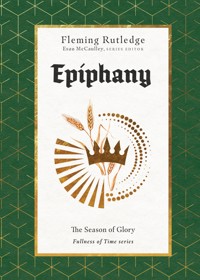
Credo Book Award Winner – Imagination, Beauty, and Liturgy "We have beheld his glory, glory as of the only Son from the Father." This line from the prologue of the Gospel of John declares the theme of Epiphany. Christmas celebrates Christ's birth; Epiphany manifests his glory. The feast of Epiphany and its following season are not as well observed as they should be. Many of us associate Epiphany with the visit of the Magi but don't know much more about it. In this short volume, priest and theologian Fleming Rutledge expounds the primary biblical texts and narrative arc of the season, inviting us to discover anew "the glory of God in the face of Jesus Christ." Each volume in the Fullness of Time series invites readers to engage with the riches of the church year, exploring the traditions, prayers, Scriptures, and rituals of the seasons of the church calendar.
Sie lesen das E-Book in den Legimi-Apps auf:
Seitenzahl: 187
Veröffentlichungsjahr: 2023
Das E-Book (TTS) können Sie hören im Abo „Legimi Premium” in Legimi-Apps auf:
Ähnliche










For Elizabeth
who, at the crucial moment, gave me the gift ofuninterrupted time for writing.Dedicated in faith, hope, and love.
SERIES PREFACE
ESAU MCCAULLEY, SERIES EDITOR
Christians of all traditions are finding a renewed appreciation for the church year. This is evident in the increased number of churches that mark the seasons in their preaching and teaching. It’s evident in the families and small groups looking for ways to recover ancient practices of the Christian faith. This is all very good. To assist in this renewal, we thought Christians might find it beneficial to have an accessible guide to the church year, one that’s more than a devotional but less than an academic tome.
The Fullness of Time project aims to do just that. We have put together a series of short books on the seasons and key events of the church year, including Advent, Christmas, Epiphany, Lent, Easter, and Pentecost. These books are reflections on the moods, themes, rituals, prayers, and Scriptures that mark each season.
These are not, strictly speaking, devotionals. They are theological and spiritual reflections that seek to provide spiritual formation by helping the reader live fully into the practices of each season. We want readers to understand how the church is forming them in the likeness of Christ through the church calendar.
These books are written from the perspective of those who have lived through the seasons many times, and we’ll use personal stories and experiences to explain different aspects of the season that are meaningful to us. In what follows, do not look for comments from historians pointing out minutiae. Instead, look for fellow believers and evangelists using the tool of the church year to preach the gospel and point Christians toward discipleship and spiritual formation. We pray that these books will be useful to individuals, families, and churches seeking a deeper walk with Jesus.
In the 1940s, when I was very young, my mother occasionally took me with her as she did her regular stint as a member of the altar guild in our tiny Episcopal church in Tidewater Virginia. The calendar of the church year always hung on the wall of the sacristy, in a format that can still be seen today in some parishes. All the days of the year were shown in their proper liturgical colors, and it was cheerful to look at. Epiphany was green. That calendar fascinated me as a child. It was a visual companion to my mother’s reverent altar work and my grandmother’s King James Bible. All my life I have found the liturgical calendar to be a primary source of identity, belonging, and delight. I am therefore grateful to be able to make this contribution to a new series about the seasons of the church year. It is intended not for academic specialists, but for anyone: pastors, church musicians, teachers, worship leaders, students, inquirers, anyone at all who wants to deepen their understanding of a rich and ancient heritage—or to begin to learn it for the first time.
A great many Christians have not been nurtured in the church’s calendar, except for the more or less universally recognized holidays of Christmas and Easter. This lacuna in Christian heritage is beginning to be replenished rather unexpectedly. Groups of Protestants with no experience of the liturgical year have begun to show a marked interest in it. This phenomenon is most welcome. It is part of a renewal of interest in the patristic and medieval periods generally, and in the many treasures to be found in some of the traditions that were discarded after the Reformation. I am very much a Reformed Protestant thinker myself, so I am hoping that this book will appeal to those who have not been immersed in the more catholic traditions.
This exciting new phenomenon of inquiry and experimentation comes with a caveat, however. Many worshiping communities have enthusiastically taken up using the ancient calendar as though it were an easy thing to accomplish—as though lighting an Advent wreath (a very recent development) and releasing balloons on the Day of Pentecost (ditto) would do the trick almost overnight. On the contrary, understanding and enacting the seasons in their depths requires patient learning and substantial immersion. A superficial Advent, in particular, may be worse than no Advent at all, because it passes so lightly over the apocalyptic depths of the season. Nor does Epiphany—the subject of this book—yield its wonders easily. Entering into and receiving the riches of the liturgical cycle requires humility and patience. Above all, a willingness to “read, mark, learn, and inwardly digest”1 the biblical foundations of the seasons is essential, and that cannot be done in a few weeks, or by glancing over a few notes in a weekly bulletin. Full immersion is necessary, and that can happen only with embodied commitment over periods of years—two or three years to begin with, and a lifetime to absorb and make one’s own.
This little book, however, cannot pretend to be anything other than one small offering along the way of reinvigorating the church’s way of thinking about seasonal observance. If these pages can be of any small help in the major project of reorienting the people of God to live according to the seasonal rhythms of the story of redemption, that will indeed be a cause for thanksgiving.
The message of “Jesus Christ and him crucified” (1 Corinthians 2:2), unfolded year by year in the church’s calendar, is life itself. In this modest attempt to suggest the depths and wonders of the Epiphany season, even from the confines of age and restricted mobility, I have been consoled and encouraged by the promise in the concluding words of the Proper Preface for the Feast of the Epiphany:
Through Jesus Christ our Lord; who in substance of our mortal flesh, manifested forth his glory; that he might bring us out of darkness into his own glorious light.2
Amen.
Fleming RutledgeRye Brook, New YorkAsh Wednesday 2022
Many scholars have attempted to reconstruct the earliest years of the liturgical calendar. It is pleasing to imagine the leaders of the emerging Christian communities discussing the various portions of the Bible and attaching them to the various liturgical feasts and seasons, selecting which ones to use and how to place them in a sequence. Exactly how all of this was accomplished in the first four centuries is largely unrecoverable to historical method. The wonder is that still today, the liturgical calendar retains its power. The list of historical calamities over the centuries has been amplified by the extreme, indeed unprecedented, global threats of our own time in the third millennium, and yet the Word of God read in the sequence of the church seasons remains ever “living and active, sharper than any two-edged sword” (Hebrews 4:12). Whatever charges can be brought against the lectionary, it remains an extraordinary sword in the hands of the Church Militant.1
We know for certain that the liturgical calendar began to take shape in the first four centuries AD, but it did not become embedded in all formal Christian worship until the sixteenth century. When the Protestant Reformation declared its independence from the Church of Rome, a large part of the Western church abandoned the calendar, along with a great many other accumulated traditions. Observation of the church seasons remained largely intact, however, in the Anglican Communion (including American Episcopalians), the Lutheran church, the Moravian church, and a few other smaller branches. In recent decades, there has been a phenomenal resurgence of interest in the other American “mainlines”—Methodists, Presbyterians, Congregationalists, the Reformed churches—and also in a surprising number of looser forms of Protestantism.
This somewhat unexpected development has shown that the calendar can be a powerful aid to growth in faith and service. The rhythm of the seasons, the repetition of the sequence year after year despite outward circumstances, the variety and richness of the Scripture readings, and, most of all, the story that the seasons tell in narrative progression throughout the year—all of this can be powerful for the nourishment of growth in grace. Thus we may say that the calendar is edifying—providing instruction, guidance, and inspiration for the upbuilding of the church.
But above all, the church year leads us to Jesus Christ. This will be the central focus of the pages that follow. The progression of seasons, when all is said and done, is designed so that the members of Christ’s body may participate even now in his eternal life by rejoicing in his living presence, following him in our various vocations, enacting his teachings in our ministries, knowing him as our Savior, and above all glorifying him as Lord. In our time, however, many of the very same mainline churches who show a new interest in the church seasons have grown weak in proclaiming Christ. It does not give me any pleasure to note this. Jesus of Nazareth is revered as a teacher and moral exemplar, not infrequently side by side with various other religious figures, but the apostolic message about the unique identity and destiny of the Messiah (Christos) has become attenuated. As for the so-called evangelical, conservative, or right-wing churches, they have often allowed Jesus to become a repository of various grievances, so that the invocation of his name at political rallies has become commonplace. When something or someone less than God in Jesus Christ is evoked in worship, the central focus of the apostolic message is obscured, if not negated outright.
The good news that the Scriptures proclaim will not thrive in this theological crisis. Serious attention paid to the themes of the season following the Feast of the Epiphany, in particular, can be a strong antidote to a weak Christology. To be sure, all of the church calendar is formed around Jesus, but there is a sense in which Epiphany is the most specifically christological season.2 The lectionary readings for Epiphany are chosen and arranged in an order designed to glorify him. When the season is preached and taught with this in mind, there can be no doubt—for those who have ears to hear—as to who Jesus is and what he has been born to accomplish. As we shall see, there are particular events from Christ’s life that have been part of Epiphany for two millennia—events that specifically elevate him as Savior and Lord.
Because of this, the season needs to be brought into the foreground along with Christmas. If the season of Epiphany were to be strongly presented as a central, cohesive narrative during the winter months by clergy, teachers, and other leaders, it would make a powerful impression. Lent gets more attention, and for good reason, but Epiphany can excel in theological and narrative power if it is forcefully shaped, preached, and taught. If those who shape worship in local congregations took seriously the opportunity to manifest the identity, mission, and, yes, the glory of Christ as Epiphany unfolds, it could be a transformative season of growth in faith. It is not for nothing that the season has been associated with mission and growth—with the spread of the gospel (much more of that later).
The season of Epiphany always begins on January 6 (the Feast of the Epiphany) and extends until Ash Wednesday, the beginning of Lent. Ash Wednesday’s date is determined by the date of Easter, so Epiphany is much shorter in some years than in others. This may have something to do with its comparative neglect in the church.3 Despite its beauty and depth, it is arguably the least understood and least appreciated of all the seasons. We know Advent, or think we do, because it comes just before Christmas—a fact which, for better and worse, has shaped the season.4 We know that Lent means the cross, and Easter means the empty tomb. Pentecost means the descent of the Spirit.5 Epiphany means . . . what, exactly?
Epiphaneia in New Testament Greek means manifestation. An effective method of teaching the content of the faith, not often enough used, is to instruct congregations in the texts of the seasonal hymns. This can be easily done by calling attention to the words being sung in the service of worship. One of the Epiphany hymns, “Songs of Thankfulness and Praise,” which briefly summarizes the trajectory of the season, repeats the word “manifest” a number of times, so as to make clear its significance. This hymn text displays the major biblical passages associated with Epiphany in narrative order.6 It remarkably sets out the Epiphany sequence in order of its special themes:
Manifest at Jordan’s stream,
Prophet, Priest, and King supreme;
And at Cana, wedding guest,
In thy Godhead manifest;
Manifest in pow’r divine,
Changing water into wine;
Praises be to thee addressed,
God in flesh made manifest.
Manifest in making whole
Palsied limbs and fainting soul;
Manifest in valiant fight,
Quelling all the devil’s might;
Manifest in gracious will,
Ever bringing good from ill;
Praises be to thee addressed,
God in flesh made manifest.
Following this striking summary, the Episcopal hymnal inserts a verse by the noted clergyman F. Bland Tucker, in order to complete the sequence with the climactic scene of the transfiguration:7
Manifest on mountain height
Shining in resplendent light,
Where disciples filled with awe
Thy transfigured glory saw.
When from there thou leddest them
Steadfast to Jerusalem;
Cross and Easter Day attest,
God in man made manifest.
Each of these references in the hymn refers to passages in Scripture that “manifest” the identity of Jesus as God in human form. They are “epiphanies”—events of revelation not available to human beings without an act of God. This is important, because in biblical faith, knowledge of the true God is not attainable by human effort. We cannot summon up the presence of the living Jesus by efforts of our own, however “spiritual”; his presence is his to give.8 Any manifestation that reveals Jesus’ true identity occurs because the power of God is at work upon the eyes, ears, and hearts of the recipients. The unfolding of the Epiphany season is therefore a record of God’s definitive and unique actions in the One who has been born in Bethlehem.
We may therefore note that the familiar Christmas hymn of Charles Wesley, “Hark! The Herald Angels Sing,” sets out in one verse a capsule of Nicene doctrine:
Christ, by highest heaven adored,
Christ, the everlasting Lord . . .
veiled in flesh the Godhead see;
hail th’incarnate Deity,
pleased with us in flesh to dwell,
Jesus, our Emmanuel.
The fulness of the incarnation that has taken place will be manifested in various ways during the Epiphany season—and climactically in Lent and Easter soon to follow. The themes of Epiphany can be powerfully preached and taught for the health and growth of the church. They are revelatory themes, suitable to the overall motif of manifestation or showing forth—the basic definition of epiphaneia in New Testament Greek. What exactly is it that is shown forth? We shall see as the biblical witness unfolds.
A WORD ABOUT THE LECTIONARY
Various Sunday lectionaries have been used over the centuries, but for the purposes of this series on the church seasons it is important to note that many of its prominent seasonal passages have been in place since the very earliest centuries—particularly those for the major themes of Epiphany described in these pages. The most commonly used lectionary at present in the American Protestant denominations is the Revised Common Lectionary (RCL), which has strong roots in the post-Vatican II Roman Catholic lectionary. The RCL was authorized in 1992 for use in the Episcopal Church as a replacement for the Common Lectionary (CL), which can still be found at the back of the 1979 Book of Common Prayer.
Despite its widespread use, the RCL has proven controversial. One of its improvements over the CL was supposed to be a greater emphasis on the Old Testament, with longer sequential passages, sometimes spread over many Sundays. This has been a mixed blessing. It can be argued that it has resulted in less, rather than more, preaching from the Old Testament. The CL brought Old Testament passages into conversation with the New Testament in ways that illuminated them both. In two decades of Sunday preaching before 1992, I found this to be of inestimable advantage. I have therefore based this book on the earlier (1983) Common Lectionary.
AND ABOUT TRANSLATIONS
The King James Version (KJV), for me, remains the gold standard of the English language. There is no way adequately to calculate its influence on the best writing and speech over many centuries. It should be emphasized that the preaching of the Black church would not have been the inspired influence that it has been without the KJV. (I can still hear Fannie Lou Hamer saying about her persecutors during the struggle for the Mississippi vote, “They know not what they do.”9) I urge readers to read and use the KJV from time to time. I continue to prefer to use the Revised Standard Version (RSV) in my books because, although it is modernized, it retains at least some of the cadence of the KJV (for example, “As in Adam all die, so also in Christ shall all be made alive” [1 Corinthians 15:22]). However, I have occasionally quoted the New Revised Standard Version, New International Version, and others; these departures from the RSV are noted in parentheses.
The Feast of the Epiphany on January 6 once had an alternative title. Pope Leo I (“Leo the Great”) referred to it in his Homilies not as Epiphaneia but as Theophania—a manifestation of God (theos). The famed “Tome of Leo” became a conclusive statement of orthodox Christology when it was ratified at the Council of Chalcedon in AD 451, and it remains today a christological gold standard for anyone seeking a clear statement of Jesus Christ’s person as theophany.1
We will approach the season of Epiphany (or theophany) by focusing on just one word: glory. The season following January 6 begins, continues, and comes to a climax with various epiphanies of the glory of Jesus Christ as the only begotten Son of God. A good place to begin is one verse from the prologue of the Gospel of John, one of the most important testimonies to the identity of Jesus in all of Scripture, and certainly a foundation for orthodox Christian belief:
The Word became flesh and dwelt among us, full of grace and truth; we have beheld his glory, glory as of the only Son from the Father. (John 1:14)
In the unfolding of the lectionary for the season, we see the glory of the only Son. This word glory will inform the shaping of the pages to follow. Indeed, the glory of God is one of the most frequent motifs in the Scriptures, both Old and New Testaments, appearing in many hundreds of verses. The Psalms are full of God’s glory:
Ascribe to the Lord the glory due his name;
worship the Lord in the splendor of his holiness.
(Psalm 29:2 NIV)
Not to us, O Lord, not to us,
but to thy name give glory,
for the sake of thy steadfast love and thy
faithfulness! (Psalm 115:1)
In the biblical languages, the word for glory is kavod in Hebrew, doxa in Greek. The Greek word doxa comes over into English in doxology, literally, “to speak glory”—that is, to utter praise to the doxa of God. Understanding the glory of Christ requires understanding the importance of kavod in the Old Testament. This should be stressed in order to maintain the unity of Jesus Christ with the so-called Old Testament God. They are not two different gods. They are one, and the glory of one is the glory of the other.
“The glory of God” of which we so often hear in the Old Testament does not describe God’s essence. A word used to identify that essence is aseity (Latin aseitas, “being from itself”)—God as he is in himself. Doxa is one step removed from God’s aseity. It is the radiant revelation of himself, an emanation of his attributes that humans can receive only by faith. It is his outgoing self-revelation perceived by disciples as dazzling radiance, yes—but more important still, as absolute power.
That is the combination—radiance and power—that makes glory one of the most telling words used to describe God in the Bible. Because it denotes God’s sheer majesty and dominion, it should always be a companion to attributes like “merciful” and “loving.”2 The glory of the love of Jesus is not the same as human love, because his glory is something that is impossible for unaided humanity: namely, it is able to triumph over all that would destroy it.
The body of Christ needs to recommit to this concept of the glory of God. It has been in semi-eclipse of late, as Jesus has been presented as a moral exemplar, social activist, and religious teacher minus his unique identity as Son of God. Perhaps the very word glory seems bombastic to some, for reasons similar to recent attempts at eliminating the idea of Jesus as “Lord.” However, the glory of God and the lordship of Christ are too central to the biblical message to be pushed to the side in the church’s witness. In particular, the glory of God needs to be recovered as a preaching theme if we are to seek a more obviously revelatory way of proclaiming Christ.3 The Epiphany season, with its narrative arc shaped by manifestations of Jesus’ uniquely divine identity, is well suited to this project.
WHATIS THE GLORY OF GOD?
What resonance does the word glory have in today’s English language? How often is it used, and with what meaning? The adjective glorious




