


10,99 €
Mehr erfahren.
- Herausgeber: Infinito edizioni
- Kategorie: Gesellschafts- und Liebesromane
- Sprache: Englisch
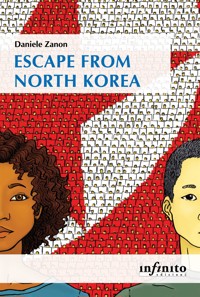
Escape from North Korea is based on the first-hand account of a human-rights activist’s time in North Korea, where she worked for an NGO. Shared anonymously (for reasons of security) with her friend, the novelist and screenwriter Daniele Zanon, this account has become a novel that reflects the painful reality of life under a dictatorship in a country that the United Nations has called “one large prison.”
The brutality of the regime turns North Korean daily life into a collective nightmare. With a light but firm hand, Daniele Zanon tells the story of a group of young people condemned to live this nightmare in a North Korean “rehabilitation commune,” from which they decide to escape. Their adventures are as engaging as they are extraordinary, against the backdrop of a country where the all-powerful Kim family is deified, the military omnipotent and foreigners a source of wonder and fear. The strange story of one of the rare Western families living in Pyongyang is skilfully woven into the narrative, which has a fantastic ending filled with hope.
Das E-Book können Sie in Legimi-Apps oder einer beliebigen App lesen, die das folgende Format unterstützen:
Veröffentlichungsjahr: 2024
Ähnliche




















Escape from North Korea
Table of contents
Author’s Note
Part one
One
Two
Three
Four
Five
Six
Seven
Eight
Nine
Ten
Eleven
Part two
One
Two
Three
Four
Five
Six
Seven
Eight
Nine
Ten
Eleven
Twelve
Thirteen
Fourteen
Fifteen
Sixteen
Seventeen
Eighteen
Nineteen
Twenty
Twenty-one
Twenty-two
Twenty-three
Twenty-four
Twenty-five
Twenty-six
Twenty-seven
Twenty-eight
Twenty-nine
Thirty
Thirty-one
Thirty-two
Thirty-three
Thirty-four
Thirty-five
Thirty-six
Thirty-seven
Thirty-eight
Thirty-nine
Forty
Forty-one
Forty-two
Forty-three
Forty-four
Forty-five
Forty-six
Forty-seven
Forty-eight
Forty-nine
Fifty
Fifty-one
Fifty-two
Fifty-three
Fifty-four
Fifty-five
Fifty-six
Fifty-seven
Fifty-eight
Fifty-nine
Sixty
Sixty-one
Sixty-two
Sixty-three
Sixty-four
Sixty-five
Sixty-six
Sixty-seven
Epilogue
The entire drafting work of this book was powered by clean energy produced by a photovoltaic system
© Copyright Infinito edizioni, 2024
Italian edition: February 2018
English edition: January 2024
Electronic mail: [email protected]
Website: www.infinitoedizioni.it
Facebook: Infinito edizioni
Instagram: Infinito edizioni
X: @infinitoed
ISBN 9788868617745
Cover: Infinito edizioni
Cover illustration: Noemi Zanon (by courtesy)
Layout and graphics: Infinito edizioni
Author’s Note
I am fortunate to be the friend of a woman who lived in Pyongyang for two years. She was an official in a humanitarian agency that works full-time in North Korea.
She lived in Pyongyang when it was reminiscent of films set in Moscow during the Cold War. With hidden microphones in homes, under surveillance when she moved around, the telephone monitored constantly. Nevertheless, despite the contradictions of a country that forbids entry with a cell phone but has no clear ideas about what the internet is supposed to be, we were able to maintain a correspondence via e-mail.
The idea for a book quickly became apparent from the accumulation of information and impressions that my friend shared with me.
Escape from North Korea grew out of a clear-eyed view from the inside. Descriptions of places, scenes from daily life, impressions, stories of wrongdoing and abuse of power. Images formed in her own words one by one ended up in a scenario that slowly began to take shape.
At a certain point, I felt the need to see this country with my own eyes. Through my friend, I applied to the appropriate North Korean Ministry, saying that I was her cousin, knowing that a degree of kinship is essential to obtain an entry visa for Pyongyang. My application was refused. Only sisters and brothers, parents and spouses are admitted.
Even if I have not been to North Korea and have not been able to do my own research in the country, I can assure you that, even though the characters in the novel are fictitious in order not to risk anyone’s life, the world that surrounds them is entirely real. Everything in the book about the regime of Kim Jong-il corresponds to the truth, even if the very concept of truth, in a dark reality like that of a totalitarian regime, is full of nuances and uncontrollable angles.
Escape from North Korea owes a lot to my friend. Yet, the humanitarian organisation for which she works has absolutely forbidden the use of her name in this novel, or the name of the organisation itself, for reasons of security and preservation of diplomatic relations with the regime.
Let me share with you what my friend wrote to me in a recent e-mail: “After some thought…the only thing in this novel that does not correspond to the North Korea that I knew is the resourcefulness with which the protagonists, especially Shin-jo, try to make a change in their lives. Young people entrusted to the State are stunted, undernourished and, at the same time, a little deprived of the strength to fight.”
We realize that the desire for a better life in a setting like North Korea, where minds are indoctrinated from birth, seems almost like a fantasy. Yet giving our protagonists the inner strength to oppose the injustice around them is an act of faith that is fundamental to the change that must, sooner or later, take place in a country like North Korea. A country that is truly sealed off from the world and where hidden truths are beyond the imaginings of even the most fantastical writer.
Part one
September 2011
One
One can get used to anything, cold, fatigue, hunger. Even the stench of pigs! Yet, for Shin-jo, the pig stench was much harder. Maybe because he hadn’t known anything but cold, fatigue and hunger all his life.
Shin-jo was fifteen years old and had no idea who his parents were. Not one single person in his whole life had ever told him the truth. He had lived in orphanages ever since he could remember. He did remember a brother, however. A twin brother, to be precise. A brother who gave him the only affection that he ever knew, and from whom he was quickly separated. It happened when they were six, just as they were starting primary school. From that moment on, he never heard another word about his brother.
Shin-jo had been in the institution for a year. Last stop on a long road through “educational centres” for those without families. But this institution was different. Its classification: specially for difficult boys. In short, an agricultural reform school in the middle of nothing, where “nothing” was the operative word for everything. No food, it was never enough. No fun. No affection. No future.
The commune accommodated 100 boys, more or less. Their daily duty was to produce food supplies for the army. North Korea, with one million soldiers out of a population of 22 million, is the most militarised country in the world. The army is a very costly apparatus that requires constant sustenance from within.
People in the outside world have no idea that places like this agricultural commune exist, places where the basic rights of children are violated every day.
Shin-jo went into the pigsty with the feeling that he was already behind schedule. He cast a glance at the western wall. The sun streaked the windows with shadows nearly all the way to the ceiling. It was around 7:30. Give or take one minute. He had to hurry. He climbed the partition that separated the pigs from the equipment and the bins of food. Once inside, the animals swirled around him. Shin-jo whistled his way through the seething mass of pigs. Other boys used their feet to kick them. Shin-jo considered boys like this stupid rather than mean. Beating an animal does no good, unless you want him to resist you even more. He told everybody this. Nobody listened.
When he reached the middle of the pigsty, Shin-jo put two tin buckets down on the beaten earth, under a layer of excrement and slurry. Another whistle and the mass parted again, letting him pass. He returned to the steel enclosure to pick up a shovel. There were 20 pigs, all nice and plump. Shin-jo liked these animals. He spent nearly all day with them and called them by name. Each pig was called Cloud in the Sky. All of them had the same name. It was a great memory-saver.
Shin-jo started to shovel the excrement and fill the first bucket. It was mindless work that did not require much thinking. So, Shin-jo could let himself think about everything. He thought about his brother. About the first years they spent together in the orphanage. He thought about his parents, but, even when he concentrated, he could not bring the face of either one into focus. He thought about his future, which he knew would have to be the army. All the boys were destined for the army, once they turned sixteen. The idea did not please him at all. He hated being made to march in the square with the others. They were trained to move according to a precise choreography. To what purpose? he asked himself. He especially hated it when they made him sing war songs with no meaning.
– The army! – he exclaimed, out loud. And then he spat on the ground.
He was incensed at the idea that his life was spelled out for him. At least they could have given him something specific to do in the army. But he knew that would not be the case. He would have liked to be an airplane pilot, or, at least, a mechanic. He was sure that he had a certain talent for mechanics, or, at least, a real passion.
As soon as he arrived at this new centre, a year ago, he had dared to show off. There was an old tractor behind the pigsty. Rusted and abandoned to the rain. He had said that he could fix it. He said it to the Director, in person. Colonel Kang. Shin-jo could not stand the idea that the boys had to tramp through the mud in the fields, when a tractor was available. Amused by the nerve of the boy, the Colonel let him try.
Shin-jo worked hard, stealing time from his few moments of freedom. After not more than two months, he declared that the tractor was ready. The afternoon of the day that the tractor was due to start up, there was a large crowd in the square, but there was not a single sound. The boys were immobile, suspended in surreal anticipation. Nobody had ever dared to stand out like this, like the new boy who had just arrived. The teachers, military men themselves, called comrade-educators by the boys, looked on stonily from the second row. Were they hoping for a failure? Was that the only reason they had let Shin-jo try? To see him fail and become an example to all?
Confidently, but with a lump in his throat, Shin-jo slid behind the wheel and turned on the engine. The tractor jumped backwards. The gear was in reverse, and he hadn’t realized it. It just took a few seconds. The heavy piece of agricultural equipment literally ran over Colonel Kang’s minivan, crushing it like an empty beer can. Nobody cheered. Nobody laughed. The scene was pure tragedy. That same evening Shin-jo was placed in solitary confinement, where he stayed for three weeks before being sent to take care of the pigs.
While he finished filling the first bucket, Shin-jo couldn’t help smiling at the memory of that afternoon. He had caused a lot of damage, but what nobody recognised was that the tractor had started, and that, therefore, he had succeeded in fixing it. Why hadn’t anybody grasped this basic fact?
Cloud in the Sky detached himself from the herd, came up to Shin-jo and began to rub against his trousers. Maybe the pig had read his mind and was trying to comfort him.
Shin-jo whistled.
– Move, Cloud in the Sky!
The pig seemed not to hear him.
– Come on, you... can’t you see I’m working?
Shin-jo whistled again. Louder. This second whistle was wiped out by the sound of an engine. He raised his head. He could recognise the sound of any engine. This one was certainly not the Director’s new mini-van.
– It’s a jeep! Did you hear that, Cloud?
The pig sniffed the air as if he had understood. Shin-jo put down his shovel.
– It’s a 200 horsepower. It must be an army jeep. Listen... the engine knocks a little. Those idiots don’t know how to take care of their cars.
What was the military coming to do in this agricultural commune? The rice harvest had only just begun. It was too early to begin weighing and deciding on the distribution.
There was another possibility. The military handled the transport of new boys from police stations where they had ended up because they had been caught stealing something. Or, they were sons of parents, dissidents against the regime and recently taken to prison camps. These prison camps might be a legend, but Shin-jo liked legends. He liked to think that maybe he himself was the child of a dissident. Being shut up where he was because he was the child of a dissident would be an acceptable idea. Even something to be proud of.
The jeep entered the square, screeching on the gravel. Shin-jo was overcome with curiosity. He decided to take a peek. It was forbidden to interrupt one’s duties without the permission of a superior, so it was better for Shin-jo not to be seen snooping. He looked at the window on the side that overlooked the square. It was a little more than two metres high.
– Come here, Cloud! – he said.
He went to the window, and the pig followed him. Other pigs left the herd and gathered around.
– I need something to stand on. I have to be able to see out. Who wants to volunteer?
There were seven pigs at his feet. Cloud in the Sky grunted. And it wasn’t one of the others. It really was that Cloud. The one who always followed Shin-jo like a puppy and who had rubbed against his leg earlier.
– Good boy! – he said, scratching the pig behind his ear. – Sooner or later I’m going to have to find names for the others.
Taking Cloud by the neck, he pushed him back to the wall.
– Stand still and don’t move, I have to climb onto your back.
The pig grunted again.
Shin-jo put one foot on his back, gave a little leap and ended up with both feet on the back of the pig. Perfect! The window now opened just at the level of his nose.
The army jeep was parked at the bottom of the square. He had been right about the kind of vehicle that it was. This thought made him smile. The jeep’s doors were still closed. The motor died right at that instant.
Underneath his feet, the pig swayed.
Shin-jo looked down: – Be good! Stand still! Don’t move!
When he looked back out, the jeep doors were open and two soldiers were walking towards the back gate.
One of the two pulled the handle. The other motioned toward the interior with his head. With one bound, three boys jumped out of the jeep and stood at attention. They were identical: three drops of water.
– What the...? – said Shin-jo under his breath.
He couldn’t believe his eyes. He stuck his chin out a little, as if a few more centimetres would make things clearer. They were triplets. But not just any triplets. He recognised them. These were the legendary Sung triplets!
– What are the Sung triplets doing here? – he asked himself.
Just then, a colonel (maybe even a general) got down from the jeep, in parade posture and with all his military insignia in view.
– Shin-jo! – a voice shouted behind his back.
Under his feet, Cloud in the Sky panicked and raced back to the herd. Shin-jo flew backwards and landed on his back. The layer of pig excrement broke his fall.
– What are you doing? Why aren’t you working?
Shin-jo leaned back and saw a comrade-educator with his hands on his hips standing over him.
– Get up immediately and go back to work. Everything in here has to be clean in an hour. We have a surprise visit by a General of the Army. He will report the state of our institution to the Party. Do you want to make us look bad on a festive day like today? Have you forgotten what day it is?
Get going!
– Yes, sir! Comrade-educator! – said Shin-jo, sitting up.
He had forgotten. It was September 9. North Korea’s Independence Day. In 1948, Korea was divided in two. The South took the name Republic of Korea or South Korea. The North became the People’s Democratic Republic of Korea, or North Korea. In other words, the harshest Communist regime that history has ever known. Designated by Russia’s Soviet government, General Kim Il-sung became the founder of the regime.
The door closed with a bang. The comrade-educator had gone – Shin-jo fell back into the filth. It was a holiday and the military visit probably was justified. It would evaluate and report on the level of preparation of the institute’s military marches and songs. Nevertheless, something still did not make sense. What were the Sung triplets doing there?
Two
A soldier swept the air over the heads of thousands of boys with his rifle. He was huge, proud. Half threatening, half protective, he was looking into the distance, while, with one arm raised, he seemed to be inviting his people to follow him. The youth beneath him were smiling. Just a few seconds, two beats of a military march, and the army vanished into thin air. In its place, a gigantic armoured car appeared, perched on the hills of a hostile country. Waving on the turret of the half-track, painted blood red, was the flag of North Korea.
Sitting in the stands of Pyongyang’s First of May stadium, Sara clapped delightedly.
The armoured car disappeared and was replaced by four boys. Seen from the waist up, they were waving flags in the wind and seemed to be singing a patriotic song. Over their heads, floated a banner with the words “Children, Future of the Nation”. These were North Korea’s Mass Games, the largest example of collective art ever conceived by humanity.
The image of the four boys faded. In its place appeared a portrait of Kim Il-sung, eternal leader and founding father of the homeland.
The huge images, which changed with surprising speed, one after the other, seemed to be projected onto a giant screen. But they weren’t. About 20,000 children filled the stands along one of the stadium’s two sides. Tightly packed together, they stood on the steps. Each child held a large book in front of himself, with the pages open to the public to hide his face. The position of each child on the steps was very precise. Each book was different. All it would take to ruin the project would be for some of the children to change places. Following the precise signals of a director, each boy or girl turned a page, in synch. What the public saw, from the other side of the stadium, was a vast screen with spectacular moving images. Each child was nothing more than a coloured piece of a mosaic, an insignificant pixel in a human screen of unimaginable dimensions.
This was just one of the manifestations of the Mass Games. Thousands of other extras were involved in other choreographed spectacles on the playing fields of the stadium. Altogether, nearly 100,000 people were taking part in the Mass Games.
Under the smiling image of Kim Il-sung, the grass of the stadium filled with young people in military uniform marching forward in squadrons, with the synchronised speed of a flock of birds. Sara kept on clapping.
– Mass Games! – said Dominik, sitting beside her. – The greatest show on earth!
His tone was unmistakably sarcastic.
– Fantastic! – said Sara, continuing to applaud, sincerely entertained.
– Is this the first Arirang you’ve seen? – asked Dominik, after a while. Arirang was the name given to the Mass Games.
Sara looked at Dominik, smiling. He knew very well that this was her first Arirang, but just asked to hear himself talk. They had hardly had a chance to speak since Sara had moved to Pyongyang with her family.
– You know it’s my first Arirang! – she answered.
Dominik turned red, knowing that he had asked a stupid question. The typical pick-up line.
– But I’ve watched all the clips there are on YouTube – she added, as the music suddenly got louder.
– What did you say? – asked Dominik, raising his voice.
– I have watched all the Mass Games videos on YouTube – said Sara, moving closer so he could hear her.
Dominik felt his face burn. He waited a couple of seconds and then tried to look her in the eye, forcing himself to smile in the least embarrassing way possible. But Sara’s liquorice-black eyes were already turned back to the choreography on the field.
Sara was 15 years old, with a face that looked oriental, hair that looked African and skin that seemed tanned by a never-ending vacation in the sun. Her family was a melting pot of races. The son of a Nigerian mother and an Englishman of colour, Jack Fisher, her father, had married Nam-suk, a woman from South Korea. The family lived in England where they switched from English to Korean and back again when they spoke to each other at home. At least in terms of language, Sara could feel at home in Pyongyang.
A medical doctor specializing in nutrition, Jack Fisher worked for a large, humanitarian organisation. When he found out that there was a job opening in North Korea, it seemed to make sense, after years in Africa, to accept and move. Primarily because he spoke the language, but also because North Korea, for all those who worked for non-governmental organisations, was considered a mysterious place and one that was, at the same time, totally fascinating. The perfect place for anyone who had decided to dedicate their life to the defence of human rights.
Jack arrived first in North Korea. He had been there six months, when Sara and Nam-suk joined him, just in time for Sara to start school. It had not been easy to convince Sara to leave England, abandon her friends and classmates and accept a transfer of at least three years. But, ever since she was a little girl, she had been resigned and used to the life of a citizen of the world. This was her father’s work. Sara loved him and could not stand the idea of living far away from him or of forcing her parents to separate so that she could stay in England with her mother. The family had to stay together. Sara was absolutely sure of that.
All the non-Koreans in Pyongyang lived in the international neighbourhood, south of the city, not far from the banks of the Taedong river. Actually, there weren’t that many. Most of the kids who lived in the neighbourhood were children of ambassadors or bureaucrats in foreign legations.
Or, like Sara, they were the children of people who worked for NGOs or UN agencies. They were just a few. They were not allowed to attend the schools of the capital together with North Korean kids. There was a school in the international quarter, administered by the Korean Ministry of Public Education. Its classes were, sometimes, composed of a single student. All things said, Sara had been lucky: other than Dominik, there were only three other kids in her class.
On that morning of September 9, the five students in the 9th grade of the Pyongyang international school represented all the public at the dress rehearsal of the Mass Games. The educator who taught Korean at the school had arranged the half-day outing. A preview for the new students of the organising prowess and skill of the youth of great People’s Republic of Korea.
Three
When the military jeep drove into the square, Colonel Kang was fast asleep at his desk in his office. Not that he needed an office, for what he did at the institution. Much less a desk. His duties were limited to shouting at everybody for the greater part of the day. The rest of the time was devoted to getting drunk. The noise of the jeep engine woke him up. Whose car was that? Could it be that one of his men had had the nerve to take his van without his permission? If so, he would hear from the colonel, but later. Kang opened a drawer in his desk and pulled out a bottle still full of soju, rice liquor produced by the agricultural commune. It wasn’t even eight o’clock yet, but he was feeling tired. He had been feeling liverish lately, and a drop of soju would be just the thing to make him feel better.
There were a pair of drinking glasses on the desk top and nothing else, a perfect picture of his main preoccupation. He filled one of the glasses to the brim and took a sip.
A knock on the door.
He drank the contents of the glass in one gulp. The liquor burned his throat before a feeling of well-being filled his whole body.
Two more knocks on the door.
– Come in! – he shouted.
– Comrade-Colonel! – one of the men said, as he opened the door to the office. – Three new boys have arrived.
– What? – he said, with a watery glance at the Sung triplets who had just come in.
He rested both hands on his desk.
– Why wasn’t I informed?
– I don’t know, Sir! – said the soldier, apologetically.
The colonel pushed himself up off the desk and stood.
– Everything around here is screwed up! – he started to say, struggling to find his balance. – So, what did these three do to get themselves brought here?
Just at that moment, General Pak came in: – And how about you, Comrade Kang?... What have you done to get yourself stuck here?
General Pak was wearing a pair of dark glasses, and the colonel had trouble recognizing him.
– Well, I’ll be... Look who’s here! – said the colonel, recovering his composure. – If it isn’t my old friend, General Pak!
– Dear Comrade! cried the general, coming over to the colonel with a sincere smile.
The two embraced.
– It’s not even eight o’clock in the morning and you already stink of alcohol!
– Well, what can you do, Comrade? We all have our vices! And this place is really tough to live in.
– You’re going to rot in this place, if you don’t pull yourself together!
Then, they both fell about laughing.
Colonel Kang and General Pak had moved up the ladder together. At one point, Kang’s career had come to a grinding halt, while Pak became a general. It was said that he had even become an intimate friend of Kim Jong-Il, the Dear Leader himself. Colonel Kang, on the other hand, fell into deep disgrace because of drink. Alcoholism in the army was hardly rare, even among the officers, but it was necessary to preserve a semblance of presentability and decency in public. This semblance had proven to be beyond the capacity of Colonel Kang on more than one occasion. His friend Pak had stuck by him as long as he could. Then he had distanced himself. It was he, however, who had, as a last act of courtesy, recommended Kang for the post of Director of the agricultural rehabilitation centre. A post that, officially, did not exist, so there was no risk of losing face at national level. The two men had not seen each other for two years, probably more out of laziness than resentment. In fact, they had never had an argument. Pak had left his friend to his fate and concentrated on his own career. Kang did not hold that against him. He was fully aware that he was a disappointment to all. The Party, the army, his friends and his family.
– So, Comrade Pak – said the colonel, visibly happy to see his old friend again, – what brings you to these parts after all this time?
– Officially, I came to deliver these three kids.
– You don’t mean to tell me that a big cheese like you went out of his way to bring me these three losers! What are they... thieves? Sons of dissidents? – asked the colonel in a fake friendly tone.
– Don’t you recognize them? A fanatic like you?
– Fanatic? What do you mean?
The colonel looked at the triplets one more time. He couldn’t say why, but they did, in fact, look familiar. The Sung triplets were lined up against the wall. Immobile. Eyes cast down to the pavement.
– Didn’t you see the documentary on the national channel? – the General said, finally.
The colonel’s face lit up: – Don’t tell me that these are the Sung triplets!
– That’s exactly who they are.
The Sung triplets. There, in his office. The colonel went over to the trio and began to shake their hands. The triplets accepted this clammy hand, without the trace of a smile.
– Cheer up, kids! You are the future of the great Korea! – he said.
– They will be, the future! – the general interjected. – I hope so for their sake. But they have to learn some manners. They have to learn how to behave.
Pak took off his dark glasses: – Here’s what they’ve done!
The general displayed a beautiful black eye. So swollen that he could hardly keep it open.
– Heavens! Look at that! What on earth happened to you?
– I’ll spare you the details, but they know very well what happened!
– It was an accident – said one of the three.
– Shut up! – screamed the general. – Consider yourself lucky to be here... in one piece. My passion for football is stronger than any passion that I might have for human beings. And that’s the only reason that you have been given this opportunity. So, don’t push your luck and don’t say a single word in your defence.
– Yes, sir, General sir! – said the one who had spoken up.
The general put his dark glasses back on. Took a deep breath and tried to recover his composure.
The Sung triplets were 14 years old and the pure essence of football talent. A gift to Korean football unlike any other that the country had ever seen. Football has always been very popular in North Korea. And the country’s passion for the sport grew after the national team reached the qualifying finals for the 2010 World Cup in South Africa. This hadn’t happened since 1966. Now, the 2014 World Cup was the objective. By that time, the Sung triplets would be 16 years old and would be the golden trident of the North Korean attack. Proof to the world of the grandeur of the country.
At the express desire of the Dear Leader, Kim Jong-Il, himself a passionate football fan, a documentary had been produced about the new national team. Obviously, the Sung triplets were the main protagonists. The film had been transmitted many times on State TV. Celebrities did not exist in North Korea. There were no actors or famous singers. Only the paternal and reassuring figure of the Dear Leader. The Sung triplets were the first exception. Those three, with their prowess on the pitch, already were a legend.
The Sung triplets currently played with Sobaeksu, a youth football team of the multi-decorated 25 April Club. In North Korea, there is a football championship with several categories. In Korean Series A, the first category, four teams won over all the rest: 25 April, the team belonging to the Army; Amrokgang, the Ministry of Public Safety’s team; Kilgwancha, representing the Ministry of Transport; and the City of Pyongyang, the capital’s main team, which recruited its athletes from the schools of physical education.
In their youth, Kang and Pak were personally involved in the fate of the Army’s club. Kang was even a trainer, while Pak had always wanted to be a manager. Now, General Pak, among other posts that he held to serve the country, was also President of 25 April and of Sobaesku, the youth team. The Sung triplets were one of his discoveries, which was one of the reasons why he was personally involved with their fate.
– Now tell me, my friend – said the colonel, – how did they give you that black eye? They couldn’t possibly have dared to lay a hand on you, could they?
– They wouldn’t be alive today, if they had.
– So, how?
General Pak himself was embarrassed to even think about the truth. He cleared his throat: – Comrade Kang... – he said firmly, – you don’t need to know what happened. The only thing that should matter to you is that you have to keep them here for six months. That’s what the court decided.
Colonel Kang shrugged. For the rest, he couldn’t care less.
– Not to worry! – he said. – I will take care of them. I’ll put them to work doing something useful and not excessively tiring. I might even give them time off to train.
– No! They are being punished! – said the General, practically shouting. – They have to understand that the Party does not forgive. They are going to stay here for six months, in the pigsty to look after the pigs. No training. They’ll work hard and that’s all. In six months’ time, I’ll come and get them myself. Is that clear?
– At your orders, General! – said Kang, coming sharply to attention.
Pak realized that he might have over-reacted: Kang was an old friend, after all, and did not deserve to be treated like any old soldier.
– Forgive me if I raised my voice... – he said, taking off his glasses again. – No, in any case, it was a football!




