


31,19 €
Mehr erfahren.
- Herausgeber: Packt Publishing
- Kategorie: Wissenschaft und neue Technologien
- Sprache: Englisch
Statistics remain the backbone of modern analysis tasks, helping you to interpret the results produced by data science pipelines. This book is a detailed guide covering the math and various statistical methods required for undertaking data science tasks.
The book starts by showing you how to preprocess data and inspect distributions and correlations from a statistical perspective. You’ll then get to grips with the fundamentals of statistical analysis and apply its concepts to real-world datasets. As you advance, you’ll find out how statistical concepts emerge from different stages of data science pipelines, understand the summary of datasets in the language of statistics, and use it to build a solid foundation for robust data products such as explanatory models and predictive models. Once you’ve uncovered the working mechanism of data science algorithms, you’ll cover essential concepts for efficient data collection, cleaning, mining, visualization, and analysis. Finally, you’ll implement statistical methods in key machine learning tasks such as classification, regression, tree-based methods, and ensemble learning.
By the end of this Essential Statistics for Non-STEM Data Analysts book, you’ll have learned how to build and present a self-contained, statistics-backed data product to meet your business goals.
Das E-Book können Sie in Legimi-Apps oder einer beliebigen App lesen, die das folgende Format unterstützen:
Seitenzahl: 388
Veröffentlichungsjahr: 2020
Ähnliche


















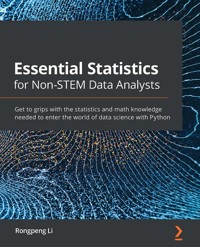
Essential Statistics for Non-STEM Data Analysts
Get to grips with the statistics and math knowledge needed to enter the world of data science with Python
Rongpeng Li
BIRMINGHAM—MUMBAI
Essential Statistics for Non-STEM Data Analysts
Copyright © 2020 Packt Publishing
All rights reserved. No part of this book may be reproduced, stored in a retrieval system, or transmitted in any form or by any means, without the prior written permission of the publisher, except in the case of brief quotations embedded in critical articles or reviews.
Every effort has been made in the preparation of this book to ensure the accuracy of the information presented. However, the information contained in this book is sold without warranty, either express or implied. Neither the author, nor Packt Publishing or its dealers and distributors, will be held liable for any damages caused or alleged to have been caused directly or indirectly by this book.
Packt Publishing has endeavored to provide trademark information about all of the companies and products mentioned in this book by the appropriate use of capitals. However, Packt Publishing cannot guarantee the accuracy of this information.
Commissioning Editor: Sunith Shetty
Acquisition Editor: Devika Battike
Senior Editor: Roshan Kumar
Content Development Editor: Sean Lobo
Technical Editor: Sonam Pandey
Copy Editor: Safis Editing
Project Coordinator: Aishwarya Mohan
Proofreader: Safis Editing
Indexer: Pratik Shirodkar
Production Designer: Roshan Kawale
First published: November 2020
Production reference: 1111120
Published by Packt Publishing Ltd.
Livery Place
35 Livery Street
Birmingham
B3 2PB, UK.
ISBN 978-1-83898-484-7
www.packt.com
Packt.com
Subscribe to our online digital library for full access to over 7,000 books and videos, as well as industry leading tools to help you plan your personal development and advance your career. For more information, please visit our website.
Why subscribe?
Spend less time learning and more time coding with practical eBooks and Videos from over 4,000 industry professionalsImprove your learning with Skill Plans built especially for youGet a free eBook or video every monthFully searchable for easy access to vital informationCopy and paste, print, and bookmark contentDid you know that Packt offers eBook versions of every book published, with PDF and ePub files available? You can upgrade to the eBook version at packt.com and as a print book customer, you are entitled to a discount on the eBook copy. Get in touch with us at [email protected] for more details.
At www.packt.com, you can also read a collection of free technical articles, sign up for a range of free newsletters, and receive exclusive discounts and offers on Packt books and eBooks.
Contributors
About the author
Rongpeng Li is a data science instructor and a senior data scientist at Galvanize, Inc. He has previously been a research programmer at Information Sciences Institute, working on knowledge graphs and artificial intelligence. He has also been the host and organizer of the Data Analysis Workshop Designed for Non-STEM Busy Professionals at LA.
Michael Hansen (https://www.linkedin.com/in/michael-n-hansen/), a friend of mine, provided invaluable English language editing suggestions for this book. Michael has great attention to detail, which made him a great language reviewer. Thank you, Michael!
About the reviewers
James Mott, PhD, is a senior education consultant with extensive experience in teaching statistical analysis, modeling, data mining, and predictive analytics. He has over 30 years of experience using SPSS products in his own research, including IBM SPSS Statistics, IBM SPSS Modeler, and IBM SPSS Amos. He has also been actively teaching about these products to IBM/SPSS customers for over 30 years. In addition, he is an experienced historian with expertise in the research and teaching of 20th century United States political history and quantitative methods. His specialties are data mining, quantitative methods, statistical analysis, teaching, and consulting.
Yidan Pan obtained her PhD in system, synthetic, and physical biology from Rice University. Her research interest is profiling mutagenesis at genomic and transcriptional levels with molecular biology wet labs, bioinformatics, statistical analysis, and machine learning models. She believes that this book will give its readers a lot of practical skills for data analysis.
Packt is searching for authors like you
If you're interested in becoming an author for Packt, please visit authors.packtpub.com and apply today. We have worked with thousands of developers and tech professionals, just like you, to help them share their insight with the global tech community. You can make a general application, apply for a specific hot topic that we are recruiting an author for, or submit your own idea.
Table of Contents
Preface
Section 1: Getting Started with Statistics for Data Science
Chapter 1: Fundamentals of Data Collection, Cleaning, and Preprocessing
Technical requirements
Collecting data from various data sources
Reading data directly from files
Obtaining data from an API
Obtaining data from scratch
Data imputation
Preparing the dataset for imputation
Imputation with mean or median values
Imputation with the mode/most frequent value
Outlier removal
Data standardization – when and how
Examples involving the scikit-learn preprocessing module
Imputation
Standardization
Summary
Chapter 2: Essential Statistics for Data Assessment
Classifying numerical and categorical variables
Distinguishing between numerical and categorical variables
Understanding mean, median, and mode
Mean
Median
Mode
Learning about variance, standard deviation, quartiles, percentiles, and skewness
Variance
Standard deviation
Quartiles
Skewness
Knowing how to handle categorical variables and mixed data types
Frequencies and proportions
Transforming a continuous variable to a categorical one
Using bivariate and multivariate descriptive statistics
Covariance
Cross-tabulation
Summary
Chapter 3: Visualization with Statistical Graphs
Basic examples with the Python Matplotlib package
Elements of a statistical graph
Exploring important types of plotting in Matplotlib
Advanced visualization customization
Customizing the geometry
Customizing the aesthetics
Query-oriented statistical plotting
Example 1 – preparing data to fit the plotting function API
Example 2 – combining analysis with plain plotting
Presentation-ready plotting tips
Use styling
Font matters a lot
Summary
Section 2: Essentials of Statistical Analysis
Chapter 4: Sampling and Inferential Statistics
Understanding fundamental concepts in sampling techniques
Performing proper sampling under different scenarios
The dangers associated with non-probability sampling
Probability sampling – the safer approach
Understanding statistics associated with sampling
Sampling distribution of the sample mean
Standard error of the sample mean
The central limit theorem
Summary
Chapter 5: Common Probability Distributions
Understanding important concepts in probability
Events and sample space
The probability mass function and the probability density function
Subjective probability and empirical probability
Understanding common discrete probability distributions
Bernoulli distribution
Binomial distribution
Poisson distribution
Understanding the common continuous probability distribution
Uniform distribution
Exponential distribution
Normal distribution
Learning about joint and conditional distribution
Independency and conditional distribution
Understanding the power law and black swan
The ubiquitous power law
Be aware of the black swan
Summary
Chapter 6: Parametric Estimation
Understanding the concepts of parameter estimation and the features of estimators
Evaluation of estimators
Using the method of moments to estimate parameters
Example 1 – the number of 911 phone calls in a day
Example 2 – the bounds of uniform distribution
Applying the maximum likelihood approach with Python
Likelihood function
MLE for uniform distribution boundaries
MLE for modeling noise
MLE and the Bayesian theorem
Summary
Chapter 7: Statistical Hypothesis Testing
An overview of hypothesis testing
Understanding P-values, test statistics, and significance levels
Making sense of confidence intervals and P-values from visual examples
Calculating the P-value from discrete events
Calculating the P-value from the continuous PDF
Significance levels in t-distribution
The power of a hypothesis test
Using SciPy for common hypothesis testing
The paradigm
T-test
The normality hypothesis test
The goodness-of-fit test
A simple ANOVA model
Stationarity tests for time series
Examples of stationary and non-stationary time series
Appreciating A/B testing with a real-world example
Conducting an A/B test
Randomization and blocking
Common test statistics
Common mistakes in A/B tests
Summary
Section 3: Statistics for Machine Learning
Chapter 8: Statistics for Regression
Understanding a simple linear regression model and its rich content
Least squared error linear regression and variance decomposition
The coefficient of determination
Hypothesis testing
Connecting the relationship between regression and estimators
Simple linear regression as an estimator
Having hands-on experience with multivariate linear regression and collinearity analysis
Collinearity
Learning regularization from logistic regression examples
Summary
Chapter 9: Statistics for Classification
Understanding how a logistic regression classifier works
The formulation of a classification problem
Implementing logistic regression from scratch
Evaluating the performance of the logistic regression classifier
Building a naïve Bayes classifier from scratch
Underfitting, overfitting, and cross-validation
Summary
Chapter 10: Statistics for Tree-Based Methods
Overviewing tree-based methods for classification tasks
Growing and pruning a classification tree
Understanding how splitting works
Evaluating decision tree performance
Exploring regression tree
Using tree models in scikit-learn
Summary
Chapter 11: Statistics for Ensemble Methods
Revisiting bias, variance, and memorization
Understanding the bootstrapping and bagging techniques
Understanding and using the boosting module
Exploring random forests with scikit-learn
Summary
Section 4: Appendix
Chapter 12: A Collection of Best Practices
Understanding the importance of data quality
Understanding why data can be problematic
Avoiding the use of misleading graphs
Example 1 – COVID-19 trend
Example 2 – Bar plot cropping
Fighting against false arguments
Summary
Chapter 13: Exercises and Projects
Exercises
Chapter 1 – Fundamentals of Data Collection, Cleaning, and Preprocessing
Chapter 2 – Essential Statistics for Data Assessment
Chapter 3 – Visualization with Statistical Graphs
Chapter 4 – Sampling and Inferential Statistics
Chapter 5 – Common Probability Distributions
Chapter 6 – Parameter Estimation
Chapter 7 – Statistical Hypothesis Testing
Chapter 8 – Statistics for Regression
Chapter 9 – Statistics for Classification
Chapter 10 – Statistics for Tree-Based Methods
Chapter 11 – Statistics for Ensemble Methods
Project suggestions
Non-tabular data
Real-time weather data
Goodness of fit for discrete distributions
Building a weather prediction web app
Building a typing suggestion app
Further reading
Textbooks
Visualization
Exercising your mind
Summary
Other Books You May Enjoy
Leave a review - let other readers know what you think
Section 1: Getting Started with Statistics for Data Science
In this section, you will learn how to preprocess data and inspect distributions and correlations from a statistical perspective.
This section consists of the following chapters:
Chapter 1, Fundamentals of Data Collection, Cleaning, and PreprocessingChapter 2, Essential Statistics for Data AssessmentChapter 3, Visualization with Statistical Graphs




