


6,00 €
Mehr erfahren.
- Herausgeber: Galley Beggar Press
- Kategorie: Gesellschafts- und Liebesromane
- Sprache: Englisch
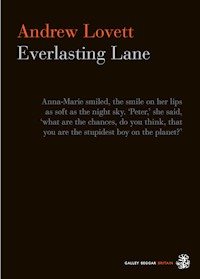
"There was something frightful about those woods. But it wasn't the trees… It was the shadows squeezed between them." Galley Beggar Press's third release is another novel from a wonderful new talent, following the success of The White Goddess: An Encounter in 2012, and Eimear McBride's remarkable A Girl Is A Half-formed Thing in 2013. Andrew Lovett's Everlasting Lane evokes the eternal summer of a 1970s childhood: sun-soaked, nostalgic, with the soft focus and warm glow of a Polaroid - but offset by darkness. Peter is a boy who doesn't really understand the present, who refuses to think properly about the past, but is compelled to come to terms with both, in a story that is part Secret Seven, part I'm Not Scared, and part A Month In The Country. Glorying in the joys and gentle adventures of childhood, and featuring a sidekick - Anna-Marie - as memorable as Dill in To Kill A Mockingbird, Everlasting Lane is a bittersweet and delightfully strange exploration of the complexities of family relationships, and the shadows that the past can cast over the present.
Das E-Book können Sie in Legimi-Apps oder einer beliebigen App lesen, die das folgende Format unterstützen:
Veröffentlichungsjahr: 2014
Ähnliche




















Everlasting Lane
byAndrew Lovett
First published in 2013
by Galley Beggar Press Limited
The Book Hive, 53 London Street, Norwich, NR2 1HL
All rights reserved
© Andrew Lovett, 2013
The right of Andrew Lovett to be identified as the author of this work has been asserted by him in accordance with the Copyright, Designs and Patents Act, 1988
This ebook is licensed for your personal enjoyment only, so please don’t re-sell it or give it away to other people. We want to be able to pay our writers! If you are reading this book and did not purchase it, please visit http://www.galleybeggar.co.uk and buy your own edition, or send a donation to make up for the money we and our author would otherwise lose. Thank you for understanding that we are a small publisher dependent on each copy we sell for our survival – and most of all, thank you for respecting the hard work of our author and ensuring we are able to reward him for his labours.
A CIP record for this book
is available from the British Library
Everlasting Lane
Andrew Lovett
nunquam refero
For Carole and Wynne
PART I
A Game of the Imagination
Chapter 1
I was nine-years-old the night my father died. Or ten.
I don’t remember.
‘Peter?’ My mother’s voice. ‘Peter?’
‘What?’ I was half-awake, half-asleep. ‘What is it?’ Like the moon: half sunlight, half midnight. All moon.
‘Peter.’
‘Whatisit?’
I was in my bed, eyes closed, my mother’s breath on my face. And I could see her tears like stars, for although my eyes were closed I believed them open.
She took me in her arms; pulled me to my feet.
‘What?’ My heart thumping in the darkness. ‘What is it? Where’s Daddy?’
I was led by the hand into the brightly lit corridor. ‘Peter, you know Daddy’s been poorly a long time—’
‘No!’ Struggling in her arms. ‘No!’ Louder: ‘No!’ Screaming: ‘No, no, no!’ Twisting, turning, pounding with my fists. ‘No, no, no!’
‘Peter. Come and see him, Peter.’ I wrestled free. ‘Please don’t do this.’
I ran to my room, the door slamming behind me and I hid, cold and breathless, beneath sheets and blankets.
From the landing, silence. And then a terrible howl rising from the silence, filling the night. And then long, trembling sobs fading away. A door closed. My mother cried alone.
So, how do I begin?
It was 1975 when he died. Or 1976. I don’t know. It was definitely a year in which I was ten.
As they lowered his coffin into the warm ground my mother’s face crumpled up like old tissues, her tears drying in the spring sun, her make-up all blotchy.
A tall man with sharp, little teeth and shiny, black eyes took my mother’s hand. ‘This is a terrible,terrible tragedy,’ he said. ‘If there’s anything I can do.’
‘Peter,’ said my mother, ‘this is Doctor Todd. Say “hello”.’
‘Peter,’ he beamed. ‘Your mother’s told me so much about you. I didn’t get the chance to really know your father, of course, but I believe he was a wonderful man.’ A fat cigar burned bright between his knuckles. ‘Awonderful man. And so devoted to you. And to your mother, of course...’
Stooping, he pinched a clump of soil between forefinger and thumb, pulled it from the upturned pile and tossed it into my father’s grave. He plucked a red handkerchief from his breast pocket to wipe his fingers clean.
‘I’m so alone,’ said my mother. ‘So completely alone.’
I missed my father very much but sometimes it was nice having my mother to myself. I couldn’t remember the last time she’d hugged and kissed me and told me she loved me. And she would tell me stories about my father. How he’d been in the war fighting the Germans before she’d even been born. ‘He always told me,’ she said, ‘that he waited to marry someone who hadn’t been alive then: someone, I don’t know… someone clean.’
She was only young and very beautiful but she had this sore leg that hurt when she was tired or sad and I would fetch a stool so she could rest it. I would look at her smooth, copper hair curling at the shoulder, her autumn eyes shining and think of bonfires and fireworks, of blackberry picking and everlasting misty mornings.
But sometimes she would look at me like a mad man and shout: ‘Peter, tidy your fucking room!’ She would grab fistfuls of paper. ‘Throw away all this rubbish!’
‘But I—’
‘Just keep what’s important and throw away the rest!’
‘But I don’t know—’
‘And I don’t know how I’m supposed to cope with you running around under my feet all day long!’
Or I’d stare at her and she’d shout, ‘For God’s sake, Peter, you wouldn’t say “boo” to a goose!’ or, ‘Don’t just stand there crying like a baby!’ And her face would move so close to mine that I could smell her sour breath and see my own startled reflection in her eyes.
A few weeks after the funeral I returned home from school to a kitchen full of pots and pans, and a table laid with the best mats and the nice plates with the gold edge. And beside each mat not just one knife and fork but several. And there were three places laid. There were three of everything.
There were three knocks on the front door.
‘Hello, Peter,’ said Doctor Todd.
‘Peter!’ My mother, stepping into the hallway, wiped her hands on her apron and struggled to unpick the strings tied tight across her tummy. Beneath the apron she wore the green dress my father’d bought her, a golden necklace and the butterfly earrings that sparkled if she laughed. ‘Doctor Todd,’ she said, ‘Clive, you’re,’ glancing at the hall clock, ‘right on time.’
‘It pays to be punctual,’ said Doctor Todd. ‘I abhor lateness. Ha!’ And as he laughed the house filled with the smell of cigar smoke stinking it up like a dead cat.
My mother laughed too: ‘Ha-ha-ha,’ her hand waving politely in front of her face.
‘These are for you,’ he said, pink roses appearing from behind his back. ‘A token of my – ahem – esteem.’
‘Oh,’ she murmured, ‘they’re lovely!’
‘Yes,’ said Doctor Todd. ‘Red, I thought, perhaps too demonstrative; white too cold; and yellow too ambiguous.’ He touched her shoulder and kissed her cheek. She blushed when she caught me watching. ‘Goodness,’ said Doctor Todd, touching her earrings. ‘These are very pretty.’
‘I’ve got a bit of a thing about butterflies,’ she said smiling nervously. Doctor Todd chuckled. ‘Well, anyway,’ she scooped a strand of red hair behind her ear, ‘the flowers are lovely, Clive. Thank you but you really shouldn’t... I’ll put them in some water.’
‘And, Peter, how have you been? Behaving yourself I hope.’ He bared his teeth. ‘Ah, of course, the enigmatic Peter I’ve heard so much about. A gift,’ he announced, presenting me with a small box, ‘to help you,’ and he tapped me on the head with each syllable, ‘or-ga-nise yourself.’ It was a watch with a thick strap and little hands ticking.
‘What do you say, Peter?’ called my mother from the kitchen.
‘Thank you.’
‘You’ll think of me everytimeyou look at it,’ he said, ‘eh, Peter?’ and he nudged my shoulder. ‘Ha!’
‘That’s so kind, Clive.’ My mother was stood in the doorway watching us. The evening sun played like music in her hair.
Doctor Todd cleared his throat, his face suddenly pink. ‘I couldn’t help but notice aLipton’son the corner. If it’s not too… Why don’t I go and buy us a nice bottle of wine?’
‘If you’re sure,’ said my mother. And then she smiled. ‘Yes. That would be lovely.’
‘Perhaps Peter wouldn’t mind keeping me company, eh, Peter?’
‘Yes,’ said my mother. ‘That would be lovely.’
‘I know, Peter,’ said Doctor Todd as we walked along, the setting sun stretching our shadows, ‘you like games, don’t you? Why don’t we play a game? Let’s see. I know, why don’t you tell me the very first thing you remember. I mean your very earliest memory.’
Well, I couldn’t’ve answered that even if I’d wanted to. I didn’t really have any memories of when I was very little. It was just like a big, black hole. Sometimes I would try to remember things. I’d poke my head into the hole but all I could hear were echoes and I would feel all giddy standing there on the very edge. The only really earliest thing I could remember was this one day after we moved when it started snowing and my father took me into the garden. I ran round and round trying to catch it. The snow, I mean. It was nearly over the top of my boots. And I could remember Daddy grabbing me and lifting me into the air. It seemed so high and I was laughing and screaming, and he was laughing. And then he hugged me really tight. And then I could even remember looking across to where my mother was staring at us through the kitchen window, tears on her face.
There was this photo on the TV of my father from when he was in the army. I could barely remember him being well, sat all day in front of the television, the curve of his ribs through the top of his pyjamas, thin hair turning to snow. He’d lift his unshaven face and smile his skeleton smile: ‘How was school today?’
‘Okay.’
And I’d go out and ride my bike up and down the rain-soaked street until teatime.
And I could remember how I would lie in bed and hear my mother pleading with him to stay. And later I’d listen to her pacing back and forth, muttering to herself; and to my father’s breath hissing like steam.
But I didn’t say any of that to Doctor Todd.
He bought a bottle of wine and gave me ten new pence for Blackjacks and Fruit Salads. ‘Could I have a receipt?’ he asked the lady.
On the way back, Doctor Todd said, ‘And how are things at home?’
I chewed hard, my teeth all sticky and my tongue turning liquorice-grey.
‘Ah,’ said Doctor Todd. ‘I see.’
It was a proper dinner with three courses, four if you counted the cheese. I had to turn off the television.
Doctor Todd sat straight-backed and forked cubes of meat into his puckery mouth. Between chews he asked me about school (‘So, do you have many friends or one particular close friend?’) and my hobbies (‘Your mother tells me you keep a scrapbook. I’d love to take a look’) and some things I didn’t even understand (‘Tell me, Peter, do you ever find you’re awake when you thought you were dreaming?’). His eyes gleamed and he caressed his sideburns like a pantomime villain.
I turned my arctic roll to mush with my spoon.
‘Peter!’ said my mother tapping my arm. ‘When Doctor Todd asks you a question, you must answer. And make sure you’re telling the truth.’
‘Ha!’ exclaimed our guest lighting a cigar and sucking until his cheeks went all hollow. ‘Not to worry. Peter will talk when Peter’s good and ready to talk, isn’t that right, eh, Peter?’ The smell of smoke was making me sick. ‘Do you know, my mother would never –never– have allowed me to even sit with my elders, let alonespeakat the table.’
‘I am so sorry, Clive,’ said my mother. ‘It’s just sometimes he has a very vivid—’
‘Yes, yes,’ said Doctor Todd. ‘With regards to that, Peter, do you think you ever find it hard to distinguish between—’
And I tipped my pudding to the floor with a crash. Ice cream bloomed on the kitchen tiles from beneath the shattered bowl.
And so I was sent to bed.
And so, how do I begin?
Chapter 2
I awoke from shuddery dreams of frozen desserts: icebergs of vanilla, mountains of soft sponge. I crept down to my secret step, my tummy grumbling like that waste ground behindLipton’s.
‘It’s perfectly understandable.’ Doctor Todd’s voice spreading like oil. ‘Perfectly. But you mustn’t blame yourself.’
‘I know, I know, but I’m so alone. There’s nobody I can talk to.’
The television was black, and candles, like those ones we’d used in the power cuts, flickered through Doctor Todd’s smoke. I could see my mother’s leg resting on that stool I told you about. I could hear her sniffing into her hankie.
‘Well, that’s whatI’mhere for,’ said Doctor Todd. ‘You can talk to me about anything. Anything.’
‘I know, Clive. I don’t know how I would have got this far without you. But Peter—’
‘No “buts”,’ said Doctor Todd. ‘You’re not being fair. You’ve said it yourself, you need some time. It’s for your benefit. And Peter’s too, of course.’
‘I know. I know.’
‘I mean, isn’t thereanyother family? Of course, I know about his grandmother but I’m sure—’
‘His grandmother?’
‘Yes, I’m sorry. But surely there’s someone who’d take him off your hands… for a while.’
‘Off my hands?’
‘Yes. I mean who wouldn’tloveto spend some time with Peter?’ said Doctor Todd. ‘He’s such a… such a character. It would do him the world of good. Besides, you’ve said it yourself: you need a change, a new beginning, and this is your opportunity.’
‘But she—’
‘That’s enough,’ scolded Doctor Todd. ‘You mustn’t be selfish. You really need to think about what’s best for Peter.’
‘Maybe you’re right,’ she murmured. ‘This could be my last chance.’
‘Exactly. Exactly.’
‘I could take him back to Amberley. Wouldn’t that—?’
‘Well, no, I’m not sure that would be such a good... What Imeantto say was that I could take him if you like, if there’s someone... I’ll get him there,’ he said, ‘safe and sound.’
‘No, no. You mustn’t. I’ve imposed too much—’
‘Nonsense,’ said Doctor Todd. ‘It’s been,’ his shadow leant towards hers, ‘an absolute,’ was that the sound of, ‘pleasure’?
The tennis ball went bobbling across the back lawn. I was always challenging myself: the further I punted the ball with my father’s golf club the higher my score. But I couldn’t concentrate. I couldn’t even think why until, tick by tick, I remembered the watch clinging to my wrist. Doctor Todd’s watch. The seconds were speeding. I could see them and feel them, frantic-tick-ticking deep within. I shook my wrist. And again. Harder.
I released the watch, placed it on the path and returned to my game. But I couldn’t shake it out of my head. I could still see the hands spinning, you see, the numbers changing, the time passing.
I could hear Doctor Todd speaking to me in my head: ‘So, do you have many friends or one particular close friend?’
There was sweat on my face and tears prickling my eyes. It was like I could feel myself crumbling, blood thick and throbbing, noises exploding in my head, lights flashing like blades.
‘Your mother tells me you keep a scrapbook.’
I raised and tested the golf club. I lifted it higher and swung it through the air.
‘I’d love to take a look.’
The head of the club hit the watch with a crack, splitting its ugly face.
Again.
Again and again. Crack. Crack. Crack.
I smashed the watch into its tiniest.
Smallest.
Pieces.
And then my mother, thunder and lightning, staggering towards me. ‘Why?’ she cried. ‘Why must you always…?’ And then pain as her stick went splintering across my shoulder. Once. Twice. And I really did cry, spinning as I fell. She turned her back, stumbling away before I’d even hit the ground.
When I found her at the top of the stairs, head hanging down, hands covering her face like the soil across my father’s grave, she said, ‘I’ve decided,’ her voice all muffled. ‘We’ll go to Amberley. Clive’s right: it’ll be good for both of us. A new start.’
‘There’s no grandmother.’
‘What?’
‘You were lying.’ I knew she was. ‘I haven’t got a grandmother!’ My dad always told me how she died when he was still in the war.
‘Peter.’ My mother sighed and raised her head. She looked like an alien, her eyes all dark and swollen. Her hair was wild. ‘Heaven and Earth are full of things you’ve never even dreamt of. I deserve a second chance, Peter, don’t you think? Doesn’t everybody deserve a second chance? Well? Don’t just stand there blubbering: say something!’
‘I don’t want to.’
‘Don’t want to what?’
‘I don’t want to be with you,’ I said. ‘Someone else... Someone else would love to spend time with me. I’m such a character.’
She kind of laughed when I said that with her shoulders all shaky. ‘Unfortunately, Peter,’ she said in a kind of wet whisper, ‘there isn’t anyone else. I’m the only mother you’ve got.’ And then she sniffed and said: ‘I just thought we needed a break. A little holiday. And then everything will be like it used to be. You’d like that, wouldn’t you?’
Doctor Todd, in a safari suit and a silk cravat, came to see us off. ‘If you’re absolutely sure,’ he said, smoothing his sideburns before touching my mother and kissing her cheek. ‘You’d best leave right away.Rightaway. It’s a hot day and theroadsare atrocious. Atrocious.’
‘Yes,’ said my mother. ‘The sooner the better. Peter,’ she snapped, ‘stop chattering and use the toilet.’
Doctor Todd glanced at my wrist. ‘Where’s your watch?’
‘Come on, Peter. You know what you’re like.’
When the car door closed Doctor Todd’s face appeared leering against the glass, his terrible teeth glinting. ‘Off you go then,’ he said and the engine roared.
The daywashot and the car stank of fresh leather. My stomach gurgled and churned as we passed the hospital with the pretty nurses, and weary mothers shunting prams along the pavement. Everything was different: the colours had all changed, the sun was bright. I saw daffodils, and sunlight falling through the branches of trees. I saw people on their way to work: people for who this was just another day, people whose daddies were fixing cars or mowing lawns or rolling pens back and forth across office desks. The car slid across the lanes and the motorway swept us away from town.
I kept a scrapbook, of sorts, like Doctor Todd said, bits and pieces pasted on paper. I always wanted to control things, you see, the things that happened and put them in order just like the kings and queens on the classroom wall. But it was so hard. I could never tell what mattered. I couldn’t control the world any better than I could an armful of snakes. The hills and fields unfolded like pages and the contents of my scrapbook shuffled all higgledy-piggledy across the back seat of the car. I scrambled to collect everything and hurry it back between the covers.
But why was it so frightening? I mean, you know, when everything got all muddly? Grown-ups always pretended that everythingcouldbe answered or explained or justified. But if you’ve ever seen the face of a lady who’s lost her child or a child that’s lost its mummy or daddy you might think that, well, maybe, life is all confusing and messy and wouldn’t fit between the pages of a book no matter how hard you tried. Maybe it’d be better if you just closed your eyes and went to sleep and dreamed. And then when you woke up, if you had to wake up, you might as well just forget about trying to make everything make sense and lie in your bed, eyes wide open, waiting for another day to start.
I saw handfuls of sheep scattered across the hillsides, and villages small enough to put in my pocket: so small that I imagined ruling over them, bringing destruction whenever the mood took me. The people would scream in terror at the wild world I’d made.
‘Peter,’ my mother’s eyes flared in the rear-view mirror, ‘what is it? What are you saying?’
‘Nothing!’ and I slapped the back of her seat. Sometimes I wondered what it would be like if I really could kill someone.
She twisted around, her finger jabbing at me. ‘Are youtrying to cause an accident?’ She spun back to the road and I sat plastered with fear to my seat, her spit on my face. ‘Not long now,’ she muttered. ‘Amberley: two miles. Thank God. As soon as we get to Everlasting Lane—’
Everlasting Lane? I hadn’t heard that name before. It took me by surprise. How long would we have to drive down an everlasting lane?
‘It’s just aname,Peter!’
And then we passed the sign – Amberley – and everything changed.
I made up stories, you see, and filled my scrapbook with the people I knew: a widowed mother; a lost child; the woman, smiling, her shadow sliding back towards the large house; the young man taking a match to a bundle of secrets. And now the swinging chain, turning, creaking, the air still. I made a world where summers were warmer, where the winters were whiter, and even love seemed better.
I can’t promise that this is the way it was, not exactly, only that this was perhaps how it sometimes seemed to be. Because it’s a strange kind of courage, isn’t it? The courage to let someone die; to let them die alone without a word. And you should tell her that I’m sorry because, in the end, maybe, I didn’t do the right thing at all. But, you see, although I believed them open, my eyes were closed.
I stood in the doorway of the little white cottage as my mother ruffled through her handbag and produced a bundle of keys. I heard church bells: chimes rising into the spring sky, and a tumble of silver notes. I heard the turn of the squeaky lock. The branches of a weeping willow rose and fell; birdsong twinkled in the taller trees.
And, so, this is how I begin.
My father died when I was nine-years-old. I must have been nine because I was ten when I went to live in Everlasting Lane.
It was all so long ago, how could I ever forget?
Chapter 3
The cottage in Amberley always made me think of an old library or museum: dusty and undisturbed.
I sat at the kitchen table, lurching from thought to thought, watching my mother’s every move. She brought out lemonade and biscuits and perched on the yellow worktop to watch me eat and drink. I wasn’t hungry but ate anyway, forcing mouthfuls of digestive down my throat. The table-top was plastic and patterned to look like wood. It was funny because there was something familiar about it just as there was about the floor tiles and the cupboards and the yellow curtains tied up at the window.
The kitchen smelt empty. Opening a brown cupboard, my mother cleared a space among old packets and tins for beans and bread; in the fridge she placed butter, milk and cheese. The fridge shuddered as she switched on the power and at the same moment a memory flickered across my brain. I saw myself building towns of coloured paper, my feet swinging clear of the kitchen floor, large blocks of pale afternoon pasted on the walls. There was a smell of fresh paint and brushes soaking upended in old jam jars. I could hear my father singing and I could see myself, my tiny self, giggling with glee at his funny voice and thoughts of hippopotamuses and glooorious mud as he slipped ginger cake into the oven and warmed cocoa in the pan.
I could hear my mother’s footsteps upstairs stomping on the old floorboards and the Hoover rattling against the skirting and whooshing under the beds. I listened out for the sudden silence that would follow the end of her housework. You see, something was about to happen. Something only I knew.
My father stood behind me admiring my work.
I wondered how much I knew about this man. Not much. He had a moustache and his tummy hung a little over the rim of his belt but he was tall and proud like the soldier he’d once been. He never talked about it but at least I knew what a soldier was. I’d seen pictures and read comics and, sometimes, my mother told me stories. But he wasn’t a soldier any more. He was a businessman and I didn’t really know what he did or understand that world of suits and ties and secretaries. There were no comics about businessmen. He was so much older than me I couldn’t imagine the world through his eyes. He was a mystery; a mystery in my own house, but I never thought to ask. In my dreams he never changed. He was never ill and he was never dead. He was always Daddy and that was all that mattered.
‘Peter,’ he said smiling, ‘have you seen this trick?’ He moved to the opposite side of the table and—
‘Peter?’ I flinched. My mother’s eyes were scorching me, a whisper of smoke rising from my hair. ‘What is it?’
A sip of lemonade washed down the last stubborn bite of biscuit. I shook my head. ‘I’ve been here before.’
‘Peter,’ she frowned at my confusion, ‘why don’t youremember?’
‘Who lives here?’ I demanded.
‘We do.’
‘Yes, but whose house is it?’
‘Well, your grandma – my mum – lived here a while,’ she said. ‘But now it’s ours.’
‘And we live here?’
She nodded.
She clunked my suitcase up the narrow stairs. If the downstairs was small, the upstairs was smaller still and the wooden chair on to which my mother sank filled most of the landing. I nearly toppled backwards but she seized my wrist. The shadow of the gloomy, green drape hanging behind her slid across her face.
‘You nearly had a nasty fall,’ she said.
She produced a brass ring from which rattled an assortment of keys. She removed four. ‘Bathroom,’ she said handing me the first. I fitted the key, unlocked the door and returned the key to my mother. ‘Mine,’ she said, and I repeated the task a second time. ‘Yours.’
I twisted the third key into its lock. As the door opened the room coughed out a puff of stale, stuffy air. My mother jerked back the curtain and pushed open the tiny window. ‘Oh, Lord,’ she said as a triangle of light fell across the room and its contents. ‘This,’ she said, shuffling an armful of clothes from the pink eiderdown, ‘is, apparently, where your grandmother decided to store all her junk. She was a devotee ofWoman’s Weekly,’ my mother went on, a stack of magazines threatening to slip from her grasp, ‘and clearly reluctant to throw away a single edition.’ Sniffing the bedding she said, ‘And a change of sheets is in order, methinks.’
She winced as she lowered herself to her knees. She reached beneath the bed and began tugging free toys and books. ‘Your old Action Man,’ she cried, ‘your Robin Hood set, your Rupert annuals. Oh, and look who we’ve got here!’ It was a piggy bank, pink and smiling, forgotten pennies rattling around inside. And then a tattered glove-puppet. ‘Goodness me, Peter, you were always “Pinky-this, Perky-that”. You drove us to despair.’ She slipped the toy on to her hand and wiggled it as if it were talking. ‘Pinky-Perky-Peter we used to call you,’ she said in a squeaky voice. ‘Don’t you remember?’
I shrugged and scowled at the pig. I wondered whether I wanted to remember.
‘Look,’ she sighed removing the puppet from her fingers and reaching back under the bed, ‘I know it’s not much, but sort out your pictures and things, it’ll be just like…’
She now held a skipping rope. It looked nearly new. She caressed its silky strands and wrapped it around her fingers like beads.
‘That’s a girl’s toy,’ I said.
Alone in the living room, afternoon sun speckling the air, I counted porcelain animals roaming the shelves in packs or lurking alone between the spines of tattered books. A clock squatted on the mantelpiece, its hands still. Kneeling before the TV I scrawled my name across its dusty screen.
I studied a row of photographs that sat along the sideboard. They made me feel happier. Photographs always did. It was like I could pretend that they were real and the room around me was the picture. Like when you look in a mirror and see the world where everything is backwards, so that your right hand is your left hand and all the writing looks funny and mysterious. It’s like another world where the things that happen are opposites and if you’re sad in the real world then you’d be happy in the mirror, and if you were lost in one world then you’d be found in the other. And the people who were dead might be alive and everything would be different and better.
Some of the photos were black and white, others pale and coloured. Some I’d seen before at home, stacked in a box in the garage, damp-dry at the corners. Others I hadn’t seen before, like this one with my father and mother sat side by side and smiling for the camera but the picture was torn like a third person had been removed.
I couldn’t guess who.
‘What are you up to?’
I jumped. ‘Nothing.’
My mother held a lemonade in each hand, bubbles rising. ‘Don’t worry,’ she said passing a glass to me and tugging a duster from her back pocket. ‘It just needs a good clean.’ She swept the yellow cloth across the television’s blank eye, erasing dust and signature in a single swipe. She went to the window and glowered at the tangle of weeds that had once been a garden.
I stared at her. She’d changed her clothes. She was all made up like a younger person, with pink cheeks and a storybook smile. She wore a t-shirt, red, white and blue like an American flag; and proper jeans, flared ones, almost like a teenager. But her eyes, when she turned to smile at me, were the same smoky shade as always.
‘Where is she now?’ I asked.
‘Who?’
‘My grandmother.’
My mother shuddered as if tasting something bitter. She fiddled with an earring – a butterfly, its wing sparkling by the light from the window. ‘Maybe, when you know me better,’ she said.
‘Idoknow you.’
‘Oh, Peter,’ she said joining me on the sofa, ‘you don’t know me at all.’ And then she took my hands in hers. ‘I was thinking about what you said. You know, about not wanting to live with me.’
‘But I—’
‘No, it’s all right. I was wondering what it would be like if you could live with someone else. Someone who wasn’t cross all the time.’
And then she explained. We were going to play a game, she said, a game of the imagination. She told me how she was going to be my Aunt Kat (with a ‘K’) and how my mummy had gotten very tired and had decided to take some time to sort herself out because I knew what it was like whenIwas tired and how grumpyIgot, didn’t I?
I nodded. I didn’t want to make her cross.
‘Do you know why people play games, Peter?’
‘Because it’s fun?’
‘Well, yes, sometimes, but sometimes it helps them discover something too.’
‘Like Hide and Seek.’
The game had rules, of course – just like that man inIt’s a Knockoutwho tells everyone the rules before he blows the whistle – but in this game you could change, you could be anything or anyone you wanted because the past and the things we’d done, which I’d always thought were carved in stone, might as well be carved in water. And it was a strange game, yes, but a good one because, as she explained, if you were losing, you just returned to ‘Go’ and started all over again.
But then she said how she wanted us to keep ourselves to ourselves and that people in a village had big noses and would want to poke them into our business given half a chance and I wasn’t to tell anyone anything and even when I went to school – ‘Yes, Peter, school. Did you really think you wouldn’t have to go?’ – I needed to be careful because the game, she said, and the rules were secret. ‘And if people ask questions,’ she said, ‘never answer.’
‘Why?’
She groaned and then laughed. ‘Do you know something, Peter Lambert?’
‘No. What?’
‘Youask too many questions.’
‘Butwhatdo I call you?’
‘I told you: you can call me Kat—’
‘Why?’
‘—with a “K”.’
‘But why? It’s not even a proper name.’
‘Of course it is. You are your name,’ she explained, ‘and your name is who you are. It’s just sometimes you need another name to make yourself something more, something better. Your dad understood that,’ she said, ‘but I let him down. And now I’m making up for it. Well, what do you think?’
Well, sometimes, I didn’t know what to think.
‘Let me look at you,’ she knelt at my feet, ‘Oh, Peter, your daddy would be so proud,’ as if seeing me for the first time. Her fingers teased my hair. And then, ‘Oh, Peter,’ she said, ‘I’m sorry.’ And then, ‘It’s all right,’ as she reached for me. ‘Don’t cry. Big boys don’t cry.’ And I didn’t.
Hardly at all.
‘Listen, Peter,’ she said, her smoky eyes filling the room, ‘can you keep a secret?’
‘Yes.’
She put a finger to my lips. ‘Then keep it.’
A butterfly fluttered among the thick, green leaves of the overgrown garden. Gardens at home were mirrors, reflecting other gardens, other houses and other small boys, but this garden backed on to trees. Not like the skinny trees at home either. These trees were thick and old with dark stories stuffed into the lines of their rugged faces.
Having turned it on to something big, thumping and full of summer, Kat, as I was supposed to call her, slipped a radio onto the seat of the rusty garden chair. ‘There used to be a scythe,’ she said squinting at the chaos before her, ‘but I’d hate to take you home with less legs than when you arrived.’ And then, turning her back on the jungle to survey the rear of the house, she cried out: ‘Oh, no. Look! The local yobbery have put a brick through a window.’ A jagged black hole gaped from the first floor. ‘Oh, Peter, is nothing sacred?’ she sighed. ‘I won’t rest until I’ve done something about that. Can you entertain yourself, Peter? Yes?’
‘What about Doctor Todd?’ I said.
My mother – I mean Kat – sighed again, ‘Ooooh,’ as if I’d stuck her with a pin. ‘Listen, Peter, my suggestion to you is that you don’t worry about Doctor Todd. In fact, that’s not even a suggestion,’ she said. ‘It’s pretty much an order.’
That seemed too easy.
‘Okay?’
I nodded.
‘I’ll not be long,’ she said. ‘Now be good.’
Left alone I couldn’t resist plunging into the overgrown garden, like Doctor Livingston, I presume, or Doug McClure, fully expecting to discover the ruins of some dark forbidden temple or one of those Japanese soldiers that never know the war is over. I had to keep my wits about me, of course. You never knew what dangers might be lurking deep within the undergrowth: lions, probably, ready to rip your throat out; snipers, a pot-shot from the shadows; maybe aliens.
I tightened my grip on my gun and, with my walkie-talkie pressed to my ear, I could communicate with HQ and keep them alerted to my progress: ‘I am approaching the nest,’ in a whisper, twisting the dial. ‘Over. I must be absolutely silent,’ I went on. ‘Over. Who knows what I might find,’ I concluded. ‘Over and out.’
There was a burst of activity. I crouched and gazed in wonder at the mighty beast rising in to the air, leathery wings beating over the land that time forgot. Awed by its ancient beauty, I—
‘What the hell are you doing?’
The pterodactyl vanished. My gun, I discovered, was only a stick, and the voices of my comrades were static crackling from the wireless in my hand. It took a moment to remember where I was and a moment more to locate the source of the question.
A pale, freckle-faced girl was leaning over next-door’s fence. She had long, golden blonde hair and big ears. I had the uneasy feeling she’d been watching me for some time.
Chapter 4
The girl frowned at me with serious eyebrows.
‘What the hell,’ she repeated, as if I was retarded, ‘are you doing?’
‘Playing.’
‘Playing? Is that what you call it? Is that why you’re muttering to yourself like a demented baboon?’
‘I…’ I stared at my feet, blushing.
‘I asked you a question, dimwit.’
I prayed she wouldn’t climb over the fence. But she did. One long, spider-thin leg appeared and unfolded itself. And then a second. She slid down into the overgrown flowerbed. ‘Thanks for your help,’ she said, straightening her dress and glaring at me with pale blue eyes. ‘Frankly, it’s nice to know that chivalry is so far from being dead.’ Her knees were grazed and dirty.
My heart thumped and bumped like a body falling down stairs. I studied the buckle of my sandal and the earth beneath my feet with a sweaty concentration that would have delighted my teachers. I finally looked up past her grubby knees and faded yellow dress. She was a year or so older than me and a head taller. Of all the challenges I’d faced that day, she was the toughest.
‘I’m Anna-Marie,’ said the girl. ‘Anna-Marie Liddell. And,’ she said, as if discovering something hairy in her salad, ‘who the hell are you?’
‘Peter.’
‘Peter?’ she said with disgust. ‘What are you doing here?’
‘I… I live here,’ I said. ‘With my… with my… my aunt.’
‘Since when?’
‘Since… today.’
‘Oh.’ She considered this information whilst using her little finger to free something green from between her teeth. ‘You’re not Oliver Twist are you? I mean, you’re not some awful, Victorian orphan?’
‘No.’
‘Why don’t you live with your mum or dad then?’
‘I… My dad’s dead.’
Anna-Marie looked away. ‘My dad is in sales,’ she said. ‘He’s away a lot, but it’s very lucrative. So what’s she like then, this aunt? She’d better not be a horror like Mrs Winslow. Mrs Winslow hates me.’
‘Why?’
‘It’s a long story,’ said Anna-Marie. ‘Anyway, now she says I’m “bad news”. That’s what Tommie says. Do you know Tommie?’
‘No.’
‘He’s at his dad’s for the holidays and who can blame him,’ said Anna-Marie pausing to chew a nail. ‘Isay that Mrs Winslow is an ugly old trout. And she is.’
‘Oh!’
‘Mrs Winslow is Tommie’s mother,’ she explained. ‘Tommie’s a bit of a spud but his dad doesn’t live with him so I look out for him. To be kind.’ She looked at me again. ‘You’re a bit of a non-entity, frankly.’
‘What?’
‘Are you simple?’
‘No.’
‘You must be if you don’t even know what a non-entity is. Perhaps you were dropped on your head as a baby. That would explain why you run around talking to yourself and don’t even know what the simplest words in the English language mean.’
My lips were tight, my face hot with shame. So I kicked her. Hard. On the shin.
‘Fuck-a-doodle-duck!’ she cried. ‘What was that for, you lunatic?’ She sat down heavily, flattening the tall grass, and unrolled her grey sock. ‘I think you must be deranged,’ she said. She tapped the faint mark with her finger. ‘Good kick, though.’
The sun tickled my head and the bare skin of my arms. A cat appeared, smooth and black, following the flies and raising a curious paw. Bees bobbled up and down between the weeds, stalks swaying beneath their weight.
‘Are you standing there all day?’ asked Anna-Marie, her voice gentler than before. I sat down. She flicked the hair from her face and smiled. Her teeth were white and straight, and two deep dimples burrowed their way into her cheeks. I felt a flicker of electricity.
‘Are you clever?’ she asked. ‘At school, I mean.’
‘I don’t know.’
‘I have an excellent vocabulary,’ said Anna-Marie. ‘They did a test. But I have a blind spot for numbers. I don’t let it bother me. Maths is boring. There’s no… variety. Everything’s either right or wrong. There’s no grey areas.
‘I like English: reading and writing, but don’t get me started on children’s books.’ I shook my head. ‘All those animals running around in hats and jackets with their bottoms hanging out,’ she said. ‘I mean, why do they even wear clothes? They should at least wear them properly, I mean trousers, don’t you think?’ I nodded. ‘And what about their names: Mr Toad, Badger, Rabbit? I mean, what are all theotherrabbits called?
‘Anyway, I don’t read kids’ books. I read grown-up books like Agatha Christie and Frances Hodgson Burnett. I like mysteries. I love books where anything can happen,’ said Anna-Marie, ‘don’t you? Like somebody says they laughed their head off or it’s raining cats and dogs. I used to write stories myself and... Well, in a story that can happen. It could really rain real cats and dogs. Literally. That’s much more interesting than normal rain.’
I smiled.
‘The impossibilities,’ she said, ‘are endless.’
‘What’s your school like?’
Anna-Marie wrinkled her nose. ‘It’s all right, I suppose. The teachers don’t like me much and the headmistress is awful but I’m going to secondary soon anyway. And I’ll be glad to go. I’ve had enough of baby school.’
‘Well,’ I said, ‘what do you want to be when you grow up?’
Anna-Marie gave me a withering stare. ‘Oh, please,’ she sneered. ‘What’s this: “Conversation for the Under-Fives”? You are such a child.’ She plucked a tuft of grass from the lawn and brushed it against her cheek. ‘In fact,’ she said, ‘I’m going to be a teacher.’
‘A teacher?’
‘Yes and I know what you’re thinking but I don’t mean like a normal teacher. I mean a good teacher. Do you know that gameConsequences?’ I didn’t. ‘We play it in school sometimes. Well, it’s like that. Children don’t know anything about consequences. They think they can just do any old stuff and that’s all there is to it. What they need is someone to teach them about the consequences of what they do. Do you know what I mean?’
I didn’t.
‘I want to be an astronaut,’ I said.
Anna-Marie snorted. ‘Your chances of ever becoming an astronaut are about the same as mine of growing an extra head.’ She glanced up at the cottage. ‘Sorry about the window, by the way. I didn’t know anyone was living here, obviously.’
‘We keep ourselves to ourselves,’ I murmured.
Anna-Marie gave me a funny look. ‘Oh, you do, do you?’
‘Who used to live here?’
‘Well, when we first moved here there was this little old woman – Mrs Whatnot or something. She was nice enough. She used to say I was an angel and give me sweets and stuff,’ Anna-Marie smiled, ‘until they carted her off. I don’t know much about it to be honest. You know what adults are like. As if I cared.’ She touched the bruise on her shin again. ‘Cockaleekie soup,’ she murmured, and then, ‘You’ve probably never heard anyone swear like that before, have you? Properly I mean. I’m the best swearer in school. My mum hits me whenever I do it but it’s funny ‘cause I learnt them from her in the first place.’
She closed her eyes with a sigh, her face smooth and peaceful like a china god. We sat in silence, listening to the breeze rippling in the trees and somewhere the rusty joints of a child’s swing. White sheets rippled on the Liddells’ washing-line like a sailing ship. The cat crept closer and wrapped its slinky back about my neighbour’s arm. ‘This is Kitty,’ she said. I fiddled with the buckle of my sandal and watched Anna-Marie, waiting for her to speak again. ‘Pillock,’ she said.
‘What’s a non-entity?’
‘It doesn’t matter,’ she shrugged. ‘Besides, you may not be one. Time will tell.’ She caressed her shin one last time. ‘I know,’ she said. ‘Come on,’ and she leapt to her feet, grabbing my hand and pulling me up. ‘You’re coming with me.’ My heart thrilled to her dry, determined grip.
‘Peter!’ it was my mother, ‘I’ve put some cardboard in the window,’ I mean Kat, of course, ‘cleaned up the glass,’ calling from inside, ‘and I’m going to phone a man in the village about,’ stepping from the back door on to the patio, ‘the gar... Oh,’ she said, seeing Anna-Marie for the first time.‘Hello. Who’s this?’
‘It’s Anna-Marie.’
‘Anna-Marie Liddell,’ said my new friend smoothing the creases out of her dress.
‘Oh, well, I hope Peter’s not bothering you.’
‘He seems harmless enough,’ laughed Anna-Marie.
‘Don’t you believe it,’ said my... said Kat.
‘Can I go out?’ I said. ‘We were going to—’
‘Well, I’m hardly keeping you a prisoner, am I? I want you to look around,’ she said. ‘See what you can find. Tea’s baked beans with cheese on top – just how you like it – so make sure you’re not back too late.’
‘Don’t worry,’ said Anna-Marie. ‘I’ll look after him, Mrs—’
‘Kat,’ said Kat. ‘With a “K”,’ and then she smiled at me just like an aunt would and said, ‘‘Bye, Peter.’
And I said, ‘‘Bye, Kat.’ It was new and strange but it was kind of nice.
As Anna-Marie and I walked along I nearly began to believe what Kat had said about my having lived there before because nothing I saw seemed entirely new. Hadn’t I once hidden beneath that willow tree waiting to spring out on my mother as she hung the laundry? Wasn’t that pothole the one I had tripped on whilst chasing a pigeon and skinned my knee so badly that Daddy had had to bathe it inDettol? Why did the low branches of that tree remind me of hiding myself among its green leaves and giggling as my parents bellowed out my name below? But if it was true why was I not sure? The memories were more like dreams than things that had really happened.
‘So,’ said Anna-Marie, ‘that’s the notorious aunt, is it?’
‘Where are we going?’
‘Kirrins’.’
I remembered when my dad, sat up in bed waiting for the nurse to come, was telling me about that funny feeling French people get when they’ve been somewhere before when they haven’t really. Now that I could remember quite clearly: the sickening warmth of the room, the smell of medicine and Daddy’s dry voice saying, ‘Sometimes the mind likes to play tricks on people, Peter. Just like you do.’
‘What’sKirrins’?’
‘It’s a shop.’
‘Why? What are we going to do?’
Anna-Marie smiled. ‘Something reprehensible.’
By the time we reached the sign that welcomed us to Amberley, wedged tightly into a wall of yellow bricks,I had decided that it was Kat who was playing the trick. After all, if we had once lived here, why had we left?
Along Hayes Road,the road that wound through the village itself, were rows of tiny cottages with black roofs and white walls wrapped in vines and creepers, their small front gardens brimming with flowers and shrubs. Anna-Marie hop-scotched along the pavement, the loose rubber of her plimsoll flip-flapping. Occasionally she paused, frowning with concentration, to slip her hair back behind her ears before tossing her stone and skipping off again in pursuit, me trotting to keep up.
We passed the village green, the yellowing grass revealing the brown earth underneath, and the pond, scum collecting in the bottom, the dry bed rising to meet the water level. We passedThe White Hartwhere a row of old men, skins dark and cracked, sat muttering and drinking, squinting at the sun; and beer, Coca-cola and cheese and onion wafted across the road.
Anna-Marie said: ‘Where did she get that limp?’
‘What?’
‘Your aunt. She’s got a limp, hasn’t she? I mean I’m not saying she’s Long John Silver or anything but you can see it.’
We left the pavement and crossed the road towards a pokey shop: trays of shrivelly fruit and buckets of droopy flowers lay outside and in its window a plastic sheet protected the insides from the glare of the sun. Above the door a sign, its black and white paint all scratched and peeling, read:Kirrins’ General Store.
‘She should use a walking stick or something,’ said Anna-Marie as she took the handle and leant her bottom against the door.
‘What’s reprehensible?’
Anna-Marie sighed. ‘Reprehensible: naughty, wrong, blameworthy, disobedient, wayward, mischievous, impish. Antonym,’ she added with a wink as she pushed against the glass panel, ‘good.’
Oh. Well, that was all right then.




