


Erhalten Sie Zugang zu diesem und mehr als 300000 Büchern ab EUR 5,99 monatlich.
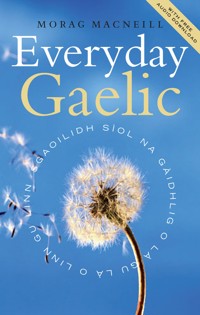
This is an invaluable learning resource for anyone interested in Scottish Gaelic. In addition to basic words and phrases, it also includes more complex and idiomatic material, all arranged thematically and covering topics such as meeting and greeting, travelling, the weather and eating and drinking. There are also clearly explained sections on grammar and imitated pronunciation for all Gaelic words and phrases. The result is an accessible and useful book which will be of benefit to all levels and ages of Gaelic learners. This edition includes an audio download link to allow readers quick, easy and convenient access.
Sie lesen das E-Book in den Legimi-Apps auf:
Seitenzahl: 231
Veröffentlichungsjahr: 2023
Das E-Book (TTS) können Sie hören im Abo „Legimi Premium” in Legimi-Apps auf:
Ähnliche



EverydayGaelic
Morag MacNeill
FREE AUDIOBOOK
To access the audio download, click here and follow the instructions.
The Author acknowledges assistance from the Gaelic Books Council in the production of this book/CD, and would also like to thank her husband Finlay for his unfailing encouragement and support in producing this new edition.
This edition first published in 2006 by
Birlinn Limited
West Newington House
10 Newington Road
EdinburghEH9 1QS
www.birlinn.co.uk
Reprinted 2006, 2007, 2010, 2014
First published in 1984 by Gairm Publications, Glasgow
Copyright © 1984 and 2006 Morag MacNeill
The moral right of Morag MacNeill to be identified as the author of this work has been asserted by her in accordance with the Copyright, Designs and Patents Act 1988
All rights reserved. No part of this publication may be reproduced, stored or transmitted in any form without the express written permission of the publisher.
Book only
ISBN: 978 1 84158 340 2
Book and CD
ISBN: 978 1 84158 370 9
British Library Cataloguing-in-Publication Data
A catalogue record for this book is available from the British Library
Designed and typeset by Sharon McTeir
Printed and bound by Bell & Bain Ltd, Glasgow
Preface
Everyday Gaelic is more than a foreign phrase book. Since English is also spoken in the Gaelic-speaking areas, communication in Gaelic is not so much a matter of necessity as of choice and interest.
This book, therefore, covers more than just the phrases needed by an outsider in a foreign land – it also dips into the chatty, the personal and domestic aspects of the language. It ranges from simple words and phrases to the more complex and idiomatic.
Hopefully it will serve the non-speaker of Gaelic who wishes to utter the odd phrase and get an idea of the language, the person whose parents spoke Gaelic and who understands it but is unwilling to ‘try his hand’, and also the keen learner, who might like to gain a greater scope of everyday phrases than those contained in grammar books of the language.
Obviously the whole of the Gaelic language cannot be contained in one book. Therefore a selection has had to be made of those words and phrases most likely to be useful in everyday situations. If this selection has been successful, the reader will find the book not only informative but also interesting.
The above preface still stands for this new edition. However, some of the language has been updated, as well as the numbering system, weights and measures, Public Office Names, modern technology words, etc., to reflect the general change in lifestyle in the past twenty years.
In view of the greater numbers of children now attending Gaelic medium schools, many with enthusiastic Gaelic learner parents, I have also extended the ‘Talking with Children’ section to include some phrases relevant to the situation.
Gaelic hill/outdoor names are also of great interest to learners, and some of these have been added.
Also a feature of this new edition is the inclusion of a section on jokes and sayings: One-liners.
Morag MacNeill
Inverness
February 2006
Contents
PREFACE
A PRONUNCIATION AND IMITATED PRONUNCIATION
B BASIC GRAMMAR
C QUESTION AND ANSWER (VERBS)
D NUMBER AND TIME
Time of the day/week etc.
E MEETING FRIENDS AND GETTING ACQUAINTED
How are you?
Getting to know you /Asking after others
F THE WEATHER
G OUTDOORS
In the country
Topography
Flora and fauna
On the farm/crops
Farm and domestic animals
At the seashore
Fish and fishing
H PLACE-NAMES: SCOTLAND AND INTERNATIONAL
Countries, nationalities and languages
J TRAVELLING, TRANSPORT AND ACCOMMODATION
Transport
Travelling by car
Travelling by public transport
Travel information
Buying tickets
Accommodation and Facilities
K EATING AND DRINKING OUT
A quick cuppa
In the hotel/bar
Eating a meal
L INVITATIONS, ENTERTAINMENTS AND ACTIVITIES
The Church
M ONE-LINERS (Sayings and Jokes)
N SPECIAL OCCASIONS/GREETINGS
Special times of the year
General greetings/weddings
Birth
O IN TOWN
Places in town
Offices and institutions
Asking directions
P SHOPPING (See separate Contents on first page of this Section)
Q OCCUPATIONS: JOBS AND WORK
R PERSONAL AND FAMILY NAMES
First names (Female and Male)
Surnames
Clan crest slogans
General patriotic slogans
S THE DOMESTIC SCENE
The house
The family
Schooling and education
Common domestic phrases
Lost and found
Doing things around the house
In the kitchen/cooking
Family meals
Talking with children
Family friction
T TALKING ABOUT PEOPLE
Numbers of people
Describing People
Physical description
Character and personality
Feelings and emotions
Having and owning
Wearing
V PERSONAL COMMUNICATION
Writing letters
On the computer
On the phone
Speaking/telling
Thinking/knowing
Intention/decision/action
W THE BODY
The faculties/senses
Parts of the body
Discomfort, illness and injury
At the dentist
ALPHABETICAL INDEX OF MAIN TOPICS
HANDY PHRASES
A
Pronunciation
The Gaelic alphabet consists of only 18 letters: there is no J K Q V W X Y or Z. However there are sounds in Gaelic quite different from English, which are made up of combinations of letters. Once these are mastered, Gaelic spelling and pronunciation is very consistent.
As in English, there are five vowels A E I O U.
E and I are considered slender vowels, while A O U are broad. Gaelic spelling observes a balance – where a slender vowel comes before a consonant or consonant group in the middle of a word, then normally a slender vowel will come after also, and likewise with a broad vowel.
In traditional Gaelic there is/was also an acute accent which could be found over the letters ‘e’ and ‘o’. These not only denoted length but also the quality of the vowel sound, the e acute giving an ae sound as in ‘day’, while the e grav denoted an eh sound as in ‘ten’; o acute gave ‘oe’ as in ‘grow’, and o grav gave ‘aw’ as in ‘paw’. I’m very much in favour of retaining this distinction, but ‘modern’ Gaelic has dictated that all acute accents should be discarded in favour of all grav accents. Since I had no editorial control over the first edition of Everyday Gaelic, ‘modern’ Gaelic was used. Therefore I have decided to go with the flow in this edition also.
At first sight to the English-speaker, written Gaelic looks impossible to pronounce. But once it is understood that the letter ‘h’ is never sounded as such, and is there only to influence the sound of the consonants, then the picture clears. (When followed by an ‘h’ the letters d, f, s and t can become totally silent!)
In this book not only is the proper Gaelic spelling given, but it is supplemented by the imitated pronunciation, which reproduces the Gaelic sounds in a written form more recognisable to the English-speaking reader. Any imitated pronunciation, however, can only be an approximation to the original. Where possible the learner should listen to the native Gaelic-speaker – this will help improve his ‘blas’ or accent.
Imitated Pronunciation
The imitated pronunciation should be read as if one was reading English, but keeping a few points in mind:
1 Stress marks have been omitted to avoid over-complexity. Stress in Gaelic words is generally on the first syllable of the word. As in English, short words like a, an, air, do, le, anns, etc are unstressed.
2 The ‘pointing’ in the middle of words (g·ee·urry) is to make the sound more easily and accurately read, and does not denote any kind of gap or stop in the voice.
3 a should be said as in cat
ah as in car
e, eh as in let
u, uh as in but (or more precisely as an indiscriminate ‘u’ sound as in infant or listen)
ae as in pale, fail, etc
oe as in hoe
aw as in law
g hard as in gap
tch as in chair, itch, etc
ñ as in union (a combination of n + y together)
Sounds not common in English:
eu should be said as in French ‘fleur’ (or as an Englishman (not a Scot!) would say bird, her, burn, etc)
ch as in Bach, loch (a gutteral sound as if trying to clear a fish-bone from the back of the mouth!)
gh a blown-through hard g (the same sort of sound as in ‘ch’ above, but slightly voiced, and achieved by placing the bridge of the tongue in the roof of the mouth – it can’t be too difficult – most babies achieve this ‘ghh’ sound before proper speech!)
t, d, l, n (individually underlined) said basically the same as in English but ‘thickened’, not spat out. This is achieved by placing the tip of the tongue behind the top front teeth while sounding the t, d, l or n. (Non-underlined t, d, l, n are as in English).
B
Basic Grammar
This section contains a brief outline of some of the more basic facets of Gaelic grammar. It should not be studied in detail by the faint-hearted ‘dipper’ who could be put off by the seeming complexity of the rules.
Once these rules are learned, however, Gaelic deviates very little into the irregularities and inconsistencies which can be experienced in the learning of other languages.
For ease of reference some grammatical lists have been given in the main body of the book, where particularly relevant. The localities of these lists, and of examples illustrating grammatical points, are given in this section.
1 WORD ORDER
In Gaelic, the verb comes at the beginning of the sentence, whether a question or a statement. The Question form of the verb is not the same as the statement form as is the case in English.
The word order of a simple sentence, therefore, is verb + subject + object
2 ASPIRATION (LENITING)
These are terms used to describe how the start of a word is altered when affected by certain other words.
In writing – it means simply that an ‘h’ is added after the first letter of the word.
Note however that vowels and the letters l, r, sg, sm, sp and st cannot be aspirated in this way.
In speech – aspiration describes a breathing through the first letter of the word affected.
Examples of the effect of aspiration on a letter or sound can be seen throughout the book.
3 PERSONAL PRONOUNS
Gaelic also makes much use of emphatic and reflexive forms of the pronoun. In English this emphasis could be achieved only by placing vocal stress on the pronoun.
Pronoun
Emphatic form
Reflexive form
I/me
mi
mise (me)
mi fhìn (myself)
you
thu
thusa (you, etc)
thu fhèin (yourself, etc)
he/him/it (masc)
e
esan
e fhèin
she/her/it (fem)
i
ise
i fhèin
we/us
sinn
sinne
sinn fhìn
you (pl or polite sing See p 17)
sibh
sibhse
sibh fhèin
they/them
iad
iadsan
iad fhèin
4 NOUNS
All nouns in Gaelic are either masculine or feminine in gender. The gender of nouns is given in any Gaelic dictionary and has to be learned as you go along.
Indefinite Article
There is no indefinite article in Gaelic. The noun alone is used.
Definite Article
There are a number of forms of ‘the’ in Gaelic. In the singular, the most common are an, am (before the letters b, p, f, m) and a’, and na in the plural. The correct form depends on the gender, case and first letter of a noun.
The first letter groupings for declension into which regular nouns fall are:
Group 1 b p c m g
Group 2 d t l n r
Group 3 a e i o u
Group 4 f
Group 5 s
A summary of the declension of these noun groups is as follows:
Group 1 e.g. am bàrd – the poet (masculine); a’ bhròg – the shoe (feminine)
Singular
Plural
Singular
Plural
Nominative (the …)
am bàrd
na bàird
a’ bhròg
na brògan
Genitive (of the …)
a’ bhàird
nam bàrd
na bròige
nam bròg(an)
Dative (at, on the …)
(Preposition)
a’ bhàrd
na bàird
a’ bhròig
na brògan
Group 2 e.g. an doras – the door (masc); an daolag – the beetle (fem)
Nominative
an doras
na dorais
an daolag
na daolagan
Genitive
an dorais
nan doras
na daolaige
nan daolag(an)
Dative
an doras
na dorais
an daolaig
na daolagan
This gives the general pattern. Below are given the other Groups (article and start of word only). The main stem of the word follows the above pattern (i.e. singular – adding ‘i’ in the masculine genitive, and ‘i’ and ‘e’ in the feminine genitive, and ‘i’ in the feminine dative. Plural – adding ‘i’ to the nominative masculine and ‘an’ to the nominative feminine).
Group 3
Group 4
Group 5
masc
fem
masc
fem
masc
fem
Sing
Nom
an t-u
an o
am f
an fh
an s
an t-s
Gen
an u
na h-o
an fh
na f
an t-s
na s
Dat
an u
an o
an fh
an fh
an t-s
an t-s
Pl
Nom
na h-u
na h-o
na f
na f
na s
na s
Gen
nan u
nan o
nam f
nam f
nan s
nan s
Dat
na h-u
na h-o
na f
na f
na s
na s
Some other nouns change internally in declension, e.g.:
fiadh (a deer) > fèidh
bòrd (a table) > bùird
Most Gaelic dictionaries give the declension of a noun.
5 ADJECTIVES
(Examples on pp. 25–27, 31, 54, 57, 80–86, 118–120)
When an adjective qualifies a noun it comes after the noun and agrees with it in gender and case, e.g.:
a big man (masc) duine mòr
a big tree (fem) craobh mhòr
the big boys (masc) na balaich mhòra, na gillean mòra
the big trees (fem) na craobhan mòra
Note that a feminine single noun in the Nominative case (the …) aspirates the adjective(s) which follow(s) it, likewise a masculine plural noun with an included internal ‘i’ ending (balaich, coin bheaga, etc).
Demonstrative adjectives
Note that the definite article is used with the noun.
Comparisons
Comparative Adjectives
(See also pp. 25, 48–49, 84, 107)
The general pattern to form the comparative adjective is to add ‘i’ before the last consonant group, and ‘e’ at the end, e.g.:
Often, however, in single-syllable adjectives the adding of the ‘i’ creates a general vowel change within the adjective, e.g.:
By using this altered stem word we can now form the Comparative (e.g. taller) and Superlative (e.g. tallest) Adjectives.
Comparative
(Note that bu generally aspirates a consonant which follows it).
Superlative
As for the comparative, but preceding the adjective with as (Pres/Fut) or a bu (Past/Condit), e.g. as caoile (thinnest); a bu chaoile
The Superlative adjective normally requires the Assertive form of the verb.
Possessive Adjectives
(See also pp. 95, 121–22)
In the ‘new’ Gaelic spelling the apostrophes preceding the above ’nam/’gam are being omitted as cumbersome. However, since the ’nam/’nan/’na without apostrophes can be confused for nam/nan/na with other meanings, I retain the old spelling. Since gam/gad etc have no other parallel or confusion, I omit these apostrophes.
6 ADVERBS
Formed by preceding the adjective with the word ‘gu’, e.g.:
Stress is sometimes gained by adding ‘fhèin’, e.g.:
7 VERBS
For the formation of Past, Future, Conditional Tenses of the verb, see ‘Question and Answer’ in the next Section (Section C).
For Reported Speech form, see p. 126–128.
The Past Participle is formed by adding ‘ta’ or ‘te’ to the imperative of the verb, e.g.:
Infinitive
The infinitive of a verb is formed according to its first letter, i.e.
Idiomatic Phrases
(See also pp. 128–29)
These are a limited number of phrases, normally formed with a preposition, eg:
I should … Bu chòir dhomh …
I usually … Is àbhaist dhomh …
I can … Is urrainn dhomh …
I prefer … Is fheàrr leam
…with an object:
…with an object and a verb:
Note that the noun comes before the second verb. This second verb is formed according to its first letter:
…with a pronoun object and a verb:
8 PREPOSITIONS
(See also pp. 31, 39, 72–73)
The most common simple prepositions are:
When a simple preposition and a pronoun come together (as often happens in the Idiomatic Phrases above), Gaelic contracts them into one new word, e.g.:
The formation pattern is fairly regular and most can be easily learned. See pp. 95, 121–23 for examples of these Prepositional Pronouns.
When a noun is governed by a preposition (e.g. to the shops) then the noun is considered to be in the Dative case. Note the effect of prepositions on nouns in the Nouns paragraph already given in this Section B.
Compound Prepositions:
These are made up of a noun and a simple preposition. Dependent on whether the noun comes first or last in the compound preposition, the second noun (the one being governed by the compound preposition) is in the Genitive or Dative Case (See Nouns, pp. 4–5)
C
Question and Answer
Gaelic does not have a one-word ‘Yes’ or ‘No’. To answer a question, one replies in the affirmative or negative of the verb with which the question was asked (e.g. Did you hit Mary? Answer: Did hit or Did not hit).
This is a quick-reference section, designed for those who wish to find the correct form and tense of a verb, thus enabling them to answer (or ask) questions correctly.
Question
Affirmative
Negative
Verb ‘to be’
Is/Are (you)?
A(m) bheil (thu)?
Tha
Chan eil
Was/Were (they)?
An robh (iad)?
Bha
Cha robh
Will (the man) be?
Am bi (an duine)?
Bidh
Cha bhi
Would … be?
Am biodh/bitheadh …?
Bhiodh
Cha bhiodh
Assertive form of Verb ‘to be’ (See p. 26)
Is/Are?
An e?
’S e
Chan e
(+ noun)
Was/Were?
Am b’e?
B’e
Cha b’e
Is/Are?
An ann?
’S ann
Chan ann
(+ preposition)
Was/Were?
Am b’ann?
B’ann
Cha b’ann
Do … like?
An toil?
’S toil
Cha toil
Would … like?
Am bu thoil/chaomh?
Bu thoil/chaomh
Cha bu thoil/chaomh
Regular Verb pattern
Did … lift?
An do thog?
Thog
Cha do thog
(1st letter – consonant/fl/fr)
Did … eat?
An do dh’ith?
Dh’ith
Cha do dh’ith
(vowel)
Did … leave?
An do dh’fhàg?
Dh’fhàg
Cha do dh’fhàg
(f + vowel)
Will … lift?
An tog?
Togaidh
Cha thog
Will … eat?
An ith?
Ithidh
Chan ith
Will … leave?
Am fàg?
Fàgaidh
Chan fhàg
Would … lift?
An togadh?
Thogadh
Cha thogadh
Would … eat?
An itheadh?
Dh’itheadh
Chan itheadh
Would … leave?
Am fàgadh?
Dh’fhàgadh
Chan fhàgadh
Irregular verbs
Did … say?
An tuirt?
Thuirt
Cha tuirt
Will … say?
An abair?
Their
Chan abair
Did … see?
Am faca?
Chunnaic
Chan fhaca
Will … see?
Am faic?
Chì
Chan fhaic
Did … hear?
An cuala?
Chuala
Cha chuala
Will … hear?
An cluinn?
Cluinnidh/Chluinn
Cha chluinn
Did … do/make?
An do rinn?
Rinn
Cha do rinn
Will … do/make?
An dèan?
Nì
Cha dèan
Did … get?
An d’fhuair?
Fhuair
Cha d’fhuair
Will … get?
Am faigh?
Gheibh
Chan fhaigh
Did … give/take?
An tug?
Thug
Cha tug
Will … give/take?
An toir?
Bheir
Cha toir
Did … come?
An tàinig?
Thàinig
Cha tàinig
Will … come?
An tig?
Thig
Cha tig
Did … go?
An deach(aidh)?
Chaidh
Cha deach(aidh)
Will … go?
An tèid?
Thèid
Cha tèid
Did … reach?
An do ràinig?
Ràinig
Cha do ràinig
Will … reach?
An ruig?
Ruigidh
Cha ruig
Did … catch?
An do rug? (+ air)
Rug
Cha do rug
Will … catch?
Am beir? (+ air)
Beiridh
Cha bheir
Who (saw)?
Cò (chunnaic)?
(followed by affirmative of verb)
What (was)?
Dè (bha)?
(followed by affirmative of verb)
Why?
Carson?
(followed by affirmative of verb)
When?
Cuine?
(followed by affirmative of verb)
How?
Ciamar?
(followed by affirmative of verb)
How many?
Co mheud?
(followed by affirmative of verb)
From where?
Co às?
(followed by affirmative of verb)
On whom/what?
Co air?
(followed by affirmative of verb)
Where (was)?
Càite (an robh)?
(followed by question form of verb)
What about …?
Dè mu dheidhinn …?
D
Number and Time
Number and Years




