


50,39 €
Mehr erfahren.
- Herausgeber: Packt Publishing
- Kategorie: Wissenschaft und neue Technologien
- Sprache: Englisch
This book is a comprehensive guide to understanding the ins and outs of data modeling and how to create data models using Power BI confidently.
You'll learn how to connect data from multiple sources, understand data, define and manage relationships between data, and shape data models to gain deep and detailed insights about your organization.
In this book, you'll explore how to use data modeling and navigation techniques to define relationships and create a data model before defining new metrics and performing custom calculations using modeling features. As you advance through the chapters, the book will demonstrate how to create full-fledged data models, enabling you to create efficient data models and simpler DAX code with new data modeling features. With the help of examples, you'll discover how you can solve business challenges by building optimal data models and changing your existing data models to meet evolving business requirements. Finally, you'll learn how to use some new and advanced modeling features to enhance your data models to carry out a wide variety of complex tasks.
By the end of this Power BI book, you'll have gained the skills you need to structure data coming from multiple sources in different ways to create optimized data models that support reporting and data analytics.
Das E-Book können Sie in Legimi-Apps oder einer beliebigen App lesen, die das folgende Format unterstützen:
Seitenzahl: 495
Veröffentlichungsjahr: 2021
Ähnliche



















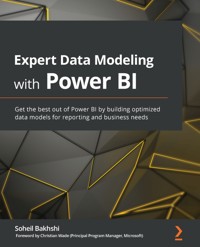
Expert Data Modeling with Power BI
Get the best out of Power BI by building optimized data models for reporting and business needs
Soheil Bakhshi
BIRMINGHAM—MUMBAI
Expert Data Modeling with Power BI
Copyright © 2021 Packt Publishing
All rights reserved. No part of this book may be reproduced, stored in a retrieval system, or transmitted in any form or by any means, without the prior written permission of the publisher, except in the case of brief quotations embedded in critical articles or reviews.
Every effort has been made in the preparation of this book to ensure the accuracy of the information presented. However, the information contained in this book is sold without warranty, either express or implied. Neither the author, nor Packt Publishing or its dealers and distributors, will be held liable for any damages caused or alleged to have been caused directly or indirectly by this book.
Packt Publishing has endeavored to provide trademark information about all of the companies and products mentioned in this book by the appropriate use of capitals. However, Packt Publishing cannot guarantee the accuracy of this information.
Group Product Manager: Kunal Parikh
Publishing Product Manager: Sunith Shetty
Senior Editor: Mohammed Yusuf Imaratwale
Content Development Editor: Nazia Shaikh
Technical Editor: Devanshi Deepak Ayare
Copy Editor: Safis Editing
Project Coordinator: Aishwarya Mohan
Proofreader: Safis Editing
Indexer: Rekha Nair
Production Designer: Shankar Kalbhor
First published: June 2021
Production reference: 1120521
Published by Packt Publishing Ltd.
Livery Place
35 Livery Street
Birmingham
B3 2PB, UK.
ISBN 978-1-80020-569-7
www.packt.com
I dedicate this book to my lovely wife, Elica Mehr, and our precious daughter, Avina.
Without their unconditional support, this matter would not have been possible.
I also owe this success to my parents, who always believed in me and encouraged me to follow my dreams.
Foreword
I am happy to know that Soheil, who I have seen grow as an MVP with expert knowledge of Power BI, has authored this hands-on book that covers a range of topics. Learning by example is something every committed student wants to do. The effort needed to go through online documentation and extract useful information can be prohibitive. Many students can become frustrated during the process and leave the task unfinished because it is easy for any beginner to lose sight of the learning task while trying to find good, real-world, example-based content.
Soheil's book includes many resources from beginner to expert level for Power BI. Power BI is the leading platform and tool for enterprise and self-service BI. It is a joy to use and is very flexible. This book is appealing both to beginners and to experts who build systems for thousands of users. I'm happy to recommend Soheil's book to any enthusiast, regardless of their level of expertise. His book navigates the world of Power BI in a very engaging way. It starts from the basic building blocks and elaborates on many aspects of data modeling, including star schema, managing bi-directional relationships, many-to-many relationships, calculated tables, preparing the data structure in Power Query to achieve a star schema design, RLS, OLS, and composite models. Any student will appreciate the hands-on approach of this book. Every concept is explained with examples.
Christian Wade
Principal Program Manager, Microsoft
Contributors
About the author
Soheil Bakhshi is the founder of Data Vizioner and is a sought-after BI consultant. Having worked in data and analytics for more than 20 years, Soheil's experience lies in Microsoft BI, data warehousing, and the Power BI platform. He possesses MSCE and MCSA certifications and is a Microsoft MVP (Most Valuable Professional). He has a passion for sharing knowledge via his website www.biinsight.com and for speaking at conferences and Power BI community events locally and globally. In following his desire for simplicity and efficiency, he has been behind Power BI community tools and commercial products such as Power BI Exporter and Power BI Documenter.
About the reviewers
Felipe Vilela worked for many years with system development and then started working in BI/data warehousing, mainly using MicroStrategy, more than 8 years ago. He worked with many companies in Brazil and the United States, implementing MicroStrategy projects, customizing, and administrating MicroStrategy. He taught BI/data warehousing and MicroStrategy to many companies using the company's, personal, and MicroStrategy's official courses. He also has a blog (www.vilelamstr.com). He was one of the MicroStrategy mobile app developers at MicroStrategy World 2016 and 2017. He has more than 30 MicroStrategy certifications, including the MCEP certification.
Nikita Barsukov is an experienced data scientist, focusing on delivering end-to-end analytical solutions. After growing up in Ukraine and studying in Finland and Sweden, he started his career in IT as a software developer in testing, only to realize his true passion lies in data science and building analytics tools that bring others joy and enhance data discovery. Nikita is currently employed by Microsoft; he is a part of a team of like-minded colleagues that develop analytics solutions for Power Platform and Dynamics 365. Outside of work, Nikita listens to podcasts and audiobooks; plays board games with friends, and occasionally even with himself; and enjoys a good run, craft beer, and a great book. Nikita lives in Copenhagen with his wife and three kids.
Ana Maria is a BI consultant and trainer as well as a Microsoft Data Platform MVP, Microsoft Partner in Power BI, and LinkedIn Learning Trainer. She has more than 25 years of industry experience ranging from the development of desktop solutions in FoxPro in the 1990s to data analysis and BI consulting and training. She has a degree in economic cybernetics from Moscow's State University of Management, in the former USSR, and also a master's degree in BI from the University of Alcala, in Spain. She is focused on the data world in Microsoft technology, modeling, and data analysis with SQL Server BI, Excel BI, Azure Machine Learning, R, and Power BI. You can find her at technical events and forums, as a speaker, organizer, or attendee.
Table of Contents
Preface
Section 1: Data Modeling in Power BI
Chapter 1: Introduction to Data Modeling in Power BI
Understanding the Power BI layers
The data preparation layer (Power Query)
The data model layer
The data visualization layer
How data flows in Power BI
What data modeling means in Power BI
Semantic model
Building an efficient data model in Power BI
Star schema (dimensional modeling) and snowflaking
Power BI licensing considerations
Maximum size of individual dataset
Incremental data load
Calculation groups
Shared datasets
Power BI Dataflows
The iterative data modeling approach
Information gathering from the business
Data preparation based on the business logic
Data modeling
Testing the logic
Demonstrating the business logic in a basic data visualization
Thinking like a professional data modeler
Summary
Chapter 2: Data Analysis eXpressions and Data Modeling
Understanding virtual tables
Creating a calculated table
Using virtual tables in a measure – Part 1
Using virtual tables in a measure – Part 2
Visually displaying the results of virtual tables
Relationships in virtual tables
Time intelligence and data modeling
Detecting valid dates in the date dimension
Period-over-period calculations
Generating the date dimension with DAX
Creating a time dimension with DAX
Summary
Section 2: Data Preparation in Query Editor
Chapter 3: Data Preparation in Power Query Editor
Introduction to the Power Query M formula language in Power BI
Power Query is CaSe-SeNsItIvE
Queries
Expressions
Values
Types
Introduction to Power Query Editor
Queries pane
Query Settings pane
Data View pane
Status bar
Advanced Editor
Introduction to Power Query features for data modelers
Column quality
Column distribution
Column profile
Understanding query parameters
Understanding custom functions
Recursive functions
Summary
Chapter 4: Getting Data from Various Sources
Getting data from common data sources
Folder
CSV/Text/TSV
Excel
Power BI datasets
Power BI dataflows
SQL Server
SQL Server Analysis Services and Azure Analysis Services
OData Feed
Understanding data source certification
Bronze
Silver
Gold/Platinum
Working with connection modes
Data Import
DirectQuery
Connect Live
Working with storage modes
Understanding dataset storage modes
Summary
Chapter 5: Common Data Preparation Steps
Data type conversion
Splitting column by delimiter
Merging columns
Adding a custom column
Adding column from examples
Duplicating a column
Filtering rows
Working with Group By
Appending queries
Merging queries
Duplicating and referencing queries
Replacing values
Extracting numbers from text
Dealing with Date, DateTime, and DateTimeZone
Summary
Chapter 6: Star Schema Preparation in Power Query Editor
Identifying dimensions and facts
Number of tables in the data source
The linkages between existing tables
Finding the lowest required grain of Date and Time
Defining dimensions and facts
Creating Dimensions tables
Geography
Sales order
Product
Currency
Customer
Sales Demographic
Date
Time
Creating Date and Time dimensions – Power Query versus DAX
Creating fact tables
Summary
Chapter 7: Data Preparation Common Best Practices
General data preparation considerations
Consider loading a proportion of data while connected to the OData data source
Appreciating case sensitivity in Power Query saves you from dealing with issues in data modeling
Be mindful of query folding and its impact on data refresh
Organizing queries in Query Editor
datatype conversion
Data conversion can affect data modeling
Include the datatype conversion in a step when possible
Consider having only one datatype conversion step
Optimizing the size of queries
Removing unnecessary columns and rows
Summarization (Group by)
Disabling query load
Naming conventions
Summary
Section 3: Data Modeling
Chapter 8: Data Modeling Components
Data modeling in Power BI Desktop
Understanding tables
Table properties
Featured tables
Calculated tables
Understanding fields
Data types
Custom formatting
Columns
Hierarchies
Measures
Using relationships
Primary keys/foreign keys
Handling composite keys
Filter propagation behavior
Bidirectional relationships
Summary
Chapter 9: Star Schema and Data Modeling Common Best Practices
Dealing with many-to-many relationships
Many-to-many relationships using a bridge table
Hiding the bridge table
Being cautious with bidirectional relationships
Dealing with inactive relationships
Reachability via multiple filter paths
Multiple direct relationships between two tables
Using configuration tables
Segmentation
Dynamic conditional formatting with measures
Avoiding calculated columns when possible
Organizing the model
Hiding insignificant model objects
Creating measure tables
Using folders
Reducing model size by disabling auto date/time
Summary
Section 4: Advanced Data Modeling
Chapter 10: Advanced Data Modeling Techniques
Using aggregations
Implementing aggregations for non-DirectQuery data sources
Using the Manage Aggregations feature
Incremental refresh
Configuring incremental refresh in Power BI Desktop
Testing the incremental refresh
Understanding Parent-Child hierarchies
Identifying the depth of the hierarchy
Creating hierarchy levels
Implementing roleplaying dimensions
Using calculation groups
Requirements
Terminology
Implementing calculation groups to handle time intelligence
Testing calculation groups
DAX functions for calculation groups
Summary
Chapter 11: Row-Level Security
What RLS means in data modeling
What RLS is not
RLS terminologies
Assigning members to roles in the Power BI service
Assigning members to roles in Power BI Report Server
RLS implementation flow
Common RLS implementation approaches
Implementing static RLS
Implementing dynamic RLS
Summary
Chapter 12: Extra Options and Features Available for Data Modeling
Dealing with SCDs
SCD type zero (SCD 0)
SCD type 1 (SCD 1)
SCD type 2 (SCD 2)
Introduction to OLS
Implementing OLS
Validating roles
Assigning members to roles in the Power BI service
Validating roles in the Power BI service
Introduction to dataflows
Scenarios for using dataflows
Dataflow terminologies
Creating dataflows
Introduction to composite models
New terminologies
Summary
Other Books You May Enjoy
Section 1: Data Modeling in Power BI
In this section, we quickly introduce data modeling in Power BI from a general point of view. We assume you know what Power Query is, what DAX is, and that you know the basic concepts of the star schema. In this section, you will learn about virtual tables and time intelligence functionalities in DAX and how you can implement a powerful model with real-world scenarios.
This section comprises the following chapters:
Chapter 1, Introduction to Data Modeling in Power BIChapter 2, Data Analysis eXpressions and Data Modeling




