


15,49 €
Mehr erfahren.
- Herausgeber: Nick Hern Books
- Kategorie: Poesie und Drama
- Sprache: Englisch
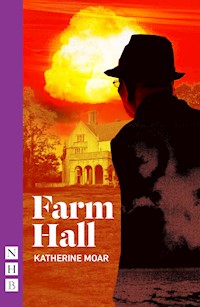
'It was never about the Reich or the war. It was about physics.' Summer 1945. Hitler is dead, but the war in the Pacific rages on. When six of Germany's top nuclear scientists – including three Nobel Prize winners – are detained by Allied forces at a stately home in the Cambridgeshire countryside, they find themselves shut off from the outside world. Their only distractions are board games, a broken piano and a copy of Blithe Spirit. But as the months go by, their attention turns to the ongoing war and thoughts of their broken homeland. The scientists' tranquil summer is shattered by the inconceivable news that the Americans have succeeded where the Germans have failed: the United States has not only built an atomic bomb, but they have used one against Japan. Katherine Moar's captivating debut play Farm Hall dramatises the true story recorded inside the bugged walls of the actual Farm Hall between July 1945 and January 1946. It was premiered at Jermyn Street Theatre, London, in March 2023, before transferring to the Theatre Royal Bath, directed by Stephen Unwin. It transferred to the West End's Theatre Royal, Haymarket, in 2024.
Das E-Book können Sie in Legimi-Apps oder einer beliebigen App lesen, die das folgende Format unterstützen:
Veröffentlichungsjahr: 2023
Ähnliche







Katherine Moar
FARM HALL
NICK HERN BOOKS
London
www.nickhernbooks.co.uk
Contents
Original Production Details
Dedication
Epigraph
Summary
Characters
Note on Play
Farm Hall
About the Author
Copyright and Performing Rights Information
Farm Hall was first performed at theJermyn Street Theatre on 9 March 2023, with the following cast:
BAGGE
Archie Backhouse
WEIZSÄCKER
Daniel Boyd
HEISENBERG
Alan Cox
DIEBNER
Julius D’Silva
HAHN
Forbes Masson
VON LAUE
David Yelland
Director
Stephen Unwin
Set and Costume Designer
Ceci Calf
Lighting Designer
Ben Ormerod
Sound Designer
John Leonard
Casting Director
Ginny Schiller CDG
Assistant Director
Millie Gaston
Production Manager
Lucy Mewis-Mckerrow
Stage Manager
Daisy Francis-Bryden
Assistant Stage Manager
Fae Hochgemuth
Costume Supervisor
Lauren Savill
Lighting Programmer
Jodie Underwood
Set Construction
Overflow Events Ltd.
Production Technician
Tom McCreadie
PR
David Burns
For my parents, Todd, and Stephen Unwin
‘The story of Farm Hall is another complete play in itself.’
Michael Frayn in his postscript to Copenhagen
Summary
Summer 1945. Hitler is dead. Germany is defeated. The war in the Pacific rages on.
In England, six of Germany’s foremost scientists are detained following their capture by Allied forces. They are Hitler’s Uranium Club, the men tasked with producing an atomic bomb for the Nazis.
Stowed safely in Farm Hall, a stately home nestled in a quiet corner of the Cambridgeshire countryside, these ‘guests’ of His Majesty are forced to entertain themselves. Removed from the chaos of war and convinced of their scientific superiority, they while away the hours playing chess, restoring a broken piano, and rehearsing an all-male amateur production of Noël Coward’s Blithe Spirit.
But the war and the world cannot be shut out forever. The guests’ tranquil summer is shattered by the revelation that the unthinkable has occurred, that the Americans have succeeded where the Germans have failed, that the United States has not only built an atomic bomb, but has used one against Japan…
During their seven-month detainment, unbeknownst to its occupants, almost every inch of Farm Hall was bugged. The guests’ recorded conversations were translated, transcribed and, finally, in 1992, declassified and published as The Farm Hall Transcripts. This play is inspired by The Farm Hall Transcripts and by true events that occurred at Farm Hall between July 1945 and January 1946.
Characters
VON LAUE, late sixties. An open objector to Nazism. Played no role in Hitler’s Uranium Club. Won the Nobel Prize for Physics in 1914 for the discovery of the diffraction of X-rays by crystals
DIEBNER, early forties. The head of Hitler’s Uranium Club when it was under the control of the Army Ordnance Office. Nazi Party member
HEISENBERG, early forties. Replaced Kurt Diebner as the symbolic leader of Hitler’s Uranium Club when the army ceded control to the Reich Research Council. He won the Nobel Prize in 1932 for ‘the creation of quantum mechanics’
WEIZSÄCKER, early thirties. Heisenberg’s close friend and colleague. Member of the prominent Weizsäcker family. His father served as State Secretary at the Foreign Office of Nazi Germany from 1938 to 1943, and as its Ambassador to the Holy See from 1943 to 1945. His younger brother would serve as President of Germany between 1984 and 1994
BAGGE, early thirties. Heisenberg’s former student. Nazi Party member. According to Heisenberg, Bagge came from a ‘proletarian family’
HAHN, early sixties. Discovered nuclear fission, the process that makes an atomic bomb possible. He received the 1944 Nobel Prize for Chemistry for this discovery. Anti-Nazi
Note on Play
The Uranverein or ‘Uranium Club’ was the name given to the project to research nuclear technology, including nuclear weapons and nuclear reactors, in Nazi Germany during the Second World War. Broadly, there were two streams of activity. The first was led by Kurt Diebner and administered by the Army Ordnance Office. When it became clear that the Uranverein would not make a decisive contribution to ending the war, the army ceded control of the project to the Reich Research Council and Werner Heisenberg.




