



Erhalten Sie Zugang zu diesem und mehr als 300000 Büchern ab EUR 5,99 monatlich.
- Herausgeber: Pushkin Press
- Kategorie: Gesellschafts- und Liebesromane
- Sprache: Englisch
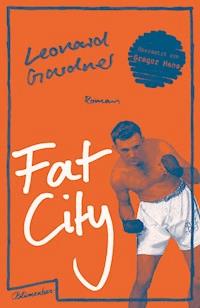
A muscular novel about boxers in small town California in the 50s: an American classic Stockton, California: a town of dark bars and lunchrooms, cheap hotels and farm labourers scratching a living. When two men meet in the Lido Gym - the ex-boxer Billy Tully and the novice Ernie Munger - their brief sparring session sets a fateful story in motion, initiating young Munger into the "company of men" and luring Tully back into training. Fat City is a vivid novel of defiance and struggle, of the potent promise of the good life and the desperation and drink that waylay those whom it eludes. This acclaimed American classic tells of their anxieties and hopes, their loves and losses, and the ephemeral glory of the fight. Leonard Gardner was born in Stockton, California. His short stories and articles have appeared in the Paris Review, Esquire, Southwest Review, and Brick, among other magazines. His screen adaptation of Fat City was made into a film by John Huston in 1972; he subsequently worked as a writer for independent film and television. For his work on the series NYPD Blue he twice received a Humanitas Prize (1997 and 1999) as well as a Peabody Award (1998). In 2008 he was the recipient of the A.J. Liebling Award, given by the Boxing Writers Association of America. A former Guggenheim Fellow, he lives in Northern California.
Sie lesen das E-Book in den Legimi-Apps auf:
Seitenzahl: 231
Veröffentlichungsjahr: 2017
Das E-Book (TTS) können Sie hören im Abo „Legimi Premium” in Legimi-Apps auf:
Ähnliche



















Contents
FAT CITY
1
HE LIVED IN THE HOTEL COMA—named perhaps for some founder of the town, some California explorer or pioneer, or for some long-deceased Italian immigrant who founded only the hotel itself. Whoever it commemorated, the hotel was a poor monument, and Billy Tully had no intention of staying on. His clean laundry he continued to put back in his suitcase on the dresser, ready to be hurried away to better lodgings. He had lived in five hotels in the year and a half since his wife had left him. From his window he looked out on the stunted skyline of Stockton—a city of eighty thousand surrounded by the sloughs, rivers and fertile fields of the San Joaquin River delta—a view of business buildings, church spires, chimneys, water towers, gas tanks and the low roofs of residences rising among leafless trees between absolutely flat streets. Along the sidewalk under his window, men passed between bars and liquor stores, cafés, secondhand stores and walk-up hotels. Pigeons the color of the street pecked in the gutters, flew between buildings, marched along ledges and cooed on Tully’s sill. His room was high and narrow. Smudges from oily heads darkened the wallpaper between the metal rods of his bed. His shade was tattered, his light bulb dim, and his neighbors all seemed to have lung trouble.
Billy Tully was a fry cook in a Main Street lunchroom. His face, a youthful pink, was lined around the mouth. There was a dent in the middle of his nose. Thin scars lay one above another at the outer edges of his brows. Crew-cut on top and combed back long on the sides, his rust-colored hair was abundant. He was short, deep-chested, compact, neither heavy nor thin nor very muscular, his bones thick, his flesh spare. It was the size of his neck that gave his clothed figure its look of strength. The result of years of exercise, of lifting ten-and twenty-pound weights with a headstrap, it had been developed for a single purpose—to absorb the shock of blows.
Tully had not had a bout since his wife had left him, but last night he had hit a man in the Ofis Inn. What the argument involved he could no longer clearly recall, and he gave it little thought. What concerned him was what had been revealed about himself. He had thrown one punch and the man had dropped. Tully now believed he had given up his career too soon. He was still only twenty-nine.
Down stairs carpeted with rubber safety treads, where someone fell nearly every night, he set off for the YMCA to test himself on the punching bags. Enjoying a sense of renewal after a morning of hangover, he walked quickly along the cold streets.
In a subterranean locker room, hearing a din from the swimming pool, Tully removed his clothes. He had four tattoos, obtained while in the army and now utterly disgusting to him: a blue swallow in flight over each nipple, a green snake wound up his left wrist, and on the inside of his right forearm a dagger piercing a rose. Wearing pale-blue trunks and a gray T-shirt, he went silently down a corridor on soft leather soles toward the sound of a furiously punched bag. When Tully entered the room at the end of the corridor, a tall, lean, sweating youth glanced up, took a final swing at the bag and sat down on a bench amid a disarray of barbells on the cracked concrete floor. There was no one else in the room. Tully swung his arms, rolled his neck, squatted, and rose in alarm at a loud pop in his knee, conscious all the while of the boy’s stillness. After his violent activity at the bag, he now sat motionless on the bench, looking at the wall. It was the attitude of one wishing to repel attention, and so, perversely, Tully invited him to box, though he himself had come here only to punch the bag.
The boy rose then, quickly and gloomily. “You a pro?”
Tully could see he was looking at his brows. “I was. I’m all out of shape now. We’ll just fool around easy, and I can show you a few things, okay? I won’t hit you hard.”
His face morose, the boy went off to check out the gloves. Tully continued his warm-up and was breathing heavily by the time the other returned. They pulled on the gloves in silence and entered the ring. When Tully reached out to touch gloves, the boy sprang warily away. Smiling tolerantly, Tully pursued him. After that he felt only desperation because everything happened so quickly: smashes on his nose, jolts against his mouth and eyes, the long body eluding him, bounding unbelievably about the ring while Tully, flinching and covering, tried to set himself to counter. In sudden rage he lunged, swinging like a street fighter, and his leg buckled. Hissing with pain, he began hopping around the ring.
That was how it ended. Bent over, kneading a pulled calf muscle, his face contorted, Tully asked between clenched teeth: “What’s your name, anyway?”
The boy remained at the far side of the ring. “Ernie Munger.”
“How many bouts you had?”
“None.”
“You’re shitting me. How old are you?”
“Eighteen.”
Tully gingerly took a step. “Well, you got it, kid. I fought Fermin Soto, I know what I’m talking about. I mean nobody used to hit me. They couldn’t hit me. They’d punch, I wouldn’t be there. You ought to start fighting.”
“I don’t know. I just come down to mess around. Get a little exercise.”
“Don’t waste your good years. You ought to go over to the Lido Gym and see my manager.”
In the showers, Tully was thankful he had not gone to the Lido Gym himself. Beside him water streamed over Ernie Munger’s head. The boy’s shoulders were broad, his chest flat and hairless, his waist narrow, his arms and legs long and slender, and looking at his face, Tully regretted that he had not had a chance to hit it squarely. It was well formed and callow, the forehead wide and high, the nose prominent. In the dressing room with a towel around his waist, Tully brought a pint of Thunderbird from his athletic bag, and sensitive to its impropriety here in the YMCA, he took a drink with the metal door of his locker blocking him from Ernie’s view. In the ceiling a ventilator labored in vain against the odors of sweat and soap and musty athletic clothes.
Tully limped upstairs and, whispering curses at his leg, started back toward his hotel. The sun was setting on a gray day, tinting mauve the flat undersides of clouds beyond the deserted shipyard where two great cranes slanted against the sky. Leaves and papers blew along the gutters. Boats rocked in the floating sheds of the yacht harbor. Farther down the channel a lone freighter was moored by a silo fifty miles from the sea.
There were few figures along Center Street. In the Harbor Inn half the stools were empty. Tully seated himself with care, grasping the edge of the bar. Opposite the notice
PLEASE DON’T SPIT
ON THE FLOOR
GET UP AND SPIT
IN THE TOILET BOWL
I thank you
he ate a pickled pig’s foot on a napkin and drank a glass of port. He was eating a bag of pork cracklings when a familiar couple sat beside him. The man was a Negro, with a parted mustache and bald temples, his face indolent and dejected. The woman was white, near Tully’s age, with thin pencil lines where her eyebrows had been and a broken nose much like his own.
“Don’t you ever go home?” she asked him.
“I just got here.”
She turned to her companion. “What’s keeping him? He knows we’re here. Can’t you make him come over and serve us?”
“Just take it easy. He be here.”
“Well, you spineless son-of-a-bitch, you’d take up for any-body against me.” She stared ahead, face propped in both hands. “I want a cream sherry.” Then she was again speaking to Tully. “Earl and I have something very wonderful together. I love that man more than any man’s got a right to be loved. I couldn’t live without him. If he left me I just couldn’t make it. But you think he’d even raise his voice to get me a drink? No. He’ll just sit there and let him ignore us.”
“Here he come,” said Earl.
“No thanks to you.”
Tully shifted his leg, wincing. He gave a small groan and the woman glanced at him. “Charley horse,” he said. When she did not inquire, he went on to tell what had happened to him just as he had been about to get into shape.
She spoke over her shoulder. “Earl?”
“Uh huh.”
“This guy’s a fighter.”
“Oh yeah?”
“Christ. Why did I even mention it? What do you know about it anyway?”
“Not much.”
“That’s what I mean. Sorry to bother you. Why did I open my mouth? I apologize. Well, what do you want? I said I was sorry, what more can I say?”
Earl gazed toward the mirror, where a row of gloomy faces looked out into the room. “I hear you, baby.”
“You sure don’t act like it.” With a sigh she took up her glass. “Sometimes I wonder why I put up with him. Basically they’re a mistrustful people. You don’t know the things I do for that man, but he couldn’t care less. You’re not as black as he is, then you’re shit in his book. He don’t like me talking to you, I know. I got to talk to somebody.”
“This kid could make a lot of money some day,” Tully continued. “He’s a natural athlete.”
“What’s his name?” Earl inquired, leaning in front of the woman, his face impassive.
“You wouldn’t know who he was if he did tell you.”
“Just asking.”
“Got to know everything. Now he won’t talk. He’s mad. Butts in and then shuts up. I wanted to hear this.”
“There’s nothing more to hear. That’s it. The kid’s a natural, that’s all. They come along about one in a million.” Enjoying himself, Tully signaled for another drink.
“He’s so goddamn sour. I’m having a good talk, that’s what’s eating him. I don’t see why I can’t have a little fun. Let him sit there and stew, I don’t care. If that’s what he wants, why should I? I believe everybody’s got a right to live his own life. So screw everybody.” She straightened, her voice louder. “I want to say something. I want to give a toast to this gentleman. I’ll make it short, just a few words. Here’s to your health. God bless you and keep you in all your battles.”
Not a head turned as she raised her glass. With large, dark, intense eyes she regarded Tully until he too, in embarrassment and sudden erotic curiosity, lifted his drink.
“Oma?”
“What is it?”
“Nothing.”
She turned. “For Christ’s sake, what do you want then? Can’t I even talk to anybody?”
“I’m not stopping you.”
“No, you’re not stopping me. Oh, no, you just sit there with your sad-ass face shut until the minute I start having a good time. I’m sick of your bellyaching. Is it my fault if you can’t fit in? Why can’t you mind your own business? And that goes for the rest of you. None of you is worth a fart in a windstorm. So to hell with it.” She got down from her stool and went off toward the back of the room.
Uncomfortable, Tully studied the cigarette-burned surface of the bar. A glass of port was set down by his hand. “Thanks.”
“Don’t mention it,” said Earl. “I don’t claim to be nothing more than I am. You maybe can fight, I’m an upholsterer.”
“That’s the way it goes.”
“One man got muscles, another got steel. It all come out the same.”
They drank in silence. When the woman returned, Tully rose and went out. He crossed the dark street to his hotel and limped up the stairs. On the bed in the dim light, hearing coughing from across the hall, he knew he had magnified Ernie Munger’s talents. He had done it in order to go on believing in his body, but he had lost his reflexes—that was all there was to it—and he felt his life was coming to a close. At one time he had believed the nineteen-fifties would bring him to greatness. Now they were almost at an end and he was through. He turned onto his side. On the worn linoleum lay a True Confession and a Modern Screen, magazines he once would not have thought could interest him, but in reading of seduction and betrayal, adultery, divorce and the sorrows of stars, he found the sad sentiment of his love.
Tully had met his wife at Newby’s Drive-Inn, a squat white building covered with black polka dots in the center of an expanse of asphalt shaded by mulberry trees. Despite the staining berries that had dropped on his yellow Buick convertible, he had gone there to see her every night. A carhop in tight black slacks and white blouse, she had presented a spectacular image. He could not stop thinking of her. Expensively dressed and winning fights, he felt he had to have her, and he was a proud husband, especially when she accompanied him to the local bouts, on the nights when he went as a spectator. Entering the auditorium on his arm, wearing knitted wool jersey—orange or white—or low-cut dresses held up by minuscule straps, in high backless shoes and with her long auburn hair piled on her head, she had roused the gallery to tumultuous shouting and whistling. He had come to expect it, walking in carrying her coat. That period had been the peak of his life, though he had not realized it then. It had gone by without time for reflection, ending while he was still thinking things were going to get better. He had not realized the ability and local fame he had then was all he was going to have. Nor had his manager realized it when he moved him up to opponents of national importance. That knowledge had been mercilessly pounded into Tully in a half dozen bouts as he swung and missed and staggered, eyes closed to slits. Then he had looked to his wife for some indefinable endorsement, some solicitous comprehension of the pain and sacrifice he felt he endured for her sake, some always withheld recognition of the rites of virility. Waiting, he drank. After six months he fought once more and was knocked out by a man of no importance at all. Then he began to wish for someone who could give him back that newly-wed wholeness and ease, but it was a feeling he could not find again, and he knew now that his mistake had been in thinking he could. That was how he had lost her—by looking for it. Without her he could not get up in the morning. He lost his job at the box factory and found another driving a truck. After he lost that too, the truck on its side in a ditch along with a hundred lugs of apricots, he lost his car. Now he brought an occasional woman to his room, but none of them could give him anything of his wife, and so he resented them all.
Since the receipt of the ominous papers referring to him as the defendant, as if his marital shortcomings had been criminal, Tully’s only knowledge of his wife had come from her brother, Buck, whom he had met again one night on El Dorado Street between two shore patrolmen. A third-class petty officer, he appeared to have been strolling with the thirteen buttons of his fly open. Tully had hurried over and asked what had happened to Lynn. The patrolmen had ordered him to leave, an argument ensued, and Buck, between displays of defiance and submission, told him that Lynn was married to a Reno bartender. At the time the news had shaken Tully, yet he could not completely believe it. On these melancholy nights when he felt that only reconciliation could salvage his life, he believed she could not love anyone but him.
Shoes squeaked by outside the door. Reviewing old uncertainties and mistakes, Tully gazed down at the magazines. Finally he reached for the Modern Screen and propped himself up with his head between the rods of the bed. On the magazine’s cover was an extravagantly smiling starlet in a bathing suit with a penciled dot over each breast and a scribbled cleft at the crotch. The coughing went on across the hall. It was time to change hotels.
2
THE LIDO GYM WAS IN THE BASEMENT of a three-story brick hotel with a façade of Moorish arches, columns, and brightly colored tile. Behind the hotel several cars, one tireless and up on blocks, rested among dry nettles and wild oats. In a long, narrow, open-end shed of weathered boards and corrugated steel, a group of elderly men were playing bocce ball with their hats on and arguing in Italian. A large paper bag in his hand, Ernie Munger went down the littered concrete stairs. In a ring under a ceiling of exposed joists, wiring, water and sewage pipes, a Negro was shadowboxing in the light of fluorescent tubes. Three men in street clothes, one bald, one with deeply furrowed cheeks, the third wearing a houndstooth-check hat with a narrow upturned brim, all turned their faces toward the door. The one with the deeply furrowed cheeks reached Ernie first.
“Want a fight, kid?”
“You Ruben Luna?”
“Gil Solis. How much you weigh? You got a hell of a reach. You looking for a trainer?”
They were joined by the man in the hat. A Mexican, as was Solis, he was perhaps forty, his face plump and relaxed, his skin smooth, his smile large, guileless and constant. “I’m Luna. You looking for me?”
“Yeah, I just thought I’d work out. Like to see what you think. Billy Tully told me I ought to come by.”
“You know Tully?”
“I boxed with him the other day down at the Y.”
“Is he getting in shape? How’d you do, all right? You must of done all right, huh?”
Now the bald man came over, whispering hoarsely, and Luna guided Ernie away with a hand on his shoulder. “Got your stuff there? We’ll get you started.” They walked on their heels through the shower room, the floor wet from a clogged drain. In a narrow, brick-walled, windowless room smelling of bodies, gym clothes and mildew, several partially dressed Negroes and Mexicans glanced up and went on conversing.
“Look around and find you an empty locker,” said Luna. “Better bring a padlock with you next time. Get one of those combination kind. They’re hard to pick. I’ll be out in the gym when you get your togs on.”
A service-station attendant, Ernie removed his leather jacket, oil-spotted khaki pants and shirt. When he came out into the gym in tennis shoes and bathing trunks, Ruben Luna sent him into the ring. With other shadowboxers maneuvering around him in intent mutual avoidance, their punches accented by loud snuffling, Ernie self-consciously warmed up.
“How’d you like to go a round or two?” Luna asked after he had called him out. “I’m not rushing you now. I’d just like to get a look at you.”
“With who?”
“Beginner like you. Just box him like you did Tully. Colored boy over there.”
Before a full-length mirror a boy in a Hawaiian-print bathing suit and white leather boxing shoes, his reddish hair straightened, was throwing punches.
Looking at those high white shoes, Ernie pushed his hands into heavy gloves held braced for him by the wrists. He stepped into a leather foulproof cup. A headguard was jerked over his brows. Padded and trussed, his face smeared with Vaseline, a rubber mouthpiece between his teeth, he stood waiting while two squat men punched and grappled in the ring. Then he was following his opponent’s dark legs up the steps. For two rounds he punched, bounded and was hit in return, the headguard dropping over his eyes and the cup sagging between his legs. Afterward Ruben Luna leaned over the ropes, contending with Gil Solis for the headguard’s buckle.
Stripped of the gloves, Ernie stood on the gym floor, panting and nodding while Ruben, squared off with his belly forward and hat brim up, moved his small hands and feet in quick and graceful demonstrations. “You got a good left. Understand what I mean? Step in with that jab. Understand what I mean? Get your body behind it. Bing! Understand what I mean? You hit him with that jab his head’s going back, so you step in—understand what I mean?—hit him again, throw the right. Bing! Relax, keep moving, lay it in there, bing, bing, understand what I mean? Keep it out there working for you. Then feint the left, throw the right. Bing! Understand what I mean? Jab and feint, you keep him off balance. Feinting. You make your openings and step in. Bing, bing, whop! Understand what I mean?”
In the flooded shower room, Ernie was addressed by a small Mexican standing motionless under the other nozzle: “How’s the ass up here?”
“Not good. Where you from?”
“L.A.”
“How’s the ass down there?”
“Good.”
Soapless, the two hunched under the hissing spray.
“Are the guys tough in this town?”
“Not so tough. How about down there?”
“Tough.”
“Just get here?”
“Yeah, I was in a bar yesterday, this guy’s calling everybody a son-of-a-bitch. So I go out and wait for him. He come out and I ask did that include me. Says yeah. So I got him. I mean I just come to town. Some welcome. I don’t know, trouble just seems to come looking for me.”
Then the man began to sing, repeating a single phrase, his voice rising from bass moans and bellows to falsetto wails. Earth Angel, Earth Angel, will you be mine? The song went on in the locker room, the singer, as he put on his clothes, shifting to an interlude of improvisation: Baby, baaaby, baaaaby, uh baby, uuh, oh yeauh, BAAAAAAABY, I WANT you, while naked figures walked to and from the showers and steam drifted through the doorway. Drawing on his pants, Ernie, bruised, fatigued and elated, felt he had joined the company of men.
3
THE BRUISES AROUND ERNIE’S EYES faded from purple to greenish yellow and were superimposed by others. His lashes were rooted in blood-filled ridges, red welts marked the outer corners of each narrowed eye, there was a fatness to his nose. Yet Ruben Luna, observing from the ropes, knew this helmeted and heavy-gloved sparring in the gym was hardly fighting at all.
“Hit him. Don’t apologize,” he shouted, and Ernie nodded, once turning his head to listen and taking a punch. Assuming a classic pose, he circled and feinted, springing away from threatening gestures, then with no discernible reason, as if he had been waiting not for an opening but for inspiration, he charged, punching wildly. Every day, by another amateur or by the two professionals near his weight, one lighter, one heavier, both phlegmatic, his nose was bloodied.
Ruben watched patiently, believing in the eventual perfection of every promising move. He attended with towel and water bottle. Holding the heavy bag bucking against his chest, he coached with his cheek against the leather only a few inches from Ernie’s smacking fists. Concluding every workout he folded the towel into a pad, placed it on the floor, and while Ernie balanced on his head, bending his long neck from side to side, Ruben stood holding his ankles, gazing between the V of his legs off across the gym with the rapt eyes of a man whose reason for attention was ending for the day.
He went home to his family. Amid the arguing and nonsensical monologues of his children and the scolding of his wife, he ate his supper. He went to bed early and got up early, drove to the union hall, was dispatched with the gangs in the cold early light, and passed the day driving a forklift in the port. At noon he bought coffee and cupcakes from a girl in gabardine slacks who arrived every day in a snack truck. After work he drove across town to the gym, and in a coffee shop he was served pie by a tall blond waitress before crossing the street to his boxers.
“My white kid might shape up into something,” he told his wife.
“That’s good.” Her hips wide in a sheer, peach-colored nightgown, her legs heavy and short, she was bending over, folding back the white satin bedspread. With a weary moan she crawled onto the bed and settled herself under the covers. Leaning against the upholstered headboard, she began creaming her face. There was a fullness to her brown throat, a softness under her chin. Her thick, wide, fierce lips that had once excited him sank at the corners into plump cheeks creased where there had once been dimples.
“He’s got a great reach and a good pair of legs. And he’s white, you know? He’s a real clean good-looking kid. He could draw crowds some day if he could just fight. And maybe he can if he’d just listen. If I could put all I know in him he could make it. But I didn’t learn it overnight either.”
When his wife put away her jar and turned onto her side, pulling the covers up, Ruben began to undress. The room was lit by a bedside lamp, its shade enclosed in cellophane wrapping. On the dresser were a number of photos of his family, in frames and cardboard studio easels, among small boxes, ceramic figurines, and several bronze saddle horses of varying sizes standing on doilies. From one wall the serene face of Christ stared obliquely toward the back yard from a brass grillwork frame with a tiny burnt-out night light at the top.




