


7,99 €
Mehr erfahren.
- Herausgeber: WS
- Kategorie: Abenteuer, Thriller, Horror
- Sprache: Englisch
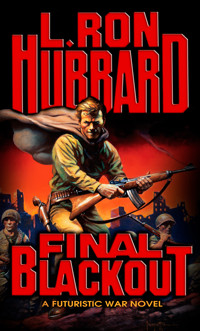
A land ravaged by war without end.
Cities gutted by weapons of mass destruction.
Countries laid waste by biological warfare.
Governments ruined by greed, violence, and corruption.
This is a world in the throes of economic decay and at the mercy of terrorists.
This is Asia. This is Europe. This is America. This is Final Blackout.
Across this devastated, post-apocalyptic landscape marches one extraordinary soldier and his band of brothers. He is the Lieutenant, a hardened military strategist and a charismatic leader of men. The narrow-minded high command may have relieved the Lieutenant of duty, but not of his honor—and his crack unit of warriors remains fiercely loyal to him.
Now, in a time of deception, desperation, and betrayal, they are headed into the ultimate battle against the ultimate enemy—their own treacherous leaders. But for the Lieutenant, a hero at the crossroads of history, it is time to do what is best for his country and for his men—to undertake one last act of courage and sacrifice … the Final Blackout.
“As perfect a piece of science fiction as has ever been written.” —Robert A. Heinlein
Das E-Book können Sie in Legimi-Apps oder einer beliebigen App lesen, die das folgende Format unterstützen:
Seitenzahl: 290
Veröffentlichungsjahr: 2005
Ähnliche

FINAL BLACKOUT
“Final Blackout is as perfect a piece of science fiction as has ever been written.”
—Robert A. Heinlein, author of Starship Troopers
“Like Fatherland, Hubbard spins a masterful tale of suspense and non-stop action in Final Blackout.”
—Harold Robbins, author of The Adventurers
“The books that Hubbard wrote were and are timeless; the instruments of war, the things that drive our economy, technology, etc., may all be changing—but the fact of the matter is when it comes to doing the right thing, that is consistent, and essentially the theme that Hubbard always tries to present. It is as germane today as it was in the forties.”
—Lt. General Pete Osman, USMC (ret.)
“A gripping and gritty read of a dark future, set in a tragic post-apocalypse of endless war. Politically incorrect and politically relevant. Deserves its reputation as a classic of the Golden Age.”
—Michael Z. Williamson, author of Freehold
“A gritty, imaginative tale of survival and heroic leadership that is a chilling prophesy for our time. A work of stunning vision that is right on the mark.”
—Greg Dinallo, author of Rockets’ Red Glare
“A chilling and lucid picture of the effects of incessant warfare.”
—Kirkus Reviews
“A landmark classic! It has been remembered through the decades as one of the all-time memorable classics of the science fiction field.”
—Robert Bloch, author of Psycho
“Hubbard’s best science fiction novel. Compelling. Riveting. A superior piece of pulp adventure writing.”
—Publishers Weekly
“An excellent novel of a man rebuilding a war-ravaged civilization and willing to pay the price for what that takes.”
—David Drake, author of Hammer’s Slammers
“A survivor of the test of time. The story strikes deep.”
—Larry Niven, author of Ringworld
“L. Ron Hubbard understands how people wage war—but more important, what war does to humanity. Final Blackout is hard-edged and hard-nosed, a modern classic.”
—Edward Bryant, author of Phoenix Without Ashes
“The hero of Final Blackout has glowed in my mind ever since I read the initial magazine version in 1939. This final version shows that the story, like all timeless works of fiction, is also timely.”
—Philip José Farmer, author of To Your Scattered Bodies Go
“A grim look at the immediate future, a science fiction masterpiece.”
—A. E. van Vogt, author of Slan
“Packs an undeniable wallop.”
—Ellery Queen Mystery Magazine
Selected fiction works by L. Ron Hubbard
FANTASY
If I Were You
Slaves of Sleep & The Masters of Sleep
Typewriter in the Sky
SCIENCE FICTION
Battlefield Earth
Final Blackout
The Great Secret
The Kingslayer
Ole Doc Methuselah
To the Stars
The Mission Earth Dekalogy:*
Volume 1: The Invaders Plan
Volume 2: Black Genesis
Volume 3: The Enemy Within
Volume 4: An Alien Affair
Volume 5: Fortune of Fear
Volume 6: Death Quest
Volume 7: Voyage of Vengeance
Volume 8: Disaster
Volume 9: Villainy Victorious
Volume 10: The Doomed Planet
Ole Doc Methuselah
To the Stars
HISTORICAL FICTION
Buckskin Brigades
Under the Black Ensign
MYSTERY
Cargo of Coffins
Dead Men Kill
Spy Killer
WESTERN
Branded Outlaw
Six-Gun Caballero
A full list of L. Ron Hubbard’s fiction works can be found at www.GalaxyPress.com
*Dekalogy—a group of ten volumes
Thank you for purchasing Final Blackout by L. Ron Hubbard.
To receive special offers, bonus content and info on new fiction releases by L. Ron Hubbard, sign up for the Galaxy Press newsletter.
Visit us online at GalaxyPress.com
FINAL BLACKOUT
© 2019 L. Ron Hubbard Library. All Rights Reserved. Any unauthorized copying, translation, duplication, importation or distribution, in whole or in part, by any means, including electronic copying, storage or transmission, is a violation of applicable laws.
Cover artwork by Frank Frazetta. © 1991 L. Ron Hubbard Library.
Mission Earth is a trademark owned by L. Ron Hubbard Library and is used with permission. Battlefield Earth is a trademark owned by Author Services, Inc. and is used with permission.
Additional credits: British flag © viktorrijareut—stock.adobe.com
Print edition ISBN: 978-1-61986-636-2EPUB edition ISBN: 978-1-61986-635-5Kindle edition ISBN: 978-1-61986-640-9
Published by Galaxy Press, Inc.7051 Hollywood Boulevard, Los Angeles, California 90028www.GalaxyPress.com
DEDICATION
To the men and officers with whom I served in World War II, first phase, 1941–1945.
Contents
Maps
Final Blackout
Preface
The Lieutenant
Chapter One
Chapter Two
Chapter Three
Chapter Four
Chapter Five
Chapter Six
Chapter Seven
Chapter Eight
Chapter Nine
Chapter Ten
Story Preview: Fear
L. Ron Hubbard Literary Life & Legacy
Glossary
PREFACE
WHENFinal Blackout was written there was still a Maginot line, Dunkirk was just another French coastal town and the Battle of Britain, the Bulge, Saipan, Iwo, V2s and Nagasaki were things unknown and far ahead in history. While it concerns these things, its action will not take place for many years yet to come and it is, therefore, still a story of the future though some of the “future” it embraced (about one-fifth) has already transpired.
When published in magazine form before the war, it created a little skirmish of its own and, I am told, as time has gone by and some of it has unreeled, interest in it has if anything increased. So far its career has been most adventurous as a story. The “battle of Final Blackout” has included loud wails from the Communists—who said it was pro-Fascist (while at least one Fascist has held it to be pro-Communist). Its premises have been called wild and unfounded on the one hand while poems (some of them very good) have been written about or dedicated to the Lieutenant. Meetings have been held to nominate to greatness while others have been called to hang the author in effigy (and it is a matter of record that the last at least was successfully accomplished).
The British would not hear of its being published there at the time it appeared in America, though Boston, I am told, remained neutral—for there is nothing but innocent slaughter in it and no sign of rape.
There are those who insist that it is all very bad and those who claim for it the status of immortality. And while it probably is not the worst tale ever written, I cannot bring myself to believe that Final Blackout, as so many polls and such insist, is one of the ten greatest stories in its field ever written.
Back in those mild days when Pearl Harbor was a place you toured while vacationing at Waikiki and when every drawing room had its businessman who wondered disinterestedly whether or not it was not possible to do business with Hitler, the anti–Final Blackoutists (many of whom, I fear, were Communists, whatever those are) were particularly irked by some of the premises of the tale.
Russia was, obviously, a peace-loving nation with no more thought than America of entering the war. England was a fine going concern without a thought, beyond a contemptuous aside, for the Socialist who, of course, could never come to power. One must understand this to see why Final Blackout slashed about and wounded people.
True enough, some of its premises were far off the mark. It supposed, for instance, that the politicians of the great countries, particularly the United States, would push rather than hinder the entrance of the whole world into the war. In fact, it supposed, for its author was very young, that politicians were entirely incompetent and would not prevent for one instant the bloodiest conflict the country had ever known.
Further, for the author was no military critic, it supposed that the general staffs of most great nations were composed of stupid bunglers who would be looking at their mirrors when they should be looking to their posts and that the general worldwide strategy of war would go off in a manner utterly unadroit to the sacrifice of quite a few lives. It surmised that if general staffs went right on bungling along, nations would cease to exist, and it further—and more to the point—advanced the thought that the junior officer, the noncom and, primarily, the enlisted man would have to prosecute the war. These, it believed, would finally be boiled down, by staff stupidity, to a handful of unkillables who would thereafter shift for themselves.
Final Blackout declared rather summarily—and very harshly, for the author was inexperienced in international affairs—that the anarchy of nations was an unhealthy arrangement maintained by the greed of a few for the privileges of a few and that the “common people” (which is to say those uncommon people who wish only to be let go about their affairs of getting enough to eat and begetting their next generation) would be knocked flat, silly and completely out of existence by these brand-new “defensive” weapons which would, of course, be turned only against soldiers. Bombs, atomics, germs and, in short, science, it maintained, were being used unhealthily and that, soon enough, a person here and there who was no party to the front-line sortie was liable to get injured or dusty; it also spoke of populations being affected boomerang fashion by weapons devised for their own governments to use.
Certainly all this was heresy enough in that quiet world of 1939, and since that time, it is only fair to state, the author has served here and there and has gained enough experience to see the error of his judgment. Everything, it can be said with Pangloss, so far, has been for the best in this best of all possible worlds.
There have been two or three stories modeled on Final Blackout. I am flattered. It is just a story. And as the past few years proved, it cannot possibly happen.
L. Ron Hubbard
Hollywood, 1948
THE LIEUTENANT
HE WAS BORN in an air-raid shelter—and his first wail was drowned by the shriek of bombs, the thunder of falling walls and the coughing chatter of machine guns raking the sky.
He was taught in a countryside where A was for Antiaircraft and V was for Victory. He knew that Vickers Wellington bombers had flown nonstop clear to China. But nobody thought to tell him about a man who had sailed a carrack as far in the opposite direction—a chap called Columbus.
War-shattered officers had taught him the arts of battle on the relief maps of Rugby. Limping sergeants had made him expert with rifle and pistol, light and heavy artillery. And although he could not conjugate a single Latin verb, he was graduated as wholly educated at fourteen and commissioned the same year.
His father was killed on the mole at Kiel. His uncle rode a flamer in at Hamburg. His mother, long ago, had died of grief and starvation in the wreckage which had been London.
When he was eighteen he had been sent to the front as a subaltern. At twenty-three he was commanding a brigade.
In short, his career was not unlike that of any other highborn English lad born after the beginning of that conflict which is sometimes known as the War of Books—or the War of Creeds, or the War Which Ended War or World Wars II, III, IV and V. Like any other, with the exception that he lived through it.
There is little accounting for the reason he lived so long, and, having lived, moved up to take the spotlight on the Continental stage for a few seconds out of time. But there is never any accounting for such things.
When officers and men, sick with the hell of it, walked out to find a bullet that would end an unlivable life, he shrugged and carried on. When his messmates went screaming mad from illness and revulsion, he gave them that for which they begged, sheathed his pistol and took over the fragments of their commands. When outfits mutinied and shot their officers in the back, he squared his own and, faced front, carried on.
He had seen ninety-three thousand replacements come into his division before he had been a year on the Continent. And he had seen almost as many files voided over again.
He was a soldier and his trade was death, and he had seen too much to be greatly impressed with anything. Outwardly he was much like half a million others of his rank; inwardly there was a difference. He had found out, while commanding ack-acks in England, that nerves are more deadly than bullets, and so he had early denied the existence of his own, substituting a careless cheerfulness which went strangely with the somber gloom that overhung the graveyard of Europe. If he had nerves, he kept them to himself. And what battles he fought within himself to keep them down must forever go unsung.
Before he had been a year on the Continent, the dread soldier’s sickness—that very learned and scientific result of bacteriological warfare, the climax of years of mutating germs unto final, incurable diseases—had caused a quarantine to be placed on all English troops serving across the Channel, just as America, nine years before, had completely stopped all communication across the Atlantic, shortly after her abortive atom war had boomeranged. Hence, he had not been able to return to England.
If he longed for his own land, shell-blasted though it might be, he never showed it. Impassively he had listened each time to the tidings of seven separate revolutions which had begun with the assassination of the king, a crime which had been succeeded by every known kind of political buffoonery culminating in Communism (for at least that is what they called this ideology, though Marx would have disowned it. And the late, unlamented Stalin would have gibbered incoherently at the heresy of its tenets). And he saw only mirth in the fact that, whereas the crimson banner flew now over London, the imperial standard of the czar now whipped in the Russian breeze.
Seven separate governments, each attacked and made to carry on the war. Nine governments in Germany in only eighteen years. He had let the ribbons and insignia issued him drop into the mud, wishing with all his kind that all governments would collapse together and put an end to this. But that had never happened. The fall of one side netted attack from the organized other. And turnabout. Just as the problem of manufacture had unequalized the periods of bombing, so had it served to prolong this war that the brief orgy of atomics, murderously wild, if utterly indecisive, had spread such hatreds that the lingering sparks of decency and forbearance seemed to have vanished from the world. War, as in days of old, had become a thing of hate and loot, for how else was a machine-tooled country to get machines and tools which it could no longer generate within itself?
He knew nothing about these international politics—or at least pretended that he did not. He was, however, in close touch with the effects, for such a collapse was always followed by the general advance of the other side. The fall of his own immediate clique in command meant that he, as a soldier, would be attacked; the banishing of the enemies’ chiefs caused him to attack in turn. But war, to him, was the only actuality, for rarely had he known of that thing of which men spoke dreamily and to which they gave the name “peace.”
He had seen, in his lifetime, the peak and oblivion of flight, the perfection and extinction of artillery, the birth and death of nuclear physics, the end product of bacteriology, but only the oblivion, extinction and death of culture.
It had been three years since he had heard an airplane throbbing overhead. As a child, to him they had been as common as birds, if a shade more deadly. They had flown fast and far, and then when the crash of atom bombs in guided missiles had finally blotted out three-quarters of the manufacturing centers of the world, they had flown no more. For the airplane is a fragile thing which cannot exist without replacement parts, without complex fuels, without a thousand aids. Even the assembly of a thousand partly damaged ships into perhaps fifty that would fly did not give a nation more than a few months’ superiority in the air. It was quiet, very quiet. The planes had gone.
Once, great guns had rumbled along definite lines. But big guns had needed artfully manufactured shells, and when the centers of manufacture had become too disorganized to produce such a complex thing as a shell, firing had gradually sputtered out, jerkily reviving, but fainter each time, until it ceased. For the guns themselves had worn out. And when infantry tactics came to take the place of the warfare of fortresses and tanks, those few guns which remained had, one by one, been abandoned, perforce, and left in ruins to a rapidly advancing enemy. This was particularly true of the smaller field guns which had hung on feebly to the last.
It had been four years since he had received his last orders by radio, for there were no longer parts for replacement. And though it was rumored that GHQ of the BEF had radio communication with England, no one could truly tell. It had been seven years since a new uniform had been issued, three years or more since a rank had been made for an officer.
His world was a shambles of broken townships and defiled fields, an immense cemetery where thirty million soldiers and three hundred million civilians had been wrenched loose from life. And though the death which had shrieked out of the skies would howl no more, there was no need. Its work was done.
Food supplies had diminished to a vanishing point when a power, rumored to have been Russia, had spread plant insects over Europe. Starvation had done its best to surpass the death lists of battle. And, as an ally, another thing had come.
The disease known as soldier’s sickness had wiped a clammy hand across the slate of Europe, taking ten times as many as the fighting of the war itself. Death crept silently over the wastes of grass-grown shell holes and gutted cities, slipping bony fingers into the cogs of what organization had survived. From the Mediterranean to the Baltic, no wheel turned, for the illness was not one disease germ grossly mutated into a killer which defied penicillin, sulfa, pantomycin and stereo-rays, it was at least nine illnesses, each one superior to yellow fever or the bubonic plague. The nine had combined amongst themselves to create an infinite variety of manifestations. In far countries, South America, South Africa, Scandinavia, where smoke might have belched from busy chimneys, nearly annihilated nations which had never been combatants had closed their ports and turned to wooden sticks for plows. Their libraries might still bulge with know-how, but who could go there to read them? Nations entirely innocent of any single belligerent move in this war, or these many wars, had become, capitals and hamlets alike, weed-grown and tumbled ruins to be quarantined a half a century or more from even their own people.
But the Lieutenant was not unhappy about it. He had no comparisons. When lack of credit and metal and workmen had decreed the abandonment of the last factory, he had received the tidings in the light that artillery had never accomplished anything in tactics, anyway, Napoleon to the contrary. When the last rattling wreck of a plane had become a rusting pile of charred metal, he had smiled his relief. What had planes done but attack objectives they could not hold?
From the records which remain of him, it is difficult to get an accurate description of the man himself, as difficult as it is easy to obtain minute accounts of his victories and defeats. His enemies represent him as having an upsetting and even ghoulish way of smiling, an expression of cheerfulness which never left him even when he meted death personally. But enemies have a way of distorting those they fear, and the oft-repeated statement that he took no pleasure in anything but death is probably false.
Such a view seems to be belied by the fact that he took no pleasure in a victory unless it was bloodless so far as his own troops were concerned. This may be accounted as a natural revulsion toward the school of warfare which measured the greatness of a victory in terms of its largeness of casualty lists. Incredible as it may seem, even at the time of his birth, the mass of humanity paid no attention to strategic conquests if they were not attended by many thousands of deaths. But men, alas, had long since ceased to be cheap, and the field officer or staff officer that still held them so, generally died of a quiet night with a bayonet in his ribs. And so the question may be argued on both sides. He might or might not be credited with mercy on the score that he conserved his men.
Physically, he seems to have been a little over medium height, blue gray of eye and blond. Too, he was probably very handsome, though we only touch upon his conquests in another field. The one picture of him is a rather bad thing, done by a soldier of his command after his death with possibly more enthusiasm than accuracy.
He may have had nerves so high-strung that he was half-mad in times of stress—and not unlikely, for he was intelligent. He might have educated himself completely out of nerves. As for England herself, he might have loved her passionately and have done those things he did all for her. And, again, it might have been a coldblooded problem in strategy which it amused him to solve.
These things, just as his name, are not known. He was the Lieutenant. But whether he was madman and sadist or gentleman and patriot—this must be solved by another.
CHAPTER ONE
THE BRIGADE HUDDLED about two fires in the half dawn, slowly finishing off a moldy breakfast, washing down crumbs of rotted bread with drafts of watery, synthetic tea. About them stood the stark skeletons of a forest, through the broken branches of which crept wraiths of mist, quiet as the ghosts of thirty million fighting men.
Half-hidden by the persistent underbrush were several dark holes; down awry steps lay the abandoned depths of a once-great fortress, garrisoned now by skeletons which mildewed at their rusty guns.
Though not yet wholly awake, the attitudes of the men were alert through long practice. Each man with half himself was intent upon each slightest sound, not trusting the sentries who lay in foxholes round about. Much of this tautness was habit. But more of it, today, had direction. A night patrol had brought word that several hundred Russians occupied the ridges surrounding this place. And the brigade which had once been six thousand strong now numbered but a hundred and sixty-eight.
They were a motley command: Englishmen, Poles, Spaniards, Frenchmen, Finns and Italians, uniformed in the rags of twenty nations, friend and foe alike. They were armed with a catalog of weapons, the cartridges of one seldom serving the rifle of another. They were clothed and armed, then, by the whim and experience of each.
In common they had endless years of war behind them. In common they had the habit of war. Long since, the peasants of the armies had slid over the hill, back to devastated farms and fields, leaving only those who had but one talent.
The English could not, because of the quarantine against soldier’s sickness, go home. Once they had had sweethearts, wives and families. But no one had heard for so long—
They had survived whole divisions of replacements. They had been commanded by more officers than they could count. They had been governed by more creeds than they could ever understand.
Here was their world, a shattered wood, an empty fortress, a breakfast of crumbs and hot water, each man hard by his rifle, each existing for the instant and expecting the next to bring danger and death.
These were the unkillables, immune to bullets, bombs and bugs, schooled in war to perfection, kept alive by a seventh and an eighth sense of danger which could interpret the slightest change in their surroundings and preserve themselves from it.
Having lost all causes and connections, having forgotten their religions, they still had one god, their Lieutenant. He was, after all, a highly satisfactory god. He fed them, clothed them and conserved their lives—which was more than any other god could have done.
Now and then eyes wandered to the Lieutenant and were quieted by the sight of him. For, despite all danger, the Lieutenant was sitting upon the half-submerged wheel of a caisson, shaving himself with the help of a mirror stuck in the crotch of a forked stick.
The cook came up with a kettle of hot water which he emptied into the old helmet that served the Lieutenant as a wash basin. The cook was a corpulent fellow of rather murderous aspect, wholly unwashed and hairy and carrying a naked bayonet thrust through his belt.
“Can I get the Leftenant anythin’ else, sir?”
“Why, yes. A fresh shirt, an overcoat, a new pistol and some caviar.”
“I would if them Russians had any, sir.”
“I’ve no doubt of it, Bulger,” smiled the Lieutenant. “But, really, haven’t you something a bit special for breakfast? This is an anniversary, you know. My fifth year at the front was done yesterday.”
“Congratulations, Leftenant, sir. If you don’t mind my mentioning it, are you goin’ to start the sixth year with a fight?”
“Ho!” said a rough voice nearby. “You’ll be advising us on tactics next. Stick to your foraging, Bulger.” And Pollard, the sergeant major, gave the cook a shove back toward the fire. “Sir, I just toured the outposts and they been hearin’ troops movin’ on the high ground. Weasel is out there and he claims he heard gun wheels groanin’ about four.”
“Gun wheels!” said the Lieutenant.
“That’s what he said.”
The Lieutenant grinned and rinsed off his face. “Someday a high wind is going to catch hold of his ears and carry him off.”
“About them Russians, sir,” said Pollard, soberly, “are we just going to stay here until they close in on us? They know we’re down here. I feel it. And them fires—”
Pollard was stopped by the Lieutenant’s grin. He was a conscientious sergeant, often pretending to a sense of humor which he did not possess. No matter how many men he had killed or how terrible he was in action, his rugged face white with battle lust, he shivered away from ridicule at the hands of the Lieutenant. In his own way he respected the boy, never giving a thought that his officer was some twenty-three years his junior.
The Lieutenant slid into his shirt and was about to speak when the smallest whisper of a challenge sounded two hundred yards away. Instantly the clearing was deserted, all men instinctively taking cover from which they could shoot with the smallest loss of life and the greatest damage to the foe. There had been a note of anxiety in that challenge.
The Lieutenant, pistol in hand, stood with widespread boots, playing intelligent eyes through the misty woods. A birdcall sounded and the camp began to relax, men coming back to their fires and again addressing their synthetic tea.
After a little, as the call had indicated, an English officer strode through the underbrush, looked about and then approached the Lieutenant. Although a captain, he was dressed in no manner to indicate his outfit. Like the Lieutenant, he had amalgamated the uniforms of some four services into an outfit which was at least capable of keeping out the wet.
“Fourth Brigade?” he questioned.
“Right,” said the Lieutenant. “Hello, Malcolm.”
The captain looked more closely and then smiled and shook the extended hand. “Well, well! I never expected to find you, much less get to you. By the guns, fellow, did you know these ridges are alive with Russians?”
“I suspected so,” said the Lieutenant. “We’ve been waiting three days for them.”
Malcolm started. “But … but here you are, in a death trap!” He covered his astonishment. “Well! I can’t presume to advise a brigade commander in the field.”
“You’ve come from GHQ?”
“From General Victor, yes. I had the devil’s own time getting to you and then finding you. I say, old boy, those Russians—”
“How is General Victor?”
“Between us, he’s in a funk. Ever since the British Communist Party took over London and executed Carlson, Victor hasn’t slept very well.”
“Bulger,” said the Lieutenant, “bring the captain some breakfast.”
Bulger lumbered up with a whole piece of bread and a dixie of tea which the staff officer seized upon avidly.
“Not much,” said the Lieutenant, “but it’s the last of the supplies we found cached here in this fortress. Eat slowly, for the next, if any, will have to be Russian. Now. Any orders?”
“You’re recalled to GHQ for reorganization.”
The Lieutenant gave a slight quiver of surprise. “Does this have anything to do … with my failure to comply with the BCP Military Committee’s orders to appoint soldiers’ councils?”
Malcolm shrugged and spoke through a full mouth and without truth. “Oh, no. Who’d bother about that? I think they wish to give you a wider command. They think well of you, you know.”
“Then—” said the Lieutenant, knowing full well that a recalled officer was generally a deposed officer.
“It’s the general’s idea. But, see here, those Russians—”
“I’ll engage them shortly,” said the Lieutenant. “They’re fresh and they ought to have boots and bread and maybe something to drink. My favorite listening post, a chap named Weasel, said he heard wheels last night.”
“Right. I was going to tell you. I saw a trench mortar and an antitank rocket—”
“No!”
“Truth,” said Malcolm.
“Artillery!”
“No less.”
“Well, I’ll … Why, there hasn’t been a fieldpiece on this front since the storming of Paris two years ago. Though mortars and bazookas could hardly be called fieldpieces. Have they got shells, do you suppose?”
“They had caissons.”
“And … Say! Horses!”
“I saw two!”
The Lieutenant beamed happily. “Ah, you’ve come just in time. Roast horse. Think of it! Brown, sizzling, dripping, juicy horse!”
“Horse?” said Bulger, instantly alert although he had been a hundred feet and more away.
The brigade itself looked hopeful; they moved about through the naked starkness of the trees and tried to catch sight of the Russians on the heights.
The event was, to say the least, unusual. And the thought of food momentarily clogged Malcolm’s wits. In light of what he was trying to do, he would never have made such a statement. “It’s been a long time since I’ve had a decent meal of anything. Much less horse.”
The Lieutenant caught at the remark. There was no sympathy between field officers and staff officers, for, while the former fought and starved, the latter skulked in the protection of impregnable GHQ and received occasional rations from England, existing betweentimes on condensed food stored in times past for many more men than were now left alive. That a staff officer had risked this trek in the first place struck the Lieutenant as being very odd.
“What’s up?”
Malcolm realized then, possibly from the sharpness of the tone, that he had done wrong.
“What’s up?” repeated the Lieutenant insistently.
Malcolm put a good face on it. “I shouldn’t tell you, but we’re out of touch with England. There’s been no food for three months.”
“That isn’t all you can tell me.”
Malcolm squirmed. “Well, if you’ll have it. GHQ is recalling all field troops. General Victor is thinking of withdrawing from our present base into the south where there may be some fertile area. It will be better for all of us.” Sycophant that he was, he sought to allay further questioning. “I was sent expressly to get you. Your ability is well-known and appreciated, and Victor feels that with you guiding operations we cannot fail.”
The Lieutenant brushed it aside. “You’re telling me that England—no, not England but those damned Communists there—have forbidden us ever to return.”
“Well—the quarantine did that.”
“But it left room for hope,” said the Lieutenant.
Malcolm was silent.
“They’re afraid,” said the Lieutenant. “Afraid we’ll come back and turn their government appetite over dixie.” He laughed sharply. “Poor little shivering fools! Why, there aren’t ten thousand British troops left in the world outside of England. Not one man where there was once a thousand. We’ve battered French and German and Russian and Italian and German again until we’re as few as they. First we came over to get machine tools and food. Then, with one excuse or another, they began to tell us false tales of impending invasion, but it has been two years since we could locate anything you could call a political entity on this continent. We can’t go home because we’ll take the sickness. And what are we here? We’re mixed up with fifty nationalities, commanded by less than a hundred officers, scattered from Egypt to Archangel. Ten thousand men and ten million, twenty million, graves. Outcasts, men without a country. A whole generation wiped out by shot and starvation and sickness and those that are left scarcely able to keep belly, ribs and jacket together. And they’re afraid of us in England!”
It had its effect upon Malcolm. He had been out only two years. Sent originally full of hope and swagger with a message for General Victor from the supreme council and never afterwards allowed to return home. For a moment he forgot his fear of a field officer, remembering instead a certain girl, weeping on a dock. “I’ll get back some way. It’s not final. I’ll see her again!”
“Not under Victor, you won’t.”
“Wait,” cautioned Malcolm, afraid again. “He’s your superior officer.”
“Perhaps,” and in that word Malcolm read direful things.
“But you’ll obey him?” said Malcolm.
“And go back to GHQ? Certainly.”
Malcolm sighed a little with relief. How dull these field officers were at times! Didn’t they ever hear anything? But then, thirty or more outfits had innocently obeyed that order, little knowing that they would be stripped of their commands immediately upon arrival and asked to be off and out of sight of the offended staff. But, no, the Lieutenant would not understand until the whole thing was over. There was nothing unreasonable in this to Malcolm. Importance now was measured only by the number of troops an officer commanded. It was not likely that the staff would leave mutinous field officers at the head of soldiers and thus menace the very foundation of the general staff.
“They’ve had their way in England,” said the Lieutenant. “Yes. They’ve had their way.”




