


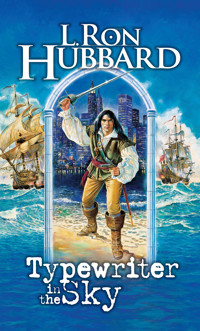
7,99 €
Mehr erfahren.
- Herausgeber: WS
- Kategorie: Abenteuer, Thriller, Horror
- Sprache: Englisch
It’s not easy living in someone else’s world, trapped in a reality over which you have no control. But that is the story of Mike de Wolf’s life … literally.
The whole thing started at his friend Horace’s Greenwich Village apartment. Horace is a writer and he’s decided to model one of his villains after Mike. Sounds crazy … until Mike reaches to turn on a light and gets the shock of his life.
Knocked unconscious, Mike wakes up to find himself tossing in a violent ocean surf and getting slammed against the rocks. That wouldn’t be so bad if it weren’t for the bullets flying over his head, followed by the swordfight, certain to end in death … if not for the wild, beautiful woman on horseback who comes to his rescue.
This isn’t the West Village anymore. Apparently it’s the West Indies, some three hundred years ago, and Mike de Wolf is now Miguel Saint Raoul de Lobo, pursued across the Spanish Main by pirates, Englishman, and worse.
He doesn’t know how he got here or why, but he does know he has to get out fast. Two problems: first off, the bad guys in Horace’s stories never get out alive, and second, Mike’s not all that sure he wants to leave after all. Seems he’s fallen for that wild woman on horseback… What’s a guy to do? The answer’s written in the sky—in a wildly original, wickedly amusing novel in which, if you’re not careful, you might just find yourself getting lost.
“An adventure story written in the great style adventures should be written in.” —Clive Cussler
Das E-Book können Sie in Legimi-Apps oder einer beliebigen App lesen, die das folgende Format unterstützen:
Seitenzahl: 211
Veröffentlichungsjahr: 1995
Ähnliche



Also byL. Ron Hubbard
Buckskin Brigades
The Conquest of Space
The Dangerous Dimension
Death’s Deputy
The End is Not Yet
Fear
Final Blackout
The Kilkenny Cats
The Mission Earth Dekalogy*
Volume 1: The Invaders Plan
Volume 2: Black Genesis
Volume 3: The Enemy Within
Volume 4: An Alien Affair
Volume 5: Fortune of Fear
Volume 6: Death Quest
Volume 7: Voyage of Vengeance
Volume 8: Disaster
Volume 9: Villainy Victorious
Volume 10: The Doomed Planet
Ole Doc Methuselah
Slaves of Sleep & The Masters of Sleep
To the Stars
Triton
Typewriter in the Sky
The Ultimate Adventure
* Dekalogy—a group of ten volumes
For more information on L. Ron Hubbard and his many works of fiction visit www.GalaxyPress.com.
Galaxy Press, Inc. 7051 Hollywood Boulevard Los Angeles, CA 90028
TYPEWRITER IN THE SKY
©1995 L. Ron Hubbard Library. All Rights Reserved.
Any unauthorized copying, translation, duplication, importation or distribution, in whole or in part, by any means, including electronic copying, storage or transmission, is a violation of applicable laws.
Jacket illustration by Blas Gallego ©1995 Galaxy Press. All rights reserved.
EPUB ISBN: 978-1-59212-629-3Kindle ISBN: 978-1-59212-092-5
Contents
Introduction
Chapter 1
Chapter 2
Chapter 3
Chapter 4
Chapter 5
Chapter 6
Chapter 7
Chapter 8
Chapter 9
Chapter 10
Chapter 11
Chapter 12
Chapter 13
Chapter 14
Glossary
About the Author
Introduction
It had been a horrendous six months.
I had written a 500-page “Star Wars” novel (from start to finish in eight weeks), then moved right into an ambitious science fiction novel, the most complex book I had ever attempted (also 500 pages, also done in about two months), then I completed the third novel in a Young Adult series co-written with my wife, and then there were the juvenile science fiction books, the editing of three anthologies, writing comic book scripts, a few short stories … Don’t expect me to keep track of it all.
And here I had always imagined being an author simply entailed wearing cable-knit sweaters and dangling an unlit pipe from one corner of the mouth, all the while waiting to be inspired by the elusive Muse …
Which was why, when the phone rang—the twelfth time that day—I was somewhat daunted by the conversation. It was my friend from Bridge Publications, and he wanted me to write the introduction for a reprint of L. Ron Hubbard’s classic novel “Typewriter in the Sky.”
I finally got him off the phone by saying, “Just send me a copy of the book, and I’ll read it. If I like it, I might be able to write you something. When is the absolute latest I can turn in the introduction?”
The book arrived before I managed to forget what I had promised, and so I hefted it in my hand, cocked my arm back, and tossed it to the top of my stack of things to read. That evening, as I attempted to dissolve in a hot bath, I leaned back and flipped to page one of “Typewriter in the Sky” and began to read:
—about a harried writer behind on his deadlines, buried under dozens of projects, and talking as fast as he can to convince his editor that everything is indeed under control, that the blockbuster novel (which he hasn’t even started yet) is well on its way.
Boy, things sure haven’t changed in fifty years!
Right away I knew I was going to enjoy reading this book. Very much, in fact.
“Typewriter in the Sky” is about Mike de Wolf, friend of the popular pulp fiction writer Horace Hackett, who—through a freak accident—finds himself transported into the pages of Hackett’s swashbuckling work-in-progress … and to his horror finds himself cast as the villain!
Mike, having read most of his friend’s hack fiction, knows full well what a horrible end Horace’s villains always encounter!
Since the original publication of this novel, Mr. Hubbard’s idea has often been emulated. As “The New Encyclopedia of Science Fiction,” edited by James Gunn (1988) says, “Typewriter in the Sky, which anticipates plot gimmicks now popular among experimental metafictionists, ought to be taken seriously by the critics who will evaluate his strange genius.” Author Frederik Pohl said much the same: “Fans and other writers were doing variations on that for years.” Most recently, John Carpenter’s film In the Mouth of Madness adds a macabre twist to this idea: horror novelist Sutter Cane has such power in his prose that he was able to rewrite the world according to his own nightmarish visions.
“Typewriter in the Sky,” though, is a much more exhilarating romp, filled with delightful twists and turns. Mr. Hubbard uses the material to its fullest effect, playing even self-parody to great effect. The snapshots of the New York writing life in the 1940s are pure gems.
The tale of a modern man stranded in a pirate adventure, complete with obvious anachronisms and sloppy details, makes the reader’s head spin. Mike de Wolf comments aloud about his own stilted dialog, how his surroundings blatantly change as the writer pounding on his “typewriter in the sky” remembers belatedly to put in the necessary details.
Once he finally figures out what has happened, Mike must play upon the predictability of Horace’s hackneyed plots to save himself and change the outcome of the story. Meanwhile, outside the story, Horace Hackett himself goes to a bar to commiserate with another pulp fiction writer about how sometimes characters just sort of take on lives of their own! “Typewriter in the Sky” is a true masterpiece of the genre, my personal favorite among the L. Ron Hubbard books I have read.
This novel was published in two installments in the November and December 1940 issues of Unknown magazine by the famous science fiction editor, John W. Campbell, Jr. The author had had an intensely productive year in 1940, and “Typewriter in the Sky” was written under great pressure—but L. Ron Hubbard seemed to work well under pressure.
That same year, within a six-month span, he produced two more of his greatest works, the chilling psychological horror novel “Fear” (soon to be a major motion picture) and the bleak story of the aftermath of a future war, “Final Blackout.” (And only months earlier, in July 1939, one of his other favorites, “Slaves of Sleep,” was published in Unknown magazine.) In short, it was a very good year for vintage L. Ron Hubbard.
At his peak, Mr. Hubbard was astoundingly prolific, publishing 154 novels and short stories—over ten million words —in the decade from 1930 to 1940. With the low pay rates of the day, pulp fiction writers were forced to be prolific or starve—and there was absolutely no question of L. Ron Hubbard starving! He supposedly wrote a hundred words a minute on an electric typewriter on many diverse topics. Following the credo that “a writer writes,” Mr. Hubbard was indeed a writer.
He follows a tradition set by a number of classic authors who wrote quickly and in first-draft form. Alexandre Dumas, Jules Verne and Charles Dickens were amazingly prolific, and their works have remained on bookshelves for more than a century. Dickens wrote “A Christmas Carol,” one of the best-loved novels of all time, in a feverish frenzy that lasted only a few days. William Faulkner supposedly wrote his classic “As I Lay Dying” in one weekend and published his first draft without a single editorial change.
L. Ron Hubbard was a very different type of writer from the one-book-per-decade “artistes” whose work was wrenched out with angst and hair-pulling to critical acclaim (one hopes), yet was totally devoid of enjoyment.
“Typewriter in the Sky,” as I discovered, is a book that remembers how to be fun and entertaining, a pleasure to read instead of a chore.
Sit back, relax, and enjoy the ride!
—Kevin J. Anderson
Chapter 1
Horace Hackett, as one of his gangster characters would have said, was on the spot. About three months before, Jules Montcalm of Vider Press had handed to Horace Hackett the sum of five hundred dollars, an advance against royalties of a novel proposed but not yet composed. And Horace Hackett, being an author, had gaily spent the five hundred and now had nothing but a hangover to present to Jules Montcalm. It was, as one of Horace Hackett’s heroes would have said, a nasty state of affairs. For be it known, publishers, when they have advanced sums against the writing of a book, are in no mood for quibbling, particularly when said book is listed in the fall catalogue and as there were just two months left in which it could be presented to the public.
Horace Hackett was popular, but not popular enough to get away with anything like that. He wrote novels of melodramatic adventure for Vider Press, at about the rate of one a year—though he also wrote gang stories for Pubble House and love stories for Duffin & Co. Just now Horace Hackett was furiously fumbling with facts in an attempt to explain to Jules Montcalm just why it was that no manuscript had arrived as per contract. Jules Montcalm, being a publisher, did not believe authors. In fact, it is doubtful if Jules Montcalm ever believed anything beyond the fact that he was probably the one genius in the book business. He had, let us say, a suspicious eye. This he had focused upon Horace Hackett and Horace Hackett squirmed.
They were in the living room of Horace Hackett’s Greenwich Village basement studio apartment, a darkish place well padded with sheets of forgotten manuscripts, unanswered letters from bill collectors, notes from the ex-wife’s lawyer asking for alimony, empty brandy bottles, broken pencils, a saddle somebody had sent from New Mexico, several prints of furious revolutionary battles, three covers from some of Horace’s magazine serials, crumpled packages of cigarettes—all empty—a stack of plays somebody had sent—just knowing that Horace could advise about them—newspapers which dated back to the tenth battleship Germany had claimed to have sunk, a number of scatter rugs from Colombia, where they had begun life as saddle pads, three empty siphons, a dun from the company which had foolishly financed Horace Hackett’s car and a piano at which sat Michael de Wolf.
Horace Hackett did not appear disturbed. In fact, he was airy. This thing, his attitude plainly said, was a mere bagatelle. Why, the business of dashing off that novel was so simple and could be done so quickly that one wondered why another one should think twice about it. But deep down, under his soiled bathrobe, Horace Hackett knew that he had never been closer to getting caught.
Mike de Wolf, at the piano, was grandly oblivious of the pair. His slender fingers were caressing a doleful dirge from the stained keys, a very quiet accompaniment to his own state of mind. Mike had a chance to audition the following morning, but he was pretty certain that he would fail. He always had, hadn’t he?
Jules Montcalm, with the air of a hunter who has just treed a mountain lion and is now training his rifle to bop it out of the branches, leveled a finger at Horace.
“I don’t believe,” said Jules Montcalm—whose real name was Julius Berkowitz—“that you even have a plot for it!”
“Heh, heh, heh,” said Horace, hollowly. “Not even a plot. Heh, heh. That is very funny. Mike, he doesn’t even think I’ve got a plot for this novel!”
“Well,” said Mike de Wolf, not turning, “have you?” And he ran into a more mournful set of chords than before.
“Heh, heh. You don’t think for a minute that Mike means that, do you, Jules? Why, of course I’ve got a plot!”
“Uh-huh,” said Jules. “I bet you can’t even begin to tell me about that plot!”
“Here, have another drink,” said Horace, getting hurriedly up and pulling his dirty bathrobe about him while he poured Jules another drink.
“Well, if you got a plot, then why don’t you tell it to me and stop saying ‘Heh, heh, heh!’ ” Jules had scored.
Horace sat in the chair, still airy, and he managed to put an enthusiastic light behind his pale blue eyes. He leaned forward. “Why, this is one of the greatest stories I ever did! It’s marvelous. It’s got everything! Drama, character, color—”
“The plot,” said Jules.
“It’s sparkling and exciting, and the love interest is so tender—”
“The plot,” said Jules.
“—that I almost cried myself thinking it up. Why, it’s a grand story! Flashing rapiers, tall ships, brave men—”
“I already said that in the catalogue,” said Jules, hopelessly. “Now I want to hear the plot. I bet you ain’t got any plot at all!”
“Mike! Here I am telling him the greatest story ever written—”
“You haven’t written it yet,” said Mike, without turning his head.
“He’s a great kidder,” said Horace to Jules. “Heh, heh.”
“The plot,” said Jules.
“Why, sure. I was just going to tell you. It’s about pirates. Not pirates, you understand, but buccaneers. Back in the days when England and France were fighting for a toehold on the Caribbean and the dons had it all sewed up. Back about sixteen hundred, just after the time of Drake—”
“We got all that in the catalogue,” said Jules. “The plot!”
“Well, it’s about a fellow called Tom Bristol,” said Horace, thinking so hard that he squinted. “Yes, sir, it’s about a fellow named Tom Bristol. A go-to-hell, swashbuckling, cut-’em-down, brawny guy who’s the younger son of a noble family in England. He’s a gentleman, see? But when he gets into the King’s navy he don’t like the admiral, and when he’s given command of a ship he fights the battle his own way, and that makes the admiral mad, and so they cashier Tom Bristol from the service, even though he won the fight for them. He’s too smart for them, see? And he’s too hotheaded for the discipline, and so his old man, the duke, boots him out and tells him never to come back.”
“Like all the other pirate novels you’ve written,” sighed Jules.
“Like … Say, don’t you think I’ve got artistic temperament? Do you think I’ve got just one story? Why, the sales on my last book—”
“Don’t try to get out of this by getting mad,” said Jules. “The plot! His old man, the duke, kicks him out—so what?”
“Why, so he comes to the New World. Out to St. Kitts. And there he runs into this girl. Her old man is the merchant prince of the English. He’s got stacks of money that he’s made by trafficking with the buccaneers, and he’s really kingpin in the West Indies. And because society in St. Kitts is very swell, why, his daughter is there with him.”
“With blond hair and blue eyes and very sweet …” said Jules, hopelessly.
“No!” said Horace, thinking faster. “Hell, no! She’s a wildcat, see? She’s turned down half the lords in England because she’s looking for somebody that’s really a man. She can ride to hounds and shoot better’n a musketeer, and she’s a gambling fool. And she figures all these noblemen are just soft-bellied bums. No, sir, she’ll never give her hand to any guy that can’t beat her at any game she tackles, and she’s never met such a guy. So—”
“Well, that’s different enough for a heroine,” said Jules. “But you know what they always say. It takes a good villain to make a story. And if you go making the villain like you did in ‘Song of Arabia,’ people are going to say you’re slipping. Now a good villain—”
“That’s what I’m getting to,” said Horace, pretending to be much offended. “But you wanted the plot, and I’m giving you the plot. Now, listen. This guy Tom Bristol and the girl get together, and they like each other, but it looks like this business in the West Indies is going to fold up for England and the girl’s old man because Spain is getting mighty tired of it, and so the dons figure out it’s about time to wipe out all the buccaneers. So in comes this villain business. Now listen. I got it. This villain is the lord high admiral of the Spanish navy in the Caribbean, see? And this Tom Bristol mixes it up with him.
“Well, the girl’s old man doesn’t like Bristol because Bristol isn’t rich and he hasn’t got a title, and so the old man thinks he’ll polish off Bristol by telling him that if he knocks hell out of the dons—why, he can have the girl. And so Bristol is fitted out with a ship to knock off a couple of Spanish ships, and with a crew of buccaneers he goes slamming off to meet this admiral—”
“That’s thin,” said Jules. “You gotta have a good villain. You gotta have conflict.”
“Well, haven’t I got it?” howled Horace.
“You ain’t got any villain,” said Jules.
“Now look,” said Horace, “I’m telling you all about it. I’m getting to this villain. He’s the lord high admiral of his Catholic majesty’s navy in the Caribbean. And he gets it in for Bristol, too, and so they proceed to knock hell out of each other all through the book. But, of course in the end, Bristol kills the Spanish admiral and gets the girl.”
“Spanish admiral, sure,” said Jules. “But what kind of guy is he?”
Horace was stuck for only an instant. There was Mike, sitting at the piano, playing dolorously. There was no gauging what Mike de Wolf ’s ancestry really was, but it was certain that the Irish side of his family had been enjoined by one of the dons who, defeated in the Armada, were flung up on the coast of Erin to give the Irish race occasional black hair and dark eyes. Whence came the strain which made Mike what he was, he certainly could not be told from a don. Horace had his inspiration.
“Why, there’s your villain,” said Horace. “Now what more can you ask than that, see? Mike! Now look, Jules. Look how narrow and aristocratic his face is. Why, his nostrils are so thin that you could see light through them. And his complexion is as pale as alabaster. He’s beautiful, see? He’s tall and graceful, and he’s got manners that’d put a king to shame. And he’s got a well of sadness in him which, combined with his beauty, makes the girls fall for him in regiments. He looks delicate, but by heaven, I’ve seen him lick guys twice his size and weight. There’s your Spanish admiral. A romantic! A poetry-reading, glamorous, hell-fighting, rapier-twisting, bowing beauty of a gentleman, all perfume and lace and wildcat. There’s your Spanish admiral. And he falls in love with this girl when he gets shipwrecked on the island where she lives and she doesn’t know he’s a don because he’s so educated he can speak English without an accent …”
Mike had begun to glare.
“You leave me out of this.”
“See the fire flash in that dark eye?” said Horace to Jules. “Can’t you see what he’d think of a swashbuckling captain from barbaric England? And when he gazes upon this girl who has saved his life he loses his heart to her. And not only does it become a battle between them for empire, but a conflict for a woman.”
“Well …” said Jules, doubtfully, “it sounds pretty good. But the color—”
“The color will be perfect!” said Horace. “I know the Caribbean like I know the keys of my mill. Can’t you see it now?” And he really was taking fire about the idea. “This Mike, as the Spanish admiral, will wow ’em. He’s the perfect character!”
“I said to leave me out of it,” said Mike. “I’ve got to audition in the morning, and I don’t feel any too good as it is.”
“Nonsense,” said Horace, and faced Jules. Horace girdled the bathrobe about him and began to pace up and down the floor amid the scattered rugs from Colombia. “So there’s the novel. It begins with this Bristol getting the boot like I said and then, when he’s en route to the Indies, we cut the scene and we find ourselves on St. Kitts. No. We find ourselves on the deck of the Natividad, flagship of the Spanish fleet. This Mike is on deck, and the captain is telling him that the rest of the fleet’s been scattered by the gale, and that the island off there is St. Kitts. Well, just as they’re looking at the island, Mike’s telescope picks out a couple of pinnaces coming out from the land. They’ve got a lot of men in them, and as the sea is calm and as the wind after the storm has died, why, there’s no getting away from them. So this Mike says to the captain—and boy, have we got a story here!—he says, ‘Pirates! Clear for action!’ And so they begin to clear for action. Mike …”
Mike was trying not to listen. At the beginning of this he hadn’t been feeling any too well, and now that Horace kept talking about him being on the deck of a ship and all that—Damn him, what was the idea of sticking his best friend into a story, anyway! There were a lot of things about Horace that Mike didn’t quite like, such as drinking a cup of coffee halfway and then dropping cigarette butts into the cold remains, and wearing a bathrobe which hadn’t been washed since Horace found it five years ago. And Horace, when he took off on a plot, was far too much to bear.
The story went on, but Mike closed his ears. He felt a little faint. An audition in the morning and if he made it then he’d be playing piano for the Philharmonic. No wonder he felt that way. But he wouldn’t drink. Maybe Horace had an aspirin in the bathroom.
Unnoticed by the other two, Mike got up and tottered towards the bathroom, tagged by Horace’s ringing tones. It was quite unusual for Mike to have anything go wrong with him, for his reputation, for all of his apparent pale visage, was that he could be killed only with an ax. This worried him. And the condition was such that he soon found himself barely able to navigate.
Foggily, he fumbled for the aspirin in the medicine chest, and failing to find it, reached for the light. The metal string eluded him and he sought to support himself by leaning against the washbowl.
He made contact. A blinding one! The light short-circuited with a fanfare of crackling!
Paralyzed and unable to let go, Mike sagged. He could still hear Horace as though Horace’s plot was coming from Mars. He began to shiver and slump and then very quietly, he fell forward against the tub. A few seconds of consciousness remained to him and he dimly sought to pull himself up. He reached out with his hand towards the edge of the tub and then came a surge of terror which momentarily gave him animation.
Even as he reached out with that hand it was disappearing!
From fingertips to wrist to elbow!
Vanishing!
With a quiver, he shifted his fading gaze to his other hand, but it, too, was missing. And his legs were missing and his shoulders were missing …
There wasn’t anything left of him at all!
The room was wheeling and dipping. He sought to howl for help. But he didn’t have any mouth with which to howl.
Michael de Wolf was gone!
Some time after, Jules, much pleased about the plot now, got up to take his leave.
“That ought to make a fine story, Horace. When do you think you’ll have it finished?”
“Oh, maybe six weeks,” said Horace. “Maybe a little longer.”
“Good,” and then Jules looked around to say good night to Mike. But Mike was not to be seen. He never wore a hat and so there was no way to tell whether he remained in the apartment or not.
“He beat it, I guess,” said Horace. “He’s probably sore about my using him as a character in this story.”
“He’s a good one, though,” smiled Jules. “Well, good night, Horace. I’ll call from time to time to see how you are getting along.”
“And I’ll be getting right along, too,” said Horace. “In fact, I’m going to start in on the first chapter right away.”
Jules left and Horace pulled his machine to the forward part of the desk, brushing the alimony duns into the wastebasket. Soon there was no sound in the apartment beyond the rapid clatter of typewriter keys.
Chapter 2
There was roaring in his head and bitter water in his mouth, and all around him white froth and green depths intermingled furiously. Something crashed into his side, and he felt himself lifted up and cast down into silence, immediately afterwards to be torn in all directions by a savage, snarling cyclone of spray and undertow. Again he was slammed brutally into fanged rocks and heaved up and over, to land upon soggy solidity.
The next wave mauled him and tried to get him back, but he still had enough wit about him to dig his fingers into the sand and essay a crawl to a higher level. After that the surf, booming about its losses, only reached his feet.
Mike de Wolf was ill. He had swallowed a gallon or two of the sea and his stomach disliked the idea. There was blood on his hand and upon his cheek and his head ached until he had no memory whatever of what had happened to him. Exhausted, he could not move another inch up the strand. Far off sounded a rattle of musketry, but it fell upon disinterested ears. The world could have ended at that moment and Mike de Wolf would not have cared.
How long he lay there he had no way of knowing, but when he came around, the back of his neck felt scorched and he himself was hot and gritty and bothered by the flies which hovered above and settled upon his wounded head. There was no further sound of firing. Instead, there was a faint whir, reminiscent of a typewriter, which seemed to come out of the sky.
He groggily sat up. Something within was telling him that if he stayed there he would invite even further disaster. But … where else could he go?
Immediately before him was a toothy series of rocks awash in a restless sea. To his right, a craggy point reached up and out, a brownish silhouette against a crystal blue sky. Reaching away illimitably was the sea, quiet and sparkling and full of the whole spectrum.
Where was he, and why?
He turned his head and winced at the pain it brought him. Behind him lay a tangle of brown and green foliage, a wall reared up out of the gleaming yellow of the sand. This beach was not deep, and it ended at one end with the point and at the other with a tumble of gray blue stones.




