


122,99 €
Mehr erfahren.
- Herausgeber: John Wiley & Sons
- Kategorie: Wissenschaft und neue Technologien
- Sprache: Englisch
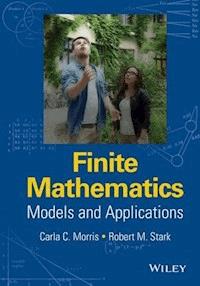
Features step-by-step examples based on actual data and connects fundamental mathematical modeling skills and decision making concepts to everyday applicability
Featuring key linear programming, matrix, and probability concepts, Finite Mathematics: Models and Applications emphasizes cross-disciplinary applications that relate mathematics to everyday life. The book provides a unique combination of practical mathematical applications to illustrate the wide use of mathematics in fields ranging from business, economics, finance, management, operations research, and the life and social sciences.
In order to emphasize the main concepts of each chapter, Finite Mathematics: Models and Applications features plentiful pedagogical elements throughout such as special exercises, end notes, hints, select solutions, biographies of key mathematicians, boxed key principles, a glossary of important terms and topics, and an overview of use of technology. The book encourages the modeling of linear programs and their solutions and uses common computer software programs such as LINDO. In addition to extensive chapters on probability and statistics, principles and applications of matrices are included as well as topics for enrichment such as the Monte Carlo method, game theory, kinship matrices, and dynamic programming.
Supplemented with online instructional support materials, the book features coverage including:
- Algebra Skills
- Mathematics of Finance
- Matrix Algebra
- Geometric Solutions
- Simplex Methods
- Application Models
- Set and Probability Relationships
- Random Variables and Probability Distributions
- Markov Chains
- Mathematical Statistics
- Enrichment in Finite Mathematics
Sie lesen das E-Book in den Legimi-Apps auf:
Seitenzahl: 682
Veröffentlichungsjahr: 2015
Ähnliche


















Table of Contents
Cover
Title Page
Copyright
Preface
About the Authors
Chapter Content
Algebra Skills
Basic Finance
Matrices
Linear Programming
Probability and Statistics
Enrichment
Supplements
Suggestions
Acknowledgements
About the Companion Website
Chapter 1: Linear Equations and Mathematical Concepts
1.1 Solving Linear Equations
1.2 Equations of Lines and Their Graphs
1.3 Solving Systems of Linear Equations
1.4 The Numbers π and
e
1.5 Exponential and Logarithmic Functions
1.6 Variation
1.7 Unit Conversions and Dimensional Analysis
Historical Notes and Comments
Chapter 2: Mathematics of Finance
2.1 Simple and Compound Interest
2.2 Ordinary Annuity
2.3 Amortization
2.4 Arithmetic and Geometric Sequences
Historical Notes
Chapter 3: Matrix Algebra
3.1 Matrices
3.2 Matrix Notation, Arithmetic, and Augmented Matrices
3.3 Gauss–Jordan Elimination
3.4 Matrix Inversion and Input–Output Analysis
Historical Notes
Chapter 4: Linear Programming – Geometric Solutions
Introduction
4.1 Graphing Linear Inequalities
4.2 Graphing Systems of Linear Inequalities
4.3 Geometric Solutions to Linear Programs
Historical Notes
Chapter 5: Linear Programming – Simplex Method
5.1 The Standard Maximization Problem (SMP)
5.2 Tableaus and Pivot Operations
5.3 Optimal Solutions and The Simplex Method
5.4 Dual Programs
5.5 Non-SMP Linear Programs
Historical Notes
Chapter 6: Linear Programming – Application Models
Product Mix and Feed Mix Problems
Fluid Blending Problem
Assignment Problems
Transportation Problem
The Knapsack Problem
The Trim Problem
A Caterer Problem
Another Planning Horizon
Historical Notes
Chapter 7: Set and Probability Relationships
7.1 Sets
7.2 Venn Diagrams
7.3 Tree Diagrams
7.4 Combinatorics
7.5 Mathematical Probability
7.6 Bayes' Rule and Decision Trees
Historical Notes
Further Reading
Chapter 8: Random Variables and Probability Distributions
8.1 Random Variables
8.2 Bernoulli Trials and the Binomial Distribution
8.3 The Hypergeometric Distribution
8.4 The Poisson Distribution
Historical Notes
Chapter 9: Markov Chains
9.1 Transition Matrices and Diagrams
9.2 Transitions
9.3 Regular Markov Chains
9.4 Absorbing Markov Chains
Historical Notes
Chapter 10: Mathematical Statistics
10.1 Graphical Descriptions of Data
10.2 Measures of Central Tendency and Dispersion
10.3 The Uniform Distribution
10.4 The Normal Distribution
10.5 Normal Distribution Applications
10.6 Developing and Conducting a Survey
Historical Notes
Chapter 11: Enrichment in Finite Mathematics
11.1 Game Theory
Historical Notes
11.2 Applications in Finance and Economics
11.3 Applications in Social and Life Sciences
11.4 Monte Carlo Method
Historical Notes
11.5 Dynamic Programming
Historical Notes
Answers to Odd Numbered Exercises
Using Technology
Matrices
Matrix Operations
Linear Programming
Using Lindo
Using Excel for Factorial, Combinations, and Permutations
To Create a Frequency Histogram
Using Excel to Determine Summary Statistics
Glossary
Index
End User License Agreement
Pages
ix
x
xi
xiii
xiv
xv
xvi
1
2
3
4
5
6
7
8
9
10
11
12
13
14
15
16
17
18
19
20
21
22
23
24
25
26
27
28
29
30
31
32
33
34
35
36
37
38
39
40
41
42
43
44
45
46
47
48
49
50
51
52
53
54
55
56
57
58
59
60
61
62
63
64
65
66
67
68
69
70
71
72
73
74
75
76
77
78
79
80
81
82
83
84
85
86
87
88
89
90
91
92
93
94
95
96
97
98
99
100
101
102
103
104
105
106
107
108
109
110
111
112
113
114
115
116
117
118
119
120
121
122
123
124
125
126
127
128
129
130
131
132
133
134
135
136
137
138
139
140
141
142
143
144
145
146
147
148
149
150
151
152
153
154
155
156
157
158
159
160
161
162
163
164
165
166
167
168
169
170
171
172
173
174
175
176
177
178
179
180
181
182
183
184
185
186
187
188
189
190
191
192
193
194
195
196
197
198
199
200
201
202
204
205
206
207
208
209
210
211
212
213
214
215
216
217
218
219
220
221
222
223
224
225
226
227
228
229
230
231
232
233
234
235
236
237
238
239
240
241
242
243
244
245
246
247
248
249
250
251
252
253
254
255
256
257
258
259
260
261
262
263
264
265
266
267
268
269
270
271
272
273
274
275
276
277
278
279
280
281
282
283
284
285
286
287
288
289
290
291
292
293
294
295
296
297
298
299
300
301
302
303
304
305
306
307
308
309
310
311
312
313
315
316
317
318
319
320
321
322
323
324
325
326
327
328
329
330
331
332
333
334
335
336
337
338
339
340
341
342
343
344
345
346
347
348
349
350
351
352
353
354
355
356
357
358
359
360
361
362
363
364
365
366
367
368
369
370
372
373
374
375
376
377
378
379
380
381
382
383
384
385
386
387
388
389
390
391
392
393
394
395
396
397
398
399
400
401
402
403
404
405
406
407
408
409
410
411
412
413
414
415
416
417
418
419
420
421
422
423
424
425
426
427
428
429
430
431
432
433
434
435
436
437
438
439
440
441
442
443
444
445
446
447
448
449
450
451
452
453
454
455
456
457
458
459
460
461
462
463
464
465
466
467
468
469
470
471
472
473
474
475
476
477
478
479
480
481
482
483
484
485
486
487
488
489
490
491
492
493
494
495
496
497
498
499
500
501
502
503
504
505
506
507
508
509
510
511
512
513
514
515
516
517
518
Guide
Cover
Table of Contents
Preface
Begin Reading
Finite Mathematics
Models and Applications
Carla C. Morris
University of Delaware
Robert M. Stark
University of Delaware
Copyright © 2016 by John Wiley & Sons, Inc. All rights reserved
Published by John Wiley & Sons, Inc., Hoboken, New Jersey
Published simultaneously in Canada
No part of this publication may be reproduced, stored in a retrieval system, or transmitted in any form or by any means, electronic, mechanical, photocopying, recording, scanning, or otherwise, except as permitted under Section 107 or 108 of the 1976 United States Copyright Act, without either the prior written permission of the Publisher, or authorization through payment of the appropriate per-copy fee to the Copyright Clearance Center, Inc., 222 Rosewood Drive, Danvers, MA 01923, (978) 750-8400, fax (978) 750-4470, or on the web at www.copyright.com. Requests to the Publisher for permission should be addressed to the Permissions Department, John Wiley & Sons, Inc., 111 River Street, Hoboken, NJ 07030, (201) 748-6011, fax (201) 748-6008, or online at http://www.wiley.com/go/permission.
Limit of Liability/Disclaimer of Warranty: While the publisher and author have used their best efforts in preparing this book, they make no representations or warranties with respect to the accuracy or completeness of the contents of this book and specifically disclaim any implied warranties of merchantability or fitness for a particular purpose. No warranty may be created or extended by sales representatives or written sales materials. The advice and strategies contained herein may not be suitable for your situation. You should consult with a professional where appropriate. Neither the publisher nor author shall be liable for any loss of profit or any other commercial damages, including but not limited to special, incidental, consequential, or other damages.
For general information on our other products and services or for technical support, please contact our Customer Care Department within the United States at (800) 762-2974, outside the United States at (317) 572-3993 or fax (317) 572-4002.
Wiley also publishes its books in a variety of electronic formats. Some content that appears in print may not be available in electronic formats. For more information about Wiley products, visit our web site at www.wiley.com.
Library of Congress Cataloging-in-Publication Data:
Morris, Carla C.
Finite Mathematics : Models and Applications / Carla C. Morris and Robert M. Stark.
pages cm
Includes bibliographical references and index.
ISBN 978-1-119-01550-5 (cloth)
1. Mathematics–Textbooks. I. Stark, Robert M., 1930- II. Title.
QA39.3.M68 2015
511′.1–dc23
2014042187
Preface
Mathematical development has recently grown at an exponential rate. The mathematics of computers, statistics, matrices, linear programming, and game theory, to name a few, has changed and expanded the landscape of mathematical influence. Many view films such as A Beautiful Mind, and Pi, plays such as Proof, and TV shows such as Numb3rs to witness a wider recognition of mathematics and enhance its awareness in daily lives.
Prior to World War II, basic college and university mathematics consisted mainly of college algebra and calculus. The enormous success of those Newtonian era mathematical discoveries in the development of physical sciences and engineering continues today.
War often brings scientific and technological advances, and World War II was no exception. Developments in the immediate post-World War II years and remarkable advances in automated computation led to new mathematics and to new uses for older mathematics.
Among the many post-World War II developments: three stand out that have become a basis for finite mathematics courses:
Linear Programming
Linear programming, the mathematics for the optimal allocation of resources, has found wide usage in the cutting and planting of forests, automobile production lines, oil refining, hospital menus, and much more. A Google search actually returns millions of references.
Matrix Algebra
The algebra of this mathematical subject is now vital to the operation of computers that store, move, manipulate, and analyze huge arrays of data and variables. It has wide usage in engineering, social, business, and health contexts. Leontief's Nobel Prize winning input – output economic models of firms, governments, and nations are well known.
Chance and Probability
With origins predating the 17th century, mathematical probability matured in the 20th century and with related topics has found applications in virtually every branch of science, technology, and commerce. Examples include the proliferation of medical tests with false negatives and positives, risk assessments, artificial intelligence usages of Bayes' Rule, tracking demographics and behavior with Markov chains, and the development of mathematical statistics.
Recognition of the fuller import of these three primary topics led to their aggregation into a new course, “Finite Mathematics”, in the 1960's. The course and its topics have these distinctions:
Topics are mostly independent of one another.
Topics often differ from pre World War II curricula.
Topics deal with discrete or finite events from which the course and text derive their title. This contrasts with Calculus, which is based upon continuous variation.
Finite mathematics is more a course title than a branch of mathematics marked by an intrinsic coherence. In a sense, it is a hybrid branch of mathematics.
While calculus remains fundamental to physical science and technology, its impact upon the post-World War II social, behavioral, life, health, business, management, and economic sciences has been markedly less. However, it is finite mathematics topics that have become more important to post-World War II business and social sciences applications. One expects finite mathematics topics to find a niche in college curricula.
While a finite mathematics course is often required at many colleges and universities, students in our classes range from freshmen to seniors. Although business, economics, finance, and management students are often the primary enrollment, other students often enroll and can easily benefit as the text and exercises span many disciplines in the life, natural, and social sciences.
The course typically features matrix algebra, linear programming, probability, and related topics. For a one-semester course, this text has ample material for teachers to enrich or offer a two-semester course, perhaps for honors students.
Many institutions have shown an interest in developing General Education guidelines to encourage student development in oral, written communication, and quantitative reasoning skills. Several of the exercises in this text were included with the idea that they would be well suited for instructors looking to aid students in developing skills that suit General Education guidelines. The exercises in this text may be completed with or without the use of technological aids. That decision is for the teacher.
About the Authors
Carla C. Morris has taught courses ranging from college algebra to calculus and statistics since 1987 at the Dover Campus of the University of Delaware. Her B.S. (Mathematics) and M.S. (Operations Research & Statistics) are from Rensselaer Polytechnic Institute, and her Ph.D. (Operations Research) is from the University of Delaware.
Robert M. Stark is Professor Emeritus of Mathematical Sciences at the University of Delaware. His undergraduate and doctoral degrees were awarded by, respectively, Johns Hopkins University and the University of Delaware in physics, mathematics, and operations research. Among his publications is the 2004 Dover Edition of Mathematical Foundations for Design with R.L. Nicholls.
Chapter Content
Algebra Skills
Chapter 1, Linear Equations and Mathematical Concepts is provided for students not fully prepared for a finite mathematics course. The chapter reviews algebra skills and emphasizes solving linear equations and basic graphing skills. In addition, exponential and logarithmic functions, π and e, variation and dimensional analysis are briefly considered.
Basic Finance
Chapter 2, Mathematics of Finance addresses the importance of complex finance considerations of modern life. Here the basics underlying consumer financial products and more advanced topics are included. This chapter, requiring only elementary mathematics, appears early in the text for the benefit of some curricula and can be omitted.
Matrices
Chapter 3, Matrix Algebra is one of the pillars of finite mathematics courses. Matrices have gained a vital role in the operations of large computer databases, manipulating large systems of equations, as in linear programs, and in the increasing quantification of economics, finance, and social sciences. The text covers the encoding of data into matrices, their characteristics, and appropriate algebraic manipulations as addition, multiplication, and inversion. The application to solving systems of equations using Gauss-Jordan elimination schemes is an entire section.
Still, teachers find higher quality examples of actual applications of matrices to be elusive. Examples from cryptology (a major government and industrial security usage) and Input-Output analysis (a fundamental application for economics) are included. A novel section in Chapter 11 has examples of sociological usage in studies of kinship structures through generations and of occupational mobility among populations.
Linear Programming
Linear optimization, or linear programming as it is better known, is another pillar of finite mathematics courses. It is the subject of the second portion of the text in Chapters 4, 5, and 6 and in game theory and finance in Chapter 11. This text mirrors others and has added features and enrichment. In Chapter 4, for Geometric Solutions to linear optimization problems, graphing and solving simple systems of linear equations, some of the introductory skills of Chapter 1 are utilized. However, graphical solutions are limited to problems of few variables.
The Simplex Method appears in Chapter 5. Linear programming is likely the most widely used mathematics to allocate scarce resources in industry and government. Here the matrix algebra skills of Chapter 3 aid in solutions. However, the use of LINDO™ the widely available popular software, enables students to solve larger problems if an instructor wishes to take a more technological approach to optimization. The basic Standard Maximization Problem (SMP) with “less than” constraints is in Sections 5.1 – 5.3. A flow chart aids students to master the simplex iterations.
Section 5.4 on duality and Section 5.5 on non – SMP programs have an extended treatment of linear programming. Two solution methods are given for minimization objectives and excess variable situations. One uses artificial variables and the other algebraic manipulation. A unique flow chart guides students.
Chapter 6, Application Models enhances the valuable skill of formulating linear programs. The use of linear programming for diverse industrial and governmental purposes is widespread. Google has well over a million references! The many prototype models presented in Chapter 6 such as the knapsack, trim waste, and caterer problems are classics of linear programming literature. Virtually all applications require automated computation and computer software is widely available.
Two additional linear programming features are its mathematical history and application to game theory in Chapter 11. Game theory is important to contemporary economics and industrial competition. In addition to the elementary methods usual in finite texts, this text places emphasis on the connection between game theory and linear programming. This aids applications that require automated computation as well as understanding of mathematical theory.
Probability and Statistics
Mathematical probability and statistical topics usually form another pillar of a finite mathematics course. It comprises the third major part of the text. Chapter 7, Set and Probability Relationships; Chapter 8, Random Variables and Probability Distributions; Chapter 9, Markov Chains; Chapter 10, Mathematical Statistics; and a section on Monte Carlo Method, unique to this text, in Chapter 11.
Chapter 7, Set and Probability Relationships has ample examples to illustrate the basics of sets and the relations to probabilities. One section emphasizes tree diagrams both as an aid to teaching probability and as an introduction to their widespread use in managing large projects from building construction to varied components of space ship design. A unique feature of combinatorics in this text is a table aid to help with these challenging exercises. Also included is a fourth combinatoric possibility, usually omitted, that samples with replacement but without regard to order. Newer applications of combinatorics in computer program speed estimates are included.
Bayes' Rule has earned a niche in much of everyday life in applications from spam filters to medical tests and oil exploration. The text provides a robust treatment of the Total Probability Theorem and Bayes' Rule. Both algebraic and tree diagrams are used to aid students' skill and appreciation.
While Chapter 8, Random Variables and Probability Distributions has more material than can usually be included in a semester course, it can be used for enrichment or a second semester. Aside from the customary basic topics of the distributions, the hypergeometric and Poisson distributions are included. The hypergeometric distribution, easily taught, has a role in industrial quality control and estimation of sizes of animal populations that our students find interesting. The Poisson's Law's ubiquitousness in everyday situations is briefly explored.
Chapter 9, Markov Chains is a staple of many finite mathematical courses. This text uniquely pairs matrix and diagram solutions to each example. Students are aided to grasp matrix methods with a diagrammatic solution alongside. Students learn to form and execute transition matrices in regular and absorbing Markov chains.
Chapter 10, Mathematical Statistics an occasional topic, has become fundamental in many social science and business contexts. Some feel that statistics should be a part of a collegiate education. Included here are topics in statistical graphs, and surveys, basic definitions and interpretations of mean and variance. The normal distribution receives robust attention in view of its basic theoretical and practical importance.
Enrichment
Chapter 11Enrichment in Finite Mathematics may be unique among finite mathematics texts. Each section of this chapter deals with a nontraditional and useful topic related to finite mathematics. One section has the elements of game theory and its connection to linear programming. Other sections, somewhat novel to finite mathematics texts, are both interesting and useful in seeking fresh topics.
There is a section on financial and economic applications and another that uses matrix applications to the social and life sciences. The last two sections involve the Monte Carlo Method and Dynamic Programming. Monte Carlo method, often called simulation, is a staple of planning, research, and operations in a huge variety of contexts. A popular topic with students it is easily mastered. Dynamic Programming, a relatively new optimization format, relies on mathematical recursion. A useful topic in its own right, additionally, it alerts students to the limits of automated computation even for seemingly “small” problems.
Supplements
A modestly priced companion “Student Solutions Manual” has detailed solutions to the odd numbered exercises and is recommended.
For teachers, a complete solutions manual, PowerPoint® slides by chapter, and a test bank are available from John Wiley & Sons.
Suggestions
Suggestions for improvements are welcome.
Acknowledgements
We have benefitted from advice and discussions with Professors Louise Amick, Washington College; Nancy Hall, University of Delaware Associate in Arts Program-Georgetown; Richard Schnackenberg, Florida Gulf Coast University; Robert H. Mayer, Jr, US Naval Academy, Dr Wiseley Wong, University of Maryland; and Carolyn Krause, Delaware Technical and Community College-Terry Campus.
We acknowledge the University of Delaware's Morris Library for use of its resources during the preparation of this text.
About the Companion Website
This book is accompanied by a companion website:
http://www.wiley.com/go/morris/finitemathematics
The website includes:
Instructors' Solutions Manual
PowerPoint® slides by chapter
Test banks by chapter
Teacher Commentary
Chapter 1Linear Equations and Mathematical Concepts
1.1 Solving Linear Equations
Example 1.1.1 Solving a Linear Equation
Example 1.1.2 Solving for y
Example 1.1.3 Simple Interest
Example 1.1.4 Investment
Example 1.1.5 Gasoline Prices
Example 1.1.6 Breaking a Habit
1.2 Equations of Lines and Their Graphs
Example 1.2.1 Ordered Pair Solutions
Example 1.2.2 Intercepts and Graph of a Line
Example 1.2.3 Slope-Intercept Form
Example 1.2.4 Point-Slope Form
Example 1.2.5 Temperature Conversion
Example 1.2.6 Salvage Value
Example 1.2.7 Parallel or Perpendicular Lines
1.3 Solving Systems of Linear Equations
Example 1.3.1 Graphical Solutions to a System of Linear Equations
Example 1.3.2 Substitution – Consistent System
Example 1.3.3 Substitution–Inconsistent System
Example 1.3.4 Elimination Method – Consistent System
Example 1.3.5 Market Equilibrium
1.4 The Numbers π and
e
The Number
π
Example 1.4.1 A Biblical π
The Number
e
1.5 Exponential and Logarithmic Functions
Exponential Functions
Example 1.5.1 Using Laws of Exponents
Example 1.5.2 Simplifying Exponential Equations
Example 1.5.3 Simplifying Exponential Exponents
Logarithmic Functions
Example 1.5.4 Exponential and Logarithmic Forms
Example 1.5.5 Simplifying Logarithms
Example 1.5.6 Simplifying Logarithmic Expressions
Example 1.5.7 Base 10 Exponents
Example 1.5.8 Base e Exponents
1.6 Variation
Example 1.6.1 Summer Wages
Example 1.6.2 Hooke's Law
Example 1.6.3 Geometric Similarity
Example 1.6.4 Volume of a Sphere
Example 1.6.5 Seawater Density
Example 1.6.6 Illumination
Example 1.6.7 Beam Strength
1.7 Unit Conversions and Dimensional Analysis
Example 1.7.1 Dimensional Correctness
Example 1.7.2 Speed Conversion
Example 1.7.3 Time Conversion
Example 1.7.4 Atoms of Nitrogen
Example 1.7.5 Atoms of Hydrogen
Historical Notes and Comments
1.1 Solving Linear Equations
Mathematical descriptions, often as algebraic expressions, usually consist of alphanumeric characters and special symbols.
Physicists describe the distance, s, that an object falls under gravity in time, t, by . Here, the letters s and t are variables since their values may change, while, g, the acceleration of gravity is considered constant. While any letters can represent variables, typically the later letters of the alphabet are customary. The use of x and y is generic. Sometimes, it is convenient to use a letter that is descriptive of the variable, as t for time.
Earlier letters of the alphabet are customary for fixed values or constants. However, exceptions are widespread. The equal sign, a special symbol, is used to form an . An equation equates algebraic expressions. Numerical values for variables that preserve equality are called to the equations.
Lesen Sie weiter in der vollständigen Ausgabe!
Lesen Sie weiter in der vollständigen Ausgabe!
Lesen Sie weiter in der vollständigen Ausgabe!
Lesen Sie weiter in der vollständigen Ausgabe!
Lesen Sie weiter in der vollständigen Ausgabe!
Lesen Sie weiter in der vollständigen Ausgabe!
Lesen Sie weiter in der vollständigen Ausgabe!
Lesen Sie weiter in der vollständigen Ausgabe!
Lesen Sie weiter in der vollständigen Ausgabe!
Lesen Sie weiter in der vollständigen Ausgabe!
Lesen Sie weiter in der vollständigen Ausgabe!
Lesen Sie weiter in der vollständigen Ausgabe!
Lesen Sie weiter in der vollständigen Ausgabe!
Lesen Sie weiter in der vollständigen Ausgabe!
Lesen Sie weiter in der vollständigen Ausgabe!




