


73,99 €
Mehr erfahren.
- Herausgeber: John Wiley & Sons
- Kategorie: Wissenschaft und neue Technologien
- Serie: Developments in Forensic Science
- Sprache: Englisch
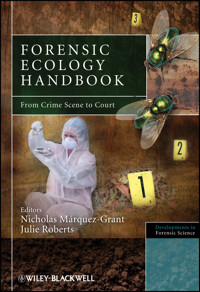
The analysis of plants, insects, soil and other particulates from scenes of crime can be vital in proving or excluding contact between a suspect and a scene, targeting search areas, and establishing a time and place of death. Forensic Ecology: A Practitioner’s Guide provides a complete handbook covering all aspects of forensic ecology. Bringing together the forensic applications of anthropology, archaeology, entomology, palynology and sedimentology in one volume, this book provides an essential resource for practitioners in the field of forensic science, whether crime scene investigators, forensic science students or academics involved in the recovery and analysis of evidence from crime scenes.
Forensic Ecology: A Practitioner’s Guide includes information not only on the search, location, recovery and analysis of evidence, but includes sampling strategies for diatom analysis, pollen and soils samples and entomology and provides guides for good practice. Each chapter provides background information on each discipline and is structured according to pre-scene attendance (what questions should the scientist ask when receiving a call? What sort of preparation is required?), scene attendance (including protocols at the scene, sampling strategies, recording), scientific examination of analysis of the evidence up to the stages and guidelines for witness statement and presenting evidence in court.
The book is written by specialists in all fields with a wealth of experience who are current forensic practitioners around the world. It provides an essential and accessible resource for students, academics, forensic practitioners and police officers everywhere.
Sie lesen das E-Book in den Legimi-Apps auf:
Seitenzahl: 449
Veröffentlichungsjahr: 2012
Ähnliche



















Contents
Cover
Title Page
Copyright
About the Editors
List of Contributors
Series Foreword
Foreword
Foreword
Chapter 1: Introduction
Chapter 2: Aspects of crime scene management
2.1 Introduction
2.2 Professionals within the investigation
2.3 Crime scene principles
2.4 Records and documentation
2.5 Crime scene attendance
2.6 Expectations
2.7 Conclusion
Acknowledgements
Chapter 3: Forensic archaeology
3.1 Introduction
3.2 Forensic archaeology at a crime scene
3.3 Pre-scene attendance
3.4 Scene attendance
3.5 Case studies
3.6 Reporting and court testimony
3.7 Conclusion
Chapter 4: Forensic anthropology
4.1 Introduction
4.2 The role of the Forensic Anthropologist in criminal investigation
4.3 Pre-scene attendance
4.4 Scene attendance
4.5 In the mortuary
4.6 Positive identification
4.7 Production of an Expert Witness Statement and court attendance
4.8 Conclusion
Chapter 5: Forensic radiography
5.1 Introduction and current state of the discipline
5.2 Application of radiology to the analysis and identification of human remains*
5.3 Conclusion
Chapter 6: DNA analysis for victim identification
6.1 Introduction
6.2 Taking DNA samples from the deceased
6.3 Collection of reference samples for victim identification
6.4 DNA laboratory analysis
6.5 Common DNA profiling tests
6.6 Conclusion
Chapter 7: Other scientific methods related to victim identification
7.1 Introduction
7.2 Dating of human remains
7.3 Other analytical techniques
Chapter 8: Forensic entomology
8.1 Introduction and current state of the discipline
8.2 Applications
8.3 Pre-scene attendance
8.4 Scene attendance
8.5 Mortuary attendance
8.6 Laboratory analysis
8.7 Reporting and court appearance
8.8 Conclusion
Chapter 9: Diatoms and forensic science
9.1 Introduction
9.2 Applications
9.3 Pre-scene attendance
9.4 Scene attendance and sampling
9.5 Preparation and treatment of samples in the laboratory
9.6 Analysis of samples
9.7 Reporting and court appearance
Chapter 10: Forensic palynology
10.1 Introduction and current state of the discipline
10.2 Pollen
10.3 Applications
10.4 Pre-scene attendance
10.5 Scene attendance
10.6 Mortuary attendance
10.7 Laboratory analysis
10.8 Reporting and court appearance
Chapter 11: Forensic botany
11.1 Introduction
11.2 Applications
11.3 Pre-scene attendance
11.4 Scene attendance
11.5 Mortuary attendance
11.6 Laboratory analysis
11.7 Reporting and court appearance
11.8 Conclusion
Chapter 12: Forensic geology and soils
12.1 Introduction and current state of the discipline
12.2 Applications for forensic geology
12.3 Pre-scene attendance
12.4 Scene attendance and sampling
12.5 Sampling and preparation in the laboratory
12.6 Laboratory analysis
12.7 Reporting and court appearance
Acknowledgements
Chapter 13: Exhibits
13.1 Introduction
13.2 Exhibit principles
13.3 Recovery procedures
13.4 Labelling exhibits
13.5 Key exhibit principles
13.6 Practical guidelines for exhibit handling
13.7 Splitting exhibits
13.8 Long-term sporadic seizures of exhibits
13.9 Unsealing and resealing exhibits for examination
13.10 Conclusion
Chapter 14: Forensic photography
14.1 Introduction
14.2 Basic elements of photography
14.3 Security of images
14.4 The forensic photographer and the crime scene
14.5 The forensic photographer at the mortuary
14.6 Conclusion
Index
This edition first published 2012 © 2012 by John Wiley & Sons, Ltd
Wiley-Blackwell is an imprint of John Wiley & Sons, formed by the merger of Wiley's global Scientific, Technical and Medical business with Blackwell Publishing.
Registered office:John Wiley & Sons, Ltd, The Atrium, Southern Gate, Chichester, West Sussex, PO19 8SQ, UK
Editorial offices:9600 Garsington Road, Oxford, OX4 2DQ, UK The Atrium, Southern Gate, Chichester, West Sussex, PO19 8SQ, UK 111 River Street, Hoboken, NJ 07030-5774, USA
For details of our global editorial offices, for customer services and for information about how to apply for permission to reuse the copyright material in this book please see our website at www.wiley.com/wiley-blackwell.
The right of the author to be identified as the author of this work has been asserted in accordance with the UK Copyright, Designs and Patents Act 1988.
All rights reserved. No part of this publication may be reproduced, stored in a retrieval system, or transmitted, in any form or by any means, electronic, mechanical, photocopying, recording or otherwise, except as permitted by the UK Copyright, Designs and Patents Act 1988, without the prior permission of the publisher.
Designations used by companies to distinguish their products are often claimed as trademarks. All brand names and product names used in this book are trade names, service marks, trademarks or registered trademarks of their respective owners. The publisher is not associated with any product or vendor mentioned in this book. This publication is designed to provide accurate and authoritative information in regard to the subject matter covered. It is sold on the understanding that the publisher is not engaged in rendering professional services. If professional advice or other expert assistance is required, the services of a competent professional should be sought.
Library of Congress Cataloging-in-Publication Data
Forensic ecology handbook : from crime scene to court / edited by Nicholas Márquez-Grant and Julie Roberts.
p. cm. Includes bibliographical references and index. ISBN 978-1-119-97419-2 (cloth) 1. Forensic sciences. 2. Forensic anthropology. 3. Forensic archaeology. 4. Forensic botany. 5. Environmental sciences. 6. Crime scene investigation. I. Márquez-Grant, Nicholas, 1976- II. Roberts, Julie (Julie J.) HV8073.F564 2012 363.25–dc23 2012016770
A catalogue record for this book is available from the British Library.
Wiley also publishes its books in a variety of electronic formats. Some content that appears in print may not be available in electronic books.
First Impression 2012
About the Editors
Dr Nicholas Márquez-Grant is a Forensic Anthropologist and Archaeologist at Cellmark Forensic Services (UK), having worked previously for other forensic science providers and commercial archaeological units. He is also a Research Associate of the Institute of Human Sciences, School of Anthropology and Museum Ethnography, University of Oxford. Having worked as a specialist in human skeletal remains from archaeological sites for over 15 years, he has considerable experience in the excavation and study of cremated and unburnt bone from prehistoric sites to twentieth-century conflict sites and from a variety of geographical areas in Europe, and in particular Spain. Dr Márquez-Grant has taught biological anthropology since 2001 at the University of Oxford where he was awarded his doctoral degree in archaeology and physical anthropology in 2006. In recent years he has worked full-time as a forensic anthropologist and archaeologist in cases from a large number of police forces in the United Kingdom, dealing with the search, recovery, location and identification of human remains, and has acted as an expert witness. He also trains crime scene investigators from a number of forces in the United Kingdom and abroad.
Dr Julie Roberts is Scientific Lead and Team Leader for the Anthropology, Archaeology and Ecology Department at Cellmark Forensic Services (UK). She is a biological anthropologist and archaeologist by background with over 15 years’ experience working in archaeology and at crime scenes, excavating and examining decomposed, skeletonised, fragmented, burnt and commingled human remains. Her forensic experience includes deployment as forensic anthropologist with the British Forensic Team in Kosovo in 1999, 2000 and 2002, exhumation and examination of murder victims in Iraq in 2003, and lead anthropologist following the London bombings in 2005 and the Nimrod air crash in 2006. Recent casework includes successfully locating, recovering and assisting in the identification of human remains in Lebanon and mass fatality deployments to Afghanistan. Dr Roberts has attended numerous crime scenes of different types across the United Kingdom, specialising in the excavation and analysis of burnt and fragmented remains. She is one of only two forensic anthropologists who sit in the expert panel for UK Disaster Victim Identification. She is registered with the National Policing Improvement Agency (NPIA) as an expert advisor in anthropology and archaeology, and has been involved in instructing police officers and crime scene investigators for over 10 years.
List of Contributors
Beverley Adams-Groom, National Pollen and Aerobiology Unit (NPARU), University of Worcester, Worcester, UK
Sophie Beckett, Cranfield Forensic Institute, Cranfield University, Shrivenham, UK
Ruth Buckley, Metropolitan Police Service, London, UK
Gordon Cook, Scottish Universities Environmental Research Group (SUERC), East Kilbride, Scotland, UK
Eileen J. Cox, Natural History Museum, London, UK
Martin Hall, Department of Life Sciences, Natural History Museum, London, UK
Andy Langley, Metropolitan Police Service, London, UK
Stephen Litherland, Cellmark Forensic Services, Abingdon, UK
Nicholas Márquez-Grant, Cellmark Forensic Services, Abingdon, UK; and Institute of Human Sciences, School of Anthropology and Museum Ethnography, University of Oxford, Oxford, UK
Peter Massey, Forensic Science Department, Henry C. Lee College of Criminal Justice and Forensic Sciences, University of New Haven, West Haven, CT, USA
Andrew McDonald, Cellmark Forensic Services, Abingdon, UK
Heather Miller Coyle, Forensic Science Department, Henry C. Lee College of Criminal Justice and Forensic Sciences, University of New Haven, West Haven, CT, USA
Duncan Pirrie, Helford Geoscience LLP, Penryn, UK
Cameron Richards, Department of Life Sciences, Natural History Museum, London, UK
Julie Roberts, Cellmark Forensic Services, Chorley, UK
Alastair Ruffell, School of Geography, Archaeology and Palaeoecology, Queen's University Belfast, Belfast, Northern Ireland, UK
Peter Valentin, Forensic Science Department, Henry C. Lee College of Criminal Justice and Forensic Sciences, University of New Haven, West Haven, CT, USA
Mark Viner, Inforce Foundation, Cranfield Forensic Institute, Shrivenham, UK; and St Bartholomew's and The Royal London Hospitals, London, UK
Michael Walbank, Cellmark Forensic Services, Abingdon, UK
Chris Webster, Cheshire Constabulary, Cheshire, UK
Amoret Whitaker, Department of Life Sciences, Natural History Museum, London, UK
John Yoward, Cellmark Forensic Services, Abingdon, UK
Series Foreword
Developments in forensic science
In the past few years the development of teaching, research and knowledge exchange activities associated with forensic science policy and practice have increased almost exponentially. Technological innovations, the pursuit of new knowledge and the interpretation of analytical and other data as it is applied within forensic practice is to be welcomed as we move to a phase where our profession is striving towards gaining a foothold on maturity as a science. Practising forensic scientists are constantly striving to deliver the very best in their service to the judicial process and as such need a reliable and robust knowledge base within their diverse disciplines.
As we develop new knowledge and address the research and practical application issues within the field, the consolidation and dissemination of new methdodologies relevant to forensic science practice becomes essential. It is the objective of this book series to provide a valuable resource for forensic science practitioners, educators and others in that regard. The books developed and published within this series come from some of the leading researchers and practitioners in their fields and will provide essential and relevant information to the reader.
Professor Niamh Nic Daéid Series Editor
Foreword
Jonathan Smith
National Forensic Specialist Adviser
National Policing Improvement Agency, UK
Traditionally forensic science has been organised in terms of the scientific disciplines, for example biology, chemistry, drugs and toxicology, and firearms.
The scientists involved in the examination of casework exhibits in many instances have extended their expertise across the disciplines giving a more integrated view of the sciences that can be applied to the varying situations appearing in police investigations.
Taking the biology specialism of forensic science as an example, this has mostly dealt with the wide range of biological materials that might be transferred during the commission of a crime. This could be the transfer of blood and body fluids, hair, textile fibres and botanical material. It is fair to say that the examination of transferred botanical material has in the past not really featured as a major consideration in many investigations.
Over the last decade there is no doubt that the focus of the science applied to forensic science cases has centred on developments in DNA technologies. Some of the other scientific skills applied to forensic science have to a large extent been less well supported. This situation at one stage led to the development of sciences such as botany, entomology, archaeology and anthropology being centred on academic institutes, or in some instances experts acting alone.
Consequently this resulted in an almost peripheral group of experts, who were seen as detached from mainstream forensic science, confined by the boundaries of their discipline, and who relied upon their individual reputation rather than a corporate assurance implied by the traditional forensic science providers.
The situation now is distinctly different, with a greater integration of these specialist disciplines into forensic science.
In this volume the expertise in these various disciplines is brought together for the use of investigators, specialists and those working within the criminal justice system. The structures that are in place within a major crime investigation, and the roles and responsibilities of the investigation team are outlined, and there is an explanation of how the various elements of the team interact. Also included in the text is some specific detail for the practitioner outlining sampling procedures, packaging and exhibit examination practices.
There is recognition by the contributors of the ultimate responsibility of the expert to present to the court the scientific findings in a balanced manner, mindful of the need for quality, peer review and an assurance that the science being applied is based on published data and tested principles. In this way the confidence in the application of these scientific disciplines into an all-encompassing forensic science response to crime investigation is greatly enhanced.
Foreword
Richard T. Shepherd
Consultant Forensic Pathologist, UK
One of the many changes that has occurred during the 30 years that I have been practising forensic pathology is the rise of forensic science. To cite but one example, blood serology, which relied upon the visual identification of antibody agglutination of red blood cells which determine the major and minor blood groups present, has been swept away by DNA analysis. This has resulted in an increase in the specificity and accuracy of blood analysis by a factor of many millions. However, this apparent ‘certainty’ has meant that if there was a mistake it would in all probability be a big one. Instead of the accepted ‘possible error’ of blood serology, DNA resulted in statements approximating to certainty which may have reflected the science but they did not allow for fundamentally faulty practice.
And there were setbacks when enthusiasm exceeded reliable, scientific analysis and sound forensic practice. When those results and opinions were robustly tested by other practitioners in the laboratory and then by the lawyers in the courts, parts were exposed to be flawed and the whole edifice collapsed. These moments are salutary lessons for us all, for they inform us that just because we think that something might be right that does not in itself make it right. We must build our skills and our expertise and our evidence on the solid foundations of knowledge, experience and adherence to strict forensic practices.
The process of scene examination has also progressed in ways that simply could not have been anticipated in the 1980s. At one time, the forensic pathologist did just about everything at the scene – seldom even wearing overshoes – and now everyone wears full protective clothing and the pathologist gets to do very little indeed because they no longer have the full set of skills that are needed, but they have to be aware of the whole spectrum of specialist skills and experience that the forensic scientists can bring to a scene or a post-mortem examination.
As the apparent accuracy of forensic science increases, the subject in all its many forms is becoming increasingly important in this modern, litigatious world. The interface between science and the law, whether civil or criminal, is becoming more challenging and it is essential that there are forensic science practitioners available to the police, to the defence and above all to the courts. Those practitioners must have the requisite knowledge, skills, and also the experience to perform the highly complex, specialist scene and laboratory examinations in a forensically satisfactory manner. They must also be able to produce and give reliable, science-based evidence that will enable the court to reach their verdict with a full understanding of the facts and confidence in their source.
Despite the longevity of forensic science as a whole, the subject continues to develop new specialist areas in response to scientific advances combined with pressure from the police and the criminal justice system. The over-arching speciality of Forensic Ecology that is the subject of this book covers both the well-established fields of archaeology and anthropology and also extends into rather more recently developed fields such as forensic botany.
This textbook emphasises the need for a methodical, careful and precise approach to all problems. It accepts that not all practitioners will have all of the precise skills that may eventually be needed in any particular case and it emphasises that the adoption of the correct approach will allow others – possibly someone with greater specialist skills or maybe just the expert acting for the defence – to understand and to rely on the processes by which the information was obtained so that opinions will be based on reliably obtained evidence.
Those who choose to practise forensic science must now move their subjects forward. They must ensure that current and future practitioners are both skilled and experienced in all the relevant areas of practice and they must ensure that the police, the courts and the public insist on that professionalism and expertise. The authors have ensured that this present volume is specifically designed to be practical and they have included useful, focused and reliable advice on the handling of casework throughout the text. The case histories that are also included provide a superb basis for learning and for the understanding of both basic and more advanced forensic concepts. However the practice of forensic medicine does not stop at the examination of a scene or the examination of the victim or perpetrator and this handbook recognises these crucial aspects and also deals with the task of report writing and the giving of evidence in court.
This excellent volume is a thorough and complete overview of this speciality and provides a reliable and comprehensive textbook that is suitable both for practitioners already working within this field and for those seeking to develop a specialist interest and skill in Forensic Ecology. Julie Roberts and Nicholas Márquez-Grant have extensive knowledge and skill and have worked for many years in their own fields. To bring to one book such experience and expertise is rare and their joint efforts in producing this book reflects their immense knowledge and enthusiasm for their subject.
1
Introduction
Nicholas Márquez-Grant1 and Julie Roberts2
1Cellmark Forensic Services, Abingdon, UK; and Institute of Human Sciences, School of Anthropology and Museum Ethnography, University of Oxford, Oxford, UK
2Cellmark Forensic Services, Chorley, UK
This volume stems from the editors’ experience in archaeology and anthropology as applied to criminal investigation. Archaeologists have always been familiar with sampling for soils, pollen and other environmental sources to provide information about ancient landscapes and for their contribution to our understanding of the past. Likewise, physical anthropologists specialising in human skeletal anatomy have studied demographic profiles, disease patterns and funerary practices in past societies with the purpose of understanding the lifestyles and environment of pre-modern populations.
The disciplines of archaeology and anthropology (whether under the same umbrella or as separate fields of study), are closely interlinked with environmental sciences such as palynology, botany, pedology, geology and entomology. This applies in both modern and ancient contexts, although the way in which they are used will vary according to the questions being asked. For example, the physical anthropologist and palynologist working on an Iron Age settlement site might be utilising their skills to assess the life expectancy, health, diet and nutritional status of the people who once lived there, whereas at a crime scene the same expertise might be used to establish the identity of the deceased and to link a suspect to a scene. In both cases, the science and the principles behind it remain the same, although the specialists engaged in forensic casework need to have a good working knowledge of the criminal justice system of the country they are working in, and an awareness of their place within it.
Lesen Sie weiter in der vollständigen Ausgabe!
Lesen Sie weiter in der vollständigen Ausgabe!
Lesen Sie weiter in der vollständigen Ausgabe!
Lesen Sie weiter in der vollständigen Ausgabe!
Lesen Sie weiter in der vollständigen Ausgabe!
Lesen Sie weiter in der vollständigen Ausgabe!
Lesen Sie weiter in der vollständigen Ausgabe!
Lesen Sie weiter in der vollständigen Ausgabe!
Lesen Sie weiter in der vollständigen Ausgabe!
Lesen Sie weiter in der vollständigen Ausgabe!
Lesen Sie weiter in der vollständigen Ausgabe!
Lesen Sie weiter in der vollständigen Ausgabe!
Lesen Sie weiter in der vollständigen Ausgabe!
Lesen Sie weiter in der vollständigen Ausgabe!
Lesen Sie weiter in der vollständigen Ausgabe!




