


8,63 €
Mehr erfahren.
- Herausgeber: Seren
- Kategorie: Gesellschafts- und Liebesromane
- Serie: New Stories from the Mabinogion
- Sprache: Englisch
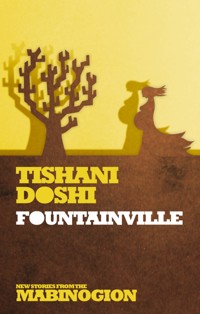
Gang wars, opium dreams and a mysterious clinic are all part of the landscape in the remote borderland town of Fountainville. But when Owain Knight arrives, his entanglement with the owner of the town's magical fountain, her mobster husband and her assistant, Luna, spells a terrible change for them all. Fountainville is the tenth and final tale in Seren's New Stories from the Mabinogion series and weaves together Celtic and Indian cultures.
Das E-Book können Sie in Legimi-Apps oder einer beliebigen App lesen, die das folgende Format unterstützen:
Seitenzahl: 158
Veröffentlichungsjahr: 2013
Ähnliche




















Contents
Title Page
Dedication
Introduction
Fountainville
A Little Fable
Part One
Chapter I
Chapter II
Chapter III
Chapter IV
Chapter V
Chapter VI
Chapter VII
Chapter VIII
Chapter IX
Part Two
Chapter I
Chapter II
Chapter III
Chapter IV
Chapter V
Chapter VI
Chapter VII
Chapter VIII
EPILOGUE
The Lady of the Fountain: a synopsis
Afterword
Acknowledgements
Copyright
i.m.
John Emrys Roberts and Blodwen Griffiths
New Stories from the Mabinogion
Introduction
Some stories, it seems, just keep on going. Whatever you do to them, the words are still whispered abroad, a whistle in the reeds, a bird’s song in your ear.
Every culture has its myths; many share ingredientswith each other. Stir the pot, retell the tale and you draw out something new, a new flavour, a new meaning maybe.There’s no one right version. Perhaps it’s because myths were a way of describing ourplace in the world, of putting people and their search for meaning in a bigger picture, that they linger in our imagination.
The eleven stories of theMabinogion(‘story ofyouth’) are diverse native Welsh tales taken fromtwo medieval manuscripts. But their roots go back hundreds of years, through written fragments and theunwritten, storytelling tradition. They were firstcollected under this title, and translated into English, in the nineteenth century.
TheMabinogionbrings us Celtic mythology, Arthurian romance, and a history of the Island of Britain seen through the eyes of medieval Wales – but tells tales that stretch way beyond the boundaries of contemporaryWales, just as the ‘Welsh’ part of this island once did:Welsh was once spoken as far north as Edinburgh. In one tale, the gigantic Bendigeidfranwears the crown ofLondon, and his severed head is buried there, facing France, to protect the landfrom invaders.
There is enchantment and shape-shifting, conflict, peacemaking, love, betrayal.A wife conjured out of flowers is punished for unfaithfulness by being turned into an owl, Arthur and his knights chase a magical wild boar and its piglets from Ireland across south Wales to Cornwall, a prince changes places with the king of the underworld for a year...
Many of these myths are familiar in Wales, andsome have filtered through into the wider Britishtradition, but others are little known beyond the Welsh border. In this series of New Stories from the Mabinogion the old tales are at the heart of the new, to be enjoyed wherever they are read.
Each author has chosen a story to reinvent and retell for their own reasons and in their own way:creating fresh, contemporary tales that speak to us as much of the world we know now as of timeslong gone.
Penny Thomas, series editor
Fountainville
A Little Fable
‘Alas,’ said the mouse, ‘the world is growing smaller every day.At first it was so big that I wasafraid, I ran on and I was glad when at last Isaw walls to left and right of me in the distance, but these long walls are closing in on each otherso fast that I have already reached the endroom, and there in the corner stands the trap that I am heading for.’‘You only have to change direction,’ said the cat, and ate it up.
Franz Kafka,The Great Wall of China and Other Short Works
Part One
I
People know our town because of the fountain. For centuries, grannies and god-men have been saying,Go to Fountainville. Go to Fountainville, and you’ll be cured of all your problems. Arrive there barren,tired, deprived, mad, washed inside out with nowhere else to go, and you might be restored. They’ve been spinning stories from the beginning, of course, about places that are holier than others – villages along riverbanks where it’s auspicious to die, citadels where eternal flames burn, pilgrim centres to heal your heart. In the old myths and the new, there have always been places with special powers, and Fountainville is such a place.
Not that our town looks very different from any others in these Borderlands. There are good parts and bad, same as the rest, and it doesn’t take very long to figure out which side’s which. The dangerous folk stick to the west for the brothels, opium dens and gambling saloons, and the pious circumambulate the east where the school, church and clinic are set up. Only the stray dogs and roosters roam freely across both sides, paying no heed to who is watching who.
Main Street, which divides Fountainville, is a dirty narrow road with stores on either side that cramp up on each other, where you can procure everything from king chillies to imported silk shirts. Those who can’t afford to rent a space bring their wares and spread themselves out on the stone blocks above the sewers to chew on tobacco and gossip. Further up the street are government offices, tearooms and the newly established Sanity Boarding House – the only place for out-of-towners to stay. At the very top of the street is the bus station and the cinema, which can always be relied upon to play one of those song-and-dance films they produce on the Mainland. A few years ago, in a bid to offer ‘positive outlets’ to our disenchanted youth, the municipality installed the Ambition Computer Centre and a bodybuildinggym beside the cinema so our youngsters could aspireto look like those gyrating muscleheads in the films.
Most of the townsfolk of Fountainville arefarmers who cultivate rice and rapeseed, millet and maize, still using bullocks as their ancestors did a hundred years ago. They live in simple mud houseswith tin roofs on the outskirts of the NorthernForest Ridge. The only signs of prosperity there are the outcrops of television satellite dishes that stick out of every roof, forming strange mushroom shapes against the sky. The rich, of which there are few – government officials, traders, proprietors and the like, live closer to Main Street in walled-in concretehouses with SUVs in their driveways and spittoonsin their drawing rooms. Pastor Joseph, who used to be the most important person in Fountainville until my mistress, Begum, set up operations, lives on the highest point of town where the Baptist church stands in all its yellow and green glory.
The Baptists, we were taught in school, came and saved us at some point early last century. Howthey left their country and found us through the Borderlands and the treacherous forests that surround these hills, no one can say for sure, but it is they who are credited with civilising us and abolishing our headhunting ways. Some old-timers say that the coming of the church emasculated our men and drove them into opium dens because they no longer had anything to protect. I say it would have happened anyway.
There are two signposts at the entrance ofFountainville – a weathered stone on the side of the road, which says:
AFTER WHISKY
DRIVING RISKY
And the more official, bright-blue hoarding with a few letters smudged away:
Welcome to Fountainville
Established 1501
Home to world-famous Fountainville Clinic
Please D I E Slowly
The fountain, which gives this town its name, lies under the shadow of a giant alder tree. It is an old, dark, magnificent tree whose branches holdthousands of coloured ribbons and cloths – prayer flags – left by the many who have made pilgrimagehere. Our women worshipped the fountain forcenturies, tended the gardens, made offerings and prayers to placate the spirits. Even when the Baptistscame and preached that God was not sun or wind or fire or thunder, they continued to protect thefountain because they understood its magic, how it connected the sky to the earth. ‘Keep the fountainsafe,’ our elders told us, ‘and it will keep you safe.’Of course, it did much more than that. It made mymistress famous, and our town something of a visitorattraction.
My mistress is known to everyone as Begum. She is the Lady of the Fountain, and I, Luna, her assistant. It was Begum who discovered the fountain’s deeper secrets and entrusted it to our women. She drew them out of fields where they broke their backs threshing corn and drying rice, from sweatshops where they ruined their eyes and fingers embroidering gold threads on pillow cushions so that fat ladies in foreign lands could lie against them. At first sheonly enlisted the women in our town, but whenthey heard about the magic, they came from across the mountains and from the seaside too – tall andbarrel-shaped, sinister and kind, munificent andstupid. For a while you could meet all kinds of women in Fountainville, and Begum accepted them all.
Of course, there were complaints. Mainly from men who thought it was unnatural, who couldn’t bear doing without their wives for months at a time. When their women returned with money in their pockets – money that would’ve taken them ten years to make, they beat them and called them whores, gambled and drank the money away, then said, ‘Maybe you could do it again.’ These women wouldcome and go, swelling up with pride and shame, confused about what was right and wrong untiltheir bodies were too used up to do anything.
Whatever complaints anyone might have had about the fountain, they knew not to complain too loudly because the fountain was the source of our town’s changing fortunes, and all those who came into contact with it benefited from its richness. And you and I know that most everyone, whether man or woman or in-between, is crazy for richness.
II
I was born in Fountainville in 1984 and, like most babies at the time, was delivered on the floor of my grandparents’ house rather than in the hospital. We didn’t trust doctors around here then. They were usually Mainlanders, sent out on two-year missions, thinking they were equipped to handle life in the Borderlands. Most of them struggled with the isolation; the few that didn’t capitulate to opium took up a local wife and managed to fool themselves into thinking that this was a life that was always calling for them. I can’t think of one happy story that ever transpired between a woman of this town and an outsider, but that’s bound to change, the way all things are.
Fountainville is different now. We have running water, twenty-four hour electricity, doctors and nurses in neat white coats and hairnets and, unlessit’s animal in nature, no birthing is done on thefloor. Funny the way change swoops down so suddenly you can scarcely say how things were before. Used to be that expecting mothers drank at the fountain every day at dusk. Now they just make a prayer before each trimester, tie a little ribbon around the branch of the alder tree and go back to their lives. Rituals have a habit of losing potency too, I suppose, same as anything else.
Our fountain isn’t really a fountain, it has to be said. Fountain is just a prettier way of sayingWell– with a marble slab over it. It’s grand enough, being that the marble’s over five hundred years old, and the silver cup we use to draw water from the well hasn’t tarnished a bit. But it’s nothing like the other famous fountains of the world that shoot up high in the air or make music or change colours.
Begum says that the natural underground springs that feed the well are rich in nutrients, which is why avocado and coffee, things that normally do betterin warmer climates, thrive so well in our grove.And there’s a reason why our women live long, and continue to be so fertile. Every one of us drinks atthe fountain at least a couple of times a year. As far as scientific proof goes – well, there isn’t any. But belief’s a powerful thing, which is why whenBegum set up operations she incorporated the fountain as a central part of the process. ‘Everyone likes to believe in something outside the limitations of their own bodies,’ Begum always said. ‘Here, atFountainville, we can offer that miracle.’
How I came to be Begum’s assistant is a strange story. I hardly ever feel the need to unburden myself on others, but not so long ago I found myself doingexactly that with a potential client on Begum’sporch. It happened in April, on the day after a crazyhailstorm, which had blown every single leaf offthe alder tree. All night the storm raged. It was the most terrifying thing. People hid under beds and in disused bunkers. Two youngsters walking home late got caught in it and were killed. I was in the office, wrapped in blankets at the window. I couldn’t sleep. I watched the sky fill up with lightning – all that noise and fury, and then, stillness. At daybreak, a flock of babblers descended on the bare branches of the alder tree and started singing like a watch of nightingales. Their sound was so miraculous and pure, calling from some place else, refiguring all the broken pieces of the freshly destroyed world. And it was the birds I think, that set me on my own babbling, later, to the stranger on Begum’s porch.
‘Things always so dramatic around here?’ he asked, surveying the grove.
The stranger introduced himself in that stifflyelegant way some foreigners do – with a handshake.I prefer the ones who kiss or leap into immediateintimacy with a bear hug. But the formality of this one suited his appearance. He looked like he’d been lifted straight out of one of those westerns we used to watch when television first came to Fountainville. A town sheriff character in a three-piece suit with immaculate leather boots and an equally immaculate moustache. There was a bit of swagger about himeven though he had large, soft, pampered handsthat had clearly never saddled a horse or loaded a gun. But the most striking thing about him was the unusual colour of his eyes – a deep sapphire blue, whose magnificence was only somewhat diminished by a pair of rimless spectacles.
‘Mind if I smoke?’ he asked, before giving his trousers a little tug and sitting down on the steps.
‘I had a time of it at the Sanity Boarding House last night,’ he said. ‘Can you tell me, is that name meant to reassure guests or terrify them?’
‘I’m not sure even old Quintus knows why he chose that name,’ I said, going in to fetch the registration forms.
The garden was a mess – clusters of strangled leaves everywhere, puddles and mud, bits of broken fence lying about. In the distance I could see that the rainwater harvest pipe on top of the greenhouse had collapsed. I’d need to get the ladder later and fix it back.
‘It’s going to be fine. Just fine here, I think,’ he said, taking the forms. ‘My name is Owain, by the way. Owain Knight.’
I liked him immediately. The way he spoke – softly, almost beseechingly, but with authority.The cut of his bespoke suit. His hair, which was dark and kept cropped to stave off the onslaught of curls.But it wasn’t sexual, if that’s what you’re thinking. People always jump to that conclusion as though it couldn’t be possible for two strangers to feel immediate kinship. I liked that he carried none of theusual traveller’s woes. For someone who had arrived just the day before – into the eye of the storm, so to speak, he was determined to settle in fearlessly.
We sat for a while listening to the babblers, contemplating the greenhouse in the distance. After the storm it looked like one of those cottages youeventually stumble upon in the woods of a childhood fairytale.
‘Tell me the strangest story you know,’ he said.
And I did.
*
My father was a hardworking man. He farmed, kept pigs, tutored mathematics, and still had time to give my mother seven children. I was the youngest – the only girl – which meant that I spent most of mychildhood running around in my brothers’ hand-me-downs. We were poor, so the occasion for a new frock or a beaded necklace happened only once a year, if that, and I’m ashamed to say I coveted thosethings, yearned for a drawer full of pretty, cleantreasures of my own.
My parents met at a harvest dance on a full moon night. My mother was there with her sweetheart, Mr Philo – an arrogant, rodent-looking fellow (asdescribed by my father) who owned a general store and a fancy goods shop on Main Street. ‘He had his paws so tight around your mother she couldn’tscurry away from him, but she found a way...’ Myfather always teased my mother about her infidelity. ‘If only you’d stayed with the rodent, Tania,’ he’d say, ‘What a different life you could have had.’
They exchanged looks under the glare of the full moon, and every day afterwards, my father followed her home from school, giving her gifts of passion fruit and mango. Apparently, in those days, an exotic fruit was enough to seal the deal. My mother succumbed quickly to my father’s persistence and charm, but continued to appear in public with the rodent because she lacked the courage to let him down. When she got pregnant with my eldest brother, she finally ended it by walking into the Philo General Store and announcing to everyone present (his parents were in the background stacking cans) that she was leaving him to marry Vincent Anto. It was my mother’s last act of fiery resolve.
They were married at the church shortly after, aged 16 and 17. People thought nothing at the time, of a bride already three months pregnant. It had been the way before, for a couple to test each other out prior to submitting to matrimonial contract. Things are entirely more puritanical these days, but in my parents’ time it didn’t matter how loudly the Baptists preached against the word fornication. People continued to fornicate behind bushes, in fields and against gravestones in the cemetery, ready to risk hell and brimstone in the hereafter.
My parents were so good at it they produced a band of brothers at the rate of one a year, all named after my father’s heroes: Newton, Carl, Euclid, Archimedes (Archie), Jules, and Ramanujan (Ram). I followed respectfully three years later – a sign from somewhere that perhaps they should stop.
I did not care much about my brothers, nor were they very concerned about me. What mattered to them was food. What mattered to me was beauty. I was a bony, nondescript thing with stringy hair and a watered-down version of my father and mother’s very weakest genes, as far as looks went. Smarts-wise,I think my father was proud of me. All his sons, with the exception of Newton, had the combinedmathematical genius of a gnat. If you’d asked me then, I would have swopped my brains for looks, no questions. But that remained one of those unresolved dreams like the drawer of treasures.




