


Erhalten Sie Zugang zu diesem und mehr als 300000 Büchern ab EUR 5,99 monatlich.
- Herausgeber: Nick Hern Books
- Kategorie: Poesie und Drama
- Serie: NHB Modern Plays
- Sprache: Englisch
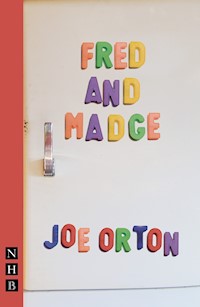
Joe Orton's brilliantly inventive and staggeringly bold first play. Fred and Madge are a normal couple. Or so we think until a director and an audience member start interrupting and reworking this play within a play. Exhilaratingly subversive, the play includes the destruction of the Festival Hall, professional insulters intent on purging society with laughter and a dystopian England overgrown with marigolds. Full of biting satire and sardonic wit, it mingles astutely observed social realism with myth: Fred's job is to push boulders up a hill, and Madge's is to sieve water. Written in 1959, Fred & Madge finally received its premiere in 2014 at the Hope Theatre, London.
Sie lesen das E-Book in den Legimi-Apps auf:
Seitenzahl: 110
Veröffentlichungsjahr: 2014
Das E-Book (TTS) können Sie hören im Abo „Legimi Premium” in Legimi-Apps auf:
Ähnliche

















Joe Orton
FRED & MADGE
NICK HERN BOOKS
London
www.nickhernbooks.co.uk
Contents
Title Page
Original Production
Joe Orton and Fred & Madge
Characters
Fred & Madge
About the Author
Copyright and Performing Rights Information
Fred & Madge was first performed at the Hope Theatre, London, on 15 September 2014, with the following cast:
PETRIEAndy BrockFREDJake CurranMISS OLDBOURNELoz KeystoneWEBBERJordan Mallory-SkinnerMADGEJodyanne RichardsonQUEENIEGeordie WrightDesignerChristopher HoneLighting DesignerSeth Rook-WilliamsCostume DesignerHarriet StantonSound DesignerJordan Mallory-SkinnerProducerAdam Spreadbury-MaherAssistant ProducerRachel IllingworthProduction AssistantRamona PulsfordStage ManagerRobert PerkinsGraphic DesignerDesign by MintyProduction PhotographerChristopher TribbleJoe Orton and Fred & Madge
Thursday February 24th 1949Not a good day. Finished all my work so asked Horace to give me some work I didn’t like cleaning ink wells.
Monday April 11thNot much to say work as usual excruciatingly rotton.
Thursday April 21stI had to help necky in post room it was dead awful.
The above is taken from Joe’s 1949 diary. They show his hatred of the daily grind of mundane workaday life in Leicester. He mirrors these sentiments in the opening scene of Fred & Madge: ‘Oh the boredom! The fatigue of living.’
This monotonous existence was to be his life until he found the theatre, first through joining amateur-dramatic societies in Leicester and eventually securing a place at RADA where he met and eventually moved in with Kenneth Halliwell. For twelve years they lived a monkish existence. The rarely socialised with anyone; they read voluminously and began writing together. They both had a revulsion of the ethics of work that dominates our lives.
‘Do you know what subreption is?’ said Donnelly.
‘No.’
‘To obtain something by misrepresentation. That is what our civilisation does – it holds carrots in the air to make donkeys work. Do you know what it wants in exchange for a house, a car, a larger house, two cars, a television set in every room?’
‘No.’
‘It wants their lives.’
Joe Orton and Kenneth Halliwell, typescript novelThe Boy Hairdresser
In the tradition of Samuel Becket, Ionesco and Pirandello, Orton in this play is experimenting with the theatre of the absurd, a form he intended to return to in the late 1960s. Orton wrote in a footnote of his diaries, ‘I’ve written the first draft of a third play [What the Butler Saw] which will be a conventional form, but the ideas I’ve got for a fourth play won’t be conventional form at all. So you see I am not even committed to the conventional theatre. But I think one should prove that one can do it, like Picasso proved he could paint perfectly recognisable people in his early period and then he went on to some much more experimental things.’*
In Joe’s early novel Head to Toe the character Gombold says: ‘Cleanse my heart give me the ability to rage correctly.’ Later, turning to the genre of farce Joe Orton found his own unique voice and raged exceedingly, wonderfully correctly.
Leonie Orton BarnettJoe’s sister
* Joe Orton cited in Arthur Burke’s Laughter in the Dark: The Plays Of Joe Orton, Greenwich Exchange London 2001, p. 92
Characters
FRED
MADGE
QUEENIE
GLADYS
WEBBER
DR PETRIE
MISS OLDBOURNE
OLD MAN
SYKES
SMALL PART PLAYER
Settings
ACT ONEEngland. A normal room belonging to Fred and Madge.Two fireside chairs and a standard lamp are visible.A children’s playground.A factory.A theatre.
ACT TWOA hospital. Five years later.A home in England.A garden.The Daily Mail Building.
ACT THREEA home in an overgrown jungle of an England.The same, six months later.
ACT ONE
Curtain up. Two fireside chairs and a standard lamp are visible. Silence. FRED and MADGE are sitting, staring into the distance.
FRED. Speak to me.
MADGE (firmly). No.
Silence.
FRED (exploding). Oh, the boredom! the fatigue of living! No merriment, no whoopie, no frolics. We never have a spree. Time hangs heavily on our hands. (Pause.) If we were animal lovers it would give us an interest in life. (Pause.) You do nothing to break the monotony. You haven’t bothered. You’ve let things slide.
MADGE. I have the shoes to think about; the heels, the soles, the polish, the nails.
FRED. Shoes.
MADGE. – shoes!
Silence.
FRED. We could keep pets. (Pause.) What do you say to bats?
MADGE. What about the coal? They’re heavy on coal. And coal isn’t what it used to be. (Pause.) When I remember what it used to be like. The flames –
FRED. – how bright they were.
MADGE. How they leapt up the chimney.
FRED. Up and up, up and up.
MADGE. We couldn’t look at the fire –
FRED. – keep away, you’d say, it’s so bright!
MADGE. How bright it used to be.
FRED. And the nuts we roasted. All those nuts roasting in the flames. All those onions and potatoes in their jackets. Oh!
MADGE (wistfully). We’ve had some exciting moments.
FRED. – those onions in the winter –
MADGE. And there! think of the winter. It’s all right in the summer, but in the winter you’ll wish we’d never bothered. Bats are no company; they hibernate.
FRED. You’re a hard woman.
Silence.
MADGE. What about the time you tried to breed locusts?
FRED (in great agitation). You make me lose confidence bringing that up.
Silence.
Do you think Queenie could lend a hand?
MADGE. I don’t know; she has a lot on her –
FRED. – plate.
MADGE. A lot on her plate –
FRED. – plate.
MADGE. – running the snack counter. (Pause.) They do cold milk now as well as hot.
FRED. It’s a dreary life.
MADGE. Where does it all lead?
FRED. Work, work, work, for forty years and all you get at the end of it is a pension. Not even a thank you.
MADGE. It isn’t good enough.
FRED. People don’t know how to treat one another.
MADGE. It’s a shame.
FRED. Think of the things that could be done to improve people’s lives; they could do a lot to make things pleasant. They might have cards printed saying charming, delightful, felicitous things, and they could distribute them. Give people refreshing smiles in the street. Oh, there’s a lot to be done. (Pause. Bitterly.) Not even a thank you!
MADGE. They don’t stand up in the buses.
FRED. They don’t raise their hats to a lady. Times are bad. Never raising a hat.
MADGE. – hats.
FRED. – hats.
MADGE. – nobody wears hats now.
FRED. Oh! I think the whole world has gone mad!
Silence.
MADGE. That’s what it is.
FRED. Mad.
MADGE. You were always very perceptive, dear.
FRED. Mad.
MADGE. – put your finger right on the –
FRED. Mad.
MADGE. – heart of the matter –
FRED. Mad.
MADGE. – solve all our problems if we –
FRED. Mad.
MADGE. – did away with them all together. (Pause.) I’m frightened. I am. (In a panic.) I’m easily worried and depressed. Everything gets on my nerves. What’s the matter with me?
Silence.
FRED (in a low voice). Bats.
MADGE. We’ve Janice to consider; she’s a growing girl.
FRED. Bats.
MADGE. She’s growing.
FRED. Growing all the time.
MADGE. It wouldn’t be right for her sake.
FRED. No, it wouldn’t be right as she’s growing. (Pause.) Think of a growing girl!
MADGE. She’s getting big now. She’s shooting up.
FRED. The expense is crippling.
MADGE. Yes, the expense is crippling.
FRED. I don’t know which way to turn.
MADGE. It won’t always be the same.
FRED. She’ll stop one day.
MADGE (brightly). It’s something to look forward to.
Silence.
FRED (shocked). She’ll be gone from us. Gone! Our baby. What will we do? What will we do?
MADGE. We’ll be old.
FRED (the idea sinking in). Old. That’s it! We’ll be old. Every minute we’re growing older and older and older and older –
MADGE (sharply). Stop it!
FRED. – and older and older and older. Gradually mouldering away. Turning to –
MADGE. Stop it, will you!
FRED. – dust. Turning to dust. Look at my hand, my arm; they’re firm now, they’re young; in a few years I’ll be wrinkled, toothless, a mass of decay.
MADGE. Stop it!
FRED. I’ll be bald. I’ll be impotent. I’ll be unable to climb stairs. I’ll be cold in the middle of summer. I’ll be garrulous. I’ll be drawing the pension. And soon after that –
MADGE (hysterically). Stop it! stop it! I can’t stand it!
FRED. I’ll be dead. What am I doing sitting here talking when I’ll be dead? What am I doing, mouldering slowly into deaf and lonely old age? There’s something wrong somewhere.
MADGE. What’s it all for? (Pause.) I’m so depressed. My nerves are on edge. I think I ought to see someone about it. I ought to see –
FRED. You ought to see a doctor.
MADGE. I don’t have faith in doctors.
FRED. No, you don’t. And you need faith.
MADGE. And I don’t have any. It’s no good. No good. Everything looks black. What future have we? We’ve no future.
FRED. Age, aches, and the grave; that’s the future.
MADGE. No future.
FRED. You’ve no faith. No faith.
MADGE. None at all.
FRED. Think of the times we could have had. The wasted opportunities. (Pause. With inspiration.) I could have been a clergyman; think of that!
MADGE. It’s a good job.
FRED. Good wages and short hours.
MADGE. It’s steady.
FRED. It’s always there.
MADGE. It’s stimulating. (Pause.) It’s stimulating.
FRED. You give a lot of pleasure to others.
MADGE. It helps to make the world go round.
FRED. All the sermons I could have preached! All the marriages solemnised. (Pause.) I might have got my name in the papers! (Pause.)
Or I might even have been a bus conductor.
MADGE. There’s a lot of climbing stairs on the double-deckers. (In anguish.) What if you were on a single-decker? Oh!
FRED. All the tickets I could have punched.
MADGE. Oh!
FRED. I can’t bear it.
MADGE. I can’t bear it. If you were on a single-decker and they made you climb the stairs – the danger!
FRED. The times I could have rung the bell and made out my returns and done overtime. Pounds out of pocket I am.
MADGE. So dangerous! I’d be a widow. Think of Janice and me left alone. Don’t do it, for our sakes.
FRED. You’re taken care of; I’m insured.
MADGE. What am I going to tell Janice? – she thinks the world of you,
FRED (harassed). I don’t know what to do for the best. I’m out of pocket, and you worrying me – You’ll have me in my grave. Here! see these? Grey hairs. Grey hairs!
MADGE. – oh, dear!
FRED. Grey hairs. I’m only thirty-nine. Thirty-nine; with more grey hairs than my father had when we buried him. He was eighty and not a grey hair.
MADGE. Perhaps it was dye.
FRED. Not a grey hair.
MADGE. Perhaps it was dye.
FRED. I’m going to pieces. This rushing about. Hurrying backwards and forwards. It’s driving me out of my mind. (Pause. In a panic.) Do you know, this morning I – I forgot where I was going. I didn’t know where I was going.
MADGE. You worry too much.
FRED. I worry over you and Janice and the house.
MADGE. Tossing and turning in your sleep. Worry, worry, worry.
Silence.
FRED. I forgot where I was going.
MADGE. Where were you coming from; that’s more to the point?
FRED. I don’t know.
MADGE. You don’t know?
FRED. No.
MADGE. You don’t know where you were coming from either?
FRED. No.
MADGE. It’s very worrying.
Silence.
FRED. I found myself – there – in the street – wondering. I tell you straight, I’m all on edge. It’s the life we lead. This coming and going, and the things they put in the bread.
MADGE. Chemicals.
FRED. The chemicals they put in the bread. It’s not right. It’s not natural. They should leave it alone. Leave it alone and we’d be all right. (Pause.) Oh, I get such a funny feeling sometimes.
MADGE. Funny feeling?
FRED. Here. In my head. As though I were going to do something violent.
MADGE. Something violent.
FRED. Yes.
Silence.
MADGE (plaintively). You never told me this before.
FRED. No.
MADGE. Why not? I have a right to know. I’m your wife. And – Fred – listen to me.
FRED. I am listening.
MADGE. If –
FRED. I am listening.
MADGE. Yes.
FRED. I think I’d like to do something violent to you.
MADGE. Oh, dear.
FRED. – and to Janice.
MADGE. To Janice?
FRED. Do you both a mischief.
MADGE (indignant). Our baby? How could you. The times you’ve told me what a blessing she is. The pleasure she’s given you. (Pause.) She’s such a pet. Such a nice girl. She is.
Silence.
And she’s popular. She must be the most popular girl in the whole school. And it’s frightened her. She isn’t used to it. It’s had a peculiar effect on her; she’s been off her food.
Silence. He stares into the distance; his face wears a blank look.
She’s on about learning to scrub floors; to scrub and polish and cook – it’s a job with a future. (




