


1,99 €
Niedrigster Preis in 30 Tagen: 0,00 €
Niedrigster Preis in 30 Tagen: 0,00 €
Mehr erfahren.
- Herausgeber: Musaicum Books
- Kategorie: Sachliteratur, Reportagen, Biografien
- Sprache: Englisch
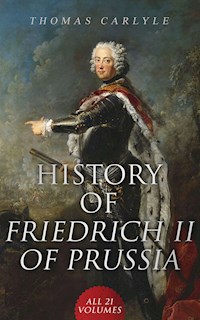
Thomas Carlyle's monumental work, 'Friedrich the Great', is a detailed and insightful examination of the life and reign of Frederick II, the great King of Prussia. Carlyle's narrative style is characterized by its vivid imagery and passionate prose, which brings to life the political and military struggles of Frederick during the 18th century. With painstaking research and a keen eye for historical detail, Carlyle presents a gripping account of the challenges and triumphs that defined Frederick's rule. The book effectively captures the turmoil and grandeur of the era, making it a compelling read for history enthusiasts and scholars alike. As a renowned historian and essayist, Thomas Carlyle was deeply fascinated by great leaders and the impact of their actions on society. His passion for understanding the complexities of history shines through in 'Friedrich the Great', as he delves into the psyche of Frederick and the tumultuous times in which he lived. Carlyle's meticulous approach to storytelling and his unique perspective make this work a standout in the realm of historical biographies. I highly recommend 'Friedrich the Great' to readers who are interested in delving into the life of one of history's most intriguing figures. Carlyle's masterful storytelling and deep historical insights make this book a valuable addition to any library, offering a rich and engaging exploration of power, politics, and leadership. In this enriched edition, we have carefully created added value for your reading experience: - A succinct Introduction situates the work's timeless appeal and themes. - The Synopsis outlines the central plot, highlighting key developments without spoiling critical twists. - A detailed Historical Context immerses you in the era's events and influences that shaped the writing. - An Author Biography reveals milestones in the author's life, illuminating the personal insights behind the text. - A thorough Analysis dissects symbols, motifs, and character arcs to unearth underlying meanings. - Reflection questions prompt you to engage personally with the work's messages, connecting them to modern life. - Hand‐picked Memorable Quotes shine a spotlight on moments of literary brilliance. - Interactive footnotes clarify unusual references, historical allusions, and archaic phrases for an effortless, more informed read.
Das E-Book können Sie in Legimi-Apps oder einer beliebigen App lesen, die das folgende Format unterstützen:
Veröffentlichungsjahr: 2022
Ähnliche


Friedrich the Great (Vol.1-21)
Published by
Books
Table of Contents
Introduction
Between iron necessity and restless genius, a kingdom forges itself in the fire of a single will. Thomas Carlyle’s vast historical project takes this tension as its animating core, pursuing the drama of character meeting circumstance across the crowded stage of eighteenth-century Europe. It is an epic of ideas as much as events, a reckoning with work, duty, and the burdens of leadership. The narrative advances with a novelist’s momentum yet stays anchored in the grain of documented fact. From court corridors to borderlands, it studies how a mind and a state are made, and how both answer the summons of their age.
Thomas Carlyle, the Victorian moralist and historian, published his History of Friedrich II of Prussia, called Frederick the Great in multiple volumes between 1858 and 1865. Long in preparation and monumental in scope, the work crowns his career as a writer of historical portraits. Its subject is Friedrich II—king, strategist, and patron—set within the intricate machinery of European power. Carlyle writes not merely to recount incidents but to disclose the energies that drive them. His method fuses narrative propulsion with documentary density, offering readers a life-and-times that treats the person and the polity as mutually illuminating realities.
The book holds classic status because it combines amplitude of research with a distinctive literary vision. Carlyle’s voice—grave, satiric, exacting—presses beyond chronicle to interpretive history, shaping a model for narrative non-fiction that later writers would adopt or contest. It helped crystallize the nineteenth-century debate about what moves history: impersonal forces or decisive individuals. The work’s enduring themes—duty, administration, character under trial—remain legible independent of particular battles or treaties. Its imaginative verve, coupled with scrupulous attention to sources, left a mark on English prose and set a benchmark for ambitious, document-driven biography.
At its center stands a premise at once biographical and geopolitical: the making of a ruler and the consolidation of a state in an era of shifting alliances. Carlyle begins with ancestry, education, and the strict regimen of a royal household, then moves outward to the wider European field where dynastic interests intersect with new ideas about governance and culture. He prepares the reader to see north German landscapes not as scenery but as strategic and administrative realities. Without foreclosing conclusions, the early volumes assemble the formative pressures that shape Friedrich’s mind, showing how private temperament meets public necessity.
Carlyle’s research was expansive. He read widely in German sources, sifted correspondence and memoranda, and integrated official papers into his narrative fabric. He visited relevant locales to test maps against terrain and to weigh testimony against what the ground itself revealed. In place of abstract generalities, he offers the obstinate particularity of letters, orders, and dates. The resulting texture lets readers hear multiple registers of the age: court etiquette, provincial economies, military logistics, and the intellectual traffic of the Enlightenment. The book strives to make the past palpable, yet it never disguises the interpretive choices required to stitch evidence into meaning.
The style is unmistakable: a cadence that can thunder or whisper, a moral intensity capable of irony, and portraits etched with a draughtsman’s eye. Carlyle lingers over character—the brave, the pedantic, the scheming, the steadfast—and over the stubborn facts that constrain them. He likes to turn a detail until it catches light from several angles, then set it within a large design. Digressions become instruments of insight, mapping connections among bureaucratic reform, philosophical fashion, and the weather of human moods. The prose aspires to prophecy yet remains rooted in the ledger and the dispatch box.
This synthesis of temperament and fact gives the book thematic breadth. Leadership is examined as labor—persistent, repetitive, and often lonely. Duty becomes less a slogan than a daily arithmetic of resource and risk. Fortune and foresight, patience and decisiveness, the ethics of power and the cost of decision—all are tested against the long pressure of events. Carlyle’s vision of the “hero” is not ornamented by flattery; he insists that greatness, if it exists, manifests as work done in stern conditions. In tracing governance from council chamber to village, he portrays statecraft as a moral practice as well as a technical craft.
The work’s literary impact lies also in its challenge to prevailing historical habits. Where some narratives smooth complexity into inevitability, Carlyle dramatizes contingency and character, thereby provoking debate about causation in history. Later scholars would refine, revise, or resist his emphasis on agency, but the conversation often begins at his table. The book helped legitimate a mode of history that is at once archival and artful, elastic enough to hold policy analysis, topographical description, and psychological portraiture. In doing so, it broadened expectations for what a life-and-times can achieve.
Its influence can be seen in the confidence with which later biographers and essayists attempt long-form portraits of political figures. The work demonstrated that biography could illuminate the architecture of an age without dissolving into anecdote, and that a national story could be told through the disciplined focus of a single life. It encouraged writers to read documents not only for data but for cadence and character. Beyond the study, it also widened English-speaking engagement with Prussian history, persuading general readers that the intricate mechanisms of administration and culture are worthy subjects of sustained narrative.
Carlyle structures his narrative as a sequence of interconnected Books, each building layers of context before advancing the life. He is careful with thresholds: genealogies ground the reader, landscapes are fixed before movement begins, and institutions are sketched before decisions test them. The pacing alternates between panoramic survey and close-up scene, allowing patterns to emerge without losing the feel of circumstance. Humor punctuates solemnity, and the occasional sardonic aside prevents piety from clouding judgment. The result is a reading experience that rewards patience with accumulating clarity about how systems and souls interact.
To modern eyes, the work invites both admiration and scrutiny. Its archival industry remains impressive; many citations still guide inquiry. Its valuations—ethical, aesthetic, political—reflect the convictions of its century, and later scholarship has revised aspects of its context and emphasis. Yet the architecture endures because it rests on evidence, crafted narrative, and a sustained effort to see cause and effect without flattening human motive. It is a monument of Victorian historiography that continues to serve as an interpretive companion, even when readers dissent from its judgments.
In an age that asks urgently about leadership, responsibility, and the uses of power, Carlyle’s Friedrich speaks with undiminished relevance. It reminds us that administration is a moral art, that decisions are forged where information, pressure, and character converge, and that nations are built as much by steady labor as by crisis. Read today, the book offers not a manual but a lens: a way to weigh the claims of principle and necessity, to measure rhetoric against results, and to consider how individuals and institutions bind fate together. Its lasting appeal is the clarity of its gaze and the ambition of its craft.
Synopsis
Thomas Carlyle’s multi-volume History of Friedrich II of Prussia, called Frederick the Great (1858–1865), advances a sustained, document-based narrative of Prussia’s rise framed through the life of its most famous ruler. Beginning long before Frederick’s birth, Carlyle situates the monarchy within the geography of Brandenburg and the legacies of the Holy Roman Empire. He emphasizes the incremental construction of authority by the Hohenzollerns, tracing institutions, habits of governance, and the European pressures that molded them. The work presents a dense chronicle of persons, places, and administrative choices, seeking to show how a relatively modest electorate assembled resilience enough to contend with the great powers of eighteenth-century Europe.
Carlyle first recounts the early Hohenzollerns and the consolidation of Brandenburg, charting how scattered territories became a governable whole. He highlights the Electors’ persistent work of taxation, settlement, and military organization, especially amid the turmoil following the Thirty Years’ War. The figure of the “Great Elector” looms large as a builder of stability, shaping the bureaucracy and army on which later rulers would rely. By placing family lineage beside statecraft, Carlyle proposes that Prussia’s character derived from cumulative effort rather than sudden transformation, and he anchors Frederick’s later choices in the administrative habits and strategic horizons inherited from these predecessors.
The narrative then turns to Frederick William I, whose frugal, exacting rule concentrated resources and tightened discipline. Carlyle presents a stark domestic regime oriented to readiness and order, reducing court spectacle while expanding military capacity and supervision of provincial life. Within this stern household, the young Crown Prince Frederick cultivated literature, music, and philosophy, creating a tension between paternal demands and personal inclination. Carlyle treats the conflict as formative, culminating in a crisis that exposed the stakes of disobedience in a militarized state. The episode, and its human costs, becomes a lens through which Carlyle connects family authority, institutional purpose, and the training of a future sovereign.
On Frederick’s accession, Carlyle outlines a ruler steeped in Enlightenment correspondence and policy curiosity, yet determined to test the capabilities he inherited. Intellectual engagements, including a controversial treatise on princely conduct and exchanges with French writers, frame the new king’s ideals. Almost immediately, European succession disputes open opportunities and dangers. Carlyle positions Silesia at the crossroads of legal claims, resources, and prestige, making it the arena in which Frederick’s methods—swift decision, careful logistics, and personal oversight—first become visible. The historian balances court deliberations with field realities, using this phase to show how principles are translated into campaigns and how reputation begins to form.
The ensuing War of the Austrian Succession is treated as a sequence of marches, battles, and diplomatic recalculations, with Prussia’s advances and pauses interleaved among the maneuvers of larger coalitions. Carlyle emphasizes the operational details—timing, terrain, supply, and the stress of winter quarters—while tracking negotiations that reframed objectives as alliances shifted. Battles such as Mollwitz, Hohenfriedberg, and Soor appear as tests not only of tactical agility but also of administrative endurance. Throughout, the historian keeps the wider chessboard in view, observing how courts in Vienna, Paris, London, and other capitals continually redefined what victory, security, and legitimacy could mean.
Between major wars, Carlyle examines governance in peacetime: the repair of finances, the pruning and encouragement of officialdom, and the king’s interventions in agriculture, manufactures, and provincial administration. Policies of religious tolerance and settlement are described as instruments for population and productivity, aligning moral posture with pragmatic state aims. At court and in towns, the arts and letters are cultivated, though never far from the demands of utility. Carlyle highlights the tension between aesthetic aspiration and administrative precision, portraying a ruler who writes, builds, and debates while monitoring taxation, justice, and conscription—an interleaving of culture and control central to the Prussian experiment.
The Seven Years’ War arrives as a continental crisis that places Prussia at the center of converging fronts. Carlyle narrates the compression of time and space: decisions forced by multi-directional threats, marches executed under extreme strain, and battles that alternately buoy and imperil the state. Engagements such as Lobositz, Prague, Kolin, Rossbach, Leuthen, Zorndorf, and Kunersdorf mark phases of adaptation and attrition. Diplomacy intertwines with battlefield outcomes as Britain’s support, Austrian persistence, Russian pressure, and shifting French commitments shape strategy. Carlyle’s focus remains on the mechanics of survival—supply, morale, terrain—while tracing the reciprocal education of ruler and army under unprecedented stress.
After the great war’s exhaustion, Carlyle follows Frederick through reconstruction and guarded statecraft. Administrative tightening resumes, with attention to justice, infrastructure, and economic resilience. Foreign policy turns to vigilance and limited objectives, notably in the Bavarian Succession controversy, where maneuver and provisioning overshadow decisive engagements. Intellectual pursuits continue but with altered tone, as earlier enthusiasms meet the abrasion of experience. Relations with philosophes are revisited alongside the evolving public image of the monarch. Carlyle shows a sober routine—inspection, correspondence, and quiet architectural projects—setting the rhythm for a polity that balances austerity with selective cultivation.
Across its twenty-one books, the history advances an argument about character, labor, and state formation. Carlyle treats Frederick as inseparable from the institutional fabric he inherited and reshaped, proposing that endurance in policy and in war rests on disciplined attention to means as much as ends. Without romanticizing conflict, he probes the costs of greatness and the ambiguities of enlightened rule in a competitive Europe. The work’s lasting significance lies in its fusion of granular narrative with questions about leadership, legitimacy, and responsibility—inviting readers to weigh the interplay of individual agency, administrative tradition, and circumstance without foreclosing their own judgments.
Historical Context
Thomas Carlyle’s multivolume history of Frederick II of Prussia unfolds within the long eighteenth century, when Europe’s political life was dominated by dynastic monarchies, established churches, and expanding bureaucratic states. Prussia, a composite realm centered on Brandenburg and East Prussia, relied on a disciplined army and regimented administration to secure survival amid larger neighbors. The narrative ranges from the early Hohenzollern consolidation after the Thirty Years’ War to Frederick’s reign (1740–1786), against a backdrop of Enlightenment debate, mercantilist economics, and balance-of-power diplomacy. Carlyle writes from nineteenth-century Britain, yet anchors his story in eighteenth-century institutions—hereditary kingship, the estates, and a military-fiscal state—whose pressures shape both policy and everyday life.
The Hohenzollern rise provides Carlyle’s foundation. The Great Elector (r. 1640–1688) restored ravaged Brandenburg, built a standing army, and secured a measure of sovereignty within the Holy Roman Empire. His successors elevated Prussia to a kingdom in 1701. Frederick William I (r. 1713–1740) intensified centralization: he expanded the army, created War and Domain Chambers for provincial administration, and instituted the canton system (from 1733) to tie rural populations to regiment recruitment. Carlyle’s early volumes detail these structures, treating them not as mere prelude but as the machinery that enabled Frederick II’s later military and administrative ventures.
The intellectual climate blended German Pietism and the broader European Enlightenment. Pietism, strong in Brandenburg-Prussia (notably around Halle), shaped Frederick William I’s severity and emphasis on duty. At the same time, the Aufklärung promoted reason, toleration, and scientific inquiry. The Berlin Academy, founded in 1700 and reorganized by Frederick II in 1744 as the Royal Academy of Sciences, symbolized learned ambition. Frederick’s own formation reflected this duality: a francophone prince steeped in French letters and music, yet heir to a Spartan court. Carlyle contrasts Frederick’s cosmopolitan tastes with the stern piety of his father, framing a tension between culture and discipline that runs through the book.
A major geopolitical flashpoint was the succession to the Habsburg lands. The Pragmatic Sanction (1713) sought acceptance of Maria Theresa’s inheritance, but Charles VI’s death in 1740 triggered the War of the Austrian Succession (1740–1748). Frederick seized Silesia in 1740–1741, sparking the First Silesian War and then a second in 1744–1745; the broader conflict entangled France, Britain, Bavaria, Saxony, and others. Carlyle recounts diplomatic gambits, battles, and treaties (notably Breslau and Dresden), interpreting Frederick’s move as audacious statecraft. While presenting the facts of campaign and negotiation, he probes motives—ambition, fear, and calculation—within the era’s dynastic logic.
Military organization and technology undergird the narrative. The early eighteenth century saw standardized flintlocks, socket bayonets, and the Prussian adoption of iron ramrods, which quickened fire. Linear tactics, exact drill, and stringent discipline made Prussian infantry formidable. Frederick refined maneuver with the “oblique order,” seeking local superiority at the decisive point. Supply and staff work remained rudimentary by later standards, making logistics a constant constraint. Carlyle’s battle chapters—marches, deployments, intertwined command decisions—reflect the period’s military culture and the centrality of fortresses, magazines, and season-bound campaigning in shaping strategy and outcomes.
Economically, Prussia exemplified cameralism—an administrative creed that fused fiscal extraction with policies to increase population, production, and state revenue. Administrators managed domains, customs, and excises; monopolies in salt and tobacco, and regulated guilds, framed daily commerce. Frederick pushed land improvement projects, most famously the drainage and settlement of the Oderbruch (mid-century), and promoted manufactures in Silesia after its conquest. Carlyle, alert to ledgers as well as lances, treats these programs as state-building instruments. Yet he notes persistent constraints: fragmented markets, burdensome indirect taxes, and enduring rural subordination that limited the spread of prosperity beyond towns and court.
Cultural life in Frederick’s Prussia blended French styles with local traditions. Court language was often French, and Rococo architecture left its imprint at Potsdam and Sanssouci. Music flourished: Frederick played the flute, employed composers such as C. P. E. Bach, and supported opera. Urban life in Berlin and provincial capitals revolved around guilds, schools, churches, and an evolving print sphere. Postal routes, improved roads, canals, and regimented timetables facilitated circulation of people and ideas. Carlyle situates grand decisions within this texture, acknowledging how ceremonial display, sociability, and increasingly literate publics intersected with the calculus of cabinet politics.
The Diplomatic Revolution of 1756 reshuffled alliances: Prussia aligned with Britain, Austria with France and Russia. The Seven Years’ War (1756–1763) placed Frederick against a powerful coalition. Battles at Rossbach and Leuthen (1757) showcased rapid maneuver; Zorndorf and Kunersdorf revealed attrition’s toll. By 1762 Prussia faced disaster until Russia’s policy shifted after Empress Elizabeth’s death—often termed the “Miracle of the House of Brandenburg.” The Treaty of Hubertusburg (1763) restored the status quo ante in Central Europe and left Prussia in possession of Silesia. Carlyle highlights the human and material costs while analyzing how alliance politics constrained royal will.
Eastern European developments press constantly upon the story. The Polish-Lithuanian Commonwealth’s political paralysis and border vulnerabilities drew Prussia into partition schemes. The First Partition of Poland (1772) gave Prussia West Prussia (excluding Danzig and Thorn), creating a land corridor linking Brandenburg and East Prussia and altering Baltic trade patterns. Carlyle narrates the calculations leading to partition as cold statecraft practiced by Prussia, Russia, and Austria. He traces how the acquisition consolidated territory and revenue, while acknowledging that the rearrangement of populations, jurisdictions, and confessions posed long-term administrative and moral challenges for the expanding Prussian state.
Religious policy in Frederick’s reign combined Enlightenment toleration with fiscal and administrative pragmatism. Prussia accommodated Lutherans and Calvinists, maintained Catholic institutions in Silesia, and—after the papal suppression of the Jesuit order in 1773—permitted Jesuits to continue teaching in Prussian lands for their educational value. Frederick encouraged Huguenot and other immigrant communities, seeing population as wealth. Jewish communities operated under special regulations and taxes, with limited rights varying by locale and privilege. Carlyle presents this as reason-of-state toleration rather than benevolent pluralism, noting both the relative breadth of conscience in Prussia and the inequalities that structured confessional life.
Legal and administrative reforms were ongoing projects rather than a single code. Frederick promoted procedural streamlining, royal oversight of judges, and efforts to reduce judicial torture—limited early in his reign and curtailed further in mid-century ordinances. He encouraged codification, though comprehensive consolidation culminated only under successors with the Allgemeines Landrecht (1794). Provincial War and Domain Chambers managed taxation and infrastructure, while the General Directory in Berlin coordinated policy. Carlyle, attentive to memoranda and decrees, interprets these measures as manifestations of a working monarchy: a sovereign constantly writing, revising, and supervising in pursuit of order and efficiency.
The intellectual milieu around Frederick included transnational correspondence and patronage. Voltaire’s residence at Sanssouci (1750–1753) and subsequent quarrels symbolized convergences and frictions between philosophic critique and royal authority. The Royal Academy sponsored scientific and historical inquiries; French remained the literary medium of Frederick’s own writings, including his anti-Machiavellian tract and historical essays. German letters advanced in the broader period, with Lessing and, later, Kant working in Prussian domains. Carlyle frames Frederick as both participant in and patron of the Enlightenment, yet emphasizes his selective adoption—valuing utility and clarity over metaphysical speculation or radical political theory.
Demography and rural economy shaped state capacity. War, disease, and migration altered population patterns, making colonization and resettlement policies crucial. The crown promoted agricultural innovations and introduced crops such as the potato more widely through edicts and publicity, aiming at food security. Land reclamation projects and settlement of religious refugees, including groups admitted earlier and reinforced under Frederick, strengthened frontier provinces. Silesia’s textile sector received privileges and technical encouragement, while crafts in other towns benefited from targeted support. Carlyle links these measures to fiscal resilience, noting setbacks from harvest failures and wartime disruption, and the uneven diffusion of gains to peasantry bound by estates’ obligations.
War finance was a persistent strain. Indirect taxes and domain revenues rarely covered the costs of extended campaigns. During the Seven Years’ War, the Prussian government resorted to measures including coin debasement in occupied and allied territories, followed by attempts at postwar stabilization. Credit, subsidies from Britain, and requisitions sustained armies but burdened civilians. Carlyle traces the movement of money as carefully as the march of troops, underlining how fiscal improvisation and administrative rigidity coexisted. The result, he argues, was a state hardened by necessity—capable of swift mobilization yet continually balancing solvency, discipline, and the legitimacy of royal command.
Carlyle’s method reflects nineteenth-century archival and narrative ambitions. He mined Prussian archives in Berlin and Potsdam, consulted vast correspondence—royal letters, diplomatic dispatches, memoirs—and visited key sites and battlefields during research trips in the 1850s. The work appeared in installments between 1858 and 1865. Maps, citations, and documentary excerpts support a dramatic, character-driven narrative. He blends minute operational detail with editorial judgments, aspiring to show the “fact” through lived texture. The result is both a repository of transcribed sources and a crafted literary history, revealing as much about Victorian historiography as about eighteenth-century Prussia.
The Victorian context informs Carlyle’s emphases. Writing after the crises of the 1840s and the European revolutions of 1848, and amid Britain’s industrial and imperial transformations, he distrusted rhetoric unmoored from work and authority. His On Heroes, Hero-Worship, and the Heroic in History (1841) articulated a “great man” approach that he carries into Frederick’s portrayal. Debates over parliamentary reform, administrative efficiency, and military professionalism (sharpened by the Crimean War, 1853–1856) shaped British readers’ interests. Carlyle leverages Frederick’s career to comment on leadership, duty, and the perils of ideological abstractions, offering an implicit critique of contemporary laissez-faire and party maneuvering.
Reception reflected these crosscurrents. Many Victorian readers admired the narrative vigor and perceived lessons in organization and resolve; some German audiences valued the rehabilitation of Prussia’s eighteenth-century achievements. Others later faulted the hero-centric frame and moralizing tone, arguing that structural forces—economies, classes, and ideas—deserve fuller weight. As professional historiography developed in German and British universities, Carlyle’s literary method appeared old-fashioned to some, yet his archival labors remained respected. The book helped shape Anglophone images of Frederick and Prussia, embedding terms, episodes, and judgments that subsequent scholars would confirm, nuance, or contest with broader social analysis and comparative perspectives. Carlyle’s work also mirrors tensions within the eighteenth century itself: between Enlightenment rationalization and militarized absolutism, between cosmopolitan letters and provincial hardships, between fiscal engineering and peasant constraint. He shows how diplomacy, administration, and culture intertwined in building a mid-European power under relentless external pressure. At the same time, the nineteenth-century lens is clear—leadership, discipline, and “work” receive pride of place, while parliamentary or popular politics stand at a critical distance. As such, the History functions both as a record of Frederick’s era and as a Victorian meditation on authority, responsibility, and the costs of statecraft.
Author Biography
Thomas Carlyle (1795–1881) was a Scottish essayist, historian, and social critic who became one of the most commanding prose voices of the Victorian era. Writing in a prophetic, highly metaphorical style, he attacked the moral complacency of industrial society while celebrating strenuous labor, character, and leadership. His work ranged from experimental fiction-philosophy in Sartor Resartus to panoramic narrative history in The French Revolution: A History. Carlyle’s pronouncements shaped debates about modernity across Britain, Europe, and the United States, attracting devoted admirers and fierce detractors. Few nineteenth‑century authors combined literary bravura with social diagnosis so forcefully, and few provoked such sustained controversy over politics, ethics, and historical method.
Raised in southwest Scotland, Carlyle studied at the University of Edinburgh, concentrating on mathematics, languages, and philosophy. He did not pursue ordination but turned to teaching and scholarship, acquiring a command of German at a time when few British writers read it closely. German classicism and Romanticism—above all Goethe and Schiller—formed his early canon; he translated, reviewed, and interpreted them for British audiences, and published a Life of Schiller. Equally formative were Enlightenment moralists, the Bible, and contemporary political economy, which he resisted. A lasting friendship with Ralph Waldo Emerson helped introduce his ideas to American readers and linked his thought to Transcendentalist currents.
After brief posts as a schoolmaster and tutor, Carlyle committed to authorship in the 1820s, contributing long review‑essays to leading periodicals. Pieces such as Signs of the Times and Characteristics diagnosed a “mechanical age” governed by quantification and routine. His most daring early work, Sartor Resartus, composed in rural seclusion and issued in serial form in the early 1830s, mixed satire, autobiography, and philosophy in the guise of editing a German savant. Initially puzzling to British readers, it gained a warmer reception in the United States, where Emerson championed it. The book secured Carlyle as an original, if unruly, moralist of modern life.
Carlyle achieved international prominence with The French Revolution: A History (1837), a work of narrative history written in urgent, cinematic prose. After an early manuscript was lost in an accident at a friend’s house, he rewrote the opening volume at speed, producing a book whose intensity and moral fervor stunned contemporaries. It influenced historians, journalists, and novelists—Charles Dickens drew on it for A Tale of Two Cities—and established Carlyle as a master of historical portraiture. Alongside major books, he continued to publish vigorous essays and pamphlets, addressing what he called the “Condition of England” and criticizing utilitarian remedies.
In the 1840s his lectures On Heroes, Hero‑Worship, and the Heroic in History articulated a theory of history driven by exemplary individuals—prophets, poets, priests, and rulers. Past and Present juxtaposed medieval monastic labor with industrial Britain to argue for duty, leadership, and social responsibility. Oliver Cromwell’s Letters and Speeches, with extensive commentary, sought to rescue Cromwell from partisan caricature. The polemical Latter‑Day Pamphlets attacked bureaucratic complacency and mass opinion. Carlyle’s political stances—skeptical of liberal democracy and often authoritarian in tone—were increasingly divisive. An 1849 essay on West Indian labor advanced racist arguments now widely condemned, further complicating his reputation. Life of John Sterling offered a contrastingly humane memorial.
From the late 1850s to the mid‑1860s he published his largest enterprise, a multivolume History of Friedrich II of Prussia, called Frederick the Great, a monument of archival labor and dramatic narration. The work consolidated his status as a national sage, even as critics questioned his emphasis on power and obedience. In the later 1860s he was elected Rector of the University of Edinburgh and delivered a widely discussed address to students. Late writings and the posthumous Reminiscences, edited for publication by James Anthony Froude, sparked debate for their portraits of friends and contemporaries and for the austerity of Carlyle’s self‑judgment.
Carlyle spent his final years in London, withdrawing gradually from public activity while revising earlier work. He died in 1881 and was buried in his native Dumfriesshire. His legacy is double‑edged: he bequeathed an inimitable prose style, a fierce critique of materialism, and a galvanizing ideal of work and duty; yet his defense of hierarchy and his writings on race and empire have drawn sustained moral and scholarly scrutiny. Modern readers encounter both a visionary diagnostician of industrial modernity and a reactionary polemicist. The durability of his influence—on historians, social critics, and transatlantic literature—rests on that tension and on the energy of his language.
Friedrich the Great (Vol.1-21)
Volume 01
Book I. — BIRTH AND PARENTAGE. — 1712.
Chapter I. — PROEM: FRIEDRICH'S HISTORY FROM THE DISTANCE WE ARE AT.
About fourscore years ago, there used to be seen sauntering on the terraces of Sans Souci[1], for a short time in the afternoon, or you might have met him elsewhere at an earlier hour, riding or driving in a rapid business manner on the open roads or through the scraggy woods and avenues of that intricate amphibious Potsdam region, a highly interesting lean little old man, of alert though slightly stooping figure; whose name among strangers was King FRIEDRICH THE SECOND, or Frederick the Great of Prussia, and at home among the common people, who much loved and esteemed him, was VATER FRITZ[2]—Father Fred—a name of familiarity which had not bred contempt in that instance. He is a King every inch of him, though without the trappings of a King. Presents himself in a Spartan simplicity of vesture: no crown but an old military cocked-hat—generally old, or trampled and kneaded into absolute SOFTNESS, if new;—no sceptre but one like Agamemnon's, a walking-stick cut from the woods, which serves also as a riding-stick (with which he hits the horse "between the ears," say authors);—and for royal robes, a mere soldier's blue coat with red facings, coat likely to be old, and sure to have a good deal of Spanish snuff on the breast of it; rest of the apparel dim, unobtrusive in color or out, ending in high over-knee military boots, which may be brushed (and, I hope, kept soft with an underhand suspicion of oil), but are not permitted to be blackened or varnished; Day and Martin with their soot-pots forbidden to approach.
The man is not of godlike physiognomy, any more than of imposing stature or costume: close-shut mouth with thin lips, prominent jaws and nose, receding brow, by no means of Olympian height; head, however, is of long form, and has superlative gray eyes in it. Not what is called a beautiful man; nor yet, by all appearance, what is called a happy. On the contrary, the face bears evidence of many sorrows, as they are termed, of much hard labor done in this world; and seems to anticipate nothing but more still coming. Quiet stoicism, capable enough of what joy there were, but not expecting any worth mention; great unconscious and some conscious pride, well tempered with a cheery mockery of humor—are written on that old face; which carries its chin well forward, in spite of the slight stoop about the neck; snuffy nose rather flung into the air, under its old cocked-hat—like an old snuffy lion on the watch; and such a pair of eyes as no man or lion or lynx of that Century bore elsewhere, according to all the testimony we have. "Those eyes," says Mirabeau[4], "which, at the bidding of his great soul, fascinated you with seduction or with terror (portaient, au gre de son ame heroique, la seduction ou la terreur)." [Mirabeau, Histoire Secrete de la Cour de Berlin, Lettre 28?? (24 September, 1786) p. 128 (in edition of Paris, 1821)]. Most excellent potent brilliant eyes, swift-darting as the stars, steadfast as the sun; gray, we said, of the azure-gray color; large enough, not of glaring size; the habitual expression of them vigilance and penetrating sense, rapidity resting on depth. Which is an excellent combination; and gives us the notion of a lambent outer radiance springing from some great inner sea of light and fire in the man. The voice, if he speak to you, is of similar physiognomy: clear, melodious and sonorous; all tones are in it, from that of ingenuous inquiry, graceful sociality, light-flowing banter (rather prickly for most part), up to definite word of command, up to desolating word of rebuke and reprobation; a voice "the clearest and most agreeable in conversation I ever heard," says witty Dr. Moore. [Moore, View of Society and Manners in France, Switzerland and Germany (London, 1779), ii. 246.] "He speaks a great deal," continues the doctor; "yet those who hear him, regret that he does not speak a good deal more. His observations are always lively, very often just; and few men possess the talent of repartee in greater perfection."
Just about threescore and ten years ago, [A.D. 1856—17th August, 1786] his speakings and his workings came to finis in this World of Time; and he vanished from all eyes into other worlds, leaving much inquiry about him in the minds of men;—which, as my readers and I may feel too well, is yet by no means satisfied. As to his speech, indeed, though it had the worth just ascribed to it and more, and though masses of it were deliberately put on paper by himself, in prose and verse, and continue to be printed and kept legible, what he spoke has pretty much vanished into the inane; and except as record or document of what he did, hardly now concerns mankind. But the things he did were extremely remarkable; and cannot be forgotten by mankind. Indeed, they bear such fruit to the present hour as all the Newspapers are obliged to be taking note of, sometimes to an unpleasant degree. Editors vaguely account this man the "Creator of the Prussian Monarchy;" which has since grown so large in the world, and troublesome to the Editorial mind in this and other countries. He was indeed the first who, in a highly public manner, notified its creation; announced to all men that it was, in very deed, created; standing on its feet there, and would go a great way, on the impulse it had got from him and others. As it has accordingly done; and may still keep doing to lengths little dreamt of by the British Editor in our time; whose prophesyings upon Prussia, and insights into Prussia, in its past, or present or future, are truly as yet inconsiderable, in proportion to the noise he makes with them! The more is the pity for him—and for myself too in the Enterprise now on hand.
It is of this Figure, whom we see by the mind's eye in those Potsdam regions, visible for the last time seventy years ago, that we are now to treat, in the way of solacing ingenuous human curiosity. We are to try for some Historical Conception of this Man and King; some answer to the questions, "What was he, then? Whence, how? And what did he achieve and suffer in the world?"—such answer as may prove admissible to ingenuous mankind, especially such as may correspond to the Fact (which stands there, abstruse indeed, but actual and unalterable), and so be sure of admissibility one day.
An Enterprise which turns out to be, the longer one looks at it, the more of a formidable, not to say unmanageable nature! Concerning which, on one or two points, it were good, if conveniently possible, to come to some preliminary understanding with the reader. Here, flying on loose leaves, are certain incidental utterances, of various date: these, as the topic is difficult, I will merely label and insert, instead of a formal Discourse, which were too apt to slide into something of a Lamentation, or otherwise take an unpleasant turn.
1. FRIEDRICH THEN, AND FRIEDRICH NOW.
This was a man of infinite mark to his contemporaries; who had witnessed surprising feats from him in the world; very questionable notions and ways, which he had contrived to maintain against the world and its criticisms. As an original man has always to do; much more an original ruler of men. The world, in fact, had tried hard to put him down, as it does, unconsciously or, consciously, with all such; and after the most conscious exertions, and at one time a dead-lift spasm of all its energies for Seven Years[3], had not been able. Principalities and powers, Imperial, Royal, Czarish, Papal, enemies innumerable as the seasand, had risen against him, only one helper left among the world's Potentates (and that one only while there should be help rendered in return); and he led them all such a dance as had astonished mankind and them.
No wonder they thought him worthy of notice. Every original man of any magnitude is;—nay, in the long-run, who or what else is? But how much more if your original man was a king over men; whose movements were polar, and carried from day to day those of the world along with them. The Samson Agonistes—were his life passed like that of Samuel Johnson in dirty garrets, and the produce of it only some bits of written paper—the Agonistes, and how he will comport himself in the Philistine mill; this is always a spectacle of truly epic and tragic nature. The rather, if your Samson, royal or other, is not yet blinded or subdued to the wheel; much more if he vanquish his enemies, not by suicidal methods, but march out at last flourishing his miraculous fighting implement, and leaving their mill and them in quite ruinous circumstances. As this King Friedrich fairly managed to do.
For he left the world all bankrupt, we may say; fallen into bottomless abysses of destruction; he still in a paying condition, and with footing capable to carry his affairs and him. When he died, in 1786, the enormous Phenomenon since called FRENCH REVOLUTION was already growling audibly in the depths of the world; meteoric-electric coruscations heralding it, all round the horizon. Strange enough to note, one of Friedrich's last visitors was Gabriel Honore Riquetti, Comte de Mirabeau. These two saw one another; twice, for half an hour each time. The last of the old Gods and the first of the modern Titans;—before Pelion leapt on Ossa; and the foul Earth taking fire at last, its vile mephitic elements went up in volcanic thunder. This also is one of the peculiarities of Friedrich, that he is hitherto the last of the Kings; that he ushers in the French Revolution, and closes an Epoch of World-History. Finishing off forever the trade of King, think many; who have grown profoundly dark as to Kingship and him.
The French Revolution may be said to have, for about half a century, quite submerged Friedrich, abolished him from the memories of men; and now on coming to light again, he is found defaced under strange mud-incrustations, and the eyes of mankind look at him from a singularly changed, what we must call oblique and perverse point of vision. This is one of the difficulties in dealing with his History;—especially if you happen to believe both in the French Revolution and in him; that is to say, both that Real Kingship is eternally indispensable, and also that the destruction of Sham Kingship (a frightful process) is occasionally so. On the breaking-out of that formidable Explosion, and Suicide of his Century, Friedrich sank into comparative obscurity; eclipsed amid the ruins of that universal earthquake, the very dust of which darkened all the air, and made of day a disastrous midnight. Black midnight, broken only by the blaze of conflagrations;—wherein, to our terrified imaginations, were seen, not men, French and other, but ghastly portents, stalking wrathful, and shapes of avenging gods. It must be owned the figure of Napoleon was titanic; especially to the generation that looked on him, and that waited shuddering to be devoured by him. In general, in that French Revolution, all was on a huge scale; if not greater than anything in human experience, at least more grandiose. All was recorded in bulletins, too, addressed to the shilling-gallery; and there were fellows on the stage with such a breadth of sabre, extent of whiskerage, strength of windpipe, and command of men and gunpowder, as had never been seen before. How they bellowed, stalked and flourished about; counterfeiting Jove's thunder to an amazing degree! Terrific Drawcansir figures, of enormous whiskerage, unlimited command of gunpowder; not without sufficient ferocity, and even a certain heroism, stage-heroism, in them; compared with whom, to the shilling-gallery, and frightened excited theatre at large, it seemed as if there had been no generals or sovereigns before; as if Friedrich, Gustavus, Cromwell, William Conqueror and Alexander the Great were not worth speaking of henceforth.
All this, however, in half a century is considerably altered. The Drawcansir equipments getting gradually torn off, the natural size is seen better; translated from the bulletin style into that of fact and history, miracles, even to the shilling-gallery, are not so miraculous. It begins to be apparent that there lived great men before the era of bulletins and Agamemnon. Austerlitz and Wagram shot away more gunpowder—gunpowder probably in the proportion of ten to one, or a hundred to one; but neither of them was tenth-part such a beating to your enemy as that of Rossbach, brought about by strategic art, human ingenuity and intrepidity, and the loss of 165 men. Leuthen, too, the battle of Leuthen (though so few English readers ever heard of it) may very well hold up its head beside any victory gained by Napoleon or another. For the odds were not far from three to one; the soldiers were of not far from equal quality; and only the General was consummately superior, and the defeat a destruction. Napoleon did indeed, by immense expenditure of men, and gunpowder, overrun Europe for a time: but Napoleon never, by husbanding and wisely expending his men and gunpowder, defended a little Prussia against all Europe, year after year for seven years long, till Europe had enough, and gave up the enterprise as one it could not manage. So soon as the Drawcansir equipments are well torn off, and the shilling-gallery got to silence, it will be found that there were great kings before Napoleon—and likewise an Art of War, grounded on veracity and human courage and insight, not upon Drawcansir rodomontade, grandiose Dick-Turpinism, revolutionary madness, and unlimited expenditure of men and gunpowder. "You may paint with a very big brush, and yet not be a great painter," says a satirical friend of mine! This is becoming more and more apparent, as the dust-whirlwind, and huge uproar of the last generation, gradually dies away again.
2. EIGHTEENTH CENTURY.
One of the grand difficulties in a History of Friedrich is, all along, this same, That he lived in a Century which has no History and can have little or none. A Century so opulent in accumulated falsities—sad opulence descending on it by inheritance, always at compound interest, and always largely increased by fresh acquirement on such immensity of standing capital;—opulent in that bad way as never Century before was! Which had no longer the consciousness of being false, so false had it grown; and was so steeped in falsity, and impregnated with it to the very bone, that—in fact the measure of the thing was full, and a French Revolution had to end it. To maintain much veracity in such an element, especially for a king, was no doubt doubly remarkable. But now, how extricate the man from his Century? How show the man, who is a Reality worthy of being seen, and yet keep his Century, as a Hypocrisy worthy of being hidden and forgotten, in the due abeyance?
To resuscitate the Eighteenth Century, or call into men's view, beyond what is necessary, the poor and sordid personages and transactions of an epoch so related to us, can be no purpose of mine on this occasion. The Eighteenth Century, it is well known, does not figure to me as a lovely one; needing to be kept in mind, or spoken of unnecessarily. To me the Eighteenth Century has nothing grand in it, except that grand universal Suicide, named French Revolution, by which it terminated its otherwise most worthless existence with at least one worthy act;—setting fire to its old home and self; and going up in flames and volcanic explosions, in a truly memorable and important manner. A very fit termination, as I thankfully feel, for such a Century. Century spendthrift, fraudulent-bankrupt; gone at length utterly insolvent, without real MONEY of performance in its pocket, and the shops declining to take hypocrisies and speciosities any farther:—what could the poor Century do, but at length admit, "Well, it is so. I am a swindler-century, and have long been—having learned the trick of it from my father and grandfather; knowing hardly any trade but that in false bills, which I thought foolishly might last forever, and still bring at least beef and pudding to the favored of mankind. And behold it ends; and I am a detected swindler, and have nothing even to eat. What remains but that I blow my brains out, and do at length one true action?" Which the poor Century did; many thanks to it, in the circumstances.
For there was need once more of a Divine Revelation to the torpid frivolous children of men, if they were not to sink altogether into the ape condition. And in that whirlwind of the Universe—lights obliterated, and the torn wrecks of Earth and Hell hurled aloft into the Empyrean; black whirlwind, which made even apes serious, and drove most of them mad—there was, to men, a voice audible; voice from the heart of things once more, as if to say: "Lying is not permitted in this Universe. The wages of lying, you behold, are death. Lying means damnation in this Universe; and Beelzebub, never so elaborately decked in crowns and mitres, is NOT God!" This was a revelation truly to be named of the Eternal, in our poor Eighteenth Century; and has greatly altered the complexion of said Century to the Historian ever since.
Whereby, in short, that Century is quite confiscate, fallen bankrupt, given up to the auctioneers;—Jew-brokers sorting out of it at this moment, in a confused distressing manner, what is still valuable or salable. And, in fact, it lies massed up in our minds as a disastrous wrecked inanity, not useful to dwell upon; a kind of dusky chaotic background, on which the figures that had some veracity in them—a small company, and ever growing smaller as our demands rise in strictness—are delineated for us.—"And yet it is the Century of our own Grandfathers?" cries the reader. Yes, reader! truly. It is the ground out of which we ourselves have sprung; whereon now we have our immediate footing, and first of all strike down our roots for nourishment;—and, alas, in large sections of the practical world, it (what we specially mean by IT) still continues flourishing all round us! To forget it quite is not yet possible, nor would be profitable. What to do with it, and its forgotten fooleries and "Histories," worthy only of forgetting?—Well; so much of it as by nature ADHERES; what of it cannot be disengaged from our Hero and his operations: approximately so much, and no more! Let that be our bargain in regard to it.
3. ENGLISH PREPOSSESSIONS.
With such wagon-loads of Books and Printed Records as exist on the subject of Friedrich, it has always seemed possible, even for a stranger, to acquire some real understanding of him;—though practically, here and now, I have to own, it proves difficult beyond conception. Alas, the Books are not cosmic, they are chaotic; and turn out unexpectedly void of instruction to us. Small use in a talent of writing, if there be not first of all the talent of discerning, of loyally recognizing; of discriminating what is to be written! Books born mostly of Chaos—which want all things, even an INDEX—are a painful object. In sorrow and disgust, you wander over those multitudinous Books: you dwell in endless regions of the superficial, of the nugatory: to your bewildered sense it is as if no insight into the real heart of Friedrich and his affairs were anywhere to be had. Truth is, the Prussian Dryasdust, otherwise an honest fellow, and not afraid of labor, excels all other Dryasdusts yet known; I have often sorrowfully felt as if there were not in Nature, for darkness, dreariness, immethodic platitude, anything comparable to him. He writes big Books wanting in almost every quality; and does not even give an INDEX to them. He has made of Friedrich's History a wide-spread, inorganic, trackless matter; dismal to your mind, and barren as a continent of Brandenburg sand!—Enough, he could do no other: I have striven to forgive him. Let the reader now forgive me; and think sometimes what probably my raw-material was!—
Curious enough, Friedrich lived in the Writing Era—morning of that strange Era which has grown to such a noon for us;—and his favorite society, all his reign, was with the literary or writing sort. Nor have they failed to write about him, they among the others, about him and about him; and it is notable how little real light, on any point of his existence or environment, they have managed to communicate. Dim indeed, for most part a mere epigrammatic sputter of darkness visible, is the "picture" they have fashioned to themselves of Friedrich and his Country and his Century. Men not "of genius," apparently? Alas, no; men fatally destitute of true eyesight, and of loyal heart first of all. So far as I have noticed, there was not, with the single exception of Mirabeau for one hour, any man to be called of genius, or with an adequate power of human discernment, that ever personally looked on Friedrich. Had many such men looked successively on his History and him, we had not found it now in such a condition. Still altogether chaotic as a History; fatally destitute even of the Indexes and mechanical appliances: Friedrich's self, and his Country, and his Century, still undeciphered; very dark phenomena, all three, to the intelligent part of mankind.
In Prussia there has long been a certain stubborn though planless diligence in digging for the outward details of Friedrich's Life-History; though as to organizing them, assorting them, or even putting labels on them; much more as to the least interpretation or human delineation of the man and his affairs—you need not inquire in Prussia. In France, in England, it is still worse. There an immense ignorance prevails even as to the outward facts and phenomena of Friedrich's life; and instead of the Prussian no-interpretation, you find, in these vacant circumstances, a great promptitude to interpret. Whereby judgments and prepossessions exist among us on that subject, especially on Friedrich's character, which are very ignorant indeed.
To Englishmen, the sources of knowledge or conviction about Friedrich, I have observed, are mainly these two. FIRST, for his Public Character: it was an all-important fact, not to IT, but to this country in regard to it, That George II., seeing good to plunge head-foremost into German Politics, and to take Maria Theresa's side in the Austrian-Succession War of 1740–1748, needed to begin by assuring his Parliament and Newspapers, profoundly dark on the matter, that Friedrich was a robber and villain for taking the other side. Which assurance, resting on what basis we shall see by and by, George's Parliament and Newspapers cheerfully accepted; nothing doubting. And they have re-echoed and reverberated it, they and the rest of us, ever since, to all lengths, down to the present day; as a fact quite agreed upon, and the preliminary item in Friedrich's character. Robber and villain to begin with; that was one settled point.
Afterwards when George and Friedrich came to be allies, and the grand fightings of the Seven-Years War took place, George's Parliament and Newspapers settled a second point, in regard to Friedrich: "One of the greatest soldiers ever born." This second item the British Writer fully admits ever since: but he still adds to it the quality of robber, in a loose way;—and images to himself a royal Dick Turpin, of the kind known in Review-Articles, and disquisitions on Progress of the Species, and labels it FREDERICK; very anxious to collect new babblement of lying Anecdotes, false Criticisms, hungry French Memoirs, which will confirm him in that impossible idea. Had such proved, on survey, to be the character of Friedrich, there is one British Writer whose curiosity concerning him would pretty soon have died away; nor could any amount of unwise desire to satisfy that feeling in fellow-creatures less seriously disposed have sustained him alive, in those baleful Historic Acherons and Stygian Fens, where he has had to dig and to fish so long, far away from the upper light!—Let me request all readers to blow that sorry chaff entirely out of their minds; and to believe nothing on the subject except what they get some evidence for.
SECOND English source relates to the Private Character. Friedrich's Biography or Private Character, the English, like the French, have gathered chiefly from a scandalous libel by Voltaire, which used to be called Vie Privee du Roi de Prusse (Private Life of the King of Prussia) [First printed, from a stolen copy, at Geneva, 1784; first proved to be Voltaire's (which some of his admirers had striven to doubt), Paris, 1788; stands avowed ever since, in all the Editions of his Works (ii. 9–113 of the Edition by Bandouin Freres, 97 vols., Paris, 1825–1834), under the title Memoires pour servir a Vie de M. de Voltaire,—with patches of repetition in the thing called Commentaire Historique, which follows ibid. at great length.] libel undoubtedly written by Voltaire, in a kind of fury; but not intended to be published by him; nay burnt and annihilated, as he afterwards imagined; No line of which, that cannot be otherwise proved, has a right to be believed; and large portions of which can be proved to be wild exaggerations and perversions, or even downright lies—written in a mood analogous to the Frenzy of John Dennis. This serves for the Biography or Private Character of Friedrich; imputing all crimes to him, natural and unnatural;—offering indeed, if combined with facts otherwise known, or even if well considered by itself, a thoroughly flimsy, incredible and impossible image. Like that of some flaming Devil's Head, done in phosphorus on the walls of the black-hole, by an Artist whom you had locked up there (not quite without reason) overnight.
Poor Voltaire wrote that Vie Privee in a state little inferior to the Frenzy of John Dennis—how brought about we shall see by and by. And this is the Document which English readers are surest to have read, and tried to credit as far as possible. Our counsel is, Out of window with it, he that would know Friedrich of Prussia! Keep it awhile, he that would know Francois Arouet de Voltaire, and a certain numerous unfortunate class of mortals, whom Voltaire is sometimes capable of sinking to be spokesman for, in this world!—Alas, go where you will, especially in these irreverent ages, the noteworthy Dead is sure to be found lying under infinite dung, no end of calumnies and stupidities accumulated upon him. For the class we speak of, class of "flunkies doing saturnalia below stairs," is numerous, is innumerable; and can well remunerate a "vocal flunky" that will serve their purposes on such an occasion!—
Friedrich is by no means one of the perfect demigods; and there are various things to be said against him with good ground. To the last, a questionable hero; with much in him which one could have wished not there, and much wanting which one could have wished. But there is one feature which strikes you at an early period of the inquiry, That in his way he is a Reality; that he always means what he speaks; grounds his actions, too, on what he recognizes for the truth; and, in short, has nothing whatever of the Hypocrite or Phantasm. Which some readers will admit to be an extremely rare phenomenon. We perceive that this man was far indeed from trying to deal swindler-like with the facts around him; that he honestly recognized said facts wherever they disclosed themselves, and was very anxious also to ascertain their existence where still hidden or dubious. For he knew well, to a quite uncommon degree, and with a merit all the higher as it was an unconscious one, how entirely inexorable is the nature of facts, whether recognized or not, ascertained or not; how vain all cunning of diplomacy, management and sophistry, to save any mortal who does not stand on the truth of things, from sinking, in the long-run. Sinking to the very mud-gods, with all his diplomacies, possessions, achievements; and becoming an unnamable object, hidden deep in the Cesspools of the Universe. This I hope to make manifest; this which I long ago discerned for myself, with pleasure, in the physiognomy of Friedrich and his life. Which indeed was the first real sanction, and has all along been my inducement and encouragement, to study his life and him. How this man, officially a King withal, comported himself in the Eighteenth Century, and managed not to be a Liar and Charlatan as his Century was, deserves to be seen a little by men and kings, and may silently have didactic meanings in it.
He that was honest with his existence has always meaning for us, be he king or peasant. He that merely shammed and grimaced with it, however much, and with whatever noise and trumpet-blowing, he may have cooked and eaten in this world, cannot long have any. Some men do COOK enormously (let us call it COOKING, what a man does in obedience to his HUNGER merely, to his desires and passions merely)—roasting whole continents and populations, in the flames of war or other discord;—witness the Napoleon above spoken of. For the appetite of man in that respect is unlimited; in truth, infinite; and the smallest of us could eat the entire Solar System, had we the chance given, and then cry, like Alexander of Macedon, because we had no more Solar Systems to cook and eat. It is not the extent of the man's cookery that can much attach me to him; but only the man himself, and what of strength he had to wrestle with the mud-elements, and what of victory he got for his own benefit and mine.
4. ENCOURAGEMENTS, DISCOURAGEMENTS.
French Revolution having spent itself, or sunk in France and elsewhere to what we see, a certain curiosity reawakens as to what of great or manful we can discover on the other side of that still troubled atmosphere of the Present and immediate Past. Curiosity quickened, or which should be quickened, by the great and all-absorbing question, How is that same exploded Past ever to settle down again? Not lost forever, it would appear: the New Era has not annihilated the old eras: New Era could by no means manage that;—never meant that, had it known its own mind (which it did not): its meaning was and is, to get its own well out of them; to readapt, in a purified shape, the old eras, and appropriate whatever was true and NOT combustible in them: that was the poor New Era's meaning, in the frightful explosion it made of itself and its possessions, to begin with!
And the question of questions now is: What part of that exploded Past, the ruins and dust of which still darken all the air, will continually gravitate back to us; be reshaped, transformed, readapted, that so, in new figures, under new conditions, it may enrich and nourish us again? What part of it, not being incombustible, has actually gone to flame and gas in the huge world-conflagration, and is now GASEOUS, mounting aloft; and will know no beneficence of gravitation, but mount, and roam upon the waste winds forever—Nature so ordering it, in spite of any industry of Art? This is the universal question of afflicted mankind at present; and sure enough it will be long to settle.




