


3,99 €
Mehr erfahren.
- Herausgeber: Inscript Books
- Kategorie: Religion und Spiritualität
- Sprache: Englisch
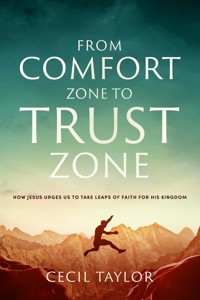
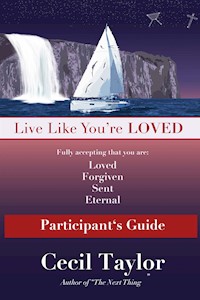
The innate human longing for comfort is undeniable. However, Jesus challenges us to step beyond the boundaries of our comfort zones and venture into the profound realm of faith, aptly described as trust zones by Cecil Taylor. These are the spaces where we dare to take risks in service of Christ's Kingdom. In this enlightening exploration of the Bible, Cecil Taylor delves into 12 narratives of Jesus encouraging individuals to forsake their comfort zones in favor of trust zones. Through insightful interpretation, he unveils the valuable lessons these stories impart for contemporary followers of Jesus.
Das E-Book können Sie in Legimi-Apps oder einer beliebigen App lesen, die das folgende Format unterstützen:
Veröffentlichungsjahr: 2024
Ähnliche
















From Comfort Zone to Trust Zone:
How Jesus Urges Us to Take Leaps of Faith for His Kingdom
Copyright 2023 by Cecil Taylor
All rights reserved.
No part of this work may be reproduced or transmitted in any form or by any means, electronic or mechanical, including photocopying and recording, or by any information storage or retrieval system, except as may be expressly permitted by the 1976 Copyright Act or in writing from the publisher. Requests for permission can be addressed to Inscript Books, a division of Dove Christian Publishers, P.O. Box 611, Bladensburg, MD 20710-0611, www.inscriptpublishing.com.
Please note the information contained within this document is for educational and entertainment purposes only. No warranties of any kind are declared or implied. By reading this document, the reader agrees that under no circumstances is the author responsible for any losses, direct or indirect, that are incurred as a result of the use of the information contained within this document, including, but not limited to, errors, omissions, or inaccuracies.
e-Book Edition
All Scripture quotations are taken from the Holy Bible, New International Version®, NIV®. Copyright © by Biblica, Inc.™ Used by permission of Zondervan. All rights reserved worldwide. www.zondervan.com The “NIV” and “New International Version” are trademarks registered in the United States Patent and Trademark Office by Biblica, Inc.™ Version 2011 is used.
Inscript and the portrayal of a pen with script are trademarks of Dove Christian Publishers.
Published in the United States of America
Cover
Copyright Page
Now Entering the Trust Zone
Taking Risks
Going All-In
Replacing Status-Seeking with Servanthood
Releasing Your Sins and Your Stones
Looking at Jesus Rather Than Obstacles
Exchanging the Familiar for a New Calling
Relinquishing Certainty, Embracing Uncertainty
Trading Governments and Empires for Jesus’ Kingdom
Leaving Safety for Danger
Yielding Your Privilege for Humble Service
Journeying from Separation to Brotherhood
Implementing Jesus’ Vision of Loving Unity
Summary of Comfort and Trust Zones
Go Deeper with the Participant’s Guide
Please Review This Book!
Free Mini-Book Offer: The Disciple Profiles
Free Mini-Book Offer: The Eternal Trust Zone
About the Author
Cecil’s Social Media URLs and QR Codes
Free Offer: Subscription to Cecil Taylor Ministries Plus Gift
Gratitude
Endnotes
Landmarks
Cover
Now Entering the Trust Zone
When we commit to becoming disciples of Christ, we need to understand what it means to be a disciple. What does Jesus require of us? What do those requirements mean to our daily lives? How can we apply the stories and sayings of Jesus to life situations?
As I read the Gospels, I’m struck by how often Jesus challenges people, urging them to leave their pasts behind, to immediately follow him, to repent and change their ways, to take risks, to do uncomfortable things to serve his kingdom, to trust utterly with faith that at its fullest would move mountains.
1 The very first disciples, as described in the Gospel of John, are thought to be Andrew and John. They learned quickly about Jesus’ challenges to take risks. Scripture tells us they quit following John the Baptist to literally follow behind Jesus, who turned and asked them, “What are you looking for?”
They answered, “Rabbi, where are you staying?” Their intent was to have a deeper conversation with Jesus, to build a deeper relationship. And Jesus replied, “Come and see!”
Come and see! Jesus made no promises of what their discipling lives would be like. He didn’t offer a salary or benefits or even a job description. He essentially said, “Dive in, and you’ll figure it out.”
Jesus still instructs us to dive in today. Jesus is looking for new, risk-taking disciples today to join him in his kingdom on earth. And he’s looking for his current disciples to also take risks and go deeper in their faith and trust.
From Comfort Zone to Trust Zone is a Bible study that explores a dozen ways that Jesus urges you to move from your comfort zone into his trust zone – the place where you come and see, the place where you dive in, where you go deeper with him, where you move mountains with faith, where his kingdom is revealed.
Comfort Zones vs. Trust Zones
“Comfort zone” is a familiar term. I imagine we hear this phrase almost every day.
“Trust zone” is a term I made up – as far as I know. Thus, it needs definition.
What is a comfort zone, and what might a trust zone be? I asked this of a class I was teaching. Some of their brainstorming ideas:
COMFORT ZONE
EasySafePeacefulFamiliarPeople you knowConfidentRestRelaxedHassle-freeNo riskTRUST ZONE
Out of comfort zoneIn dangerSafety netFeeling free to speakComfortably vulnerableNo judgmentTrustingWhat struck me about their perceptions is that a trust zone may contain risk and danger, but it also includes comfort and safety of its own.
Clearly, I don’t expect you to feel comfortable about leaving your comfort zone. My role is to point out what Jesus said and did, and to help push you toward the new, the ambiguous, the uncertain. But you won’t be alone there. Because as we’ll learn, Jesus is always with you in the trust zone.
A Trust Zone Analogy
I have a hobby of ascending tall towers wherever I travel: The Empire State Building and CN Tower in North America, the Eiffel Tower and Vienna Tower in Europe, Taipei 101 and Tokyo Skytree in Asia, Melbourne Skydeck in Australia, and many more famous and not-so-well-known towers. I love the views where I can learn about the surrounding area. I look forward to the elevator journeys up and down, which with new technology, are becoming faster all the time. I enjoy the stories of how these towers were built.
These days, many of them have added a clear floor, upon which you can stand, look down through your feet, and see the ground hundreds of feet below. The first such floor I visited is previously pictured, at Calgary Tower. Those aren’t my feet, but that is indeed the view I saw and remember!
It’s a disconcerting experience; all of your senses warn you that you are in danger of falling, yet you’re actually standing on a solid, secure platform.
The most wicked tower glass experience I witnessed was at Melbourne Skydeck. It’s a skyscraper with an observation deck and a “torture chamber” you pay for called Edge. Adventurous visitors enter an enclosed glass cube that slides out horizontally from the building, seemingly without any support. I wasn’t so adventurous, so I decided to watch from a side point of view to see its operation before I tried it.
I don’t know if Skydeck does this anymore, but when I visited in 2010, the cube’s glass was tinted so you couldn’t see out as the cube slid into the sky. Here’s the wicked part: The cube would stop, and the tinted color would seem to fall, replaced by transparency, at the same moment that the sound of shattering glass was played! The effect was to momentarily make you think that the cube had been shattered, and you were going to fall.
It’s a scream-o ride. People experienced a terrifying instant, then laughter would follow. For some. The rest were still shaken. I watched this several times and decided Edge wasn’t for me.
Grand Canyon Skywalk is a 10-foot wide, horseshoe-shaped glass bridge that extends 70 feet out over the canyon. While I’m fascinated by glass floors, my senses twang too much for me to walk such a distance without freaking out!
I took this selfie while lying on the transparent floor at Lotte Tower in Seoul, clowning around, knowing it was safe. Yet I could not bring myself to put my whole body on the clear surface, although that floor is probably as sturdy and supportive as the surrounding concrete. But I was lying on a trust zone, right?
This is what it’s like when we obey Jesus’ urging to take risks for His kingdom. We’re actually led to solid ground, perhaps the most solid ground we’ve ever stood upon, but it doesn’t look like it. It’s like a glass floor. It feels uncomfortable, disorienting, and even hazardous. We worry that the structure will collapse, and we may fall at any moment. But Jesus will support us when we take those risks, loving us, providing help, even carrying us if we need it. That’s when you’re in Jesus’ trust zone.
Challenging Your Faith
I found this quote to be most interesting and worth considering. It comes from Alexander Lang, a former pastor who became burned out in his job. Here’s one reason.
Most Christians don’t want their thinking challenged. They come to church to reinforce what they’ve believed their entire lives. From their perspective, the job of the pastor is not to push them to grow, but to reassure them that they are already on the right track. Any learning should support the party line and comfort them that their investment of resources in the church will result in a payoff somewhere down the line, particularly once they reach the afterlife. 2
This book may indeed show you that you are on the right track, in some ways. But this book will also challenge your faith and push you to grow.
There are 12 comfort zones and 12 corresponding trust zones identified in this book.
You may find that some comfort zones do not apply to you. You are past those comfort zones and are already in the corresponding trust zones.You may find that a comfort zone sort of applies to you. You can see where you can improve your faith walk by following the description of the trust zone.You may find comfort zone descriptions that hit a nerve, that make your cheeks turn red with shame or make your blood boil with anger. Pay close attention to these, because you have located your cherished comfort zones, and you should seriously consider how to leap from them to the corresponding trust zones. This is where you can grow your faith. But you’re going to have to change, leaving behind something you have long believed or followed. Listen closely to what Jesus has to say to you through scripture and through this book.Now let’s start our study of 12 Bible stories in which Jesus challenges people to enter a trust zone, learning how to apply these stories to our 7-day practical faith journey.
Taking Risks
Bravado. Courageous. Boldness. Audacity. Adventuresome.
You might find these words in a thesaurus to represent risk-taking and risk-takers. They certainly sound accurate on the surface.
Then again, I know this phrase as well: “Sometimes not taking a risk is taking a risk.” Life calls us forward whether we want to take a risk or not. It can be dicey to try to stay in the same comfortable place.
What I want to show in this chapter is that there is another side of risk-taking that should inform us Christians as we strive to live a 7-day practical faith. It is a dimension of attitude, priority, and obligation, all in the service of God.
I would never skydive. Uh-uh. Too risky! But I would (and did) quit my job to fully launch Cecil Taylor Ministries, because I sensed over a period of years that I was called to do so.
If God ever called me to skydive, I would have to reconsider. Thankfully, that call will probably never come!
A Parable of Risk-Taking
The core Bible passage for this chapter is also the core passage for the entire book. It has traditionally been labeled as the Parable of the Talents, but I opt for an updated label called the Parable of the Bags of Gold.
The reason is that the word “talent” gives us English speakers the wrong impression. We think of talents as gifts or abilities. But back in Biblical days, “talents” indicated weight. When the parable reads that a person was given five talents, that indicates the measure of the weight of the coins or gold handed over.
With that in mind, let’s examine the Parable of the Bags of Gold, as Jesus tells the tale in Matthew 25: 14-30.
“Again, it will be like a man going on a journey, who called his servants and entrusted his wealth to them. To one he gave five bags of gold, to another two bags, and to another one bag, each according to his ability. Then he went on his journey. The man who had received five bags of gold went at once and put his money to work and gained five bags more. So also, the one with two bags of gold gained two more. But the man who had received one bag went off, dug a hole in the ground and hid his master’s money.
3 “After a long time the master of those servants returned and settled accounts with them. The man who had received five bags of gold brought the other five. ‘Master,’ he said, ‘you entrusted me with five bags of gold. See, I have gained five more.’
“His master replied, ‘Well done, good and faithful servant! You have been faithful with a few things; I will put you in charge of many things. Come and share your master’s happiness!’
“The man with two bags of gold also came. ‘Master,’ he said, ‘you entrusted me with two bags of gold; see, I have gained two more.’
“His master replied, ‘Well done, good and faithful servant! You have been faithful with a few things; I will put you in charge of many things. Come and share your master’s happiness!’
“Then the man who had received one bag of gold came. ‘Master,’ he said, ‘I knew that you are a hard man, harvesting where you have not sown and gathering where you have not scattered seed. So I was afraid and went out and hid your gold in the ground. See, here is what belongs to you.’
“His master replied, ‘You wicked, lazy servant! So you knew that I harvest where I have not sown and gather where I have not scattered seed? Well then, you should have put my money on deposit with the bankers, so that when I returned I would have received it back with interest.
“‘So take the bag of gold from him and give it to the one who has ten bags. For whoever has will be given more, and they will have an abundance. Whoever does not have, even what they have will be taken from them. And throw that worthless servant outside, into the darkness, where there will be weeping and gnashing of teeth.’
Scottish theologian William Barclay wrote, “In this parable Jesus tells us that there can be no religion without adventure.” 4 To what adventure is Christ calling you?
Let’s clarify a few things about the parable. The bags of gold belong to the master (meaning, God). They never belong to the individual. Any benefits from managing the money also go to the master. It’s not clear what percentage, if any, goes to the servant.
The master is pleased with those who invested and doubled his money. To invest means to take a risk. If you’ve ever invested, you know that there are few promises about the return. Financial caveats state that the more return you seek, the bigger the associated risk. The two servants who were able to double the master’s money took big, risky swings to do so.
The servants were given bags of gold to work with. What do these bags of gold represent? Ray Stedman points out that they stand for opportunities:
(The bags of gold) represent the opportunities that come to us, as professing Christians, to invest and utilize the natural abilities that God has given us, not on our behalf, but for Christ’s sake…
They are moments of fateful decision when we are confronted with the question of whether we are willing to invest our life and risk the loss of something we want, in order that God may have something he wants…
These opportunities to invest your life for his sake or save it for yourself are God-given opportunities which he provides. In that fateful moment we hang between heaven and hell, a moment of crisis and decision.5
The first two servants took that risk for the sake of their master. But the third servant did not.
That servant hid the money and returned to the master the same sum given. The master was furious because the servant did not at least invest the money in a bank for some nominal, low-risk return.
Here’s a question: Exactly what did the third servant do while the master was gone? He clearly wasn’t acting in the master’s interests. It’s easy to conclude that the servant was lazy, but I think the problem goes deeper than that.
My conclusion is that the third servant was working for himself.
Just as he did not invest the money, he also invested neither time nor energy on the master’s behalf. The servant felt no debt or obligation to the master. He selfishly worked for himself, ignoring the opportunities the master gave him, and then came up with a lame, rather rude excuse when called to account. Stedman interprets the third servant’s excuse in this way:




