


139,99 €
Mehr erfahren.
- Herausgeber: John Wiley & Sons
- Kategorie: Wissenschaft und neue Technologien
- Sprache: Englisch
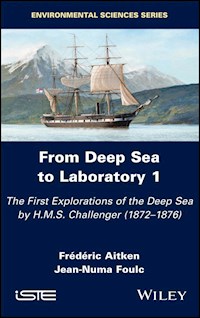
The scientific expedition of H.M.S. Challenger in the 1870s marks the starting point of physical oceanography. This ship traveled the seas of the globe pursuing a dual objective: to conduct an in-depth study of animal life and to observe the physical properties of ocean waters. Volume 1, richly illustrated, relates the expedition of the Challenger and addresses the problems of measuring the great depths. A theoretical approach to the immersion velocity of a probe is also proposed, as well as a presentation of some results of bathymetric surveys and physical observations made by the Challenger scientists. From Deep Sea to Laboratory is available in three volumes for curious readers drawn to travel, history and science. Students, researchers and teachers of physics, fluid mechanics and oceanography will find material to deepen their knowledge.
Sie lesen das E-Book in den Legimi-Apps auf:
Seitenzahl: 357
Veröffentlichungsjahr: 2019
Ähnliche
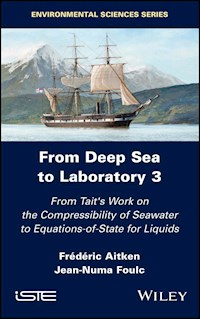
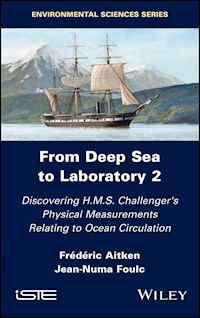

















Table of Contents
Cover
Foreword
Preface
1 Background and Challenges of Submarine Exploration in the 19th Century
1.1. Submarine exploration
1.2. Means of communication in the 19th Century: birth of the telegraph
1.3. Establishment of the first international telecommunications network
1.4. Economic and political contexts of England in the 1870s
2 Sailors and Scientists of the H.M.S.
Challenger
2.1. Introduction
2.2. Biographies of the Royal Navy officers
2.3. Biographies of the scientific team
2.4. List of officers, scientists and members of the technical, medical and administrative bodies of the
Challenger
expedition when departing from Portsmouth, on December 21, 1872
3 Narrative Summary of the H.M.S.
Challenger
Cruise
3.1. Introduction
3.2. Explorations in 1873
3.3. Explorations in 1874
3.4. Explorations in 1875
3.5. Explorations in 1876
3.6. Epilogue of the cruise
4 Scientific Equipment and Observations of the H.M.S.
Challenger
4.1. Introduction
4.2. The H.M.S.
Challenger
and its scientific facilities
4.3. Dredging and sounding instruments
4.4. Dredging, trawling and sounding methods
4.5. Immersion speed of a sounding apparatus
4.6. Contribution of the H.M.S.
Challenger’s
expedition to knowledge of seabed relief
4.7. Observation of the ocean waters during the expedition of the H.M.S.
Challenger
Conclusion
References
Index
End User License Agreement
List of Illustrations
Illustration representative of the book
Illustration representative of the book: the Challenger expedition (route, vol. …
Chapter 1
Leaves of gutta-percha
Figure 1.1. Thermohaline circulation. Oceanic convective motion generated by dif…
Figure 1.2. Map of the British colonial empire (zones in red) in 1897. For a col…
Figure 1.3. Chappe telegraph. The semaphore consists of a main arm (AB), called …
Figure 1.4. Georges Lesage’s electrostatic telegraph. In the foreground, there i…
Figure 1.5. Principle of the Morse telegraph. The illustrated Morse telegraph co…
Figure 1.6. Example of coding “telegraph” in Morse code. The electric signal is …
Figure 1.7. Illustration of Isonandra gutta. This tree, which grows abundantly i…
Figure 1.8. Construction of the 1851 Dover–Calais cable: (a) central conductor, …
Figure 1.9. Brooke’s sounding machine: (a) in the descending position; (b) when …
Figure 1.10. Simplified model of a submarine telegraph line. Transmitter (E: ele…
Figure 1.11. Example of coding “telegraph” in the Recorder code. The electric si…
Figure 1.12. Constitution of transatlantic submarine cables of 1865 and 1866
Figure 1.13. Loading the transatlantic cable in 1866 in the Great Eastern’s hold…
Figure 1.14. Operation to recover the transatlantic cable submerged in 1865. Sai…
Figure 1.15. International telegraph cable network in 1901. For a color version …
Portrait 1.1. William Ewart Gladstone (1809–1898). British Prime Minister, Liber…
Portrait 1.2. Benjamin Disraeli (1804–1881). British Prime Minister, leader of t…
Chapter 2
John Wild in the Kerguelen Islands
Figure 2.1. H.M.S. Lightning. 38 m long gunboat with paddle wheels built in 1823…
Figure 2.2. A rare photograph of H.M.S. Porcupine. 43 m long warship with paddle…
Figure 2.3. H.M.S. Shearwater. 49 m long propeller ship built in 1861, in Pembro…
Figure 2.4. Seamen who were the crew of the canoe-shuttle transporting officers …
Figure 2.5. Map of England (Mercator projection). After being refurbished and eq…
Figure 2.6. Scientists, officers and training staff on board the H.M.S. Challeng…
Portrait 2.1. Edward Forbes (1815–1854). Professor of Natural History at the Uni…
Portrait 2.2. George Joachim Goschen (1831–1907). First Lord of the Admiralty (©…
Portrait 2.3. George Biddell Airy (1801–1892). Royal Astronomer. Chairman of the…
Portrait 2.4. Sir George Henry Richards (1820–1896). Hydrographer of the Admiral…
Portrait 2.5. Sir George Strong Nares (1831–1915). Commander of the H.M.S. Chall…
Portrait 2.6. Frank Tourle Thomson (1829–1884). Commander of the H.M.S. Challeng…
Portrait 2.7. John Fiot Lee Pearse Maclear (1838–1907). Second-in-command of the…
Portrait 2.8. Thomas Henry Tizard (1839–1924). Assistant Hydrographer of the Adm…
Portrait 2.9. Pelham Aldrich (1844–1930). Admiral of the Royal Navy. Fellow of t…
Portrait 2.10. William Benjamin Carpenter (1813–1885). Professor of Medicine at …
Portrait 2.11. Sir Charles Wyville Thomson (1830–1882). Head of the Scientific T…
Portrait 2.12. Sir John Murray (1841–1914). Naturalist aboard the H.M.S. Challen…
Portrait 2.13. Henry Nottidge Moseley (1844–1891). Naturalist aboard the H.M.S. …
Portrait 2.14. Rudolf von Willemoës-Suhm (1847–1875). Naturalist aboard the H.M….
Portrait 2.15. John Young Buchanan (1844–1925). Physicist and Chemist aboard the…
Portrait 2.16. John James Wild (1824–1900). Secretary and Artist aboard the H.M….
Chapter 3
The H.M.S. Challenger
Figure 3.1. The circumnavigation of the H.M.S. Challenger from 1872 to 1876 (Mer…
Figure 3.2. The H.M.S. Challenger band on the deck of the ship. This musical gro…
Figure 3.3. Visit of the King of Portugal aboard the H.M.S. Challenger. In the p…
Figure 3.4. Representation of Henry the Navigator
Figure 3.5. Crosses at the tombs in Bermuda erected in memory of Adam Ebbels and…
Figure 3.6. Close-up view of the H.M.S. Challenger during the stopover in Bermud…
Figure 3.7. The H.M.S. Challenger moored at the Saint Paul Rocks. The coast made…
Figure 3.8. View of the Port of Bahia. The H.M.S. Challenger was probably among …
Figure 3.9. Drawing representing an Ipnops murrayi. Details: (a) the underside o…
Figure 3.10. View of Edinburgh of the Seven Seas. This town, located on the isla…
Figure 3.11. The Stoltenhoff brothers among a group of sailors from H.M.S. Chall…
Figure 3.12. Journey of the H.M.S. Challenger in the Indian Ocean and in the Ant…
Figure 3.13. Simulation of what astronomers must have seen on December 9, 1874, …
Figure 3.14. Map of the Kerguelen Islands (equirectangular projection, gridlines…
Figure 3.15. Journey of the H.M.S. Challenger in Antarctica (Mercator projection…
Figure 3.16. Journey of the H.M.S. Challenger in the Antarctic (equirectangular …
Figure 3.17. Illustrations of the passage of the H.M.S. Challenger in the Antarc…
Figure 3.18. View of the Port of Sydney (Farm Cove). A crowd, dressed in their S…
Figure 3.19. The H.M.S. Challenger anchored in Sydney. The crew used the ship’s …
Figure 3.20. Sydney Harbor map in 1860. The red ellipse locates Farm Cove as wel…
Figure 3.21. Village of Nuku’alofa on Tongatapu in 1874. The drawing depicts a p…
Figure 3.22. Inhabitants of Levuka with members of H.M.S Challenger’s crew. The …
Figure 3.23. View of the Beacon Tower on Raine Island in 1878. This 15 m high to…
Figure 3.24. Journey of the H.M.S. Challenger in Indonesia and in the Philippine…
Figure 3.25. Tribal leader of the city of Dobo and his son (© The Trustees of th…
Figure 3.26. Kai Dulah Mosque. This photograph, taken when the H.M.S. Challenger…
Figure 3.27. Zamboanga houses. The photograph shows a small village with houses …
Figure 3.28. View of the Hong Kong Harbor and the H.M.S. Challenger, anchored, p…
Figure 3.29. View of the Joss House Temple. Joss House Bay is the oldest temple …
Figure 3.30. Euplectella aspergillum. Sponge growing abundantly in the seas of t…
Figure 3.31. The H.M.S. Challenger in Humboldt Bay. A flotilla of canoes surroun…
Figure 3.32. Family of natives near their hut in the Admiralty Islands (© The Tr…
Figure 3.33. The H.M.S. Challenger hoisted for repair work in Yokosuka. This pho…
Figure 3.34. Emperor Mutsuhito of Japan in ceremonial attire. During the stopove…
Figure 3.35. Distinguished visitors aboard the H.M.S. Challenger. The photograph…
Figure 3.36. The Government of Honolulu located at Pali Hall (© The Trustees of …
Figure 3.37. Photograph of King Kalakaua’s visit. The King of Hawaii (seated) an…
Figure 3.38. Papeete Port in Tahiti in 1875. Papeete looks like a small village …
Figure 3.39. The Queen of Tahiti, Aimata Pōmare, ruled for 50 years on the islan…
Figure 3.40. Photograph of a young Tahitian (© The Trustees of the Natural Histo…
Figure 3.41. Panoramic photograph by Juan Fernández. Reconstructed panorama from…
Figure 3.42. Northern entrance to the Messier Channel (Chile). Members of the cr…
Figure 3.43. Southern map of South America (Mercator projection). For a color ve…
Figure 3.44. Sandy Point Colony in the Strait of Magellan (© The Trustees of the…
Figure 3.45. Coal mine in Sandy Point (© The Trustees of the Natural History Mus…
Figure 3.46. Photograph of Port Stanley (Falkland Islands). Workers at the port …
Figure 3.47. After its journey around the world, the H.M.S. Challenger became a …
Chapter 4
Upper deck of the H.M.S. Challenger
Figure 4.1a. Overview of the various decks of the H.M.S. Challenger
Figure 4.1b. Overview of the various decks of the H.M.S. Challenger
Figure 4.2. Naturalists’ workroom
Figure 4.3. Chemistry laboratory
Figure 4.4. Drawing representing the spacious cabin of Henry Moseley, Naturalist…
Figure 4.5. Dredge with swabs. Ready to dredge, the trawl is supported on one of…
Figure 4.6. Trawling. The net is held by a wooden rod and two metal parts that k…
Figure 4.7. Accumulator. Wooden disks (E), tensioners (D), rope limiting elongat…
Figure 4.8. Hydra Sounding Machine. Compressed spring (D), cast iron disks (F), …
Figure 4.9. Drawing illustrating the dredging method. Evolution, in time and spa…
Figure 4.10. Drawing showing the ship ready to conduct a sounding. Sounder equip…
Figure 4.11. Immersion of a line with an attached mass of 152 kg. The immersion …
Figure 4.12. Change in the time difference between the passage between two marke…
Figure 4.13. Representation of forces on a cast iron cylinder
Figure 4.14. Change of the descent speed of the line with an attached mass of 15…
Figure 4.15. Representation of the forces acting on the line submerged in water
Figure 4.16. Change of the descent speed of the line reaching close to the Puert…
Figure 4.17. Reynolds number calculated at depth z, based on observations for tw…
Figure 4.18. Asymptotic descent speed for two different sounding apparatus weigh…
Figure 4.19. Comparison of experimental and theoretical descent speed (equation …
Figure 4.20. Variation in the inverse of the descent speed of the sounding appar…
Figure 4.21. Contemporary bathymetric map of the Indian and Pacific Oceans (equi…
Figure 4.22. The Mariana Trench (Pacific Ocean). (a) Coordinates of the Mariana …
Figure 4.23. Puerto Rico Trench (Atlantic Ocean). Bathymetric profile (developed…
Figure 4.24. Japan Trench (Pacific Ocean). Bathymetric profile (developed length…
Figure 4.25. Location of the tectonic plates (thick black lines) and route of th…
Figure 4.26. Bathymetric measurements in the area located east of Valparaiso. Th…
Figure 4.27a. Bathymetric map of the Atlantic Ocean (orthographic projection). F…
Figure 4.27b. Bathymetric map of the Atlantic Ocean (orthographic projection). F…
Figure 4.28a. Bathymetric measurements carried out during the vertical passage a…
Figure 4.28b. Bathymetric measurements carried out during the vertical passage a…
Figure 4.29. Slip water-bottle. Sampler for collecting water from the seabed. (a…
Figure 4.30. Stop cock water-bottle. Sampler for collecting water from intermedi…
Figure 4.31. Hydrometer: in reading position
Figure 4.32. Temperature variations depending on latitude in the Central Pacific…
Figure 4.33a. Observation of surface waters in the Antarctic Zone. (I) Temperatu…
Figure 4.33b. Observation of surface waters in the Antarctic Zone. (III) Excess …
Figure 4.34a. Variation in seawater salinity as a function of depth in the South…
Figure 4.34b. Observation of water according to the depth in the South Atlantic….
Figure 4.35a. Observation of water according to the depth in the South Atlantic….
Figure 4.35b. Observation of water according to the depth in the South Atlantic….
Conclusion
Figure C.1. Chronology of the steps of the scientific cruise of the H.M.S. Chall…
Guide
Cover
Table of Contents
Begin Reading
Pages
ii
iii
iv
v
ix
x
xi
xiii
xiv
xv
xvi
1
2
3
4
5
6
7
8
9
10
11
12
13
14
15
16
17
18
19
20
21
22
23
24
25
26
27
28
29
30
31
32
33
34
35
36
37
38
39
40
41
42
43
44
45
46
47
48
49
50
51
52
53
54
55
56
57
58
59
60
61
62
63
64
65
66
67
68
69
70
71
72
73
74
75
77
78
79
80
81
82
83
84
85
86
87
88
89
90
91
92
93
94
95
96
97
98
99
100
101
102
103
104
105
106
107
108
109
110
111
112
113
114
115
116
117
118
119
120
121
122
123
124
125
126
127
128
129
130
131
132
133
134
135
136
137
138
139
140
141
142
143
144
145
146
147
148
149
150
151
152
153
154
155
156
157
158
159
160
161
162
163
164
165
166
167
168
169
170
171
172
173
174
175
176
177
178
179
180
181
182
183
184
185
186
187
188
189
190
191
192
193
194
195
196
197
198
199
200
201
202
203
204
205
206
207
209
210
211
212
213
215
216
217
218
219
221
222
223
224
225
Illustration representative of the book: the Challenger expedition (route, vol. 1), physical measurements (samples, vol. 2) and the compressibility of liquids (globes, vol.3)
From Deep Sea to Laboratory 1
The First Explorations of the Deep Sea by H.M.S. Challenger (1872–1876)
Frédéric Aitken
Jean-Numa Foulc
First published 2019 in Great Britain and the United States by ISTE Ltd and John Wiley & Sons, Inc.
Apart from any fair dealing for the purposes of research or private study, or criticism or review, as permitted under the Copyright, Designs and Patents Act 1988, this publication may only be reproduced, stored or transmitted, in any form or by any means, with the prior permission in writing of the publishers, or in the case of reprographic reproduction in accordance with the terms and licenses issued by the CLA. Enquiries concerning reproduction outside these terms should be sent to the publishers at the undermentioned address:
ISTE Ltd
27-37 St George’s Road
London SW19 4EU
UK
www.iste.co.uk
John Wiley & Sons, Inc.
111 River Street
Hoboken, NJ 07030
USA
www.wiley.com
Cover image © John Steven Dews (b.1949), H.M.S. Challenger in Royal Sound, Kerguelen Island, in the Southern Ocean (oil on canvas).
© ISTE Ltd 2019
The rights of Frédéric Aitken and Jean-Numa Foulc to be identified as the authors of this work have been asserted by them in accordance with the Copyright, Designs and Patents Act 1988.
Library of Congress Control Number: 2018965669
British Library Cataloguing-in-Publication Data
A CIP record for this book is available from the British Library
ISBN 978-1-78630-374-5
Foreword
It is a beautiful adventure that Frédéric Aitken and Jean-Numa Foulc have undertaken, using physical data from the Challenger expedition, the first major oceanographic expedition, sponsored by the British Admiralty in the 1870s. Indeed, this data, temperature and pressure readings at various depths and at multiple points of the world, was relatively little used at the time despite the visionary intuition of one of the initiators of the expedition, Professor Carpenter, that this data would allow for the reconstruction of ocean circulation. The authors attribute this relative lack of interest to the fact that most scientists on the expedition were naturalists, and that from the point of view of biology, the total benefits were already huge, with, for example, the discovery of life at a great depth.
Exploiting data is not the least interesting of the physicist’s tasks. To deal with the problem, we simplify the situation and try not to delete anything essential. The terms of the equations are evaluated, keeping only the most important, and then two situations may arise. Let us say that the discrepancy with the data is clear: we are generally convinced that it has been oversimplified, but where? We are tempted in bad faith to defend our idea, even if it means becoming the Devil’s advocate and destroying what we have built. We go back to the overlooked terms one by one, and, with some luck, this may lead to a new effect. We make do with what we know; the battle is tough, and this is its appeal.
Let us say that the similarity is acceptable. This is when a good physicist is suspicious: is it not a coincidence that two important effects are not offset by any chance? It would be necessary to make a prediction, and to repeat the experiment in different conditions, but it is not always possible. Another boat was not sent out with 200 people around the world for three years! The rigor with which experiments have been conducted, and the confidence that can be placed in the measures, are essential. The experimenters have had to multiply the situations blindly, without knowing which ones would be used as a test, with the sole aim of doing their best every time, by describing their protocol for future use.
The development of the measurement protocol is part of the experiment’s design, as was instrument construction. At that time, a physicist worth his salt would never have used an instrument that he did not know how to build. How can one measure a temperature in a place that one cannot reach oneself (2,000 m below the surface of the sea, for example)? We can record the maximum and minimum temperatures reached during the descent (I found, with much emotion, the description of the maximum and minimum thermometer used by my grandfather in his garden). But what to do for intermediate temperatures? How to make sure that the line does not break in bad weather under the boat’s blows? How to decide the real depth despite currents, and the fact that the line continues to run under its own weight once the sensor is at the bottom? The design phase of the experiment can be exciting: I knew a physicist who was ready to sabotage a barely built experience (under the pretext, of course, of improving it) to be able to move more quickly to the design of the following experiment.
Despite all the attention given to the design, sometimes an error is suspected in the measurements. This is the case here. Having reached unexpected depths (they discovered the Mariana Trench), the Challenger scientists wondered if their measurements had not been distorted by contraction of the glass envelopes. After their return, they assigned Peter Tait, a physicist from Edinburgh, the task of assessing these errors. One thing leading to another, he raised questions about the compressibility of seawater, and other liquids, and so about their equation-of-state, connecting pressure, temperature and density (and even salinity). The result of his studies left a lasting mark on the physics of liquids. Estimating errors, a task hated and despised by the typical physics student, yielded new knowledge.
From the same period as the van der Waals equation, Tait’s efforts were part of the first trials to represent the equation-of-state of dense, liquid and solid bodies by continuous functions. The goal was twofold: metrological, to interpolate between experimental results, and to provide experimenters and engineers with the most accurate characterization of the thermodynamic and physical properties of the fluids they use. But also more fundamental, in the wish to have a better understanding of the underlying physical mechanisms: formation of molecular aggregates, local crystalline order, shape of interaction potentials, etc. These two interests, pragmatism and rigor, are often in conflict, as is clear from the authors’ account, who apply the ideas from that time to fluids that were not of concern then, such as the fluid phases of the two stable isotopes of helium.
Many aspects of this scientific adventure are thus universal, and it is touching to see how the value codes of the scientific approach have been transmitted over decades, or almost centuries. But our step back in time gives us an advantage: the ability to judge the ideas from that period in light of the extraordinary sum of knowledge that has been accumulated since. However, a direct comparison would be unfair and clumsy. It is much more interesting to put us in the mindset of the players of that era, to share their doubts, their hesitations and even their mistakes. This is an aspect that is too often absent from our education. For the sake of efficiency, we do not mention brilliant ideas that have led to a stalemate. Yet these ideas may contribute elsewhere. There may be some hesitation in mentioning great names such as Clausius, Joule and van der Waals, who fill us not only with humility in the face of the mastery that allowed them to find the right path, but also with confidence when faced with our own doubts. The variety of players and points of view that have marked this period show how much science is a collective adventure.
It is all of this that I found in this book by Frédéric Aitken and Jean-Numa Foulc, and even more: the human adventure that was this trip of three years around the world, the incidents, drama and joys, what it revealed about the personality of each participant, their lives which, for some, are also described, the moving relay that is transmitted when a change of assignment, or worse, death, interrupts a task. There is also the welcome reserved for the expedition, sometimes idyllic (ah! the difficulty of leaving Tahiti), sometimes colder, the importance of the band and personal talent of the participants, not to mention the providence that the Challenger represented for the Robinsons, abandoned on an island by a boat that was unable to come back for them. After reading the story based on the logbook, how can we not mention Jules Verne’s novels? It is the same period, that of a thirst for knowledge about our environment, accessible to all of us, acquired by real yet so human adventurers, so close to us. The credit goes to the authors for having dedicated so much time, energy and enthusiasm to this humanist and complete book, with the spirit of this laboratory where I had the pleasure to come for discussions during my years at Grenoble.
Bernard CASTAING
Member of the French Academy of Sciences
Preface
In May 1876, the oceanographic expedition of the H.M.S. Challenger reached England after having sailed the seas of the world for more than three years. The main objectives of this voyage were to study animal life in depth, examine the ocean floor in order to improve the knowledge of undersea reliefs and observe the physical properties of the deep sea. However, while books on animal life following the expedition have been amply highlighted, it was not the same for physical observations accumulated throughout the voyage, as theoretical knowledge of the dynamics of the oceans was then almost non-existent.
Yet as early as 1870, one of the initiators of the Challenger expedition, naturalist William Carpenter, had suggested that the ocean circulation could be reconstructed from depth-dependent water temperature profiles. One of the challenges of the book is to precisely show that measurements collected by the Challenger’s scientists were the potential source of all data necessary to establish the link between currents and ocean temperatures. Another person played a decisive role after the return of the Challenger. It was physicist Peter Tait, who was asked by the scientific leader of the expedition to solve a tricky question about evaluating the temperature measurement error caused by the high pressure to which the thermometers were subjected. On this occasion, Peter Tait used a new high-pressure cell that enabled him to accurately determine the correction to be made to the temperatures collected by the Challenger and embark on more fundamental research on the compressibility of liquids and solids that led him, nine years later, to formulate his famous equation-of-state. Analysis of the properties of the compressibility of liquids is the second challenge of this book.
From Deep Sea to Laboratory has three volumes. The first volume relates the H.M.S. Challenger expedition and addresses the issue of great-depth measurement. The second and third volumes offer a more scientific presentation that develops the two points raised earlier: the correlation between the distribution of temperature and ocean currents (Volume 2) and the properties of compressibility of seawater and, more generally, that of liquids (Volume 3).
Presentation of Volume 1
Chapter 1 describes the background and explains the reasons that led the British government to organize a major oceanographic expedition towards the end of the 19th Century. England then, the first world economic power, had to communicate everywhere and quickly with her vast colonial empire. The advent of the landline electric telegraph and then the undersea telegraph, in the 1860s, made it possible to construct the first international telecommunication network. Many sea and ocean sounding surveys were necessary to facilitate and secure submarine cable laying.
Chapter 2 focuses on sailors and scientists who worked to ensure that the Challenger expedition could happen and conclude with a real success. During the expedition, naturalists, officers, engineers, two doctors, one photographer, one drawer and about 200 crew members came together on a daily basis and for months. This expedition was also a human adventure, with its moments of exaltation, difficulties and dramas. The biographies of the expedition’s key figures are collected in the same document for the first time ever.
Chapter 3 takes us from December 1872 to May 1876 in the long journey of the Challenger across oceans where the bulk of time was dedicated to scientific exploration. The Antarctic crossing gave the photographer the opportunity to take the first ever iceberg photographs. We also enjoy many boat stopovers ourselves to discover unusual, wild and sometimes hostile lands, and many more or less friendly islands, making allusions to their often-turbulent history and toponymy. Many maps, photographs and illustrations, rarely presented, adorn the chapter.
Chapter 4 describes the scientific installations of the Challenger which, from 1872, made it possible to transform this warship into a real oceanographic vessel. In this chapter, we address one of the first difficulties encountered by sailors of that era: how to measure great depths with sufficient precision. From the Challenger surveys and a theoretical study of the sink rate of a sounding line, we highlight the ingenuity of the technique used. Bathymetric measurements made by the Challenger are then used to illustrate some examples of submarine reliefs (ridges, plains, pits). It is particularly during this cruise that the Challenger discovered an abysmal area of more than 8,000 meters between Australia and Japan, which later proved to be located near the Mariana Trench. Finally, we present some results of physical measurements made during the H.M.S. Challenger expedition.
Summary of Volumes 2 and 3
In Volume 2, we examine the extent and distribution of temperature in the ocean and its relationship with ocean circulation. We begin by describing the evolution of techniques for measuring temperature in the 19th Century by recalling the impact of pressure (at great depths) on measurements. After emphasizing that the ocean is composed of different strata, we develop a simplified model of the thermocline, interacting with different ocean layers, limited to thermal aspects (temperature difference between the equator and the poles) and mechanics (effect of the Earth’s rotation, action of the wind on surface layers), in order to establish a link between the cartography of the great ocean currents and the distribution of the ocean temperature. Observations and the physical data from the Challenger, collected in the Atlantic, Pacific and Indian Oceans, are first analyzed and implemented in relation to more recent work. We conclude with a more general presentation of mechanisms that lead to the stirring of the world ocean waters, called the thermohaline circulation.
Volume 3 begins with a reminder of the concept of compressibility and its associated coefficients. We then present a detailed history of techniques for measuring the compressibility of liquids. This leads us naturally to Tait’s work undertaken since 1879 on the measurement of the compressibility of fresh water, seawater, mercury and glass and its equation-of-state set with two parameters. The evolutions and the physical interpretations of the parameters of the Tait equation, as well as those associated with the Tait–Tammann equation, are studied by comparison or analogy with some classical equations-of-state, especially including that of van der Waals, so as to obtain a certain image of the “structure” of liquid media. An in-depth study of the isothermal mixed modulus and the adiabatic tangent modulus leads us to propose new equations-of-state. We show that these new relationships have a precision comparable to that of reference equations and thus enable us to describe, in particular, the liquid phase of fresh water, seawater, and helium-3 and -4. Different “anomalies” of these mediums are then highlighted and discussed.
The book describes a “journey over and through water” with a cross-examination of human history, the history of science and technology, terrestrial and undersea geography, ocean dynamics and thermics, and the sciences dealing with the physical properties of liquids. Curious readers, attracted by travel, science and history, will discover the background and conduct of a great scientific expedition in Volume 1. Students, engineers, researchers, and teachers of physics, fluid mechanics and oceanography will also find subjects to deepen their knowledge in Volumes 2 and 3.
We would like to warmly thank Bernard Castaing, a former professor at Joseph Fourier University (Grenoble-I) and ENS Lyon, for carefully reading the manuscript and for his pertinent remarks. We express our gratitude to Ferdinand Volino and André Denat, Research Directors at the CNRS, and Jacques Bossy, CNRS researcher, who kindly shared their observations and advice during the preparation of the manuscript and for reading the final manuscript. We warmly thank Armelle Michetti, head of the library of physics laboratories of the CNRS campus in Grenoble, for her contribution to the search for often old and restricted documents that enabled us to illustrate and support the historical parts of the sciences of the book.
We also thank the people who gave us special support: Michel Aitken, Philippe Vincent, Yonghua Huang, Glenn M. Stein and John Steven Dews.
Finally, we would like to thank the organizations and their staff who have graciously allowed us to use some of their iconographic holdings, and in particular the Natural History Museum in London, the National Portrait Gallery in London, the United Kingdom Hydrographic Office, London, the University of Vienna (Austria), the scientific museum of Lycée Louis-le-Grand in Paris and Orange/DGCI.
Bibliographical references on specific points appear in footnotes, and those of a more general nature are collated in the bibliography section at the end of each volume. The footnote reference numbers always correspond to the footnotes of that chapter.
Frédéric AITKEN
Jean-Numa FOULC
January 2019
1Background and Challenges of Submarine Exploration in the 19th Century
Leaves of gutta-percha
(source: according to [WUN 88])
1.1. Submarine exploration
Until the 19th Century, the undersea environment remained profoundly mysterious and led our imagination to populate this immensity with all kinds of spooky creatures, just as our irresistible fear of the unknown populated chasms and caves with evil demons. It was not until the expedition of the British ship H.M.S.1Challenger in 1872 and the underground explorations of Édouard Alfred Martel (1859–1938) in the 1880s that deeply held popular beliefs began to be demystified.
But what do we know today about abyssal depths?
One of the biggest recent discoveries was undoubtedly that of hydrothermal sources 2,600 meters deep off the east coast of the Pacific Ocean (Galápagos) in 1977. This discovery caused a sensation because it showed that an amazing animal community [GEI 02], made up of previously unknown organisms, abounds in the vicinity of hydrothermal vents several tens of meters high, in an environment previously considered inaccessible to life: very hot water (T > 300°C), strongly acidic (pH between 2 and 6), deprived of oxygen and light but rich in mineral salts and toxic compounds such as hydrogen sulfide, and where there is an overwhelming pressure (P > 250 bars). Studying and understanding how life has emerged and developed in these extreme depths is a major scientific challenge for modern oceanography2.
Most of the hydrothermal vents discovered until now are located on the ocean ridges, which represent a mountain range approximately 60,000 km long, bordering the large plates that make up the Earth’s crust. However, for a long time, the seabed was imagined as monotonous plains. It was not until the 1950s that the development of satellites equipped with altimetry radars helped oceanographers to truly discover the astonishing diversity of underwater landforms and better understand the impact of plate dynamics on ocean floor geomorphology3. Today, knowledge of the seabed relief is fundamental to understanding the functioning of the Earth because the vast majority of it results from an internal origin process4. We know that the first forms of animal life appeared in the oceans, perhaps near hydrothermal sources, and that then, when life came out of the water, its evolution and diversity have been strongly conditioned by the planet’s climate. First, it is energy exchanges between the ocean and the atmosphere that control the redistribution of heat on a planetary scale. In fact, surface waters absorb much more heat in the tropics than near the poles, and this unequal distribution gives rise to superficial ocean currents that transport energy stored at low latitudes to high-latitude deficit areas. In the North Atlantic, colder waters and increased salt concentration due to the formation of sea ice dive to depths of 2,000–4,000 meters and eventually reach the stirring zone called the Antarctic Circumpolar Current. These waters near the Antarctic are the densest in the world, which line all the ocean floors. This vast convection movement, called thermohaline circulation (Figure 1.1), stirs all the waters of the globe like a gigantic conveyor belt5. This thermohaline circulation is one of the movers that regulate the planet’s climate6. We will see this in detail in Volume 2, section 4.5. The El Niño coastal current is a perfect example of the close coupling between the ocean and the atmosphere. But, we also know that the main perpetrator of global climate change is the atmospheric carbon dioxide (CO2) content, as it contributes to global warming. However, the ocean is once again at the heart of this problem because it contains 50 times more carbon than the atmospheric reservoir. Absorption of atmospheric CO2 by the ocean, then its restitution, involve many thermodynamic, chemical and biological processes that we still do not understand very well. Untangling this level of processes and their interactions is a challenge that the scientific community must take up over the coming decades7.
Figure 1.1.Thermohaline circulation. Oceanic convective motion generated by differences in temperature and salinity of waters at different latitudes. The cold currents (in blue) slowly stir the ocean floor, and higher-temperature surface currents (orange and red) warm the planet’s atmosphere. For a color version of this figure, see www.iste.co.uk/aitken/deepsea1.zip
All this knowledge related to the undersea environment that constitutes oceanography is not only the result of modern investigation methods (deep submersible vehicles, acoustic sounders, radar altimeter, specific devices for HPSS sampling8, etc.) but also based on the exploratory work of sailors and scientists who, from the 18th Century (the Age of Enlightenment), put forth efforts to break free of ancestral beliefs to inventory and study marine species harvested in all the seas of the world. To explain the reasons for this craze for marine science, we can, of course, invoke the legitimate desire to acquire new knowledge, but the overriding reasons were first of all strategic and economic. Indeed, although the major maritime nations are always honored by treating it as a duty to occasionally give a few vessels to scientific voyages around the world, the primary purpose of these expeditions was, until the middle of the 17th Century, the discovery of new lands or the more rigorous determination of the position and configuration of coastal areas suitable for trade. Only coastal geography and navigation benefitted from those long explorations. In an issue of the Revue maritime et coloniale9, it was stated that maritime commerce represented 5 billion 321 million francs for France in 1865. By comparison, the regular budget of the French Navy and the colonies for the year 1865 was 151,092,332 francs10, that of the English Navy for the fiscal year 1865–1866 was 259,805,600 francs11 and that of the Russian Navy for the year 1865 was 89,304,656 francs12. It is easy to understand the economic challenge that colonies represented, and the interest of governments in exploring new lands and discovering other riches.
The expansion and remoteness of colonies and trading agencies to exploit gave rise to a new requirement: being able to communicate and exchange commercial, diplomatic or other information fairly quickly and all over the world. In fact, oceanography truly developed that day when the first tests of the submarine telegraph gave an immediate practical interest to this new field of activity. Here again, the scientific advancements were subordinated to other strategic and economic interests. Major von Otto Wachs, a German expert on military matters, wrote in 189913 that:
“Wealthy England, farsighted and tenacious, has managed, by laying submarine cables, to create an actual monopoly that particularly interests global trade because it is based on maritime communications, which unite so many diverse interests. […] While submarine cables play a big role, from the political and economic point of view, it is but small next to the powerful interest attached to its role during the war, when the latter takes place at a distant theatre of operations. Long before the war is declared, England may, at its discretion, prevent sending cablegrams relating to the political situation and the maritime preparations […]. Similar in all respects to the strategic railway, cable gives a superiority on the sea that must not be overlooked. […] We must not be surprised that England, in addition to the one it carries with its fleet, has attached so much interest to submarine cables that it is one of the main factors of the maritime strategy, a factor that removes the enemy’s strength and exploits the latter’s weakness, while at the same time ensuring the unity of plan and action, necessary for success, in its conduct of war”.
In addition to the strategic issue clearly expressed above by major Otto Wachs, the development of a telegraph network between the colonies and the mainland was an indispensable economic tool for the development of the colonies (Figure 1.2). As B. Castel noted in his PhD thesis14: “In 1871, with 37,000 kilometers of cables, [England] made trade worth 2 billion 835 million francs with its colonies, and in 1894, with 276,000 kilometers of cables, worth 6 billion 121 million francs”. The importance of communication needs led each State to strive in order to develop undersea telegraph cables as much as possible. To link States with each other, or with their colonies, a multitude of cables crossed the seabed. However, the high seas being free, all powers had the right to immerse telegraph cables, but because of this freedom, which does not bring the sea under any jurisdiction, cables were not protected against accidental or intentional destruction. Thus, the protection of submarine cables depended on an international agreement.
Upon France’s initiative, a series of meetings and international conferences on this subject was established in 1863. For 20 years, many discussions, proposals and draft agreements were established between several countries on the status of telegraph lines (aerial and submarine cables) in times of peace and war. Advances were slow and difficult due to the almost permanent obstruction of England, whose status as the dominant power was questioned in these regulatory proposals. Under the pressure of economic partners (cable manufacturers, installation of undersea lines, telegraph companies), France helped with the deadlock by bringing together 32 States at an international conference in Paris, October and November 1882, to lay down rules ensuring the protection of submarine communication cable networks.
Figure 1.2.Map of the British colonial empire (zones in red) in 1897. For a color version of this figure, see www.iste.co.uk/aitken/deepsea1.zip
COMMENTS ON FIGURE 1.2




