


Erhalten Sie Zugang zu diesem und mehr als 300000 Büchern ab EUR 5,99 monatlich.
- Herausgeber: Books on Demand
- Kategorie: Gesellschafts- und Liebesromane
- Sprache: Englisch
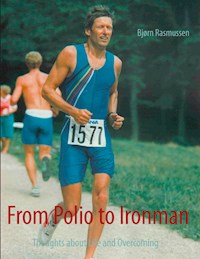
What do you do if your left leg is 1 inch shorter than your right leg and has only a fraction of the power of your right leg? According to Bjørn Rasmussen you train harder. Bjørn got polio (infantile paralysis) in 1941, when he was only a week old. The polio attack was so violent that the doctors asked for permission to let him die. "But my parents wanted me to live" says Bjørn. "Therefore I can write this book." This is a book about a boy who could barely walk up the stairs when he was in school, but later in life completed an Ironman - a triathlon - consisting of 3.8 km swimming, 180 km cycling and a marathon of 42 km.
Sie lesen das E-Book in den Legimi-Apps auf:
Seitenzahl: 52
Veröffentlichungsjahr: 2012
Das E-Book (TTS) können Sie hören im Abo „Legimi Premium” in Legimi-Apps auf:
Ähnliche




















Contents
Preface
My Childhood in Aarhus
Moving to Kalundborg
Moving to Copenhagen and Ølstykke
Bicycling in the Ølstykke Bicycle Club
Bicycling in the Roskilde Bicycle Club
Jogging in the Ølstykke Jogging Club
Learning to Swim
Triathlon
Triathlon on the Ironman Distance
Ten years after
The Future
Preface
I have written this book for myself. After being employed for 44 years I recently retired in 2002 and am deciding how to best use my new freedom. I will spend my time doing what I like to do and I will try to be happy.
This book is about surviving with polio, and I believe other polio survivors would like to read about my experiences to see that they, too, can live and thrive in spite of polio. My hope is that this book can help them to be happier and more content with life.
This book is also about making wishes come true. If you really want to be stronger, or more successful in life for that matter, you must believe in yourself. There are lots of obstacles—your own mind must not be one of them.
My Childhood in Aarhus
I was born December 18, 1941, during World War II. There was little food. My mother could not breast-feed me, so I was fed sugar water. It was very common to give babies sugar water at that time. My father, Ejnar, was a carpenter, and my mother, Ingeborg, was a bookbinder.
I got polio the first month I was born. There was a polio epidemic at that time and I became very sick. My condition was so bad, my parents told me later, that the doctors recommended letting me die. But my parents wanted me to live, and that is why I can write this book. The polio struck my left hip and left leg—my right hip and leg were OK.
I was at the hospital for a month. Then I came home to my parents. As far as I remember, there was no rehabilitation. How do you rehabilitate a baby? Once a year I went back to the hospital to see if my left leg was getting weaker. It was always the same, I think. The doctors didn’t tell me anything since I was only a child.
The polio killed some of the nerves in my left hip and leg, leaving me with very little muscle power on my left side—only 10% compared to my right side.
The lack of strength in my left leg became a problem when I was old enough to go to school. The school was three stories high with lots of stairs up and down. I didn’t like stairs. I had to use my strong right leg when I climbed the stairs—my weak left leg just dragged behind.
I also discovered I was terrible in gymnastics. Because of the polio I couldn’t do the various jumps, and I was a very bad runner.
I remember a sports day in fifth grade. There were four boys on each running team. The two strongest boys on my team dragged me the whole route. It was very hard and frustrating being a dead weight and hurting, rather than helping, my teammates. I knew they could have won without me.
I was good at something, however. I was the best in my class at climbing a rope. Here I could use the muscles in my arms, and we weren’t supposed to use our legs anyway. I was also good at pulling my legs to my chin when I was on the top wall bar, because I had good muscles in my abdomen.
Soccer was the favorite sport of my class, but I was the lousiest soccer player. Yet I can remember one day, to everyone’s surprise, when I scored two goals. I felt ecstatic. It only happened that one day, but I will never forget it. It was some kind of magic, and I knew that if this could happen, anything could happen.
I rode my bicycle every day with my friends. In fact, I rode my bicycle much better than I ran. When I ran, I could only go as fast as my weaker left leg, which had only 10% the strength of my right leg. When biking, however, my strong right leg determined how fast I could go. It made a big difference.
My best friend, Knud, lived on the same street as I did growing up. He was a stout boy, but I could just keep up with him on a bicycle. We made many fine bicycle rides to the beach to look at girls. Later on, Knud immigrated to the United States. Today he has a bar at Key West, Florida. I am almost sure I could still keep up with him on a bicycle.
After 10 years of education I left school. (In Denmark at that time, most youth went to school for eight years—those who wanted to work with their hands. For people who wanted to work in an office, 10 years of school was necessary, along with learning the foreign languages of English, German and French.) I was displeased with my grade in physical education, which was a D. This one grade pulled my total examination results down and made it difficult for me to find a job. I complained to the gym master, but he simply asked me, "Do you think you deserve more worth than a D?" While I had to admit that I didn’t deserve anything better, I was still very disappointed and discontented.
Moving to Kalundborg
Despite my D in physical education, my total overall grade was a B+ and was sufficient to get me a job with the Customs Administration. Why did I want to work at the Customs Administration? My father recommended it. Sometimes he worked as a carpenter at the customhouse of Aarhus, a nearby city. He told me that the staff took it very easy there and that the work wasn’t as hard as being a carpenter. So I got a job at Kalundborg Custom House and worked there for two years.




