


9,49 €
Mehr erfahren.
- Herausgeber: Europa Edizioni
- Kategorie: Gesellschafts- und Liebesromane
- Sprache: Englisch
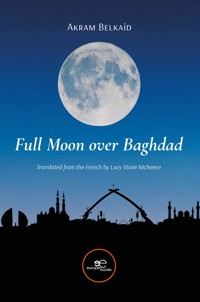
Full Moon over Bagdad: a collection of evocative short stories that recalls a key moment in the history of Iraq and the Middle East.
Apparently independent, these fourteen chapters are actually intertwined by the presence of the moon which marks existences and events, together as well as quotes from Arabic poetry.
The reader will be enthralled by tales of diverse Arab cultures for which the moon has always held profound significance “… Each one of us is tied by the moon by an invisible thread that gathers us together the way silk fronds arrange the pearls of a necklace.”
Two decades have passed since the invasion of Iraq. Yet bombs and calamities continue to fall upon other countries affected by this event. Despite the geopolitical chaos it engendered across the Islamic world which has made peace seem a distant dream, these stories reveal the diverse resources of Arabic cultures that enable them to survive…
Akram Belkaïd is editor-in-chief of Le Monde diplomatique. Born in Algeria in 1964, he graduated from an engineering school and began his career in Algeria writing for Le Quotidien d’Algérie and La Nation. He settled in France in 1996 where he wrote for the economic and financial daily La Tribune. Author of several works on Algeria, the Maghreb and the Middle East, his work also covers current events, commodity markets and international geopolitics of the entire Arab world.
Das E-Book können Sie in Legimi-Apps oder einer beliebigen App lesen, die das folgende Format unterstützen:
Veröffentlichungsjahr: 2024
Ähnliche




















Akram Belkaïd
Full moon over Baghdad
© 2024Europe Books| London
www.europebooks.co.uk | [email protected]
ISBN 9791220141772
First edition: January 2024
Full moon over Baghdad
To Mouni and Amin
To Ellyas and Jahane
Ô Sultan, my master,
if my clothes are torn
and in tatters
It is because your dogs have permission
to tear me to pieces
Nizzar Qabbani
A moon that turns away from the sun
Becomes right then equal to the dark night
Jalal al-Din Rûmi
I have passed through centuries of sewn-up mouths
Abel-Amir Jaras
Are you a cup of whipped milk that foams,
a river of mother-of-pearl
The remains of the incandescent day on the cheeks
of the fragrant night
Nâzik al-Malâïka
Leave, Sirs
Have a good trip to the moon
And cover your ears well...
They say that this part of the heavens is cold
But that there one lives a thousand years
Instead of a hundred
Félix Leclerc
On the 20th of march, under a full moon, the United States of America and their allies launch the invasion of Iraq to overthrow president Saddam Hussein and his regime.
At the same moment, from Baghdad to Casablanca, from Gaza, Tunis, and Washington to Paris, peoples’ destinies are thrown into disarray, dramas are played out behind closed doors. Two smugglers penetrate into the (Saudi) Najd, two Kuwaitis find themselves facing their demons, four friends recite poetry in an old house in Damascus, an Algerian surgeon remembers the war, a commando leads a showdown in Beirut, while a Jordanian taxi driver and his passengers have a very strange encounter in the Iraqi desert...
I
Dried fruit, Verses and Vipers
Baghdad is pale. Her rooftops and terraces are covered with an alabaster shroud that blends into the night. In the heavy waters of the Tigris, carp rise to the surface, attracted by the light beams that pierce the sky, and by the reflections of the full moon that scatter like pearls escaping from a velvet box. It is not yet dawn, but the city does not sleep. Or, rather, she sleeps no longer. Explosions resonate to the West and South, where there are some of the tyrant’s palaces. With each bomb, a powerful shudder shakes the ground and the walls. It is the shadow of war, another war, and certainly not the last, that spreads its wings.
Baghdad trembles. She mourns the loss of her three round walls that vanished in the obscurity of centuries. But how could they serve her in the face of the wave that is about to unfurl? Baghdad panics. She senses the specter of Hulagu Khan on the prowl. Wary of seeing the rise of his successors, the wolf of the steppes smells the odor of blood and fear. He takes the form of a cloud of dark threads and, whistling, roams the deserted streets. Inside households, in rare cellars and old dilapidated shelters, fingers point and sighs punctuate the expressions of faith appropriate to moments such as this, warning of misfortune. The hour approaches and, with it, the time of the split moon, this clear sign of the end of the world. No citizens of Baghdad are ignorant of this. All, or almost all, believers or not, beg for mercy from the Master of the Universe or the protection of the Virgin Mary, the best woman of all time.
East of the city, at the edge of Saddam-City, in the bedroom of a little house made of grey brick, a new-born screams. Lying in a basket of palm-leaves, his fists clenched, he thrusts his feet forward, his black eyes ready to burst out of their orbits. Gamra, his mother, a well-rounded thirty-year-old with fine features, jumps out of bed, her feet almost tripping on her red robe. Wathiq, the father, stands up too, and grabs her brutally by the arm.
“Let him cry,” he orders in a cavernous voice, gutted by tobacco.
Dressed in striped pajama pants and a military shirt, he appears furious, but his wife cannot know if it’s because of the explosions or the infant’s cries. He is red-headed, puny, almost sickly, with an intense gaze and a bony face that is barred by a mustache whose points are burned by cigarettes. He is fifteen years older than she is but seems twice her age.
“I said let him be!” he scolds as she tries to extricate herself.
Gamra obeys. She has known for a long time the devastating power of his anger.
At the university, like all the other students in his section, she felt a fearful respect for this former officer who became douktour, a doctor of literature, after his retirement. Easily angered, he was capable of wrecking an office, of trampling on student papers, or of fighting with someone stronger than himself. For no reason. For a job poorly done, for a careless answer, a misunderstanding or a harmless joke, about poets, about the art of poetry judged to be superfluous in a country starved by sanctions. Later, once they married, she saw him force their noisy or too familiar neighbors to grovel, almost killing them, his body and spirit possessed by sudden rancor.
“Your son is afraid,” she protests, without raising her voice. “All the noise is hurting him.”
“He has to get used to it. The more he hears the bombs, the less he’ll be afraid of them,” mumbles Wathiq, without letting go.
The mother stifles a cry of pain. She thinks of the bruise that she won’t be able to hide at the baths and of the mocking comments of the other women. She insists.
“He is terrified! Don’t let your oldest child cry like an orphan! You’ll have plenty of time to teach him bravery.”
The father hesitates. The baby chokes on his cries. A siren is heard in the distance. In the street, they hear people rushing and a man with a strident voice screaming “qassef!”, “qassef!”1
“It’s alright,” mumbles the father, twisting his mustache. “But don’t make him into a sissy!”
“Don’t worry,” she says. “He will be a great warrior, strong and virile, like all the men of this country.”
She sits cross-legged on a sheepskin rug and nurses the infant. Wathiq bites his lips and stares at his wife’s back. “Strong and virile,” he repeats to himself as he cracks his knuckles. Strong, he has not always been. But virile, no one can doubt it. “Twelve years ago, I fought the Americans and I survived. I only fled because the chiefs of Baghdad ordered it,” he still believes. He lies down on the bed and recites a prayer in a low voice.
Gamra recognizes the verses of The Nascent Dawn.
She is asking herself why he has chosen this koranic verse when she is startled by new explosions. She passes a trembling hand over the infant’s head who sucks voraciously. She knows, she guesses, that it is merely the beginning of a nightmare. The Americans, the English, the Italians, the Danish, the Spanish, the Hungarians, the Polish, the Portuguese, the Czechs – she cites them all, cursing them – but also Saddam and his minions, not to mention her husband and his stupid principles: the entire world seems to be conspiring against her and her son. She wants to ask the Creator for the intercession of the Prophet and his son-in-law, but the usual appeals seem derisive. Her spirit wanders and childhood memories come back to her. Every evening on the television she sees black and white images of long lines of Iranian prisoners advancing, barefoot, their hands on their heads, smiling nervously at the camera. Young men, sometimes children, all crushed by shame. They are followed by close-up shots of corpses mutilated by the enemy, with clouds of flies and piled-up bodies in obscene positions.
Gamra continues to caress the baby. She thinks again of the sirens of Basra and of the incessant rumors that announce a bombing to come at this or that hour, for this or that reason.
“To be born in fear,” she murmurs to herself, as much to the infant as to Wathiq, whose heavy gaze she feels on her. “To grow, live and give birth in fear. Fear, always, again and again fear... Everything is predestined, my son, but I will know how to protect you.”
When the baby has finished nursing, Gamra holds him up, presses him against her chest and taps him lightly on the back. She remains several minutes mulling over dark thoughts, struggling against the depression overcoming her.
Her gaze ranges around the room. Wide, but poorly furnished, without any decoration on the walls except for a small scarlet fabric bought from the Bedouins in the West. Several carpets on the floor – Wathiq detests feeling the cold tile under his feet – an English cabinet, somewhat shaky, and, in a corner, a heap covered by a military tarpaulin. “This emptiness is the stigma of my life,” she thinks to herself, stifling a sob. In the street, the same strident voice implores the inhabitants of the neighborhood to turn off their lights.
“He was starving,” she says lying down again. “I put some wool in his ears. My mother used to do the same thing.”
In his crib, the baby sleeps, his fists still clenched. He seems to be smiling.
The husband holds a small radio against his ear. He finally turns it off and puts it down with a gesture of annoyance on the stool that serves as a bedside table.
“The BBC is blurred, but I heard what’s important, he grumbles. “The attack has begun. The cursed Americans are invading us”.
Gamra shrugs her shoulders.
“The last time, they stopped on the way...”
She almost adds, “...at the wrong moment.”
Wathiq shakes his head. He speaks without looking at her, his eyes riveted on the many patches of moisture spread across the ceiling.
“We’re going to lose this war. The Americans will come to Baghdad to capture Saddam, and they will shoot him or else hang him: it is written. Be careful not to repeat it. Our heads....”
Gamra bites her lip. Have confidence in the Americans? Forget 1991? Erase the massacre of her people by the Republican guard after the debacle in Kuwait? Then, too, they announced the imminent end of Saddam’s regime. Enlisted before the invasion, her brothers had deserted the army and joined the rebels. It was a pointless revolt, lacking both aid and support, despite the promises and the encouragement of the West. A huge massacre. Useless sacrifices so that the blood of communal tombs would replace the water of the dried marshes. So that her two brothers would disappear forever. So that her father, a decorated veteran of the war against Iran, but “progenitor of two traitors” would be humiliated in public and die of grief. So that Saddam would remain in place. So that the embargo would transform his people into beggars exhausted by privation, debased by ration-cards. So that vermin would infest the museums of Baghdad, and so the rarest books would be sold by weight in the filthy streets. Gamra can neither forget nor forgive. “Even if he eats a monster, the demon is still a creature of the devil,” she says, careful not to interrupt Wathiq.
“The Americans will settle in with us,” Wathiq continues, lighting a cigarette. “Like the English before them, they’ll impose a new despot. One master chases another... But Allah alone is the winner, and a day will come when we will be free, standing straight with our heads high. I pray each day that our son may never be haunted by fear and the cries of Abu Ghurayb. I don’t want anyone to oblige him to denounce his brother or his neighbors. I don’t want him to suffer the fate of his uncles.”
Gamra straightens up. Her husband has never spoken to her this way, or, at least he has never spoken this way in her presence. She senses that a fissure is opening, that the words that will be said will resonate forever.
“So we will have to survive this war,” she blurts out, leaning down so that she finally catches his eye. “The fate of Saddam is perhaps sealed, but not ours. Survive, do you hear me?”
A sad smile softens Wathiq’s features. He doesn’t know how to confide either his fears nor his hopes to his wife. He is certain that things will change, that one world is already collapsing, and he has sworn to take advantage of it. Not for himself, nor his wife, but for his son. The fire flushes out the game..., he repeats often to himself, pretending to forget that this fire often burns the hunter. He knows the risks, but feels capable of conquering his fear and of defying everything: the bombs, the security apparatus, the secret police and their informers. Strong and virile... In February 1991, didn’t he survive the massacre on the road back? Didn’t he retain his dignity during the hours of the fiasco? He and his brothers in arms had been abandoned by Saddam. This time Wathiq has decided not to do anything for al-Tikriti. He will carry no rifle, will write no poem, will recite no verses and will say no prayers. He will not fight. No matter what happens. Yes, he will protect his son. By God he will find the means and the force to do so.
New explosions resonate at a distance and the ground still trembles. Wathiq says to himself that he should reinforce the tape on the windows. He regrets that he didn’t have time to dig himself a shelter in the garden where meager shrubs of hibiscus grow. His mind boiling, he lights a new cigarette with the still glowing butt of another, then recites some lines in a wavering voice:
Far away, behind the clouds whose
mouths open on our neglected street,
perhaps a glow appears, like a veil,
a promise of light amid the ominous shadows.
“Nâzik al-Malâïka! exclames Gamra. “The poor thing…What would she say about all this if she were still in this world?”
“But she is still alive!” says Wathiq, indignantly.
Gamra shakes her head, surprised.
“Are you joking?”
“I assure you I am not. She left Kuwait a long time ago and lives in Cairo. I know that no one speaks of her in this country, but that’s no reason to bury her.”
Gamra is taken aback. This morning, as she was nursing her son, verses of al-Malâïka, the very ones that her husband used to hum to himself, came forcefully to her mind. “Mama Mama Mama Mama Mamama / the wonder with the sweet lisp is looking for a nap / the nap behind the hill prepares a dream / the dream of her wings rises up to the star / the star on her lips would love a kiss / the kiss will awaken my baby / Mama Mama...” And now Wathiq is singing the words of this aging poetess whom he never quotes. Gamra would like to find the hidden meaning of such a coincidence.
“They say she still writes poetry,” continues Wathiq, who hesitates for a few moments before going on. “When we took Kuwait City, it was my squad that was supposed to arrest her. The chiefs wanted her to return to Baghdad. But she had already left for Egypt.”
“Arrest her?” exclaims Gamra. “My God, why?”
Her surprise is such that she barely understands that it is the first time that her husband has brought up the subject of this war. This almost forgotten war. His war.
Wathiq shrugs his shoulders, taking the answer to be obvious.
“Saddam hated the exiles in Kuwait... I don’t think he wanted to execute her. He would have simply demanded praise from her and a long poem of allegiance. Or perhaps a public lecture of a passage from the Long days or from Zabiba and the King.”
Gamra lies down, amused by the allusion to the autobiography of the president and his “novel” published in a so-called anonymous manner. She thinks again about the collective reading sessions imposed on the students. Certain people openly mocked them, while others were terrified by the idea of bursting out laughing when one of them tried to glorify the style of the great anonymous author, nonetheless known to everyone thanks to incessant laudatory propaganda.
“Anonymity desired, itself decided by the prestigious author in the name of the imperative of humility befitting all great men,” murmured Gamra, remembering the official formula. Wathiq, who heard it, bursts out laughing at the same moment.
“The exceptional author who wants to remain sheltered from celebrity but whom it is forbidden not to know or admire,” he adds gaily.
“The most known unknown and the most venerated of Iraq,” adds Gamra, saying to herself that it has been a long time since she has enjoyed this sort of complicity with her husband.
But very quickly, disturbing thoughts chase this distraction away. She thinks again of the invasion of Kuwait. She imagines Wathiq floating in a dusty wire trellis, a black beret pulled down on his head. She sees him wandering about in a mansion deserted by the poetess, surely looking for her library. She prepares to ask him when she hears new explosions. In the street, a strident voice announces the end of the world. Another voice, grave and threatening, tells the first to be quiet and to pray for the final victory. Farther away, someone announces that the Americans have been taken prisoners on the banks of the river. Gamra gets up to make sure that the window and its shutters are well closed.
“They always target the palaces,” she whispers. “If they could rid us of him this evening, the war would be quickly over.”
“Don’t be so naïve,” replies Wathiq, annoyed. “You know very well that he never sleeps. It is merely a message to let him know that he has no hope of saving his skin. And even if they kill him tonight, they will all come in anyway. It’s the entire country that interests them: oil, water... Other treasures that we know nothing about. The Americans never do anything by chance. Never! They know things that even Saddam doesn’t know.”
The wail of a fire engine’s siren forces Gamra to get up again. She makes sure that the baby is sleeping on his back, then sits down on the edge of the bed.
“We will need to buy milk,” she says, dreamily. “I’m going to try to nurse him for the longest possible time, but we need to be prepared. There will be shortages.”
Wathiq frowns. He prefers to avoid the coming discussion.
“How many cartons?” he asks nonetheless, crushing his cigarette in a big ashtray of hammered glass.
“As many as possible,” she replies, stressing each word. “Ten, twenty, a hundred. All that you can find. No Turkish or Syrian ones. I don’t want Iranian milk either. The very best are the ones from the Red Cross.”
“And where can I find them?” protests the husband, lighting another cigarette. “Can you see me knocking at the Swiss’s door and showing them my ration card? Do you want me to be arrested?”
“This milk is sold on the black market,” Gamra replies, getting irritated. “Old Yazid has a stock of it in the back of his shop. I spoke to him about it. He agrees to reserve twenty cartons until the end of the week. He demands two hundred dollars, but I think you can get a discount.”
Wathiq stands up suddenly and starts to walk around the room.
“Two hundred dollars? Do you really believe I have that amount?” he grumbles, pointing his finger at her menacingly.
“This Yazid is not one of ours. He disdains us. He spends his time spying on people and plotting I don’t know what with the party’s police and Saddam’s Fedayeen his combatants. In any case, he’s an ass-hole to whom I no longer speak. I saw him tear out the pages of a book to make cones for dried fruits! Do you realize what that means? Tear up a book for pistachios! No, this illiterate dog will never give me a discount, even if I promise to curse a thousand timesAli and his sons.”
“He will give you one,” replies Gamra with a hint of rage in her voice.
Her face is closed. Her tight body and clenched fists make her look like a wrestler ready to strike.
“He knows that soon he’ll need friends and protectors,” she goes on. “Believe me, he has seen the look of our young people. He knows what is going to happen. His wife and his children have already left Ramadi and he will be happy to get rid of all his merchandise and get out. I’m even sure he’ll accept Swiss francs. He’ll go spend them among the Kurds...”
Wathiq is eager to end the discussion. His wife and he know how to find the money, but he is silent, thinking that it is up to her to bring up the topic. He awaits the request. The bended knee, the petitioner’s plea, and the inescapable gratitude engendered by the answered prayer. As for Gamra, she’s familiar with this game imposed on her. She would like to rebel. Once. Just once. But a small voice tells her to think of her son and of the milk that he cannot do without.
Minutes go by. Everything seems suspended. No more noise comes from outside, and the house settles into the muffled silence that comes before dawn. Wathiq is seated on the stool, smoking cigarette after cigarette. Gamra doesn’t want to sleep. She knows that the game will play out now, and that in a few hours, she will need to expend even more energy to get what she wants.
“I ask you to sell one or two of them,” she murmurs finally, holding in her bitterness. “He’s your son as much as he is mine, and I have no fortune.”
Wathiq nods. Now that the request has been formulated, he can agree to it. He knows he has no choice. No one, not even a member of his tribe, will lend him money.
“Well then, I’m going to sell the poems of al-Jawahiri2,” he says in a weak voice, closing his eyes.
“No!” exclaims Gamra. “Not that!”
Wathiq pretends not to have heard her.
“It’s a very rare edition from the nineteen forties. I don’t even dare photocopy it because I know that would attract thieves. They could kill us for these volumes. But I know where to find a trustworthy buyer. He’ll offer me a good price. We’ll be able to manage for several months.”
“I forbid you to do it, do you hear?” says Gamra, almost screaming. “It would be a shameful act! Sell anything else you want to!”
Wathiq seems detached. In reality, he has no intention of giving up this collection. How could he betray the father of modern Iraqi poetry? This descendent of illustrious men, the jewel of Najaf, this blessed city where he himself was born. Al-Jawâhirî... cantor of the Euphrates and inspired surveyor of the Tigris. The living emblem of Iraq, but forced into exile like al-Malâïkaand so many others. The true Iraqi, of whom insignificant foreigners, from Yemen or Syria, dared to deny the identity, and like enraged hyenas, urged him to return to Iran. Al-Jawâhirî, the soul of the Iraqi people. The people whom he never ceased to defend, consciously echoing the watchwords of the Party. Oh, not the Ba’ath, but the other party that counted, the only one that should have counted. The one of the raised fists, the hammer, the scythe and the long battle waged in the name of History.
Wathiq clenches his teeth. He searches his memory for verses that refuse to come. The only thing that comes to mind is this question that was asked already, after many precautionary measures, by an old friend from Najaf: “How did Iraq produce both an al-Jawâhirî and a Saddam?” Wathiq has not found an answer. Even today, he would be quite incapable.
“Do you remember any lines of The Lullaby ?” he asks Gamra suddenly in a thick voice.
Despite being taken aback, she replies almost immediately:
Sleep, famished people, sleep
The fertile gods watch over you
Sleep, if waking doesn’t satisfy you
Sleep will fully gratify you
“Bravo to you! I won’t sell the diwan then,” says the husband with an ironic smile.
He has known since the birth of the baby that he would have to sacrifice other works. Actually give them up, not simply photocopy them in bundles in order to obtain a few thousand dinars gleaned some Friday morning on a dusty stall on al-Mutanabbi street.
He knows that the only solution is to separate himself forever from a book and to abandon a part of himself and what remains of his father and of his father’s fathers. To sell a book, from hand to hand: a tearing apart, an incurable wound... Sell, and lose his dignity, his honor. Tell oneself that they are attacking his country, that they are diluting and profaning what is and what should remain forever. Sell a book in order to eat. To survive. Give up the old edition of Kitâb al-Hayawân of al-Jâhiz to pay Gamra’s clinic. Sacrifice all the volumes of Lisân al-‘arab, an old Lebanese edition, illuminated and very rare, to repair a part of the roof, or to pay, only in part, the marriage of a brother or a close cousin... Since he finds himself each time in this situation, Wathiq beseeches the merciful Almighty to give him strength. To prevent him from screaming in rage and cursing Saddam and his sons, the Americans and their embargo, their injustice and their wars, not to mention the other Arab peoples so indifferent to the suffering of Iraq.
Gamra is quiet. She’s familiar with the silent lamentations of her husband. She’s familiar with this inner discourse whose shards and bites she suffered only a while ago. She knows, also, that she must insist, that she must force him to make the decision. To choose the book that must be sacrificed.
“One day things will change,” she says, finally. “You will be able to buy others and give them to your sons, who will pass them on to the children of their children.”
“Perhaps,” sighs Wathiq. “But there are some that I will never find again. I sold the Talkhîs Bârîz of al-Tahtâwi. It was a bilingual edition, in Arabic and Turkish, from the end of the nineteenth century. It was annotated by my great grandfather. He used green ink to express his admiration and black ink to signify disagreement or misunderstanding. Green and black. Who is capable of that today? Annotate a book... Page after page... And I gave up this marvel to the Egyptian Consul for two thousand dollars. Stupidity...”
Gamra stares at him with a mixture of curiosity and irritation.
“You mean you could have gotten more?”
“But of course! That bean-eater resold it for ten times the price. Twenty thousand dollars...”
Gamra can’t believe her ears.
“But who paid such a price?”
Wathiq replies with a derisive gesture. He even thinks of spitting into the ashtray, but restrains himself by letting out an expletive.
“A businessman from Qatar or Abu Dhabi, I can’t remember. Apparently he’s a big collector. He owns more than fifty thousand rare books. Someone told me about a centuries-old Koran that a family from Mosul finally sold him in order to settle in Germany. The cover was of leather from Kufa, the inside of paper from Khorasan, and the calligraphy done by a scholar from Basra. That’s our world: pearl fishermen are pillaging our heritage. I hope they end up like al-Jâhiz, buried under their libraries! Twenty thousand dollars...”
Gamra has had enough. Exhaustion, sleeplessness, but also fear, have made her lose patience.
“If I had any jewelry, I would sell it,” she says, raising her voice. “If I had a rich relative, I would throw myself at his feet.”
Wathiq shakes his two hands to indicate that this is not what he wants. He leaves the stool and walks slowly towards the end of the room. After a few moments of hesitation, he pulls on the tarpaulin, then squats with difficulty to open a khaki-colored box, the sides creaking.
“I could sell this one,” he says in a quavering voice, holding up a book bound in dark leather.
“I can’t read the title!” says Gamra, annoyed, still sitting on the bed.
Wathiq gives her an astonished look. She never speaks to him in such a tone. “The war, perhaps,” he says to himself.
“It’s a compilation of the early poems of Badr Shâkir as-Sayyab. A very rare book. Someone offered me five hundred dollars. I’m sure that I can get double or maybe triple that.”
Gamra relaxes. She inhales, then recites all at once:
The poet is thus there when the poem springs
He does not see it beat its rhythm of eternity
He will destroy what he builds
He will scatter the stones of his edifice,
Then he will bury them under
the ashes of silence and repose.
Wathiq nods his head with an air of satisfaction. He shakes the book and a paper, folded in two, falls at his feet. He picks it up slowly. His hand trembles when he reads the first lines. It’s a copy of an exam in miniscule letters, written in turquoise ink. Wathiq reads it in a low voice but so that Gamra can hear him:
Introductory remarks for a poetic manifesto dedicated to the incomparable Badr Châker as-Sayyâb:
By the poet’s verses.
By the power of words and the voice.
By women and men. By the river and the village. By the palm grove and the clay. By the hill and the light. By the mountain and the marsh. By the desert and the stones...
There is a truth that every man of letters owes himself to restore. Iraq, our Iraq, that of today and that of tomorrow, is not the creation of the Abbasids, the Ottomans or the English, and still less that of the Americans. It is the vision of the poet who has been able to define it and draw its contours. Our country is not the daughter of revolutionaries in uniform nor of plotters in costume. It is the poet and he alone who has created it.
By the poet and his verses.
By the saintly processions, by the cross, the crescent, the star and the hearth. By the ruins and the footsteps of the patriarch.
It is the poet, and he alone, who has given shape to our nation and revealed it to our people. But the poet has betrayed us and has condemned himself to silence. He celebrated the party, the quintals of wheat, and the supposed revolution. He sang the praises of some and the glory of others. But by the exiled man who forgets nothing, and the imprisoned man who never stops writing verse, the poet comes back to himself and always prefers the creative shadow to poisoned glory.
By the father’s tired arms.
By the mother draped in black.
We must listen to Badr Châkir as-Sayyâb when he asks us not to deny the benefits of Iraq. Yes, the wind cries Iraq and the wave moans Iraq. Our chance is to inhabit the best of all waters and greenery, this land, blessed by the sun, the light of God, flooded in Summer as in Winter. No, we must not forget Iraq for another! This country is a paradise. Let us fear the viper which will slip across its fresh earth. And let us make of the words of the poet a sacred incantation, for poetry alone liberates the soul and conquers the vipers.
Wathiq refolds the sheet of paper, nodding his head in admiration. He looks quickly at Gamra, who remains silent. She remembers this exam paper, her own, and these lines written in a state of extreme exaltation, during several days of fasting. An exaltation like those that one experiences at the age of twenty, when one is convinced that one has found one’s vocation, that a pathway had just opened, even if it be strewn with setbacks and persecutions.
But nothing happened. Neither convocation nor reprimands. Wathiq, her professor at the time, claimed he lost the copies and had graded other exercises. Frightened afterwards by her audacity, Gamra hurried to rejoin the pale anonymity that characterized the students without goals or ideals. She had remained in that reassuring light and turned her back on the creative shadow.
“This exam could have changed my life,” she says, finally, trying to control her voice. In spite of her anger, she doesn’t forget the cartons of milk needed from old Yazîd.
“You wouldn’t be a mother at this moment,” replies Wathiq in a detached manner, a derisive expression forming under his mustache. “I couldn’t hand this copy in to the rectorate. Someone would have alerted the authorities, and you would have disappeared. How, then, could I have asked for your hand? I was looking for a companion, not a martyr.”
Since Gamra remains frozen, he then goes on, holding up the collection of as-Sayyab.
“There is even an inscription in honor of the former owner. That will increase its value.”
“This book, did you take it from al-Malâïka’s library? asks his wife coldly.
Wathiq’s expression tightens. He is about to yell, but decides against it, shrugging his shoulders. Why should he justify himself? And why now? Because of the war that has just started? Because of the bombs one no longer hears exploding? He continues to search in the trunk, moving one volume, caressing another. What he did there is no one’s business. No, he didn’t take any books from the poetess. When the red berets pillaged the villa, carrying off with them the entire library, he watched them do so without protesting, without even trying to help himself. No, he stole nothing. Or so little. The fire flushes out the game...This sentence, he didn’t say it at the time, still believing Saddam’s speeches about the greatness of Iraq and the nobility of the hearts of her children. A book thief? Never. Especially not after such a beautiful victory. It was a time for euphoria. Iraq ruled over Kuwait. It would dominate the Gulf, and cause the Emirs and the little kings/princes to kneel down.




