


96,99 €
Mehr erfahren.
- Herausgeber: John Wiley & Sons
- Kategorie: Wissenschaft und neue Technologien
- Sprache: Englisch
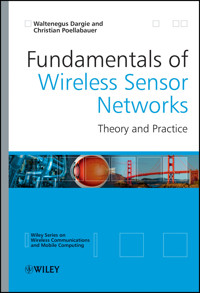
In this book, the authors describe the fundamental concepts and practical aspects of wireless sensor networks. The book provides a comprehensive view to this rapidly evolving field, including its many novel applications, ranging from protecting civil infrastructure to pervasive health monitoring. Using detailed examples and illustrations, this book provides an inside track on the current state of the technology. The book is divided into three parts. In Part I, several node architectures, applications and operating systems are discussed. In Part II, the basic architectural frameworks, including the key building blocks required for constructing large-scale, energy-efficient sensor networks are presented. In Part III, the challenges and approaches pertaining to local and global management strategies are presented – this includes topics on power management, sensor node localization, time synchronization, and security. At the end of each chapter, the authors provide practical exercises to help students strengthen their grip on the subject. There are more than 200 exercises altogether.
Key Features:
- Offers a comprehensive introduction to the theoretical and practical concepts pertaining to wireless sensor networks
- Explains the constraints and challenges of wireless sensor network design; and discusses the most promising solutions
- Provides an in-depth treatment of the most critical technologies for sensor network communications, power management, security, and programming
- Reviews the latest research results in sensor network design, and demonstrates how the individual components fit together to build complex sensing systems for a variety of application scenarios
- Includes an accompanying website containing solutions to exercises (http://www.wiley.com/go/dargie_fundamentals)
This book serves as an introductory text to the field of wireless sensor networks at both graduate and advanced undergraduate level, but it will also appeal to researchers and practitioners wishing to learn about sensor network technologies and their application areas, including environmental monitoring, protection of civil infrastructure, health care, precision agriculture, traffic control, and homeland security.
Sie lesen das E-Book in den Legimi-Apps auf:
Seitenzahl: 601
Veröffentlichungsjahr: 2010
Ähnliche



















Table of Contents
Wiley Series on Wireless Communications and Mobile Computing
Title Page
Copyright Page
Dedication
About the Series Editors
Preface
Part One: Introduction
1 Motivation for a Network of Wireless Sensor Nodes
1.1 Definitions and Background
1.2 Challenges and Constraints
2 Applications
2.1 Structural Health Monitoring
2.2 Traffic Control
2.3 Health Care
2.4 Pipeline Monitoring
2.5 Precision Agriculture
2.6 Active Volcano
2.7 Underground Mining
3 Node Architecture
3.1 The Sensing Subsystem
3.2 The Processor Subsystem
3.3 Communication Interfaces
3.4 Prototypes
4 Operating Systems
4.1 Functional Aspects
4.2 Nonfunctional Aspects
4.3 Prototypes
4.4 Evaluation
Part Two: Basic Architectural Framework
5 Physical Layer
5.1 Basic Components
5.2 Source Encoding
5.3 Channel Encoding
5.4 Modulation
5.5 Signal Propagation
6 Medium Access Control
6.1 Overview
6.2 Wireless MAC Protocols
6.3 Characteristics of MAC Protocols in Sensor Networks
6.4 Contention-Free MAC Protocols
6.5 Contention-Based MAC Protocols
6.6 Hybrid MAC Protocols
6.7 Summary
7 Network Layer
7.1 Overview
7.2 Routing Metrics
7.3 Flooding and Gossiping
7.4 Data-Centric Routing
7.5 Proactive Routing
7.6 On-Demand Routing
7.7 Hierarchical Routing
7.8 Location-Based Routing
7.9 QoS-Based Routing Protocols
7.10 Summary
Part Three: Node and Network Management
8 Power Management
8.1 Local Power Management Aspects
8.2 Dynamic Power Management
8.3 Conceptual Architecture
9 Time Synchronization
9.1 Clocks and the Synchronization Problem
9.2 Time Synchronization in Wireless Sensor Networks
9.3 Basics of Time Synchronization
9.4 Time Synchronization Protocols
10 Localization
10.1 Overview
10.2 Ranging Techniques
10.3 Range-Based Localization
10.4 Range-Free Localization
10.5 Event-Driven Localization
11 Security
11.1 Fundamentals of Network Security
11.2 Challenges of Security in Wireless Sensor Networks
11.3 Security Attacks in Sensor Networks
11.4 Protocols and Mechanisms for Security
11.5 IEEE 802.15.4 and ZigBee Security
11.6 Summary
12 Sensor Network Programming
12.1 Challenges in Sensor Network Programming
12.2 Node-Centric Programming
12.3 Macroprogramming
12.4 Dynamic Reprogramming
12.5 Sensor Network Simulators
Index
Wiley Series on Wireless Communications and Mobile Computing
Series Editors: Dr Xuemin (Sherman) Shen, University of Waterloo, Canada
Dr Yi Pan, Georgia State University, USA
The “Wiley Series on Wireless Communications and Mobile Computing” is a series of comprehensive, practical and timely books on wireless communication and network systems. The series focuses on topics ranging from wireless communication and coding theory to wireless applications and pervasive computing. The books provide engineers and other technical professionals, researchers, educators, and advanced students in these fields with invaluable insight into the latest developments and cutting-edge research.
Other titles in the series:
Misic and Misic: Wireless Personal Area Networks: Performance, Interconnection, and Security with IEEE 802.15.4, January 2008, 978-0-470-51847-2
Takagi and Walke: Spectrum Requirement Planning in Wireless Communications: Model and Methodology for IMT-Advanced, April 2008, 978-0-470-98647-9
Pérez-Fontán and Espiñeira: Modeling the Wireless Propagation Channel: A simulation approach with MATLAB®, August 2008, 978-0-470-72785-0
Ippolito: Satellite Communications Systems Engineering: Atmospheric Effects, Satellite Link Design and System Performance, August 2008, 978-0-470-72527-6
Lin and Sou: Charging for Mobile All-IP Telecommunications, September 2008, 978-0-470-77565-3
Myung and Goodman: Single Carrier FDMA: A New Air Interface for Long Term Evolution, October 2008, 978-0-470-72449-1
Wang, Kondi, Luthra and Ci: 4G Wireless Video Communications, April 2009, 978-0-470-77307-9
Cai, Shen and Mark: Multimedia Services in Wireless Internet: Modeling and Analysis, June 2009, 978-0-470-77065-8
Stojmenovic: Wireless Sensor and Actuator Networks: Algorithms and Protocols for Scalable Coordination and Data Communication, February 2010, 978-0-470-17082-3
Liu and Weiss, Wideband Beamforming: Concepts and Techniques, March 2010, 978-0-470-71392-1
Riccharia and Westbrook, Satellite Systems for Personal Applications: Concepts and Technology, July 2010, 978-0-470-71428-7
Hart, Tao and Zhou: Mobile Multi-hop WiMAX: From Protocol to Performance, October 2010, 978-0-470-99399-6
Qian, Muller and Chen: Security in Wireless Networks and Systems, January 2011, 978-0-470-512128
This edition first published 2010
© 2010 John Wiley & Sons Ltd.
Registered office
John Wiley & Sons Ltd, The Atrium, Southern Gate, Chichester, West Sussex, PO19 8SQ, United Kingdom
For details of our global editorial offices, for customer services and for information about how to apply for permission to reuse the copyright material in this book please see our website at www.wiley.com.
The right of the author to be identified as the author of this work has been asserted in accordance with the Copyright, Designs and Patents Act 1988.
All rights reserved. No part of this publication may be reproduced, stored in a retrieval system, or transmitted, in any form or by any means, electronic, mechanical, photocopying, recording or otherwise, except as permitted by the UK Copyright, Designs and Patents Act 1988, without the prior permission of the publisher.
Wiley also publishes its books in a variety of electronic formats. Some content that appears in print may not be available in electronic books.
Designations used by companies to distinguish their products are often claimed as trademarks. All brand names and product names used in this book are trade names, service marks, trademarks or registered trademarks of their respective owners. The publisher is not associated with any product or vendor mentioned in this book. This publication is designed to provide accurate and authoritative information in regard to the subject matter covered. It is sold on the understanding that the publisher is not engaged in rendering professional services. If professional advice or other expert assistance is required, the services of a competent professional should be sought.
Library of Congress Cataloging-in-Publication Data:
Dargie, Waltenegus.
Fundamentals of wireless sensor networks : theory and practice / Waltenegus Dargie, Christian Poellabauer.
p. cm.
Includes index.
ISBN 978-0-470-99765-9 (cloth)
1. Wireless sensor networks. I. Poellabauer, Christian. II. Title.
TK7872.D48D37 2010
681'.2 — dc22
2010003984
A catalogue record for this book is available from the British Library.
ISBN 978-0-470-99765-9 (H/B)
To my wife, Kathy, and my children, Joshua and Pheben
Waltenegus Dargie
To my wife, Rumana, and my children, Adam and Maya
Christian Poellabauer
About the Series Editors
Xuemin (Sherman) Shen (M'97-SM'02) received the B.Sc degree in electrical engineering from Dalian Maritime University, China in 1982, and the M.Sc. and Ph.D. degrees (both in electrical engineering) from Rutgers University, New Jersey, USA, in 1987 and 1990 respectively. He is a Professor and University Research Chair, and the Associate Chair for Graduate Studies, Department of Electrical and Computer Engineering, University of Waterloo, Canada. His research focuses on mobility and resource management in interconnected wireless/wired networks, UWB wireless communications systems, wireless security, and ad hoc and sensor networks. He is a co-author of three books, and has published more than 300 papers and book chapters in wireless communications and networks, control and filtering. Dr. Shen serves as a Founding Area Editor for IEEE Transactions on Wireless Communications; Editor-in-Chief for Peer-to-Peer Networking and Application; Associate Editor for IEEE Transactions on Vehicular Technology; KICS/IEEE Journal of Communications and Networks, Computer Networks; ACM/Wireless Networks; and Wireless Communications and Mobile Computing (Wiley), etc. He has also served as Guest Editor for IEEE JSAC, IEEE Wireless Communications, and IEEE Communications Magazine. Dr. Shen received the Excellent Graduate Supervision Award in 2006, and the Outstanding Performance Award in 2004 from the University of Waterloo, the Premier's Research Excellence Award (PREA) in 2003 from the Province of Ontario, Canada, and the Distinguished Performance Award in 2002 from the Faculty of Engineering, University of Waterloo. Dr. Shen is a registered Professional Engineer of Ontario, Canada.
Dr. Yi Pan is the Chair and a Professor in the Department of Computer Science at Georgia State University, USA. Dr. Pan received his B.Eng. and M.Eng. degrees in computer engineering from Tsinghua University, China, in 1982 and 1984, respectively, and his Ph.D. degree in computer science from the University of Pittsburgh, USA, in 1991. Dr. Pan's research interests include parallel and distributed computing, optical networks, wireless networks, and bioinformatics. Dr. Pan has published more than 100 journal papers with over 30 papers published in various IEEE journals. In addition, he has published over 130 papers in refereed conferences (including IPDPS, ICPP, ICDCS, INFOCOM, and GLOBECOM). He has also co-edited over 30 books. Dr. Pan has served as an editor-in-chief or an editorial board member for 15 journals including five IEEE Transactions and has organized many international conferences and workshops. Dr. Pan has delivered over 10 keynote speeches at many international conferences. Dr. Pan is an IEEE Distinguished Speaker (2000–2002), a Yamacraw Distinguished Speaker (2002), and a Shell Oil Colloquium Speaker (2002). He is listed in Men of Achievement, Who's Who in America, Who's Who in American Education, Who's Who in Computational Science and Engineering, and Who's Who of Asian Americans.
Preface
Rapid advances in the areas of sensor design, information technologies, and wireless networks have paved the way for the proliferation of wireless sensor networks. These networks have the potential to interface the physical world with the virtual (computing) world on an unprecedented scale and provide practical usefulness in developing a large number of applications, including the protection of civil infrastructures, habitat monitoring, precision agriculture, toxic gas detection, supply chain management, and health care. However, the design of wireless sensor networks introduces formidable challenges, since the required body of knowledge encompasses a whole range of topics in the field of electrical and computer engineering, as well as computer science.
Wireless sensor networks are currently being offered as a subject at advanced undergraduate and graduate levels at many universities around the world. Moreover, they are the focus of countless graduate theses and student projects. Therefore, this book is primarily written as a textbook aimed at students of engineering and computer science. It provides an introduction into the fundamental concepts and building blocks of wireless sensor network design. An attempt has been made to maintain a balance between theory and practice, as well as established practices and the latest developments. At the end of each chapter, a number of practical questions and exercises are given to help the students to assess their understanding of the main concepts and arguments presented in the chapter. Furthermore, the chapters and parts of the book are sufficiently modular to provide flexibility in course design.
The book will also be useful to the professional interested in this field. It is suitable for self-study and can serve as an essential reference. For such a reader, the material can be viewed as a tutorial in the basic concepts and surveys of recent research results and technological developments.
Structure of the Book
This book provides an introduction to the fundamental concepts and principles of wireless sensor networks (WSNs) and a survey of protocols, algorithms, and technologies at different layers of a sensor system, including the network protocol stack, middleware, and application level.
The text is broken into three parts. In Part One, Introduction, Chapter 1 provides an overview of WSN applications, sensor nodes, and basic system structure. Chapter 2 continues the introduction into the WSN domain by providing an overview of representative sensor network applications. Chapter 3 presents different node architectures and discusses in detail the sensing and processing subsystems as well as communication interfaces. Moreover, it provides several examples of representative prototype implementations. Chapter 4 describes functional and nonfunctional aspects of operating systems and provides a survey of state-of-the-art examples.
Part Two, Basic Architectural Framework, provides a detailed discussion of protocols and algorithms used at different network protocol layers in sensor systems. The design choices at these layers significantly impact the operation and resource efficiency of sensor nodes and networks. Chapter 5 begins this discussion with an introduction into physical layer architectures and concepts. Since the wireless medium is shared between many sensor nodes, MAC-layer protocols are required to arbitrate access to the wireless channels. MAC-layer solutions are discussed in Chapter 6. Chapter 7 discusses multi-hop communications in WSNs and the associated challenges. It also surveys existing and proposed routing protocols.
Part Three, Node and Network Management, discusses several additional techniques and presents solutions for a variety of challenges. Chapter 8 begins the discussion with an overview of power management techniques for wireless sensor networks. When multiple sensor nodes observe the same event in the physical world, it is important to correctly correlate these observations from the different sensors. This requires the clocks of the sensor nodes to be synchronized with each other. Synchronized clocks are also required by a variety of protocols and algorithms, e.g., many MAC protocols rely on accurate timing to ensure that no two nodes transmit packets at the same time. Therefore, Chapter 9 introduces the concept of time synchronization and provides an overview of several synchronization strategies. For many sensor network applications, it is essential that sensor nodes estimate their own position, either using absolute coordinates (e.g., using GPS) or relative to other nodes or landmarks in the environment. Chapter 10 presents a variety of localization strategies and compares their tradeoffs. Wireless sensor networks pose several security challenges due to the nature of many sensor applications (military, emergency response) and the unique characteristics of sensor networks (e.g., scale and unattended operation). Therefore, security challenges and defenses against attacks on sensor networks are discussed in Chapter 11. Finally, Chapter 12 concludes the book with a description of development environments and programming techniques for sensor networks, including an overview of frequently used sensor network simulators.
Part One
Introduction
1
Motivation for a Network of Wireless Sensor Nodes
Introduction
Sensors link the physical with the digital world by capturing and revealing real-world phenomena and converting these into a form that can be processed, stored, and acted upon. Integrated into numerous devices, machines, and environments, sensors provide a tremendous societal benefit. They can help to avoid catastrophic infrastructure failures, conserve precious natural resources, increase productivity, enhance security, and enable new applications such as context-aware systems and smart home technologies. The phenomenal advances in technologies such as very large scale integration (VLSI), microelectromechanical systems (MEMS), and wireless communications further contribute to the widespread use of distributed sensor systems. For example, the impressive developments in semiconductor technologies continue to produce microprocessors with increasing processing capacities, while at the same time shrinking in size. The miniaturization of computing and sensing technologies enables the development of tiny, low-power, and inexpensive sensors, actuators, and controllers. Further, embedded computing systems (i.e., systems that typically interact closely with the physical world and are designed to perform only a limited number of dedicated functions) continue to find application in an increasing number of areas. While defense and aerospace systems still dominate the market, there is an increasing focus on systems to monitor and protect civil infrastructure (such as bridges and tunnels), the national power grid, and pipeline infrastructure. Networks of hundreds of sensor nodes are already being used to monitor large geographic areas for modeling and forecasting environmental pollution and flooding, collecting structural health information on bridges using vibration sensors, and controlling usage of water, fertilizers, and pesticides to improve crop health and quantity.
This book provides a thorough introduction to the fundamental aspects of wireless sensor networks (WSNs), covering both theoretical concepts and practical aspects of network technologies and protocols, operating systems, middleware, sensor programming, and security. The book is targeted at researchers, students, and practitioners alike, with the goal of helping them to gain an understanding of the challenges and promises of this exciting field. It has been written primarily as a textbook for graduate or advanced undergraduate courses in wireless sensor networks. Each chapter ends with a number of exercises and questions that will allow students to practice the described concepts and techniques. As the field of wireless sensor networks is based on numerous other domains, it is recommended that students have taken courses such as networking and operating systems (or comparable courses) before they take a course on sensor networks. Also, some topics covered in this book (e.g., security) assume previous knowledge in other areas or require that an instructor provides an introduction into the basics of these areas before teaching these topics.
1.1 Definitions and Background
1.1.1 Sensing and Sensors
Sensing is a technique used to gather information about a physical object or process, including the occurrence of events (i.e., changes in state such as a drop in temperature or pressure). An object performing such a sensing task is called a sensor. For example, the human body is equipped with sensors that are able to capture optical information from the environment (eyes), acoustic information such as sounds (ears), and smells (nose). These are examples of remote sensors, that is, they do not need to touch the monitored object to gather information. From a technical perspective, a sensor is a device that translates parameters or events in the physical world into signals that can be measured and analyzed. Another commonly used term is transducer, which is often used to describe a device that converts energy from one form into another. A sensor, then, is a type of transducer that converts energy in the physical world into electrical energy that can be passed to a computing system or controller. An example of the steps performed in a sensing (or data acquisition) task is shown in Figure 1.1. Phenomena in the physical world (often referred to as , , or ) are observed by a sensor device. The resulting electrical signals are often not ready for immediate processing, therefore they pass through a stage. Here, a variety of operations can be applied to the sensor signal to prepare it for further use. For example, signals often require amplification (or attenuation) to change the signal magnitude to better match the range of the following analog-to-digital conversion. Further, signal conditioning often applies to the signal to remove unwanted noise within certain frequency ranges (e.g., highpass filters can be used to remove 50 or 60 Hz noise picked up by surrounding power lines). After conditioning, the analog signal is transformed into a digital signal using an (ADC). The signal is now available in a digital form and ready for further processing, storing, or visualization.
Lesen Sie weiter in der vollständigen Ausgabe!
Lesen Sie weiter in der vollständigen Ausgabe!
Lesen Sie weiter in der vollständigen Ausgabe!
Lesen Sie weiter in der vollständigen Ausgabe!
Lesen Sie weiter in der vollständigen Ausgabe!
Lesen Sie weiter in der vollständigen Ausgabe!
Lesen Sie weiter in der vollständigen Ausgabe!
Lesen Sie weiter in der vollständigen Ausgabe!
Lesen Sie weiter in der vollständigen Ausgabe!
Lesen Sie weiter in der vollständigen Ausgabe!
Lesen Sie weiter in der vollständigen Ausgabe!
Lesen Sie weiter in der vollständigen Ausgabe!
Lesen Sie weiter in der vollständigen Ausgabe!
Lesen Sie weiter in der vollständigen Ausgabe!




