


Erhalten Sie Zugang zu diesem und mehr als 300000 Büchern ab EUR 5,99 monatlich.
- Herausgeber: THP Ireland
- Kategorie: Fantasy und Science-Fiction
- Sprache: Englisch
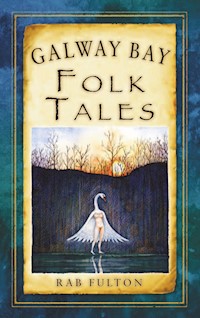
From the saints of the Dark Ages to modern-day sinners, Galway Bay is the source of some of Ireland's most magical tales. In this book local storyteller Rab Fulton takes the reader through Galway's past, recalling the myths and legend's that shaped the area's history – from the quarrelsome giants who in their rage created the Aran Isles to the corpse that flew through the air at the very first Galway Arts Festival. Also featuring tales of magic swans, miraculous nuns, a city beneath the waves and a cannibal king, this is a great companion for any visit to the county, for fascinating days out and finding exciting treasure on your doorstep.
Sie lesen das E-Book in den Legimi-Apps auf:
Seitenzahl: 236
Veröffentlichungsjahr: 2013
Das E-Book (TTS) können Sie hören im Abo „Legimi Premium” in Legimi-Apps auf:
Ähnliche









For Jennie, Dylan and Callum
CONTENTS
Title Page
Dedication
Part One: Ancient Tales
Introduction to Part One
1 An Fear Mór
2 Giant Love
3 The Time Lords
4 Hy Brazil
5 Perfect Weapons
6 Queen Medb and King Finnbheara
7 Medb Goes to War
8 The Last of the Superheroes
9 A Terrible Beauty
10 The Conquest of Cruachán Aigil
11 Satan’s Last Redoubt
12 Enda and Brecan
13 Infinite Possibilities
Part Two: ModernTales
Introduction to Part Two: The Changing City
14 The Girl Who Went for the Messages
15 Connor Quinn and the Swan Maiden
16 The Mayor’s Window
17 The City beneath the Waves
18 Toby’s Wish
Conclusion
Sources
About the Author
Copyright
PART ONE:
ANCIENT TALES
INTRODUCTIONTO PART ONE
HUNTING YETIS
I have not yet seen a yeti in Ireland, though I have been on many a yeti hunt with my two sons. A yeti is rumoured to live at the top of the hill near our home. The journey to the hill involves beating a path through long needle-sharp grass, thistles and nettles, which come up to the shoulders of my oldest son, and reach high above the head of my youngest.
As we get nearer to the hill on one such hunt the walking gets easier as the tall grasses give way to rocks, bits of bog and purple heather. The rocks have patches of lichen and moss, and the bog hosts the very occasional minute purple flower. The going is easier if a bit messier now and my oldest son explains all about yetis to my youngest: specifically that yetis are very shy and we may not get to see one. There are clues though, if you look: in particular the occasional empty can of super strong cider. Making upward progress is a slow and convoluted task as my youngest son is still not quite at the age where he can focus on one task. Distracted by a rock, flower, ant or whale-shaped cloud he wanders off and has to be retrieved.
As we go further up spikes of gorse stick out from between the heather, ready to snag and prick unsuspecting explorers, particularly pre-school age explorers. Even on the sunniest of days the wind can suddenly take a snatch at our hats.
Finally, we reach the narrow path that leads up to a huge spiky clump of gorse, which is sat like a hat or a wave or a really bad haircut right there on the very crest of the hill. This is the yeti’s hideout. Inside the great bush the hill’s crown has three deep dents were we can sit, sheltered from the wind and weather by the tight weave of gorse spikes and yellow, scented flowers. It is a wonderful spot for a yeti to live; a perfect three-room apartment without the bother of any mortgage repayments, a seemingly endless supply of alcohol and, overhead, the ever changing sky.
The yeti, however, is never at home, which invariably begins a discussion about where the yeti is, who he is hanging out with and what he’s up to. There is a suspicion, commonly articulated by my eldest son, that the yeti keeps the company of robbers and bandits, and that he may even allow them to use his home to hide in. Such discussions are usually cut short by my youngest son climbing or rolling down into the deepest of the three hollows. His rescue is simple and swift, and never ever appreciated.
Then we push and crawl our way back outside, stand on the flat rocks on the south of the hill and take a look at the view. To the west of us can be glimpsed Connemara; to east of us, and much nearer, are the lower waters of Lough Corrib; to the south lies the great expanse of Galway Bay with the hills of the Burren opposite. Following those hills westwards and we can see lying low on the horizon the Aran Islands. Looking over from the islands our view returns us to Connemara.
Folded into this topography, like children resting in a blanket, are stories – many, many stories – waiting to be roused and sent out to play. In a little while I will tell you some of those stories, but not just yet. Stories can never start exactly on time. A little bit of anticipation is great for helping a story lift-off and fly on its way. So stay with me for a moment.
SHARING STORIES
As a storyteller I hear many accounts of the strange and the wonderful. Not so long ago an acquaintance of mine encountered a capal uisge up in Connemara. I have stood in the summer sunshine discussing the legendary island of Hy Brazil with people who have encountered that peculiar aberration of physics and geology. (My oldest son does not find Hy Brazil problematic in any way – how else would foxes get to other countries?) Ghosts, of course, are a common currency, and there are still young Irish who can tell you about losing a block of time after wandering into a field belonging to the good folk.
Every so often I encounter someone who tells me that storytelling is dead and Ireland empty of folk tales, or that the tales are not quite what they use to be. I can only shrug. If it weren’t for the stories, and the desire to hear and share them, I would have great difficulty feeding my children. Ireland and the Irish remain brimming with stories. I have told stories in pubs, libraries, museums, schools, priests’ houses, Presbyterian gatherings, festivals, anarchist forums, beaches, fields, woods, on a booming bouncing ferry boat on the way to Inis Mór …
My weekly telling takes place in a darkened room in the Cottage Bar in Lower Salthill. It is not uncommon for members of my audience to tweet or blog during my show, sharing their experience as it happens. The little rectangular pool of light from an iPod adds a lovely hint of eerie future shock to any storytelling. Cameras are also ubiquitous. All of which is perfectly fine by me. When I tell stories with storms in them I encourage the audience to take pictures to simulate lightning flashes.
But what manner of stories and where do they come from? Well the tales I tell my children are usually the more innocent and magical ones. My eldest son’s favourite is the kiddy’s version I tell of ‘The Axe, the Hook and The Long Sharp Knife’. My youngest son though finds this story ‘Boring!’. The version in this book is for an older audience and is closer to the version I tell in my Celtic Tales show. Closer, but not quite the same …
Whilst all the stories in this book form part of my Celtic Tales show, it would be an impossible task to translate my live performances of these stories into a written form. How I tell a story on any given evening depends on many factors: the weather, my mood, the make-up of the audience: is it big or small, Irish, international or a mixture? Even when I begin telling a story there is often an element of free flowing, of veering off in strange directions, of responding to unexpected (but always welcome) audience participation. How then to write a story that encapsulates all that energy, fun and sleight of hand?
The answer of course is simple – it cannot be done. The written word and the spoken word are two very different ways of transmitting information to an audience. All I can do is make sure that, regardless of the form, I make the stories grab the audience and take them on strange and wonderful journeys.
The stories in this book cover the history of Galway Bay – add or take an eon or two – from the formation of the bay right up to modern period. There are humorous tales and angry tales; tales of magic and tales of the macabre; there are fantastic creatures and lusty adventurers; some of the tales, like the house martins who live in the eaves of my house, take journeys far over land and sea, before returning to their Galway home.
They are my take on existing tales; many of which have been around for a long time and in differing guises. Mine are no more the definitive version of these stories than anybody else’s. Trying to nail down the absolute and final correct version of any story in Ireland has always been a thankless task. Even the most dedicated of folklorists can only record the version of a story that they happened to hear from the person sat in front of them. If they walked a mile up the road they would encounter a completely different version of the same tale.
In the decades before the First World War, the wonderful folklorist Thomas Johnson Westropp found issues of authenticity and originality problematic, being very alive to the fact that some tales he heard in Clare, Galway and Mayo were the result of book lore, rather than oral lore, and in his writing he often takes to tasks early folklorists for their lack of critical appraisal. And yet has there ever been a time in Irish history when the written word did not impact on the spoken, and vice versa? This is the island, after all, that prides itself on preserving Latin learning for Western Europe during the post Roman period. Only the elite may have been able to read and write but they did not live cocooned from the rest of Ireland’s population. Rather, the reverse is true: those with the power and authority of the written word had a very direct impact on how Irish culture and stories developed and changed over the centuries.
Ireland, no less than any other country, has always been open to outside influences. It is up to the individual as to whether this be seen as cross fertilization or pollution, but before worrying about the purity or otherwise of stories it is well to remember that it is now a strongly held belief that Balor was a Norse creation, and I’ve heard it said that the pooka and the children of Lir are imports from the Auld enemy … Should we dismiss the pooka as nothing more than a shaggy goat story, and haven’t Fionnuala, Aodh, Fiachra and Conn suffered enough without being given a deportation order?
Westropp also mentions the caution and reluctance he encountered from some of the communities he was hoping to get stories from. There may be a perfectly innocent reason for why some people where reluctant to talk to strangers asking questions. However, when I read Westropp I am always surprised at just how welcoming people were, given that the late nineteenth century witnessed the Land War in Ireland. The violence and convulsions of the time may explain some of the resistance he encountered – or perhaps not.
Of course the converse could equally be true, and I have long had an idea of writing a story set in Connemara where a family intent on smuggling an IRB member out the back door order the granny to tell a scéal to the fellow whose turned up at the front door with a pencil in his hand and a mouthful of questions …
But these are worries for folklorists, academics and storytellers. The reader or listener of a tale would be best to relax and enjoy the tales as they unfold. As for alcohol-dependent yetis, there are those that say there are no such things, and certainly no such things in the west of Ireland. But after you have read the stories in this collection I think you will agree that absolutely anything is possible in the little corner of our planet that is Galway Bay.
But before we get to the first tale it would do well to attempt to come to some form of an understanding about the importance of stories and storytelling. To do this we need to travel back in time a bit. Say, fourteen billion years ago or so.
ONCE UPON A TIME
Fourteen billion years ago or so there were no stars, no colours, no darkness. Nothing existed and yet the potential for everything and every combination of every possibility of everything ever did exist, all waiting to play out in countless multiverses.
Then, with a slow release of divine breath, particles – so minuscule they lacked weight or even mass – slowly spread through the realm of infinite yet-to-be possibilities. As they moved they attracted mass and form, slowed down and coalesced into the actuality of times and spaces, events and places
At some point our little speck of a solar system formed. Rocks came together, forming planets and satellites; some blessed with heat, water and organic materials such as propane, ethane and acetylene. Whilst life began on a number of planets, many of the spinning moons of the outer gas giants carried on producing the compounds from which future lives could be produced.
On the planet presently know as Earth a life form came into being that was to be the most successful, adaptable and long lasting of all the planet’s inhabitants. We know such creatures by their generic name – bacteria. Despite their success, bacteria have not – as far as we know – every produced any stories of note. For stories we have to go to a species that has only been around a little while, and if its current behaviour is anything to go by, seems to be in danger of being classified as one of the least adaptable and unsuccessful creations in all the multiverse – the naked, walking and talk talk talking ape known as Homo sapien.
Speech is a very peculiar pastime, all the more so when we consider that so much of our communication with others revolves around gossip and little exchanges of information that seem to be of very little consequence. However, little things can have very big ramifications, as anyone involved with the CERN project will happily tell you. CERN, as its website succinctly puts it, is the place where the ‘world’s largest and most complex scientific instruments are used to study the basic constituents of matter – the fundamental particles’. You don’t get much smaller – or bigger – than that. However, what the CERN website does not state is that, just like you and I and the old man next door, the researchers at CERN spend much of their talking time exchanging those little bits of trivia we refer to as gossip.
This is to be expected as gossip is the particle exchange that is fundamental to all our human ingenuity. When two or more people gossip they create a space dedicated to the intricate interweave of active silence and active sound: listening and talking. The words and silences may seem trivial, but the sound silence transference system (SSTS) serves an infinity of possible functions. SSTS serves as a form of social grooming, it also takes the focus off the more analytical part of brain, allowing it to relax and muse over whatever problems are besetting us. Crucially SSTS serves to confirm that we are real, valid and functioning entities: we create words, someone listens to them; then they create words for us to listen to. In summary SSTS (aka gossip) is what proves we are human, lets our brains relax so they can solve BIG problems, and can strengthen existing – or create new – relationships.
There is another strange, and let’s face it, creepy aspect of exchanging words, whether gossip or thesis, which is this: when we speak or when we listen we change – in an instant we can become anything; the empathetic friend, the witty seducer, the patient parent, the righteous preacher, we become the demon, the angel, the spark of all new ideas and the crusher of all dreams. We, the walking, talk talk talking ape, are the true shape-shifters. The Tuatha de Danann have nothing on us; werewolves and vampires are just irate puppies and sexually frustrated bats. With words we can soothe the deepest pain or fracture and break the will of another human being. Words are magic. They can save life and they can take life.
Whilst a full understanding of words has remained as elusive as a Higgs Boson particle, I would suggest that the power of words comes from the fact that every individual word is saturated with the innate and limitless power that existed fourteen billion years ago when there were no stars, no colours, no darkness; when nothing existed except the potential for everything and every combination of every possibility of everything …
Even used casually, words have power. When they are used with deliberation and precision that power becomes magnified a thousand fold. This is why poets and satirists in many countries live in fear of their lives; why the more intolerant practitioners of religion detest theatre. In the mouths of seasoned and bloodied practitioners words can peal back the veneer of this reality and allow the audience to glimpse an infinity of other realities and possibilities. Sometimes those who have mastered the power of words, whether it is a Martin Luther King or Adolf Hitler, can shape the destinies of entire nations and eras.
It is perhaps for the best that few of us will ever command such mastery of language. Nonetheless our words are important. With them we can construct shelters, wherein we can hide for a moment from the great narratives of history whilst sharing myths, stories, tall tales and gossip. I use all of these elements when telling my Galway stories, as well as archaeology, philosophy, history and a pinch (or two) or poetic license. All of which I have attempted to translate into the following written narrative, a narrative which begins, as all tales about Galway must, with an account of those much-maligned creatures – the giants of Connemara.
1
AN FEAR MÓR
A long, long, fadó, fadó ago there lived on the shores of Galway Bay a giant, known as An Fear Mór, the Big Man. This fellow would wade out into the Atlantic to try and catch whales, much in the manner of children today trying to scoop up handfuls of sprats in the summer sunshine; one moment frustrated, the next delighted when finally they catch a slippery streak of silver.
Of course, where a child is happy enough to simply stare at the little baby fish flapping and twisting in the palm of his hand, a whale-snatching giant has other intentions. Each leviathan caught by An Fear Mór would by shoved wiggling and puffing into a satchel so big you could lose a village in it. Once enough beasts where caught, the giant would wade back to his home on southern coast of Connemara known to this day as Cuan An Fhir Mhóir, the Bay of the Big Man. There he would boil up the whales in a cavity between three massive rocks known as Brannradh An Fhir Mór, the Big Man’s Cauldron.
The cooking of the whales required a prodigious quantity of water, which was of course easily to hand, and an also equally prodigious quantity of timber to keep the fire going. At that time, so the archaeological record shows us, there was indeed plenty of woodland up in Connemara. Nowadays, save for the occasional cluster of trees, all that remains of the long-gone forests are the black stumps found deep in the bellies of the peat bogs.
The vanishing of the trees of Connemara has aroused much discussion and passion, with opinions divided on whether to blame human encroachment, climatic change or the culinary exploits of An Fear Mór. The Big Man may indeed have had some responsibility for the changing botany of the landscape around him. The problem, however, is that it is very difficult to examine the exploits of giants in a neutral fashion. They left no written or pictographical record, and much that we know of them comes from their human neighbours who were – and remain to this day – violently antagonistic towards any creature over sixty feet tall. The reputation of giants has been further sullied by the fact that it was not only whales that An Fear Mór plucked from the chilly Atlantic.
Much like the whales who fed and clothed the ancient Inuit, we can imagine that the migration of whales past the western seaboard of Ireland provided a source of food and materials for early human communities.1 Pushing their fragile skin boats out from shore, the hunters would row after the great cetacean flocks. At the climax of the chase harpoons would be embedded into a whale’s body. Attached to the harpoon were air-filled bladders that would slow down a wounded creature and stop it diving to safety. Tired and terrified, the creature would then be dragged and steered towards the shore and its slaughter.
The whale hunt was not only a source of food for humans; it also provided a heaving gore-spattered theatre for individual humans to display their skills and courage. It was a place where friendships or antagonisms were amplified to an almost supernatural degree; where future stories, myths and Gods were born in those infinite seconds of absolute soul-wrenching terror, when an enraged whale’s fluke fills the whole sky and seemingly nothing in existence can stop it smashing down on a flimsy boat.
But even as the men hunted and prayed, sang and laughed, screamed and roared, drenched and blood splattered, so they too were hunted – by An Fear Mór. Humans, however, are far trickier to catch than whales. Homo sapiens display a cunning and a tenacity for survival out of all proportion to their physical minuteness. So small are they that it is doubtful that a giant could gain any nutritional benefit from eating even a handful. But as a snack for a giant – ah well, there is nothing as tasty as a living human; the sweetness of their meat and the prickle and crack of their bones as they’re crunched up.
More important than the taste of humans though, so they say, is the narcotic buzz that comes from ingesting them. For a giant there is no ecstasy to compare to the moment when all the juice and chemical soup of the Homo sapien body flushes through a giant’s veins and slams into its brain with sparks and flashes of cosmic blasting wonderment … For this feeling a giant will hold its breath and lurk beneath the cold waves, ignoring whole nations and commonwealths of whales, just waiting and watching for the little shadows of human boats to float overhead. Then up he will come, with a leap and a gasp to grasp at the nearest of the pathetic vessels.
Humans, needless to say, have a rather negative view on being used as opiates for the massive. But from a more objective perspective it can be seen that a number of benefits accrued from a giant’s taste for human flesh. It put a check on human population expansion, allowing other creatures and plants to flourish within the ecology of southern Connemara. Furthermore, the humans that were caught were usually the weakest of the hunters, which meant the strong and the wise lived longer, which in turn led to a healthier genetic make up for the whole community.
For all the controversy about giants and their relationship to humans, there can be no denying that An Fear Mór made one very positive contribution to the development of culture and society in Galway Bay, which I will now relate.
1 Douglas, M.S.V., Smol, J.P., Savelle, J.M. and Blais, J.M., ‘Prehistoric Inuit whalers affected Arctic freshwater ecosystems’, Proceedings of the National Academy of Sciences, Vol. 101, No. 6 (2004)
2
GIANT LOVE
It happened that one day another giant came calling on An Fear Mór. The historical record is a little hazy on who this other giant was, but the speculation is that the visitor was An Bhean Mhór – the Big Woman – and that the visit was of a romantic nature. Certainly, love or lust would explain what happened next
Giants are by nature solitary creatures, rarely inclined towards friendship. Yet there comes a time when reproductive needs overcome any eremitic inclination. Deep in a giant’s head neurotransmitters suddenly flash like lightning in a summer storm, lust and love goes whistling through the great pipes and valves of its heart, the creature’s mouth dries up, and its oxters and groin sweat out the foulest of secretions. Many miles, mountains, valleys and lakes away, another of the creatures catches the scent and, regardless of what they are doing or thinking (if indeed giants can be said to think at all), they will immediately turn windward and begin the long, slow lumbering journey towards procreation.
Rocks play a large part in the mating ritual of giants: lifting them, biting them, crushing them and of course throwing them. So it was that An Fear Mór and his lady visitor played around in the local mountains, breaking bits off here, sticking a few extra bits on there. At the climax of all this horse play, they decided to have a throwing competition. As a display of prowess each would attempt to hurl an enormous boulder over the expanse of Galway Bay and land it on to Black Head at the very tip of County Clare.
So it was that each of the two giants gouged out a hill, raced down to the water’s edge and, with a roar, hurled their missiles upwards and outwards. Up and up the projectiles flew, defying gravity and smacking into the clouds. Birds screeched in terror, the very air boomed in protestation, and still the great boulders flew up. Once, twice and thrice the great stones circumnavigated the earth, skimming against the very edge of space, trailing flames and gassy tendrils.
Then, with a scream, down the great boulders came, landing in the Atlantic with such heat and force the waters opened like a monstrous flower with its white petals of roiling steam momentarily floating on the air. Next, with a boom that cracked mountains to the core, the scolding sea washed against the shores of Galway Bay, boiling the skin off all creatures feathered, finned or skin covered.
The two giants, being constructed of much tougher material, were not in the slightest damaged by the boiling tsunami that crashed over them, and were no more put out than children who have been splashed a bit after hurling a couple of stones into a pond. Unlike children though, who always take delight in their mess and mayhem, the giants were not pleased by the havoc they had caused. Their intention had not been to split the seas, but to smack Black Head. When the floods subsided and the steaming clouds parted it was clear that neither boulder had made it over the bay. There were the tops of the boulders, peeking out of the waters looking for all the world like two lumpy pancakes on a plate.
One of the rocks had almost made it to County Clare, but the giants could not agree as to who had thrown it. An argument ensued, which escalated into a fight. ‘Swim out,’ An Fear Mór cried, ‘and you’ll see the furthest rock is mine.’ At which he threw his erstwhile lover into the sea. With great paddling strokes the lady giant made her way out to the furthest rock. ‘You blind fool,’ she cried. ‘This rock is mine, without a doubt.’
But An Fear Mór was not to be out done. ‘Look closer, my love,’ he called in his most beseeching bellow. As An Bhean Mhór bent to take a closer look, An Fear Mór grabbed a hill smaller but deadlier than any of the rocks in the water, and threw it with incredible accuracy at the bowed head of his former lady friend. So ended the romance of An Fear Mhór. The rock cracked against the female giant’s skull, sending her flying out into the Atlantic. Curiously, that third rock, almost reached Black Head, but not quite.




