


28,99 €
Mehr erfahren.
- Herausgeber: John Wiley & Sons
- Kategorie: Wissenschaft und neue Technologien
- Sprache: Englisch
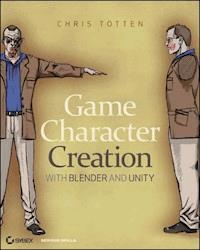
A complete guide to creating usable, realistic game characters with two powerful tools Creating viable game characters requires a combination of skills. This book teaches game creators how to create usable, realistic game assets using the power of an open-source 3D application and a free game engine. It presents a step-by-step approach to modeling, texturing, and animating a character using the popular Blender software, with emphasis on low polygon modeling and an eye for using sculpting and textures, and demonstrates how to bring the character into the Unity game engine. * Game creation is a popular and productive pursuit for both hobbyists and serious developers; this guide brings together two effective tools to simplify and enhance the process * Artists who are familiar with Blender or other 3D software but who lack experience with game development workflow will find this book fills important gaps in their knowledge * Provides a complete tutorial on developing a game character, including modeling, UV unwrapping, sculpting, baking displacements, texturing, rigging, animation, and export * Emphasizes low polygon modeling for game engines and shows how to bring the finished character into the Unity game engine Whether you're interested in a new hobby or eager to enter the field of professional game development, this book offers valuable guidance to increase your skills.
Sie lesen das E-Book in den Legimi-Apps auf:
Seitenzahl: 399
Veröffentlichungsjahr: 2012
Ähnliche



















Table of Contents
Cover
Title Page
Credits
Copyright
Publisher's Note
Dedication
Acknowledgments
About the Author
Introduction
What Is Blender?
What Is the Unity Game Engine?
Where Do I Get Blender and Unity?
Who Should Buy This Book
What You Will Learn
How to Use This Book
What’s Inside
How to Contact the Author
Chapter 1: Basic Game Art Concepts
Game Design Workflows
Creating Game Assets
Understanding and Optimizing 3D Game Art
Working with Game Engines
Scripting Happens
Chapter 2: Blender Basics for Game Characters
Working with Blender’s Unique Features
Working with Editor Arrangement and Types
Navigating and Viewing 3D Space
Creating and Manipulating Objects
Using the Properties Editor
Know Your Hotkeys
Making a Simple Block Character
Useful Techniques
Chapter 3: Modeling the Character
Working with Model Sheets
Shaping the Torso for Low Polygon Count
Extruding the Legs and Feet
Making the Arms and Hands
Separating Body Components to Create Clothing
Creating the Head with Poly-by-Poly Modeling
Carving Out Zombie Damage
Chapter 4: Prepping for Zombie Details with UV Unwrapping
The Uses of UV Layouts
Drawing Seams
Using Blender’s UV/Image Editor
Laying Out a UV Sheet
Using Blender’s Live Unwrap Functions
Chapter 5: Sculpting for Normal Maps
The Purpose of Sculpting
Introducing the Multires Modifier
Using Blender’s Sculpting Interface
Sculpting the Zombie in Blender
Baking Normal Maps
Chapter 6: Digital Painting Color Maps
Understanding Digital Painting
Preparing for Color Map Painting
Digital Painting Best Practices
Applying Your Color Map to the Zombie
Chapter 7: Rigging for Realistic Movement
Understanding Rigging
Creating a Simple Armature
Finishing the Armature with Constraints
Linking the Armature and Zombie
Chapter 8: Animating the Zombie
Understanding and Planning Game Animation
Using Blender’s Animation System
Creating an Idle Animation
Creating a Walk Animation
Creating a Chase Animation
Creating a Run Animation
Organizing Your Animations
Chapter 9: Unity Engine Basics
Understanding Unity’s Logic and Interface
Building a Whiteblock Level with Unity Primitives
Creating and Editing Materials in Unity
Organizing Assets with Unity Empties
Chapter 10: Implementing Your Zombie in a Unity Game
Importing Models into Unity
Unity Scripting—A Crash Course
Adding Interactivity to the Zombie
Turning the First Person Controller into an FPS Hero
Adding Other Gameplay Elements
Wrapping Up
Index
Acquisitions Editor: Mariann Barsolo
Development Editor: Laurene Sorensen
Technical Editor: Terry Wallwork
Production Editor: Dassi Zeidel
Copy Editor: Liz Welch
Editorial Manager: Pete Gaughan
Production Manager: Tim Tate
Vice President and Executive Group Publisher: Richard Swadley
Vice President and Publisher: Neil Edde
Book Designer: Caryl Gorska
Compositor: Chris Gillespie and Kate Kaminski, Happenstance Type-O-Rama
Proofreader: Amy Schneider
Indexer: Jack Lewis
Project Coordinator, Cover: Katherine Crocker
Cover Designer: Ryan Sneed
Cover Image: Chris Totten
Copyright © 2012 by John Wiley & Sons, Inc., Indianapolis, Indiana
Published simultaneously in Canada
ISBN: 978-1-118-17272-8
ISBN: 978-1-118-22690-2 (ebk.)
ISBN: 978-1-118-23771-7 (ebk.)
ISBN: 978-1-118-26457-7 (ebk.)
No part of this publication may be reproduced, stored in a retrieval system or transmitted in any form or by any means, electronic, mechanical, photocopying, recording, scanning or otherwise, except as permitted under Sections 107 or 108 of the 1976 United States Copyright Act, without either the prior written permission of the Publisher, or authorization through payment of the appropriate per-copy fee to the Copyright Clearance Center, 222 Rosewood Drive, Danvers, MA 01923, (978) 750-8400, fax (978) 646-8600. Requests to the Publisher for permission should be addressed to the Permissions Department, John Wiley & Sons, Inc., 111 River Street, Hoboken, NJ 07030, (201) 748-6011, fax (201) 748-6008, or online at http://www.wiley.com/go/permissions.
Limit of Liability/Disclaimer of Warranty: The publisher and the author make no representations or warranties with respect to the accuracy or completeness of the contents of this work and specifically disclaim all warranties, including without limitation warranties of fitness for a particular purpose. No warranty may be created or extended by sales or promotional materials. The advice and strategies contained herein may not be suitable for every situation. This work is sold with the understanding that the publisher is not engaged in rendering legal, accounting, or other professional services. If professional assistance is required, the services of a competent professional person should be sought. Neither the publisher nor the author shall be liable for damages arising herefrom. The fact that an organization or Web site is referred to in this work as a citation and/or a potential source of further information does not mean that the author or the publisher endorses the information the organization or Web site may provide or recommendations it may make. Further, readers should be aware that Internet Web sites listed in this work may have changed or disappeared between when this work was written and when it is read.
For general information on our other products and services or to obtain technical support, please contact our Customer Care Department within the U.S. at (877) 762-2974, outside the U.S. at (317) 572-3993 or fax (317) 572-4002.
Wiley publishes in a variety of print and electronic formats and by print-on-demand. Some material included with standard print versions of this book may not be included in e-books or in print-on-demand. If this book refers to media such as a CD or DVD that is not included in the version you purchased, you may download this material at http://booksupport.wiley.com. For more information about Wiley products, visit www.wiley.com.
Library of Congress Control Number: 2012937911
TRADEMARKS: Wiley, the Wiley logo, and the Sybex logo are trademarks or registered trademarks of John Wiley & Sons, Inc. and/or its affiliates, in the United States and other countries, and may not be used without written permission. All other trademarks are the property of their respective owners. John Wiley & Sons, Inc. is not associated with any product or vendor mentioned in this book.
10 9 8 7 6 5 4 3 2 1
Dear Reader,
Thank you for choosing Game Character Creation with Blender and Unity. This book is part of a family of premium-quality Sybex books, all of which are written by outstanding authors who combine practical experience with a gift for teaching.
Sybex was founded in 1976. More than 30 years later, we’re still committed to producing consistently exceptional books. With each of our titles, we’re working hard to set a new standard for the industry. From the paper we print on, to the authors we work with, our goal is to bring you the best books available.
I hope you see all that reflected in these pages. I’d be very interested to hear your comments and get your feedback on how we’re doing. Feel free to let me know what you think about this or any other Sybex book by sending me an email at [email protected]. If you think you’ve found a technical error in this book, please visit http://sybex.custhelp.com. Customer feedback is critical to our efforts at Sybex.
Best regards,
Neil Edde
Vice President and Publisher
Sybex, an Imprint of Wiley
To Clara, without whom none of this would have been possible
Acknowledgments
Books like this are the Olympian effort of not just the author but a great many people, who all deserve recognition for their efforts. I would of course like to thank the fine folks who make Blender and Unity and distribute them for the masses to use. You are doing a great thing for independent artists and game developers. A special thanks goes out to Ton Roosendaal for getting me in touch with Wiley in the first place to make this book happen. ■ I’d like to thank the teachers who introduced me to 3D art and animation back in college and pushed me to pursue a career making and studying games. I’d also like to thank the D.C. chapter of the International Game Developers’ Association for being so encouraging and including me in many of your great game projects. ■ I’d also like to thank the people who helped me put this book together, including Mariann Barsolo, Laurene Sorensen, Pete Gaughan, Connor O’Brien, Jenni Housh, Liz Welch, and Dassi Zeidel. You guys not only fixed many of my grammatical, technical, and formatting errors but also taught me a great deal about the publishing process. I also know more about Blender than I did going into this process because of you.■ I would also like to thank the administrators of www.lovetextures.com for their generous permission to use some of their texture files in the downloadable materials. They do a great job and everyone reading this should check them out. ■ Lastly, I’d like to thank my family for their love and support as I worked on this project, especially my mom and dad. Without you guys I wouldn’t have been capable of writing this. Thanks also to my fiancée, Clara, for pushing me to pursue this project and putting up with my long workdays creating art for the book.
About the Author
Christopher Totten is a Washington, D.C.–based professor of game design and 3D animation. He has participated in several independent game projects as an artist, animator, and project manager. Chris has written articles featured on both Gamasutra and Video Game Writers. He has been a guest speaker at Dakota State University’s Workshop on Integrated Design and at GDC China.
He has a master’s degree in architecture with a concentration in digital media from the Catholic University of America in Washington, D.C. Chris wants to help shape a new generation of game designers who look deeper into their designs. He works with students and other designers to challenge gaming conventions through cross-disciplinary research.
Chapter 1
Basic Game Art Concepts
Some people don’t want to take games seriously. This isn’t a lament against parents lashing out over gore or people who think that games are a waste of time. It is instead a statement about a popular assumption that making video games doesn’t involve a lot of work. This assumption is a problem in many game schools, whether they focus on the art, programming, or overall design of games.
Lesen Sie weiter in der vollständigen Ausgabe!
Lesen Sie weiter in der vollständigen Ausgabe!
Lesen Sie weiter in der vollständigen Ausgabe!
Lesen Sie weiter in der vollständigen Ausgabe!
Lesen Sie weiter in der vollständigen Ausgabe!
Lesen Sie weiter in der vollständigen Ausgabe!
Lesen Sie weiter in der vollständigen Ausgabe!
Lesen Sie weiter in der vollständigen Ausgabe!
Lesen Sie weiter in der vollständigen Ausgabe!
Lesen Sie weiter in der vollständigen Ausgabe!




