


Erhalten Sie Zugang zu diesem und mehr als 300000 Büchern ab EUR 5,99 monatlich.
- Herausgeber: Arc Publications
- Kategorie: Poesie und Drama
- Sprache: Englisch
This book is also available as a eBook. Buy it from Amazon here. There is a reaching for the unsayable throughout this collection, whether it is thinking about the future, people's inner lives or the shadows of place, O'Neill is wholeheartedly engaged with the unfathomable nature of living. To read these poems is to be part of his exuberance for the physical and visual experience of living, be that lying in a field, being with loved ones or watching the movement of light through a day. Each moment is brimming with imagery of its past and future, so these poems bring out the mutability and movement that both blurs and pinpoints events. Michael O'Neill has lectured at Durham University since 1979, where he is a Professor of English. He co-founded and co-edited Poetry Durham from 1982 to 1994. His critical studies include The All-Sustaining Air (OUP, 2007), an exploration of Romantic poetry's influence on poets since 1900. His first collection The Stripped Bed, was published by Collins Harvill in 1990, Arc published his second collection, Wheel, to critical acclaim.
Sie lesen das E-Book in den Legimi-Apps auf:
Seitenzahl: 51
Veröffentlichungsjahr: 2014
Das E-Book (TTS) können Sie hören im Abo „Legimi Premium” in Legimi-Apps auf:
Ähnliche
















GANGS OF SHADOW
Published by Arc Publications
Nanholme Mill, Shaw Wood Road
Todmorden OL14 6DA, UK
www.arcpublications.co.uk
Copyright © Michael O’Neill, 2014
Copyright in the present edition © Arc Publications, 2014
Design by Tony Ward
978 1906570 64 4 (pbk)
978 1906570 92 7 (ebk)
978 1906570 82 8 (hbk)
ACKNOWLEDGEMENTS
Acknowledgements are due to the editors of the following publications in which some of these poems (or versions of them) appear: The Arts of Peace: A Centenary Anthology (ed. Adrian Blamires and Peter Robinson), Being Human: Paintings by Chris Gollon (ed. David Tregunna and Tamsin Pickeral), English, Kathleen Jamie: Essays and Poems on Her Writing (ed. Rachel Falconer), Keats-Shelley Review, London Magazine, A Mutual Friend (ed. Peter Robinson), An Unofficial Roy Fisher (ed. Peter Robinson), Oxford Magazine, PN Review, Reader, TLS, and Warwick Review. ‘Meeting’ is part of a version of Purgatorio, XXI, which will appear in its entirety in The Poets’ Purgatorio, ed. Nicholas Havely and Bernard O’Donoghue (forthcoming). ‘Georg Trakl’ quotes a line from ‘Kaspar Hauser Song’, Georg Trakl: Poems and Prose, trans. Alexander Stillmark (Libris, 2001).
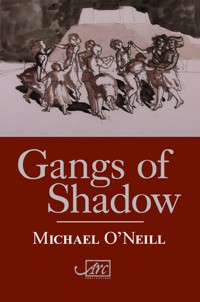
Cover image:
Drawing for ‘The Dance’ by Paula Rego, 1988
(ink on paper)
by kind permission of the artist.
This book is in copyright. Subject to statutory exception and to provision of relevant collective licensing agreements,no reproduction of any part of this book may take place without the written permission of Arc Publications.
Editor for the UK and Ireland: John W. Clarke
Michael O’Neill
Gangs of
Shadow
2014
for Posy, Daniel, Melanie
& Millie
CONTENTS
The Garden
Louis MacNeice
Shadows
Even If
Intimates
Cluny
For Whom
You
Happy Birthday
Lift
Detained
Chapter and Verse
Memory (after Rimbaud)
Twice
The Baths of Caracalla
Editing
Let It Happen
Never
Companions
Near Flatford Mill
Tryst
Until
Money
Pilgrims
The Voyage (after Baudelaire)
Loose Change
Scalinata della Trinità dei Monti
Secret Agent
Meeting (from Dante, PurgatorioXXI)
Human
The Call
Trilogy
Departure
Belief
Towards Sixty
Diagnosis
Convergence
Beatrice Cenci
The Rival
And These Too
Two for Millie
Lesson
So It Goes
Three for the NHS
Snowbound
Memorial
Georg Trakl
Covenant
Elsewhere
Sirmione
Biographical Note
THE GARDEN
There was, there had to be, a garden.
Traffic noises eddied, but it gave space
for citizens to refresh themselves,
overlooked by the palace.
Police occupied toy
sentry-boxes; behind, there must have been
briefings, e-mails, people having their say.
Beyond, though, parents helped their children
launch yachts across a wind-crisped pond, then hook
them back to safety with a long stick.
It is, a poet wrote, the nearest thing
to the idyll we deserve; we are allowed
once more to enter Eden as of right.
Many who came to the city stayed
on for the garden; drank coffee,
glimpsed meaning in the vague, arranged horizon.
One day the notices appeared: The garden
has been closed; you are advised that entrance
is unauthorised and will result in prosecution.
And then another day a message read:
By order of the undersigned(whose names
include those who roam elsewhere, being dead)
the garden is, it had to be, abolished.
LOUIS MACNEICE
That saturnine, mercurial Irishman
would sit in bars and scribble lines
on beer-mats, not bothering tra-la to scan
mechanically or fret about his rhymes.
His ear pitch-perfect, he would dive
into the flux with gusto and delight
in revelations of the cave
while ironizing Plato’s radiant light.
Who else comes close to coming close
to showing what a lyric might amount to,
a miracle of freedom you can parse,
elegance topped by sprezzatura?
Who else can match his dash
or darkness? Before Charon sticks
his oar in (‘if you want to die’), I’d wish
to praise his maker with words tricked
into place like a cab that finds
its destination in a room
that holds reflected doubles, or like minds
kindling a shared thought into flame.
SHADOWS
You stop on a bridge
towards the edge of town,
dusk already settled
over shadows from willows
angling out of the river banks.
Something to do with
the recent appointments,
perhaps, the fact-sheets of
advice, and the chances this
way and that, but, without warning,
you seem to see your own spirit
balloon beyond your lips
and spread itself as an indistinct
shadow above the mass
of shadows gathered in the water.
A couple passes, laughing.
You look at your BlackBerry,
might be a man with a life
that needs guiding through
dates, meetings and even a
decision once in a while. But
that’s only, you sense, with a chill
at the edge of your thoughts,
make-believe – the truth’s
your essence drifting
off into the night air,
unable to prevent its
conscription by the gangs
of shadow that half-beckon
towards you as you look at them.
EVEN IF
It had poured and was still raining
in Lady Katharine’s Wood.
Late evening and the days were waning.
Matting protected fresh growth underfoot.
Umbrella furled, I trod carefully,
intent on the path’s end and a signal
to bleep back to my blocked gadgetry,
when trees relayed a sound – half rustle,
half like a woman clearing her throat,
aware that speech meant risk.
I stepped on a twig, then stopped again,
edgy, keen to pick up any new note
– a fox or deer, say, hurrying through the dusk –
even if it seemed I only heard the rain.
INTIMATES
I took my illness to Valladolid;
it didn’t do much there; it merely hid
among the tapas, Castile stone, and laughter,
the visits to the Plaza late at night.
My illness and myself became good friends;
we knew the road ahead had hidden bends,
but tramped in close communion round Wastwater,
not letting one another out of sight.
We found our way to Venice, worries now
bravely laid aside, ready to allow
for alterations – richer maybe, maybe poorer –
to rise from all that water, sky, and light.
Severance at times was clearly on the cards;
San Marco in the evening pressed us hard.
The drawn-out small hours, though, brought us together,
hinting through shutters at a common plight.
Soulmates, we studied Ezra’s church,




