


95,99 €
Mehr erfahren.
- Herausgeber: John Wiley & Sons
- Kategorie: Wissenschaft und neue Technologien
- Serie: Wiley - IEEE
- Sprache: Englisch
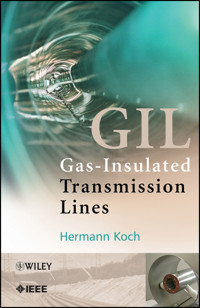
Gas-insulated transmission lines (GIL) is an established high voltage technology used when environmental or structural considerations restrict the use of overhead transmission lines. With an overview on the technical, economical and environmental impact and power system implications of GIL, this guide provides a complete understanding of its physical design, features and advantages. The author illustrates how to evaluate when GIL would be the best solution during the planning sequence and how to apply GIL in the electricity power network. Other key features include: * operation and maintenance requirements with information on repair processes, duration, and different monitoring systems enabling the achievement of reliable and safe operation; * a wide variety of realized applications from across the world over the past 35 years, illustrating typical fields of application through descriptions of real projects that the author has worked on; and * future application possibilities in a smart transmission network, used for solving power transmission problems. This is an essential reference for engineers involved in planning and executing bulk power transmission projects overground, in tunnels or buried. It offers a concise summary of all areas of the subject and is the perfect aid for utility power engineers, consulting engineers and manufacturers worldwide.
Sie lesen das E-Book in den Legimi-Apps auf:
Seitenzahl: 544
Veröffentlichungsjahr: 2011
Ähnliche


















Contents
Cover
Title Page
Copyright
Foreword
Acknowledgements
Chapter 1: Introduction
1.1 Changing Electric Power Supply
1.2 Advantages of GIL
Chapter 2: History
2.1 Transmission Network Development
2.2 Historical Development of GIL
Chapter 3: Technology
Chapter 3.1: Gas Insulation
3.1.1 Free Gas Space
3.1.2 Insulators
3.1.3 Gas-Tight Enclosure
3.1.4 Insulating Gases
Chapter 3.2: Basic Design
3.2.1 Overview
3.2.2 Dielectric Dimensioning
3.2.3 Thermal Dimensioning
3.2.4 Insulation Coordination
3.2.5 Electrical Optimization
3.2.6 Transmission Network Studies
3.2.7 Gas Pressure Dimensions
3.2.8 High-Voltage Design Tests
3.2.9 Current Rating Design
3.2.10 Short-Circuit Rating Design
3.2.11 Internal Arc Design
3.2.12 Electromagnetic Current Forces Design
3.2.13 Mechanical Design
3.2.14 Integrated Overvoltage Protection
3.2.15 Particles
3.2.16 Thermal Design
3.2.17 Seismic Design
Chapter 3.3: Product Design
3.3.1 Technical Data
3.3.2 Conductor Pipe
3.3.3 Enclosure Pipe
3.3.4 Size of Gas Compartment
3.3.5 Insulators
3.3.6 Sliding Contacts
3.3.7 Modular Design
3.3.8 Overhead Line Connection
3.3.9 Bending Radius
3.3.10 Joint Technology for Conductor and Enclosure
3.3.11 Corrosion Protection
3.3.12 On-Site Assembly Work
3.3.13 Monitoring
Chapter 3.4: Quality Control and Diagnostic Tools
3.4.1 Quality of Parts
3.4.2 Quality of Processes
3.4.3 Partial Discharge Detection
3.4.4 High-Voltage Testing On-Site
3.4.5 Conclusion of Quality Control
Chapter 3.5: Planning Issues
3.5.1 Network Impact
3.5.2 Reliability
3.5.3 Grounding/Earthing
3.5.4 Safety
3.5.5 Environmental Limitations
3.5.6 Electric Phase Angle Compensation
3.5.7 Loadability and Capability/Overload
Chapter 3.6: Specification Checklist
Chapter 3.7: Laying Options
3.7.1 General
3.7.2 Above-Ground Installation
3.7.3 Trench-Laid
3.7.4 Tunnel-Laid
3.7.5 Directly Buried
3.7.6 Directional Boring
Chapter 3.8: Long-Duration Testing
3.8.1 General
3.8.2 Tunnel Version
3.8.3 Directly Buried Version
3.8.4 Long-Duration Test Results
Chapter 3.9: Gas Handling
3.9.1 General
3.9.2 Gas Mixture Handling
3.9.3 Conclusion
Chapter 3.10: Commissioning and On-Site Testing
Chapter 4: System and Network
4.1 General
4.2 Line Constants of GIL
4.3 Transmission Losses
4.4 Operational Aspects
4.5 Ageing
4.6 Internal Arc Fault
4.7 Maintenance
4.8 Repair
4.9 Personnel Safety
4.10 Insulation Coordination
4.11 System Control
Chapter 5: Environmental Impact
5.1 General
5.2 Visual Impact
5.3 Electromagnetic Fields
5.4 Gas Handling
5.5 Thermal Aspects
5.6 Recycling
5.7 Lifecycle Assessment
5.8 CO2 Footprint
Chapter 6: Economic Aspects
6.1 General
6.2 Material Cost
6.3 Assembly Cost
6.4 Transmission Losses
6.5 Cost Drivers
Chapter 7: Applications
7.1 General
7.2 Examples
7.3 Future Application
7.4 Case Studies
Chapter 8: Comparison of Transmission Systems
8.1 General
8.2 GIL Features
8.3 Technical Comparison
8.4 Site Comparison
8.5 Soft Parameters
8.6 Economics
Chapter 9: Power Transmission Pipeline
9.1 Feasibility Study
9.2 Offshore Wind Energy in Europe
9.3 Under Sea Tunnel System
9.4 Offshore and Onshore PTP™ Constructions
9.5 Next-Generation Technology
9.6 Offshore Environment
Chapter 10: Conclusion
References
Index
This edition first published 2012 © 2012 John Wiley & Sons, Ltd
Registered office John Wiley & Sons Ltd, The Atrium, Southern Gate, Chichester, West Sussex, PO19 8SQ, United Kingdom
For details of our global editorial offices, for customer services and for information about how to apply for permission to reuse the copyright material in this book please see our website at www.wiley.com.
The right of the author to be identified as the author of this work has been asserted in accordance with the Copyright, Designs and Patents Act 1988.
All rights reserved. No part of this publication may be reproduced, stored in a retrieval system, or transmitted, in any form or by any means, electronic, mechanical, photocopying, recording or otherwise, except as permitted by the UK Copyright, Designs and Patents Act 1988, without the prior permission of the publisher.
Wiley also publishes its books in a variety of electronic formats. Some content that appears in print may not be available in electronic books.
Designations used by companies to distinguish their products are often claimed as trademarks. All brand names and product names used in this book are trade names, service marks, trademarks or registered trademarks of their respective owners. The publisher is not associated with any product or vendor mentioned in this book. This publication is designed to provide accurate and authoritative information in regard to the subject matter covered. It is sold on the understanding that the publisher is not engaged in rendering professional services. If professional advice or other expert assistance is required, the services of a competent professional should be sought.
Library of Congress Cataloging-in-Publication Data
Koch, Hermann Gas insulated transmission lines (GIL) / Hermann Koch. p. cm. Includes bibliographical references and index. ISBN 978-0-470-66533-6 (cloth) 1. Electric cables–Gas insulation. I. Title. TK3331K63 2011 621.319′34–dc23 2011024794
A catalogue record for this book is available from the British Library.
Print ISBN: 9780470665336 ePDF ISBN: 9781119953074 oBook ISBN: 9781119953081 ePub ISBN: 9781119954354 Mobi ISBN: 9781119954361
Foreword
Environmental constrains have intensified the interest in underground transmission lines as an alternative solution to overhead lines. Nowadays, different options of underground transmission lines are available. The most common solution are cables, however, gas-insulated lines (GIL) are also applied as an alternative. GIL can be laid directly buried, in a passable or non-passable tunnel or on a gantry. In particular, the directly buried type of GIL is attractive because it can be verified over distances of some kilometres up to some tens of kilometres by adjustment to the landscape and to impediments. GIL solutions offer different advantages, such as high current-carrying capacity, low losses, low charging capacity etc.
Although GIL technology is mainly based on the experience with gas-insulated switchgear, a lot of specific features and criteria in design, installation and maintenance have to be considered. The present book written by Hermann Koch – who has been involved in this subject for nearly two decades – gives a broad overview on all issues of this technology, which was introduced in the 1970s and has since been applied more and more as an alternative to cable solutions. It differs between the first generation of GIL, filled with pure SF6 and consisting of flanged sections, and the second generation of GIL, filled with a gas mixture (SF6 and nitrogen) and comprising welded enclosures and conductors. After presentation of the dielectric properties and design features, the assembly and laying procedure is described and the quality assurance measures and testing methods – including diagnostic tools – are given. At this stage the special requirements of the different laying options are particularly taken into account. Furthermore, system and network issues, the environmental impact and economic aspects are considered. Finally, various worldwide GIL applications are illustrated and a comparison with other transmission systems regarding technical and site features as well as economical aspects and soft parameters like aesthetics, non-visibility and noises is presented.
This book will be invaluable for engineers involved in the special requirements of today's system layout. It should be of particular interest to students specializing in power system engineering, but also contains fruitful information for readers who want to get a general overview of the different underground transmission technologies.
Professor Claus NeumannEssen, Germany
Acknowledgements
This book reflects the information and experience gleaned from the development, manufacture, assembly and operation of gas-insulated transmission lines over the last 20 years. Contributions to this book have come from many sides, and many experts in the field have been involved.
My thanks go to the IEEE (who asked me in the first place to write a book on gas-insulated transmission lines) and to the IEEE PES Substations Committee, which supported me.
The material in this book is based on, and derived from, more than 130 publications – most of them written by the author together with many co-authors. Not everyone can be mentioned here who participated in the development of the second generation of gas-insulated transmission lines, which is the core content of this book. I would like to give thanks to those experts who have contributed in joint or own publications and with many persona discussions about gas-insulated technology:
Abilgaard, Max; Accourt, Christian ; Alter, Joachim; Ammann, M.; Arora, Arun; Aschendorf, M.; Bär, G.; Becks, Martinus; Benato, Roberto; Boeck, Wolfram; Bolin, Phil; Bowman, Gary; Brachmann, Patrick; Boisseau, Christoph; Brückner, Erhard; Buchholz, Bernd; Chakir, Abdellah; Chakravorti, Sivaji; Colombo, Enrique; Connor, Theodor; Cousin, Vincent; Degen, Wolfgang; Dießner, Armin; Di Mario, Claudio; Drews, Anja; Dürschner, Rolf; Ebner, Andreas; Engelhardt, Gerhard; Feldmann, Dominique; Finkel, M.; Fitzgerald, Patrick; Gatzka, Uwe; Glaubitz, Peter; Glaubrecht, Arnd; Goto, Kiyoshi; Gorablenkow, Jörg; Graf, R.; Grund, Armin; Harnass, Olaf; Hermann, Frank; Hillers, Thomas; Hinrichsen, Volker; Hennigsen, Claus; Hofmann, Lutz; Hopkins, Mel; Hühnerbein, Benjamin; Ikeda, Hisatoshi; Imamovic, Denis; Jesberger, Michael; Kaul, Guido; Kelch, Thomas; Kieper, Mario; Kindersberger, Josef; Kobayshi, Shinichi; Köpke, Kathi; Kunze, Dirk; Kynast, Edelhard; Lampe, Karl-Heinz; Lausegger, Markus; Le, Manh-Hung; Matsumura, Motofumi; Meinherz, Manfred; Monard, Denis; Muhr, Michael; Neumann, Claus; Obst, Dietmar; Olson, Erhard; Oswald, B. Pfeiffer, Wolfgang; Pigini, Alberto; Plath, Ronald; Pöhler, Stefan; Polster, Klaus; Povh, Dusan; Rathke, Christian; Renaud, Francois; Retzmann, Dietmar; Rieder, Ludwig; Ruan, Quanrong; Sabot, Alain ; Schedl, Stefan; Schichler, Uwe; Schöffner, Günther; Schramm, Heinz; Schreieder, Alfons; Schütte, Andreas; Seiter, Egon; Sieber, Peter; Siebert, Markus; Steingräber, Peter; Swiatkowski, Gernot; Trapp, Norbert; Trunk, Dieter; Vich, Piputvat; Völker, Otto; Völzke, Ronald; Waller, Rainer; Wallner, Christian; Wendt, Fred; Wimmer, Gerhard; Zilavec, Richard.
Writing a book needs many helping hands. I would like to acknowledge my secretary, Angela Dietrich, for help and encouragement with writing the text, drawing the graphics, editing the chapters and improving the wording. Also to my students, Christian Koch, Tina Le, Christina Dörner and Natalie Alter who supported her.
I received great support from my family during the writing of this book. Thanks go to my wife Edith and our children Christian and Katrin who supported me and gave me inspiration throughout the process.
Hermann Koch
2
History
In this chapter the historical background of electric power supply and the development stages of the gas-insulated transmission line will be explained.
2.1 Transmission Network Development
2.1.1 General
When electrification started in the mid-1800s, electric power generation was installed close to the consumers. At voltages of about 100 V DC, generators delivered electric power to the consumers – for electric lights and electric drives. The generators were driven by hydropower at rivers, and the consumers were households, farms, offices and small industry (e.g., sawmills).
When cities started using electric street lights and manufacturers started using electric machines for production, electrification grew quickly. Electric generators used running water at rivers or steam engines in power houses transmitted the electricity using DC. Point-to-point connection was the normal case, mainly because it was difficult to switch DC currents. During these early periods of electrification, discussion was rife over the relative advantages of DC vs AC. Arguments led to two main positions:
Tesla position – favoured AC, because it can be transferred to other voltage levels and is easy to switch.Edison position – favoured DC, because of its low transmission losses and higher transmission efficiency.Today we know that AC won the battle in this first development stage of the electrical network, and the main reason was the transformer for higher voltage levels and the availability of AC switching devices. When AC was transformed to higher voltage levels of some kilovolts, and switches and circuit breakers managed to operate reliably, the extent of electricity use increased. Larger power generation units were possible to serve more consumers in a switched distribution network of high AC voltages.
With AC technology developing new materials, higher voltage levels were introduced and could be managed. With improvements in reliability and service life of electric light bulbs and electric motors, the number of installations and with that the electric power consumption increased. The voltage levels went to higher values and reached some kilovolts in the late 1800s. At this time, the first central power stations using steam engines to operate AC generators were installed in cities like New York, London, Paris and Berlin.
Lesen Sie weiter in der vollständigen Ausgabe!
Lesen Sie weiter in der vollständigen Ausgabe!
Lesen Sie weiter in der vollständigen Ausgabe!
Lesen Sie weiter in der vollständigen Ausgabe!
Lesen Sie weiter in der vollständigen Ausgabe!
Lesen Sie weiter in der vollständigen Ausgabe!
Lesen Sie weiter in der vollständigen Ausgabe!
Lesen Sie weiter in der vollständigen Ausgabe!
Lesen Sie weiter in der vollständigen Ausgabe!
Lesen Sie weiter in der vollständigen Ausgabe!
Lesen Sie weiter in der vollständigen Ausgabe!
Lesen Sie weiter in der vollständigen Ausgabe!
Lesen Sie weiter in der vollständigen Ausgabe!
Lesen Sie weiter in der vollständigen Ausgabe!
Lesen Sie weiter in der vollständigen Ausgabe!
Lesen Sie weiter in der vollständigen Ausgabe!
Lesen Sie weiter in der vollständigen Ausgabe!
Lesen Sie weiter in der vollständigen Ausgabe!
Lesen Sie weiter in der vollständigen Ausgabe!
Lesen Sie weiter in der vollständigen Ausgabe!




