


Erhalten Sie Zugang zu diesem und mehr als 300000 Büchern ab EUR 5,99 monatlich.
- Herausgeber: Ithaca Press
- Kategorie: Poesie und Drama
- Sprache: Englisch
Patty Paine is the author of Oracle Bones (Red Hen Press, 2010) and Elegy & Collapse (Finishing Line Press, 2005). She is the founding editor of diode poetry journal. She is an assistant professor of English at Virginia Commonwealth University in Qatar where she teaches writing and literature. Jeff Lodge is the author of the novel Where This Lake Is (White Pine Press, 1997). He is the founding and contributing editor of Blackbird: an online journal of literature and the arts and co-editor of diode poetry journal. He is an assistant professor of core education at Virginia Commonwealth University in Richmond, Virginia. Dr Samia Touati is author of Literacy, Access to Information and Development in the Last Decade of the Twentieth Century Moroccan Society (University Press of America, 2010). She is an adjunct instructor in the English department at Virginia Commonwealth University in Qatar.
Sie lesen das E-Book in den Legimi-Apps auf:
Seitenzahl: 278
Veröffentlichungsjahr: 2012
Das E-Book (TTS) können Sie hören im Abo „Legimi Premium” in Legimi-Apps auf:
Ähnliche










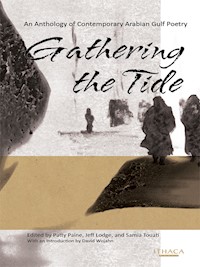
GATHERING THE TIDE
An Anthology of Contemporary Arabian Gulf Poetry
EDITED BY PATTY PAINE, JEFF LODGE,AND SAMIA TOUATI
GATHERING THE TIDE
An Anthology of Contemporary Arabian Gulf Poetry
Published by Ithaca Press 8 Southern Court South Street Reading RG1 4QS UK
www.ithacapress.co.ukwww.twitter.com/Garnetpubwww.facebook.com/Garnetpubthelevant.wordpress.com
Ithaca Press is an imprint of Garnet Publishing Ltd.
Copyright © Patty Paine, Jeff Lodge, Samia Touati, 2011
All rights reserved. No part of this book may be reproduced in any form or by any electronic or mechanical means, including information storage and retrieval systems, without permission in writing from the publisher, except by a reviewer who may quote brief passages in a review.
First Edition 2011
ISBN-13: 978-0-86372-445-9
British Library Cataloguing-in-Publication Data A catalogue record for this book is available from the British Library
Jacket design by Garnet PublishingCover illustration by Nawar Al-Mutlaq, Aisha Al-Naama, Al Hussein Wanas and Ameera MakkiTypeset by Samantha Barden
CONTENTS
Preface
Acknowledgements
One Poet’s StoryNimah Ismail Nawwab
“Because the Sand Was Made for Me Alone to Splash My Ink There”: New Poetry from the GulfDavid Wojahn
POETS FROM BAHRAIN
Qassim Haddad
Poets
Stone
The Friends There
Body
A Prayer for Travel
The Café’s Memory
Words from a Young Night
Fawzia Al Sindi
Awakening
From Less Than Ink
Ali Al Sharqawi
From Psalm 23: To the Singer’s Nectar
Beyond Language
Hameed Al Qaed
Obsession
Painting
Verses
Ahmed ALajmi
Morning in Paris
Enjoyment
Laala Kashef Alghata
Regard Me Sadly
Roadside Flowers
Ali Abdulla Khalifa
The Clover Flower
In the Presence of the One I Love
No One
A Window for Longing
Hamda Khamis
Poems from the Collection The Bliss of Love
Couple
Ray
Those Not for Me
Without Reason
Ali Al Jallawi
According to a Cloud Whispering to her Sister
You …
Trying to Understand
The Wisdom of Hallaj
Karim Radhi
Chief of Staff
Missile
Nights of War
Pretext
Soldier
War Martyr
War Poet
War Reporter
War Traders
Adel Khozam
White Shame
Do This
Sliding
Destiny
Transient Love
The Heroism of a Thread
Strange Circles
POETS FROM KUWAIT
Souad Al-Mubarak Al-Sabah
A Woman from Kuwait
Female 2000
Ingratitude
Love Poem 1
My Body is a Palm Tree that Grows on Bahr al-Arab
Ghanima Zaid Al Harb
Escaping from the Coma Cage
The Sparkle
Haifa Al Sanousi
It is not Fair
Birth of Words
Khalifa Al Woqayyan
The Harvest
A Pulse
An Elegy
Mohammad Almoghrabi
The Mural of Arrogance
Saadia Mufarreh
Refrigerator
Loss
Soon She Will Leave
Distance
Salem Sayar Mohsin Al Anzi
The Storm
Bundle of Wounds
A Miserable Childhood
Shurooq Amin
Another Day of Eid
Fate of the Gulf Mariner
Olfactory Bazaar
POETS FROM OMAN
Saif Al Rahbi
Distant Waters
Arrival
Bells will not Toll Tonight
Friends
Museum of Shadows
No Country We Headed To
Our Old House
Scream
Suitcase
A Tramp Dreaming of Nothing
Under the Roofs of Morning
Water Blessed by Prophets
Abudullah al Ryami
Please Don’t Give Birth!
Speed
Ghalya Al Said
The Car
Malika and the Zar Dance
Mohamed al-Harthy
A Little Before Reaching Death
Apology to the Dawn
Pawns of Sand
At a Slant Angle
Reem Al Lawati
The Chronology of Water
May Love Be Praised
The Psalms of Loneliness
Zahir al-Ghafri
The Angel of Power
A Room at the End of the World
Those Years
POETS FROM QATAR
Soad Al Kuwari
The Flood
Modernity in the Desert
The Queen of the Mountains
Maryam Ahmad Al-Subaiey
The Invisible Army
Dhabiya Khamis
Delhi’s Gardens
The History of that Tree
Scented Walls
Sky Rain
Zakiyya Malallah
Little Tales
If You Were Mine
Blending
Observance
Isolation
Abdullah Al Salem
A Celebration of Loss
Downtrodden People
Emergency Meeting
POETS FROM SAUDI ARABIA
Nimah Ismail Nawwab
The Streets of Makkah
The Longing
Banishment
Arabian Nights
The Ambush
Illusions and Realities
Freedom Writers
Ali Gharam Allah Al Domaini
The Signs
I Am Fatima
A Kiss
A Moon
Ashjan Al Hendi
Butterflies
A Couple
Gray Hair
I Swear by the God of Al-Kawthar
In Search of the Other
It Has Ears
Moon Wars
Abir Zaki
And You Call Me a Feminist … !
But she is never a loser …
Fowziyah Abu-Khalid
My Late Hours with Me
Craving
Acidity Smell
Pregnancy Smell
Ripe Date Smell
Labor Smell
Fenugreek Smell
Anise Smell
Baby Smell
Tuful: Noonday Rainbow
Two Little Girls
Numerical Conjecture
Abdallah Al Saikhan
Star of Ink
The Poet
Sword
Maliha
Thuraya Al Arrayed
Desert Dreams
The Doors; The Game of Times
Moments of Silence
The Stillborn
Ghazi Al Ghosaibi
Dusting the Color from Roses
In the Old Street
Oh, Desert
Which One of Us Returned Safely?
POETS FROM THE UNITED ARAB EMIRATES
Nujoom Alghanem
Blazing Fires
Immigrant
The Darkness is Thick
Monks
I Remember Him
By the Seashore
Distance
Seaflower
The Snow of Mounts
Loyalty
Shihab Ghanem
Bakhbookh
Behind the Iron Curtain
Entrapped
Illuminations in a Valley without Vegetation
Radiance
His Highness Sheikh Mohammed bin Rashid Al Maktoum
I Pictured the Dreams – Rashid and Hamdan
Poem of Condolence
Swords of Beauty
Ahmed Rashid Thani
On the Table
Valleys
Khulood Al Mu’alla
Body’s Winter
An Unexceptional Poet
The Language of the Sea
Incessant Pain
Egg
Amal Khalid Sultan Al Qassemi
Four Leaves of Basil
Anwar Alkhatib
No Land for Passersby
Two Gates to Redemption
When We Grow Older
Maisoon Saqr Al Qasimi
A Mad Man Who does not Love Me
How Lucky the Fisherman Is
I Am the Only Cat Here
Instead of Mirrors
Thani Al-Suwaidi
A Day
Delusion
The Shepherd
Testament
Transience
Poems for the Wind
Khalid Albudoor
Everything
Lantern
Soon
All That We Have
The Translators
The Editors
Credits
PREFACE
It started simply enough. In an introduction to poetry class, after reading the required books list, the students wanted to know why the list did not include an anthology of contemporary poetry from the GCC (Gulf Cooperation Council) countries of the Gulf region.
Why not indeed?
After all, this was a poetry class not in the US but at Virginia Commonwealth University in Doha, Qatar (VCUQatar), where the majority of students are from Qatar and the Gulf region. VCUQatar offers degrees in painting and printmaking, and in graphic, fashion, and interior design. It shares a sprawling thirty-five-hundred-acre campus with five other universities that together form Education City, the largest gathering of American universities outside the US. Education City is a venture of the Qatar Foundation, a private, chartered, non-profit organization founded in 1995 by decree of His Highness Sheikh Hamad bin Khalifa Al Thani, Emir of Qatar. The Qatar Foundation focuses on fostering education, scientific research, and community development.
Around the same time as that simple, but important, question was asked, the Qatar Foundation issued a call for Undergraduate Research Experience Program (UREP) grants. The intent of the UREP grant is to “engage undergraduates under the mentorship of faculty members in all universities in Qatar on research projects related to Qatar’s national needs.” The students expressed a clear need: the creation of an anthology of poetry written by the poets closest to them. We were awarded a grant to work with students to collect and translate poems from established and emerging poets in the region for use in future poetry classes.
This anthology would not exist without the four students who worked with us on this project: Aisha Khalid Al-Naama, Fatima Abdulhameed Mostafawi, Hend Mubarak Aleidan, and Sara Marwan Al-Qatami. We spent countless hours together identifying poets in the region who merited inclusion in an anthology. We moved through poems, sometimes word by word, to translate them from Arabic into English. We attended conferences on translation together, and we formed our own translation workshops with poets and translators who were kind enough to come to Doha to work with us. Our students’ work is present in every aspect of this anthology, but we are especially delighted and proud that poems they have translated appear within. It is particularly impressive when one remembers that VCUQatar is a school of design and that the time and effort Aisha, Hend, Sara, and Fatima dedicated to this project was outside their course work.
We made an unlikely trio of editors of an anthology of Arabic poetry in translation. Patty and Jeff have editing and publishing experience in poetry and fiction, but none of us were expert in Middle Eastern poetry, and only Samia, originally from Morocco, is fluent in Arabic. What we did have, though, were those four eager and outstanding students, support both from VCUQatar and the Qatar Foundation, and our own passion for the project driven by a desire to give voice to the poets of this region who have been largely neglected by western readers and to give something back to Qatar, a country that generously welcomed us and entrusted us to educate its young people.
The Gulf region has a wealth of talented poets, and in the early stages of compiling our anthology Banipal, www.jehat.com, and the anthologies The Poetry of Arab Women, edited by Nathalie Handal, Modern Arabic Poetry, edited by Salma Khadra Jayyusi, and A Crack in the Wall, edited by Margaret Obank and Samuel Shimon, were essential resources for identifying them. (A more complete list of the people and resources we owe a debt of gratitude to follows.) We expected this project to be challenging, but finding contact information for the poets we hoped to include in the anthology was an unexpected difficulty. Had we been looking for American poets, the process would have been as simple as searching Facebook, or a university faculty page. Our Gulf poets were much harder to find. There is a higher degree of privacy in the Middle East, and of the poets represented in the anthology only a very small number are career poets. Several work at newspapers and magazines, others for TV stations, and several hold government positions, including the Emir of Dubai and the Prime Minster and the Vice President of the United Arab Emirates. Others own businesses or work in the sciences or law. We are grateful to all those, from poets, to translators, to friends of friends, who helped us make contact with poets. Still, there are several poets we would have liked to include in this collection but were unable to find. Their exclusion is regrettable, though not intentional.
We decided early on that we didn’t want to merely collect and re-present the relatively small number of poems that had been translated and were available to a western audience. Our goal was to give voice to as many poets and poems from the Gulf region as we could. As daunting and time consuming as it was, we wanted the anthology to contain work translated specifically for this publication. We worked with an incredible team of translators, and we are proud that over seventy percent of this anthology is made up of poems that will appear in print in English for the first time.
We thank our translators for their commitment to honoring the voice and intent of the poets. We worked closely with the translators and poets, and at times translator and poet worked together line by line. Arabic is a rich, and richly nuanced and musical, language. It is difficult to capture in English, but we believe our translators did extraordinary work in echoing the voice of the poets. We tried to maintain a light touch as editors, editing primarily to address mechanics and clarity. Translation and editing is painstaking and difficult work. It requires a delicate balance, and a constant struggle between bringing the poem to the reader and the reader to the poem. We tried very hard to maintain this balance and to create translations that are accessible to a western reader but have not been made over into western poems.
Gathering the Tide was over three years in the making, and it is the product of the work of nearly a hundred poets, translators, editors, and others. We hope that it will enable its readers to come to understand and appreciate differences among peoples of different regions and varying cultures even as they gain a greater sense of, and appreciation for, all that unites us. The poets in this anthology grapple with the same hopes and fears as we all do. They celebrate life, they contend with loss. They wonder at contradiction, they marvel at paradox. They do so in a region with a long and exceptional history, and with a fascinating and rapidly evolving present.
We owe our greatest of debts to the stunningly talented poets of this region. We have been amazed by their generosity and overwhelmed by their enthusiasm. They entrusted us with their poems, and we hope we have honored their trust.
Finally, we would like to acknowledge and express gratitude to all who supported this endeavor. Foremost, we thank Allyson Vanstone, Dean of Virginia Commonwealth University in Qatar, who has supported the project fully from inception to completion. Also at VCUQatar, we thank all the faculty and staff who at one time or another have lent their support and encouragement, especially Bill McGee, Peter Chomowicz, Charles Bleick, Noel Knille, Byrad Yyelland, Brian Harris, Lolwa Ibrahim M Abdulla, Carmina Celeridad, and our colleagues in the English program: Robin Fetherston, Diana Woodcock, Jesse Ulmer, and Lauren Maas.
We thank the four VCUQatar students who contributed the beautiful cover design: Nawar Al-Mutlaq, Aisha Al-Naama, Al Hussein Wanas, and Ameera Makki. We also thank the graphic design professors who supervised them, Muneera Spence and Law Alsobrook.
We offer special thanks to our friend and colleague David Wojahn for his insightful introduction and to his former student Khaled Mattawa for his early participation and advice. We offer special thanks also to Dan Nunn, formerly of Garnet Publishing/Ithaca Press, who was the first publisher to express interest in our proposal and whose enthusiasm and professionalism persuaded us to choose Garnet/Ithaca over other publishers.
And, of course, we thank everyone at Garnet Publishing/Ithaca Press, but especially Arash Hejazi, for his support, insights, and patience.
We thank Dr. Shihab Ghanem for the valuable historical information he provided, and we thank the Ministries of Culture in each of the Gulf states, Dr. Khalid Abdellatif Al Shaiji, the Kuwaiti Writers Guild, and Cat Lucas, campaigns officer of English PEN.
We thank the editors of the several publications who allowed us to reprint poems that they had published previously. A complete list can be found in the Credits section at the end of this anthology.
We thank our family and our friends for their faith in our work and their patience, as we so often gave it priority over them. They are too numerous to mention, but they know who they are.
And we must acknowledge again two pioneers in the dissemination of contemporary Arab literature – including, of course, poetry – to the English-speaking world, both for their contributions to this book and for their contributions to literature as a whole. Since 1998, Banipal: Magazine of Modern Arab Literature has published in nearly forty issues hundreds of poets and writers, strengthening the dialogue between cultures and bringing the joy of Arab literature to multitudes. Founded and edited by Margaret Obank and Iraqi author Samuel Shimon, it has set the standard for all of us who follow. Also, poet, playwright, writer, and editor Nathalie Handal, with the Poetry of Arab Women: a Contemporary Anthology, published in 2000, and Language for a New Century: Contemporary Poetry from the Middle East, Asia, and Beyond, published in 2008, showed us what an excellent anthology should be.
Patty Paine, Jeff Lodge, and Samia Touati
ACKNOWLEDGEMENTS
This publication was made possible in part by a grant from the Qatar National Research Fund under its Undergraduate Research Experience Program. Its contents are solely the responsibility of the authors and do not necessarily represent the official views of the Qatar National Research Fund.
ONE POET’S STORY
Nimah Ismail Nawwab
The work of Gulf poets is deeply rooted in the pre-Islamic oral tradition of sharing wisdom, thoughts, stories, joys, and trials. The long oral history of the Gulf region from the pre-Islamic era accords poets a special place of honor in Arab culture. Poets were the historians and oracles of their tribes – very much the voice of their people. Poets continue to be held in high esteem, and events, both formal and informal, are often initiated with passages of poetry.
The poetry of this region offers a window into a world teeming with creativity. Even for a Saudi Arabian poet originally from Mecca (now known as Makkah), the spiritual heartland of Muslims, discovering the work of Gulf poets is exhilarating. The unique voices of the poets collected here create a tapestry that stirs the heart and soul and offers insight into the rich culture and history of the region.
Gulf poets, like all poets, address universal themes such as love and loss, but they also encompass themes that are uniquely Arab, and uniquely Khaliji, or Gulf-related. The identity of those poets is multi-layered and the result is a poetry that is complex, dynamic, and distinctive.
The role of faith in the lives of Gulf poets cannot be separated from our work, as religion forms a major aspect of our identity and voice. Even with evolving spirituality and the rise of liberalism, faith still remains an irrefutable aspect of who we are. Our sense of identity is also influenced by nationalism, political circumstances, and the complexity of life in this volatile region. This region has endured political unrest, and this upheaval is often explored through poetry. Alienation, patriotism, pride, and even tribalism are often expressed as loss, frustration, bitterness, and pessimism in the wake of wars, such as the latest Gulf war. It is interesting to note how some poems are overtly political while the politics in other poems is submerged and relies on metaphor and allusion.
Non-political poems, in general, are a unique combination of romanticism melded with Arab culture and nationalism. These poems take on themes of love, relationships, family, and social life as well as offering praise of certain figures in present or past history. In both political and non-political poems, intense emotions drive poetic expression.
The oil boom and sudden wealth has led to a contemplation of the westernization, the technology, and the rapid development that is taking place in this region. Poets who once composed poems about the desert, hunting, and pearl diving now also write about the challenge of balancing tradition with modernity. Now there are poems about shopping malls, trips abroad, the gender gap, and the job market. Although a great deal has been written about the massive development in the Gulf by journalists and scholars, poets offer a unique, and necessary, perspective. As Aristotle said: “Poetry is finer and more philosophical than history; for poetry expresses the universal, and history only the particular.”
Challenges
From afar it is easy to assume that Gulf poets lead lives of ease and are constantly sought out and published. However, the reality is that like poets elsewhere Gulf poets search for sources of inspiration, strive to produce good work, and hope to publish poetry that will withstand the test of time. Arab poets, however, face some challenges that western poets may not.
In middle and high school, most students generally read the classic poets who are part of the required reading in literature classes; however, we are not taught the rudiments of creative writing as a craft. The lack of Master of Fine Arts programs in creative writing at the university level is another impediment in the pursuit of poetic studies in the region as a whole. Literature studies are inclusive of all types of literature, but the study of poetry falls within the study of literature as a whole; it is not a separate discipline. A program to write poetry formally is not offered at any university in the Middle East, unlike journalism, for example. The lack of poetry workshops, conferences, specialized poetry publications, and established networks also creates gaps that need to be filled to help nurture established and emerging voices. There is also a serious lack of mentoring, and this is a major problem because one-on-one attention to craft is very much needed.
Although Arab poets lack established networks, it can be argued that poetry is much more popular in the Middle East than in the west. Popular songs by celebrated male and female singers have for centuries included the verses of renowned poets. In this way the general populace is exposed to the work of master poets and the beauty of the Arabic language. Popular magazines, newspapers, and women’s journals often include poetry features by amateur and established poets. Even children’s magazines include poems by classic or modern poets.
An extremely popular television show called Millionaire Poet has led to a phenomenon where the media and public play a role in assessing a poet’s work in a competitive, public arena that includes poetry judging and audience feedback. The pros and cons of the show have become subject of much debate in the region. Some argue that it has led to a rise in pride and tribalism as poets often sing the praises of their local tribes or political figures while seeking to gain fame, fortune, and votes. The caliber of the work is also a note of contention, and this has resulted in debates over classic, spoken, and modern Arabic trends in poetry and the strength of each.
This show has drawn a massive audience and hundreds of competitors, and has created another link in the history of the primacy of poetry in the region. Pre-Islamic poetry competitions at renowned sites such as Suq Ukaz drew poets from all parts of the area as they engaged in poetic battles that often included work composed on the spot. This chain in the history of poetry is one that most poets will continue to draw on for the foreseeable future as new voices join established voices to prove the Arabic saying “Poetry is the mirror of the ages.”
Personal Journey
My journey as a poet is not a typical one for a Gulf poet. It began in 2000, after meeting the wonderfully versatile writer, essayist, songwriter, and poet Naomi Shihab Nye, whom I have since called “My Inspiration.” I studied English literature, and despite my fondness for Shakespeare, I never attempted poetry, thinking it beyond me and the forte of masters such as Shelley, Lord Byron, Keats, Wordsworth, and Tennyson. Meeting Naomi with her sense of inner peace and calmness, seeing the way she wrote about ordinary people and even such small things as a button or broom, imbuing them with a philosophy of life, made me want to attempt poetry.
For many years I had been a translation specialist, an English writer and reviewer, and I also combined writing with photography. I wrote pieces for international magazines on a range of topics, but I had never tried to write poetry. But meeting Naomi prompted my first four poems on family, and later my first political poem in response to the murder of the young Palestinian Muhammad al-Durrah. This poem became my first internationally published poem.
Following four years of writing poems on women, youth, Arabia, politics, and freedom, I began to compile a collection of poems. During that time I contacted poets in the US and Europe, began experimenting with style, and became interested in modern poetry. In addition to the poems of Naomi, I soon become familiar with modern verse through the work of Wisława Szymborska, Czesław Miłosz, Pablo Neruda, Joy Harjo, Maya Angelou, Langston Hughes, Yusef Komunyakaa, Rita Dove, Robert Bly, Carolyn Forché, and Jane Kenyon.
The first time I began to seriously consider publishing abroad, I wrote an email to Naomi Shihab Nye. She immediately responded and detailed the chronology of first publishing in journals, followed by chapbooks, and then possibly having a book selected by a publisher. What she stated was the reality that all poets have to live with: it could take many years to publish a book of poetry, if it happens at all.
I began to seriously revise my work, writing and revising sometimes up to fifty drafts per poem. My composing habits have remained the same for many years: I work from midnight until dawn. Some nights poems flooded in while on others, they trickled in. The journey to publishing a full-length collection took an unexpected turn. I wrote a letter to a US publisher specializing in the Middle East inquiring about a technical matter unrelated to my poetry. During our correspondence he asked what I was working on. I sent off a few poems, and he then asked to see the entire manuscript. I sent off the manuscript, without even entertaining the possibility that it would be picked up. A day later I learned that my book would be published. That day was the first day in a series of surprising days. Poetry took over my life.
The adventure continued in a very unexpected manner. My book, The Unfurling, sold over five thousand copies and had three printings in the first six months. My publisher and I worked on a systematic plan of tours, readings, and speaking engagements, what one heading in the media called a “historic tour”: the first time a female Saudi poet would give readings in the US. But before I left for the US, I wanted to hold a book signing in Saudi Arabia. Surprisingly, this had never been attempted, and it led to what was dubbed “a leap in the literary scene in the Gulf,” a new phenomenon, as poets and writers of both genders weren’t in the habit of meeting with readers in such a fashion. Having a signing in a public setting at the largest bookstore in Saudi Arabia, in the coastal city of Jeddah, was a challenge in terms of logistics, but it proved to be well attended. This was followed by another first: a book signing by a Saudi Arabian poet at a Barnes & Noble bookstore in Washington, DC. The tour ultimately evolved to include a US-wide tour followed by international tours.
The Unfurling has received positive notice and reviews, and was featured by Newsweek International and BBC World News. The unexpected media attention was a challenge for a very private young female poet from a highly private family in a society where the image of fully veiled women often working behind the scenes is the norm.
My work as a poet and activist also led to being nominated as a Young Global Leader whereby I have been able to combine my own love for the arts, a belief in humanity, and a sense of mission to mentor emerging voices. I have endeavored to be a voice for Arab women and youth; and as such I have been active with issues related to youth and women and have campaigned for causes such as working with orphans, mounting a relief campaign for flood victims, and advocating human rights.
Gathering the Tide, with its overarching themes and the combination of the work of established and emerging voices, is an invaluable resource on the intricate and evolving reality of life in the Gulf and in the Middle East. Above all, this anthology shows how poetry can build bridges in this global world and how we can transcend limits and cross boundaries.
“BECAUSE THE SAND WAS MADE FOR ME ALONE TO SPLASH MY INK THERE”: NEW POETRY FROM THE GULF
David Wojahn
In January of 2010 the one hundred and sixty-story Burj Khalifa was dedicated in Dubai. It is currently the world’s tallest building, and it is (excepting perhaps the Great Pyramid of Khufu and the Great Wall of China) the most grandiose structure ever built. The renowned American architectural firm of Skidmore, Owings and Merrill was responsible for the building’s design, which was inspired in part by Frank Lloyd Wright’s quixotic rendering of a “mile high” skyscraper to soar above the Chicago lakefront. The Burj Khalifa – a bedazzling concoction of glass and steel shaped something like a sci-fi movie rocket ship – is a truly visionary endeavor, the brainchild of a figure of unflagging entrepreneurial zeal, His Highness Sheikh Mohammed bin Rashid Al Maktoum. Foreseeing that the Gulf’s oil reserves are destined to deplete themselves in the fairly near future, the Sheikh has sought to replace his nation’s dependence on crude oil with a new dependence on glitz and tourism. The Burj sits in the midst of a development known as Downtown Dubai, among scores of other skyscrapers, dozens of upscale shopping malls, and a brace of four- and five-star hotels. There is nothing in the world quite like Downtown Dubai; Las Vegas, Hong Kong, downtown LA, the hulking vertical business districts of the American Sunbelt – and, yes, even Manhattan – all look a bit paltry beside it. But Downtown Dubai is at present a vexed place. The worldwide recession which began in 2007 has affected the nations of the Gulf every bit as significantly as it has elsewhere. The Burj could only be completed thanks to the last-minute financial largesse of another Gulf potentate, Sheikh Khalifa bin Zayed Al Nahyan, Emir of Abu Dhabi. And Downtown Dubai? Many of its buildings now sit empty and unfinished.
Interestingly enough, one of the poets represented in the pages this anthology is HH Sheikh Mohammed himself. One of his poems addresses his sons on the occasion of their graduation from Great Britain’s Sandhurst Military Academy, and in it he employs the classic tropes of a proud father. His sons are “the dreams of a bright tomorrow.” Downtown Dubai is inspired by a vision that is similarly glittering and bright, even in its vast excess. And there’s something about Dreaming Big that is as irresistible to the North American mind as it is to the Sheikh and his fellow grandees. That the Burj Khlaifa in some ways fulfills the grandly tumescent dream of Frank Lloyd Wright, perhaps our most insistent, most cranky, and most imperious dreamer, seems altogether fitting. But, as North Americans know quite well – and as the inhabitants of the Gulf states have recently come to know – Big Dreams can only be fulfilled in decidedly fraught ways, and with manifold consequences that are largely unintended. You may get the money, the Long Island mansion with its stables and the pool, and everyone may know you as the dashing Jay Gatsby. But you’re also Jimmy Gatz, a poor kid from a one-horse Minnesota town. Our longings derive, above all, from contradiction, paradox, and all manner of inherent ironies.
Poetry, too, derives from these forces. They furnish it with both subject matter and form, and eras of tumultuous social and technological change – when the ironies and contradictions go viral – have often begotten great poetry, although such times can be awful to live through. Tu Fu, Li Po, and Wang Wei composed their lyrics during a time of vicious civil war, and it was trench warfare rather than MFA programs that made Wilfred Owen and Robert Graves into estimable poets. The Russian revolution helped to form the mature aesthetics of Mayakovsky and Mandelstam, although that same revolution would in time destroy them. As we read the poems of Gathering the Tide, we sense above all the immense variety of ways in which contemporary poets of the Gulf must confront contradiction and social upheaval. They are fortunate not to live in times as trying as those of the great T’ang poets or of the Russian poets of the early Soviet period. But they surely inhabit a culture of fraught dichotomies. On the one hand, the nations of the Gulf epitomize modernity – theirs is a world of conspicuous consumption, multi-lane highways, Al Jazeera, and the “economic cities” currently under construction in Saudi Arabia. But on the other hand its nations are for the most part rigidly stratified monarchies whose basic governmental structures differ only slightly from those of the city-states that populated nearby Mesopotamia some four thousand years ago. Progressive forces struggle to bring about free expression and gender equality; traditionalism, most recently in the form of the revival of Islamic fundamentalism, continues to resist these trends. Yet it is reductive to see this struggle in black and white terms. It is better to say that the poets represented in this anthology have chosen to follow Keats’ example as he stated it in his famous Negative Capability letter. They must be “capable of being in uncertainties, Mysteries, doubts, without any irritable reaching after fact & reason.” This is never an easy task.




