


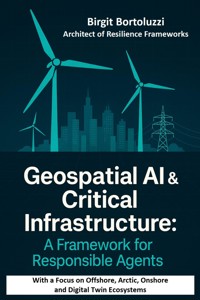
Geospatial AI & Critical Infrastructure – A Framework for Responsible Agents E-Book
Birgit Bortoluzzi
Erhalten Sie Zugang zu diesem und mehr als 300000 Büchern ab EUR 5,99 monatlich.
- Herausgeber: epubli
- Kategorie: Wissenschaft und neue Technologien
- Sprache: Englisch
We live in a time in which global crises no longer occur sequentially, but overlap, reinforce one another and challenge our systems in constantly shifting constellations. In the midst of this dynamic, a new need for orientation is emerging — not through simple answers, but through architectures that make complexity visible, keep uncertainty navigable and distribute responsibility. This framework proposes such an architecture. It unites epistemic, semantic and resilient integrity and shows how knowledge emerges, how it is shared and how it can be used responsibly. Geospatial AI & Critical Infrastructure describes not merely a technical field, but a space in which spatial intelligence, operational systems and societal responsibility are inseparably intertwined. A particular focus of this work also lies on offshore systems, Arctic operational environments and the responsible use of digital twins. The framework shows how AI agents can become reliable partners in sensitive domains — not through maximal automation, but through transparent, robust and self reflective models. It reveals how many blind spots exist today and why epistemic integrity must become the foundation of modern world models, from BIM to digital twins to shadow pattern to EO supported systems. At the same time, it introduces a new profession: Epistemic Engineering — the design of knowledge architectures that understand their own limits. With the Epistemic Maturity Model and the Epistemic Integrity Layer, structures emerge that make stability, transparency and resilience measurable. Many additional solution concepts, modules, geo AI scenario training, guidelines and much more await you in this framework. And with the Geo Resilience Compass, this architecture gains an instrument that provides orientation where uncertainty dominates. This work unfolds its strength not in individual chapters, but in the interplay of all its components. I warmly invite you to join me on this exciting and necessary journey.
Sie lesen das E-Book in den Legimi-Apps auf:
Seitenzahl: 596
Veröffentlichungsjahr: 2026
Das E-Book (TTS) können Sie hören im Abo „Legimi Premium” in Legimi-Apps auf:
Ähnliche



















Imprint
Birgit Bortoluzzi
Burgwartstraße 25
01159 Dresden
Germany
Text: Copyright by Birgit Bortoluzzi
Cover Design: Copyright by Birgit Bortoluzzi
Publisher: Birgit Bortoluzzi, Burgwartstraße 25, 01159 Dresden, Germany
Version 1.0 (January 2026)
Note: This book was published independently. Distribution is provided by epubli – a service by neopubli GmbH, Berlin.
Distribution: epubli – a service by neopubli GmbH, Berlin
Copyright and Usage Rights: © 2026 Birgit Bortoluzzi. All rights reserved.
This publication - including its terminology, semantic architecture, governance logic and all visual and structural elements - is the intellectual property of the author. Redistribution, adaptation or translation of any part of this work (textual, visual or structural) is permitted only with explicit attribution and in accordance with the ethical principles outlined herein.
Collaborative use in humanitarian, academic or institutional contexts is expressly welcomed - provided that transparent governance agreements are in place. Commercial use or modification requires prior written consent.
Visual Material and Cover Design: All images, illustrations and graphic elements used in this book - including the cover and visual modules - are protected by copyright. Their use outside this publication is permitted only with explicit authorization and in accordance with the principles of semantic integrity.
Disclaimer: The contents of this book have been prepared with the utmost care and to the best of the author’s knowledge. They serve as strategic guidance, ethical reflection and operational support in complex crisis contexts. However, they do not replace individual consultation by qualified professionals, authorities or legal experts.
This e-book is the result of extensive development and design work. To safeguard the quality, integrity and continued evolution of this publication, unauthorized conversion, reproduction or distribution in alternative formats is not permitted. Purchasing the original edition ensures that the author’s work is respected and that future updates, extensions and improvements remain possible.
The author assumes no liability for decisions made on the basis of this work, particularly not for direct or indirect damages resulting from the application, interpretation or dissemination of its contents. Responsibility for use lies with the respective users and institutions.
About the Author
Birgit Bortoluzzi is a strategic framework architect, graduate disaster manager, author, and creator of the Geo Resilience Compass. She specializes in the development of epistemic, semantic, and resilience-oriented frameworks that are globally interoperable and follow a holistic 360-degree approach.
Her internationally applicable concepts are designed to help organizations and companies become more resilient in an increasingly fast-moving and highly complex world. Her frameworks integrate operational decision logics, uncertainty modeling, semantic stability, provenance structures, resilience-oriented governance, and much more — with the aim of strengthening the epistemic and structural foundations of modern ecosystems, whether in AI/Geospatial systems, zoonosis management, Long Covid contexts, sensitive conflict management, CBRN/Biosens environments or Earth observation.
Birgit is an active member of the leadership team of the IEEE GRSS Disaster Management and Early Warning Working Group, where she contributes to the development of responsible standards.
In May 2025, she presented innovative approaches for emergency responders, with a focus on fire services, at the Pracademic Emergency Management and Homeland Security Summit (Embry-Riddle University).
Her international engagement is shaped by the ambition to connect diverse disciplinary perspectives and to foster systemic, multi-layered thinking across sectors.
Her professional path is rooted in a lifelong fascination with complexity, communication, creative design, knowledge architectures, our global world and the people who live on it.
From crisis management and scenario planning to interdisciplinary analysis and governance questions, her work is guided by a deeply human motivation: to structure complexity, strengthen collective responsibility, and contribute to a future in which our global community — despite already more than 400 million Long Covid patients, a steadily growing number of chronic illnesses, increasing extreme weather and disaster impacts, and diverse conflicts — has a real chance to meet the enormous challenges of our time.
Foreword
We live in a time in which global crises do not occur sequentially, but overlap, amplify one another, and affect our systems in ever-changing constellations. Environmental shifts, biological risks, technological dependencies, geopolitical tensions, and societal fragmentation form a web that increasingly overwhelms classical models of analysis and control. Amid this dynamic, there is a growing need for orientation — not in the sense of simple answers, but in the sense of a new strategic AI architecture that makes complexity visible, navigates uncertainty, and distributes responsibility.
This framework presents such an architectural proposal. It unites epistemic, semantic, and resilient integrity into a coherent structure that not only describes how knowledge emerges, but how it can be used, shared, and governed responsibly. The many concepts and solution approaches developed here are not theoretical constructs, but building blocks for a new form of scientific, technical, and societal practice — a practice that knows its own limits, reveals its uncertainties, and makes its knowledge pathways traceable.
Geospatial AI & Critical Infrastructure describes not merely a technical field, but a new sphere of interaction in which spatial intelligence, operational systems, and societal responsibility are inseparably intertwined. This book develops a framework for responsible agents operating in highly sensitive domains such as offshore and onshore energy production, Arctic operational environments, renewable energy systems, and digital twins. In all these domains, it is not data quality alone that determines outcomes, but above all the integrity of the models, the transparency of decisions, and the ability to understand complex environments in a spatio-temporal manner.
The framework developed here aims to show how Geospatial AI could become a reliable partner for critical infrastructures — not through maximal automation, but through responsibly designed, traceable, and resilient agent architectures.
At the same time, this framework reveals how many blind spots may exist in the here and now — in the offshore domain alone, I have identified 130 AI-agent gaps.
Another central component is the question of why epistemic integrity is indispensable for Building Information Modeling (BIM). BIM models have long become operational world models that shape decisions about safety, energy flows, material cycles, and infrastructure risks. The framework shows how an Epistemic Integrity Layer (EIL) could extend BIM with a transparent, auditable knowledge architecture, enabling BIM to become not only more precise, but also more self-reflective, secure, and future-proof.
Another building block of this framework is the insight that we need a new profession: Epistemic Engineering. In nearly all domains — GIS, XR, digital twins, photogrammetry, EO, BIM, energy, infrastructure, security and software engineering — world models are emerging whose quality depends not only on data, but on the ability to make their own limits, uncertainties and distortions visible. Epistemic Engineering describes the design of such self-reflective models and the governance of their knowledge architectures. It marks the transition from systems that make decisions to systems that understand what they know and what they must not assume they know. In doing so, it aims to provide an essential foundation for a new generation of responsible, resilient AI ecosystems that are not only technically capable, but epistemically stable, transparent, and trustworthy.
We will also explore the world of Twin Epistemic Integrity, and you will find a conceptual module designed to ensure that AI agents do not treat digital twins as direct reality, but actively reflect their epistemic boundaries. It functions as a filter and protective layer that examines every twin output for what it can know, what it must not infer, and where uncertainties, distortions, or misuse risks may lie.
Especially in the handling of EO data, shadow patterns, and technical signals, this module prevents AI systems from unintentionally reading security-relevant meanings into data or drawing operational conclusions that go beyond what is visible. Twin Epistemic Integrity is intended to create a new form of digital caution — an architecture that embeds reflexivity, contextualization, and restraint as core principles and enables digital twins to become responsible, epistemically stable components of critical infrastructures.
Our journey does not end there, as we will also address a category still missing in AI design: Epistemic Governance. While classical governance models primarily regulate the behavior of a system, epistemic governance focuses on the origin, structure, and limits of the knowledge from which this behavior arises. It reveals blind spots, distinguishes process data from snapshot data, identifies dual-use risks as forms of ambiguity, and aims to contribute to a new quality standard for resilient AI. The blind-spot matrix developed here enables organizations and governments not only to build trust, but also to actively secure the epistemic robustness of their systems — a crucial step in a world in which AI increasingly assesses risks, prepares decisions, and interprets critical infrastructures.
The framework will broaden your horizon even further and present concrete possibilities for the cross-sector relevance of epistemic integrity. Beyond the geospatial and infrastructural perspective, it demonstrates that epistemic integrity can become a cross-industry principle — particularly in domains where digital knowledge processes, automated decisions, and complex data chains have operational, regulatory, or strategic impact. In fields such as compliance, auditing, governance, consulting, finance, and risk management, there is a growing need for mechanisms that secure not only technical correctness but also make the origin, stability, and limits of the underlying knowledge visible. Epistemic integrity introduces new standards of quality and governance and could form the basis for “Epistemic Quality Assessments,” helping organizations prepare early for emerging regulatory requirements. In this way, epistemic integrity becomes a unifying guiding principle — wherever knowledge forms the basis of decisions.
The framework also develops a new (global) role: the Epistemic Engineer, as it shows that the future of responsible AI systems requires a new profession. This role carries responsibility for the epistemic integrity of AI-supported world models and is intended to ensure that organizations not only possess data but understand how knowledge emerges, what its limits are, and how it evolves. This could give rise to a new professional profile that becomes indispensable in a world of multimodal digital twins, geospatial systems, and automated agents — a role that forms the foundation for safe, traceable, and resilient world models.
With the Epistemic Maturity Model (EMM), this framework also introduces an assessment structure designed to make epistemic integrity measurable. The EMM describes stability, traceability, transparency, and resilience as structural properties of world models and organizational knowledge architectures, and it aims to enable their systematic development while providing a clear orientation framework.
Finally, this framework also shows why an Epistemic Integrity Certification Framework (EICF) could be of decisive importance for scientific communities such as the IEEE Geoscience and Remote Sensing Society (GRSS). Especially at the intersection of Earth observation, AI-supported world models, and critical infrastructures, a standardization of epistemic quality is still missing — a gap that could have direct implications for energy supply, water resources, climate forecasting, Arctic operations, and urban resilience. It could form the basis for international standards designed to ensure that geoscientific models are not only technically capable but also epistemically stable, traceable, and resilient. The proposals and concepts presented here are intended to offer the IEEE GRSS and comparable communities — the opportunity to actively shape global epistemic standards and significantly influence the future of responsible world models.
Yet the work does not stop at diagnosis: for many of these challenges, concrete solution approaches, guidelines, modules, and layers have been developed that could be transferred directly into operational systems.
In addition, the framework includes a dedicated block for GEO-AI scenario training, enabling realistic simulation of complex situations, testing of decision logics, and the practical exercise of resilience rather than merely planning it.
With the Geo Resilience Compass, this architecture gains another dimension: a navigational instrument designed to provide orientation where complexity becomes overwhelming and to reveal room for maneuver where uncertainty already dominates. The compass translates abstract relationships into clear directions and shows where resilience can emerge. It makes visible how systems can be connected across space, time, and sectors. Even though it appears at the end of the framework, it is not an accidental appendix to this book but an essential operational core — a tool intended to support organizations, governments, companies, critical infrastructures, academic institutions, global governance systems, and many others in acting more consciously, coherently, and proactively.
This work unfolds its value not in individual chapters but in the architecture they collectively form. Every module, every layer, and every definition is part of a larger whole that becomes visible only through their interplay.
I therefore warmly invite you to read this book not selectively but as an interconnected system — because the true strength of this framework lies in its entirety, in the relationships between the concepts, and in the way they reinforce, extend and refine one another.
Perhaps this is where the true power of this work lies: in the possibility that a framework may become a standard, a standard may become a shared responsibility, and a compass may become a collective orientation system for a global world in constant and rapid transformation.
Birgit Bortoluzzi
Graduate Disaster Manager (WAW), Strategy Planner & Architect of Resilience Frameworks
Version 1.0 – First Edition
Geospatial AI & Critical Infrastructure: A Framework for Responsible Agents - An Architecture for Responsible World Models with a focus on Offshore, Onshore, Digital Twins and Arctic
Developed and authored by Birgit Bortoluzzi
Dresden (Germany), January 2026
© 2026 Birgit Bortoluzzi. All rights reserved. This publication — including its terminology, semantic architecture and governance logic — is the intellectual property of the author. Redistribution, adaptation or translation of any part of this work (textual, visual or structural) is permitted only with explicit attribution and in accordance with the ethical principles outlined herein. Collaborative use in humanitarian, academic or institutional contexts is welcomed under transparent governance agreements. Commercial use or modification requires prior written consent.
This framework represents a consolidated and stable Version 1.0. As the field of GeoAI evolves and new insights emerge from research, practice, and interdisciplinary collaboration, future iterations may further refine, expand, or deepen its concepts. A Version 2.0 is therefore not only possible, but anticipated — building on the foundations established here while integrating new epistemic, technical and governance perspectives.
Note on Accessible Readability
To ensure readability for all audiences, including individuals with cognitive or visual impairments, I have chosen to omit gender-specific special characters throughout this book. All personal designations are inclusive and refer to all genders.
Source: Image created with Microsoft Copilot (2026)
Geospatial AI & Critical Infrastructure: A Framework for Responsible Agents
It begins seemingly harmless.
A brief glimpse into the near future: Someone opens a geospatial application, enters a sentence in natural language and the agent understands. It flies to a landmark, overlays hospitals within a certain radius, displays slopes, flood zones, pipelines, wind farms, supply networks. Digital twins react in real time, Earth-observation data adds the current situation. Everything appears seamless, intuitive, efficient.
Yet it is precisely within this effortlessness that a risk emerges.
Because the very capability celebrated today as a gain in convenience may tomorrow become a tool through which target chains become visible, vulnerabilities become modellable, and critical dependencies become exploitable – in environments where peace is not guaranteed. A wind energy project that, in stable times, stands as a symbol of climate protection and technological confidence can, in an escalating conflict, become a nodal point: energy source, target of attack, leverage, and risk for entire regions. Digital twins that today facilitate planning and maintenance would then not only represent infrastructure, but also points of attack. EO data that today helps identify damage and coordinate assistance could, in other hands, become a means of precise reconnaissance. Geospatial AI is therefore not simply another technological domain. It is an epistemic system that determines what becomes visible, how it is framed and for whom.
This is why we must not only ask what geospatial agents can do, which queries are possible, which visualizations impress, or how detailed digital twins have become.
We must also ask the more uncomfortable questions: What should agents be allowed to do at all when they perceive the world as a searchable, manipulable, three-dimensional space?
Which answers must they categorically refuse?
Which insights must they not generate because they would create vulnerability?
As different as the perspectives within this framework may be, they converge on the same core: Geospatial intelligence is always also power and power creates responsibility.
It shows, among other things:
We live in a world in which renewable energies are not only symbols of hope but strategic levers. In which digital twins can be not only planning instruments but potential vectors of attack. In which geospatial data streams not only help but – when used unfiltered – can render entire regions vulnerable.
This framework therefore does not understand itself as a technical manual in the narrow sense, but as a protective space: a structure in which geospatial agents are conceived in such a way that, in moments of highest tension, they do not become accelerators of harm but limiters of risk.
This also includes questioning familiar optimization logics:
“Geospatial AI & Critical Infrastructure: A Framework for Responsible Agents” invites developers, planners, operators, authorities, researchers and policymakers to treat agents not as neutral tools but as actors whose behavior we must proactively constrain, structure, and secure.
Those who make the world visible in 3D assume responsibility for the worldviews that emerge and for the actions they enable.
Those who empower agents to operate in critical infrastructures, energy and water systems, or urban spaces bear responsibility for ensuring that these agents are not only technically competent but epistemically constrained.
This framework aims to open a space in which clarification and further thinking become possible before reality forces us into situations where decisions must be made under time pressure, with fragmented data, and with irreversible consequences.
In such moments, it is not only the performance of our agents that matters, but how well we have prepared them to bear responsibility and to respect boundaries.
Recently, I saw another one of those posts: “Fly to the … Tower,” “Show me hospitals ….” The community’s enthusiasm was great. Natural-language agents interacting with digital twins, analyzing geodata, identifying risks. The future seemed elegant, intuitive and intelligent.
Yet if geospatial agents will soon be capable of interpreting spaces, modeling risks, and preparing decisions, then their reliability will not depend solely on computational power or model architecture, but on the quality and structure of the knowledge on which they operate.
This is precisely where the real challenge begins. Most geospatial datasets that today serve as foundations were not created for agentic systems. They originate from administrative records, planning processes, historical compromises, and technical limitations and they carry all these traces within them. What appears in the introduction as an abstract responsibility becomes concrete at this point: An agent can act only as responsibly as the epistemic integrity of its data allows.
Why AI Agents Can Fail Without Epistemic Reflexivity
Historical geodata is often treated in many technical systems as an objective foundation for siting decisions. Yet especially in the field of renewable energies and particularly in wind siting – such datasets can create a deceptive sense of certainty.
We should ask ourselves here: Do these data truly reflect reality, or do they represent a past, selective, and at times distorted reconstruction of decisions, conflicts and administrative processes?
AI agents that operate on such data foundations without recognizing their structural blind spots risk not only reproducing historical misconceptions but amplifying them algorithmically. What human experts intuitively recognize as gaps, distortions, or loss of context appears to an agent without epistemic reflexivity as a consistent, trustworthy basis.
This is precisely where systemic danger emerges. An agent that does not recognize the limits of its own knowledge cannot prepare responsible decisions. It interprets patterns that may never have been patterns. It extrapolates from data that were never created for this purpose. And it may generate recommendations based on an epistemic architecture that is neither complete nor robust.
Let me take the topic of wind energy as an illustrative example – not because it is a special case, but because it is a global one. Many countries rely on wind energy as a key technology of the energy transition. Yet numerous siting decisions are based on national administrative logics, regional conflicts, historical permitting practices, and at times even undocumented preliminary assessments. An AI agent trained on such data could interpret local particularities as universally valid patterns and potentially reproduce them worldwide.
What appears at first glance to be a “success” may in reality have been a coincidence, a political compromise, or a regulatory exception.
An agent that adopts such data uncritically may learn:
And this could become globally problematic.
What appears as “success” in historical siting data – such as the approval or realization of a project – is not necessarily an expression of technical suitability, ecological viability, or societal acceptance. Often, this status reflects contingent factors: a political compromise to ease local tensions, a regulatory exception during a transitional phase, or simply favorable timing – such as a submission shortly before a legislative change or processing by an especially project-friendly authority.
An agent that adopts such data uncritically may not learn the quality of the site, but the conditions under which it historically became visible. It interprets approval as a seal of quality, even though it often represents only the administrative surface of a complex, partly coincidental decision-making process.
Without epistemic reflexivity, this produces a model that treats past exceptions as generalizable success logic and thereby generates systematically distorted recommendations for the future.
Many of these distortions arise not only because their risks were unknown, but also because they have been epistemically normalized over years. In many fields, it becomes evident that existing knowledge does not always fully flow into planning and governance. Before we think about complex, agentic future logics, we must first understand and internalize the fundamental epistemic patterns in which evidence exists but does not become effective. This very shift between “known” and “considered” can be a central mechanism through which vulnerability emerges. Resilience arises not only through data and models but also through participation – systems that include people create trust; systems that exclude them create dependency.
A central building block of epistemic resilience is transparency. Open data, traceable methods, and verifiable models create spaces in which knowledge can be shared, questioned, and further developed, and in which differences in access to information are not silently reproduced.
Yet its true value lies even deeper. It is a transparency that reveals how knowledge is produced, which assumptions it carries, which gaps it contains, and which alternatives might be possible. It transforms geospatial agents from black-box systems into verifiable actors whose decisions are not only technically but also epistemically comprehensible.
In a field where models “decide” about sites, pipelines, corridors, or infrastructures, transparency means not only openness but also an architecture of responsibility. A transparent responsibility architecture can make it possible to detect errors early, make distortions visible, incorporate local perspectives, and shape decisions so that they are not only efficient but also fair, verifiable, and robust.
Transparency is therefore not a technical detail but a valuable protective mechanism. It prevents geospatial intelligence from reinforcing existing inequalities and instead creates the foundation for systems that are trustworthy, correctable, and capable of resilience.
This is precisely why it is worthwhile to take a closer look at how supposed “successes” in historical siting data come into being in the first place and why, without transparency about their conditions of origin, they do not constitute a reliable indicator of quality.
Why “Success” in Historical Siting Data Does Not Necessarily Constitute an Objective Quality Indicator
In real-world planning and permitting procedures – whether for wind energy, solar parks, transmission lines, roads, or other infrastructure – a “success status” can reflect far more than a purely technical or ecological suitability assessment. It often emerges from the interplay of administrative processes influenced by factors that are not visible in the dataset itself.
These may include considerations from fields such as
public administration
planning research
environmental law practice
energy and infrastructure policy
the sociology of large-scale projects
Such factors can influence which projects are approved, which fail, which are prioritized or delayed, and thus also which traces appear in historical siting data at all. A “success” in the data may therefore be less an objective quality indicator than a reflection of institutional routines, political negotiations, local dynamics, or temporal constellations that are not discernible within the dataset itself.
If we take into account that historical “successes” in siting data do not necessarily represent objective quality indicators, another aspect comes into view: the conditions under which permits arise in the first place and the diverse factors that can influence these decisions.
Political compromises can play a role, because planning authorities rarely decide in a vacuum. They operate within complex negotiation processes and must, among other things,
balance local interests
consider political directives
resolve conflicts
incorporate economic objectives
take regional development strategies into account
Under such conditions, it may occur that a project is approved because it appears politically advantageous, and not necessarily because the site is objectively the best possible one.
If we consider that permits reflect not only technical assessments but also administrative and political negotiation processes, another aspect becomes visible: the role of regulatory frameworks and the leeway they can create.
Regulatory exceptions are normal, not rare
Especially during transitional phases for example, when new setback rules, revised environmental standards, or updated grid requirements are introduced – regulatory flexibilities can arise that influence the course of a permitting procedure. In such phases, it is common for
transition periods to be granted
exceptions to be allowed
grandfathering provisions to be applied
Such constellations can lead to a project appearing “successful” because it fell within a particular regulatory window – a window that might no longer have existed at a later point in time.
Such a success therefore does not necessarily rest on objective site quality but may instead reflect a temporally limited regulatory context that is not visible in the dataset itself.
In addition to political and regulatory influences, the factor of time can also play a role – often subtle, but with noticeable effects on the course of a permitting procedure.
Timing effects can significantly influence decision-making processes
Empirical observations from various planning and administrative fields show that the timing of an application or its processing can have a substantial impact on the outcome of a procedure.
Such situations may include, among others:
a submission shortly before a legislative change
processing by an overburdened or particularly project-friendly authority
political shifts occurring during the procedure
local conflicts that become visible only later in the process
Such constellations can lead to a “successful” site being less the result of inherent suitability and more the result of a temporal coincidence that is not visible in the dataset itself. A project may therefore appear successful simply because it was submitted or decided at the right moment.
Beyond political, regulatory, and temporal influences, another fundamental question arises: which parts of a decision-making process are visible in historical datasets at all, and which remain invisible.
What if the dataset shows only the outcome but not the path leading to it?
Historical datasets often contain only those elements that were administratively documented or technically required – such as
Yet many aspects that can shape the course of a procedure do not appear in them, or appear only in highly reduced form. These may include:
If such elements are missing, a dataset may show primarily the outcome of a procedure but not the path that led to that outcome.
This raises the epistemically central question:
Does our dataset actually show why something happened, or merely that it happened?
If historical datasets primarily depict outcomes but not the conditions under which they emerged, this has direct consequences for systems that are meant to learn from these data.
Why this can be problematic for AI agents
An agent that sees primarily “success” in historical datasets but not the reasons that produced this success may derive patterns that are epistemically unsound. It might, for example, learn:
Such conclusions are algorithmically understandable when a system has no means of distinguishing between outcomes and the conditions that produced them. To the agent, the dataset appears consistent – yet it may not reflect site quality but rather the historical constellations under which a site became visible.
This creates a fundamental risk: the agent does not learn what makes a site suitable, but under which circumstances a site was approved in the past. It therefore does not necessarily reproduce suitability but visibility, and may reinforce historical distortions that are not recognizable within the dataset itself.
If such distortions can already arise within individual planning and permitting systems, the question becomes what dynamics will emerge once geospatial AI agents are scaled beyond local contexts.
Why This Could Be Globally Problematic
AI agents scale and potentially their errors as well
If a model has been trained on the data of one country and is subsequently deployed in other regions, semantic fractures that originated in the initial context can be propagated algorithmically. This may produce patterns that contribute to distorted site assessments, unintended disadvantages for certain regions, or the reproduction of historical inequalities.
Regulatory drift and context blindness are globally widespread phenomena
What was permissible in a certain period may later no longer be ecologically or socially viable. Conversely, a historical “success” may have been based on political opportunities that no longer apply today.
If an agent does not incorporate knowledge about changing framework conditions – such as climate targets, grid stability, social acceptance, or biodiversity – it may optimize for approval probability without considering the actual resilience of a site.
The Black-Swan risk can be universal
If an agent extrapolates historical patterns without limiting their validity, systemic risks may arise.
Such an agent might:
Such dynamics would not only pose technical challenges but could also affect questions of governance, security, and trust and thus impact any country working with geospatial AI.
Against this backdrop, it is worthwhile to examine the structures of historical datasets more closely – not to discredit them, but to reveal which blind spots may emerge when their conditions of origin are not taken into account.
Let us therefore “dive” a little deeper into these blind spots.
A fictional example – which could nonetheless reflect realistic structures – illustrates why historical wind turbine datasets, including manually curated lists such as “Failed and Successful Wind Turbine Positions,” may represent less a neutral knowledge base than a complex web of uncertainties, distortions, and semantic fractures.
The following blind-spot matrix serves to make these structures visible and forms the foundation for resilient, explainable, and future-proof AI agents in the sense of a Black-Swan Intelligence.
Semantic blind spots – When terms are ambiguous
Historical datasets often use categories such as “successful,” “failed,” “operational,” or “submitted” without making clear what these terms actually mean in their respective contexts. Such labels may originate from administrative processes and do not necessarily indicate whether a site was technically suitable, ecologically viable, economically stable, or socially accepted.
An artificial agent that adopts such terms uncritically may therefore confuse approval with suitability, equate application submission with site quality, or interpret administrative success as an indicator of genuine resilience.
In this way, models emerge that appear to detect clear patterns but in reality primarily reproduce the logic of past administrative decisions.
To avoid decisions based on potential semantic ambiguities, categories should be formally defined, cleanly versioned, and equipped with clear uncertainty classes. Only then does it become visible what a label actually conveys and what it does not.
Agent requirement: Every category should be formally defined, versioned, and equipped with uncertainty classes.
Spatial blind spots – The illusion of precision
Many coordinates appear absolute at first glance: a point with several decimal places, seemingly unambiguous, reliable, precise. Yet the question of how this point came into being in historical datasets often remains unanswered. Some positions may originate from professional surveying, others may have been adopted from different coordinate systems without documented transformation. Still others may have been manually traced from PDF plans or automatically extracted from documents.
Do we truly know in every case?
If information on measurement accuracy is missing and no error bands exist to indicate how far a point may deviate from its actual location, a precision illusion easily arises – an accuracy that appears visible in the dataset but may not exist in reality.
To prevent artificial agents from building on potential pseudo-precision, every geometry requires a traceable provenance, a defined accuracy class, and an explicit error band. Human cognition is susceptible to visual and numerical pseudo-precision, and algorithmic systems are equally vulnerable when such uncertainties are not made visible.
Temporal blind spots – Static stamps instead of dynamic processes
Historical siting data often contain only individual timestamps such as “project date start” or “project date end”. Such entries appear precise, yet they may reflect administrative updates rather than actual process trajectories. This raises the question of whether these data truly represent process information or merely the moment when an entry was modified.
As a result, it may remain invisible how a project actually evolved: which objection phases it underwent, which delays occurred, how political framework conditions changed, or how climatic developments might have influenced the site.
Time appears in the dataset as a static point, although in reality it is a complex sequence of decisions, conflicts, adjustments, and external changes.
An artificial agent that interprets time only as a single value may lose the ability to recognize dynamics, drift, and path dependencies – precisely those factors that determine whether a project is feasible, stable or future-proof.
Time should therefore not be modeled as an isolated stamp but as a chain of events that makes changes, transitions, and contextual shifts visible.
Agent requirement: Time should be modeled as a chain of events, not as a single value. Model drift must be visible so that changes in the agent’s own evaluation logic remain traceable. An agent should also be able to explain which data version a recommendation is based on. Full versioning plus an “epistemic changelog” – when and why the data basis changed – are essential building blocks for this.
Selection Blindspots – The invisible non-sites
A frequently overlooked aspect of historical siting data also concerns the question of which projects become visible at all. Many datasets show only those cases that were officially submitted, digitally recorded, or documented in some form. This is precisely where a fundamental blind spot may lie.
Why?
► All those sites that were discarded early, were politically blocked, failed in informal pre-assessments, or were deemed unsuitable in internal risk analyses likely remain invisible.
► Conflicts that were never documented because they occurred outside formal procedures may likewise be missing.
An artificial agent that works exclusively with the visible cases may therefore learn a distorted world – a world in which the non-visible does not exist and the visible appears as complete reality. Yet it may be precisely the invisible non-sites that are decisive, because they contain indications of risks, conflicts, or exclusion criteria that do not appear in the dataset itself.
For this reason, agents should explicitly communicate that every detected pattern is selective and incomplete – and that the invisible non-sites may be just as relevant as the documented ones.
Agent requirement: Agents should explicitly indicate: “This pattern is selective and incomplete”, so that no distorted world is learned or conveyed.
Causality Blindspots – Success without reasons
Historical siting data often show only where a project was planned, which status it reached, and how a turbine is described geometrically. Yet this leaves open whether we actually know why a project succeeded or why it failed.
What if decisive influencing factors are missing – such as ecological conflicts, grid restrictions, social acceptance, legal objections, economic risks, or political interventions? Without these connections, an artificial model may be unable to identify real causes and may instead detect only superficial patterns that appear as regularities but in truth rest on coincidences or historical particularities.
Such a model could confuse observation with explanation and generate decisions based on correlations without meaning. Visible patterns then appear stable even though they may merely reflect the traces of past constellations.
For this reason, artificial agents should clearly distinguish between what is visible in the dataset and what might constitute the actual reasons for success or failure. Missing causality must be explicitly marked – not to dramatize uncertainty, but to prevent it from being silently obscured.
Agent requirement: Agents should consistently distinguish between “observation” and “explanation” and explicitly mark missing causality – otherwise a pattern may remain merely a correlation without meaning.
Regulatory Blindspots – Invisible legal spaces
Planning law is not a static backdrop but a living, multilayered, and often conflict-laden structure of laws, regulations, court rulings, participation procedures, and political decisions that can change over time. Historical siting data alone, however, usually do not represent these legal spaces in the necessary depth.
At this point, the question becomes worthwhile: Do the underlying legal provisions contain indications of planning zones, objection procedures, local exemptions, ongoing litigation, or changes in the legal framework?
If such information is missing, it may easily appear as though decisions could be derived solely from spatial or technical characteristics – even though legal frameworks are, in many cases, a decisive factor for the success or failure of a project.
An artificial agent trained on incomplete legal information may therefore be unable to provide legally robust recommendations, because it cannot recognize under which conditions a decision was valid or would still be valid today. Without this contextualization, it remains invisible that legal contexts are not universal but bound to time and place.
For this reason, every assessment should explicitly state under which legal regime and at which point in time it applies. Only then does it remain comprehensible that legal validity is not a static condition but a dynamic regime that can change.
Agent requirement: Every recommendation should include a regime validity (“under legal framework X, as of Y”), otherwise it may not be legally robust.
Climate Blindspots – Historical patterns as a future risk
Historical siting data often reflect a world that no longer exists in this form. They may depict wind patterns, temperatures, and weather conditions that are already outdated by today’s climatic realities.
This raises once again the question: Are such datasets possibly missing projections for future climate changes – as well as information on extreme events that may occur more frequently and more intensely in the coming decades?
Are all indications present regarding how robust a site would be against storm clusters, altered wind profiles, or prolonged weather anomalies, or are such details partially or even entirely absent?
An artificial agent that extends historical patterns into the future without reflection may generate decisions that are vulnerable under future climate conditions. Visible stability in the dataset may then be merely an echo of past climatic conditions – not an indicator of future resilience.
For this reason, climate scenarios should be a central component of every assessment – not as an additional supplement, but as a fundamental prerequisite for any form of siting analysis that claims future viability.
Agent requirement: Climate scenarios should be an integral component of every assessment to prevent an agent from extrapolating historical patterns and thereby producing climate-vulnerable decisions.
Ecological Blindspots – Dynamic systems in static data
For ecological aspects, the question arises again of how much of actual environmental reality is visible in historical siting data at all. Do species migrations, habitat changes, or the significance of ecological corridors remain largely invisible?
Does the dataset show seasonal patterns, climate-driven shifts, cumulative pressures, or the logics of protected areas that may change or emerge over the years, or are such details partially or entirely missing?
If these dynamics are not represented, it may easily appear as though ecology were a static backdrop. In reality, however, it is a highly dynamic, sensitive, and often conflict-laden system that continuously adapts to climate, land use, and human interventions.
Is species migration possibly invisible? Are flight routes, habitat dynamics, or protection priorities encoded in the dataset?
A single point reveals nothing about ecological path dependencies – such as the loss of corridors or cumulative impact effects.
Legal risks also remain invisible if NATURA-2000 areas, FFH conflicts, bird-protection considerations, or similar protection regimes are not encoded.
An artificial agent that does not recognize this ecological dynamism may make decisions that are ecologically risky or legally vulnerable. Visible stability in the dataset may then be merely an echo of past ecological conditions – not an indication of future viability.
For this reason, ecology should be modeled as a living, time-dependent system that explicitly accounts for interactions, uncertainties, and future changes.
Agent requirement: External ecological layers should not be treated as “additional features” but as conflict-shaping, dynamic systems – including uncertainty communication. Ecology must be modeled as a dynamic, conflict-laden system.
Social Blindspots – Invisible acceptance
For social factors, the question arises again of how much of actual societal reality is visible in historical siting data at all. It may remain invisible whether there were local citizen initiatives, whether a project faced resistance, who was involved, what the political climate was, or whether questions of social justice played a role.
An artificial agent that distinguishes only between “successful” and “failed” may overlook those social forces that decisively determine whether a project is supported, blocked, or remains permanently contested. Societal dynamics would then be treated like technical parameters – even though acceptance is not a secondary aspect but an independent, nonlinear system that can change rapidly and often exerts more influence than any technical metric.
For this reason, social acceptance should be modeled as its own dimension – with its own logic, its own uncertainties, and its own dynamics. Only then does it remain visible that societal processes are not merely “noise” but central factors influencing the feasibility and stability of a project.
Agent requirement: Social acceptance should be modeled as an independent, nonlinear dimension, otherwise social reality may remain invisible.
Infrastructure Blindspots – Grid logic as a blind spot
At first glance, many siting datasets appear complete – yet as soon as the actual functioning of the electricity grid is considered, a surprisingly large gap often becomes visible. Do the data truly contain information about available grid capacities, existing bottlenecks, actual power flows, or planned expansion measures?
It is easy to get the impression that spatial proximity to a substation could serve as a reliable indicator of grid connection potential. But does this proximity actually reveal whether the grid could absorb additional energy, whether lines are already overloaded, or whether a connection would be economically viable?
An artificial agent that adopts such simplifications could thereby generate a dangerous pseudo-precision and recommend sites that are not technically or economically connectable. Visible proximity in the dataset would then be merely a spatial proxy – not an indication of actual grid capability.
For this reason, grid logic should be integrated as a dynamic, systemic model: one that makes capacities, flows, bottlenecks, and future developments visible and incorporates them into every assessment. Only then does it remain clear that grid connection potential is not a static characteristic but a shifting interplay of infrastructure, load distribution, expansion plans, and regulatory frameworks.
An AI agent that uses “proximity to the substation” as a proxy generates pseudo-precision.
Agent requirement: Grid logic should be integrated as a dynamic, systemic model. An agent that uses spatial proximity as the sole proxy may generate pseudo-precision.
Economic Blindspots – Invisible risks
Economic factors are among the central drivers determining whether a wind project is viable in the long term – and yet they remain largely invisible in many historical siting datasets. Do such datasets actually contain information about investment and operating costs, or whether a project would have been insurable at all?
Are electricity market prices, regional support schemes, political incentives, or risks in global supply chains – such as delays in turbines, steel, or electronics – fully represented? And are CAPEX and OPEX truly visible, or do they appear only as abstract background variables, even though they were in fact decisive factors behind historical “successes”?
If we take the logic of blind spots seriously, it becomes clear:
CAPEX and OPEX are not merely cost categories but also invisible drivers that determine whether a project was realized, failed, or never progressed beyond preliminary assessment. In many datasets, however, these factors do not appear and thus the very economic relationships essential for realistic evaluation are missing.
CAPEX – Capital Expenditures: one-time investment costs incurred for the construction and installation of a project.
OPEX – Operational Expenditures: ongoing operating costs that apply throughout the entire lifetime.
An artificial agent that does not recognize these economic dimensions may make decisions that are economically risky or not viable in the long term. Visible site characteristics in the dataset may then be only the surface – while the decisive economic realities remain hidden.
What historical datasets (possibly) do not show
Economic blind spots include numerous factors that often appear only partially or not at all in historical siting data. Yet they significantly shape whether a project was economically viable and therefore also why a site appears “successful” or “failed”
These include, for example:
Purchase of turbines – Technology, market cycles and contractual logics
Among investment costs, the purchase of turbines is one of the central components. It includes not only the unit price but also technology- and manufacturer-specific differences: power class, hub height, rotor diameter, efficiency, warranty periods.
Historical projects may appear “successful” because certain models were inexpensive at the time or because manufacturers offered special financing packages.
But are these market- and time-dependent effects visible in the dataset?
Or does the site appear merely as a point with a status – without any indication of how strongly economic viability depended on turbine prices and contractual conditions at that time?
Foundation, construction work, soil assessments, logistics – The invisible site physics
The costs for foundations, construction, and logistics depend heavily on local conditions: soil composition, topography, groundwater, accessibility, weather, regulatory requirements.
Complex foundations in rock, peat, or steep terrain, complicated construction phases in difficult-to-access areas, temporary roads, bridge reinforcements, or curve adjustments can massively increase CAPEX.
Are these factors visible in historical datasets?
An AI agent that sees only the status but not the engineering depth structure may learn a highly reduced picture of site quality and economic viability.
Grid connection – Distance, complexity and hidden costs
The costs for cable routes, substations, transformer stations and grid reinforcements vary enormously and are likely not represented in the dataset.
Transport logistics and heavy-load access – The invisible infrastructure
Road widenings, bridge reinforcements, curve radii, temporary construction roads:
All of this can multiply CAPEX.
But does it appear in the dataset?
Turbine availability and supply-chain risks – Market luck instead of site quality
A site may have been “successful” because the desired turbine happened to be available at that time.
Was that a quality indicator or merely a factor of timing and market luck?
Permitting and planning costs – The invisible lead-in
These costs arise long before construction: technical documentation, EIA, noise and shadow-flicker assessments, species-protection evaluations, visualizations, wind studies, legal advice, stakeholder dialogues, coordination with authorities and grid operators.
Are these costs visible in the dataset?
Or does the site appear only with a status such as “approved”, “rejected” or “withdrawn” – without any indication of how expensive, lengthy or risk-laden the path to that status was?
A “successful” site may have been the result of an exceptionally costly or politically sensitive procedure.
A “failed” site may have failed because planning costs exploded or new requirements made the project unviable.
Measurement campaigns – The invisible quality of the data foundation
Measurement campaigns are cost-intensive and crucial for site assessment: met masts, LiDAR/SoDAR, long-term wind-measurement series, turbulence analyses, ice detection, environmental measurements.
Are these details visible in the dataset?
Or does the site appear only as a point with a status – without any indication of the quality, duration or uncertainties of the measurement campaign?
An AI agent then sees the outcome but not the quality of the data foundation that produced it.
Infrastructure measures – Access roads, cable routes, construction facilities
Often cost-intensive, often invisible.
Financing costs – Cost of capital
Interest rates, loan conditions, risk premiums are historically extremely volatile.
A site may have been “successful” because capital was cheap at the time.
Is that visible in the dataset?
Currency risks – Global markets, local effects
International manufacturers, exchange-rate fluctuations, import dependencies:
Historical “successes” may have been purely currency advantages.
Insurance and liability costs – The invisible risk premium
Construction, assembly, transport, liability and storm-risk insurance can massively influence CAPEX.
Are they encoded in the dataset?
Project-development risks – The invisible upfront effort
Upfront costs, studies, legal advice, stakeholder processes – decisive for success or failure, but rarely visible.
Grid-connection waiting times – The invisible time economy
Delays of 2–7 years, cost explosions due to bottlenecks: Historical “successes” may have been pure grid-luck events.
OPEX – Operational Expenditures
While CAPEX describes the one-time investment costs, OPEX encompasses those operating costs that accrue continuously over the entire lifetime of a project. These costs are by no means static but depend heavily on local conditions – such as wind characteristics, accessibility, grid stability, conflict exposure, technological reliability, supply chains or inflation-driven price developments.
Precisely because OPEX is shaped so strongly by situational, time-dependent and systemic factors, its economic significance may remain invisible in many historical datasets. A site then appears as a point with a status – without revealing which ongoing cost structures may have shaped its actual economic viability.
OPEX includes, for example:
► Maintenance and servicing: Regular maintenance cycles, preventive inspections, replacement of wear parts – depending on turbine model, age, site conditions and service contracts.
► Operational insurance: Operational insurance policies such as machinery breakdown insurance, storm and extreme-weather insurance, operational liability, loss-of-revenue insurance, ice-throw and lightning-protection insurance. These premiums can vary significantly and are often strongly risk-based.
► Lease payments: Variable lease models, municipal participation schemes, local negotiations – decisive for economic viability but often not visible in historical datasets.
► Grid fees: Ongoing costs for grid usage, feed-in, billing and system services.
► Repairs: Unplanned repairs, depending on spare-part availability, manufacturer stability, turbine age and technological reliability.
► Operational personnel: Costs for operational management, technical support, security services, standby teams.
► Spare parts: Price volatility, supply-chain dependencies, manufacturer insolvencies – factors that can massively influence OPEX.
► Monitoring: Costs for SCADA systems, condition monitoring, remote diagnostics, data analysis, security monitoring.
► Maintenance and repair costs: Depending on turbine model, age, spare-part availability, offshore vs. onshore conditions, service contracts and accessibility.
► Site-dependent accessibility: Winter conditions, steep terrain, island locations, remote regions – OPEX may multiply here without the dataset showing it.
► Grid fees and curtailment costs: Curtailment, redispatch, grid bottlenecks. A historical “success” may have been a site that would be economically unviable today due to changed grid conditions.
► Lease and land-use costs: Local negotiations, municipal participation, variable lease models – decisive for economic viability but rarely encoded.
► Operational risks from supply chains: Spare-part availability, manufacturer insolvencies, service contracts – risks that shape OPEX in the long term.
► Operational insurance: Storm, lightning, ice throw, machinery damage – premiums that depend heavily on site-specific risks.
The epistemic core: OPEX as invisible deep logic
An artificial agent that does not recognize these OPEX structures may see only the status of a site – not the economic realities that may have led to that status.
It then learns patterns from visible outcomes without understanding the invisible cost pathways that shaped those outcomes
This can create a fundamental blind spot
The ongoing costs, risks and dependencies that make a project economically viable or cause it to fail remain invisible in the dataset and therefore also to the model.
Agent requirement: OPEX should be modeled as a dynamic, site-dependent, risk-shaped cost structure – not as an abstract category. An agent that does not account for this deep logic may generate decisions that are economically distorted or not viable in the long term.
Extended economic blindspots – Systemic, external and time-dependent costs
In addition to CAPEX and OPEX, there are further layers of cost that often remain invisible in historical siting datasets. Yet they significantly shape whether a project was economically viable and therefore also why a site appears “successful” or “failed”. These costs operate not only at the site itself but across the entire energy system, in the environment and over long time horizons.
A. Systemic costs (System CAPEX/OPEX)
Many costs do not arise at the site itself but within the overall system. They can be substantial and may remain partially or even entirely invisible in historical datasets:
A site may appear “successful” because the system absorbed the costs – not because the site itself was economically or technically particularly suitable.
B. External costs (Externalities)
External effects may also rarely be documented historically. Yet they may have been decisive for whether a site was socially, ecologically or politically viable:
A “successful” site may have been extremely costly externally – but this cost reality may not appear in the dataset.
C. Time-dependent costs (Temporal CAPEX/OPEX drift)
Economic conditions change over years and decades. Historical siting data rarely reflect this dynamic:
A historical success may be a snapshot and does not necessarily indicate inherent site quality.
Why CAPEX and OPEX may remain invisible in historical datasets
The economic deep structures of a project may be missing for many reasons:
Without these dimensions, an artificial agent cannot assess whether a site is economically stable, vulnerable or high-risk. The economic reality then remains invisible and so do the reasons for success or failure.
The epistemic core: Economic contingency instead of site quality
A historical “success” may be economically contingent – meaning it may reflect the CAPEX and OPEX structures of a past moment, not the inherent quality of the site.
An agent that does not know these economic conditions may confuse historical economic viability with timeless suitability.
A historical “success” may be economically contingent, i.e. it may reflect the CAPEX and OPEX structures of a past moment, not the inherent quality of the site. An agent that does not know these economic conditions may then confuse historical economic viability with timeless suitability.
Agent requirement: Economic uncertainty should be explicitly modeled – not as an afterthought, but as an integral component of any assessment that claims future viability.
12. Data-quality blindspots – Mixing precision and interpretation
Please consider the questions:
Do historical geodata truly reveal how precise a site location actually is?
Were coordinates perhaps missing, and were sites “traced from a plan”?
Does a point originate from professional surveying, from a map that was traced, from estimates, or was it automatically extracted from a document?
Do these entirely different levels of accuracy appear in the dataset as equivalent coordinates?
Are hard measurement values mixed with interpretative approximations, without users being able to recognize how reliable a position truly is?
An artificial agent that does not know these differences may treat all points as equally precise and thereby create a dangerous pseudo-objectivity.
For this reason, every single data element requires a clear quality class and a transparent provenance, so that decisions do not rest on an invisible mixture of precision and interpretation.
Agent requirement: Every feature requires a quality class and a provenance.
Note: “Traced from a map” simply means the following. A person did not have digital coordinates but only a graphical representation for example a site plan, a PDF drawing or a printed map. And instead of precise survey data, they:
It is therefore not a measured location but a manually interpreted one.
Why this matters
When tracing, inaccuracies arise automatically:
The result may be a point that appears precise but may in reality be several meters to several dozen meters off.
This creates:
locational inaccuracies
potential systematic distortions (e.g. always toward the map center, generalized lines, scale errors)
For grid connection, distances to settlements, protected areas etc., this is not trivial but potentially decision-relevant.
For AI agents this means:
They must not treat such coordinates as real measurement data but must label them as:
Versioning Blindspots – No transparency about changes
With historical geodata, the fundamental question arises whether it is actually visible how precise a location entry is, or whether measurement values and interpretative approximations have silently blended together. Were coordinates perhaps missing originally, so that sites were “traced from a plan”?
A point may originate from professional surveying, from a traced map, from estimates, or may have been automatically extracted from a document. Yet do these entirely different accuracy levels appear in the dataset as equivalent coordinates?
When hard measurement values and manual interpretations stand side by side without users being able to recognize how reliable a position truly is, an invisible mixture of precision and interpretation emerges. An artificial agent that does not know these differences may then treat all points as equally precise and thereby create a dangerous pseudo-objectivity.
For this reason, every single data element requires a clear quality class and transparent provenance, so that decisions do not rest on an invisible mixture of measurement and interpretation.
Agent requirement: Every feature should have a quality class and a provenance.
What “traced from a plan” really means
“To have been traced from a map” describes a simple but potentially consequential process:A person did not have digital coordinates but only a graphical representation – such as a site plan, a PDF drawing or a printed map.
Instead of precise survey data, they:
visually located the point,
traced it by hand,
and derived approximate coordinates from it.
It is therefore not a measured location but a manually interpreted one.
Why this is relevant
Tracing automatically introduces inaccuracies:
The result may be a point that appears precise but may in reality be several meters to several dozen meters off.
These deviations create:
For grid connection, distances to settlements, protected areas or infrastructure, this is not trivial but potentially decision-relevant.
What this means for AI agents
An artificial agent must not treat such coordinates as real measurement data. They should be labeled as:
Only then does it remain visible that precision is not automatically given but is itself the result of measurement methods, interpretations and uncertainties.
Scale Blindspots – Missing multi-scale logic
Geodata-based models often create the impression that they represent reality in full. Yet every representation is only a fragment of a much larger reality, and this insight can easily be lost in historical datasets.
A single point shows only a position, but not the ecological, social or infrastructural system in which that location is embedded.
A raster represents an area, but does it also represent the landscape, its dynamics or its interactions?
And a single project is never equivalent to the energy system whose stability, grid logic and climate resilience it influences.




