


Erhalten Sie Zugang zu diesem und mehr als 300000 Büchern ab EUR 5,99 monatlich.
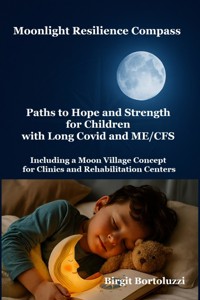
The Moonlight Resilience Compass is a guide of light, hope, and strength for children with Long Covid, ME/CFS, and other chronic illnesses – in a world where much remains invisible. A compass does not show how fast one should move, but where one stands and which direction is possible. This is exactly what children with fluctuating strength and uncertain daily lives need. Why the moon and why a compass? Because these illnesses do not follow a linear course; they unfold in cycles: exhaustion, withdrawal, hope, strength. The compass helps to recognize and name these phases. It builds bridges between strain and self efficacy, invisibility and visibility, and between children and adults. Cyclical intelligence means understanding these fluctuations not as a deficit but as a valuable resource. It makes individual states systemically compatible and opens new pathways for resilience and participation. The Moonlight Resilience Compass translates inner states into symbols, transition rituals, and child friendly anchoring formulas that everyone can understand. In this way, new protective spaces emerge that legitimize withdrawal and enable guidance in the rhythm of the children. Scenarios, modules, and visual markers make fatigue, sensory overload, and cognitive fluctuations visible. The moon goddess accompanies these cycles as a semantic figure – not as a fantasy character, but as a resonance body for what cannot be spoken. All modules are globally applicable and important for disaster and emergency management, as they structure cycles of strain, enable crisis communication, and strengthen self efficacy. Spatial examples, scenarios, and practice scripts present care in a new way, because we must succeed in meeting one of the greatest social, health, and educational challenges of our time. The book also contains a comprehensive concept proposal for the creation of a Moon Village, which can provide orientation and safety both in everyday life and in times of crisis.
Sie lesen das E-Book in den Legimi-Apps auf:
Seitenzahl: 244
Veröffentlichungsjahr: 2025
Das E-Book (TTS) können Sie hören im Abo „Legimi Premium” in Legimi-Apps auf:
Ähnliche














Imprint
Birgit Bortoluzzi
Burgwartstraße 25
01159 Dresden
Germany
Text: Copyright by Birgit Bortoluzzi
Cover Design: Copyright by Birgit Bortoluzzi
Publisher: Birgit Bortoluzzi, Burgwartstraße 25, 01159 Dresden, Germany
Version 1.0 – First Edition (November 2025)
Moonlight Resilience Compass – Pathways to Hope and Strength for Children with Long Covid and ME/CFS (including a Moon Village Concept Approach for Clinics and Rehabilitation Facilities)
This work was originally published in German under the title “Moonlight Resilience Compass – Wege zu Hoffnung und Stärke für Kinder mit Long Covid und ME/CFS (inclusive Moon Village-Konzept für Kliniken und Rehaeinrichtungen)”
Note: This book was published independently. Distribution is provided by epubli – a service by neopubli GmbH, Berlin.
Distribution: epubli – a service by neopubli GmbH, Berlin
Copyright and Usage Rights: © 2025 Birgit Bortoluzzi. All rights reserved.
This publication - including its terminology, semantic architecture, governance logic and all visual and structural elements - is the intellectual property of the author. Redistribution, adaptation or translation of any part of this work (textual, visual or structural) is permitted only with explicit attribution and in accordance with the ethical principles outlined herein.
Collaborative use in humanitarian, academic or institutional contexts is expressly welcomed - provided that transparent governance agreements are in place. Commercial use or modification requires prior written consent.
Visual Material and Cover Design: All images, illustrations and graphic elements used in this book - including the cover and visual modules - are protected by copyright. Their use outside this publication is permitted only with explicit authorization and in accordance with the principles of semantic integrity.
Disclaimer: The contents of this book have been prepared with the utmost care and to the best of the author’s knowledge. They serve as strategic guidance, ethical reflection and operational support in complex crisis contexts. However, they do not replace individual consultation by qualified professionals, authorities or legal experts.
The author assumes no liability for decisions made on the basis of this work, particularly not for direct or indirect damages resulting from the application, interpretation or dissemination of its contents. Responsibility for use lies with the respective users and institutions.
About the Author
Birgit Bortoluzzi is a strategic architect, a graduate in disaster management, a certified marketing and social media PR manager, and a coach. Her core focus lies in crisis and disaster resilience as well as in the development of strategic and semantic frameworks. As the initiator and author of the “Semantic Integrity Framework for Disaster Imagery – Strategic Architecture for Visual Integrity in Disaster Management,” she develops globally adaptable concepts for evaluating and managing visual content in crisis contexts. Her work integrates operational decision logic, ethical communication strategies and interdisciplinary data sources, with the clear goal of redefining visual responsibility and global responsiveness.
She is an active member of the IEEE GRSS Disaster Management Study/Working Group and the BioHazard & Vector EO Group, and has presented innovative approaches for emergency responders at the Pracademic Emergency Management and Homeland Security Summit 2025 (Embry-Riddle University). Her engagement in international networks aims to bring together diverse perspectives and promote systemic 360-degree thinking.
As someone personally affected by a chronic illness, Birgit shares her knowledge and experience to encourage and guide others. Through the knowledge platform she founded, “University of Hope” at www.präventionschütztleben.de, Birgit has created a public-good knowledge space dedicated to promoting resilience, disaster preparedness, and societal care. Special attention is given to the needs of people with Long Covid, ME/CFS, MCS and other vulnerable groups. The University of Hope is a place of trust, connection and empowerment — driven by the conviction that hope is strength, and resilience begins where we not only hope, but act.
Versatile, profound, and full of curiosity — that may be the most fitting description of Birgit’s nature. She never wanted to merely observe the world, but to experience, understand and shape it in her own way. From an early age, she was fascinated by the world of communication, strategy and scenario planning, holistic analytical approaches, marketing, photography, painting, poetry, writing — as well as the world of pharmacokinetics, chemistry, natural and nutritional sciences. In all her considerations, her special focus is always on children, vulnerable groups, and emergency responders.
Her thinking is not only interdisciplinary, but deeply human — driven by the desire to organize complexity, share responsibility and shape a meaningful future.
.
Foreword
This book quite deliberately bears the title Moonlight Resilience Compass, and that is exactly what it intends to be. A compass of light that offers children orientation when illness and invisibility define their everyday lives. Children with Long Covid and ME/CFS often experience that their voices are ignored, their needs remain invisible for a long time, and their experiences are not understood. This book seeks to give them a language, not only through words, but above all through symbols, images and rituals.
Why the moon, of all things?
For me, the moon is far more than just a celestial body in the night sky. It is a mirror of our inner world; it gives us rhythm and hope and makes the invisible visible. Stories, myths, and rituals surrounding the moon lend the hidden a very special form and aura. Children with Long Covid or ME/CFS carry much within them that is not always outwardly recognizable — exhaustion, sensory overload, the need for withdrawal. Their words often do not suffice to explain this. The moon creates a wonderful bridge here, for it becomes the narrator that makes inner states visible. Its phases show that withdrawal, silence, and new beginnings are just as much a part of life as resonance and strength.
In all cultures, the moon speaks of protection, renewal and rest. These narratives legitimize pauses and make them valuable in this context. A moon diary, a change of symbols, or small rituals give children the opportunity to make their inner state visible. The moon goddess as narrator helps them to understand their experiences not as a deficit, but as part of a cycle. Withdrawal thus becomes a movement and not a standstill. The moon transforms the invisible into symbols that parents, teachers, and therapists can understand. In this way, a shared language emerges that protects children and at the same time is systemically integrable.
Children with Long Covid and ME/CFS often experience that their strength wanes, that they must withdraw, and that they do not “function” like others. In our society, this is quickly interpreted as weakness. Yet the moon tells a different story. It shows that phases of darkness are also valuable, that they mean rest, protection, and preparation.
But the moon is more than a symbol of withdrawal and hope. It is an element that connects our world. Across all times, cultures, and continents, people have gazed at the moon, gifted it with wonderful stories, and used it for orientation. It is a shared point of reference for our humanity and our nature, and it is a silent companion that shows us we are all part of a greater rhythm. This universal function of connection makes it a particularly powerful symbol for children who often feel alone in their invisibility. The moon then whispers softly to them: “You are part of a whole, and you are connected.”
For me personally, the moon is a symbol of hope. As someone affected myself, I know how important it is that withdrawal is legitimized and not regarded as weakness. The moon grants us this legitimacy. It shows us that every cycle has its own meaning, and that we are not “weak/less valuable,” but cyclically intelligent.
New pathways through the Moon Village
This book is at the same time an invitation to rethink or further develop spaces. The Moon Village presented in the book is a concept that can open a protective space for children with Long Covid and ME/CFS, one that takes their cyclical needs seriously and legitimizes their cyclical experience as strength. It is intended to protect them from overload, to foster creative forms of expression, and to enable therapeutic support in the rhythm of the children.
A perspective for clinics
The concept of the Moon Village is also an impulse for clinics that care for children with Long Covid and ME/CFS. With simple means such as mobile partitions, dimmable light sources, symbol cards, and ritual objects, spaces can be created that are not only functional but also emotionally safe. The clinical concept proposed here envisions that rights of withdrawal are clearly legitimized, balance zones are creatively designed, and connection spaces are ritualized. In this way, a new culture of care emerges, one that can ease the hectic daily routine of clinics and give children a language that goes beyond their words. The room examples, checklists, and practice scripts presented in the book show how this concept can be integrated step by step into everyday clinical life, turning a vision into a manageable model of care. Thus, the Moon Village can serve not only as a pilot model, but in the long term establish a new standard language of care that protects children and strengthens institutions.
This book was written for all the children in our world whose strength is quiet, whose paths are cyclical, and whose light is often overlooked. For those who must withdraw in order to endure, and who are nonetheless connected. It is a compass of light that tells them: You are meant. You are seen. And your path deserves space, time and hope.
This book warmly invites you to join me in a world where symbols provide orientation, rituals create safety, and the moon goddess with a gentle gaze says “You may be as you are, and you will be seen.”
And at the same time, it shows how such spaces can come into being — with concrete room examples, practical checklists, and simple rituals that give children orientation and security, and open up a new culture of care for clinics, schools and families.
Birgit Bortoluzzi
Version 1.0 – First Edition
Moonlight Resilience Compass – Pathways to Hope and Strength for Children with Long Covid and ME/CFS (including a Moon Village Concept Approach for Clinics and Rehabilitation Facilities)
Developed and authored by Birgit Bortoluzzi
Dresden (Germany), November 2025
© 2025 Birgit Bortoluzzi. All rights reserved. This publication — including its terminology, semantic architecture and governance logic — is the intellectual property of the author. Redistribution, adaptation or translation of any part of this work (textual, visual or structural) is permitted only with explicit attribution and in accordance with the ethical principles outlined herein. Collaborative use in humanitarian, academic or institutional contexts is welcomed under transparent governance agreements. Commercial use or modification requires prior written consent.
Note on Accessible Readability
To facilitate readability for all target groups — including people with cognitive or visual impairments — I refrain from using gender-specific special characters in this book. All personal designations are always inclusive and refer to all genders.
Moonlight Resilience Compass
The Moonlight Resilience Compass is not an ordinary book – it is more than a story. It is a symbolic language that makes the invisible visible and offers guidance to both children and adults, even in the darkest phases. A beacon of light for children with Long Covid and ME/CFS, who move in a world where much remains hidden. A compass does not show how fast one should go, but where one is and which direction is possible and this is exactly what children and adolescents need, whose strength fluctuates and whose everyday life is marked by uncertainty. The compass gives them orientation without pressure, hope without compulsion and a language that makes their inner states visible with dignity.
Why a compass, of all things?
Because Long Covid and ME/CFS do not follow straight paths. There are no simple solutions here and no line from “ill” to “healthy.” Instead, children and adolescents experience many cycles – days of complete exhaustion, despair and hopelessness, moments of openness, but also phases of strength. The compass helps them to recognize these cycles and to give them meaning. It shows not only where one currently stands, but also that every state is part of a larger rhythm. It builds a bridge between children and adults, between invisibility and visibility, between withdrawal and self-efficacy, and it shows that resilience is not a straight path, but a rhythm we can walk together.
The Moonlight Resilience Compass is intended to make these cycles visible and to translate inner states into symbols that everyone can understand.
A Little Story of the Compass in the Fog and the Moon’s Dust Cloud
It was a night when the moon shimmered only faintly and a fine fog enveloped the world. For the children, this fog sometimes felt heavy – their thoughts blurred, words got stuck, and their path was lost within it. It was as if an invisible dust cloud circled around them, like the one that surrounds the moon and that researchers could not explain for a long time.
For the moon also carries a cloud – of fine dust, stirred up by tiny impacts of micrometeorites. These particles are smaller than a hair, yet they strike with such force that they can crumble the surface and create a fluffy layer called regolith. When the sun warms the moon, this dust layer swirls up more strongly, especially at the transition to morning. Thus an asymmetric bell of dust rises, carried spirally into orbit.
The children in the Moon Village knew about this. They had learned that their fatigue also does not run evenly – sometimes paralyzingly heavy, sometimes almost gone. Their sensitivity could suddenly flare up massively when sounds, light, or smells became too much. Joy and sadness shifted abruptly, like a sky that suddenly changes from sun to storm without warning. Sometimes learning came easily to them, sometimes their thoughts blurred and dissolved. On some days their strength was enough for movement, on others barely for getting up. And when they withdrew, it was not always the same – sometimes a quiet retreat, sometimes a complete disappearance. Their inner dust cloud was dense and heavy and then again lighter and barely noticeable.
But in the middle of the fog, suddenly a light began to shine – the Moonlight Resilience Compass. It did not show them how fast they should go, but where they were standing. Sometimes it pointed to the new moon – a sign that rest is allowed. Sometimes it led to the spiral – a hint that movement may also be slow and circling. Sometimes it guided them into the crater – a space just for themselves. And sometimes a star blinked through the fog – a small point of light that told them, “Very good, you did it. Your light counts.”
The children received a special lantern – the Dust Cloud Lantern. It shone according to their inner state – sometimes bright when the cloud was heavy, sometimes gentle when it lifted. In this way, the other children could recognize when retreat was necessary, when protection was needed, and when a small moment of strength could be celebrated.
The fog was no longer a sign of being lost for them, but a part of their path. The asymmetric dust cloud of the moon became a symbol of their inner states – not as a disturbance, but as a rhythm. And so begins the journey through the symbols of the Moonlight Resilience Compass – each of them an important point of light that makes inner states visible and offers orientation. The first step leads us to the new moon, the sign of retreat and the need for protection.
For just as the moon slowly turns and never shows its dark side, children with Long Covid and ME/CFS also carry forces within them that are not always visible. Yet with the compass, the lantern, and the knowledge of the dust cloud, the invisible becomes recognizable and walkable paths light up, even in the fog.
New Moon stands for withdrawal and the need for protection
In the Moonlight Resilience Compass, the New Moon represents the phase of lowest strain – a symbol that legitimizes withdrawal, makes energy cycles visible, and gives all involved clear rules for protection and rest.
Why I associate the New Moon with the lowest level of strain in the Moonlight Resilience Compass …
Symbolic and functional meaning of the New Moon
Why “lowest strain”?
After the phase of the New Moon, in which withdrawal and protection are in the foreground, the compass slowly opens further – the Half Moon appears as a symbol of cautious opening and limited resilience, an intermediate space between rest and resonance.
Half Moon shows cautious opening and limited resilience
Symbolic Meaning
The Function in the Compass
Transitional phase:
The Half Moon mediates between withdrawal (New Moon) and resonance (Full Moon).
Dosage:
Strain is possible, but only in mini-steps.
Legitimation:
The child may say, “I will join in, but only a little.”
Orientation:
For parents, school, caregivers, and doctors it is clear: no full strain, but cautious opening.
Concrete examples of Half Moon phases (that may be feasible and implementable)
School:
The child attends class, but only for one or two hours, then withdrawal.
Therapy:
Speech therapy or occupational therapy only 10 minutes, then a break.
Physiotherapy:
Micro-exercises such as arm circles or foot circles, no long training sessions.
Care:
Vital signs check once daily, no blood draws (except when necessary).
Rehabilitation:
Small concentration tasks (puzzle, memory), no tests or long sessions.
Parents:
The child may play with friends, but only within a limited time frame and with sufficient opportunity to withdraw.
Transport:
Guaranteed seat on the school bus, preferably only short distances.
Nutrition:
Light snacks instead of full meals, to stabilize energy.
Spiritual support:
Short ritual (candle, singing bowl), no long ceremonies.
Art/Music therapy:
Small creative impulses (a song, a picture), no large projects.
After the cautious opening in the Half Moon, the cycle in the Moonlight Resilience Compass reaches its peak – the Full Moon appears as a symbol of resonance, strength, and connection and makes visible that children are now in their greatest energy phase and ready for participation, exchange, and joint action.
Full Moon symbolizes resonance, strength and connection
Symbolic Meaning
The Function in the Compass
Concrete examples of Full Moon phases
School:
Participation in projects or group work, with the option for breaks.
Therapy:
Longer sessions (e.g., 30 minutes of speech therapy or occupational therapy), but with clear dosage.
Physiotherapy:
Balance exercises, yoga, or coordination games.
Care:
Blood draws or examinations are deliberately scheduled during the Full Moon phase, as energy is higher here.
Rehabilitation:
Coordination games, light tests, or training with a clear break structure.
Parents:
Shared family activities, walks, or small outings.
Transport:
Participation in longer trips (e.g., school excursion), with guaranteed seating.
Nutrition:
Full meals, trying new foods, replenishing energy.
Spiritual support:
Blessing rituals or moon stories in a larger group, resonance with the community.
Art/Music therapy:
Making music together, painting, or performing small works as an expression of strength and connection.
For children with Long Covid, ME/CFS, or even cancer, the moon is not only a comforting image, but it is also a valuable navigation system. It can help them to understand themselves, to show themselves, to protect themselves and all of this without words and without feelings of guilt.
Exactly at this universal symbol of the moon the Moonlight Resilience Compass takes hold – it transforms the ancient imagery of the moon phases into a modern, child-friendly orientation model that makes inner states visible, legitimizes withdrawal, and strengthens self-efficacy. Our moon has a unique symbolic role, and that in almost all cultures, for it embodies change without this being read or regarded as error or disturbance. The moon is thus a rare, universally connectable symbol that not only allows fluctuations, but presents them as natural, rhythmic, and meaningful – without judging or pathologizing them.
1. The moon is universally relatable
In nearly all cultures of the world, the moon is a central symbol — from the Greek Selene to the Chinese Chang’e to the Maya goddess Ixchel.
It is not bound to language, religion, or culture, but is visually perceptible and emotionally accessible.
2. The moon stands for change — without deficit
Its phases (new moon, half moon, full moon) are visible, recurring fluctuations and are not considered disturbance, but a natural cycle.
These fluctuations are not linear (like progress vs. regression), but cyclical — they legitimize withdrawal, emptiness, and invisibility.
That means, for example, the new moon is “invisible,” but not “gone.” It is not deficient, but still part of the whole.
3. The moon is emotionally safe
It does not dazzle, it does not demand, and it does not judge.
It is quiet, constant, and protective — ideal for children with chronic exhaustion, sensory sensitivity, or need for withdrawal.
Children can say, “I am in the new moon” and thereby express fluctuation of state without having to explain or justify themselves.
4. The moon is semantically open, yet structured
It allows individual interpretation (e.g., as protection, rhythm, mirror).
And at the same time, it offers a structured order (e.g., 8 moon phases, 29-day cycle) that provides narrative security.
The moon is a universally understood symbol that shows fluctuation not as a problem but as a principle, which is precisely why it is so ideal for children with long COVID, ME/CFS, or even cancer. It translates their inner states into visible, legitimate and non-pathologized forms of expression.
Our moon is a universal symbol for cyclical change and emotional self-regulation — without pathologization. (1) (2) (3) (4) (5)
The moon is therefore not only a poetic metaphor, but at the same time a practical model of orientation. Its phases translate fluctuations into a visible, legitimate, and non-pathologized language. This is precisely where the Moon Resilience Kit comes in. It makes the universal symbolism of the moon usable for children and their caregivers in everyday life. What was previously described as abstract mythology now becomes a concrete tool that legitimizes withdrawal, makes strain visible and strengthens self-efficacy.
Moon Resilience Kit
The Moonlight Resilience Compass unfolds its practical power in the Moon Resilience Kit – a child-friendly system that translates the universal symbolism of the moon phases into concrete orientation and thereby legitimizes withdrawal, makes strain visible and strengthens self-efficacy.
The Moon Resilience Kit will be the practical heart of this compass. It translates the moon phases into a child-friendly logic that legitimizes withdrawal, makes strain visible, and strengthens self-efficacy. The moon is not only a poetic image, but a universal symbol, for it connects cultures and times. It shows that darkness is just as valuable as light and it makes the invisible visible. Please try it out.
The Resilience Backbone – the backbone of the Moon Resilience Kit
At its core, this is not about control, but about connection. The compass should create structural coherence, meaning that environment, health, school, and family are not considered separately, but as a learning overall system.
An example: when a child is in the “Half Moon,” they receive reduced tasks and longer breaks, and the system checks the next day whether a change is possible.
Reflexive Decision Logic
What does that mean? Decisions here should not be made linearly and in rigid patterns (“symptom → measure”), but as part of a dynamic, learning and cyclical system. Every decision is at the same time a preparation for the next strain.
Children with Long Covid and ME/CFS experience daily fluctuating strains (fatigue, sensory sensitivity, cognitive fluctuations, sleep disturbances, head and muscle pain, temperature and circulatory problems, post-exertional malaise (PEM), breathing difficulties, gastrointestinal complaints, emotional strain, and much more). This list alone makes clear that the strains are highly complex and variable — physically, cognitively, and emotionally.
The Moon Resilience Kit is intended to provide you with
a cyclical decision logic
— for example, the moon phase compass shows not only the current state, but also anticipates the next.
An example
: A child chooses “Half Moon” in the morning → the system (which you have worked out according to your circumstances and requirements) suggests reduced tasks, longer breaks, and light therapy. On the following day, it is then checked whether the strain has decreased and the phase can be adjusted.
Desired Strategic Effect: Decisions here are not only reactive, but embedded in a learning and visual system. This strengthens self-efficacy and resilience.
Adaptive Coordination:
Roles can be flexibly distributed here. Sometimes the child steers independently through symbols, sometimes parents or teachers take over. All use the same markers — colors, crater symbols, shadow signs.
Semantic Openness:
The Moon Resilience Kit is language-free and universally accessible. Children, parents, and professionals see the same situational images and can act without misunderstandings.
Integration of Anticipation, Structuring and Implementation:
Risks can thereby be identified early, corresponding structures prepared, and measures continuously implemented — from the withdrawal space to micro-maneuvers such as the child’s “crater withdrawal.”
The Resilience Backbone shows how decisions in everyday life can be made cyclically, in a learning and adaptive way. Yet every system needs not only structure, but also symbols that carry this logic emotionally and make it immediately tangible for children. This is where the moon goddess comes into play. She translates the abstract decision logic into a semantic resilience figure that accompanies, protects and gives children a new language for the invisible.
The moon goddess as a semantic figure of resilience
In the Moonlight Resilience Compass, the Moon Goddess appears as a living translation of its symbolic language – she is the guardian of withdrawal, the navigator of inner cycles, and the storyteller of a new language for the invisible.
The Moon Goddess is not a figure from old stories and not a pure fantasy being, but in our context she is a strategic companion for cyclical strain, visual self-regulation, and emotional safety. She is a visual resonance body for children with Long Covid and ME/CFS because she embodies exactly what they lack and what they need in order to experience themselves again as part of a system.
In our Moon Resilience Kit she becomes the guardian of withdrawal, the navigator of inner cycles, and the storyteller of a new language – a language for the invisible.




