


15,49 €
Mehr erfahren.
- Herausgeber: Nick Hern Books
- Kategorie: Poesie und Drama
- Sprache: Englisch
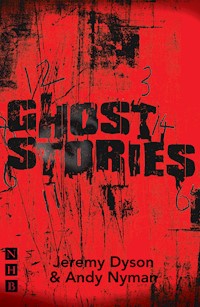
Professor of Parapsychology, Philip Goodman, is an arch-sceptic with a mission to debunk the paranormal, wherever it occurs. But when he embarks on an investigation of three apparent hauntings – as recounted by a night-watchman, a teenage boy, and a businessman awaiting his first child – Goodman finds himself at the outer limits of rationality, and fast running out of explanations. Jeremy Dyson and Andy Nyman's play Ghost Stories first started terrifying audiences at Liverpool Playhouse and the Lyric Hammersmith, London, in 2010, directed by its authors along with Sean Holmes – and has since become a worldwide cult phenomenon, with two West End transfers, productions in China, Australia, Canada and Europe, and an award-winning film adaptation. It was revived at the Lyric in 2019. This official tie-in edition features the complete script for the show, and an exclusive introduction by Jeremy Dyson and Andy Nyman, about the origins and development of the play.
Das E-Book können Sie in Legimi-Apps oder einer beliebigen App lesen, die das folgende Format unterstützen:
Veröffentlichungsjahr: 2019
Ähnliche





Jeremy Dyson & Andy Nyman
GHOST STORIES
NICK HERN BOOKS
London
www.nickhernbooks.co.uk
Contents
Introduction
Production History
Characters
Ghost Stories
About the Author
Copyright and Performing Rights Information.
Introduction
Jeremy Dyson and Andy Nyman
Ghost Stories is a dream come true.
We met in 1981 at a Jewish summer camp called, appropriately enough, ‘Chai ’81’ (‘Chai’ being Hebrew for ‘life’). It was fate that threw together three kids from Leeds (including Dyson) and three kids from Leicester (including Nyman) into one cramped room for six. We were fifteen and within a couple of hours had discovered that we shared two mutual loves: dirty jokes and a burning obsession with Horror. We became best friends, and in the thirty-eight intervening years very little has changed.
Over the years we’ve shared in every aspect of each other’s lives: through adolescence, the trials and tribulations of dating, both moving to London, both getting married, both becoming fathers, both becoming middle-aged. Always sharing the ups and downs of life, always sharing laughs and news of the latest, greatest horror films.
Throughout our friendship we constantly mused, ‘Wouldn’t it be wonderful to actually work together?’, always meaning it, but somehow never quite finding the time. We’ve both remained busy, Jeremy as a writer and Andy as an actor. Our careers, and the practicalities of being freelancers with families, meant the realities of collaborating were beginning to feel like an impossible dream.
Then one day that all changed. Andy was in the West End of London and happened to walk past the Fortune Theatre, where The Woman in Black has been playing for almost thirty years. Andy was struck by a thought: how insane it was that there hadn’t been another horror play since that one had opened, almost as though such a thing wasn’t allowed.
Andy had also recently seen The Vagina Monologues in which the staging is remarkably simple – three women sit on three stools reading/performing the play directly from the script. The two experiences collided and Andy phoned Jeremy with this thought – ‘I think I know what we should work on together – a play, like The Vagina Monologues, but with ghost stories. Three men, sitting on three stools telling ghost stories.’ Jeremy loved the idea and we started to ponder.
The third essential cog in the machine was Sean Holmes. He and Andy had worked together on a play Andy had starred in (Moonlight and Magnolias by Ron Hutchinson); they’d loved working together and wanted to collaborate on something else. Andy casually mentioned the idea of the ghost-story play. A month later Sean became the Artistic Director of the Lyric Hammersmith, and his second phone call on his first day in the job was to Andy, to find out what was happening with ‘that ghost play’. A meeting was set for three days later.
Fortunately we’d been talking about it and thinking about it on and off for about a year, emailing each other fragments of our own writing and our favourite ghost stories by other people – so in some ways the earth had been tilled when we got together, prior to meeting Sean to drew up some rules of engagement:
• It had to be contemporary, so that it was as different as possible from The Woman in Black.
• It had to have a small cast to keep costs down.
• It should only be ninety minutes without an interval to keep the tension high.
• There should be no spoilers allowed at all, no plot given to press or indeed auditioning actors.
And finally, and most importantly:
• It had to be as frightening as the best modern horror film, with full ‘leap out your seat’ scares.
On 27 January 2009, we had the meeting and, incredibly, Sean and the Lyric commissioned the play, with us set to direct. Sean’s masterstroke, though, was programming the dates there and then that the play would open: exactly a year away.
We were both busy for about six months with our own various commitments, but set a time when we could get started properly. We sent each other thoughts, ideas and scribbles to keep the fires burning.
Then from the 19 July 2009, we finally sat down with four clear days to scratch out something concrete. The script had to be delivered on 1 October. The first thing we did was put a large index card on the wall. It said simply ‘FUN’, and it acted as an essential reminder both that the play itself should be entertaining and enjoyable, but also that the creative process wasn’t to be some terrifying daunting task, but was built around the simple joy of two lifelong friends finally coming together to do what they had talked about doing for over thirty years.
We then set out with one very simple premise: what was the play we would most want to see ourselves? We started talking about our favourite moments from horror films, what made us laugh, scream and jump; but we also discussed what were the most memorable and impactful moments of theatre we could remember. The aspiration was somehow to combine both.
Very quickly the wall filled up with random thoughts and ideas, all disconnected but all born from the same place.
As we started to sift and shift these ideas into categories and sections, we realised that the ‘three men telling three stories’ idea had somehow shifted itself into a stage version of a cinematic phenomenon we both adored: the portmanteau horror film.
The incredible films of the production companies Amicus and Tigon in the 1970s, and their earlier 1940s Ealing Studios predecessor, Dead of Night, had shaped our childhoods – utterly British and yet fantastically global, full of deliciously playful scares that had creeped us out and stayed alive in our imaginations for decades. We knew, though, that we also wanted to craft a play that would deliver something of substance to an audience, some solid ground underneath the fun, that would leave a deeper, darker residue and be harder to shake off.
With that in mind, we asked each other a question: ‘Had you ever done anything in your life that you were truly ashamed of?’ The answers we gave would go on to shape both the individual stories and the overall plot in ways that were consistently surprising to us both.
* * *
Sean came to see us for a progress report and Andy performed a basic one-man version of the whole play for him. At that point, Sean suggested that as well as us directing, Andy should play Professor Goodman himself, truly a thought that had never occurred to us. Sean also told us that the play would now run for three weeks at the Liverpool Playhouse before moving to the Lyric. Very exciting news.
Incredibly, within three days, thirty years of friendship and a lifetime of absorbing horror had created the framework of the play. Many of the moments, scares and beats that we discussed then have remained unchanged over the subsequent years in which the play has been performed.
Another creative element that we were both very passionate about was that the show should also include something of our love of theme-park rides – that the story should somehow burst its banks and spill out into an immersive experience for the audience.
As you will see from reading the script, exactly what the experience of being in the theatre would be like was actually written into the show. We wanted to be playful with the form: What could the audience see around them? What could they smell? We also loved the idea that their involvement with the play would actually begin when they bought their ticket – with the purchaser being given a warning about how scary it was going to be by the box-office staff before they’d even handed over their money.
We delivered our first draft on 1 October 2009 and then kept developing and writing right though till day one of rehearsals – 11 January 2010.
* * *
Ghost Stories opened at the Liverpool Playhouse on 4 February 2010, and we truly had no idea what to expect. By now Sean had come on board as a third director, bringing a wealth of experience to help guide us through the technical rehearsals and first previews.
When the audience screamed for the very first time, it was one of the greatest moments of our creative lives. Something so unique and very special.
We continued to work on the play, learning from the audience, changing lines, moments and, in the case of the Tony Matthews story, the entire ending! It was a blissful time: doing the show in the evening, then staying up late, deconstructing what wasn’t yet working, followed by our early morning ‘porridge sessions’, rewriting and problem-solving as we breakfasted.
The production moved to the Lyric Hammersmith where it started previewing on 24 February 2010. Wonderfully, it performed to packed houses and very swiftly transferred to the West End. It ran at the Duke of York’s Theatre for thirteen months – a fact that still makes us pinch ourselves.
Since then the show has been performed all over the world – Moscow, Sydney, Lima, Germany, Toronto, Shanghai, Norway, Finland and with many more international productions planned. We also adapted it for film, writing and directing it ourselves. It was released in cinemas in 2018 both in the UK and internationally to much critical acclaim. It also won us a Fangoria Chainsaw Award for Best First Feature – a fact that would have made our fifteen-year-old selves explode with delight.




