


21,99 €
Mehr erfahren.
- Herausgeber: ESMOD
- Kategorie: Lebensstil
- Sprache: Englisch
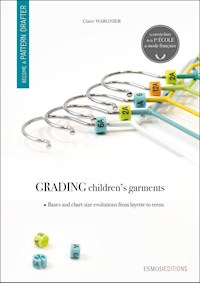
Reducing or enlarging a sewing pattern - Grading children's garments
This book, the second stage in our ""Become a pattern drafter”, Children’s garments series, completes the creation of garments developed earlier using a point-by-point explanation of how to move from one size to the other.
Conceived to respond to the needs of today’s clothing industry, it also addresses individuals passionate about sewing thanks to the choice of models used which can serve as examples for creating a multitude of other designs. Manual methods and sizing charts for the models in a children’s wardrobe are explained.
ABOUT THE AUTHOR
Claire Wargnier is a graduate of ESMOD, the world's oldest and most renowned fashion design school, where she was a pattern-drafting professor during thirty years. Her experience in the different sectors of the fashion industry have allowed her to adapt her teaching methods to the students' needs. She is also a consultant in the fashion industry, works and lives in Paris.
Das E-Book können Sie in Legimi-Apps oder einer beliebigen App lesen, die das folgende Format unterstützen:
Veröffentlichungsjahr: 2021
Ähnliche















Table OF CONTENTS
Claire WARGNIER
Gradingchildren’sgarments
Lesavoir-fairede la1reécole de mode française
Bases and chart size evolutions from layette to teens
Supplies........................................4
Collection process......................6
Collection processmanual grading...........................7
Collection process / cad ...........8
Collection process / evolution scales..........................9
General grading methods.......10
Different evolutions for grading..................................16
Examples of evolutions details..........................................20
Measurements charts layette.............................24
Measurements charts toddler............................26
Measurements charts child.................................28
Measurements charts junior girl .......................30
Measurementscharts junior boy.......................32
Measurement table (in french- english)..................34
Measurement table (ingerman-spanish -japanese)....................................36
Measurement table (inportuguese - norwegian - korean)........................................38
Measurement table (initalian - indonesian -chinese).......................................40
Work method on bodice stack layette - toddler (from 60 to 104)........................42
Work method on bodice stackchild (from 104 to 134)...........44
Work method on bodice stackjunior boys or unisex (from 134 to 170).....................46
Work method on bodice stackjunior girls (from 134 to 164)48
Work method on sleeve stack layette - toddler - child...........52
Work method on sleeve stackjunior boys or unisex (from 134 to 170) / junior girls (from 140 to 164).....................54
Work method on collar stack.56
Work method on stack: layette trousers.........................58
Work method on stack: toddler trousers........................60
Work method on stack: child trousers.............................62
Work method on stack: junior boys trousers.................64
Work method on stack: junior girls trousers..................66
Work method on stack: toddler - child skirt...................68
Work method on stack: junior skirt..................................70
Grading by evolution scales...72
Construction based on a measurement table (mt).........76
Grading a placed motif............80
Evolutions for necklines, shoulders and sleeve lengths head ease....................................82
Size evolutions: shirts - polos - blouses............84
Size evolutions: dresses - tops - skirts...............85
TABLE OF CONTENTS
01.Parallel ruler
02.L-square
03.Flexible ruler 30 cm
04.Japanese flexible ruler 50 cm
05.Metal ruler 1 meter
06.French curve
07.French curve
08.Tailor curve
09.Measuring tape
10.Pencil sharpener
11.Red and blue pencil
12.Black pencil
13.Permanent markers
14.Eraser
15.Awl
16.Tracing wheel
17.Scissors for paper cutting
18.Fabric scissors
19.Pins
20.Self-adhesive, thin ribbons
21.Thin ribbons
22.Notcher
23.Puncher
24.Pattern weights
9
6
24
2
Supplies
1
4
3
20
18
5
21
Table OF CONTENTS
13
9
15
19
10
12
11
14
8
7
22
16
23
18
17
LEGEND
Dark or blue line: final outline:
Light Line: construction outline:
Straight Grain:
Center:
Tear:
6
The work processes explained in the following three pages present the organization of the different roles in the industry for creating a collection, notably the position of the pattern-maker-grader within the production process.
The processes differ depending on the company’s organization and set-up.
We have schematized three examples which allow for a better understanding of the different types of grading currently used in companies.
Grading by projection, referred to as « manual grading », is used in companies which are not computer-equipped and serves as a base for conception of the other methods used. It is thus essential to know.
Grading by CAD (computer assisted design)has considerably improved the precision of tracings and the rapidity of the patternmaker-grader’s work. It is done either in the company’s patternmaking office or in the manufacturer’s planning department.
Grading by evolution scales requires the patternmaker-grader to have the same qualifications, but the work process differs. In this case, he or she will only conceive the evolution of the models, the grading and patterns wil be done according to his instructions by the manufacturer’s planning department.
Collection process
Table OF CONTENTS
7
Collection process / manual grading
8
Collection process / cad (computer assisted design)
Table OF CONTENTS
9
Collection process / evolution scales
10
Introduction
The way to grade a model, meaning, the evolution of its volume from size to size, has evolved considerably in recent years. Usually graded manually by the patternmaker in small and mid-sized companies(Collection process - Manual grading, see p.7), models are increasingly worked on the computer in all companies as they were done, just a few years ago, only in big industrial set-ups(Collection process - Computer grading process, see p.8).
This evolution saves time and offers unequaled precision.
However, all companies cannot afford this equipment, since manufacturing deadlines have become much shorter. Today, pattern-makers must organize their work diffe-rently by preparing evolution scale charts(Collection process - Computer grading process by evolution scales, see p.9)which they send to a computer-equipped factory to grade and manufacture the model based on the patternmaker’s specifications.
It is these three grading methods (manual, computer or in using scales) that we will explain in this book.
Grading procedures remain the same no matter which method is used:
know the rules for size evolution.
add or diminish the amount for the type of enlargement chosen for a model.
evolve details (seams, pockets, etc.) de-pending on their location in the garment, taking into account size and volume amount (ex: a yoke seam at the halfway point of an armhole will be raised or lowered half the variation in relation to its size and volume).
Generalities
Grading children’s garment is particularly delicate.
It is necessary to take into account not only the body’s evolution, but also the increase of the same type of enlarge-ment on a body.
It is thus recommended to verify this grading by making different sizes (size run).
Most often, the sizes verified are extreme sizes (ex.: S.104 and S.152), but they can differ depending on the Brand’s product range.
Grading rules for this method thus offer an enlargement increase which corresponds to our cutting method for children’s garments.
Taking measurements and measurement table
In the following pages, we show a measu-rement chart which is from size 60 (layette) to size 170 (Junior boys).
The first column of the measurement chart indicates the increase of body measurements between each size for each measurement (size evolution). This progression is shown in millimeters.
Body measurements are indicated in centimeters.
General grading methods
Table OF CONTENTS
11




