


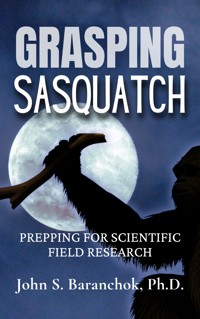
5,49 €
Mehr erfahren.
- Herausgeber: Hangar 1 Publishing
- Kategorie: Bildung
- Sprache: Englisch
Dare to step into the shadowy realm that exists at the edge of our understanding with Dr. John S. Baranchok's riveting exploration, "Grasping Sasquatch." This isn't just a book; it's an invitation to embark on a journey that challenges the very boundaries of belief and science. With a blend of captivating narratives, scientific rigor, and a dash of the unknown, Dr. Baranchok offers a glimpse into the elusive world of Sasquatch research that is bound to leave you questioning what lies beyond the seen.
What if everything you thought you knew about the natural world was only the beginning? "Grasping Sasquatch" peels back the layers of folklore to reveal a quest that is as much about discovering the unknown as it is about understanding our place within it. Dr. Baranchok, armed with a Ph.D. and an insatiable curiosity, guides us through the dense forests of mystery with a scientist's eye and a storyteller's heart.
Prepare to have your perceptions challenged as "Grasping Sasquatch" delves into the scientific methodologies that underpin Sasquatch research. But beware, for this is no dry academic tome. Dr. Barannnchok masterfully weaves together the threads of evidence, from the statistical to the anecdotal, creating a tapestry that is as compelling as it is informative. Yet, for every question answered, another arises, pulling you deeper into the mystery. "Grasping Sasquatch" is more than a book; it's a journey that promises to transform the way you view the world.
Through the eyes of a skeptic turned believer, you'll venture into the heart of the unknown, encountering along the way the challenges, triumphs, and inexplicable moments that define the search for Sasquatch. This is your chance to join an expedition that dares to ask the questions few have the courage to confront.
The path to uncovering the truth about Sasquatch is fraught with twists and turns, shadows and revelations. "Grasping Sasquatch" offers you the key to embark on this journey, but the destination remains shrouded in mystery. Are you ready to challenge the unknown and discover the truth for yourself? The forest awaits, and within it, secrets that have eluded seekers for generations.
Will you be the one to uncover them? "Grasping Sasquatch" is your invitation to a world where myth and science collide, and where the journey is as important as the destination.
Das E-Book können Sie in Legimi-Apps oder einer beliebigen App lesen, die das folgende Format unterstützen:
Veröffentlichungsjahr: 2024
Ähnliche



















GRASPING SASQUATCH
PREPPING FOR SCIENTIFIC FIELD RESEARCH
JOHN S. BARANCHOK, PH.D.
THE REVIEWS ARE IN AND THEY ARE… WELL,… MIXED!
“What will you do with your Bigfoot experience? In his book Psychological Horizons, Dr. Baranchok has stepped out of the norm and has written a book which will help you develop personal knowledge and scientific processes needed to gather and analyze data related to the mystery known as Bigfoot. He motivates you to re-evaluate how you approach the subject and how to deal with past and future experiences. The book is written … to educate the novice and challenge those who have been interested in the subject for many years. You will learn and relearn concepts which will help your own research techniques, contribute to the advancement of gathering data, and how to process your experiences. This is a must read for any Sasquatch researcher or those simply looking for a Bigfoot experience!”
Shelia Johnson, M.Ed. Counseling Psychology, Bigfoot Researcher,
Conversations with Shelia TJ Facebook Page
“Insights from a professional psychologist; a novel approach … His comedic self-depreciating approach is endearing … and … his sarcasm is fun … Really!”
Rick Reles, BFRO Investigator
“For fans of Sasquatch research comes this guidebook filled with personal encounters and laden with tools to improve skills and outcomes in your own fieldwork.”
Gary Strobl, Bigfoot Researcher
“What an unhelpful, POS! A boring, repetitive, and mostly irrelevant Bigfoot book! Only a few insights into Bigfoot or Bigfoot fieldwork techniques. The author is a conceited, “know-it-all” ass trying to impress the reader with his training, experience and knowledge of science and psychology, despite lacking the decades of Bigfoot field experience possessed by other writers, researchers, and investigators on the subject!”
(Anonymous)
“Dr. Baranchok has done the Bigfoot world a huge favor in the writing of this book. His background in neuropsychology offers insight that very few in the community can offer. His chapter on how to control your fight-flight response during a Bigfoot encounter is a must read for any and all serious researchers.”
C. Wayne Totherow, Founder of Mannimal Research
and Southeastern Sasquatch Investigations
Grasping Sasquatch: Prepping for Scientific Field Research by John S. Baranchok Ph.D.
Copyright © 2021 John S. Baranchok.
All rights reserved. No part of this publication may be reproduced, stored in a retrieval system or transmitted, in any form or by any means, electronic, mechanical, photocopying, recording, or otherwise, without the prior written permission of the author.
ISBN-13: 978-0578955292
Content Editor: Jay Kuczma
Front Cover Art Conceptualization: John S. Baranchok
Front Cover Art Illustrator: Terry Thomas
Picture of the Author Photo credit: Sedona A. Baranchok
Cover and Interior Layout Design: Rachel Pennacchio of Lazarus Tribe Media
Printed in the United States of America
DEDICATIONS AND THANKS
Dedicated to my parents John Baranchok and Evelyn M. Baranchok: Thank you for my life, your love, and wisdom. I grow to appreciate them more with each passing day! May you rest in peace.
Dedicated to My Beloved Daughter Sedona Ann Baranchok: Thank you for your ongoing presence in my life. You continue to light my life with the glow of your beauty and the caring warmth of your spirit! Always remember, you are the purveyor of your own reality!
Thanks to Anne and Ferris Maloof: Thank you for teaching me unconditional love and acceptance. I hope to master them one day!
Thanks to Lori Copeland Wade: Thanks for taking me under your wing and in doing so inspiring much contained in this book.
Thanks to Jeff Carpenter: We met when you saved my ass on my first expedition. I can’t begin to say how much you have taught me about Bigfoot research. Thank you!
Thanks to: Lori Wade, Jeff Carpenter, John Eaves, Rick Reles, George Wrigley, Glenn Williams, Mark Ogilbee, Greggory Craddock, and Charlie Raymond: You have been my Bigfoot research professors at the Bigfoot University located in Northern Georgia, Southern Tennessee, and God-only-knows-where in Kentucky. Thank you so much for your time, patience, and tolerance.
Thanks to D. Jeff Meldrum, Ph.D. for the personal communication, publishing guidance, and expressed interest in my efforts herein. Your work is part of the bedrock foundation and a pillar of the scientific exploration of the Sasquatch species. You remain a beacon to the few pursuing the scientific exploration of the species.
Thanks to Ron Morehead for the use of his photo. Your pioneering work in Bigfoot Field Research set a standard in sonic research into the species. You remain on the cutting edge of theory and thought in the field.
Thanks to Matt Moneymaker for guiding me through the Bigfoot Field Research Organization’s (BFRO’s) NDA to find a path for sharing my own and others’ expedition experiences. Thank you for forming BFRO making Bigfoot accessible to the masses and allowing me access to BFRO's internal documents.
Thanks to Janice Carter for setting a living example of strength and courage in sharing her story (through her own words and those of Mary Green) so that others might do the same. Your ongoing fieldwork, insights, and openness continue to be a source for very critical topics Bigfoot science needs to further explore.
Special Thanks to Terry Thomas for his incredible cover artwork reflecting my own biases concerning the needs for and direction of future Bigfoot research. I greatly appreciated your enthusiasm in integrating my own and other’s conceptualizations of Bigfoot into your art. Pablo Picasso and Salvador Dali were not available and likely would not have “taken notes” in as open fashion as yourself!
Special Thanks to my Copy and Content Editors: John Kuczma, Sheila Johnson, Kerry A. Cosby, Michele Ice, Gary Strobl, and Rick Reles. Your generous donation of time, effort, and feedback was invaluable to the final product of this book.
Thanks to the Crew at MedPsych Services, PC: Greg Lovell, M.A., Marcie McElroy, Tonya Davis, and Kieffer Collum. You know and have had to deal with “the good, the bad, and the ugly” in me. Your steadfast support and professionalism allowed this book to come to fruition. Thank you!
Thanks to the Primary Supporters of MedPsych Services, PC: William Naguszewski, MD; Robert Naguszewski, MD; Carl Billian, MD; Anne Groover, MD; Johnathan Beckner, MD; Brian C. Hard, MD; David Hale, MD; Marc Wall, MD; Jay Schecter, MD; Jeffrey Glass, MD; Anne White, MD; Dennett Gordon, Ph.D.; Debbie Gordon, B.A.; Shereef Girgis, MD; and Richard Donadio, MD. Without your interest in and support of my work in Neuropsychology, Pain Psychology, and General Clinical Psychology, I could have not remained living in the Southeastern United States and discovered my awesome hobby of looking for Bigfoot. (Debbie Gordon: Please catch yourself before you fall on the floor laughing.)
Thanks to Great Personal Friends and Playmates: Greg Lovell, Michael Cummings, Amanda Reisner, Dennett Gordon, Sedona A. Baranchok, Lucian Seth Turner, and Jay Kuczma. We’ve had a lot of good times together and hope we can have many more!
Thanks to: Sheila and TJ Johnson, Kevin Zorc, Garrett Strobl, Rebecca Strobl, and Sedona A. Baranchok: Thank you for your unwavering enthusiastic encouragement and support of me writing this book. Others didn’t discourage, but none have been as unconditionally strong and unwavering in their support as you guys! You have greatly helped me make it happen! Thank you!!
Thanks to you all!! I wish you peace, health, wellness, prosperity, happiness, and love. Mostly, I wish you Love, as the rest means nothing without it!
Sincerely,
John S. Baranchok, Ph.D.
DISCLAIMERS
CONCEPTUAL AND CONTENT DISCLAIMER: Although the word “Bigfoot” is in the title of this book twice and is the most frequently used word in this book, THIS IS NOT A BOOK ABOUT BIGFOOT! It is a book about PROCESSES, PROCEDURES, AND TECHNIQUES TO ENHANCE SCIENTIFIC BIGFOOT RESEARCH! These are offered as an adjunct avenue to prove the existence of the species and minimize the potential need to “harvest” and dissect a member of the species to achieve that goal.
This book is intended to provide “self-help” information on how the dedicated researcher can regulate his or her fight-flight response to move forward and pursue their quarry, should they want to take that potential risk. It is intended to educate the researcher on key psychological and scientific definitions, processes, and phenomena that influence their ability to become less biased about themselves, their observations, interpretations, and conclusions of research data. Indeed, it is intended to teach the dedicated researcher the strengths and weaknesses of different types of evidence and others’ research findings for their value, meaning, and relevance to Bigfoot. It is meant to teach basic experimental designs and statistical analysis concepts so that the researcher can develop their own research protocols in a more scientifically sound and objective fashion. In the opinion of this writer, these topics represent the fundamental prerequisite knowledge needed by any researcher dedicated to providing the SCIENTIFIC PROOF OF THE EXISTENCE OF BIGFOOT AS SPECIES IN ORDER TO BENEFIT THE SPECIES!
Although on one level, this book represents a “How To Capture Bigfoot” book, that topic is described from a SCIENTIFIC THEORETICAL PERSPECTIVE. The reader seeking concrete “How to” geographical/topographical, logistical, mechanical, and/or otherwise apparatus-based procedures and traps to “capture” Bigfoot will likely be disappointed in this book. The book does contain examples of that pragmatic ilk but is not written from the experiential/phenomenological research perspective.
That perspective, while needed and extremely valuable in scientifically proving Bigfoot’s existence has also proven itself insufficient to the task. Consider the plethora of credible evidence amassed through the phenomenological/experiential approach over the past 60+ years of modern Bigfoot research history. Credible audio, video, and photographic evidence of the creature exists. One can pay low to modest to exorbitant expedition fees to possibly versus probably have a Bigfoot experience. This might include “tree knocks,” roars, whoops, screams, cries, growls, limb breaks and twists, tree structures, eyeshine, footprints, bluff charges, fleeting glimpses of shadows, fleeting glimpses of creatures, zapping, and psychic/paranormal activity (to name few) all genuinely attributable and often attributed to Bigfoot. The rarer expeditioner may catch a brief glimpse of a Bigfoot. The much rarer and the extremely lucky one may experience an extended, multi-second view. None of these awesome experiences and evidence have been found sufficient to scientifically prove the existence of Bigfoot.
Explanations for this failure have been advanced and increasingly include government intervention/interference and conspiracy. It therefore pains me to point out a more practical explanation. Impressive as the aforementioned evidence may be, it simply fails to rise to the “standard required” by “Science” to allow it to constitute “Scientific Evidence” and proof of the species. It remains primarily anecdotal, subjective, and as such often biased. It typically lacks scientific control of extraneous influences and a tight experimental design. Most frequently, it lacks statistical data analysis answering an a priori (in advance of exploration) hypothetical question. The databases are guarded for the purposes of commercial and financial gain. Results are rarely publicly published for peer review and replication versus refutation. In short, although often using elements of the scientific method, the phenomenological/experiential approach fails to stringently follow the complete scientific method and process. As such, phenomenological/experiential evidence serves the very necessary and critical function of representing the foundation for scientific discovery. It has not, and will never, however, rise to the level of objective scientific proof! Don’t accept it. Disagree with it and reject it. Cry foul, dig in your heels, yell, scream, and protest. It remains a basic scientific fact. Phenomenological/experiential expeditions represent a good start toward “science” but are not the end point on that scientific path.
It also remains a basic fact that for humanity to assist the species in a broad and official capacity (protecting its habitat, for example), scientific proof is the standard demanded. Phenomenological/experiential proponents have given us the foundation for that proof. But for a few exceptions, research efforts continue to pour footer on top of footer, foundation on top of foundation, without moving on and upward to frame up a scientific structure to form “The House of Bigfoot.”
It is with that in mind that I labored to write this book. As such it does include a wide variety of “Scientific How To” processes and techniques, but nonetheless fails to provide many concrete geographical, topographical, and apparatus-based techniques or processes. Some examples of those are in here, but they do not predominate these writings.
The content of these writings is also not primarily of the “show and tell,” anecdotal ilk. In short, the primary goal of this book is not to tell first or second-hand “Bigfoot Encounter Stories,” be they objectively narrated or of the sensationalized variety. No offense is intended to the writers of those books when I say that it is my opinion such books have been overdone ad nauseam. No surprise there; hell, they sell! Nonetheless, those sales primarily benefit the fortune of the publisher and the fame and celebrity status of the writer. Rarely do they benefit the species! Again, this book does contain a few personal and second-hand examples of such stories, but this is not primarily that kind of book. It is not intended to be. Those stories are advanced with a broader intent.
LEGAL DISCLAIMER: WARNING: Please note, it is the opinion of the author that any person who enters the woods (or any other location) looking for Bigfoot (or on any cryptid, extra-terrestrial, or paranormal investigation or experience) puts themselves at an increased risk for psychological and/or physical harm, injury, or death. From a scientific perspective, the existence of Bigfoot remains unproven. From an experiential/phenomenological perspective, however, I have little doubt that there is an inadequately understood creature in existence that has the potential to harm, injure, dismember, destroy, or kill any human being, at will. This is not to say I believe or promote the view that this creature is inherently evil (or good), dangerous (or benign), predatory (or protective), avoidant (or social and cooperative), aggressive (or warm and cuddly), terrestrial (or extra-terrestrial), paranormal (or normal), instinctually reactive (or sentient and considerate), inter-dimensional/intra-dimensional (or four-dimensional) or anything else. I am simply saying: WE (HUMAN BEINGS) DON’T KNOW OR UNDERSTAND THIS CREATURE OR PHENOMENA WITH ANY DEGREE OF CERTAINTY! AS SUCH, WE CANNOT TRULY KNOW ITS POTENTIAL RISK (OR LACK THEREOF) TO OURSELVES!
Additionally, the range of reported locations of alleged Bigfoot evidence/sightings contain inherent risks. Swamps, bogs, forests, mountain ranges throughout the world; high and low deserts; glaciers; interstate highways and other super highways; local and city streets; suburbia; rural country forest and wilderness roads; abandoned dwellings; and even tunnels and city subways have been cited in Bigfoot sightings. Each of these locations/environments has inherent physical and psychological risks and dangers associated with them. An abbreviated list of organic creatures would include venomous and non-venomous spiders; venomous and non-venomous snakes; other venomous or non-venomous insects and bugs; disease-carrying species such as rats, mice, and mosquitoes to name a few. Here live household/domesticated cats, feral cats; household/domesticated dogs, feral dogs; coyotes, wolves; bears; big cat species; venomous and toxic plants; venomous and toxic fish; corral, microscopic viruses; bacteria, and disease. Most critically, here lives the most dangerous organic species on earth: humans, well-meaning and vicious, predatory and deadly.
There are road hazards; power tools dangerous to operate without adequate training; potentially dangerous manually manipulated tools; rocks; tree stumps; branches; unseen holes or gullies; cliffs or simply unseen unlevel surfaces over which to trip when you are walking. There are rivers and lakes to drown in; water pools (stagnant or fresh in appearance) to get sick drinking from or simply being nearby. Food poisoning, dehydration, hypothermia, hyperthermia, sunburn, and freezing to death are possible. This list fails to mention unimagined and unknown accidental occurrences that can hurt, injure, maim, or kill.
The potential for psychological trauma or injury abounds and is not limited to witnessing the harm, injury, death, or dismemberment of a friend or stranger or the same to oneself. Anxiety, fear, nightmares or terrors, insomnia, sleep deprivation, humorously intentioned hoaxes, or practical jokes turned bad can and do happen. Alternatively, you might encounter toxic, hysterical, borderline, overly controlling, inordinately helpless and needy, sociopathic, and psychopathic human personalities that are very real risks and potentially harmful, dangerous, and even life-threatening.
When you go on a solo or multi-person hunt or expedition for Bigfoot, the above represents only a partial list of risks you take and the dangers you may encounter before, during, or after that experience. THIS AUTHOR CANNOT AND WILL NOT BE HELD LEGALLY RESPONSIBLE AND BEARS NO LIABILITY FOR ANY PHYSICAL, PSYCHOLOGICAL /EMOTIONAL TRAUMA, HARM, INJURY, OR DEATH INCURRED TO ANY READER OF THIS BOOK OR ANYONE ELSE SEEKING BIGFOOT ON ANY LEVEL (PHYSICAL, PSYCHOLOGICAL, OR INTELLECTUAL). THIS REMAINS TRUE EVEN IN THE EVENT THEY ARE UTILIZING KNOWLEDGE, TECHNIQUES, OR ADVICE LEARNED FROM AND CONTAINED IN THIS BOOK. WHEN YOU LEAVE THE SAFETY AND SECURITY OF YOUR BEDROOM OR HOME TO VENTURE OUT INTO THE WORLD TO SEEK BIGFOOT OR ON ANY OTHER ADVENTURE (LOOKING FOR CRYPTIDS, UFOs, GHOSTS, OR JUST GOING TO THE CORNER GROCERY STORE, FOR EXAMPLE); YOU RISK YOUR PHYSICAL AND PSYCHOLOGICAL INTEGRITY AND WELFARE. YOU TAKE THEM “INTO YOUR OWN HANDS,” AND BEAR TOTAL RESPONSIBILITY FOR THESE. I HAVE STRIVEN IN GOOD FAITH AND WITH PERSONAL AND PROFESSIONAL INTEGRITY TO PROVIDE INFORMATION OF VALUE AND UTILITY TO THE BIGFOOT ENTHUSIAST AND/OR FIELD RESEARCHER WITHIN THESE WRITINGS. HOW YOU CHOOSE TO USE IT IS UP TO YOU, AND YOU DO SO AT YOUR OWN RISK.
It is also the opinion of this author that the person reading this book is likely to be offended by some written statement(s) in this book. I address some controversial issues and theories within the Bigfoot community. Many people have strong opinions and allegiances concerning these. I make some categorical statements that many might take exception to or find offensive. I make statements/comments about certain individuals or groups that may offend those people or those involved with those organizations. Although not on a pornographic level, I use verbiage that many consider offensive, vulgar, and inappropriate. I make bad and, at times, offensive jokes using potentially offensive language. In short, if you are thin-skinned, extremely “politically correct,” hyper-religious, or hyper-conservative, you will be offended when you read this book.
There is a good chance that even if you are none of these, you may be offended by something in this book. Please take the offensive comments in this book in the spirit in which they are intended: provocation of alternate forms of thinking/concepts, critical thinking, and as literary humor. Nonetheless, forewarned is forearmed!
NDA DISCLAIMER: It is my genuine intent and legal responsibility in these writings to comply with my Bigfoot Field Researchers Organization (BFRO) and Mannimal Research Non-disclosure Agreements (NDAs). As of this writing, I am a member of the “Mannimalresearch.com group” and have attended and will attend BFRO expeditions. Both of these groups require NDAs of participants. In these writings, I strive to honor those and believe I have been successful in doing so (in both the spirit and letter of these agreements).
One only needs to enter “Bigfoot research organizations” or “Sasquatch research organizations” into a Google or Yahoo search engine to discover just a partial list of individuals and/or organizations conducting Bigfoot/Sasquatch research. These groups have various degrees of scientific integrity and various primary motivations (mission statements notwithstanding). Most are open to the public or offer private membership for field expeditions.
I ran such searches and examined information found on pages one and two from each search. The list below is what I discovered. They are posted in the order that I discovered them during my search. The order in no way reflects which falls into the categories of: “The Good, The Bad, and The Ugly.” I assure you that all three types are out there (contained in my list or not). I leave it to the informed reader to make those determinations.
The list included: Bigfoot Research Organization (Passim), Blue Mountain Bigfoot Research, North American Wood Ape Conservancy (NWAC), Sasquatch Washington USA (the Squatchateers), Upper Peninsula Bigfoot/Sasquatch Research Organization, National BigFoot Research Organization, Native Oklahoma Bigfoot Research Organization, Alberta Sasquatch Research and Investigation Organization, Criptid Brothers Investigations, Bigfoot Research Center, The Gulf Coast BigFoot Research Organization, Cascades Sasquatch Research Organization (CSRO), (KBRO), The Sasquatch Research Association, Rocky Mountain Sasquatch Organization, Washington Sasquatch Research Team (WASRT), Sasquatch Investigations Of The Rockies, Sasquatch Canada, British Columbia Sasquatch Organization, and Alberta Sasquatch. I would add Mannimal Research to this list for their scientific dedication and goals. This latter name was not a “hit” on the first two pages of my search.
I include this partial list in my NDA DISCLAIMER page to highlight that there is not a shortage of individuals and organizations readily available to the aspiring Bigfoot researcher. This is also true of books on the subject (Squatchin 101 by Charles Kimbro & Monongahela1; The Locals by Thom Powell [2003]2, Published simultaneously by Hancock House Publishers, LTD, & Hancock House Publishers] are two of the best in my opinion). From these, one can learn specific locations, procedures, and techniques to find Bigfoot. Indeed, the World Wide Web and a recent surge in publications on Bigfoot suggest that NDAs sometimes aren’t worth the paper they are written on in terms of protecting habituation areas and other locations where concentrations of the creatures might reside. Additionally, television shows such as Mountain Monsters and Finding Bigfoot and The History Channel and The Learning Channel Bigfoot specials also provide guidance and information on how to conduct Bigfoot Field Research (BFR).
Despite the “public domain” nature of television shows like Finding Bigfoot (which in my opinion provides an excellent formula/structure/process/algorithm on “how to” conduct Bigfoot field research), non-disclosure agreements (NDAs) still abound. But to prove my point on the informative nature of TV on Bigfoot research, let’s use Finding Bigfoot3 as an excellent example it represents. How does that show go about “Finding Bigfoot”?
1. Gather Information: “Hot spot” information based on recent Bigfoot sightings is readily available from a number of sources (to the detriment of harassing the species, in my opinion). On the World Wide Web, sites such as the BFRO Main Page and Expedition Bigfoot’s page (a North GA Bigfoot museum) regularly report specific locations of Bigfoot sightings in a timely fashion. The relatively recent surge of books on the subject also provides general procedures to find likely Bigfoot habitats, as well as specific locations.
Finding Bigfoot, however, gathers this information primarily from town hall meetings. During these, individuals both of the brave and attention-seeking ilk tell their Bigfoot encounter stories. They are asked to point out on a map the exact area where these occurred. This makes for an efficient search strategy and saves leg work. The reader, however, does not need to hold a town hall meeting. One only need announce to family, friends, and new acquaintances that they are looking for Bigfoot. The information (along with some snickers, laughs, and ridicule) will be forthcoming. It is left up to the receiver of this information to weigh its authenticity and value/prioritize the locations to go looking. Never fear, Finding Bigfoot once again teaches a vetting process through their in-depth interviews and site visits with selected witnesses.
2. Develop Your Search Strategy and Deploy the Troops: Using their local map, based on vetting of witnesses and geographic/topographic considerations, the stars of the show divide and conquer. They establish their individual and group “base camps” and further discuss night-time investigation strategies. The reader only need rinse and repeat these processes.
3. Conduct Nighttime (or Daytime) Investigation Using Various Provocation Techniques: Finding Bigfoot highlights their teams’ nighttime investigations. This fits what I find a puzzling assumption versus bias within the BF community: “Bigfoots are more active at night than during the day.” I’m not really sure how or if this has been scientifically proven. It may be that supporters of evolutionary Bigfoot theory (e.g. Dr. Grover Krantz, Dr. Jeff Meldrum) “reasonably” extrapolated from parallel or potentially similar species concerning this behavior. Despite anecdotal whispers and shouts, however, I was unable to uncover statistical analysis showing significantly more nighttime than daytime sightings. It does, nonetheless, seem to be the consensus of most versus many researchers I have encountered. It also flies in the face of more than a few credible daytime sightings. I personally would suggest investigating any time of day until issues of “peak activity levels” are systematically investigated above and beyond subjective accounts. I would also add, that it’s a lot easier to see footprints and the creature itself during the day than at night. So, take a hike in the woods. Look, listen, feel, and smell your way through the forest with or without some form of recording equipment. You are doing Bigfoot field research!
4. Return to Base Camp or Otherwise Regroup and Debrief: After investigations in respective areas have been completed, the team reconvenes and compares notes. What they discover is then used to inform and plan subsequent investigations. The reader, once again, only needs to rinse and repeat!
There you go! You are now a bona fide Bigfoot Field Researcher! I haven’t violated a single aspect of any NDA I have ever signed revealing how to become one. I have done so to demonstrate how information on Bigfoot that might appear relevant under NDAs, can be sourced legally (at no risk) as they fall under the category of “public domain.”
I have also taken other steps to ensure I respect my NDAs. I do not reveal specific investigation locations. I also don’t divulge specific strategies unique to the expedition organizations that I participated in. As such, any similarity to or resemblance of information, comments, concerns, practices, and procedures noted, discussed, or employed in this book to other established research organizations (named or un-named above) or individuals (named or un-named in this text) is completely unintended and coincidental. When appropriate, based on public statements/claims, research publications, and information dissemination, I have named specific organizations and/or individuals and provided appropriate citations.
In general (with the exception of my DEDICATION AND THANKS page), I have obtained permission to use private individuals’ names or altered their identity and initials to maintain confidentiality and protect the innocent (and the guilty). The use of persons’ or organizations’ names does not constitute an endorsement of the writings in this book. Indeed, some of those might wish I hadn’t named them.
A final note revolves around clarifying and differentiating the identities of two names in the Bigfoot community used in this text: Jeff Carpenter and Scott Carpenter. These names represent two different individuals. I consider Jeff Carpenter an outstanding woodsman, Bigfoot investigator, and a personal friend. He is a BFRO Investigator. On expeditions, he was our “go-to guy” for differentiating identified/classified nature sounds and phenomena from those possibly created by Bigfoot. He considers Sasquatch a flesh and blood creature.
Scott Carpenter is also a Bigfoot researcher. He has penned multiple books on the subject that are, in my opinion, “must reads.” I met Scott when he was a guest speaker at a BFRO expedition I was attending, but I am unclear if he has any formal relationship with the BFRO organization. We also exchanged a brief private message over Facebook regarding some little-discussed topics related to Melba Ketchum’s DNA study on the species. I do not know him personally or well enough to definitively speak for his theoretical beliefs regarding Sasquatch (beyond those mentioned in his book in which he characterizes them as Nephilim). Given that characterization, some might argue that he is of what is commonly called the “Woo” theoretical orientation. This may or may not be the case. I would point out, however, that his belief that Sasquatches are Nephilim is not necessarily inconsistent with or preclusive of them being flesh and blood creatures.
Thank you for your understanding in these matters.
John S. Baranchok, Ph.D.
A BIGFOOT SCIENTIFIC RESEARCH JOKE?
A policeman sees a drunk man searching for something under a streetlight and asks what the drunk has lost. He says he lost his keys and they both look under the streetlight together. After a few minutes, the policeman asks if he is sure he lost them here, and the drunk replies, no, that he lost them in the park. The policeman asks why he is searching here, and the drunk replies, “This is where the light is.”
FOR YOUR CONSIDERATION
“The eye sees only what the mind is prepared to comprehend.”
ROBERTSON DAVIES
“One of the biggest problems with the world today is that we have large groups of people who will accept whatever they hear on the grapevine, just because it suits their worldview—not because it is actually true or because they have evidence to support it. The really striking thing is that it would not take much effort to establish validity in most of these cases…but people prefer reassurance to research.”
NEIL DEGRASSE
“To raise new questions, new possibilities to regard old problems from a new angle, requires creative imagination and marks real advance in science.”
ALBERT EINSTEIN
“To increase our objectivity, we must learn to switch off the mini-movies. Objectivity requires us to be mindful, present in the moment, and experience what is happening without judgment. “
ELIZABETH THORNTON
“In order for sensation to accede to the objectivity of things, it must itself be changed into a thing. The agent of change is language: the sensations are turned into verbal objects.”
OCTAVIO PAZ
“Science is based on the possibility of objectivity, on the possibility of different people checking out for themselves the observations made by others. Without that possibility, there is no empirical principle capable of deciding between different arguments and theories.”
JOSE PADILHA
“Through awareness of self and science, we can only hope to approach objectivity. Through self-knowledge, scientific psychologic experimentation, replication, and dissemination of information, we can hopefully achieve a scientific discovery!”
JOHN S. BARANCHOK, AUGUST, 2020
CONTENTS
Introduction
I. The Basics: Belief, Bias, Fundamental Knowledge, and Self-Control
1. Yes!! There Is a Santa Claus and I Believe in Bigfoot: These Are My Biases!
2. Scientific and Personal Objectivity vs. Bias? The Body Dictates the Answer!
3. Illusions: If It Looks and Sounds like Bigfoot, It May Not Be a Bigfoot!
4. More “Critical” Definitions and Discussion
5. How to Control Your Fight-Flight Response During a Bigfoot Encounter
6. Programming Necessary Levels of Arousal and Appropriate Behavioral Responses for A Bigfoot Encounter
II. Scientific Research Strategies - The Critical Concepts We Need to Deploy!
7. Evidence: What Field Researchers Gather and Some Sticky Wickets in the Ketchum DNA Study
8. The Fight-Flight Response, The Human Nervous System, and Bigfoot “Zapping”
9. Experimental Design: How We Scientifically “Trap” Bigfoot
10. Scientific Research and Numbers: The Necessary Evil Known as Statistics
11. Hunting/Trapping versus Field Research versus Scientific Bigfoot Research (SBFR): Where Do We Go from Here?
Appendices
Appendix A
Appendix B
Appendix C
Appendix D
Appendix E
Appendix F
Selected Bibliography
About the Author
Afterword
Notes
INTRODUCTION
This is a primer text written for the aspiring and the already practicing Bigfoot Field Researcher. It is intended to enhance their scientific and psychological knowledge base and skills in preparation for their search for Bigfoot in the fields and woods of the continental United States. The fields of counseling and neuropsychology are replete with knowledge including general psychology theory and principles, counseling and behavioral change techniques, the scientific method, experimental design and statistical analysis, and anatomy and physiology (the structure of the body and its nervous system). These need to be brought to bear in the search for Bigfoot. These are all exceedingly relevant to doing Scientific Bigfoot Research (SBFR) and fieldwork. As such, this book presents these concepts and knowledge with specific Bigfoot anecdotes and examples highlighting their relevance.
It is my goal to share key points, theories, and issues as well as other information from the field of psychology and science; giving the aspiring Bigfoot field researcher the fundamental knowledge to PREPARE to enter the field and inform their research. For the already practicing and experienced field researchers, it is my hope that this information will better inform, develop, and enhance your existing skills. It should make your research more systematic and objective. This will benefit not only the Bigfoot community but the sorely lacking “scientific evidence” that so many clamor to achieve to “preserve the species.”
At the time of completing this writing, I have attended nine Bigfoot Field Researchers Research Organization (BFRO) expeditions and several “private” or personal ones. These were done solo or with dear friends, I have met through the BFRO community. I have personally heard a tree knock, seen “red eye shine” and wood structures, heard a howl, heard a growl, saw two footprint castings, and experienced a “landslide.” These of course were all purportedly or potentially Bigfoot related. I have heard other’s stories of being “zapped” and “bluff charged,” as well as fleeting and extended, distant and up-close sightings that have included “mind speak” and vanishing. I have not had a personal definitive visual encounter where I have clearly witnessed the species with my own eyes. I continue this field research on a regular basis as I hope to learn more about field techniques and have such an encounter. As such, I am NOT a field research expert. This is not a book primarily detailing concrete methods about how or where to find Bigfoot. If you purchased this book for that purpose, I would refer you to other texts including Squatching 101 by Charles Kimbro and Monongahela1, who have covered this topic in an expert fashion that I can only aspire to. Despite already being addressed in my Conceptual and Content disclaimer, this is a book on how to enhance your psychological and scientific knowledge base and emotional reactions IN PREPARATION FOR conducting “objective and scientifically based research” into the species. Due to this goal, it will include field research examples that speak to how and where to find the creature, but addressing those subjects is not the primary goal of this book. If you hope to become a more objective or objective scientific field researcher of Bigfoot, please read on.
To the professionally trained zoologist, veterinarian, physician, physical scientist anatomist/physiologist, anthropologist, archaeologist, psychologist, therapist/counselor, lawyer, statistician, theologist, writer/editor/publisher, etc., I will first say that I am very impressed with the fact that you are open-minded enough to have bought or are considering buying this book. At the risk of offending, however, you are not the primary target audience for this book. It is unlikely you will find this book written to the standards and practices within your field of expertise. You will most certainly be offended by some of my comments therein. Furthermore, to those educated at the doctoral level, you shouldn’t find much new within these pages (beyond self-help techniques) as your education should have covered many or most of them. It has been decades since I published an academic paper or abstract. Although I had expertise in a few of the topics discussed here, I am currently an expert in none or maybe one of them, with that expertise being experiential, rather than academic or hardcore scientific. I am certainly open and will appreciate feedback clarifying unintentional misunderstandings, errors, and factual mistakes on my part. I am not perfect. But please spare me indignant rages, diatribes, as well as verbal and written assaults on my character based on your expertise in your field of study.
The primary intent of this book is to entertain and educate the Bigfoot research enthusiast less informed on scientific and psychological information; ideas and principles relevant to the study and understanding of the Bigfoot and Bigfoot phenomena. It is not to be a professional or academic treatise or tome. As such, I use my sometimes dark and/or vulgar, often sarcastic sense of humor in these writings. If you are hypersensitive or easily offended by such, please spare me the grief!
I have simplified the writing process by frequently using and citing “online” resources; not always sourcing original materials for ideas, thinking, and writings on all topics. I have relied heavily on texts in my admittedly ancient psychology, science, and statistics library. I have long forgotten the fine details of the American Psychological Association’s writing style format. I work full time, just turned 61 years of age (at the time of the original writing), and hoped to complete this manuscript before I die. Please forgive me for these admitted shortcuts. In all cases, however, when I knowingly borrow or directly use ideas and words/writings of others, I have given appropriate credit and citation. I may be a sarcastic jerk, but a plagiarist I am not!
My writing style also reflects a duality in myself and (I suspect) others with serious interests in Bigfoot: phenomenological/experiential versus scientific priorities. My writing style at times takes on a conversational tone and at others, a scientific/academic tone. Rather than forcing my writing into one style or another, I have chosen to allow those styles to remain and reflect that duality. I think it highlights an important and at times conflicting nature of Bigfoot research and fieldwork.
It was suggested I would be wise to divide this lengthy book into two separate books. A large part of me (not my belly) agreed with this suggestion. Longer books cost more money to produce and sell. By publishing one long book during a time when finances are tight for most folks, I run the risk of hurting sales of the book. Written with the intent of passing on critical information to improve Bigfoot research, that intent would be lost if it didn’t sell.
Long books are also a “turn-off.” Just looking at the thickness of a lengthy book makes me not want to read it, even when written by one of my favorite authors! I am referring to Stephen King, not myself. I lose interest, become exhausted just picking it up, and ultimately don’t read it or won’t buy it! Another good reason to divide my manuscript into two books.
The first “half” of this book is “more accessible” than the second half. The first half is frankly less boring and technical, more colorfully written, easier to digest, and probably more relevant to your “typical” Bigfoot research enthusiast than the next half. The second half mostly involves types of evidence, research design, and statistics. Only so much can be done to make the last two topics interesting. It is admittedly written in a dryer/more “academic” fashion. It will likely be of greater interest and value to the more serious and dedicated researcher than the causal hobbyist. Another good reason to divide this book into two; give people a relevant choice in their purchase.
Despite these and other very valid reasons to divide the manuscript into two books, I have kept it one book. This does run the risk of “not getting the word out” to and not benefiting a larger audience. Such a division, however, would compromise the dissemination of what I consider the most valuable and important information contained in the manuscript: that information in the second half of the book.
For the most part, Bigfoot Fieldwork has followed the same process and pattern for at least 60+ years without resulting in scientific proof of the species acceptable to the broader scientific community. Continuing to do the same for another 60 years is unlikely to yield a different result. The information contained in the second half of this book is of critical importance to the serious investigator/fieldworker and Bigfoot scientist. It represents requisite core knowledge to increase the scientific validity, reliability, and ultimately the scientific value of future research efforts. Without beginning to apply this knowledge and processes to our Bigfoot fieldwork, it seems highly unlikely that we will achieve our scientific aspirations to benefit the species.
If I had divided the manuscript into two books, the second book would most certainly not sell due to the nature of the material. The important information contained therein would therefore go primarily unnoticed and unread and have little to no potential to advance the field. By keeping this information linked to the more accessible information in the first half of the book, I hope to have maintained accessibility to information in the second half. This should also preserve its potential to be of benefit to the field. In effect, the price you pay for the more easily consumable and digestible information in the first half of the book is having access to the information contained in the second half. If you are the casual Bigfoot researcher, you might ignore the second half initially. As you develop a desire for your research to have a true scientific impact, you may then wish to wade through the second half of the book.
As such, I have divided the manuscript into a two-part book. PART ONE covers the basics of belief, bias, and other fundamental knowledge. It also concretely details lessons on how to modulate emotional and behavioral self-control (the fight-flight response). It is best suited for the casual or new Bigfoot researcher. It also remains important to the experienced fieldworker who may not be familiar with psychological self-regulation techniques and the other critical knowledge contained therein.
PART TWO covers more advanced concepts/knowledge, as well as research and statistical techniques. I consider this information more scientifically relevant and critical to improving the scientific value of future Bigfoot research. It represents the knowledge and processes that we need to use to strive to achieve more scientifically rigorous and objective scientific research and research findings. Through such applications and results, we should have a greater likelihood of scientific acceptance. This should ultimately benefit the species.
Additional introductory comments revolve around terminology that I will use liberally throughout this book. You will note I will refer to Bigfoot as an animal, beast, creature, hominid, being, spirit, demon, target species, stimuli, independent and dependent variable. I use terms like intra or inter-dimensional creatures, entities, or phenomena. I also use a variety of other terms and nomenclature depending on the context of the discussion at hand. Many of these terms carry the weight of particular theoretical underpinnings and belief systems that I do not necessarily believe or disbelieve; subscribe to or not. I will often use some of these terms interchangeably and without regard for these theoretical underpinnings. It is not the purpose of this book to define, debate, or resolve the merit and often conflicting nature of these terms and their associated theories. At the time of this writing, I have not personally adopted nor do I subscribe to a particular bias beyond emphasizing the role of science and psychology in trying to prepare one’s knowledge base and “self” to explore these issues for your own edification/enjoyment and knowledge. By using the principles discussed herein, you should find yourself in a much better position to make some decisions about your own beliefs and be better prepared to settle these sticky wickets for yourself. It is not my intent or job in this text to do this for you! That will hopefully be your own journey and adventure! Good reading!
THE BASICS: BELIEF, BIAS, FUNDAMENTAL KNOWLEDGE, AND SELF-CONTROL
YES!! THERE IS A SANTA CLAUS AND I BELIEVE IN BIGFOOT: THESE ARE MY BIASES!
Upon embarking on my journey and interest in Bigfoot, I quickly learned to anticipate a wide variety of reactions from people with whom I shared my interest. They ranged from surprised laughter of the disbelieving individual who thought I was joking. There was the reaction of the “professionally trained logical skeptic” woman who had to politely cover her snickering mouth and grab a nearby piece of furniture to stop herself from falling onto the ground, rolling about in hysterical laughter. I got the blank stare and dropped jaw of a professional colleague who knows me to be a serious neuropsychologist and couldn’t quite be sure if what I was saying was serious or an attempt to lighten the weight of a case of Alzheimer’s disease we were discussing. Then there was the genuine, “Oh really! That’s interesting” of the open-minded curiosity seeker who proceeded to ask questions. I’ve also observed the embarrassed facial expression of the reluctant person who had a face-to-face encounter with Bigfoot as they muster the courage to share their story. Then there was the “Wow! Me too!! I belong to a research group and go on expeditions!”
For myself, however, the most infuriating response was the pompously over-confident ass, who in response to my declaration that “I believe in Bigfoot” retorted “Yeah sure!! And I used to believe in Santa Claus when I was 4 years old, too!” If you represent that person, I’m torn between begging you to just put down or return this book versus insisting you read on. If you read on, please use the most open-minded attitude you can muster so that you might extricate your soul from burning in the depths of hell!!!
Yes! To an emotionally hardened and calloused adult, a belief in Santa Claus may seem like a silly, infantile lie we tell children. The Christian Church supports it to keep enrollment up and the offering plates full. “Madison Avenue” continues to promote him for sales and profit. To even the indifferent working-class Joe, St. Nick can represent either a day or two off from work (with or without pay) or an opportunity for overtime. But to continue to believe in his existence??!! Come on!!
I nonetheless believe in Santa Claus for more than one reason! First, secular history reveals there was an actual, physically endowed “St. Nick.” “Saint Nicholas” was born circa 280 in Patara, Lycia; an area that is part of present-day Turkey. He lost both of his parents as a young man and reportedly used his inheritance to help the poor and sick. A devout Christian, he later served as Bishop of Myra, a city that is now called Demre.”1 For better or worse, profit and greed, or happiness and time off, the Christian Church and Madison Avenue have undeniably propagated the character and the season.
Secondly, you only need to open your heart long enough to look into the awe, wonder, and amazement in a child’s eyes seated in Santa’s lap at the mall or on Christmas morning to see the reality living on within them. As corny and sentimental as it may seem, do it, or remember when you could or have done it, and Santa’s existence will become undeniable.
Finally, a physical being or not, a childish fantasy or not, Santa represents the spirit of giving and caring for the poor and sick and lives on in our society today. Priests, social workers, nurses, physicians, psychologists, counselors, therapists, firemen, police, and teachers on some level at some time (no matter how jaded they become) had a desire to help and heal others when they chose their profession.
So, Santa at one time was a corpuscular being, whose spirit lives on within a variety of professions, the eyes of children, and the spirit of giving during the holiday seasons or at other times. I believe in Santa Claus!
I also believe in Bigfoot! Mary Green and Janice Carter (2002) have written and published 50 Years with Bigfoot: Tennessee Chronicles of Co-Existence,2 a remarkable account of a Tennessee family’s relationship with a Bigfoot clan. It includes detailed descriptions of Bigfoots’ appearance, behaviors (including observing tree knocking), and close relationships/friendships with that family. Dr. Jeff Meldrum’s excellent book, Sasquatch: Legend Meets Science nicely reviews and summarizes Bigfoot’s existence in Native American culture through their oral tradition, totems, and other concrete symbols (masks, stone foot carvings, tracings, just to name a few).3 It also details scientific research and evidence of the animal. Nick Redfern’s book, The Bigfoot Book: The Encyclopedia of Sasquatch, Yeti, and Cryptid Primates also highlights Bigfoot occurrences in other locations and cultures under the same and similar names.4 He also documents other creatures sometimes resembling Bigfoot (the Yeti) and others bearing no resemblance (Aliens interacting with Bigfoot). Stan Gordon’ Book The Silent Invasion documents extensive sightings of Bigfoot and UFOs.5 Scott Carpenter’s Book The Nephilim Among Us Updated highlights Christian and Jewish texts referencing creatures potentially Bigfoot-related.6 It also advances his hypothesis that they represent one of a variety of Nephilim (the offspring of humans and the fallen angels cast out of heaven by God). There have also been thousands of credible and “professionally” vetted sightings that cannot be dismissed as hoaxes.
Much more “concrete evidence” (incorrectly characterized pun intended) of their existence can be found in authenticated casts of Bigfoot prints with the original ones often made from Plaster of Paris, Bakelite, or Hydrocal. Dr. Meldrum once again draws kudos on this topic.7 He is generally considered and recognized in Bigfoot circles as one of the foremost experts in debunking hoaxed and misidentified prints and authenticating genuine Bigfoot prints and print casts. He reportedly owns and maintains one of the largest collections of these, with other icons in the field (e.g., Grover Krantz, for one) contributing to that collection.
Finally, the Patterson Gimlin film (1967) was initially deemed a hoax, but later repeatedly authenticated and currently stands as the “Gold Standard” of video evidence of Bigfoot.8 (Although, at the time of final editing of this book, there are authenticity challenges being mounted.) The interested reader/viewer need only search the World Wide Web for additional Bigfoot video evidence. Such a search (with almost any search engine) on “Best Video Evidence of Bigfoot” produces a variety of videos left for the observer to vet and authenticate. They are nonetheless astonishing (and in some cases) convincing. Nonetheless, if you remain closed-minded after understanding the trials and tribulations associated with the Patterson Gimlin film and viewing it, these later examples will be a waste of your time.
My point here is I believe in Bigfoot because there is substantial evidence consistent with its existence, some of which I have personally witnessed and experienced on BFRO Expeditions. Indeed, although Dr. D. Jeff Meldrum (2006) asserts that “the question of belief is simply not at issue” … [in that] … “it connotes acceptance of something that is true in the absence of objective evidence or conclusive proof… .”9 Nonetheless, even the hard-core scientific proponent that he is has commented: “… that a respectable portion of the evidence … suggests … the existence of an unrecognized ape known as Sasquatch.”10 He later adds “For me, it now seems more incredible to suggest this matter could be dismissed as mere stories, misidentifications, and spurious hoaxes than it is to at least rationally entertain the well-founded suggestion that the legend of Sasquatch possibly has its basis in a real animal and may eventually prove to be among the most astounding zoological discoveries ever.”11 In a personal email to the current author, he wrote, “The sheer number of credible witnesses reporting remarkably consistent observations strongly indicates there is something out there unacknowledged.”12 I think those statements contain many qualifiers that go to great length to avoid saying, “I believe in Bigfoot,” despite him writing 276 pages of text on the subject. I believe he would be quick to point out, however, that there is a big difference between saying one “believes” in the existence of Bigfoot and personally or professionally “knowing it exists” and/or “proving scientifically” it exists!
I personally will never claim to know Bigfoot exists unless I see one fairly up close and can unequivocally determine it is not a man in a suit. I state this despite my unequivocal belief and certainty of the experiences of many of the investigators in the GA/TN/KY BFRO and KBRO that have had such encounters and in the face of mounting observational/phenomenological evidence.
The more formidable task for the Bigfoot community remains scientifically proving it exists. Although debated, I continue to believe we need to rise to a higher scientific level in order for government agencies and organizations to take steps to protect the species and their habitat. Currently, an internet search reveals Skamania County, Washington, passed a law in 1969 deeming the “slaying of Bigfoot to be a felony and punishable by 5 years in prison.”13 The law was later amended, designating Bigfoot as an endangered species. California keeps a record of non-game mammals in the California Code of Regulations. If any animal is missing from that list (as is the case with Bigfoot), that means it can’t be hunted legally. Oregon follows a similar policy to California’s in that any animal not classified under Oregon wildlife laws is considered “prohibited.” Like the rest of the Pacific Northwest, Oregon has a long history of alleged Sasquatch encounters. “[We] receive periodic reports of Bigfoot sightings,” [says] Michelle Dennehy, wildlife communications coordinator for the Oregon Department of Fish and Wildlife.14 “It would appear that scientific proof is needed before the broader scientific and zoological communities accept its existence and list it on a national register of endangered species. Such a designation is reportedly necessary to receive federal funding to [protect the species and its habitat].”15
Producing such evidence will not be easy. Despite multiple books touting the “scientific” evidence of Bigfoot, the bulk of the cited evidence contained therein is phenomenological in its nature (analogical, anecdotal, demonstrative, digital, forensic, physical, or testimonial; see “Evidence” definitions in Chapter 7). Such evidence is apparently insufficient for the broader scientific communities and powers that be. As such, it may be that experimental evidence will be required. Given the rarity of confirmed sightings of the beast relative to the number of those looking/researching, such experimentation will indeed be a formidable and long-drawn-out process.
A broader acceptance of Bigfoot is both plagued by and enhanced by the challenge of reconciling the phenomena of Bigfoot and the science of Bigfoot. This “split personality” may be an outgrowth of the individuals involved in the process and/or the economic reality of life. Using myself as an example, I did not set out to write a book on Bigfoot research. I originally “joined” the BFRO expedition because I needed to see a Bigfoot up-close and personally to KNOW they exist rather than simply believe that they do. In short, I was seeking a phenomenological Bigfoot experience, nothing else. This desire grew out of my initial guilty pleasure of watching a TV show entitled Mountain Monsters.16 No offense intended to the stars or producers of that show, I found it both interesting (interviewing, tracking, trap building) and funny as hell (getting all fired up for the hunt while toting shotguns, and then running like hell soon after the heated action gets started). This led me to another TV show (Finding Bigfoot17) that appeared less hysterical (in production approach and content, as well as belly laughs). It introduced me to BFRO through Matt Moneymaker’s participation in the show. Participating in a BFRO expedition therefore seemed an ideal step to achieve my phenomenological aspiration.
Expeditions: Trained as a psychologist but naive as I was about Bigfoot, I was and remain thoroughly impressed by Lori Wade’s (the Georgia BFRO expedition group leader) vetting approach to determining if I would be allowed to attend an expedition. You see, BFRO takes your money, but it’s up to the individual group leader to decide if you would be a “good fit” in the expedition group and process. (While I can’t speak for all BFRO groups, I found that this was not just paying lip service to a sham process to make money, but was a genuine concern and a very real process for her. If you ever have a chance to meet her, take it! She is an awesome expedition organizer/leader, has a genuine, deep, and abiding interest and knowledge base in Bigfoot, and has a heart of gold. Most importantly she is an incredible human being!)
I spent a little over a year with BFRO, doing six of Lori’s official BFRO expeditions. During that time, I also ventured out on five personal expeditions with friends met through the group. I was surprised and impressed by the professionalism and “scientific” foundation of these official events. Pre-scouting to identify target trails and sites, and ensuring access was safe to these is but one example. Having a medic at base camp at all times. Pre-expedition group meetings to designate group leaders and members for the night’s expedition are done. Of great value and importance, mapping what areas each group will target is done to avoid overlap engendering iatrogenic (self-produced) experiences by one group unintentionally producing a “Bigfoot experience” for another group. Enhancing this step, walkie-talkie and phone communication (when possible) are used for real-time communication and coordination during the actual outings. Notes or other forms of record keeping are done during outing activities. These notes include group-initiated provocations versus target species-initiated experiences by the occurrence’s type and time. If an encounter occurs, “on-trail” efforts to explain, understand, and/or debunk occurrences before attributing them to Bigfoot are rigorously pursued. Group debriefings following outings summarizing results on a daily and full expedition-length time frame are kept and posted. Guest speakers/lectures from experts in the field are also part of her expeditions. This represents just a partial list of the exhaustive (and likely exhausting) attempts to utilize systematic professional and scientific principles and processes to enhance the likelihood of having a fabulous phenomenological Bigfoot experience.
The longer I participated, the more I realized: 1) My Class A experience wasn’t going to come immediately if ever, as these are elusive creatures and there simply are no guarantees; and 2) The scientific and psychological side of my training rekindled a deep itch to do more systematic scientific and experimental research. This should result in numeric data that could be analyzed to prove hunches, hypotheses, and experiences. A phenomenological experience was no longer enough. I had to make some kind of scientific or research contribution to the broader process.
Speaking for myself, however, applying systematic and scientific principles to hunting or tracking Bigfoot does not make hunting and tracking “science” or “scientific.” For me, identifying an independent variable (a tree knock, for example) and dependent variable (Bigfoot responding to that knock), then developing an experimental design (a research study/experiment) around which a hypothesis (notion, idea, theory, or educated guess) can be tested is what makes “science.” I hypothesize that “Bigfoot responds to one tree knock more frequently and reliably than two consecutive tree knocks.”
Next, consistently and systematically manipulating (testing) the independent variables (one versus two tree knocks) influence on the dependent variable (Bigfoot’s response to those knocks) and recording these results are part of what makes “science.” For me, taking those experimental results, and converting (encoding) them into a numeric database for statistical analysis to test and answer the hypothesis is what turns a fun fieldwork expedition into Scientific Bigfoot Research (SBFR). Those processes are what can subsequently prove or disprove the mental and behavioral correlational or causal hypotheses related to Bigfoot. Those processes are what scientifically prove Bigfoot uniquely reacts to tree knocks. In my opinion, that is the “scientific” way of doing research and fieldwork. That is what transforms profit and fun-driven commercial expeditions into “scientific” Bigfoot research.
While an expedition can be conceptualized as an experiment, the primary independent variable is most typically the presence of human beings looking for Bigfoot in a variety of ways. These ways are not necessarily monitored or controlled for in type, frequency, consistency, and repeatability. Despite all the organized and structured steps that are taken, no hypotheses are being developed beyond the tracking and hunting hypothesis (e.g., making a tree knock will provoke a tree knock from a Bigfoot in the area). Those are not officially being investigated, let alone systemically controlled for in frequency, numbers, material used, force exerted or applied, and spacing/timing of knocks (among other things). The dependent variable is almost always a Bigfoot encounter, the face-to-face nature of which rarely happens in a sustained or extended fashion that can be objectively verified. These ARE NOT meant as criticisms of Lori, any other BFRO expedition leader, or the BFRO organization itself. These are the realities of an expedition mounted for the primary purposes of making some form of contact with a scientifically unproven species and gathering data for the primary purpose of having more expeditions and more encounters.




