


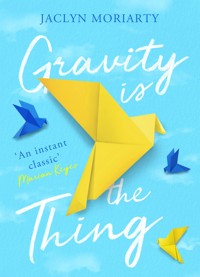
Erhalten Sie Zugang zu diesem und mehr als 300000 Büchern ab EUR 5,99 monatlich.
- Herausgeber: Allen & Unwin
- Kategorie: Gesellschafts- und Liebesromane
- Sprache: Englisch
'Clever and magical' - Women's Weekly 'Author Jaclyn is the sister of Liane Moriarty (Big Little Lies) and has the same talent for great plots. This unusual novel tugs at the heartstrings.' - Good Housekeeping Twenty years ago, Abigail Sorenson's brother Robert went missing one day before her sixteenth birthday, never to be seen again. That same year, she began receiving scattered chapters in the mail from a mysterious guidebook, whose anonymous authors promised to make her life soar to heights beyond her wildest dreams. These missives have remained a constant in Abi's life - a befuddling yet oddly comforting voice through her family's grief over her brother's disappearance, a move across continents, the devastating dissolution of her marriage, and the new beginning as a single mother and café owner in Sydney. Now, two decades after receiving those first pages, Abi is invited to learn 'the truth' about the book. It's an opportunity too intriguing to refuse - she believes its absurdity and her brother's disappearance must be connected. What follows is an entirely unexpected journey of discovery that will change Abi's life - and enchant readers. Gravity Is the Thing is a smart, unusual, wickedly funny novel - heart-warming and life-affirming.
Sie lesen das E-Book in den Legimi-Apps auf:
Seitenzahl: 583
Veröffentlichungsjahr: 2020
Das E-Book (TTS) können Sie hören im Abo „Legimi Premium” in Legimi-Apps auf:
Sammlungen
Ähnliche



















‘A thoughtful, beautifully written, truly original, and oftenhilarious meditation on loss, hope, the self-help industry, andthe difficulties of navigating life on earth.’
Emily St. John Mandel
‘Jaclyn Moriarty writes with such intimacy and charm, it’s liketalking to your dream best friend. But then she weaves a storyso compelling, and heartbreaking, and profound, it could onlyhave come from an extraordinary writer.’
Laura Bloom
‘I am in love with this hilarious and tender story aboutcharacters who enchanted and surprised me up to the lastpage.Gravity Is the Thing will lift you up and leave youwondering if the most impossible ideas are actuallythe heart of everything.’
Mary Adkins
‘Here, Jaclyn Moriarty has given readers a tender andexhilarating tale of what becomes possible when you dareto believe in the impossible. Gravity Is the Thing brims withmystery and enchantment on every page. This book willleave readers breathless and aching for more.’
Meghan MacLean Weir
Jaclyn Moriarty is the bestselling, prize-winning author of fiction for children and young adults, with Gravity is the Thing marking her debut novel for adults. A former media and entertainment lawyer, Jaclyn grew up in Sydney, lived in the US, UK and Canada, and now lives in Sydney again.
First published in Australia in 2019 by Macmillan, an imprint of Pan Macmillan Australia Pty Ltd
First published in the United States in 2019 by Harper, an imprint of HarperCollins Publishers
First published in Great Britain in 2020 by Allen & Unwin
Copyright © Jaclyn Moriarty 2019
The moral right of Jaclyn Moriarty to be identified as the author of this work has been asserted by her in accordance with the Copyright, Designs and Patents Act of 1988.
All rights reserved. No part of this book may be reproduced or transmitted in any form or by any means, electronic or mechanical, including photocopying, recording or by any information storage and retrieval system, without prior permission in writing from the publisher.
Every effort has been made to trace or contact all copyright holders. The publishers will be pleased to make good any omissions or rectify any mistakes brought to their attention at the earliest opportunity.
Allen & Unwin
c/o Atlantic Books
Ormond House
26–27 Boswell Street
London WC1N 3JZ
Phone: 020 7269 1610
Fax: 020 7430 0916
Email: [email protected]: www.allenandunwin.com/uk
A CIP catalogue record for this book is available from the British Library.
Hardback ISBN: 978 1 76087 567 1Trade Paperback ISBN: 978 1 91163 069 2E-Book ISBN: 978 1 91163 035 7
Printed in
10 9 8 7 6 5 4 3 2 1
To my son, Charlie,to my sisters, Liane, Kati, Fiona and Nicola,to Nigel, and to my parents, family and friends,because you are all the point, and the magic.
The motion of Animals is proportioned to their weight and structure. A flea can leap some hundred times its own length. Were an elephant, a camel or a horse to leap in the same proportion, their weight would crush them to atoms.
The New South Wales Journal of Richard Atkins, 1792
Two men are sitting—very quiet, motionless—one on either side of a gravel road. They are sitting on fold-out chairs. They face one another, across the gravel road. Their feet reach firmly to the dirt that lines the road.
Each man is pointing upwards.
Pointing at an angle of forty-five degrees; pointing with a straight, taut arm; pointing at an upwards that is somewhere high above the midpoint of the road.
part
1
1.
2010
A tall man at the airstrip took my suitcase.
He was tall in a long, lean, bony way, which he had tried to disguise with loose clothes. But at each gust of wind, the clothes clung fiercely, so that mostly he was out there on his own. A long, narrow flagpole of a man. He had a headful of curls, and these were unafraid. Crazed and rollicking, those curls.
‘Snow,’ he said, smiling, as he took my suitcase from me. I stared.
I’ll step right into my story at this point. Abigail Sorensen, but you can call me Abi, thirty-five years old, a Capricorn, a nail-biter, former lawyer, owner/manager of the Happiness Café on Sydney’s Lower North Shore, mother of a four-year-old named Oscar—and this day—the day that I’m describing right now—well, it had started at 6 am.
The taxi driver was twenty minutes late but this made him wild-eyed with excitement. ‘You’ll make your flight! I swear it on my mother’s life!’
Traffic was backed up right across the Bridge and his enthusiasm dimmed. He frowned quietly, moving his hands around the steering wheel. He’d been a little reckless with his mother’s life: he saw that now.
Then, just as we got into free, fast road and his spirits picked up, eyes wild again, there was an RBT stop.
‘Can you believe this?’ he said.
‘I know,’ I agreed. ‘Who’s drinking at this hour?’
But the driver’s face darkened. ‘Who drinks at this hour? You do not know the half of it!’
He was still moody when we pulled up at the airport. He’d lost all interest in my flight.
At the Jetstar counter, a woman with sharp edges typed at a computer in a slow, measured way, my breathlessness filling up the quiet around the tapping. Without looking sideways, the woman tagged my suitcase and sent it away on a conveyor belt.
So there went my suitcase—nervous, proud, excited—starting its journey alone, ahead of me.
In Melbourne, I met up with my suitcase again. It’s just your regular, black vinyl case that can stand on its own two wheels and roll along, but I felt close to it, and protective, anyway. We took the train across the city, my suitcase and I, to the smaller airport at Moorabbin.
The final leg of the journey made me uncomfortable, partly because I don’t like the expression ‘final leg’. Who started that, anyway? That dividing of rooms and people into feet, dividing of journeys into legs? The same person who tangled the ocean?
Also, it was the smallest plane I’d ever seen; I didn’t know they made them that small. My suitcase would never fit, let alone me and that big pilot.
‘My luggage won’t bring the plane down, will it?’ I joked.
The pilot turned a critical gaze on the suitcase. ‘Why?’ he asked. ‘What’s in it?’
He tested its weight with one of his big arms, laughed softly, and got on with checking over the plane.
It seemed like the kind of thing someone else should do, checking the plane—if we have to divide a journey into legs, we may as well divide it into fields of expertise. As it was, the whole thing seemed very Sundayafternoon amateurish. He was saddling up his horse.
That plane is not a horse!
‘She’s a twin-engine Cessna,’ the pilot called, which was unnerving.
The letters OWW were printed on the aeroplane’s side, and I was thinking that this was a mistake when the other passenger turned up.
‘Don’t you think that’s tempting fate?’ I asked her, as she put her suitcase down beside me. ‘Or defining destiny? At some point, that plane is going to have to say oww.’
‘Ha ha,’ said the woman beside me. Two words: ha ha. Difficult to interpret.
‘It’s going to fall out of the sky,’ I elaborated. ‘Or a missile’s going to hit it.’
‘Hm,’ the woman said, non-committal.
She was maybe thinking that missiles were unlikely. This was just a flight to an island in Bass Strait, the stretch of water dividing the mainland from Tasmania.
I will be honest with you: I had never once turned my mind to that stretch, nor to any islands it might contain, until just last week, when the invitation arrived. Turns out there are over fifty tiny, windswept islands in Bass Strait, including King Island (which I already knew: the cream and the brie) and Flinders (where, in 1830, they exiled the last of Tasmania’s Aboriginals). Taylor Island, where I was headed is south-east of Flinders, has a population of three hundred, a lighthouse, and is ‘renowned’ for its tiger snakes, muttonbirds and yellow-throated honey eaters.
After a moment of silence, the other passenger started talking.
She was oblong-shaped, this passenger, dressed in a tangerine suit, and she said that her name was Pam.
‘Just plain Pam,’ she explained, ‘though wouldn’t I have killed to be called Pamela?’
You wouldn’t have to kill someone. You could just change your name by deed poll.
But I let it pass.
Pam, it turned out, was a local of the island heading home after a holiday.
Easily, her favourite part of her trip had been the Chinatown in Melbourne, because Pam was a lover of steamed pork dumplings, and a collector of bootleg DVDs.
It was a four-and-a-half-hour flight, and we all fitted into the plane— the big pilot, me, Pam, the luggage—no trouble.
Sometimes the pilot spoke into his radio: ‘Oscar Whisky Whisky, how do you read?’ his voice cool and low, and ‘how do you read’ forming a single word, ‘howdoyouread’. Each time he said it, I would think: How do I read? Well, I turn the pages, my eyes scan the letters, I . . . even though I tried to stop myself. Even when the joke got old.
Pam kept shouting stories the whole way, only pausing when the pilot asked how to read. Pam told stories about chopsticks, and how she learned to use them, and strawberry farmers, and how they have bad teeth. (‘Oh, the stories I could tell!’ But you are, I thought.)
It’s funny the way relationships can shift. Originally I had been the queen bee—making my humorous remarks about oww, while Pam was demure. But right away she had stepped up to take over the role. Maybe doubting my ability.
At first, I ranged around for matching stories, but the effort of shouting them over the roar of the plane—or maybe the air outside was roaring?—either way, it made my stories increasingly pointless— unworthy—so I stopped talking, the way you do at nightclubs, and it was all just reaction: smile, frown, exclaim, or laugh at Pam.
Pam seemed happy.
But now here I was, standing on the airstrip on Taylor Island, and the tall man was saying, ‘Snow!’
Just confusion, that was all I had left.
‘Snow’ could be a command. All visitors, on arrival at the island, are required, please, to snow.
Or it could be the tall man’s name. In which case, I should shake his hand and say, ‘Sorensen. Abigail Sorensen.’
There was a long, formal pause. The tall man’s smile faded. Creases settled into the edges of his eyes. Something seemed to cross his face—a mild incredulity, I realised, at the fact that I was standing there, staring at him.
Then the tall man found his smile again and pointed to a sky that was heavy with cloud: ‘Snow,’ he repeated. ‘Any time now.’ And he turned away, still smiling.
He swung my suitcase onto the back of a golf buggy, and gestured for me to climb aboard.
I called goodbye to Pam and to the pilot. But Pam was crouching by an open suitcase, drawing out a long, black coat.
The pilot was scratching at the plane’s fuselage. Maybe he’d seen sense about the OWW and was scratching off the letters.
The path left the airstrip behind right away, leaning into curves like a yacht on a choppy sea. It carried the golf buggy through fields, sharp winds, and late afternoon.
We passed a letterbox encrusted with dried starfish. A general store with an axe leaning up against its doorframe. A café with a chalkboard: Fish Stew and Mashed Potatoes.
The ocean appeared now and then, grey and calm like an obliging old dog that shows up to walk by your side for short spells, but then disappears to explore.
We took a corner and, across a field, two men sat on opposite sides of a gravel road. The men were on fold-out chairs. Each was pointing up. Each was pointing at an angle just above the midpoint of the road.
The buggy turned another corner, and the pointing men were gone.
I looked sideways, but the tall man’s hands were on the steering wheel, his eyes on the path ahead.
2.
The invitation had been printed on a shiny white notecard.
You are invited to
An all-expenses paid Retreat
Where you will Learn the Truth about
The Guidebook.
The ‘Truth’ about The Guidebook! That made me laugh. A chapter from this book had been sent to me, out of the blue, when I was fifteen years old, and chapters had been arriving in the mail ever since. It was a self-help book that offered advice on how to live my life. I knew nothing about who was sending the excerpts (or why), other than that they called themselves ‘Rufus and Isabelle’.
The invitation enclosed flight details and a promise that I would be collected from the airstrip and transported to the Hyacinth Guesthouse.
Now, here I was at the guesthouse, and a woman was handing me a form. She was the manager, she said, and her name was Ellen. A name of pleasing symmetry (almost), and a pretty lilt when pronounced, this Ellen had fine white hair, and glasses with a pale pink chain that swooped down from each of her ears like curtains on a stage. After I filled in the form, Ellen glanced at it and said, ‘You’ll be turning thirty-six tomorrow, I see,’ which was quick—noticing my date of birth, and adding up the years like that so fast.
Older people, I have noticed, are sharp-minded.
‘We’ve home-baked cake and coffee every afternoon,’ she continued, ‘in the lobby here. You’ve missed it today, but it being your first day, well, I set a slice aside for you, and I’ve just now put it in your room when I lit the fire.’
She came out from behind the counter with a key.
‘Here we are then,’ she said. ‘You’re in room twelve.’ And she led me up three flights of stairs, my suitcase thumping behind me.
We paused at each landing so she could point out the rugs.
What? I almost thought. Do you mean me not to step on the rugs with my muddy boots? Or not to trip? Or do you just mean, Look—look at those beautiful rugs? But sometimes I get tired of my own confusion and over-analysis, and also I was fond of Ellen—the name, the birthday, the cake, the fireplace—so I was careful of the rugs, and smiled at them kindly, and I didn’t bother thinking anything.
The room was warm and quiet.
Ellen’s footsteps faded down the stairs, pausing at each landing. They slowed and paled into the distance, and so did the beating of my heart and the clamour of the day.
The window felt cold to my fingertips. It looked over the ocean, which blended into sky and into dusk. The wind rustled the waves and the trees, and slapped something sharp against the glass.
I stepped back and sat on the bed.
Here I was, unexpectedly, in a warm, quiet room with dark floorboards. A tapestry rug in olive green on the floor; framed antique maps on the wall. My suitcase stood in the corner, and it seemed content. By the fireplace, a tiny table with elegant legs offered a slice of frosted cake.
And the tall man had said there would be snow. Any time now, outside this window, snow. Snow in December! But that’s the way down south. Things begin to turn as you approach the poles; a giant hand tilting up the hourglass.
At least that’s what I thought in my lyrical mood. I know that it’s nonsense. It’s just it was unseasonably cold.
But at that point, happiness and calm were untangling themselves, all the way through my body, like a long, black coat drawn from a suitcase. At the same time, cold shots of excitement touched the back of my neck. It was the first time I’d taken a break from the café in three years. It was the first time I’d flown in an aeroplane since Oscar was born.
It was not the first time I’d left Oscar with my mother overnight—but this was going to be for three nights, so it was the longest.
My lips felt dry—the cracking wind—but I was smiling anyway. A bird crossed the frame of the window, trailing night. I remembered the two pointing men we’d passed in the golf buggy, and had the sudden sense that I’d seen them before.
Or I’d seen that formation, or a piece of it: a man sits by the side of a road, pointing at the sky.
I realised I was in a dream state. I would call my mum, I decided, and check on Oscar, and then have a bath and sit by the fire in my pyjamas and I’d make myself a cup of tea—there were teabags fanned out on the sideboard alongside a shy electric jug and two upturned teacups; I could see chamomile and spearmint—and I’d eat that cake, one teaspoon at a time. I breathed in the strange happiness, and smiled my cracked, dry lips, and—
The door rattled.
A piece of notepaper slid beneath it. Footsteps hurried down the corridor, away.
I picked up the paper.
You missed three, it said. Now what?
3.
I didn’t know what the note meant.
You missed three. Now what?
I felt irked.
Have you seen the movie Bolt? It’s about a dog that believes it’s a super-dog. The dog has John Travolta’s voice and a quiet pride in its own super-strength and super-bark. The humour comes from the dog running around New York, believing in itself.
I am irked! says the villain, at one point in the movie, and Oscar turned to me and explained: ‘See that man? His name is Irked.’
Kids! The world is so confusing, but now and then they think they’ve got a piece of it down: when somebody says, I am—, they are giving their name.
You think you’ve got life figured out, you lean back on the couch— and then it hits.
You don’t have superpowers. You haven’t even got basic grammar.
So, this was me in a guesthouse with cake, towels, snow clouds, and I had figured out that this night was for happiness.
But no. Underneath the door, a cold truth. You missed three. Now what?
Who likes to be told that they missed something? Let alone three things. Who likes that accusatory tone?
I suppose calm, sensible people might raise their eyebrows: ‘I did? I apologise. Can you remind me precisely what I missed?’
But I am a person who will rise up: a student of Pilates lifting, puppet strings hooked onto my head, the puppetmaster raising my whole body. (You get taller and you get inner-core strength when you do that at Pilates.) But when the voice of authority addresses me in a singsong tone—You missed three!—I rise up, hackles up, claws out: I DID NOT! I DID NOT EVEN MISS ONE! Even when I haven’t got a clue what they’re on about. Maybe I did miss three? Maybe I missed fifteen.
I threw open the door, but there was nobody there so I slammed it shut.
In my irritation, I ate the cake. Without a cup of tea, without a bath, without a robe, without calm by the fire, just scoop, scoop, scoop with the silver spoon.
I saw what I’d done and became angrier. I considered calling the front desk to ask Ellen for another slice, please.
‘On account of I accidentally ate this one.’
But that was no excuse.
I called my mum instead, and she gave me a detailed recount of how and where she’d read Where is Hairy Maclary? to Oscar that day. Ten or twelve times at least, she said. She recited the story for me—as proof, I suppose. It has pleasing rhythms. It calmed me. Next she set out the complicated rules of each game she and Oscar had played in the garden. This also manifested as a form of meditative hypnosis.
I can’t remember their other activities. She described them all; the day was crammed with them. Also, he’d had a good dinner, apparently: lamb cutlets, mashed potato, carrots, a slice of wholemeal bread with a little butter. All the food groups.
She was marking out the coordinates of her grandmothering for me, and they were excellent. They always are. From free-range mother to mindful grandma. Each time she takes care of Oscar, I think I should model my parenting on her. But then I take him back and return to normal life: go to work, collect Oscar from day care, get home, drop my bag and shoes on the floor before we eat fish and chips in front of the TV.
Oscar was asleep, which was sad, but was also, actually, a relief. I love hearing his tiny ‘hello?’ on the phone, but then I don’t know what to do with it. We have plenty to say in person, but on the phone? Well, all I can think to do is to reach down and hug his voice.
‘Have you found out what it’s all about yet?’ Mum wanted to know. ‘Have you shaved your head and signed over your fortune?’
She was pretty sure it was a cult. She’d been joking to all her friends, ‘Abi’s off to join a cult!’
But she’d also been saying, quite seriously, to me: ‘I think I should come with you, Abi. They might be going to sell you into slavery or turn you into a drug mule.’
‘They’d only do the same to you,’ I pointed out.
‘Oh no,’ she said, ‘I wouldn’t let them.’
‘Well, I won’t let them either,’ I promised, and this seemed to cheer her up.
In fact, I knew what would happen here.
There’d be more of the same empty/weird stuff as in the chapters I’d received in the mail, only they’d keep making tantalising promises that something better—the point, the answer, the Truth—was just around the corner! At the end, they’d tell me that this really valuable information would be available once I’d signed up for their two-thousand-dollar seminar and purchased this five-volume DVD.
But if they wanted to give me a free getaway and a boost of self-help? Well, great. I’d have no problem refusing to commit to anything further: I had my café and my kid. No free time and hardly any money.
And they couldn’t make me do anything. I also have a law degree.
So I chatted with Mum on the phone, scraped myself into pyjamas, dragged back the bedclothes and fell asleep.
4.
The next morning, I had a birthday room service breakfast in bed. It was excellent: crisp granola sparked with cinnamon and pecans, rich dark coffee with cream; the sky streaked with wind and grey through the softly rattling windows; the bed big and white. I took deep, shining breaths of it all, and let myself be both sad and glad, the way you’re supposed to, and felt my lost birthdays, all the lost birthdays stacking up behind me, all the anger and the anguish, the terror and the hope, all the harshness and the sweetness, the spoon a silver glint against the white.
Then I went downstairs to learn the truth.
5.
It was the tall man; the man who’d collected me from the airstrip and offered snow. He was the teacher.
Or whatever you call the person in charge at a self-help retreat on an island in Bass Strait.
As I walked into the conference room of the Hyacinth Guesthouse, he offered me a manila folder.
‘Don’t open it just yet,’ he said. ‘Take a seat.’
The conference room had much the same ambience as the guest rooms. Rugs, an open fire, framed prints of antique balloons on the walls. Narrow windows leaned into a cold, grey view of rocky slope running down to surly sea. Armchairs were scattered about like uncertain guests at a party.
A very slight woman sat in one of these armchairs, ankles crossed, manila folder resting on her lap. She was frowning to herself. She caught my eye, threw me a quick smile, then resumed the frown, deepening it now. Maybe making up for time lost with that smile. (Or had my face reminded her of something troubling? An unreturned library book, say, or soup she’d defrosted weeks before but never eaten.)
Across the room, their backs to me, two men stood at a table, each holding a large, white plate. One was broad-shouldered with red hair.
I’ll tell you this for free. I like a man with broad shoulders and red hair.
The other guy, taller and darker, hovered over a tray of pastries with a pair of silver tongs. He murmured something in the tone of an uncertain joke, and the broad guy laughed, tipping sideways with his laughter. There was a note of golden warmth in his laugh (in my view, anyway), and in the way that he straightened up again so easily, ready for the next laugh.
I sat down. A few more people arrived, one at a time, some looking around in bemusement, others bright-eyed, or with grim expressions that seemed to say: I’m suspending judgment but I won’t suspend it long.
At each new arrival, the tall man handed over another manila folder. ‘Don’t open it yet,’ he said. ‘Take a seat.’ Again and again, the same phrases. I wondered why he didn’t vary them.
But then he did. ‘Not to open yet,’ he said. ‘Please, for now, sit down.’
Hm, I thought. Maybe stick to the original. The brief expression of distress on his face suggested he was thinking the same thing.
Eventually, his stack of folders was gone.
The room was all rustle and movement now. There were maybe twenty-five or thirty people, a mix of men and women, a scattering of races and accents. I heard American, something that might be Eastern European, and a New Zealand accent in there, but otherwise mostly Australian.
Some were at the table helping themselves to the pastries and coffee, chatting about pastries and coffee—and about weather, islands, breakfast, flights; a few at the windows, hands pressed to the glass; some sitting in the chairs, silent, or talking low-voiced. (‘I like your shoes,’ I heard a man say to a woman. ‘Oh!’ said the woman, and she swung her feet from side to side, admiring the shoes herself. I admired them too. Such a glossy purple.)
Nobody mentioned the strangeness of us being here.
I stayed quiet. It was my birthday. That exempted me from small talk.
Now came an unexpected twist in the day.
That’s overstatement; it wasn’t a twist. Only, the next thing took the mood around a curve. The tall guy strode to a sideboard, messed with an iPod, and music filled the room. ‘Read My Mind’ by the Killers.
I love that song! It gives me this excited feeling like it has a secret message just for me. It’s more the song’s tone than its lyrics; I can’t really figure those out.
Anyhow, the music starts and the tall guy stands there, expressionless.
Around me the chatter stops, the purple-glossy-shoe woman does a cute tapping thing with her purple-glossy shoes, a guy with a goatee drums a quick flourish on his armrest.
And I have this surge of what my brother Robert and I used to call the Breakfast Club vibe. The feeling that something swift and strong is going to happen or unfold; that here, among these people, are stripes of energy, smouldering and poised, ready to snap into being.
Somewhere behind me, a guy sings along with a line of the song in a good, strong, unaffected voice. Another guy’s voice, also strong, shoots back the next line, and people smile or chuckle softly at this, so then I know I’m right about the Breakfast Club vibe.
I felt happy-birthday good. People are going to tell secrets here, I thought.People are going to surprise themselves and one another. We will clash and cry and challenge one another; we may even change our appearances for the better—take down our hair or muss it up! remove our spectacles! tear off our shirtsleeves and use one as a bandana?—and certainly some of us will sleep together.
I hoped I’d be one of the ones doing the sleeping together and, in particular, I hoped I’d sleep with the redheaded guy.
Or that one over there with the flat cap and hipster beard. His smile was friendly.
I hadn’t properly checked out all the men in the room, so there might have been further possibilities. I would certainly have been happy to sleep with either of the two men who’d sung along just then, although I couldn’t quite see their faces.
The song ended.
Entertain me, I thought suddenly, looking at the tall man. Out of the blue, I felt supercool. I looked right up at him, with a challenge on my face. Entertain me.
The tall man waited. He let the silence carry on. He glanced back at me, like he was all set to meet my challenge.
Nice, I thought, in reference to his glance.
Then he spoke in a low, soft, reasonable voice.
‘You might remember,’ he said, ‘twenty years ago, when you first received a letter in the mail?’
6.
He meant the letter enclosing the first chapter of The Guidebook. We all knew what he meant. At least, I assume we did. There was a wonderful rush of goosebumps across the room.
‘Open your manila folders,’ the tall man said next, same tone of voice.
Raised eyebrows, opening folders. Inside was a copy of that first letter.
‘Touché,’ someone murmured.
‘Um,’ a voice responded, ‘in what way?’
The tall man blinked at this exchange, then recovered. ‘Kindly read over the letter,’ he instructed, and we obeyed. People sighed, giggled or swore as they read.
I looked over shoulders, confirming that the other letters were essentially the same as mine. Then I read it:
Dear Abigail,
Congratulations.
Of all the people, in all the world, you have been chosen to receive this.
Enclosed is Chapter 1 of The Guidebook. One day, this book will change the world. In the meantime, it will change your life.
We invite you, please, to read this chapter.
No. More than read it. Eat it. Devour it. Freeze it into ice cubes and place these in a glass of lemonade. (Drink the lemonade.) Dive into it! Swim through it. Love it. Embrace it! Wear it as a coat!
As you may notice, Chapter 1 is very short. Some might even say peculiarly short. This happens throughout The Guidebook. Some chapters are just a line or two!
But where is the rule that says a chapter must be ten to twelve pages?
Nowhere.
Would you like to continue receiving chapters from The Guidebook? Do you dare to embrace this opportunity? Do you wish your life to soar to heights beyond your wildest dreams?
If so, please write to us at PO Box 2828, Katoomba, NSW with the single word: YES.
Yours with alacrity,
Rufus and Isabelle
PS It would be best if you kept this to yourself.
I looked up from the letter.
‘Are you Rufus?’ demanded a woman, pointing at the tall man at the front. A plastic frangipani flower was woven into this woman’s ponytail; I tried not to judge her for this.
The tall man held up his palms. ‘My name is Wilbur,’ he said.
There was an interested silence.
‘Not Rufus,’ he clarified, somewhat unnecessarily.
‘So you’re not the Rufus who sent us the chapters?’ the frangipani woman asked, in a penetrating, cross-examiner’s voice.
Good grief, I thought.
‘I hope he’s not that Rufus,’ I murmured, and people around me laughed. This warmed my heart.
However, not everyone laughed. Some, including frangipani-flower-woman, turned to me with reproachful expressions, as if I might have hurt Wilbur’s feelings.
But honestly, the tall man appeared to be no older than me. If he was Rufus, he had started sending us The Guidebook when he was around fifteen. The idea that a teen had been ‘guiding’ me was pretty unsettling.
‘What I want to know,’ said a man with a wry and sonorous voice, ‘is why I ever agreed to keep receiving these chapters.’
There was more laughter at this. I joined in. I tried to see the speaker, and he caught my eye—he had small, round spectacles, large mouth, high cheekbones—and he smiled at me. Oh, I’ll sleep with you too, I decided generously.
‘Of all the people in all the world!’ a voice proclaimed, two seats along from me, and again, everybody laughed.
That speaker had a bland, pale-pink look. I’m not going to sleep with you, I apologised.
The tall man—Wilbur—nodded towards wry-and-sonorous. ‘This is precisely the question,’ he said. ‘Close your eyes. Are everybody’s eyes closed? Good. Now, think back to the day when you first received this letter.’
My eyes snapped open.
Wilbur caught this and gave me a stern look. Quickly, I closed them.
‘Consider this.’ His voice dropped lower and took on a sway, like a voice on a meditation tape. Immediately, I grew sleepy. ‘Consider this. This letter was sent out to one hundred and twenty young people. Only forty-three responded with a yes. Over the years, that forty-three has slipped down to thirty-one. Of those thirty-one, only twenty-six agreed to come to this retreat. You are those twenty-six.’
That was good drama.
‘Now ask yourselves,’ Wilbur continued, ‘why did you say yes? Why did you never cancel the subscription? Why are you the twenty-six?’
‘Well, I think—’ began a woman’s voice, but Wilbur said, ‘Shhh. Close your eyes and think back.’
7.
At our place, the mail was always in an old frying pan on the countertop. I don’t know why.
It also contained a faded tennis ball, random elastic bands, and a little plastic Snoopy who got tossed about and clanged against the pan whenever you leafed through the mail. He seemed resigned to this.
On this particular day, I’d just walked up the driveway after school when Mum came tearing out of the house. She was shouting, ‘Robert! We forgot you’ve got that appointment!’
‘What appointment?’ I asked.
Mum ignored me. She threw open the screen door and ducked back inside. I could hear her shouting: ‘Robert! Come on! We’ve got to go right now!’
I waited in the driveway beside the car, interested to see what would happen.
The door flew open again and Mum was back. She ran down the steps to the car, opened the driver’s door, registered me, and smiled a bit maniacally while she hollered: ‘ROBERT!’ She was cradling something in her other arm, as if it were an infant. I can’t remember what it was. Not an actual infant, I’m sure.
A couple of minutes later, my brother Robert wandered out onto the porch, squinted up at the sky then down at me and across at Mum. He’d stayed home from school that day, feeling dizzy. It seemed to me that you could just as well be dizzy at school as at home, but I kept that to myself. He was wearing his old tracksuit pants and a grey t-shirt, and his clothes seemed droopy and loose.
‘What appointment?’ Robert asked.
‘You know, the thing with that doctor; the doctor who has the—he has the—’
‘The elegant moustache?’ I suggested. ‘The habit of stroking the porcelain cat on his desk?’
‘The collection of elves locked in a box, pounding to get out with tiny bruised and bloodied fists?’ Robert tried.
‘The fish tank!’ shouted Mum, relieved. ‘He has a fish tank in his office! Come on! We have to go!’
‘Ah.’ Robert and I nodded wisely to each other. ‘Of course. The doctor with the fish tank.’
Mum threw something at me—it was the object she had under her arm; I remember what it was now: a watering can. Droplets spilled out onto my wrist as I caught it. ‘Finish watering the house plants!’ she said.
‘Why?’ I enquired.
She and Robert were getting in the car.
I studied the watering can: so twee and little, neat and efficient, tip, move, tip, move, tip.
When I looked up, they were driving down the road. Robert didn’t wave at me. He was facing straight ahead. I watched them turn left at the T, and the car seemed to me to be a bright, little, twee, little, efficient, little watering can itself. I don’t know why.
Inside, I opened my schoolbag and took out a bunch of notes about excursions and new uniform rules, and carried them to the rusty frying pan. (It wasn’t just a place for stamped mail, you understand: it was the meeting point for all written communications.)
As I was about to drop in the notes, I saw a thin brown envelope addressed to me, Abigail Sorensen.
Right away, I knew it was a letter from a film producer saying they wanted to make one of my horror movie scripts into a movie.
Zing! Right up from my chest and across my face, I was so excited.
Even though I’d never actually written a horror movie script. Let alone sent one to producers. I just had a fierce intention of doing so, one of these days.
I opened the envelope, revising my excitement as I did, so as to keep it realistic. More likely, it was a film producer who’d heard about my fierce plans to write a horror movie, and now wanted to tell me that s/he admired such fierceness, and could s/he please offer me a million dollars to write a script?
But it was not from a film producer. It was the letter enclosing the first chapter of The Guidebook.
I remember I read the letter and laughed. Of all the people in all the world. I was hilarious with laughter. I couldn’t wait for Robert to get home from the doctor with the fish tank so we could rip this thing apart.
Not literally. You know what I mean.
Then I read the enclosed chapter. It was printed on a single sheet of paper. I recall exactly what it said:
Chapter 1
Welcome.
We begin with a question and a reprimand.
The question:
Did you find this book in the self-help section of the bookstore?
The reprimand:
Why?
Sweet antelope, dear reader, what were you doing in the self-help section of your bookstore! Are you a fool or a baboon? Which? Do you think that the answer can be found in self-help? Do you think that the moon has a deficiency of iron and it is that which explains its wan colouring? If so, reader, get away! Do not scald this page with your plaintive, pleading eyes, do not blink your turtle tears upon this print!
We do not want you reading our book!
Get away!
Ha!
Just joking.
You can read it.
Now, tell us quick, did we alarm you? Were you scratching the back of your neck, embarrassed and confused? Well, sweet reader, let us offer you a warning: here, in your hands, is a book that will keep you on your toes. This book intends to shock and jolt, and you, in turn, will kick and bite, but we (in our turn) will never let you down. The covers of this book—midnight blue and flecked in gold—these covers are our arms and they embrace you.
We do not mind where you found this book, though we prefer not to call it self-help. For what is the point in that? You can help yourself to the fish in the sea, you can help yourself to a coconut treat. You already know how to help yourself, yet you do not!
So this is a we-help book.
It is we who plan to help. Not you.
That was it.
The whole chapter. Done.
I felt strange.
I mean, the first few lines, I laughed aloud. Then I stopped. The laughter hung around in the kitchen, growing uncomfortable, mumbling questions about when the party was going to start again. But I’d gone quiet. I had this sense that the authors of the book knew I’d come here to mock them, but they’d stuck out a foot for me to stumble over and were ready to catch me as I fell.
It is we who plan to help. Not you.
Partly, the strangeness was the cognitive disjunction: this was a sheet of printed paper that had been mailed to me, a girl in my kitchen; but, according to the words, this was a book, its covers midnight blue and flecked in a gold, and I was a girl in the self-help section of a bookstore.
I hid the letter and chapter in my bedroom, wrote YES on the back of a retro New York postcard and mailed it to the PO address.
I think I might have done this because it was so easy. I had a lot of homework to do, most of which seemed elaborate and tiresome. Whereas writing the word YES; taking a stamp; walking down the street to post it—that was a piece of cake.
Also, it struck me as supercool, super-slick to use the retro New York postcard, so that was also a motivating factor.
Although I regretted this the moment I posted it. I’d had the postcard for years! It was from a street fair in Coolangatta, where I’d been on holiday, aged ten, with my best friend (and neighbour) Carly Grimshaw and her family. I’d been saving it for something special.
After that, I received chapters of The Guidebook regularly. No covering letters, just chapters, and in no particular order. The second one, for example, was Chapter 47. Then we skipped back to Chapter 11. Most were extremely short. I liked that about them. Again, they compared favourably to the reading I had to do for school.
I remember one:
Chapter 25
100 watts. But how many whys? How many ifs?
And what about the whens?
That was the entire chapter, and I found it extremely profound.
Sometimes they sounded like a regular self-help book, but they always veered off-track in the end. Here’s an example:
Chapter 9
It’s simple, life. You just follow a rule or two. Always keep an eye out for a fireworks display. Don’t brush your hair when it’s wet. Teach yourself to understand the wind. Never put a plastic bag over your head. If you see a trampoline, jump on it, jump higher! Never stick a knife in the toaster. Do a thing you fear every other day. Raw chicken? Avoid! Don’t walk past a row of police cars, snapping off the antennae one by one, and gathering them into your arms like kindling for a campfire. Never do that.
My parents noticed the envelopes eventually, and read a few chapters themselves, but quickly lost interest, finding them mystifying and harmless, like my homework or my music. Sometimes the chapters gave me instructions, simple tasks to complete: sign up for a martial arts class, try this dance step, photograph the clouds, procure a dandelion, eat a slice of cinnamon toast. Some of these I did, many I ignored. Also, near the end of each year, a letter would arrive from Rufus and Isabelle, urging me to write, and then send in, a few pages of ‘reflections’ on the year just past.
Alternatively, I was offered the option of cancelling my ‘free subscription’ at any time by sending them a note containing the single word, NO.
I know exactly why I never did.
8.
Wilbur cleared his throat.
‘You can open your eyes now,’ he said.
It had only been a few minutes, but people straightened, rubbed their faces and yawned, like preschoolers waking up from nap time.
‘Over the next two days,’ Wilbur declared, ‘I will lead you in a series of group activities. These will be fun!’ He hesitated, as if doubting that assertion, then carried on. ‘Tomorrow night, I will share with you the truth about The Guidebook.’
Ha!
The better, the answer, the promise. But we won’t get it tomorrow night, I thought. There’ll be something more. He will yank it from our grasp.
‘Listen—’ Wilbur continued, but a sudden chuckle cut him off. I craned my neck to see who it was. It was the guy with the red hair. I smiled at him. His eyes crinkled in reply. Everything went hazy, and I hallucinated ribbons and martini glasses. What I mean by that is, I wanted to sleep with him.
I turned back to the front.
‘But listen,’ Wilbur repeated, his voice suddenly urgent, or pleading. ‘Only certain among you will be chosen to hear the truth. Please do not be sad if you’re not chosen.’
Sparks flew up in the fireplace. Everyone was silent and thoughtful.
‘It is what it is,’ a woman suggested.
‘Right,’ Wilbur agreed, brightening. ‘So it is!’
And the first day of activities began.
9.
My memory of that day has collapsed into the following glimpses. We are buttoning our coats, turning up our collars, tramping behind Wilbur into the bluster of the wind. Above us, skidding clouds.
Now we are in a field. Wilbur is handing out sacks that smell of horses and hay. He is shouting instructions. We are climbing into the sacks, lining up side by side for a sack race. Unexpected! The strange awkward loping of a sack race. (I am winning the race for a moment! Then tipping sideways into rutted grass. Bruising my hip. Coming in last. Oh well.)
We are tying our feet together for a three-legged race! My ankle is tied to the leg of the man with the sonorous voice and round spectacles! One minute, he’s not there, and then he is. Beside me, leaning down, his hand brushing mine as he loops the rope around and pulls it tight. He looks at me and shrugs. ‘Okay?’ His eyes, behind their spectacles, are smoky grey. We both laugh and I’m thinking, He chose me for this race! He chose me! Now we’re running together, the heat of it, the panting breath, an even rhythm, a jagged rhythm, the pull of his body, his leg against mine, our legs scissoring back and forth!
We don’t win; we come in maybe fourth.
Now our legs are free again, strange to be loose and free after a three-legged race! The smoky-grey-eyed man has drifted away, much like smoke itself.
Wilbur is pointing out a long, low, brick wall. He is telling us to walk along the wall. Single file, we walk, arms out for balance. Somebody stumbles, jumps smartly down and climbs up again, all in a flash.
We are racing down a grassy slope, arms outstretched again, eyes tearing up in the wind, leaping onto the sand dunes. Everybody laughs.
‘This is a fitness camp!’ somebody suggests.
‘No,’ says Wilbur. ‘No, it’s not.’ He seems disconcerted.
We are on a long stretch of empty, cold beach. A lighthouse on a cliff. Someone shouts over Wilbur’s voice, ‘There’s a whale!’ Pointing fingers, squinting eyes, a distant haze rising out of the grey. The pale, pale pink cliffs.
Wilbur wants us to play leapfrog. Firm hands press against my back. ‘It is a fitness camp!’ people shout.
Wilbur frowns.
There’s an urgent life and laughter to the day, I remember. It’s a day that has leaped out of its bed and is dancing around its room. A vibrancy, an intensity—which is strange, because this man, this stranger, is making us race up hills, across fields, along walls, for no apparent reason, and yet, rather than querying this, refusing, demanding explanations, we are laughing, joking and delighting in it—and I realise why.
It’s a competition! Only certain among you will be chosen to hear the truth. Everybody wants to be chosen. Not only do we not complain, we embrace the day. Personalities are varnished. Voices rise, laughter arpeggios. It’s like a reality TV show, and I find myself peering around, looking for the hidden cameras.
But how do we know the criteria for selection? I wonder, watching a woman flaring out her hair as she offers chewing gum around. She collects the gum wrappers back, and presses these into her pocket.
Could the criteria be the furnishing of chewing gum combined with the thoughtful collection of litter?
Probably not, I decide.
Most people seem to have reasoned that vivacity is key. They are speaking in bursts to each other, their words flying out in the wind, their words not the point. Like extras in a film, chatting animatedly in the background.
A woman turns a cartwheel! It’s the small woman who had frowned when I arrived this morning. She’s sparked up now! Turning cartwheels! She’s even smaller than I thought; she’s teeny tiny! Perhaps that’s why she was frowning? She was thinking to herself: Why, oh why, am I so small? How can I grow? Whereas now she has come to terms with her size and thus is turning her cartwheels.
A man, seeing the cartwheel, climbs a tree. He clambers at high speed and then pauses, considering the next branch, fine, twiggy, thin. He decides on a lively leap back to the ground instead. Takes a bow. People applaud.
We are back in the conference room, faces wind-pink, eyes bright, shivering to warmth by the fire. The fruit and pastries are gone; in their place are trays of sandwiches and sushi. My hands are cold.
Wilbur splits us into groups of five or six. He seems to do this in a rapid, random way, grouping people who happen to be standing near each other.
The man with red hair is in my group, as is flat-cap guy with hipster beard.
Also in my group is a wiry little man with a disgruntled scowl, who seems to have an issue with his shoulder. He keeps stretching it, shrugging it, wincing. His shoulder has all his attention.
I worry, on his behalf, that he will be eliminated from the truth for inadequate shoulder health.
Wilbur is handing each group a long thin stick, like a cane. ‘This is a team-building exercise,’ he says. ‘Each group must place the stick along outstretched fingertips, and work as one to lower it to the floor.’
‘Why?’ calls Flat-cap, beside me. ‘Why are we doing team-building exercises when we are, in fact, not teams?’
Others gaze across at him. His friendly smile makes his question perfectly reasonable. Yet it is also a risk. I see that in many faces. You don’t get chosen for the truth if you’re insubordinate!
Wilbur smiles.
Oh. The faces falter. Maybe you do? Maybe he wants us to ask questions?
‘How do you know,’ Wilbur responds, ‘that you are not a team?’
Redhead looks directly at me and widens his eyes. You’re the kind of guy I like! I think directly at him. But then he widens his eyes at the others in our group too.
We lower the stick to the floor. It keeps rising back up! (It’s something to do with the collective pressure of our fingers being stronger than the weight of the stick, Flat-cap explains.) Everybody laughs and laughs, and then everybody works together as teams to make the stick hit the ground. The wiry guy with the shoulder issue does not appear to enjoy this game and, at one point, almost barks at us to stop lifting it up. No way he’ll get chosen.
But it doesn’t take long for us to sort it out and we feel proud.
Now we are back at the beach, kicking along in the sand, and people are pointing out seals in the whites of waves. Wilbur is handing out blank sheets of paper, which flap violently in the wind. We chase them. Wilbur’s face flashes with mild panic. He wants us to make these papers into aeroplanes, he yells.
We’re sitting on rocks, folding paper. We’re tossing our planes and our shouts into the wind, where they’re turned, turmoiled, dashed against rocks, skimmed along sand, bedraggled by foam.
Wilbur, I notice, stands perfectly still, eyes closed, wearing a strange sad smile, while the wind beats his face, wrenches at his hair, fluttering his lashes; a leaf rushes up against his cheek and away and he does not flinch. These are the Roaring Forties, I remember, the strong westerly winds that urge sailing ships around the world and that, further south, grow even angrier: the Furious Fifties, the Shrieking Sixties.
‘I forgot!’ Wilbur shouts abruptly, eyes flying open. ‘You were meant to write your names on the paper and then make them into aeroplanes.’ He slaps his own knees and bursts out laughing. This is the first time Wilbur has laughed. He seems ecstatic with his laughter. Also, for the first time, people regard him with uncertainty.
‘Let’s go inside,’ Wilbur bellows into the wind, ‘and introduce ourselves!’
The sun fades and tumbles, clouds darken. We gather all the paper planes.
It seems a little late in the day for introductions.
10.
Here my memory calms again, so I can return to past tense.
We were back in the conference room and this time the food table was bare. I felt sad. I’d been imagining coffee and cake. It seemed rhythmically natural at this point of the day. Specifically, I’d visualised coconut-raspberry-chocolate squares. I had no grounds for visualising these, I just like them.
At least it was warm in here, and we moved towards the fire, a shivering group again, but Wilbur told us to sit down. He was very quiet: his strangely heady excitement about the paper planes seemed to have fled, leaving him a shell of a man.
I exaggerate, of course. It’s another flaw of mine. I just mean he seemed subdued.
Shedding our coats and scarves, we gravitated towards the same chairs we’d chosen earlier. School classroom training: those chairs were our new homes.
Wilbur spoke at serious-information level. ‘I’m going to invite each of you to come forward and tell us your name and a little about yourself.’
He expanded on this a while, but I was thinking about the fact that it was my birthday, and that I had spent the day very oddly, jumping along inside sacks or with my leg tied to a stranger’s leg, walking on walls, running down sand dunes, making paper planes. I’d done all this with a group of slightly hysterical yet good-natured strangers, under the tutelage of a tall, lanky man named Wilbur.
My mind wandered to Rufus and Isabelle, authors of The Guidebook, and I felt a sad yearning. Where were they, anyway? Too important to be here? Probably American. Vaguely, I wondered how significant our introductions would be, and whether they might determine whether we were chosen for the truth.
For the first time, I felt a jolt about that. Now, I didn’t think the truth would count for much, but I’d been assuming I’d be chosen. Of course I would: it was my birthday! I’d been receiving these chapters for the last twenty years! Tomorrow, however, would no longer be my birthday, and every other person in the room had also been getting these chapters for twenty years. In addition, most had been lively today, whereas I’d been mild and quiet. I’d laughed and smiled, of course, chatted now and then, but without really having much to say.
If this were a reality TV show, I’d be eliminated. Not right away. The quiet ones slip along unnoticed for a few episodes, but they never make it all the way through. I needed some pizzazz!
‘Also,’ Wilbur was instructing us, ‘explain why—why you said yes to these chapters.’
‘It’s my birthday today!’ I said suddenly, and to my own surprise. (I don’t mean I was surprised that it was my birthday. I knew that.)
There was a sort of uprising of laughter and turning heads.
‘So it is, Abigail,’ Wilbur agreed warmly.
People began exclaiming, ‘Happy birthday!’ The red-haired man said, ‘Happy birthday, Abigail,’ in his lovely, broad-shouldered, redheaded voice. I liked how he took my name from Wilbur so effortlessly and adapted it to his own purposes. This struck me as resourceful.
The woman with the frangipani flower in her hair spun around and scolded, ‘Why didn’t you say so earlier?’ I tried to see beyond the criticism to the humour, but could not locate this in her expression. I smiled, trying to come up with an answer, but I didn’t have one. Eventually, she swung back around, still frosty, to face the front again. Why did it disturb her so much?
She’s jealous! I realised. She thinks I have an unfair advantage! She wants to be chosen for the truth!
I hoped she was right to think that I had an advantage. It seemed a good sign, the warmth in Wilbur’s voice when he said: So it is, Abigail.
Wilbur took the reins again. ‘Introductions,’ he said. ‘Let’s begin with you.’ And he pointed at someone just behind me.
11.
Introductions. They seem like a fascinating idea at first, and then, what are they? Just a bunch of names and résumés.
I started off ready to listen carefully, and ended up gazing at a series of vacuum cleaners. (By this I mean they seemed to me to drone.)
A commercial litigator, an admin assistant, chief . . . I don’t know, someone was the chief of something. There was also an ENT surgeon, whose family had come to Australia from Nigeria when she was twelve years old, a project manager, and everyone else was in IT.
Initially, I was quite interested to hear people’s explanations for accepting The Guidebook. But people never really know why they’ve done a thing.Everyone seemed to have first received it in 1990 or 1991, like me, and they’d all been around fifteen or sixteen at the time, again like me. A few talked about being lost as a teenager—depressed, overweight, lonely—so The Guidebook struck them as a gift from the universe (or from God, two participants declared). But I had the sense that this was a contrivance, a post hoc reinterpretation, or possibly sycophancy.
Some talked about being plain curious, which was probably more honest, but dull.
A few acknowledged they had no answer. The disgruntled guy with the shoulder seemed incensed to be asked at all. ‘Why did I accept this book?’ he demanded, as soon as he stood up. He frowned fiercely. ‘How should I know?’ He was in pest control, he added. Pete Aldridge. That was it for his introduction. He sat down right away, which made me like him.
The man with the sonorous voice, spectacles and smoky eyes also claimed he had no idea. But he claimed this in a friendly, gentle way. When he rose, ready for his turn at introductions, I realised I’d forgotten all about him. Earlier, I’d been willing to have sex with him, but then he’d completely slipped my mind. I felt ashamed at my lack of commitment.
Now I took the opportunity of his introduction to reassess.
Beautiful, wise, self-deprecating smile ... Okay, I remember you now. I’m in.
‘My name is Daniel,’ he said. Daniel,




