


122,99 €
Mehr erfahren.
- Herausgeber: John Wiley & Sons
- Kategorie: Wissenschaft und neue Technologien
- Sprache: Englisch
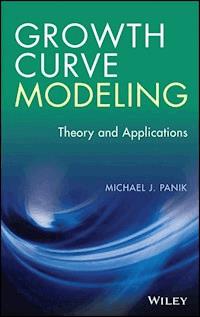
Features recent trends and advances in the theory and techniques used to accurately measure and model growth Growth Curve Modeling: Theory and Applications features an accessible introduction to growth curve modeling and addresses how to monitor the change in variables over time since there is no "one size fits all" approach to growth measurement. A review of the requisite mathematics for growth modeling and the statistical techniques needed for estimating growth models are provided, and an overview of popular growth curves, such as linear, logarithmic, reciprocal, logistic, Gompertz, Weibull, negative exponential, and log-logistic, among others, is included. In addition, the book discusses key application areas including economic, plant, population, forest, and firm growth and is suitable as a resource for assessing recent growth modeling trends in the medical field. SAS® is utilized throughout to analyze and model growth curves, aiding readers in estimating specialized growth rates and curves. Including derivations of virtually all of the major growth curves and models, Growth Curve Modeling: Theory and Applications also features: * Statistical distribution analysis as it pertains to growth modeling * Trend estimations * Dynamic site equations obtained from growth models * Nonlinear regression * Yield-density curves * Nonlinear mixed effects models for repeated measurements data Growth Curve Modeling: Theory and Applications is an excellent resource for statisticians, public health analysts, biologists, botanists, economists, and demographers who require a modern review of statistical methods for modeling growth curves and analyzing longitudinal data. The book is also useful for upper-undergraduate and graduate courses on growth modeling.
Sie lesen das E-Book in den Legimi-Apps auf:
Seitenzahl: 541
Veröffentlichungsjahr: 2014
Ähnliche

















CONTENTS
PREFACE
1 MATHEMATICAL PRELIMINARIES
1.1 ARITHMETIC PROGRESSION
1.2 GEOMETRIC PROGRESSION
1.3 THE BINOMIAL FORMULA
1.4 THE CALCULUS OF FINITE DIFFERENCES
1.5 THE NUMBER E
1.6 THE NATURAL LOGARITHM
1.7 THE EXPONENTIAL FUNCTION
1.8 EXPONENTIAL AND LOGARITHMIC FUNCTIONS: ANOTHER LOOK
1.9 CHANGE OF BASE OF A LOGARITHM
1.10 THE ARITHMETIC (NATURAL) SCALE VERSUS THE LOGARITHMIC SCALE
1.11 COMPOUND INTEREST ARITHMETIC
2 FUNDAMENTALS OF GROWTH
2.1 TIME SERIES DATA
2.2 RELATIVE AND AVERAGE RATES OF CHANGE
2.3 ANNUAL RATES OF CHANGE
2.4 DISCRETE VERSUS CONTINUOUS GROWTH
2.5 THE GROWTH OF A VARIABLE EXPRESSED IN TERMS OF THE GROWTH OF ITS INDIVIDUAL ARGUMENTS
2.6 GROWTH RATE VARIABILITY
2.7 GROWTH IN A MIXTURE OF VARIABLES
3 PARAMETRIC GROWTH CURVE MODELING
3.1 INTRODUCTION
3.2 THE LINEAR GROWTH MODEL
3.3 THE LOGARITHMIC RECIPROCAL MODEL
3.4 THE LOGISTIC MODEL
3.5 THE GOMPERTZ MODEL
3.6 THE WEIBULL MODEL
3.7 THE NEGATIVE EXPONENTIAL MODEL
3.8 THE VON BERTALANFFY MODEL
3.9 THE LOG–LOGISTIC MODEL
3.10 THE BRODY GROWTH MODEL
3.11 THE JANOSCHEK GROWTH MODEL
3.12 THE LUNDQVIST–KORF GROWTH MODEL
3.13 THE HOSSFELD GROWTH MODEL
3.14 THE STANNARD GROWTH MODEL
3.15 THE SCHNUTE GROWTH MODEL
3.16 THE MORGAN–Mercer–FLODIN (M–M–F) GROWTH MODEL
3.17 THE MCDILL–AMATEIS GROWTH MODEL
3.18 AN ASSORTMENT OF ADDITIONAL GROWTH MODELS
APPENDIX 3.A THE LOGISTIC MODEL DERIVED
APPENDIX 3.B THE GOMPERTZ MODEL DERIVED
APPENDIX 3.C THE NEGATIVE EXPONENTIAL MODEL DERIVED
APPENDIX 3.D THE VON BERTALANFFY AND RICHARDS MODELS DERIVED
APPENDIX 3.E THE SCHNUTE MODEL DERIVED
APPENDIX 3.F THE MCDILL–AMATEIS MODEL DERIVED
APPENDIX 3.G THE SLOBODA MODEL DERIVED
APPENDIX 3.H A GENERALIZED MICHAELIS–MENTEN GROWTH EQUATION
4 ESTIMATION OF TREND
4.1 LINEAR TREND EQUATION
4.2 ORDINARY LEAST SQUARES (OLS) ESTIMATION
4.3 MAXIMUM LIKELIHOOD (ML) ESTIMATION
4.4 THE SAS SYSTEM
4.5 CHANGING THE UNIT OF TIME
4.6 AUTOCORRELATED ERRORS
4.7 POLYNOMIAL MODELS IN T
4.8 ISSUES INVOLVING TRENDED DATA
APPENDIX 4.A OLS ESTIMATED AND RELATED GROWTH RATES
5 DYNAMIC SITE EQUATIONS OBTAINED FROM GROWTH MODELS
5.1 INTRODUCTION
5.2 BASE-AGE-SPECIFIC (BAS) MODELS
5.3 ALGEBRAIC DIFFERENCE APPROACH (ADA) MODELS
5.4 GENERALIZED ALGEBRAIC DIFFERENCE APPROACH (GADA) MODELS
5.5 A SITE EQUATION GENERATING FUNCTION
5.6 THE GROUNDED GADA (G-GADA) MODEL
APPENDIX 5.A GLOSSARY OF SELECTED FORESTRY TERMS
6 NONLINEAR REGRESSION
6.1 INTRINSIC LINEARITY/NONLINEARITY
6.2 ESTIMATION OF INTRINSICALLY NONLINEAR REGRESSION MODELS
APPENDIX 6.A GAUSS–NEWTON ITERATION SCHEME: THE SINGLE PARAMETER CASE
APPENDIX 6.B GAUSS–NEWTON ITERATION SCHEME: THE R PARAMETER CASE
APPENDIX 6.C THE NEWTON–RAPHSON AND SCORING METHODS
APPENDIX 6.D THE LEVENBERG–MARQUARDT MODIFICATION/COMPROMISE
APPENDIX 6.E SELECTION OF INITIAL VALUES
7 YIELD–DENSITY CURVES
7.1 INTRODUCTION
7.2 STRUCTURING YIELD–DENSITY EQUATIONS
7.3 RECIPROCAL YIELD–DENSITY EQUATIONS
7.4 WEIGHT OF A PLANT PART AND PLANT DENSITY
7.5 THE EXPOLINEAR GROWTH EQUATION
7.6 THE BETA GROWTH FUNCTION
7.7 ASYMMETRIC GROWTH EQUATIONS (FOR PLANT PARTS)
APPENDIX 7.A DERIVATION OF THE SHINOZAKI AND KIRA YIELD–DENSITY CURVE
APPENDIX 7.B DERIVATION OF THE FARAZDAGHI AND HARRIS YIELD–DENSITY CURVE
APPENDIX 7.C DERIVATION OF THE BLEASDALE AND NELDER YIELD–DENSITY CURVE
APPENDIX 7.D DERIVATION OF THE EXPOLINEAR GROWTH CURVE
APPENDIX 7.E DERIVATION OF THE BETA GROWTH FUNCTION
APPENDIX 7.F DERIVATION OF ASYMMETRIC GROWTH EQUATIONS
APPENDIX 7.G CHANTER GROWTH FUNCTION
8 NONLINEAR MIXED–EFFECTS MODELS FOR REPEATED MEASUREMENTS DATA
8.1 SOME BASIC TERMINOLOGY CONCERNING EXPERIMENTAL DESIGN
8.2 MODEL SPECIFICATION
8.3 SOME SPECIAL CASES OF THE HIERARCHICAL GLOBAL MODEL
8.4 THE SAS/STAT NLMIXED PROCEDURE FOR FITTING NONLINEAR MIXED-EFFECTS MODEL
9 MODELING THE SIZE AND GROWTH RATE DISTRIBUTIONS OF FIRMS
9.1 INTRODUCTION
9.2 MEASURING FIRM SIZE AND GROWTH
9.3 MODELING THE SIZE DISTRIBUTION OF FIRMS
9.4 GIBRAT’S LAW (GL)
9.5 RATIONALIZING THE PARETO FIRM SIZE DISTRIBUTION
9.6 MODELING THE GROWTH RATE DISTRIBUTION OF FIRMS
9.7 BASIC EMPIRICS OF GIBRAT’S LAW (GL)
9.8 CONCLUSION
APPENDIX 9.A KERNEL DENSITY ESTIMATION
APPENDIX 9.B THE LOG-NORMAL AND GIBRAT DISTRIBUTIONS
APPENDIX 9.C THE THEORY OF PROPORTIONATE EFFECT
APPENDIX 9.D CLASSICAL LAPLACE DISTRIBUTION
APPENDIX 9.E POWER-LAW BEHAVIOR
APPENDIX 9.F THE YULE DISTRIBUTION
APPENDIX 9.G OVERCOMING SAMPLE SELECTION BIAS
10 FUNDAMENTALS OF POPULATION DYNAMICS
10.1 THE CONCEPT OF A POPULATION
10.2 THE CONCEPT OF POPULATION GROWTH
10.3 MODELING POPULATION GROWTH
10.4 EXPONENTIAL (DENSITY-INDEPENDENT) POPULATION GROWTH
10.5 DENSITY-DEPENDENT POPULATION GROWTH
10.6 BEVERTON–HOLT MODEL
10.7 RICKER MODEL
10.8 HASSELL MODEL
10.9 GENERALIZED BEVERTON–HOLT (B–H) MODEL
10.10 GENERALIZED RICKER MODEL
APPENDIX 10.A A GLOSSARY OF SELECTED POPULATION DEMOGRAPHY/ECOLOGY TERMS
APPENDIX 10.B EQUILIBRIUM AND STABILITY ANALYSIS
APPENDIX 10.C DISCRETIZATION OF THE CONTINUOUS-TIME LOGISTIC GROWTH EQUATION
APPENDIX 10.D DERIVATION OF THE B–H S–R RELATIONSHIP
APPENDIX 10.E DERIVATION OF THE RICKER S–R RELATIONSHIP
APPENDIX A
REFERENCES
INDEX
Copyright © 2014 by John Wiley & Sons, Inc. All rights reserved.
Published by John Wiley & Sons, Inc., Hoboken, New Jersey.Published simultaneously in Canada.
No part of this publication may be reproduced, stored in a retrieval system, or transmitted in any form or by any means, electronic, mechanical, photocopying, recording, scanning, or otherwise, except as permitted under Section 107 or 108 of the 1976 United States Copyright Act, without either the prior written permission of the Publisher, or authorization through payment of the appropriate per-copy fee to the Copyright Clearance Center, Inc., 222 Rosewood Drive, Danvers, MA 01923, (978) 750-8400, fax (978) 750-4470, or on the web at www.copyright.com. Requests to the Publisher for permission should be addressed to the Permissions Department, John Wiley & Sons, Inc., 111 River Street, Hoboken, NJ 07030, (201) 748-6011, fax (201) 748-6008, or online at http://www.wiley.com/go/permission.
Limit of Liability/Disclaimer of Warranty: While the publisher and author have used their best efforts in preparing this book, they make no representations or warranties with respect to the accuracy or completeness of the contents of this book and specifically disclaim any implied warranties of merchantability or fitness for a particular purpose. No warranty may be created or extended by sales representatives or written sales materials. The advice and strategies contained herein may not be suitable for your situation. You should consult with a professional where appropriate. Neither the publisher nor author shall be liable for any loss of profit or any other commercial damages, including but not limited to special, incidental, consequential, or other damages.
For general information on our other products and services or for technical support, please contact our Customer Care Department within the United States at (800) 762-2974, outside the United States at (317) 572-3993 or fax (317) 572-4002.
Wiley also publishes its books in a variety of electronic formats. Some content that appears in print may not be available in electronic formats. For more information about Wiley products, visit our web site at www.wiley.com.
Library of Congress Cataloging-in-Publication Data:
Panik, Michael J.Growth curve modeling : theory and applications / Michael J. Panik.pages cmIncludes bibliographical references and index.ISBN 978-1-118-76404-6 (cloth)1. Mathematical statistics. 2. Time series analysis. 3. Regression analysis.4. Multivariate analysis. I. Title.QA276.P2243 2013519.5–dc23
2013026535
In memory of Michael Christopher Duffy
PREFACE
The concept of growth is all-pervasive. Indeed, issues concerning national economic growth, human population growth, agricultural/forest growth, the growth of firms as well as of various insect, bird, and fish species, and so on, routinely capture our attention. But how is such growth modeled and measured?
The objective of this book is to convey to those who attempt to monitor the change in some variable over time that there is no “one-size-fits-all” approach to growth measurement; a growth model useful for studying an agricultural crop will most assuredly not be appropriate for fishery management. And if, for instance, one is interested in calculating a growth rate for some time series data set, a decision has to be made as to whether or not one needs to determine a relative rate of growth, an average annual growth rate, an ordinary least squares growth rate, a geometric mean growth rate, among others. Moreover, the choice of a growth rate is subject to the idiosyncrasies of the data set itself, for example, we need to ask if the data series is trended or if it is stationary and if it is presented on an annual, a quarterly, or monthly basis. But this is not the whole story—we also need to ask if the appropriate growth curve should be linear, sigmoidal (S-shaped), with an upper asymptote, or, say, increases to a maximum and then decreases thereafter.
The aforementioned issues concerning the selection of a growth modeling methodology are of profound importance to those looking to develop sound growth measurement techniques. This book is an attempt to point them in the appropriate direction. It will appeal to students and researchers in a broad spectrum of activities (including business, government, economics, planning, medical research, resource management, among others) and presumes that the reader has had an elementary calculus course along with some exposure to basic statistical analysis. While derivations of virtually all of the major growth curves/models have been provided, they have been placed into end-of-chapter appendices so as not to interrupt the general flow of the material. Some important features of this book are: (i) in addition to detailed discussions of growth modeling/theory, the requisite mathematical and statistical apparatus needed to study the same is provided; (ii) SAS code (SAE/ETS 9.1, 2004) is given so that the reader can estimate their own specialized growth rates and curves; and (iii) an assortment of important applications are supplied.
Looking to specifics:
Although this project was initiated while the author was teaching at the University of Hartford, West Hartford, CT, the manuscript was completed over a number of years during which the author was Visiting Professor of Mathematics at Trinity College, Hartford, CT. A sincere thank you goes to my colleague Farhad Rassekh at the University of Hartford for all of our illuminating discussions concerning growth issues and methodology. His support and encouragement is greatly appreciated. I also wish to thank Paula Russo of Trinity College for allowing me to avail myself of the resources of the Mathematics Department.
A special thank you goes to Alice Schoenrock for all of her excellent work during the various phases of the preparation of the manuscript. Her timely response to a whole list of challenges is most admirable.
An additional note of appreciation goes to Susanne Steitz-Filler, Editor, Mathematics and Statistics, at John Wiley & Sons, for her professionalism, vision, and effort expended in the review and approval processes.
1
MATHEMATICAL PRELIMINARIES
1.1 ARITHMETIC PROGRESSION
We may define an arithmetic progression as a set of numbers in which each one after the first is obtained from the preceding one by adding a fixed number called the common difference. Suppose we denote the common difference of an arithmetic progression by d, the first term by a1, …, and the nth term by an. Then the terms up to and including the nth term can be written as
(1.1)
If Sn denotes the sum of the first n terms of an arithmetic progression, then
(1.2)
If the n terms on the right-hand side of Equation 1.2 are written in reverse order, then Sn can also be expressed as
(1.3)
Upon adding Equations 1.2 and 1.3, we obtain
or
(1.4)
and, from Equation 1.4,
1.2 GEOMETRIC PROGRESSION
A geometric progression is any set of numbers having a common ratio; that is, the quotient of any term (except the first) and the immediately preceding term is the same. Suppose we represent the common ratio of a geometric progression by r, the first term by a1(≠0), ∆, and the nth term by an. Then the terms up to and including the nth term are
(1.5)
(Note that, as required,
If the sum of the first n terms of a geometric progression is denoted as Sn, then
(1.6)
Using Equation 1.6, let us form
(1.7)
so that, upon subtracting Equation 1.7 from Equation 1.6, we obtain
or
(1.8)
and, from Equation 1.8,
Suppose we have a geometric progression with infinitely many terms. The sum of the terms of this type of geometric progression, in which the value of n can increase without bound, is called a geometric series and has the form
(1.9)
If we again designate the sum of the first n terms in Equation 1.9 as Sn (here Sn is called a finite partial sum of the first n terms) or Equation 1.6, then, via Equation 1.8,
(1.10)
If |r| < 1, then the second term in the difference on the right-hand side of Equation 1.10 decreases to zero as n increases indefinitely (rn → 0 as n → ∞). Hence,
(1.11)
Thus, the geometric series S is said to converge to the value a1/(1 – r). If |r| > 1, the finite partial sums Sn do not approach any limiting value—the geometric series S does not converge; it is said to diverge since |rn| → ∞ as n → ∞.
EXAMPLE 1.3 Given the geometric progression
does the geometric series
and, via Equation 1.10,
Then
1.3 THE BINOMIAL FORMULA
Suppose we are interested in finding (a + b)n, where n is a positive integer. According to the binomial formula,
(1.12)
with the coefficients of the terms on the right-hand side of Equation 1.12 termed binomial coefficients corresponding to the exponent n. For instance, from Equation 1.12,
Note that, in general:
A glance back at Equation 1.12 reveals that the (r + 1)st term in the binomial expansion of (a + b)n is
(1.13)
That is, for
Given Equation 1.13, we can now write the general binomial expansion formula as
(1.14)
1.4 THE CALCULUS OF FINITE DIFFERENCES
(1.15)
(1.15.1)
Given Equation 1.15.1, it is readily verified that:
(1.16)
Clearly
For real-valued functions f(x) and g(x) both defined over an interval containing x and x + 1,
(1.17)
Here
(1.18)
We first find
If we now add and subtract f(x)g(x + 1) on the right-hand side of the previous expression, then we obtain
(1.19)
To see this, let
(1.20)
Here
(1.21)
We simply set
(1.22)
Set
(1.23)
We first find
Then from the binomial expansion formula (Eq. 1.14) applied to (x + 1)n, we have
or Equation 1.23.
Given the real-valued function f(x), we can, via the difference operator Δ, define a new function Δf(x). If we apply the operator Δ to this new function Δf(x), then we obtain the second difference of f(x) as the difference of the first difference or
(1.24)
Similarly, the third difference of f(x), which is the difference of the second difference, is
(1.25)
In general, the nth difference of f(x), which is the difference of the (n – 1)st difference of f(x), is
(1.26)
Then, via the binomial expansion formula,
Next,
Finally,
The preceding example problem serves as a nice lead-in to the following result:
(1.27)
By property no. 8, Δ operating on xn renders a finite number of terms with n – 1 as the highest power of x. Applying this observation to Equation 1.27 enables us to conclude that Δ operating on a polynomial of degree n results in a polynomial of degree n – 1. In a similar vein, Δ2f(x) will be a polynomial of degree n – 2, and Δnf(x) will thus be a polynomial of degree 0 (i.e., a constant). Moreover, for p > n, Δp applied to a constant must be zero.
1.5 THE NUMBER e
Let us consider the sequence (an ordered countable set of numbers not necessarily all different) x1, x2, …, xn, …, where
(1.28)
If we expand the right-hand side of Equation 1.28 by the binomial formula (Eq. 1.14), then
(1.29)
Suppose we now replace n by n + 1 in Equation 1.28 so as to obtain
(1.30)
Again using the binomial expansion formula,
(1.31)
A term-by-term comparison of Equations 1.29 and 1.31 reveals that xn+1 is always larger than xn. In fact, Equation 1.31 has one more term than Equation 1.29. Hence, xn+1 > xn; that is, the sequence of values specified by Equation 1.28 is strictly monotonically increasing.
Next, looking to the expansion of xn (Eq. 1.29), we see that
Hence, Equation 1.28 is bounded from above. And since any monotone bounded sequence has a limit, we can denote the limit of Equation 1.28 as
(1.28.1)
1.6 THE NATURAL LOGARITHM
We may define the natural logarithm of x, for positive x, as
(1.32)
Figure 1.1 The natural logarithm of x.
Figure 1.2 (a) Logarithmic function and (b) Exponential function.
1.7 THE EXPONENTIAL FUNCTION
This said, given the logarithmic function y=ln x, its inverse function is
or
(1.33)
(1.34)
is equivalent to Equation 1.33 and is called the exponential function. So with the logarithmic function continuous, single valued, and monotonically increasing, it follows that the exponential function, its inverse, exists and has the same exact properties. In sum,
Hence, ex, defined for all real x, is that positive number y whose natural logarithm is x (Fig. 1.2b).
Some useful relationships between the exponential function and the (natural) logarithmic function are:
Moreover,
1.8 EXPONENTIAL AND LOGARITHMIC FUNCTIONS: ANOTHER LOOK
Specially, let us alternatively specify an exponential function of x as
(1.35)
where b is the (fixed) base of the function. The base b will be taken to be a number greater than unity (since any positive number (y) can be expressed as a power (x) of a given number (b) greater than unity). Hence, Equation 1.35 is a continuous single-valued function, which is monotonically increasing for –∞ < x < + ∞ (Fig. 1.3a).
Since Equation 1.35 is continuous and single valued, it has a unique inverse called the logarithmic function
(1.36)
read “x is the logarithm of y to the base b“ (Fig. 1.3b). In this regard, a number x is said to be the logarithm of a positive real number y to a given base b if x is the power to which b must be raised in order to obtain y. Hence,
Figure 1.3 (a) Exponential function (fixed base b) and (b) Logarithmic function (fixed base b).
Some useful properties of logarithms are
Also, some useful differentiation formulas are
1.9 CHANGE OF BASE OF A LOGARITHM
Our goal is to develop a method for transforming the logarithm of x to the base b to the logarithm of x to the base a. To this end, we know from the preceding discussion of logarithms that y=logax is equivalent to xay. Let us now take the logarithm of this latter expression with respect to the base b; that is,
or
(1.37)
Here Equation 1.37 will be termed our Change of Base Rule: the logarithm of x to the base a is the logarithm of x to the base b divided by logarithm of a to the base b.
1.10 THE ARITHMETIC (NATURAL) SCALE VERSUS THE LOGARITHMIC SCALE
Looking to Figure 1.4, we see that on an arithmetic scale, either (i) the points appear at equal distances from each other (scale a) or (ii) the points appear at increasing distances from each other (scale b).
But as Figure 1.5 reveals, (i) taking the base 10 logarithms of the values on arithmetic scale a of Figure 1.4 produces a sequence of points exhibiting decreasing distances from each other (scale a′), or (ii) taking base 10 logarithms of the values on arithmetic scale b of Figure 1.4 renders a sequence of points that are located at equal distances from each other (scale b′).
Figure 1.4 Arithmetic scale.
Figure 1.5 Logarithmic scale.
If on an arithmetic scale a sequence of X values exhibits equal point-to-point decreases (e.g., consider 50, 40, 30, 20, 10), then the corresponding base 10 logarithmic scale displays values at increasing distances (to the left). And if the X values decrease by a fixed percentage on an arithmetic scale (e.g., for a 20% decrease we get 50, 40, 32, 25.6, 20.48), then the corresponding base 10 logarithmic values display equal point-to-point distances. (The reader is asked to verify these assertions for the given sets of arithmetic values.)
1.11 COMPOUND INTEREST ARITHMETIC
Suppose a principal amount of $100.00 is invested and accumulates at a compound interest rate of 5% per year and interest is declared yearly. Then the following time profile of accumulation emerges:
In general, after t time periods or years, the accumulated amount at compound interest with annual compounding is
(1.38)
What if interest is added twice a year rather than just once at the end of each year? Since the yearly interest rate is 5%, it follows that the half-yearly rate must be 2.5% so that 2.5% is added in each first half year and 2.5% is added in each second half year. So if a principal of $100.00 is invested and accumulates at a compound interest rate of 2.5% per half year and interest is declared at the end of each half year, then the revised time profile is:
To summarize, if interest is declared half-yearly, P is the principal, and the yearly interest rate is 100r%, then after t years the accumulated amount is
(1.39)
A moment’s reflection concerning the structure of Equation 1.39 reveals that investment growth over time behaves as a geometric progression; that is, each amount is a fixed multiple (1 + (r/j))j of the previous period’s amount. That is, the sequence of terms of this geometric progression is:
Hence, the growth process represented by Equation 1.39 can be expressed as the exponential function
(1.40)
and is referred to as a compound interest growth curve (alternatively called a geometric or exponential growth curve). Transforming to logarithms gives
(1.41)
A special case of Equation 1.41 is, from Equation 1.38,
(1.41.1)
where r is the proportionate rate of growth in At per unit of time.
Given Equation 1.39, let us assume that j increases without limit or, equivalently, that the compounding or conversion periods become shorter and shorter. In this instance the term (1 + (r/j)) in Equation 1.39 is replaced by e, and we consequently have what is termed the case of continuous compounding or continuous conversion.
To see this, let us rewrite Equation 1.39 as
(1.42)
An assortment of points concerning Equation 1.42 merits our attention. First, the variable t in Equation 1.39 is discontinuous since interest is declared at specific (discrete) intervals over the investment period. However, as j → +∞ and interest is declared with increasing frequency, t tends to become a continuous variable in Equation 1.42. Second, it is instructive to view the term in Equation 1.42 as the yearly accumulated amount of $1.00 invested when interest is compounded at 100% per annum and declared n times over the year. Then as n increases without bound,
So as compound interest is declared more and more frequently, the $1.00 invested at 100% interest approaches $e at the end of a year. Third, transforming Equation 1.42 to logarithms yields
(1.43)
2 It is instructive to view the derivation of this expression in an alternative light. To this end, let us write Equation 1.39 as
where xr/j. Then applying the binomial formula 1.12 to the term in square brackets yields
As j → +∞, it follows that x → 0 so that
via Equation 1.28.1.
2
FUNDAMENTALS OF GROWTH
2.1 TIME SERIES DATA
Lesen Sie weiter in der vollständigen Ausgabe!
Lesen Sie weiter in der vollständigen Ausgabe!
Lesen Sie weiter in der vollständigen Ausgabe!
Lesen Sie weiter in der vollständigen Ausgabe!
Lesen Sie weiter in der vollständigen Ausgabe!
Lesen Sie weiter in der vollständigen Ausgabe!
Lesen Sie weiter in der vollständigen Ausgabe!
Lesen Sie weiter in der vollständigen Ausgabe!
Lesen Sie weiter in der vollständigen Ausgabe!
Lesen Sie weiter in der vollständigen Ausgabe!
Lesen Sie weiter in der vollständigen Ausgabe!




