


Erhalten Sie Zugang zu diesem und mehr als 300000 Büchern ab EUR 5,99 monatlich.
- Herausgeber: The Emma Press
- Kategorie: Gesellschafts- und Liebesromane
- Serie: The Emma Press Prose Pamphlets
- Sprache: Englisch
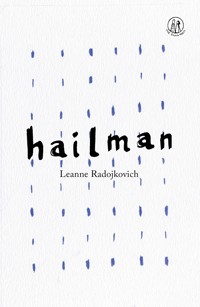
Leanne Radojkovich's writing is full of crisp, precise details, and often contains a sting. In Hailman, the follow-up to her 2017 debut First fox, the stories still have a dreamy, mythic feel, but are now rooted more firmly in the dusty suburbs and countryside of Aotearoa. In the title story, a child builds a snowman out of ice with her mum's friend Joyce and skirts round the edge of some adult truths. In 'Growing', a daughter visits her mother in the nursing home and tries to bond with her over flower seeds. In 'Double Dose', Patsy makes a Covid-y journey back to her hometown and touches on unpleasant memories of the past. All the rest home doors have name tags. Mum's has a typo: Irina. Although Irena isn't her born name – only she knows what that is, and she's never told, never discussed the war. Says she was born the day she reached Wellington harbour with papers stating she was a ten-year-old Polish orphan. Dad said not to ask about the European years, and my brother and I never did. Now they've both died and there's just me and Mum, and she's in a rest home with a mis-spelled name on her door.
Sie lesen das E-Book in den Legimi-Apps auf:
Seitenzahl: 94
Veröffentlichungsjahr: 2021
Das E-Book (TTS) können Sie hören im Abo „Legimi Premium” in Legimi-Apps auf:
Ähnliche



















HAILMAN
OTHERTITLESFROMTHEEMMAPRESS
POETRYPAMPHLETS
The Whimsy of Dank Ju-Ju, by Sascha Aurora Akhtar
Vivarium, by Maarja Pärtna, trans. from Estonian by Jayde Will
how the first sparks became visible, by Simone Atangana Bekono,
trans. from Dutch by David Colmer
SHORTSTORIES
The Secret Box, by Daina Tabūna, trans. from Latvian by Jayde Will
Once Upon A Time In Birmingham, by Louise Palfreyman
Tiny Moons: A Year of Eating in Shanghai, by Nina Mingya Powles
Postcard Stories 2, by Jan Carson
POETRYANTHOLOGIES
Everything That Can Happen: Poems about the Future
The Emma Press Anthology of Contemoprary Gothic Verse
The Emma Press Anthology of Illness
BOOKSFORCHILDREN
Poems the wind blew in, by Karmelo C Iribarren,
tr. from Spanish by Lawrence Schimel
My Sneezes Are Perfect, by Rakhshan Rizwan
The Bee Is Not Afraid of Me: A Book of Insect Poems
POETRYANDARTSQUARES
The Goldfish, by Ikhda Ayuning Maharsi Degoul,
illustrated by Emma Wright
Menagerie, by Cheryl Pearson, illustrated by Amy Evans
One day at the Taiwan Land Bank Dinosaur Museum,
by Elīna Eihmane
For Julena Ciprian and Ljubomir (Leo) Radojkovich
THEEMMAPRESS
First published in the UK in 2021 by the Emma Press Ltd.
Text © Leanne Radojkovich 2021.
All rights reserved.
The right of Leanne Radojkovich to be identified as the author of this work has been asserted in accordance with the Copyright, Designs and Patents Act 1988.
ISBN 978-1-912915-70-5
EPUBISBN 978-1-912915-71-2
A CIP catalogue record of this book is available from the British Library.
Printed and bound in the UK
by Imprint Digital, Exeter.
The Emma Press
theemmapress.com
Birmingham, UK
CONTENTS
War Stories
Hailman
On Spinning
Double Dose
The Vilina Vlas Hotel
Missing
Cats and Dogs
Where the river meets the sea
Drive-by
Growing
Acknowledgements
About the author
About the emma press
War Stories
There was no rain that summer and the heat was fierce. Trees were stripped to the bone. Pop’s pet rose bush was a thorny crown in the centre of the parched lawn. Drought restrictions meant no watering. The sun turned the iron-roofed house into a sauna. Inside, Grandma was recovering from an operation. Pop and I sat in the carport hoping for a breeze. He ground his false teeth and gripped his Best Bets magazine like he was about to rip it in two. All day he drank beer. Sometimes he’d speak to an invisible person, crushing Best Bets into a ball. We could hear Grandma moan from the carport, and Mum responding in her soothing tone. Grandma would eventually doze off. Then we’d hear the squeak of the fridge door being opened for tonic; the freezer for just one ice cube – so the gin had more bite, said Mum.
Mum told me Pop had the beginnings of dementia and was experiencing magical thinking. He was stuck in an intense silence and my nose was stuck in a book. It was definitely not a time of magical chats.
Occasionally I’d be reading and hear a thud indoors. I’d look up to see Grandma’s face at the bedroom window. She’d stare out at the bony trees, spellbound, until Mum helped her back into bed. In the evenings, I’d sit in Grandma’s room reading aloud from the Woman’s Weekly, including ads, and the Herald’s death notices. She’d rest her hand on my knee, whispering over and over ‘Wonderful, wonder-ful,’ a dab of glitter in each eye. Then Pop took over and spent the night in her room.
I dreamt of stagnation: oil slicks with fish drowning in them; me as a tortoise, slowly turning to stone. I didn’t fight these dreams. I was too drained and felt strangely old, although I was only fourteen. Mum and I had gone to Pop and Grandma’s for the summer holidays so we could help out. I had no friends in that town, and there were no laptops or cellphones back then. My sister stayed home. She’d left school the year before and was working in a bakery.
The library was two streets away and I had Grandma’s card. Every few days I’d load up with thrillers and war stories: The Medusa Touch, Catch-22, Kelly’s Heroes. Pop had been in the war on the other side of the world. He was a kid at the time, and had no family left by the end. Grandma said Pop was lucky to survive, although not even she knew exactly what happened. Whenever I asked Pop about his childhood, he’d clack his false teeth and say he’d never had one.
My sister rang every couple of days to see how Grandma was doing. Then she’d ask about the ‘old troll’. ‘He’s harmless now,’ I’d reply. She and Pop had clashed from the start. Once, he tore down the paper doll chains we’d stuck to the lounge wall and ripped them up. For one long electric moment we’d gaped at him, then my sister punched his thigh and took off. ‘Nothing should be sellotaped to wallpaper,’ Grandma said afterwards, as a kind of explanation.
How carefully we’d smoothed flat those sheets of paper and folded them in half, then in half again. How carefully we’d drawn the outlines of the girls and snipped around, then lifted them out one after another, hand in hand, to dance around the room.
As summer wore on, Grandma grew more gaunt. She stopped wearing her wig – too hot. Pop stopped wearing his teeth, his mouth a sad pocket. The hiss when he pulled the tab off a can of beer. The clink of Mum’s lonely ice cube.
I read book after book, skimming the lines until they turned into a kind of life raft. I read cereal boxes at breakfast, ingredient lists on biscuit packets and baked bean cans. We made our own food during the day, and must have had proper dinners together although I can’t remember them.
Heat parboiled the air. It felt like we were hypnotised, walking down a dream hall, moving forward as if drawn along by a string. Bees floated past like dandelion seeds – I hadn’t seen that before. Flies crouched everywhere, sizzling.
I thought Pop liked being in the carport with me – it wasn’t just to escape the sauna of the house. I thought he liked my tortoise-stillness compared to his compressed energy that seemed to rise and boil up through his hair. ‘Why are you always reading!’ he burst out one afternoon. ‘You don’t have enough… stories… of your own?’ His words crumbled. He smacked the book out of my hands. I picked it up off the concrete. ‘Do you want me to read to you?’ I asked. ‘Grandma likes it when I read to her.’ He shivered and stared at his hands.
Mum turned on the kitchen light. It turned the air outside amber. The rose bush glimmered as if wrapped in tinfoil. A few withered leaves still clung on but I wouldn’t dare nip them off. The sky darkened. Stars opened. The rose bush disappeared in the deepening gloom. In that moment I saw my sister and me, hand in hand. Me wearing her old corduroy pinafore with ruffle straps and a sash tie. Ring a ring a rosie, we danced around the roses, a pocket full of posies, A-tishoo! A-tishoo! We all fall down. We thumped down and rolled onto our backs. The roses’ scent above us was sweet and spicy, strong as incense. We looked at each other, then jumped up and ran our fingers across the fat velvety blooms. Petals slipped off and swivelled down in red splotches. Pop appeared. Slap! Slap! We stumbled back, cheeks scalded. ‘I hate you, I hate you,’ my sister sobbed and ran into the house, but I was stilled. We weren’t allowed to touch his roses, yet I felt sure that wasn’t why he’d struck us.
The hiss of Pop pulling the tab off a can of beer. The clink of Mum’s lonely ice cube.
I stopped on my way from the house to the carport. I pressed the tip of my finger against a thorn on the rose bush. Blood welled from the puncture and I licked it off. I missed my sister. I wanted to leave school and get a job, too. We’d go flatting.
It was too early in the morning for Pop to join me. When I sat down I noticed an eerie lack of birdcalls. No sparrows fossicked the dry ground. No mynahs shrieked from the telegraph wires. It was so quiet I heard an inner thrum, like when you’ve had a fright or been running a long time and your heart-beat drums in your ears. I stared down at the piles of war books and thrillers on the concrete. The smell of pine trees wafted toward me, although there were none in the neighbourhood and the Christmas tree was long gone. For some reason I prickled with cold. My vision blurred then resolved. I saw a field of snow smooth as a sheet of paper. A shadow of a large bird slowly crossed the white ground and I felt myself sinking.
The afternoon Grandma died, the daylight dimmed. Clouds rolled in and everything turned grey and smelled of nails.
Pop and I were in the carport, while inside the house Mum made arrangements on the phone.
I was crushed. I couldn’t read. Beside me, Pop had shrunk like a week-old balloon, all his static gone. He held a can of beer but forgot to open it. I had the feeling he was only just there, now Grandma was gone; a puff of wind could have blown him away. I looked down and blinked back tears.
There was a bottomless silence where even the flies had stopped sizzling. The smell of pines grew strong. An image appeared. Two girls about six years old, holding hands. A spill of sunlight, a dazzling expanse of snow. Then a close-up: their hands were roped together. My heart shrank to a pinprick and a metallic taste rushed into my mouth. Their chests torn from gunshots. Pop, about twelve, a gun hanging from one hand, a soldier behind him with a pistol to his head.
Hailman
Mum and I caught the bus to visit Aunty Joyce on Saturday mornings. Joyce wasn’t my real Aunty; I just called her that out of manners. Whenever we visited, she was mending or making gowns for ballroom dancing – liquid fabrics, shimmering falls of sequins. She’d talk with pins in the side of her mouth, and when the pins ran out she’d fit a cigarette into a holder and light up. She let me play with her offcuts. I’d feel her glances. If looks could kill… Of course they couldn’t, but they could brush against the back of your neck; they could caress your cheek.




