


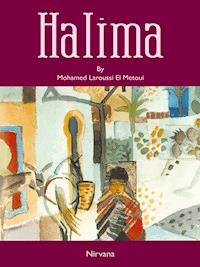
Erhalten Sie Zugang zu diesem und mehr als 300000 Büchern ab EUR 5,99 monatlich.
- Herausgeber: Éditions Nirvana
- Kategorie: Gesellschafts- und Liebesromane
- Sprache: Englisch
Secrets around Halima...
Her mother did not dare to reveal to her the secret of her father’s death. Her husband, too, could not tell her about his resistance activities… Between « the spindle » and « the suitcase for the Hammam », the course of Halima’s life is similar to that of Tunisian society liberated from colonialism and emerging into a new era of independence…
Discover the course of Halima’s life, that's similar to that of Tunisian society liberated from colonialism and emerging into a new era of independence
EXTRACT
Abdelhamid's family didn't wait long before they left for Tunis. They were packed into a car and heading for the capital only 2 months after their return from the harvest.
Halima felt very lonely when her friend Myriam left with her mother and brother. But that loneliness directed her inner self towards new sensations that pervaded her thoughts. She felt the need for sex and the want of a man. She began dreaming of her Prince Charming and of the man of her future. This feeling was increased by her mother's work preparing her "Djehaz".
ABOUT THE AUTOR
Mohamed Laroussi Métoui, de son vrai nom Mohamed Laroussi Ben Tahar, né le 19 janvier 1920 à Métouia et mort le 25 juillet 2005 à Tunis, est un écrivain tunisien. Connu sous le pseudonyme de Métoui, en référence à sa ville natale, il est considéré comme une figure emblématique du paysage culturel de son pays. Pionnier de la création romanesque en Tunisie, il écrit des nouvelles, des articles de presse, des critiques, des pièces de théâtre… Il s’intéresse aux études du patrimoine ainsi qu’aux recherches d’histoire. Dans sa jeunesse, il écrit également de la poésie.
Sie lesen das E-Book in den Legimi-Apps auf:
Seitenzahl: 119
Veröffentlichungsjahr: 2018
Das E-Book (TTS) können Sie hören im Abo „Legimi Premium” in Legimi-Apps auf:
Ähnliche




















Introduction
Since 1881 Tunisia lived under the French occupation. Although the Bardo treaty left the Tunisian King or bey as the supreme ruler of the country, the power held by the « Resident General » (French representative in Tunisia) increased day after day. Inside the country the « civil controllers » or governors expanded their control up to the most remote areas of the south of Tunisia.
The efforts of the Tunisian nationalists (Ali Bach Hamba, Salah Ech-cherif and Ismail Es-sfaihi) were in evidence well before the first world war. Few incidents took place such as those of the Jellaz in 1911 and the tramway in 1912. But soon the nationalists were repressed.
Nationalism revived again in 1920 when the 1st Tunisian party, the “Dertour Party” was founded by Abdelaziz Ath-albi. In 1924 Mohamed Ali El-Hammi founded the “Common Council for the Tunisian Worker”, and in 1934 Habib Bourguiba founded the “Neo-Destour Party”. In consequence, the resistance activities became in evidence.
At this stage, El Metoui started his story in Halima. Many resistance activities were mentioned by the writer reaching their momentum on April 9th 1938 when Bourguiba as well as many other Nationalists were jailed and the negotiations with the French government were broken.
Farhat Hached, the union’s leader, and Bourguiba worked together in leading the resistance movement. Soon new negotiations were started with the French and in 1951 more Tunisian autonomy was obtained. In 1955 internal autonomy was declared, just one year before the declaration of Independence on March 20th 1956.
El Metoui in Halima mentioned most of the important incidents Tunisia went through such as April 9th 1938, January 18th 1952 when the new negotiations were broken and Bourguiba was jailed again, and June 1st 1955 when Bourguiba returned back to Tunisia. El Metoui gave also many examples on the active resistance such as the strikes, the demonstrations, the sabotage activities, etc… and also on the retaliation of the French government such as the campaign made by the French forces in the Cap Bon area.
One should note here that the story in Halima starts almost with the birth of the “Neo Destour” party and closes with the return to Tunis of Habib Bourguiba, the founder of that party. This of course shows the author’s political commitment and strengthens in a way the political theme he wanted to develop in Halima.
The social scene
The Tunisian society was the product of several civilizations that have followed one another in the Tunisian land. But 20th century Tunisia was mainly shaped by the Muslim and Arab civilisation. Even during the French protectorate, Tunisia was considered as part of the Ottoman Empire. Arabic was the main language used and Islam was the official religion.
Although Muslims formed the majority of the population, they were the most underprivileged of all, 800,000 hectares were in the hands of the French, which is one fifth of all arable land in Tunisia. The money was held by the Europeans especially the Jews who have acquired the French nationality, and also by some aristocratic families who shared the lands with the “Muammirs” or colons. The latter’s started renting the lands from small farmers and eventually almost bought them all.
El Metoui stresses this point in his first novel wa mani ed-dhahaya when his main protagonist went into court in order to regain the “hectare colony” that his French neighbour had bought.
In parallel with this opposition between underprivileged natives and privileged occupants, existed another opposition between the capital Tunis and the rural areas deep inside the Tunisian land.
Besides being a pole of attraction to all Tunisians, Tunis sheltered the only two schools in the country, and offered many job opportunities. Most of the families who had lost their lands either worked as khammessa in others’ lands or moved to Tunis in search of new jobs. Thus we see for instance Sheik Miftah in Et Tut el Murr working as a khammas in Sheik Salah’s land after he had lost his lands in the neighbouring country of Libya.
This opposition between “Beldyas” or inhabitants of Tunis and Bedouins, was very clear in the way of life each group led. Inside the country, the people lived within large groups or tribes. The social ties were in evidence and the whole community was usually headed by “Sheik Al Ashira” or head of the tribe.
Men’s main occupation was to work in the fields during the day and to gather in cafés at night. In this respect we see Abdallah in Et Tut El Murr going every night to the café in order to play cards with his friends.
On the other hand, the way of life in Tunis was much different from that in the country. It was determined by several factors among which we can quote the mixed society and the influence of the French on the Arab community. The latter was composed of the original natives of Tunis and the exoders who were also forming separate groups according to the areas they came from. There has always been a certain feeling of superiority on the part of the “Tunisois” towards the people coming from the country.
But looking at the Tunis community from a broader point of view, on can say that there was not much difference between the 2 groups. Although tribalism was absent, the Tunis familiers were also headed by the father who was considered as the supreme ruler. Men’s main occupation was working during the day and gathering together at night either in cafés or in other social groupings among which the literary and cultural ones are to be distinguished.
The religious belief was very strong within the Bedouin community. It went even as far as to the belief in supernatural powers and holy men or “derwishes” such as Um el Ezz in Et Tut El Murr and Sheik Omar in Halima.
This same belief was shared with the people of the capital or ”Beldays”. In fact, and in spite of its relatively modern aspect and its two schools. Al Medrassa As-Sadiquia and the Zaytuna University, Tunis did not emerge from the poverty and ignorance that covered the whole country.
To summarize one can say that the French colonization was to certain extent due to the social background Tunisia knew at that time. Such background changed gradually throughout the 20th century thanks to the new educational system especially at the Zaytuna University and at Al Madrassa As-Sadiquia, which played a great part in making the Tunisians become more aware of the need to regain their freedom and independence.
Finally one should not forget the importance of the contact of the Tunisians with the French ideals such as freedom and democracy.
The cultural scene
By the end of the 19th century Tunisia experienced a new cultural renaissance. Such renaissance was the result of the contact with the Arab and western literatures, and of the efforts of reform and modernization carried on by some Tunisian reformers.
The French occupation was a setback for this literary renaissance. The French came with their culture to Tunisia and tried to spread it in the whole country. In 1909 some 200 schools on the French system were built and about 5000 students were exposed to the French culture.
Apart from the koranic schools which were present in the whole country and which allowed most of the Tunisians a preliminary religious study, the Tunisian culture was taught in two schools only: the Zaytuna University where only Arabic language and religious studies were taught; and Al Madrassa As-Sadiquia which formed a bridge between the Arab culture and that of the west.
The first literary works by Tunisian writers appeared in the form of short stories and poems. These were published through periodicals like Al Alam Al Adabi (The world of literature), Al Shaab (The people) and later Al Fikr (The mind). Drama started in Tunisia in the forms of translations from the French literature. The first originl Arabic plays were written in the 1930’s by Mohamed Ibn Habib who wrote Al Wathiq bi Allah Al Hafsi, Fathu Faris and Jil Al Yum. In 1956, Mahmud Al Mesadi wrote his book Al Sud and in the 1960’s habib Boulares wrote Murad III.
The journalistic press contributed in the production of short prose pieces which were encourages by the nationalist movement. During the interval between the two wars there were about 200 political essays in Arabic published in different periodicals and newspapers such as Al Amal Attunisi which was edited by Habib Bourguiba.
Poetry in Tunisia knew its renaissance much earlier than the novel. That is as early as the end of the 19th century, when its themes no longer remained the “Madh” and “Hija” or eulogy and satire. Many poets, like Mahmud Quabadu started attacking the French colonization of Algeria in 1830. New themes were developed like the Arab unity and the fight of colonialism. Among these poets Muhamed Chadli Khaznadar and especially Abu Al Kacim Al Shabbi were in evidence.
On the other hand, the novel was almost absent from the literary scene. Besides its being the most difficult to write, its absence was also due to the lack of publishing houses.
By the 1950’s, and despite its tender age, the Tunisian novel was very related to economical, political and social incidents through. There were writers like Mohamed Laroussi El Metoui, bechir Khurayaf, Mokhtar bin Jennet, Mohamed Salah El Jebri and Abderrahman Ammar.
According to med Salah El Jerbi, there were four trends that characterized the Tunisian novel at that time.
1)The realistic trend: This was the largest trend. Most writers wanted to stick to their reality and to report it to their readers as it took place. Bechir Khurayaf led this trend by his works: Iffles (bankruptey), Barg El Lil, Ed-digla Fi Araginha (the date palm) and Meshmum el Fil (the jasmin flower). There were also other writers like Mustapha Al Farsi who wrote Sraqtu el Qamar (I stole the moon) and Al Munaraj (the detour); and Yahia Mohamed who wrote Hiwarun Fi Al Dhil (conversation in the shade) and Nid’u al Fajr (the calling dawn).
2)The historical trend: Historical writers were mostly interested in rewriting the nationalistic resistance with an emphasis on the resistance and on the social and political scene at that time. This trend is very clear in the works of Abderrahman bin Ammar (Ibn Al waha) who wrote Indama Yanhamiru Al Mataru (when the rain pours in), and Mohamed Mokhtar bin Jennet who wrote Orjuan (purple).
Mohamed Laroussi El Metoui’s works are also among this category, especially his three novels Wamani Ed-ahahaya, Halima and Ettut el Mur. But his works as well as the works of many other writers such as Fradj Echadli, Rachad El Hamzaoui, Abdelwahab Braham and Abdelkader Nasr were criticized by many Tunisian critics for their naivety and conformity to reality. It was as if the writer was a reporter and no??? novelist.
3)The experimental trend: This is rather a new trend that started in the 1960’s. Experimentalists were mainly young novelists who have tried to bring a new style to the Tunisian novel and they resisted its old and traditional forms.
Among these writers there were Ezzeddine El Madani who wrote Khurafat (fables), Samir El Ayadi who wrote Zamanu Ez-zakharif (the time of ornamentation) and Mahmud At-Tunsi who wrote Fadha (space).
4)The reflectionist trend: Reflectionists were greatly influenced by the Italian writer Luigi Pirandello who was obsessed with man’s dilemna in choosing between a treacherous illusion and a rational but fruitless despair. Pirandello said: “Reflection is a dark hole filled with macabre ghosts and guarded by a despairing anxiety, a hole which deadly darkness is never reached by light”. This trend is largely dominated by the works of Mahmoud El Mesaadi in Haddatha Abu Hurairata Qual (Abu Huraira said), Mawlid Annissian (the birth of forgetfulness) and As-sud (the dam).
To summarize, one can say that despite a shy start, the Tunisian novel especially in the post-independence era knew a boon which was mainly due to two publishing houses, Addar Attunussia Li Neshr which published El Metoui’s At tut Al Mur and As-sharika At Tunussia Li Tawzia which published Halima. Many writers were then allowed to come to surface, among them was Med Laroussi El Metoui.
THE SPINDLE
Chapter 1
Hot and painful tears ran down her cheek like fire. She wanted to hide them, but she couldn't even reach up with her hand and dry her eyes.
She also had to find an answer, even a short one, for how could she avoid that helpless question her daughter, Halima, had just asked?
"Poor Halima, my poor little girl. How did her father die? My husband Ahmed. She used to come to me and ask with an anguished and perplexed look: "Why was my father killed, Mother? Why did he go and why hasn't he come back? He didn't return like Suad's and Khadija's fathers did. Why didn't I know this father whose name I bear? You don't even have a picture of him, Mother. Suad once showed me her father's photograph. She used to talk to me about him, about his wide eyes and about the wrinkles on his forehead. She even talked to me about full lower lip.
"Poor Halima, she was asking about him again, and again I couldn't answer her, couldn't explain to her who her father was and how he died. My God. must I suffer ever from his death and from the endless questions our daughter Halima keeps asking about him? Time did not even allow her father to give her a brother or a sister. She had no one to keep her company. And who knows, it may be better this way, for what would become of me if she had a brother or a sister? A Rachid or a Salah as I was discussing with her father, my deceased husband".
She returned to the spindle she had borrowed from her neighbour Fatma in order to spin some wool and knit an "Ajar" that she would sell on Sunday, market day in Gabes.




