


Erhalten Sie Zugang zu diesem und mehr als 300000 Büchern ab EUR 5,99 monatlich.
- Herausgeber: Parthian Books
- Kategorie: Gesellschafts- und Liebesromane
- Sprache: Englisch
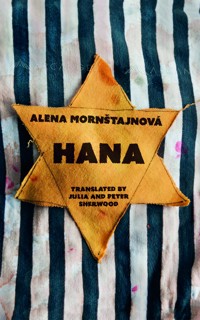
It's 1954 and nine-year-old Mira's life is about to change forever. After a typhoid outbreak rages through her town, robbing her of her parents and siblings, the orphaned child is forced to live with her mysterious, depressive Aunt Hana, a figure both frightening and fragile. Gradually, Mira uncovers the secrets of their troubled family history and begins to understand why her aunt is so incapable of trusting herself and the world around her. Deftly weaving two separate timelines, the harrowing reasons behind Hana's reclusive way of life, the guilt she wears as palpably as a cloak, and the tattoo on her wrist, are revealed to Mira.
Sie lesen das E-Book in den Legimi-Apps auf:
Seitenzahl: 464
Veröffentlichungsjahr: 2020
Das E-Book (TTS) können Sie hören im Abo „Legimi Premium” in Legimi-Apps auf:
Ähnliche



















iii
HANA
Alena Mornštajnová
Translated from the Czech by Julia and Peter Sherwood
Table of Contents
PART ONE
I, Mira
1954–1963
2
Chapter One
February 1954
I’ve never understood why grown-ups tell children that it pays to be obedient. If I’d been a model daughter, my name would now be carved on a gravestone alongside those of my mother’s parents – Grandma Elsa and Grandpa Ervin who died long before I was born. Or of Grandma Ludmila and Grandpa Mojmír, at whose grave my mother and I used to light candles in brown tubs at the far end of the cemetery.
On Sunday afternoons, if the weather was nice, my schoolfriends would go for a walk in the park or take a stroll around town with their families, while my mum would make Dagmar, Otto and me put on our Sunday best and push us out into the street outside the dark watchmaker’s shop which used to be ours but where my father was, by then, only allowed to work for a pitiful salary and my mother could only mop the floor for no pay at all.
Every Sunday afternoon, after washing the dishes, Mum would put on her black hat, plonk Otto in his pram or, when he was a little older, grab him by the hand and head with us to the cemetery. It seemed miles away. First we had to pass the church, reach the river and cross the bridge, then walk through all of the lower town, which for some mysterious reason is known as Krásno, before trudging past the enormous castle park to where the houses ended, go through the cemetery gate and wait while Mum swept the gravestones clean, arranged the flowers in the vases and lit candles. As she worked, she talked to the dead, sharing with 4them the latest gossip from Meziříčí: who had been born, who had died, what rumours were going around, how the neighbours were doing and what mischief we, the children, had got up to again.
I never dared say anything, just sighed deeply to make Mum realise how the waiting annoyed me but even that was enough to prompt a reproach: ‘Stop making that face. If it wasn’t for them, you wouldn’t be here today.’
After further names were added to the gravestones, including my Mum’s, I often thought back on how she would stand by the graves every Sunday talking to her loved ones. It was comforting to know that she was now with those she had been missing so much.
The only reason my name is not among those inscribed on the gravestone in gold lettering is because it sometimes pays to be cheeky and disobedient. If you don’t agree, you might as well stop reading right now. And don’t let your children get hold of this book either, just to be on the safe side.
The winter of the year I turned nine and my entire life was turned upside down was frosty and fairy tale white but by February we had all had enough. Only in the last days of the month did it turn slightly warmer at last, with the snow starting to melt and the ice beginning to break up.
There are stretches of the river separating Meziříčí from Krásno where the current seems to drag along modestly and sluggishly rather than rushing down to merge with bigger rivers, and since the snow on the nearby mountains was melting only very gradually, it didn’t make the river flow much faster and the water level barely rose. The conditions seemed perfect for a short ride on the ice floes that had come loose.
That February of 1954, as evil was already lurking deep in the town’s underbelly, every day after school we ran straight 5to the river and impatiently checked if the ice was beginning to break up and if the current was strong enough for us to jump onto a passing floe, ride it for a few metres and enjoy the great adventure about which the sixth-formers, twins Eda and Marek Zedníček, raved to us in every school break. During a similarly freezing winter a few years ago they had first-hand experience of riding on a floe.
Eventually, after a few days, the ice cracked, the middle of the river broke free and ice floes started slowly floating downstream. This was the moment we had prayed and meticulously planned for.
I stood in the kitchen doorway, holding my bobbly red hat in one hand and gloves in the other.
‘What’s got into you?’ Mum asked in surprise when I asked if I could go sledding with Jarmilka. The kitchen was warm and cosy, filled with the lovely smell of the tartlets my mother was baking for her birthday party. ‘The snow has started to melt, you’ll get all soaked.’
I reached for the baking sheet to take a tart but flinched as it was still hot. ‘Yes, exactly! This may be our last ride this winter.’
Mum eyed me suspiciously. ‘Mira, don’t even think of going to the river.’
The fact that Mum had guessed what I was up to with Jarmilka Stejskalová and the Zedníček boys made me wonder if, before she grew up to be so extremely cautious, she too might have enjoyed riding on ice floes. But she wouldn’t allow me to do so many things, just to keep me out of harm’s way.
I wasn’t allowed to go up to the attic, because I might trip on some junk or fall out of the window. I wasn’t allowed to go down to the cellar, because I might slip and fall down the stairs. I wasn’t allowed to go out onto the balcony because I might fall through the dilapidated floor onto the paved courtyard. And when you hear the words 6‘you mustn’t do this and mustn’t do that’ all the time, it’s no wonder that you stop taking them seriously.
‘Of course not, Jarmilka and I are just going to the hill behind the Zedníčeks’ garden,’ I said, sneaking a tart into my pocket, hot as it was.
My mum was very pretty and when she hugged me, she gave off a warmth that was like a stove with the lovely smell of vanilla sugar. But at that moment her huge brown eyes, which always seemed so sad I was afraid to look into them, were fixed on me with such suspicion that they seemed to read my innermost thoughts.
‘Jarmilka is waiting for me outside,’ I said, buttoning up my coat, tying the laces of my warm ankle boots and pushing my hat deep down my forehead.
Mum handed me another tart. ‘Take one for Jarmilka as well.’
I dashed out of the door, grabbed Jarmilka’s sled by its strap and headed for the Square. I could feel Mum’s eyes burning my back.
‘Bye-bye, Mrs Karásková,’ Jarmilka shouted, ‘and thanks.’ Tossing her long blonde plait, which I had always been jealous of because all the boys in our form used to tug at it with admiration, she shot my mum an innocent smile and bit into the tart.
At the end of the street I turned left.
‘Where are you going?’ asked Jarmilka, yanking the strap to stop me. ‘We don’t want to go around the whole town.’
‘But I don’t want my mum to see me heading for the river.’
‘Oh, come on, she can’t see around corners!’
I looked around. A curtain moved in the first-floor window of a house with peeling paint. Maybe I was just imagining it but perhaps it was old Mrs Benešová keeping watch so she did not miss anything that went on in the 7Square. I quickened my pace. ‘You never know. We might run into someone and then we’ll be in trouble.’
‘And you’ll have to have peas for your supper,’ laughed Jarmilka, scurrying after me in resignation.
She was right. I hated peas and Mum knew it too, so whenever I talked back or had been up to some mischief, she made me eat peas for lunch and supper. I would sit at the table with the rest of the family watching them enjoy potato pancakes with home-made jam or some other treat, while I forced down my peas. I pulled a face and said: ‘That’s not as bad as when my dad unbuckles his belt.’ Something I also had to put up with every now and then, certainly more often than my younger sister and brother. And today’s exploits would definitely qualify for the belt, I had no doubt about that.
My brown boots were soaked through even before we reached the river, and my gloves weren’t thick enough to stop the cold from creeping under my fingernails. The Zedníček boys were already waiting for us on the riverbank under the whitewashed church with its wood-tiled roof. They scurried up and down in the mushy snow with long sticks trying to separate the floes that had drifted towards the bank. As soon as a floe slid into the river, the current would catch it and carry it, slowly at first but gradually faster and faster, towards a low weir some fifty metres away where an accumulation of broken-up ice would block it from going any further.
Courage suddenly deserted me. Jarmilka must have felt the same because she sat down on the sled and said: ‘I’ll just sit here and watch.’
‘Scaredy-cat,’ Eda Zedníček shouted contemptuously. I realised that courage, if not beauty, might be a way for me to get the better of Jarmilka. The boys might pull at her plait but I was the one who they would point to for years to come, telling their younger schoolfriends: ‘That’s the girl who rode down the river on an ice floe.’8
I watched Eda skilfully free another chunk of ice, as large as the woven rug in my parents’ bedroom, step right into the middle of it, push off the ground with a pole and start slowly drifting on the current towards the weir. We ran along the riverbank while Eda stood on the ice floe with his legs wide apart, using a pole to steer his impromptu vehicle into the slower current, sticking it into the ground and heading for the weir at a safe distance from the bank. After softening the impact with the pole, he walked back to the shore on the pile of ice.
How simple, I thought. Except for the bit where you have to cross from one floe to the other.
As we walked back to the sled the boys dispensed some well-meant advice that took my courage away again. ‘The main thing is to step right into the middle of the floe so that you don’t slip into the water. And to keep close to the shore, the water is shallower there. The current is really strong in the middle, it could sweep you along, even I couldn’t handle that. And you have to push off with the pole on the side, don’t hold it in front of you or you might fall off.’
Now my feet were shaking not just with the cold but also fear. Eda and Mirek helped me free a floe. ‘Jump on,’ Eda shouted and I jumped, except that in the meantime the ice had floated slightly further downstream. I landed on the edge; the ice swayed and I slipped.
I spread my arms in mid-flight and could feel my body hit the river and sink into the water. At first it didn’t seem all that cold, but then it squeezed me like a pair of gigantic pliers, flooding my ears, eyes and nose, pressing me down into the shallows and pushing me to some dark place. Before I had time to get scared, someone’s hand grabbed the lapels of my coat and lifted me out of the water.
‘Didn’t I tell you not to step on the edge?’ Eda said, turning to Mirek and adding with a sneer: ‘It was your stupid idea to bring the girls. We’ll be in real trouble now.’ 9
Jarmilka stood on the shore, whimpering. I scrambled out of my sodden coat as quickly as I could and tried to wring it out. I couldn’t go home in that state, but I was terribly cold. It occurred to me that it might be an idea to make a fire so that I could dry my clothes and warm up a little. I was going to ask the boys for matches but my teeth were chattering so badly I couldn’t say a word.
‘Stop bawling, give her your coat and take her home,’ Eda shouted at Jarmilka. Reluctantly, she unbuttoned her winter coat and threw it over my shoulders. It wasn’t much help. Now both of us were shivering.
‘If you dare blurt out that we were here with you, you’ll get a proper hiding, even though you’re girls,’ Eda went on. ‘And now clear off home,’ he said, and with a nod to Mirek the two off them dashed up the hill.
I tossed the soaked coat onto the sled and we headed home, this time taking the shortest route. The cold was biting into my skin, forcing me to walk faster and faster. Two streets before our house I gave Jarmilka her damp coat back. She put it on, visibly relieved, gave me a sympathetic look and left me to it. I was still hoping that with a bit of luck I might be able to skulk up the stairs, slip past the kitchen, run up to the second floor to the room I shared with my brother and sister and secretly change into dry clothes without being spotted.
Never before had I noticed how badly our heavy front door needed oiling, how much the stairs creaked and how, unless you turned the light on, which was of course out of the question just now, you couldn’t see as far as the next step.
‘Is the light not working?’ came a voice from above, then the lightbulb flickered and I stopped in my tracks halfway up the stairs. When I turned around, I realised I couldn’t have avoided being found out anyway. I had left a small puddle behind on each step.10
‘I can’t believe it!’ Mum yelled, pouncing on me and dragging me up the stairs where she started to tear the wet clothes off me. ‘What mischief have you been up to now? Didn’t I tell you not to go to the river?’
She pulled my drenched tights off with one hand and thrashed my icy bottom with the other. I was shocked. This was the first time Mum had laid a hand on me. The blows weren’t painful, just dreadfully humiliating.
‘No,’ I shouted. ‘That’s not true! I haven’t been to the river. I went sledding with Jarmilka. It’s the snow, it’s really wet, that’s why I’m all drenched.’
I started to cry with shame, from the cold and the shock of it all. My brother and sister appeared in the kitchen doorway but, seeing me getting a drubbing, beat a quick retreat. The front door opened, as the rumpus had now reached the watchmaker’s shop, and my dad shouted out to ask what was happening.
‘You liar, you,’ Mum said angrily, rubbing my body with a towel so that it hurt, and pushing me into bed. ‘Go and make some tea, quickly,’ she called to Dad and threw an eiderdown over me. ‘Do you want to catch pneumonia and die?’
What kind of question was that? Why should I want to die? ‘I haven’t been to the river, I fell into a puddle,’ I sobbed. ‘It’s not my fault, it really isn’t.’
Mum put a mug of tea on the bedside table, jammed a woolly hat on my head, tucked a hot water bottle under my feet and closed the door. I nestled into the bedding and pressed the soles of my frozen feet into the hot water bottle, whimpering quietly. I was cold and unhappy that Mummy and Daddy were cross with me. Perhaps I shouldn’t have lied, perhaps I should have said that someone had pushed me into the river, perhaps…
Soon a pleasant warmth started to spread through my body and in half-sleep I heard the door open every now and 11then, felt a hand on my forehead and thought to myself that maybe Mummy wasn’t all that angry with me after all, that instead of getting the belt it would only be mushy peas for dinner.
My dad had an uncanny ability of treading so softly that it sometimes seemed that he’d passed through walls and floors like a ghost rather than coming in through the door. He spent his days in the watchmaking workshop on the ground floor repairing clocks. His back was stooped from sitting all the time and when he walked, he bent slightly forward. With his thick but almost completely grey hair he looked more like my mum’s father than her husband.
When I was very young, before I even went to school and my little brother Otto was still hiding under Mum’s skirts, I wondered sometimes why my beautiful mum had married someone so old. One day I asked them about it.
‘She had to marry me,’ said Dad, ‘after all, she’s the reason my hair turned grey.’
‘That’s true,’ Mum replied, patting him on his stooped back. ‘But you’re quite happy you did, aren’t you? Who would bring you gallons of tea down to the workshop? You know how many steps it is?’
Eighteen. The narrow staircase had eighteen steps, and ever since the government had nationalised the family watchmaker’s shop and had the connecting doors between the shop and the staircase bricked up, Mum had to go out into the street with every cup of tea and enter the little shop by the main door, which wasn’t much fun, especially in winter or when it rained.
My dad would spend long hours down there with his clocks and watches, not just on weekdays when the shop was open, but even on Sundays. He would only go up to our first-floor flat to eat and sleep. At lunch and supper he would talk to Mum about the clocks he was working on and she would 12listen to him as if he were recounting some amazing adventures. He never said much to us children, and when Mum had to go away leaving Dad to look after us, he was rather put out. I’m sure it wasn’t because he didn’t love us. He just wasn’t good with children and was waiting for us to grow up and find his clock stories as fascinating as Mum did.
On the Sunday when the world started turning in the wrong direction, Dad had been grumpy all day although he did his best not to show it. At first, I thought he was still angry with me because of my ice bath but in fact this time it had nothing to do with me. It was Mum’s thirtieth birthday and Dad was ill at ease because his regular routine was disrupted by the celebrations. He couldn’t go down to his workshop, sit at his bench and fix whatever needed fixing. He had to sit in the living room at the festively laid table alongside his wife, three children and sister-in-law Hana, with whom he simply couldn’t get on even if he’d wanted to.
There was one simple reason – his sister-in-law was the embodiment of reproachfulness. Her every word, every gesture and every look showed clearly how much she disliked him. Dad found sharing a table with her just as unpleasant as I did.
As for me, I was scared of Aunt Hana. She would sit on a chair like a black moth, staring into the void. I never saw her in any bright clothes. Summer or winter, she wore the same black cardigan with deep pockets over a long-sleeved black dress, black tights and lace-up boots. I had never seen her without a headscarf, which I could understand as I had noticed her white hair sticking out from under the scarf, although she can’t have been that old.
‘Why doesn’t she ever take that cardigan off?’ I asked Mum.
‘Can’t you see how skinny she is?’ she said. ‘And skinny people are often sensitive to the cold.’
‘If she ate properly, she wouldn’t be so skinny. She just nibbles the bread she pulls out of her pockets. Why doesn’t 13she eat some proper food instead?’ It wasn’t fair that grown-ups were allowed to strew breadcrumbs all over the place while children weren’t.
‘Why, why, why! Stop pestering me. It’s none of your business. Does Aunt Hana tell you what you should or shouldn’t do?’
That was quite true. Aunt Hana was the only grown-up I had never heard say “you mustn’t”. Actually, I had rarely heard her say anything at all, because Aunt Hana hardly ever spoke, she just stared. In that funny way of hers. As if she were looking but didn’t see. As if she’d gone away and left her body on the chair. Sometimes I worried that she might suddenly slide down to the floor leaving only a pile of black clothes behind.
I should have known that Mum would stick up for Aunt Hana. Aunt Hana was her older sister; in fact, she was the only family we had. Mum loved her very much, which I found quite strange because my aunt had never given any sign of caring about any of us. Once I saw Mum try to hug her when she came to visit, but my aunt shrank back as if touching Mum had burnt her. Mum would always smile at her, speak to her in a soothing voice as if to a young child, and she would have moved mountains for her if my aunt had asked her to. But my aunt never asked her or anyone else for anything. She just sat in the living room staring into the void and would sometimes reply briefly in a voice that sounded exactly like Mum’s.
As we sat down to the festive lunch, I was half expecting to find mushy peas on my plate instead of the hunter’s stew. Although I hadn’t noticed any signs of peas being cooked during my exploratory visits to the kitchen in the morning, I gathered from Mum’s reserved behaviour that she had not yet drawn a line under my river adventure.
I was served the same food as everyone else. Maybe Mum was letting me off to mark her thirtieth birthday? 14
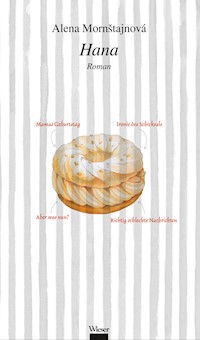
I had just got my hopes up when the time came for dessert. The lovely, fabulous cream puffs with their glittery sugar frosting and custard filling, specially bought for the celebrations from the patisserie in the Square.
One by one, my mum lifted the cream puffs off their tray with silver tongs and set them down on the gold-rimmed dessert plates she took out of the cupboard only on special occasions. She placed the first one before my aunt, then she served Dad, Dagmar and Otto. Then she looked around and said: ‘And the last one is mine.’
‘But what about me?’ I asked, a little too quickly, as I knew what the answer would be.
‘You don’t deserve a dessert. You went down to the river even though you knew you weren’t allowed to, and to cap it all you lied to me about it.’
I started to whimper. All eyes were on me. My brother and sister looked at me with sympathy, Aunt Hana uncomprehendingly. Dad just nodded and said: ‘Stop bawling or I’ll unbuckle my belt. You got away lightly as it is.’
‘Well then, it’s all yours,’ I said, pushing my chair away so forcefully it nearly toppled over, and shot out of the room.
‘And she’s cheeky with it,’ I heard Dad say. ‘I should have given her a good thrashing.’
‘Oh, come now, it’s my birthday,’ Mum said in a conciliatory voice. Those were the last words I heard before I ran up the wooden stairs to our second-floor room, where I slumped on the bed sobbing loudly.
So loudly that I didn’t hear the evil that had hatched beneath our town and stolen into some of the houses, including ours, on that day. The tears welling up in my eyes stopped me from seeing it reach out towards us with its greedy claws, smothering hope and sowing death. I had no idea that it lurked unseen and unheard downstairs at the table, stealthily picking its victims.
Chapter Two
February 1954
Next day, first thing in the morning, I sneaked into the pantry to check if there was a left-over cream puff for me, but there wasn’t so much as a crumb. I wondered for a moment if I should go into a sulk but then thought better of it as that could have earned me the promised thrashing from Dad. I generously decided to forgive my parents and pretend that none of this had happened. By way of consolation, I snatched up a few pieces of hard gingerbread Mum kept on the top shelf for grating as a topping for plum dumplings, porridge and noodles. Mum would hide them behind the jars of stewed fruit and thought I didn’t know about them. Then I found a bag of peas and pushed it into the furthest corner, just to be on the safe side.
By Friday Dagmar couldn’t get out of bed. I urged and prodded her, pulled the duvet off her, but she just wouldn’t get up. When she clutched her head and started crying, I realised she must be ill and not up to going to school. I ran downstairs to the kitchen and told Mum that Dagmar wasn’t feeling well and that I had a headache coming on, too.
Mum felt my forehead. ‘Have a bite to eat and off you go to school,’ she said, pointing to a seat at the kitchen table next to Dad. I sat down, annoyed, and tried to force a cough but gave up when Dad shot me a menacing look.
I was famished by the time I came back from school at one o’clock because in the morning commotion I’d 16forgotten to pack myself something for elevenses. Dagmar was running a temperature and no one took any notice of me. My sister couldn’t recognise anyone and kept shouting something about doorbells while Mum, with the help of old doctor Janotka, was applying compresses.
‘It’s probably mumps,’ the doctor said. ‘Be prepared, your other two will probably catch it too,’ he said, pointing to me and Otto. To be honest, seeing how poorly Dagmar was, I’d much rather have gone to school.
The doctor was right. Otto also fell ill the next day and he seemed to be even worse than Dagmar. The doctor came every day and he seemed more and more concerned, since two days later their temperatures were not going down and although my two younger siblings still had a headache and were still too weak to get up, the bulges behind the ears, typical of mumps, failed to appear. The doctor tried to make them bend their heads to their chest to see if they had meningitis. Mum was crying with fear and exhaustion, Dad tried to do his best to help but just wandered aimlessly around the kitchen, while I kept waiting to fall ill as well.
In the end it wasn’t me who fell ill but Mum and Dad. By then we knew that we weren’t the only family afflicted by this strange disease, as the number of sick people in town kept growing. It became clear that this was some kind of infection and that the sick would have to be isolated from the healthy. Since there was no hospital in Meziříčí, my entire family was taken to the isolation ward in the district hospital in the nearest big town.
‘Go to Aunt Hana’s,’ Mum said. Her cheeks were burning, she had difficulty talking and her tongue had taken on a strange brown hue. ‘Don’t forget to lock up. And don’t get up to any mischief.’ She stroked my cheek and let herself be taken down to the ambulance. Her head was bowed and the listless look in her eyes reminded me of Aunt Hana. She sat down next to Dad, resting her head on 17his shoulder. Dad opened his eyes and asked: ‘Did you wind up the clock?’ and closed them again. Mum closed her eyes without answering.
A man in a white coat slammed the ambulance door shut and I was left standing alone on the pavement in front of the watchmaker’s. There was nobody around to stop me going to the attic, the cellar or down to the river. Nobody to care about me.
I climbed the stairs and sat down on the sofa in the empty kitchen which suddenly seemed huge, listening to the loud ticking of the clock. I didn’t feel like going to Aunt Hana’s, but what else was there for me to do? I took a deep, determined breath and then, all of a sudden, I heard shuffling upstairs. I froze, dug myself deeper into one corner of the kitchen sofa and pulled a cushion onto my lap. No, it was just my imagination. I realised I had never before been at home alone. I reached for the bag Mum had helped me pack, and then I heard the noises again. As if someone were walking up and down in the attic. I shot out of the kitchen, snatched my coat off the hook by the front door, grabbed my shoes and rushed out. Not until I got to the Square did it occur to me that I hadn’t locked up.
Aunt Hana lived in the house where she and my mum were born and grew up with Grandma Elsa and Grandpa Ervin. Four large windows opened onto the Square and I used to envy her for being able to sit on the wide windowsill and watch the hustle and bustle outside. Our house had two floors but in order to see further than the narrow street I would have to climb to the attic from where you could see the whole town, but of course I wasn’t allowed to go up there. Besides, I was quite sure that Aunt Hana never looked out of her window as she didn’t like people and had not the slightest interest in them.
I dragged myself to my aunt’s flat one step at a time, 18imagining the face she would make when I told her I was going to stay with her for a few days. She wouldn’t be best pleased, there was no doubt about that. She was so used to her solitude that she had almost lost her ability to speak. She never left the house except to buy the bare necessities or to pay a rare visit to my mum. Actually, I wasn’t even sure she knew my name. I couldn’t recall her ever addressing me by name. She couldn’t have done, as a matter of fact – she had never spoken to me at all.
I rang the doorbell but there was no response. I rang again, this time more firmly. But no sound came from inside. I pressed my ear to the door. It would be just my luck not to find my aunt at home. I tried the handle. The door wasn’t locked.
‘Auntie?’ I called through the door but there was no sound. ‘Auntie, it’s me, Mira. Mum told me to go to yours.’ I imagined Aunt sitting at her table with that strange look in her eyes, not taking any notice of me. I went into the hallway, peered into the kitchen and, finally, the bedroom.
That was where I found her. She was lying in bed, in the same clothes she wore when she last came to our house, including her black headscarf, except that it had now slid off her white hair to her shoulders. She was lying on her back, strangely twisted, as if convulsed by pain, with her chin turned sideways, her eyes wide open and a strange rattle coming from her mouth.
I didn’t know what to do. I edged forward a few steps. ‘Auntie?’ But by then I could see that her face was the same colour as Dagmar’s. She was bleary-eyed and trembling all over – even more than I was after falling into the icy water.
‘Mother,’ she shouted all of a sudden. ‘Mother, I knew… I knew you would come back.’ She shook her head from side to side abruptly. ‘They’re not here, they’re not here.’ Tears rolled from her eyes. I had never seen anyone shed so many tears, even Otto who was really great at throwing tantrums.19
I don’t know what frightened me more, her violent feverish shivers, the convulsions of pain, her cries or her tears. I ran out of the flat, bounded down the stairs and once outside got hold of the first passer-by, pulling at his arm in desperation. ‘Please, please, tell me what to do, tell me what to do! My aunt is really unwell!’ To sound more serious, I added: ‘She’s fainted.’
The man in a long overcoat pushed me aside unceremoniously and moved away from me. By then everyone knew that the contagion had invaded our town. Stopping at a safe distance, he asked: ‘Where is she?’
‘Upstairs, in this house. She’s there all alone and I don’t know what to do.’
‘Follow me,’ he said and walked through the open door of a baker’s. ‘Don’t touch anything.’
It was warm inside and the place smelled deliciously of freshly-baked bread. The bread that Aunt Hana used to buy here and cut into thin slices and carry in her pockets.
Ignoring the alarmed looks of the women in the queue, the man in the long overcoat went straight up to the counter and asked the shop assistant: ‘Is there a phone I could use?’
‘It’s only for official business,’ the woman snapped. ‘This is not a post office.’
‘Call an ambulance,’ my rescuer said. ‘The little girl will give you the name and address.’
The shop assistant was about to open her mouth, but the man yelled at her: ‘Or do you want to go and take a look at the sick woman yourself first?’
The people in the queue shrank back to safety. I don’t know what they were more scared of, the contagion or the angry man. The first thing that occurred to me was how lucky I was to have picked him to grab by the sleeve. I was sure he could tell me where I should go now that I’d been left all alone. Suddenly I felt safer.20
Two women left their place in the queue, giving us a wide berth, and walked off. I told the shop assistant my aunt’s name and she went into the office at the back to make the call. I was told to go and wait outside my aunt’s house.
The ambulance arrived in no time. The front door opened, and a rotund doctor clambered out. He hesitated when he saw the stairs, gave a resigned sigh and started waddling towards the house, then stopped, took a deep breath and disappeared indoors, swearing under his breath. My aunt was carried out on a stretcher. I could tell she was still alive because the blanket they had thrown over her was trembling. The stretcher was loaded into the ambulance, the fat doctor climbed in, panting, slammed the door, the vehicle revved a few times, emitted a foul-smelling grey cloud and drove off jerkily.
I watched the white ambulance disappear and waited for the gentleman in the long overcoat to come back so I could ask his advice again. But he was nowhere to be seen.
I hung about for a good ten minutes, getting more and more chilled. It dawned on me that no one would help me and that it was up to me to find someone to look after me.
The first person who came to my mind was my golden-haired friend Jarmilka Stejskalová. Her equally fair-haired mother had always been very nice to me. I was sure she would let me stay at their house for a few days.
Once again I was standing in front of someone’s flat with my hand on the doorknob, asking for help. This time the door opened after the first ring, but only just.
‘Hello, Mira, Jarmilka is not going out today.’
‘I haven’t come to see Jarmilka. My Mummy and Daddy have been taken to hospital and I’ve been left alone. Could I stay with you until they come back?’
The gap grew even smaller. ‘Not right now. We’ve all got a cold, you might catch it.’21
‘So where should I go?’ I asked, but the door had already closed.
I looked up and down the street. In the windows, lights were being turned on; every now and then a shadow appeared behind the curtains, but I couldn’t see anyone I knew anywhere. Slowly I started walking towards our house but slowed down even more as I remembered the strange shuffling noises I had heard coming from the attic. I passed the shop window of the watchmaker’s, grown dark at the end of the day, stopped outside the front door and waited for something to happen. But nothing happened, except that the street was getting darker and on top of being cold I was getting increasingly scared of the approaching night.
I must lock up at least, I told myself. And once I’ve done that, all I can do is try knocking on a neighbour’s door and ask for their advice. I’ll go from house to house and hope someone will help me.
Having a plan gave me some courage. I pressed down the door handle. I was sure I wouldn’t have to go in as the key was usually left in the lock. I would just have to reach inside, grab it quickly, slam the door shut again and turn the key in the lock. I felt for the other side of the door but the key wasn’t there. How could that be? I was sure I’d seen it there. It could only mean that it was hanging on a coat hook a few steps from the door.
I poked my head into the unlit corridor. I didn’t dare switch on the light for fear of attracting the attention of an intruder whose presence I sensed. The faint light from the darkening street suddenly made my shadow so long that it reached all the way to the narrow stairwell and seemed to climb the stairs with every step I took. The coat hook was barely visible in the dusk. If I didn’t know it was Dad’s winter coat on it I would have thought that a shadowy figure stood there, with his back pressed against the wall. What if there really was someone here?22
I stood stock still and tried to make out the keys in the gloom. Suddenly I heard steps. They were coming closer and closer, and then another shadow joined mine on the stairs. Without trying to work out where the steps were coming from, I turned on my heels and made for the door. But the steps weren’t approaching from upstairs as I thought. They were those of the figure that was now blocking my way out. I tried to slip past, but she grabbed me by the shoulder. ‘Mira! You gave me a terrible fright.’
Chapter Three
March 1954
I once asked Mum, how come she didn’t have a “real best friend”. She was taken aback by my question and said that wasn’t the way things worked with grown-ups.
‘When people grow up, they don’t go out with their best friend every afternoon like you do with Jarmilka,’ she explained. ‘They don’t walk to work together or share their elevenses. They don’t see each other every day; in fact, sometimes they might not see each other for weeks on end, but they always know that they’re there for each other when needed.’
So Ivana Horáčková must have been a “real best friend” because the minute she heard that my family had been taken to hospital and I was left all alone, she came to see if I was all right.
The front door to our house was wide open and Ivana Horáčková noticed something moving in the dark hallway. Dashing out at her from the dusk, I gave her a bit of a fright but she quickly pulled herself together, switched on the light and helped me find the key to our house, transforming it into our safe and cosy home as if waving a magic wand. Then she got hold of my bag and led me to her house. I was still trembling.
She was a “real best friend” because, even though her husband Jaroslav shouted at her and insisted that she should hand me over to something called the council, she made up an old iron bed for me in the cubbyhole that used 24to be the servant’s room. I was so exhausted that I managed just a sip of hot milk before climbing under the duvet. But before I fell asleep I heard Mr Horáček say: ‘What did you bring her here for? Do you want us all to die?’
I didn’t hear her reply but I thought it very strange that a big man like that should be frightened of a little girl.
The next day Ivana told me to call her Auntie, even though she wasn’t my auntie at all, and explained that the town was in the grip of a typhoid epidemic and since my parents and siblings had been taken ill, it was quite likely that I was also a carrier. That was why I would have to go for a test and so would the Horáčeks, as they had come into contact with me.
I suppose Mr Horáček was still cross with me. Not only did he not suggest that I call him Uncle, he told Aunt Ivana in a huff that there was no way he would stick out his bottom just because of her. I didn’t understand what he meant until we came to the doctor’s surgery where the nurse took samples and said she would send them off for tests.
Aunt Ivana was really nice to me. She promised I could stay with her until my parents came home from hospital. The Horáčeks had plenty of room now because at the first sign that the epidemic was rampaging through the town, they had sent their two children to stay with relatives quite far away, in Kroměříž.
And it was just as well they had because Meziříčí was quickly sealed off. The two rivers running through town that share the same name and which usually hug the houses like a pair of friendly arms, now held the inhabitants in a tight grip. They turned into borders which no one was allowed to cross, to ensure that the contagion didn’t spread to the surrounding villages.
Public notices and announcements on local radio requested the residents not to leave town but people were 25terrified and anyone who could, fled to stay with friends and relations. But they soon discovered that nobody would put them up for fear that the refugees might spread typhoid beyond the town limits.
All the families where someone had been taken ill were placed under strict quarantine. I wasn’t allowed to go to school and the Horáčeks weren’t permitted to go to work. We were told to avoid showing up anywhere we might spread the contagion and banned from going to restaurants. Mr Horáček, used to his pint of beer in the evening, defied this ban, just as he did the call for a medical examination.
Men and women in white coats went from house to house checking the sources of water and searching for the cause of the sudden disaster. Since Meziříčí had no mains water supply, local people used to draw water from wells in their courtyards and cellars. And it was in one of these wells, which had for centuries provided water for people who had once dug for it in a cellar, that death was hatched.
Whether a well had been contaminated by sewage, or the body of a dead rat had decomposed in the well, we never found out. What was certain, however, was that deadly bacteria started to breed in the water. And it happened to be the well that supplied water for the local patisserie. Every single bun, cream roll, slice of tart or cake, crescent roll and roulade carried germs of death.
The germs were lurking inside the cream puffs with the custard filling and the glittery sugar icing that my family enjoyed at my Mum’s birthday celebration.
Here I was, sitting alone in someone else’s kitchen. It smelled very different from my mum’s kitchen. The floor, with its large brown tiles, felt cold to my feet. Four straight-backed wooden chairs stood around a white table and a saggy old sofa with a round cushion in a crocheted cover was pushed against the wall opposite the window. There was 26also a large cream-coloured chest of drawers with beautifully carved columns and cupboards with opaque glass.
I slipped off my chair, pushed it over to the sink, dipped my hands in the vinegary water and started to rinse the lunchtime dishes. I tried to make as little noise as possible and pricked up my ears to catch as much as I could of the conversation between Aunt Ivana and her husband next door. I knew they were discussing something important, something I was not supposed to hear even though it concerned me as well. Why else would Aunt Ivana have left the dishes in the sink and let the water go cold after heating it for a long time in a big pot, bringing it to a boil and then lugging it over to the sink and carefully pouring it in?
After scrubbing the last dish and placing it on the side of the sink to dry with the rest, I crept up to the door. I pressed my ear to the wood but still couldn’t hear anything. Suddenly the door flew open, hitting me right in the face.
‘Mira! What are you doing here?’
‘What do you think she’s doing? She’s spying on us.’ Mr Horáček still hadn’t come to terms with my presence.
‘I’ve washed the dishes,’ I announced, rubbing my bruised face. I felt like crying but I knew I had only myself to blame for the pain. I reached for the tea towel. ‘And now I’m going to dry them.’
Mr Horáček mumbled something, picked up a newspaper from the kitchen table and went back to the living room. Aunt Ivana stroked my back without saying a word.
‘I wasn’t spying,’ I said as I started on the dishes. I’d never been too keen on helping with household chores at home but I knew from experience that adults tend to open up when you’re doing something together with them. ‘I’d just like to know if there’s been any news of my family and Aunt Hana. Like when they’ll let them out of hospital.’
Aunt Ivana shrugged her shoulders. ‘Not so soon, I’m afraid.’27
I thought that was strange. ‘How can you be sure? I’ve never been sick for more than a week.’ And that was only because I had dragged it out so I didn’t have to go to school.
‘Typhoid is not your common cold. But don’t worry, I heard an announcement yesterday afternoon, it said that your family was in a satisfactory condition.’
That was news to me. ‘Where did you hear that?’
Aunt Ivana faltered. ‘In the Square.’ When she saw my puzzled expression, she went on hesitantly. ‘Lots of people are sick but no one is allowed to visit them in hospital so the local radio outside the town hall announces how people are doing.’
‘Every day?’
‘Yes.’
‘Will there be an announcement this afternoon as well?’
‘Sure. Uncle Jaroslav will go and tell us what they said.’
So this was the secret they had been whispering about behind the closed door. Why make such a fuss about it? Were they worried I might want to come along?
‘Can I come today and listen to the announcement?’
‘It’s not suitable for children. And it’s bitter out there, you might catch a cold.’
Aunt Ivana sounded so implacable that I gave up trying to persuade her and decided I’d have to come up with another idea if I wanted to go to the Square and find out more about my family.
That year, instead of the scent of spring it was the smell of disinfectant that filled the air. The houses huddled together as if trying to support each other in the gloom enveloping them as well as the people in the streets. All strife and arguments among neighbours that had seemed so important just a few weeks ago had been set aside and every conversation revolved around the people’s sense of powerlessness, fear and illness.28
Disinfection crews criss-crossed the town, stopping at every house where someone had been taken ill and leaving behind messed up beds stripped of bedding, a foul stench and white chalk marks on front doors.
Our house also had to be subjected to this humiliating procedure and I had to be present as the only member of the family not locked up in an infectious ward. At the appointed time I arrived in our street with Aunt Ivana, unlocked the door leading to the dark hallway and let two men in white coats and surgical masks over their mouths and noses into the house. We waited downstairs in the hallway for what to me seemed like an interminably long time while they got on with the job.
‘All done?’ Aunt Ivana asked when they came down the stairs.
‘Only the watchmaker’s left,’ one of the men replied. ‘The keys are supposed to be here somewhere.’
I pointed to a hook next to the front door and after they unlocked it and went in, I peeked in behind them. Everything was in its place in the shop, yet something was not quite right.
The silence. It was the alien, ominous silence that stunned me. I couldn’t hear the clocks ticking. Their pendulums hung motionless, the hands on the clock faces showing the time when they stopped. There was no one left in the house to wind up the dozens or maybe even a hundred clocks; there was no one there who needed them. It was as if they had died.
When the men were finished, they asked Aunt Ivana to sign a piece of paper confirming they had done their job thoroughly and without a hitch, as if the horrible stench they left behind wasn’t proof enough.
We locked up again, walked down the narrow street and turned into the Square. The streets were more crowded than usual and everyone was heading in the same direction.29
‘They’re going to listen to the announcement,’ said Aunt Ivana, squeezing my hand more firmly and quickening her pace. She evidently had no intention of lingering in the Square.
‘Auntie,’ I implored her, ‘let’s stay. Look, there are some other children over there.’
I’m sure it wasn’t my pleading that made Ivana stop and listen to the endless litany of names and reports on the condition of the sick. What stopped her was the curiosity aroused by the sight of the silent crowd that stood facing the town hall. What prevented her from leaving was the murmur that ran through the crowd every now and then, ominous whispers and sobs at the news that somebody’s condition had worsened. She stood still, listening out for any familiar names. She stood there even though she knew she ought to keep going, but curiosity glued her feet to the pavement.
A monotonous voice read out an endless list, articulating the names carefully and assigning them to categories. I heard the name Hana Helerová. I tugged at Aunt Ivana’s sleeve and felt very important. They were talking about my Aunt Hana on the local radio.
‘Condition very serious,’ the announcer said. That didn’t come as news to me as I’d seen for myself that she was very poorly. I kept listening. A name followed by a brief announcement. Condition moderately serious, condition critical, condition unchanged, condition satisfactory, out of danger… Then the announcer read out another name and it seemed to stick in his throat. ‘Dead,’ he said before he went on with the litany.
I was horror-struck. Until that moment it had never occurred to me that Mum, Dad, Dagmar or little Otto might die. I was sure that only old people died; Dad always used to say that it wasn’t his age but worries that had made his hair turn grey, and Mum had not a single wrinkle on 30her face. And my siblings were only little. I felt Aunt Ivana’s hand tightening its grip around my arm as she started dragging me away.
‘But they’ve already got up to the letter J,’ I howled, trying to hold Ivana back. ‘It will soon be my family’s turn.’
Aunt Ivana kept pulling me along. I dug my heels into the pavement and grabbed hold of the door frame of the bakery where I had stood two weeks earlier waiting for the ambulance to collect the sick Aunt Hana. Ivana prised my fingers away and dragged me along. She walked so fast she was almost running, but it was too late.
‘Kalaš Jan,’ the radio said. ‘Condition satisfactory. Kalašová Marta, condition serious. Karásková Dagmar, condition unchanged, Karásek Karel, condition serious, Karásek Otto, condition unchanged, Karásková Rosa…’ That was my mum. The voice went silent for a moment. Ivana kept dragging me away and I stopped resisting. Suddenly I wanted to run away as fast as I could to get away from the words I dreaded to hear.
‘Dead,’ said the voice and I heard nothing more because I broke down in tears. I sobbed uncontrollably as I bawled: ‘No, not my mummy!’
People turned their heads and gave us indignant looks thinking I was some obstinate child refusing to obey her mother. I didn’t care. Overwhelmed by terrible grief and loneliness I felt cold and wished I too could die. I became aware of someone picking me up and holding me to their chest and for a fraction of a second hoped it was all a terrible mistake and my mum had come to comfort me, but it was only Aunt Ivana. She carried me away from the Square, tears rolling down her face.




